You are currently logged-out. You can log-in or create an account to save favorites and more. more info
Unity in Monastic Eucharistic Practice
Talk at Mt. Saviour
The talk focuses on the evolution of monastic Eucharistic practices and the complexities introduced by modern liturgical reforms, emphasizing the communal nature of Eucharist celebrations as envisioned by the Vatican Council. Historical context is provided by contrasting past practices and modern reforms, noting the influence of notable figures like St. Cyprian, Gregory the Great, and Pius XII, while addressing theological and practical challenges surrounding concelebration and private Mass. Additionally, distinctions between the daily and Sunday celebrations are discussed, along with the dynamics of the priesthood and the Eucharistic piety appropriate for monastic communities.
Referenced Works and Figures:
- Albert Elias Dekkers: Criticized for minimizing the role of liturgy by ancient monks, countered by Armand Veilleux who asserted their liturgical practices.
- Regola Magistri: Indicates early monastic traditions involved in weekly and daily Eucharist rituals.
- Vatican Council and Post-Conciliar Reforms: Highlight the unified celebration, advocating for a single communal Eucharistic event, following broader church guidance.
- Saint Cyprian: Discussed for the link between daily bread and Eucharistic celebrations, significant in third-century Christian thought.
- Tertullian and Gregory the Great: Highlight historical evolution of the Eucharistic celebration from spontaneous prayer to fixed texts.
- Encyclical 'Mediator Dei' by Pius XII: Validates concelebration and receiving communion within the Mass context.
- Mysterium Fidei by Pope Paul VI: Emphasized varying forms of real presence, situating the Eucharist as the pinnacle.
- Romano Guadagni: Advocated for 'creative obedience,' balancing adherence to Church rules while proposing reforms.
- Eucharisticum Mysterium (1967): Provides theological insights into Eucharistic theology focusing on its sacrificial and communal aspects.
- Jean Leclercq's 'L'Amour de l’Étre': Cited for fostering understanding and love for the divine, relevant for monastic spirituality and study.
AI Suggested Title: Eucharistic Traditions Amidst Modern Reforms
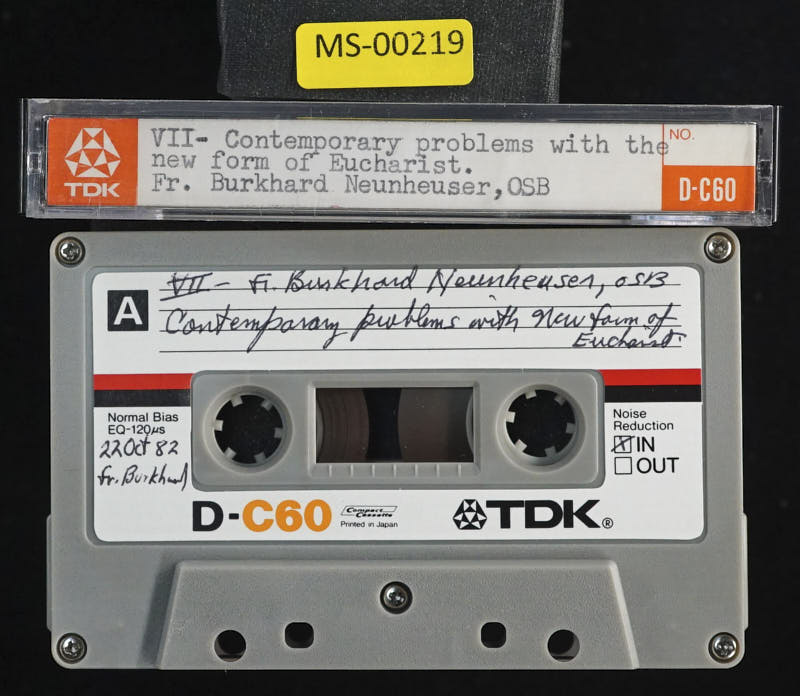
Side: A
Speaker: Fr. Burkhard Neunheuser, OSB
Possible Title: Contemporary problems with the new form of Eucharist
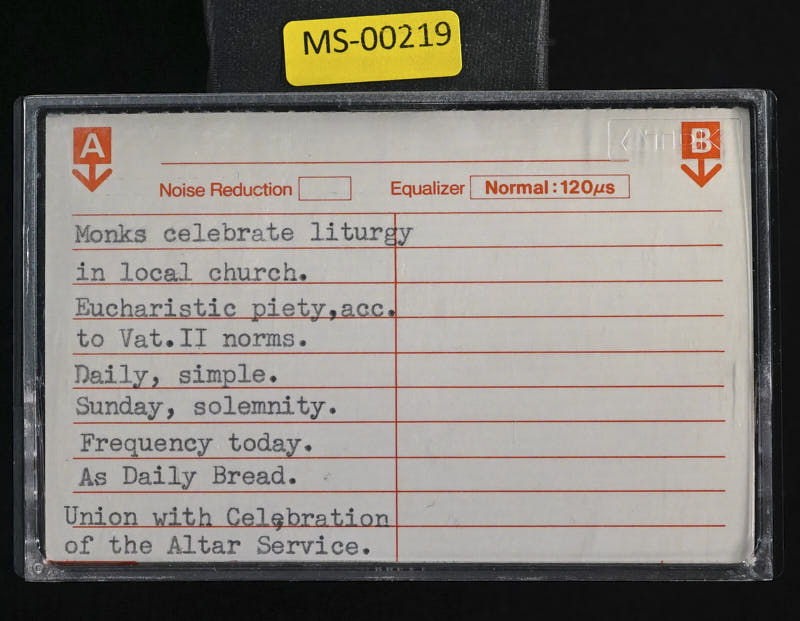
Additional text:
Monks celebrate liturgy: in local church.
Eucharistic piety: acc. to Vat.II norms.
Daily: simple.
Sunday: solemnity.
As: Daily Bread.
Union with Celebration: of the Altar Service.
@AI-Vision_v003
You remember we were speaking perhaps 10 days ago about monastic Eucharist and we are beginning with a certain protest against a very famous article of Abbot Elidius Dekos in which he says, giving a too great accent to some truth that the old monks did not celebrate liturgy. And against him, you could say with Armand Veilleux, the old monks, also in the desert, were celebrating Eucharist as the Christians in that time did do it. Every Sunday, going to the parish church. And so we heard it also in the hall of the master, in the regular magistrate. More or less, in all the 1500 years following, monks were... following the custom of the church, celebrating the Eucharist on Sundays, also daily, in a solemn way, in a very solemn way, in multiplication of masses, in a certain degeneration through the Middle Age, in a certain formalism, very pious formalism after Trent, and finally the monks were following too,
[01:27]
the liturgical movement, the inspirations of this liturgical movement of our modern times after 1909, 1918. And also today, we are following the inspirations, the intentions of the Vatican Council. Therefore, monks are celebrating liturgy as the Church is doing it. And now, I don't wish to repeat these old things, but I wish to finish and to speak about the eucharistic piety, how it must be today if we really follow the intention of the church presented to us in the Vatican Council and in the post-concilial liturgical reform. And in a certain way for you here is no problem because you are living in this way in which the church today wishes to see the Eucharist.
[02:35]
Some of my notes, I presented them first to the abbots of the English congregation in England, in World Abbey, some years ago. And in these monasteries with so many priests, And also in my own monastery, the situation sometimes is more complicated, more difficult. Nevertheless, also, if you don't have any real problems concerning Eucharistic piety, if we are all agreeing in this new orientation given by the Council to have only one Eucharistic celebration every day at non-severeal, celebrating all together as the entire community, as the entire people of God in a community which has, according to the rules of St.
[03:39]
Benedict, only some priests. Nevertheless, it would be convenient that we are seeing the problematic of these changes, which in a certain way, in many parts of the Church, are terrible, sometimes nearly scandalous for many faithfuls to whom in the last 50 years the Eucharist has been the tabernacle. How do we say tabernacle? Tabernacle. And the exposition of the Blessed Sacrament and the benediction. And all these things are left. Therefore, they are scandalized. And we must have a little bit, I would say, and pastoral prudence, charity, and patience with these poor people. And sometimes we ourselves are feeling these difficulties. We must do it in the union with the entire church. Then we would never be wrong.
[04:42]
Therefore, again, with the church, we could say daily celebration of Eucharist, of one Eucharist, It's an ideal, concelebrated mass. And we must say it also against some tendencies in our own monastic families. Many would say daily mass is too much. After that, we have multiplicative masses before the council or before the church movement. One mass. two mess, three mess, and then all the messes of many priests today may go on another extreme only someday. Therefore, for me, it's my opinion, and I think you are condividing it, in no way we could say so because
[05:48]
Already in the old times, for example, St. Cyprian is explaining the words of Horatio Dominica of the lost players. Our daily bread gives us today in vision of the Eucharist. Here is our daily bread. Therefore, already in the third century, they were seeing Eucharist is our daily breath, strengthening us to be strong in the Lord to conduce our daily duties. But according to... And so the Church was doing to all the centuries, more and more, insisting in this possibility to say a mess every day. But also... In the second century, Theatulian, and perhaps also the rule of the master, speaks about Eucharist as deliberate in a communion service.
[06:57]
Without mass, the entire development of Eucharistic liturgy shows us that the ideal of Eucharist is not only to receive body and blood of our Lord, but to do it as our Lord has done it, Eucharist says us. Therefore, receiving the body and the blood as the fruit of this memorial celebration in which the sacrifice of Christ is given present. Therefore, if we wish to eat our daily bread as our daily bread, body and blood of our Lord, we must do it in connection with the Mass as the fruit of the sacrifice of Christ and not isolating Christ the eucharistic bread from this sacrificial celebrating, as we did it in the first years of the liturgical movement, where we were very strongly insisting in this wonderful phrase of the Roman canon, we wish to receive all the communion, exact attarious participation, from the participation on this altar service, not alone, not outside of the Mass, as we did it, boys,
[08:12]
in the first years of our communion praxis, receiving Holy Communion before the Mass, to Thanksgiving during the Mass, without communion. It was in 1916, 17, and 18, and then from 19 on, we were pushing, no, no, no, not so, but we must do it from the participation of this Mass. And We were fighting for this ideal, also in our own monastery, because in many years not everyone was doing so. And finally, Pius XI, in his famous, no, Pius XII, in his famous encyclical Mediato Dei, was approving it. It is right to do so, to receive Holy Communion in the mess itself, in connection as the fruit of the Eucharistic sacrifice as a sacrificial meal. Therefore, that would be the ideal.
[09:14]
We must retain it. And to understand also the intention of the other side, who wishes not to celebrate too often. But we could say we must distinguish very clearly Sunday celebration from weekday celebration, as you are doing it. And the Sunday celebration, in reality, is the most important celebration, in Lord's Day. Here we are celebrating every week, as the council and the post-concilia reform says this, every Sunday is a Pascha, is an Easter solemnity, with a preparation in the vigil. And... to share in the death of our Lord, to rise up with him in the Lord and in the Eucharist celebration, sharing in his resurrection. Therefore, there must be a certain distinction as you are doing it. You can agree about that. And therefore, the daily celebration can be very simple, but also against some tendencies always with readings.
[10:25]
because we are in a new way realizing and seeing the reality of the Word of God, where the Lord himself is speaking still to us. Therefore, a Eucharistic celebration, as somebody who wished it beginning with the offertorium only, Eucharistic prayer, therefore present of the sacrifice and then communion, is not enough. You must have first worship of the Word of God, readings, Old Testament, New Testament, in the wonderful disposition given to us in the new disposition of the Mass, and then the sacrifice itself and the sacrificial meal. I think we could agree about these things, but no, there are still some problems remaining, and it would be convenient also if you don't have these problems to see them. The first of these problems would be the way in which we say the Eucharistic prayer.
[11:29]
In the first beginning, when this wonderful possibility of celebration was given to us, especially in the great communities with many priests, imagine in my monastery 40 priests daily, formerly the saying mess in three series of 12 messes, No, we can do it together. And in the first beginning, we did it suddenly singing. Singing all together. Eucharistic prayer. And perhaps you have heard it or have seen it, and sometimes perhaps also you did it here. And then in my monastery was a real revolution against the Concelebration. In the first beginning, not from the old fathers who were homesick to the private messes, but from the younger, who said this is an impossible way to do it, our con-celebration is nothing else than, how do we say, putting together many masses.
[12:35]
Because we were singing it aloud, and you can do it, really, to save the con-celebration. We have found this way, more or less approved also by our own, that... Only one is speaking, the first celebrant. And all the authors are whispering, saying it's not too loud. And this was a certain compromise. Approved by Rome, because Rome in the rubric says, The voice of the first celebrant must be heard very strongly. The authors must speak very, very, very, very, very slowly. Not so allowed. My confrères nevertheless did it so that no, nothing, nothing, nothing was heard, more or less as you are doing it here.
[13:44]
And I am very doubting, doubting, I have dubium. Doubtful. I did not. And therefore, if my conferee really says something, and here the problem is beginning because it's quite sure, according to the history, according to great authors as Bott, Calrano, per se, it is enough that one is speaking and all the authors are participating according to their role. Lay people as lay people. Deacons as deacons, priests as priests, staying there, for example, with a stole, and one is speaking, and all the others are participating in it. And really, it was so in the first centuries when the Eucharistic prayer has been still said, There were no texts prescribed which you could follow and speak together with the priest, because he was speaking...
[14:48]
as the Spirit has given it to him. Only when the text was fixed, when we were going from freedom to formula, as Alan Bullay said it, perhaps in the times of Gregory the Great, when they were reading a text already given, then it was possible that all the others were speaking aloud. Formerly, until Gregory the Great, when there was a celebration in the first century, it was so that only one was speaking, and all the others were sharing it. Now, today, what can we do? Would it be allowed to do so, that only one is speaking, and all the others in silence, in perfect silence, are following? I would say it is against the explicit word will and definition of the church, because in connection with the problems of the Concelebration, Pius XII has established in a decree of the Holy Office to celebrate a mass, you need the worth of consecration.
[16:08]
Therefore, if we today, against this decision, wish to act as priests, in the community, if we don't pronounce the words of the consecration, we would not celebrate the Mass in such a way, and now the problems begin to be very, very real, we would not have the right to receive a stipendium from the faithful. It's an awful situation. Therefore, to get money for our existence, we must... To make this application, we must pronounce the words. My younger confederate has been terribly scandalized about this connection of things.
[17:13]
Per se, it would be, according to the theological principle, it would be possible to assist to the Mass in perfect silence, and a priest could apply it in a certain intention. Today, it is not possible. The faithful have the right that the Mass would be said in the way in the Church has established it. Then, again, my younger confers are protesting and saying, it would be enough that one priest in this conservation takes all the intentions of all the priests and of all the faithfuls assisting, because in the real presence of the sacrifice of Christ in this Eucharist celebration, there is given everything which God could give you. give to us. It's not necessary that every priest makes his painful private intentions.
[18:23]
One could say, I take as we are saying it, we are commemorating now, we are praying now for the Pope, for the Bishop, for every clergy, for all the faithful, for the entire Church. And now, the Lord gives all the graces which come from the cross through this Eucharist celebration to the assistants, to the participating. And nevertheless, the Church, by certain reasons, has established in a different way. Therefore, we must obey. We must at least say... hoping with time that the church is allowing us to do it in a different way. I would insist also if things are not quite perfect, we must obey the church and only under this condition we are allowed to receive the intention and also the stipendium and the money of the faithful for our existence.
[19:25]
The entire problem of stipendium of money is an awful one. The money is not given for the mass. The money is given for the existence of the priest, that he, living, eating, drinking, and existing every day, may be able to celebrate the Eucharist. Per se, it would be possible to separate the money and the intention But for the moment, things are so terribly connected. Therefore, here is a certain problem, theological problem. We must celebrate according to the laws of the church, using the given possibilities. Therefore, in the Eucharistic prayer, we could do so as you are doing it practically here. One is speaking aloud and all the others are following. The priests, according to this prescription, saying so, and was also following everyone, but everyone according to his position in the church.
[20:39]
We are all participating in this one Eucharist, and through this one Eucharist, we are participating in the one and unique sacrifice of the cross. Therefore, the priests... obliged to do it so, how do we say, which, which, which, but it's not the English sort of worship. The audio is in English for sort of worship. Quietly, and also spiritually. The deacons, and the acolytes, and all the monks, and all the women, all are participating. My internal behavior may correspond to the word of the first celebrant. Faithful to the laws of the church.
[21:41]
using the given possibilities. We have so many liberties during the Mass. We can do it so and so and so. But in the essential point, we must follow the laws given by the Church. And if these laws are not good, and not everything is already perfect in our liturgical celebration, then we could insist, study, make proposals, asking also in Rome to permit it. And this time, after some... years, we shall get it. There is a splendid example. We, the consultors, in the preparation of the actual form of Mass, we were against certain forms introduced during the Middle Age. For example, washing hands after the offering of the gifts, because in no way we need it. We are washing our hands normally before the Mass. We come to the altar with clean hands.
[22:41]
And now we must wash the hands only by symbolical reasons. Only by symbolical reasons. Without any practical meaning. It's meaningless. We were fighting against it. But finally, the Pope and the Cardinals, the Bishops in our commission were, from the opinion, we must retain it. Now, in many cases, also... in St. John's yesterday, not here so far as I remember. He said, don't do it in disobedience. It's not right. No, we must obey. But we can study, we can make proposals, and we shall get it. My example, the reform of the Church of Milan. Ambrosian liturgy. They changed it. And with approbation of Rome, they made the rubric so. And now the priest is washing hands if it is necessary. Sometimes it is necessary when you receive many gifts.
[23:46]
When you are making the incense of the altar and so on. Sometimes the fingers are very, very dirty. Therefore, if it is necessary, you can do it. And so we hope also, after some years, we shall get it. But in obedience, as Romano Guadini said to us in our youth in 20, 21, 22, in a creative obedience, obeying for the moment, we are not very satisfied with the form, but we obey because the church has given us this law. And then... If we are obedient, we shall get also all the good things we hope to get. The possibility of private Masses. We say only one Eucharist in celebration. And a Mass is a celebration of the people of God.
[24:48]
Therefore, It would not be meaningful if a priest is celebrating alone. Very big problem. Until the council, in the old canonical law, it was forbidden to celebrate alone. You must have a server, at least one. During the war, it was allowed Practical reasons for the priest to celebrate alone with old server. And after the war, also after the council, more and more the custom is that with many priests who have not the possibility to concelebrate, to say mass, to totally alone. And many of my confrères in Rome, in the Social Institute, they are protesting against it. I don't, somebody said, I don't celebrate alone because it's against the meaning of the mass.
[25:52]
I am not so radical. When I must travel, I would prefer to celebrate. If I don't have a server, which is surely more ideal, I would prefer to say mass. But here is a big problem. Would it be convenient to do so? All the people who are against this custom to celebrate alone have a good reason. Eucharist is the celebration of the church, of the people of God, and if there is no people of God gathered together, assembled, then we have other means to celebrate find our Lord, to touch him in our prayer, in our faith, in reading the Holy Scripture. Many possibilities, and we now see in a new way the reality of this other means to join the Lord.
[27:00]
And Pope Paul VI, he himself, has said it. in his encyclical Mysterium Tidei of 67, where he says, we are speaking about the real presence of our Lord in the Eucharist, and underlining this word, real presence, applying it to the Eucharist, we don't wish to, no, we don't deny the negare. We don't deny the reality of our means, of the presence of our Lord in the proclamation of the word of God, in the presence of our Lord when two or three are together to pray. Also there is the Lord present and the Pope says really present. But we are speaking about the real presence of Eucharist as the highest form of reality. There are different forms of real presence, analogically real.
[28:03]
The highest is the Eucharist. And we must say the highest form of real presence is the presence under the species of bread and wine by transubstantiation. And then the actual presence in the celebration of the sacrifice where the Lord is acting, presently acting, and this real presence where he is acting in these different sacraments. And also the presence of our Lord in the proclamation of the word of God the real presence when we are gathering together to pray. Different forms in reality, analogically real. And therefore, I can understand that somebody says, if I don't have a community, I don't celebrate Eucharist because I wish to be joined with our Lord in other ways. And nevertheless, nevertheless, the other custom developed through the centuries that we are saying at least every day also in certain special situations that we are saying every day the Mass is a good way and therefore we must not exaggerate this of idea no Eucharist
[29:31]
if we are all together in certain exceptional cases, it would be quite convenient also to say this privately. More or less, the single priest must give the decision if he can do it or not. There is a certain problem. At least we would not exclude the possibility of the private mass and also the Roman... the Roman prescriptions are insisting very much in the liberty of a priest who can celebrate privately, normally with a servo. In extreme cases, also without servo. Because, as very often is said, finally, there is never a private mess. Also, if a priest is alone celebrating mess, he is, in this case, as priest, He is representing himself and the entire church.
[30:35]
But it would be better that he is not alone, but also with a certain people, at least one or two who are representing the entire church, that in every Eucharist celebration, if you are alone, if you are together with a servo, if you are together with the entire community, you are always representing the people of God. recalling our Lord and sharing in his sacrifice and eating and drinking his blood and his blood. And finally, there is still the problem of, I think, the ideal solution. You have priests, more or less, only so many as are necessary to have always Eucharistic celebration, and therefore you need more than one. And also so many priests to help the faithful who are coming for confessions, for concerts, and so on. But we now don't wish anymore to see in the priesthood the highest degree of union with our Lord.
[31:49]
In a certain way, in my younger years, when I came to the monastery, my idea was to become a priest. And we did not see the ideal of a monastic life without priesthood. It's not right. Priesthood is only a minister, a ministerium, a service. We must have service to celebrate the Eucharist. But everyone must go to the highest form of union with our Lord through this Eucharistic celebration and through many other means. prayer, reading of Holy Scripture, fraternal love, and so on. Priesthood is not a way to be united with our Lord. Priesthood is only a service to the church, to the people of God, to every faithful, that he can be united with our Lord in Eucharistic celebration, in all the other ways we have in our life.
[32:51]
Therefore, so many priests as are necessary to give the guarantee for a possibility of Jewish celebration every day. And we must not ordain monks to be priests, only that they have a pious dignity. That's right. We must not ordain a priest or somebody must not wish to be ordained priest only to have a higher place. It's also awful. Sometimes it was so. The priests are more than the others. No, no, no. We are all faithful, all monks. Somebody of these monks must serve as a priest, not to have a higher place, but to conserve the community, that the entire community is joined to our Lord.
[33:54]
And therefore, very rightly, you here, and also we in my monastery, if we are going in procession, we are going according to our monastic age, not to our priestly dignity. The younger lay monk, no, the older lay monk stay before the younger priest monk. Only in the Eucharistic celebration I must have a a certain place to exercise my priestly dignity, my service. So there are still some problems, theological problems, practical problems. You, so far as I see, you have to resolve this question. But we must think about it in patience, in charity, to give... disposition to all these things according to the great theology of the great and authentic theology of the Eucharist.
[34:57]
And now, as the last point, shortly I wish to speak about the totality of our Eucharistic piety. And here I would give a citation of this... I received it in Collegesville, an English collection of all the documents of the Vatican Council and of connected documents. I'll leave it, if you don't have it, to your library. And here I find this excellent constitution about the Eucharistic celebration, the Eucharistic theology made by our council, Concilium, in 67. Eucharistic Mysterium, the instruction about the celebration and the theology of the mystery of the Eucharist. And here, in this document, in the first part is given an excellent exposition of the theological content of the Eucharistic celebration.
[36:11]
He said, which God has made with man once for all through the blood of Christ, and in faith and hope foreshadow and anticipate the eschatological banquet in the kingdom of the Father, proclaiming the Lord's death until His coming. In the Mass, therefore, the sacrifice and sacred meal belong to the same mystery, so much so that they are linked by the closest ones. And therefore, after having spoken so theologically, they give excellent councils and prescriptions to celebrate the Eucharist every day, especially on the Sunday, in the communitarian way, the entire people, and this unity and this celebration is not allowed to be disturbed by other celebrations.
[37:36]
Other messes, one mess in which the entire people of God is together. But then again, here in number 49, he said in a marvelous way, in 67, with words of Pius XII, therefore to be sure that we are quite Catholic speaking so, we are using words of this Pope who... was before the council, who has declared this truth in a decree of the Holy Office. It would be well, so the Pope Pius XII is speaking, and we give the cessation of it here. It would be well to recall that the primary and original purpose of the reserving of the sacred species in church outside mass is the primaries. intention is not to adore to worship but is the administration of the viaticum and the secondary ends are the distribution of communion outside mess and only then the adoration of our Lord Jesus Christ concealed beneath these same species for the reservation of the sacred species for the sick led to the praiseworthy
[39:03]
custom of adoring the heavenly food which is preserved in churches. Therefore, because we must preserve the species for the sick and for the communion, there is the real body of our Lord. And because there is the real body of our Lord, we must worship it. But that is a second intention, not the first intention. It's very important to see. Therefore, if we wish to have a good, excellent Eucharistic piety, Our entire intention must be directed first to the Eucharist celebration. Here we find the Lord, and here together with Him we go to the Father. Per Christum, in Christum, et cum Christum, we worship Him, to Him all glory with the Son and in the Holy Spirit. And if we wish to have a real Eucharistic piety, after having so worshipped the Father through the Lord Jesus Christ in the Eucharistic sacrifice, we must eat and drink the body of our blood.
[40:07]
The sacrament is instituted to be eaten, not to be worshipped. But because it is preserved to be eaten, we must adore it. And therefore now, and the third intention, third point, sometimes, not sometimes, always we must have the convenient reverence before the sacrament. And here perhaps, not for you, but for many of our modern monastic communities, and also for many churches, there is a real problem. Because the council was insisting in the preeminence of the sacrifice, in the preeminence of the communion, they forgot to worship the Ducharist. if it is preserved, with a sign of reverence. And also confessing sometimes, at least, this our faith by acts of that devotion, which was given during the last centuries, sometimes too much.
[41:13]
But some points of visitation, of adoration, are convenient. some forms of it. And we could not, if we wish to stay together with the church, forget it totally. We must not make the first, we could not give the first place to these forms. We could not say with certain sisters, as we, smiling, have said before the council in the first years of the church movement, for certain sisters, the mess is nothing else than the machine to produce the host for the sacramental blessing in the afternoon. That is awful. It's not true. The mess is the most important thing. The communion is the most important thing. But because we are preserving holy species for the sick people and for communion outside of the mess in certain occasions, we must confess our faith in the real presence of our Lord. And therefore, we could not pass the sacrament without a short sign of adoration.
[42:16]
Let us do so. Therefore, reservation is per se only for the viaticum and exceptionally for the communion altar of the Mass. Nevertheless, because the real body of Christ is there present, we must adore it and from time to time confess this faith in convenient actions. And therefore, the Western Church or Latin Church or Roman Church could retain some of the forms evolved in the Middle Age in the last century. But she, the church, the Latin church, must do it in the right way. She could not blame the oriental church, the Catholic oriental church, who does not know nothing of our adoration, of our forms of devotions to the sacrament. Catholic orientals, Russians and Greek,
[43:20]
They don't know it. It's not custom there. We have these customs. We have no reason to renounce totally to it. Only we must not give to them such importance as we have done it before. Therefore, let us try to, we, as monks, to have a monastic Eucharist in the way in which the Church today wishes to have a Eucharist. We are celebrating together to be united, to be united to Christ, worshiping with Him, the Father, through Him, and to be united between us. eating this one bread, as the apostle says, we are one bread, one body. Also, we are many.
[44:21]
And we are so united that St. Augustine, and we would like to take this Eucharistic theology of St. Augustine, St. Augustine could say with the greatest emphasis, you see what you are on the altar. You see on the altar the body of Christ, and you must be the body of Christ. Therefore, the body of brothers, ... [...] I cannot say it so quickly in English. Therefore, I am adjuring you to retain the unity of the Spirit in the bond of peace, in humility, in patience.
[45:25]
We are not really celebrating Eucharist if we don't come to this unity. But to come to this unity, we must first celebrate Eucharistic sacrifice. and eat this bread, and drink this blood, and all the other forms of Eucharistic devotions are only in a separate or third way. To be united in peace, in charity, and so on. It is highest form to be the church, to be the local church, to be the local church united in charity in virtue of our Eucharistic celebration. And because we need to reserve always, therefore, the species of the consecrated blood, the body of our Lord, we must act towards this blood reserved in the tabernacle, the sign of reverence.
[46:26]
That we, therefore, adoring and worshiping the Eucharist in the tabernacle, be always recording it is only... the rest, to say so, from this wonderful, great Eucharistic celebration and adoring and worshiping the sacrament and tabernacle, we are preparing ourselves to the next Eucharistic celebration. So we, by the means of Eucharist, become more and more the Church, the body of Christ in this place, in the hope that then, at once, in eternity, we are the kingdom of God, the people of God, the body of Christ in heaven, before the Father, no more under the wails of bread and wine, but in the real vision from facie at facie, et cetera, et cetera. So, more or less, that would be humble words. I hope that you could understand my bad English. I'm always confused when I must speak, not convinced about
[47:29]
the possibility to speak it. Okay. You would think that the gesture at the Eucharist, you know, the gesture and the clear saying it mentally is not enough. At the Eucharistic, at the consecration. No. Per se, it would be enough, but we need to... if we wish to remain obedient to this explicit determination of Pius XII and retained in the Vatican Council, we need for a priestly con-celebration that also we are at least saying in this strange way... For just the institution or for the entire Eucharistic prayer? According to the... wish of the church the main part it is the 3D confederator in the evening before he suffered the year beginning until the anamnesis the memorial prayer after the consecration not the entire eucharistic prayer there is a certain part prescribed to be said by all and this part we must say it's
[48:51]
It is strange. We don't like it. And my conference don't do it. But it's not right. But we must not hear it. It is true. It's too strange. I must say, if sometimes in certain monasteries they are singing it, it's also very nice, but it's not right. Not the singing, the priest could say it, but the entire community is singing. It's a modern costume. It's not good. Excuse me if I have said things which are scandalizing for you, but... Father? When I finished my division, I took my first bow back in 1930. I was asked to sign a paper saying that I intended to model the priesthood.
[49:54]
That was the... I intended to continue... To become a priest. Begin my... Oh, yes. We did the same in my... The reason was given was that the Pope wanted a... Why don't you have a priest? Yeah, yeah, yeah. It was so formally, Pius XII prescribed that everyone who became a choir monk, a monk, must subscribe formula, I am ready to receive the priesthood. You could not become a monk without this, but today is no more necessary. We are all monks also without to become a priest. Did you say that The time that I was after doing this, it was part of the 11th.
[50:58]
Part of the 11th made the... At least he... The thing came out in 1923, I mean, at that... 20th already? Yeah. It may appear to 11th, yes, maybe, yes. but they join too much monastic life with priestly life. It's not right. Therefore, I think we are in a better way today. We are a community of monks in which somebody can be ordained and must be ordained to give the guarantee for daily euphoricic celebration. And we must say also it is convenient in certain monasteries to have many priests because they need it to help them. and so on. But in a monastery where it's not necessary to do so, two, three, four priests would be enough. It depends. If the function of the priest in the monastery is one primarily of service to the community, is that sufficient reason
[52:12]
where there's real need for someone to become a priest? And it's a double question. Is that sufficient reason for someone to become a priest where there's real need for that service? And if there is not a need for that service, is it, I mean, if there is another, if there is something that has to be inherited in the person with regard to a call or who feels called to a vocation, if that has to be there, then is it valid to deny someone the priesthood if they feel they are called to it? I would say, what is to be called? Formerly, we felt ourselves called to the priesthood to get perfection. And I think it is not right to think so. We are called all to perfection, all, men and women. also lay people and monks to get perfection, real perfection, intelligence of the mystery of Christ.
[53:16]
We don't need to become a priest. In a certain way, this tendency, feeling themselves called to priesthood, is not the right way. We must see as monks our way to come to perfection is to be a real monk, praying and also seeking, seeking, seeking, with Jean Leclerc, l'amour des lettres. Yes, intelligent of which, therefore also study. But if we study also languages, Greek and Latin, to understand better the Holy Scripture, and if we are studying theology, Sometimes, no, we could say, no, I have studied so much that I must become a priest. That's right. We must educate ourselves. For us, the older people, and also for you, it may be difficult to think so.
[54:16]
We must be ready to be monks, to get the highest form of perfection, and to get a profound intelligence of the mystery of Christ in study. Ready? Ready? Not to become a priest because we can share without being a priest in the royal priesthood of every faithful. We can share in the real sacrifice of Christ. We can offer it together with the priest. Also for other people. Priestly ordination only so far as it is necessary to give the guarantee of daily Eucharistic celebration and also for the help which is necessary to give to faithfuls in our monasteries. And it may be that many must be ordained. But Percy? Would you say that the understanding of call, of call, calling the church, this should be more objective, less subjective.
[55:18]
Objective in the sense that the call comes from the church to... the community in the States that... Yes, so you are right. So the community is calling me. My feeling to be called is a confusion. I am called, and I must answer to it, to perfection. But to be perfect, we don't need to be an ordained priest, because ordained priest is only a concrete service. And here is the great mystic of the women. The women wish to become... priest to condominate. It's an awful situation. In a certain way, also we. Because formally, it was only the priest monk is the real monk. But it was not true. And Father Damasus and your entire community was fighting against this ideal. He was one of the first to have real monks with solemn woes without priesthood. So, it's a delicate point, but it seems to be that we monks must a little bit fight to remove this situation.
[56:37]
We are all called to share in the royal priesthood of the people of God. We are all called to get the highest perfection in Christ Jesus in participation in the Eucharist, but we are therefore... To do so, to become so, it is not necessary to be an ordained priest. And the way in which you are staying around the altar, nearly no distinction, the entire community. But some are... No, one stays on the altar, and the other, two, exercise the... priestly faculty given to them must at least a little bit see the single by the stone as staying in their hands and for the moment still speaking. A sort of word, sir. Also the surroundings.
[57:41]
Minimum, yeah. At least the minimum, yes. In our community at the moment, I guess there's... In our community here, I'll say here at the moment, the situation may appear to you to be ideal. But in a few years, the passage of time and the superannuation of some of the priestly models, we're going to be faced with the problem of getting someone to confect the uterus. You are right. You need so many priests that this danger never could be existed. We're going to have to replace some of those who will no longer be in a position to offer the uterus. Therefore, yeah, it's not. In the past, we have ordained men or men have been ordained. They've been impelled and thieves. Now, whether there's some attraction that comes along with the priesthood, I don't know. But in the practical level, in order to maintain the wonderful sense of the presence of our Lord in our community, we're going to have to.
[58:42]
in conformity with the rules that you're trying to get some people ordained. Therefore, to give this guarantee, it's not necessary to ordain only one. You need more. So more, also with time, with the years, you have always enough. And here, the superior, the prior, and also the community, must give the decision. And here is the objective... call, yes. It's difficult, it's difficult sometimes. Also personal feelings, and it depends also from the tendency. Somebody came here, a young boy, with the idea to become a priest monk. It is difficult for him, but then he must not come. He must know how he is coming here, to which scope he is coming here. And in a certain way, also in my younger years, we were thinking so.
[59:46]
Some of my confrères had in Odilo Heiming, who is celebrating the next week his diamond jubilee of profession. He was sorry when he was ordained priest, because then he could no more in that time share in the dialogue mess. And he must assist to the, he must say his pride at mass. He would have been ready to renounce the priesthood, but at that time it was not possible. It's possible to be educated in such a way that I am ready, I must not become a priest, but I must share the Eucharistic celebration in which the man who is called by the community to serve can celebrate Eucharist, and to do it we need many. Two, three, four, it depends. for the priest's requirement is that he can perform the mystery the proper way that theology doesn't mean that much for them I mean it does need to be a theology but as long as he said not theology in a learned way but I was given the citation of Leclerc because he speaks about la mode lettre la mode lettre c'est-à-dire the love for the word of God
[61:13]
It's a gift for every monk, every monk. And also for you. To love and to know and to penetrate in the word of God is not the private office of the priest alone, of the monk. He must be able to preach. He must be able to give a counsel, also to speak to faithfuls, to help them. Only for the sacramental absolution you need a priest. Priest... We must learn again, the priest is, the office of the priest is only an office to serve to make possible that the entire people of God is loving the word of God, penetrating in the word of God. We must renounce to this old ideal of the priestly autocracy, domination, and so on. We are all proud to be priests. The Lord Priest. Would it be possible maybe that the way in monastic communities priests are trained needs to be done differently and maybe ask my brothers a question about lots of priests are trained but with the great university education and when they get the great university education and they come back to the monastery then they don't wish to stay in the monastery the university education propels them out into the
[62:40]
It would be possible only for people in the monastery community, if you were to be ordained, only for the service of the monastery.
[62:57]
@Transcribed_UNK
@Text_v005
@Score_94.19