You are currently logged-out. You can log-in or create an account to save favorites and more. more info
Unity in Diversity: Monastic Artistry
AI Suggested Keywords:
The talk explores the theme of "The Art of Christian and Monastic Life," focusing on the significance of community, unity in diversity, and the role of monasticism as symbols and expressions of Christ and His reconciliation of humanity. The speaker elaborates on the idea of humanity as living symbols of God's love through unity, as discussed by Dietrich Bonhoeffer, and emphasizes the importance of "Lectio Divina" and monastic principles such as stability and obedience. It further examines the interplay between art, spirituality, and monastic life, referencing Benedictine values as depicted by artistic representations and the intrinsic link of these values to fostering a just society.
Referenced Works and Discussions:
-
"Creation and Fall" by Dietrich Bonhoeffer: The book discusses God's creation as a free act, emphasizing freedom and love as central to human reflection of God's image, relevant to understanding spiritual freedom in unity.
-
The Rule of St. Benedict: Offers guidance on monastic life, highlighting the role of stability, conversion of life, and obedience in forming a communal life that mirrors divine order and spiritual discipline.
-
"Lectio Divina": Presented as both a practice and a lifestyle essential for monastic life, encouraging a method of engaging with Scripture that molds the community and connects it to the larger Church.
-
"Godric" by Frederick Buechner: Contains reflections on spirituality and community, used to illustrate the transformative potential of living out Christ-like service and holiness in a monastic context.
-
St. Matthew’s Gospel, Colossians, Ephesians, 1 Corinthians, and 1 John: Scriptural references that reinforce the message of recognizing Christ in each other and the communal responsibility in embodying God’s love.
-
"Taoism and the Arts of China" by Stephen Little: Cited to draw parallels between Taoist ideas on indescribable ultimate reality and Christian mystical traditions represented in monastic life and art.
-
Dialogues of St. Gregory the Great: Mentioned in relation to artistic inspiration and understanding of monastic figures like St. Benedict and St. Scholastica.
-
"How We See God" by Isabel Gomez-Acebo: Discussed in connection with shifting perspectives on God’s nature and exploring theological language from diverse viewpoints, particularly women's contributions.
Artistic Contributions:
-
Works of Sadao Watanabe: His art inspired by scripture, especially his depictions of Saints Benedict and Scholastica, which reflect on spiritual insights and monastic life.
-
Balthus’s approach to painting: Emphasized as a reflection of prayer and religious activity, showing how art can be a medium of spiritual expression and understanding.
AI Suggested Title: Unity in Diversity: Monastic Artistry
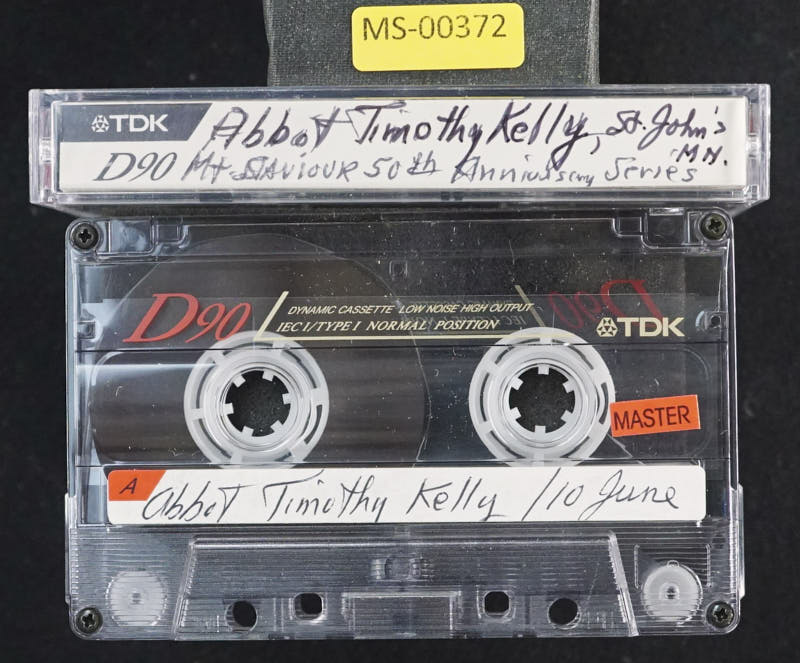
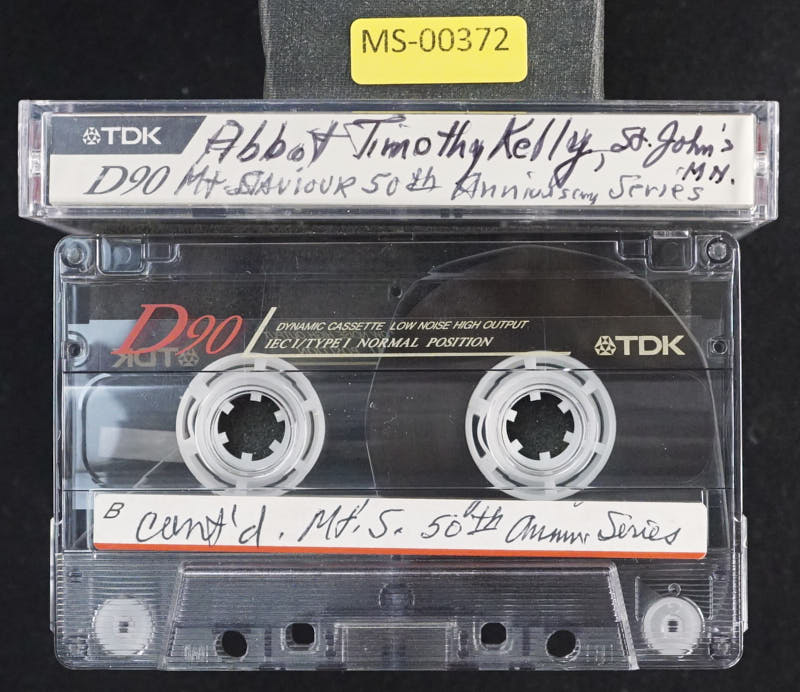
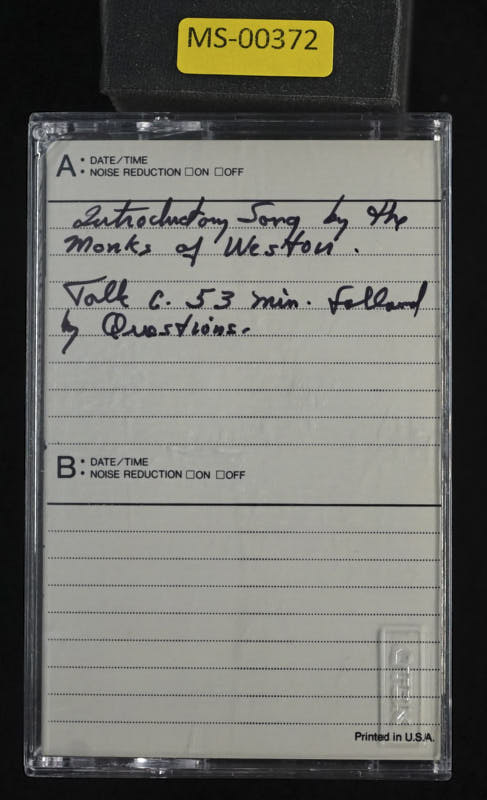
AI Vision - Possible Values from Photos:
Speaker: Abbot Timothy Kelly
Location: Mt. Saviour
Possible Title: 50th Anniversary Series
Additional text:
@AI-Vision_v002
Certainly as one who has been able to set in motion modifications and knowing that signs of our times, Abba Timothy is eminently qualified. So as a kind of introduction to his talk to us, the brothers from Weston who are here have offered to begin and set us in a kind of a mode, really, of being receptive. to God's spirit and to Abba Timothy's message. ... ...
[01:23]
I don't know. I don't know. Thank you. ... ... ...
[02:47]
Thank you. I don't know. I don't know. I don't know. Here's what I'm looking for.
[03:55]
I'm looking for this. [...] . . . I'm just jealous, and I'm saving a lot of it, and I'll give you a purpose. And the weather is going to fall, and I'll have to rest. And then, I'll find out what I'm going to do. Now, I'll have to settle for it, and I'll just see if I can take it as soon as I can take it. I'll give you a chance to see if I can take it as soon as [...] I can take it. And I'll have a girl from a leading path, and I'll have a girl from a leading path. And I'll have a girl from a leading path, and I'll have a girl from a leading path. And I'll have a girl from a leading path, and I'll have a girl from a leading path. And I'll have a girl from a leading path, and I'll have a girl from a leading path.
[04:56]
And I'll have a girl from a leading path, and I'll have a girl from a leading path. And I'll have a girl from a leading path, and I'll have a girl from a leading path. My brothers here just did everything I want to say. Marvelous. Thank you very much for that. To start out, I want to congratulate the community of Mount Savior on 50 years of faithful service to the Church, to Christ, to all of us, because that's what monastic life does. It gives witness of faithfulness
[05:59]
to the faithful God. It helps us to understand better the faithfulness of God. And I thank you for that, for these 50 years. I spent eight years in the South Bronx in a parish. And I came up this way a number of times, but never did I get to Mount Savior. I did get to Weston, and I'm very happy that the community of Weston is here. today as well. And I prayed with your community a number of times, and I have a suspicion that all of us look considerably different than we did something over 30 years ago. Another community I want to acknowledge here today is the Dominican nuns of the Monastery of Mary the Queen. I have discovered a friend that I met many, many years ago. at Corpus Christi Monastery in the Bronx, because from our parish at St.
[07:04]
Anselm's in the South Bronx, we were the chaplains for the nuns there. It was an oasis coming out of the South Bronx in the 60s and early 70s to be able to spend one week out of every four going over to their monastery and having mass over there. and discovering they were ministering far more to me than I ever did to them. Thank you for being here today as well. And to all of you who have come, I think you've already got your money's worth with the singing today. But to all present here today, I want to simply say welcome from Lake Wolbegon. Very many people don't know that Lake Wobegon is where my monastery is.
[08:07]
And that's quite literal, because Garrison Keillor started out with us. Minnesota Public Radio, the mother station, got started at St. John's. And we're very proud of that, because they've turned out to be a very influential community. sort of people in all of public radio in the United States and Canada, with Public Radio International as well. But Garrison Keillor started out with us broadcasting every morning for five days a week, and then moved on to greater things. But he never forgets Lake Wobegon. title of the talk that I have prepared, and I've cut this down considerably from what I would give you if I were doing the whole thing. The title I've given it is The Art of Christian and Monastic Life. I thought the music fit in so very, very well with that subject.
[09:11]
Let me start this way. In St. Matthew's Gospel, when Jesus was talking about the coming of the Son of Man and the time of his coming, He talked about the signs that will indicate that the time is near. And then he said the following, and I quote, Take the fig tree as a parable. As soon as its twigs grow supple and its leaves come out, you know that summer is near. So with you, when you see these things, these signs, know that he is near, right at the gates. Now, my presentation today is not going to be apocalyptic, and I wrote in here prophetic, not knowing what Prior Martin was going to say about prophetic, but nor is it going to be about art or music, mostly because I'm not an artist or a musician, nor a theoretician of art or music, nor a historian of either one of those.
[10:17]
It will not be a theological exposition of the finer points of liturgical or sacramental studies, nor a scholarly treatise on the meaning of Christian or monastic life. I simply want to talk about the sign value of human, Christian, and monastic life. Now, I come today as a man who was born into a Christian and Catholic family. I come as a Benedictine monk who entered monastic community 47 years ago. And have spent a lot of that time trying to make sense of it as an expression of the meaning of Christian life. I've pondered it as a Christian, a monk, a student, a priest, a teacher, a missionary, a pastor, a prison chaplain. That's different from the Corpus Christi, you know. A convent chaplain, a director of novices, an abbot, among other things. As you can easily tell, I've never been able to hold a job.
[11:19]
If Jesus could tell people to look for the signs of the coming of the Son of Man, then I can say that I've spent my life looking for those signs that give meaning to my life as Christian and as monk. Let's move directly to the heart of God's sign giving. Humanity made in the image and likeness of God. That's really the focus here. It seems pretty clear that the image and likeness of God in us has nothing to do with physical appearance, gender, color, size, or language. It also doesn't mean that we are just like God. That would be impossible. According to St. Thomas Aquinas, God is of an entirely different order of being. God is without limit, and in our order of being,
[12:24]
to be means to have boundaries, to have limits. So we are made in the image and likeness of God in a different way. And when we live in accord with the truth of our being, we are then living revelations. We are living revelations of who God is. Dietrich Bonhoeffer, the German Lutheran pastor and theologian who had the integrity to be martyred, rather than submit to the abominations of Nazi theory and practice, gave a series of lectures in the early 30s that were subsequently published in a small book called Creation and Fall. In a nutshell, and far too simplified, he said that God created not out of necessity, but freely, and that nothing has the power to so much as tempt God to betray God. Bonhoeffer put it in terms of freedom.
[13:28]
God is free for creation and free from what would make God stop being for creation. Bonhoeffer equated God's freedom with God's love. The image and likeness of God in humanity is that love, that freedom for the other, the freedom from whatever might destroy love from the other. In short, for Bonhoeffer, the image and likeness of God that becomes the clearest sign and revelation of the reality of God, the best sign for the rest of humanity to see is humanity in unity. Adam and Eve in the Genesis story represent the totality of humanity in unity with all their diversity. Not just the individualistic notion that each person is the image and likeness of God apart from activating that gift.
[14:33]
Together we are the image and likeness of God. Now we all know about the fall, so let's go directly to the solution. One of the best summaries of God's plan for us in Christ is is in the letter to the Colossians, and I'll quote this. He is the image of the unseen God, the firstborn of all creation, for in him were created all things in heaven and on earth, everything visible and everything invisible, thrones, ruling forces, sovereignties, powers, all things were created through him and for him. He exists before all things, and in him all things hold together, and he is the head of the body, that is, the church. He is the beginning, the firstborn from the dead, so that he should be supreme in every way, because God wanted all fullness to be found in him, and through him to reconcile all things to him.
[15:45]
everything in heaven and everything on earth, by making peace through his death on the cross. The end of the quotation. What was torn apart by sin, what lessened the effectiveness of the sign of humanity as the image and likeness of God, is now reconciled in Christ, who is head of the reconciled body of humanity, so that in him who is the image of the unseen God, we, in our reconciled unity, might become the people who reveal God with us by our love for one another as members of the body of Christ, the church. In other words, and briefly, we are God's art, God's living art. But no art perfectly expresses the mind and the heart of the creator of that heart.
[16:48]
And that's why artists keep on producing more art. The Christian community, this body of Christ, is constantly proving it is not just like God. So we make God known in halting ways, but ways that nevertheless give hope to all of humanity. We love one another as Christ has loved us and ask forgiveness and forgive when we have failed. We get married in Christ so that the unity and diversity in marriage will announce and be the sign of Christ's love for the church. We gather into intentional communities of faith, some of which are monastic, so that by the witness of inclusive love, the world might know God's inclusive love. This too is the art, the living art of God. So we are invited to know the mystery of God's purpose according to his good pleasure which he determined beforehand in Christ.
[18:01]
We read that in Ephesians. We are to look at God's plan established prior to creation so that we might understand purpose of creation, and in our hearts accept one another and all people, because God excludes no one. We are not a select elite among the few who will be saved. That would be contrary to the message God gives to us. The separation from one another that sin produces is overcome in God's plan that God would bring everything together under Christ. Everything. together under Christ as head, everything in the heavens and everything on earth. What I'm describing here is called Paschal or Easter spirituality. What that means is that because we are centered on Christ, because we have been baptized into his death and resurrection, we have a new life.
[19:06]
This is the very heart of Christian life. and therefore the very heart of monastic life. The monastic community is meant to be assigned to the whole church, to all of creation, of the reconciliation Christ has accomplished and makes known through what I dare to call the sacrament of monastic life. If married life is the sacrament, the sign, the living revelation of the faithful union between Christ and the church, then monastic life is to reveal the diversity that can come together in unity in Christ. The Benedictine monk vows stability, that is, fidelity to the community, conversatio, or living the covenant of this monastic manner of life, and obedience, or hearing God's call, God's word, God's message,
[20:11]
through the scriptures, the church, the community, the superiors, through each other. And the monk does this by living the reality of the paschal mystery today. The monastic community is a presence in this world of people who strive to have some understanding of this paschal mystery, in order to live it in such a manner that in a deceitful and underhand world we might shine out, as Philippians says, like bright stars in the world, proffering to it the word of life. Long hours in prayer and daily lexio may well be essential for the monk to live this paschal mystery, but the evidence that we are doing so will always be our faithfulness to the covenant we have freely entered into by which we say, I am here for you.
[21:14]
It is the actual living together, the encounter with fellow human beings, the mutual support, the encouragement, the forgiveness for wrongs done, the hospitality within and outside the community, the supporting with the greatest patience one another's weaknesses of body or behavior that become for the monk the font of revelational experience of the living God in our midst. Monastic life is first a living experience of God in community. I'll talk a little about the role of Lectio Divina. Lectio Divina or holy reading, is both a practice and a way of life. As a practice, it typifies monastic life. Scripture is normative for the monk as it is for all Christians.
[22:19]
And St. Benedict directs us in these words, and I quote from chapter 73. For anyone hastening on to the perfection of monastic life, there are the teachings of the Holy Fathers, the observance of which will lead him to the very heights of perfection. What page, what passage of the inspired books of the Old and New Testaments is not the truest of guides for human life? What book of the Holy Catholic Fathers does not resoundingly summon us along the true way to reach the Creator? Then, besides the conferences of the Fathers, their institutes, and their lives, There is also the rule of our Holy Father Basil. For observant and obedient monks, all these are nothing less than tools for the cultivation of virtues. End of quote. So the monk is to be immersed in the word of God, for it is the word of God who gives us life.
[23:26]
We can hardly look at the rule of St. Benedict, which goes back, by the way, to the sixth century, and not come away convinced that the vast majority of what Benedict has to say is dealing with the building of an environment that supports seeking God and enables the monks to encourage one another in this pursuit of holiness. So Benedict would set a schedule of daily prayer when the monks coming together would praise God He did so not because only these were the prayer times for the monks, but rather to sanctify all times because we are to pray always. He established an oratory where this work of God and Eucharist would be celebrated, a place where nothing else was to be done or stored. He did this to recognize a sacred space that announces to the monks that all space is sacred. And he even calls the monastery the house of God.
[24:44]
He indicates the sacredness of all objects as well by declaring that the tools of the monastery are to be treated as the sacred vessels of the altar. So all the pots and pans and the Fords and Chevys. What a wonderfully holistic view Benedict had of the monastery. What he called the school of the Lord's service. When we get right down to it, Benedict had a pretty good notion of what goes into the makeup of human beings. Maybe it took us a little bit longer, maybe to the invention of the computer, to learn a very simple rule, garbage in, garbage out. Nikos Kazantzakis, in his report to Greco, says this, and I quote, The child's brain is soft, his flesh tender.
[25:47]
Sun, moon, rain, wind, and silence all descend upon him. He is frothy batter, and they need him, K-N-E-A-D. The child gulps the world down greedily, receives it in his entrails, assimilates it, and turns it into child. End of quote. If we are what we eat, we should have no trouble understanding that we become what we do. What we read, what we listen to, what we watch on television, We know that to become anything good, we have to study, we have to absorb, we have to want to learn, we have to discipline ourselves.
[26:53]
Lectio, as a practice, is necessary if we would live a life that is Lectio, if we would be formed by the Word of God, if we would become assimilated to the Christ who became one with us, that we might become one with God. So we read and are read to, we listen to the word of God with the ears of our heart, so that we might return to him from whom we had drifted by the sloth of disobedience. After all, obedience means hearing, and disobedience means not hearing, not listening to the voice of God calling us. Now the problem with listening is that we become responsible for what we hear. And when we immerse ourselves in the scriptures, two things will happen to us. First, we will become aware of the message of the scriptures.
[28:00]
By this I do not mean that we become expert exegetes who can grapple with historical, cultural, philological problems that the experts tackle. Rather, we become experientially aware of God speaking, inviting us to recognize the word through whom all came to be that is, and that nothing that is came to be in any other way than through God's word. We begin to see more and more the unity of creation. and especially our unity in humanity that should become ever more clearly the image of God on earth. Now, it's one thing to be word-centered with a capital W, another to be word-centered with a small w. I'll point out to you, of course, that this has absolutely nothing to do with politics or politicians, you understand.
[29:06]
We tend to overuse words as though they could contain reality in and of themselves. We encapsulate God in words as though we could control God or tame God, carry God around in our back pocket or handbag. And finally, painfully, we discover that God eludes us and refuses to be imprisoned in our words, or in our concepts. We can't even do this to one another, no matter how much we think our psychologizing and Myers-Briggs tests and Enneagrams and MMTIs tell us about others. We still remain mysteries, and all the more does God. This is not a new problem. In an essay entitled Taoism and the Arts of China by Stephen Little, published by the Art Institute of Chicago in the year 2000, he writes concerning the ancient and indigenous religion of China in this way, and I quote, Tao means a road and is often translated as the way.
[30:26]
The Tao is conceived as the void out of which all reality emerges. so vast that it cannot be described in words. Beyond time and space, it has been described as the structure of being that underlies the universe, end of quotation. Well, St. John of the Cross, in our own tradition, said in the ascent of Mount Carmel, and I quote, the soul will have to empty itself of these images and leave this sense in darkness if it is to reach divine union. For these images, just as the corporeal objects of the exterior senses, cannot be an adequate proximate means to God." So words and images are insufficient to carry the reality of God.
[31:27]
They can only point in a direction and open us to what we cannot imagine. What no eye has seen and no ear heard, what the mind of man cannot visualize, all that God has prepared for those who love him, from 1 Corinthians. Interestingly enough, though Taoism asserts that the underlying reality of all that is that is, is so vast that it cannot be described in words. The Chicago Institute of Art had a wonderful exhibition entitled Taoism and the Arts of China. I spent several hours looking through that. And though St. John of the Cross could say the soul will have to empty itself of these images and leave this sense in darkness if it is to reach divine union, He will nevertheless use an abundance of words to explain this, and will even sketch an unusually beautiful and perceptive crucifixion of Jesus that he presented to a friend.
[32:37]
A little bit about liturgy. Some may find it offensive to stretch the meaning of sacrament from beyond the defined seven sacraments of the Roman Catholic and Orthodox Church. However, I would submit that if we cannot do that stretch, we impoverish the meaning of sacrament when used in the seven signs we call the seven sacraments, and in the process lose the meaning of liturgy. So let me explain. At the age of four, a little boy goes to a vacant lot next door, picks a bouquet of odd weeds and brings them home to his mother as a sign of his love for her. She takes the weeds, places them in a vase with water, and sets them on the dining room table.
[33:46]
As members of the family return home from school or work, she warns them at the door, you call those weeds and I'll annihilate you. A four-year-old boy gave his mother a sacrament, a sign of his love, and she accepted it. Here has been played out a family liturgy. The Baltimore Catechism called a sacrament an outward sign. Now, a sign that is not outward is no sign at all. By nature, we are sign givers. We are sacramental. And we understand the meaning and effectiveness of signs. St. Benedict, in his rule, appreciated the meaning of such signs and clearly went beyond words only. At liturgy in common, he recognized the value of bowing and prostrations when receiving guests of washing their feet, praying with them, and only then giving them the sign of peace.
[35:01]
He understood the reverence needed between the monks. Seniors are to love their juniors, and juniors are to reverence their seniors. All of these are accompanied by signs and liturgies that are visible in and recognizable. The whole of monastic life, then, is a liturgy, a sign, or even a sacrament that is visible and recognizable. It is clear from the rule and from life's experience that we need signs, that we need to express what is inside of us, that we need ritual to teach us how to respect and how to express respect and love and honor. Weddings, funerals, graduations, presidential inaugurations all have their rituals and liturgies that enable us to in some way make an adequate expression of the meaning of events.
[36:07]
They don't say it all, but they give us a way of indicating what is deeply inside of us. It is this recognized need that is inside of us that then becomes the source of liturgical expression, art and poetry, and many forms of artistic presentations that have been from the beginning inherent in monastic life. Now just a little bit about art in monastic life. The first time I went to Japan, I tried to learn at least some of the simple forms of kanji or their signs that make up the written language. I kept wishing that even though they had three sets of what we would call perhaps alphabets, they would come up with a strictly phonetic alphabet that would help people like me understand more clearly what the language said.
[37:08]
But as I came to appreciate more what the language was saying and what the signs were indicating, I began to change my mind about that phonetic alphabet. There is such a richness in the kanji, the pictographic signs, that a great deal would be lost if the kanji were to be abandoned. For instance, those who live according to the rule of St. Benedict take this vow of conversatio, which frequently is simply translated as a vow of conversion of life. The word self, however, is the Latin translation of the Greek polite, which has to do with citizenship or belonging. That is not at all as clear to our intelligence as the word for monks would be in Japanese, for instance. On one of my trips to Japan, I asked a Soto Buddhist priest friend what the Japanese word would be that would translate the word conversatio, or manner of life.
[38:19]
I explained to him my understanding of its meaning in English. He came up with the word for monk, which in Japanese is shudusha. The parts of this word come out this way. Shu means learning, training, struggling, or being trained. Do means a way of living, which is ongoing and continuous. Sha means a person, a man or a woman. So a shudusha is a person who is learning or struggling or being trained to live life or to lead a way of life according to the teachings of a specific teacher. And all of this is expressed in simple kanji form. This sounds very much like the rule of St. Benedict where we are told we enter into the school of the Lord's service where we give up our own will once and for all and armed with the strong and noble weapons of obedience do battle for the true King, Christ the Lord.
[39:31]
The signs we call words contain what we did not plant in them. We inherited a language, just as we've inherited all sorts of signs that speak of the reality of life. I've learned a great deal from poetry in this regard. A poet can express a deep reality in simple words, but words that point the way to mystery, somewhat enlightened, but pointing to a reality beyond the words spoken or written. Poets will speak in metaphor, symbols, similes, and so on. Put them all together, and the end product of the poem is greater than the sum of its parts. But it still does not exhaust the subject. For many years I've been an admirer of the Japanese artist Sadao Watanabe. At my abbey we have a good collection of his prints. In my visits to our monastery in Japan, I always wanted to meet this man, whose biblical scenes and depictions of the saints I have found so attractive.
[40:45]
And finally, in the fall of 1995, I had the opportunity to go to his home and have tea with him and his wife. While we were there, we talked about a work he had done in 1990 depicting St. Benedict. It was while we were talking about this work that he showed us the as yet unfinished work he was doing of St. Scholastica, the twin sister of St. Benedict. He explained some of the symbols he had used in this and in the one on St. Benedict and showed some of the contrasts between the two as well. I was impressed. For instance, at one point he said, you notice in the picture of St. Benedict, his hands were in prayer this way. And in the one he did of St. Scholastica, her hands were out this way. He said the very simple meaning is she was a better prayer than he. It was then that I asked him how he went about producing such a work.
[41:53]
It was interesting to know that he made his own paper, created his own colors, and so on. But my main interest was was what did he do to prepare himself to produce the work of art? And his answer was wonderful. The monastic superior of our priory in Tokyo at that time was Father Kieran Nolan. Mr. Watanabe was asked by him to do the St. Scholastica depiction just as he had done the one on St. Benedict five years earlier. Mr. Watanabe said that Father Kieran had given him a copy of the Dialogues of St. Gregory the Great, which tells the story of Benedict and Scholastica. He told me this. I read it over and over and over again. Then I meditated on it over and over and over again. Then I prayed about it over and over and over again.
[42:55]
Then I did it. I smiled very broadly at his words and told him, that's what we call Lectio Divina. I have no doubt that that was the way he did all of his art, most of which was inspired by the sacred scriptures of the Old and New Testaments. We spent about an hour and a half with Mr. and Mrs. Watanabe that day, and when it came time to leave, We went through the common Japanese ritual of bidding farewell. Hands together, you know, we bowed to each other, one trying to bow lower than the other. Finally, I placed his joined hands between my own. And he knew exactly why I was doing that. I honored those hands that had done such magnificent work, hands belonging to a man
[43:59]
who had so interiorized the gospel that he communicated to great numbers his own reverence for God's work. Three months later, Mr. Watanabe died. I will forever be grateful for the grace of having met him and his wife. In February of this year, a man by the name of Count Balthazar Klosowski de Rola otherwise known as the artist Baltus, died at the age of 93. On February 20th of this year, the Zenit News Service from Rome on their internet site published a report on an interview he gave to the French Catholic weekly newspaper La Vie, his last public interview. In that interview, he said this, quote, To paint and to pray are the same thing. I have never thought of painting in any other than as a religious activity.
[45:07]
And then Zenit News Service continued, the painter took pains to explain how he lived his artistic inspiration, and they quote him, a ritual that needs prayer and then silence. When I'm in my study, it often happens that I cannot paint myself. I must first sit in front of the canvas, look at it, and caress it with my hand. It is another way of painting, of proceeding. To paint means to reach, to proceed, and to conquer. To go through secrets, translate what is still obscure, and not try to give interpretations. What is important is that the painter himself often does not know the reason. Suffice it for him to have the will to communicate to the world through his darknesses.
[46:10]
You're fortunate I skipped some of this. I'm not an artist, I mentioned that before, nor a historian of art, monastic or otherwise. Once briefly in my life, when I was stationed in the South Bronx in New York City, I tried my hand at watercolors and one day got so absorbed in what I was doing that I worked on a piece for two hours straight and finally noticed that my radio wasn't on. and I didn't have WQXR serenading me as I usually did at free times. That experience alone taught me something of the kind of single-mindedness that prayer, and even all of life, can become. Or I remember the time I was truly inspired by a Broadway performance of Hello, Dolly. The lead was played by Ginger Rogers,
[47:27]
And when she sang the song, Hello Dolly, she danced around the apron surrounding the orchestra. At the completion, the whole audience was on its feet cheering. And she did it again. An encore. I don't think I'd ever witnessed an encore in the middle of any Broadway performance before or since. When I got home that night, all I could think was that as a monk and priest, My involvement in monastic life and liturgy should be as wholehearted as I had witnessed that evening. She was Dolly. I have to be Christ. So what might the monk become who by faithfulness and dedication perseveres in this school of the Lord's service? And does it make any difference to the monastery itself? or to the church at large, and to all of humanity.
[48:31]
I'm reminded of a beautiful passage in the book called Godric, my favorite book by Frederick Buechner. And it reads like this. He's writing concerning pilgrims who come to visit the hermit. The hermit by this time has been an old man. He's gone through a lot. He's matured in his life. And he says this. To touch me and to feel my touch they come. To take at my hands whatever of Christ or comfort such hands have. Of their own, my hands have nothing more than any man's. And less now at this tottering, lame-wit age of mine when most of what I ever had is more than mostly spent. But it's as if my hands are gloves, and in them other hands than mine, and those the ones that folk appear with roots of straw to seek.
[49:41]
It's holiness they hunger for. And if by some mad grace it's mine to give, if I have a holy hand inside my hand to touch them with, I'll touch them day and night. Sweet Christ, what other use are idle hervets for? End of quotation. I entered my monastic community, as I said, 47 years ago and have seen those who entered before me leave feet first after many years of faithfulness to their call. Not all were easy to get along with all the time. but I cannot thank God enough for the examples of struggle and victory that I have seen. I recall Brother Hubert Schneider, accomplished cabinetmaker, who taught us at the time young monks as much about humility as carpentry, and perhaps with as much success.
[50:52]
Or Brother Stephen Tell, who created beautiful altar pieces out of wrought iron and taught us the meaning of service to others. Or fathers Conrad Diekmann and Dunstan Tucker, whose love for Shakespeare and Dante, respectively, was exceeded only by their genuine and pure love for their confrères. One of my confrères of late has become a poet. and I suspect that one of his poems emerges from his long experience as a monk. Father Killian MacDonald wrote this poem entitled Perfection, Perfection. I've had it with perfection. I've packed my bags. I'm out of here, gone. As certain as rain will make you wet,
[51:55]
perfection will do you in. It droppeth not as dew upon the summer grass to give liberty and green joy. Perfection straineth out the quality of mercy, withers rapture at its birth. Before the battle is half begun, cold probity thinks it can't be won, concedes the war. I've handed in my notice, given back my keys, signed my severance check. I quit. Hence, I could have taken. Even the perfect chiseled form of Michelangelo's radiant David squints. The Venus de Milo has no arms. The Liberty Bell is cracked. End of quotation. It is Father Killian's poem that has brought me to think of the way artists have frequently portrayed Christ and other subjects of sacred art.
[53:01]
Scenes of the crucifixion will show the very athletic and perfect body of Jesus hanging on the cross. Or we see Mary being visited by the angel Gabriel at the Annunciation. Mary regally attired and in a splendid palatial setting. Or there's the Assumption of Mary by El Greco, royally dressed as she rises above apostles to be greeted by choirs of angels. Often we have been presented with the perfect as a reminder of the perfection of the divine and the imperfection of the beholder. Some viewers have gotten the impression of a goal beyond our reach, maybe even by grace. Other artists have presented the suffering Jesus, the sorrowful mother, the martyred saint, in such sad ways as to again make us feel our inadequacy.
[54:03]
Again, Zenit News Service on April 12th of this year published an article entitled, How Women Theologians See God. The book How We See God is a collection of writings published by Decley Publishers, directed by Isabel Gomez-Acebo, married and the mother of six, and a founding member of the Association of Spanish Women Theologians. She's quoted as saying this, The principal problem that women have in speaking about God is that all the language and categories coined have been done by men, from the vantage point of the values they regard as sublime, omnipotence, transcendence, luminosity, which clashes head-on with the sensitivity of the weak, where we women are traditionally placed, who see an eminent God sharing the life of suffering. And further on, Ms.
[55:09]
Gomez-DeSable says this, we are in a phase in which language categories have not been created that express the God in which many of us women believe. To speak of the weakness and eminence of God continues to elicit rejection in many circles, despite the fact that our Redeemer died a failure on a cross. End of quotation. But then again, there have been those whose depictions of the sacred capture something of the hope that Paschal spirituality is meant to implant in us. There are the scenes of journey that mean there is a destination to be reached through perseverance. There are the sculptors whose work reveals humanity in very unfinished and rough poses that proclaim, we are not there yet, but we are moving.
[56:09]
Doris Caesar's John the Baptist in the Baptistry of My Abbey Church, St. John's Abbey in Minnesota, or Alberto Giacometti and his depictions of people in very rough attire, stark and down-to-the-essentials-looking human beings, but moving forward in hope. Maybe this is the type of expression in art that is needed today. In a world and in a church, that knows a lot of imperfection and downright sin. We are not perfectly the body of Christ yet. We do fail. The evidence is all around us. And we do not have to dishonestly hide our sin, but we will not remain down. We are people of hope. So now the question is, What contribution has monasticism made to the Church and to society in all these years in regard to liturgy and sacraments, Lectio Divina, and art?
[57:21]
When we look at the so-called active orders in the Church, we find missionary work, preaching, teaching, heroic poverty, availability to serve at a moment's notice in far-flung places, and so on. And many of these things monks have done for centuries as well. But there is something more essential to our lives, and that, I would submit, is stability in a community where faithfully serving until death becomes the sacrament of the Paschal Covenant for all to see who will see it. St. Benedict wanted his monasteries to be known He recognized that monasteries are never without guests, so made sure that all who present themselves be received as Christ. It is this hospitality that is a major principle in the life of the monastery.
[58:22]
He knew that guests will not be received as Christ unless Christ is preferred by the monk to absolutely everything else. He is to recognize Christ in the abbot also, and in the infirm who are to be taken care of as Christ. St. Benedict also wanted his monks to live in a monastic manner of life, living under a rule in an abbot and being faithful in the monastery until death. The faithfulness of the follower of Christ, whether in the monastery or outside of it, is a revelation of Christ's faithfulness to us. The monk's faithfulness to God and to his fellow monks becomes the image of the law of Christ, since whoever does not love the brother he can see cannot love God whom he has not seen, as we read in 1 John. The witness of prayer and community is provided by the very context of monastic life and shows the monk, one another, and the whole world
[59:29]
that our God is worth the dedication of a life totally dedicated to the praise of God. This is a witness needed in a world dedicated to materialism, to material gain at the expense of mindfulness of God. This commitment to good liturgy and the sacramental life is a gift to the whole church that we might know the difference between mere ritualism and sacred ritual. that announces God in the events of salvation history and in the present celebration of the sacred mysteries handed on to us. Monastic men and women are witnesses to the effectiveness of Lectio Divina, the prayerful reading of the Word of God and those writings that comment on the Word of God. The effect of this Lectio way of life is the union created between members that provides a visible sign of what it means to be the body of Christ.
[60:33]
And it is this Lectio way of life that produces the liturgy, the art, the architecture, one could term sacred, because it creates in concrete form the fruit of the contemplative spirit fostered by absorption in the word of God. The same contemplative spirit in which the total mission of the church is rooted. And just as the budding fig tree, heralding spring, is a parable of the signs of the coming of the Lord, so those who genuinely live the Christian life reveal the presence of the Lord that he is right at the gates. Monks are no better and no worse than anyone else. I hate to admit that. Their way of life is an alternative way of saying Christ to the world, just as marriage is a way of saying Christ to the world as well.
[61:37]
Following what St. Paul describes in 1 Corinthians about the gifts of the Spirit, we can say that there are communal charisms as well as individual charisms. Monastic life is one of the wonderful ways God has given us to be witnesses to his life, death, and resurrection. Signs of the paschal mystery that gives meaning to the Christian life. Thank you. . [...]
[62:45]
how would you describe some of the elements that make the liturgy really come alive in terms of my many travels I was just thinking that maybe you've seen things that maybe spoke to you much more clearly I'd like to think about that a little while, I think. You know, I've... Some of my travels have taken me to places where I don't have a lot of... of experience of their liturgy because they are where Catholicism or Christianity is very much of a minority religion.
[64:08]
I spent some time in India. I don't think I ever got into a Catholic church any place during that time. We had mass every day, but we had it among our group, our own group. In Japan, I've been there seven times. to visit our community there. Again, most of the liturgies that I've seen there are the liturgies that we have, rather than being in parish. I think in very many places, the liturgies, there's a tendency in some countries that are being missionized, let's call it that, where they have a tendency to hang on to what they first knew as liturgy. rather than enculturation sort of a thing. One of the great liturgists of enculturation is Father Ansgar Chupongo, who is a member of the community of Montserrat in Manila in the Philippines, and who for a time was president of the liturgical history of San Asselmo in Rome, and then became the rector of San Asselmo as well.
[65:24]
He's world known for his views on enculturation and so on. I think, you know, that he's doing some very great work in helping people to move forward on this. One of the things we've done in the last eight, 10 years is we've educated priests and seminarians from mainland China who have, most of whom have now, I mean, the majority of them have now returned to China. I've been to China three times, visiting them and other places. What astounds me, really, I think, in China was that for so many years, they went on with, you know, after the Second Vatican Council, they went on with the Latin liturgy, with, you know, the Mass was going on up there, and the people were doing something else down here, doing litanies or whatever it might be. But a thing that really has astounded me is how they are really moving forward in the vernacular liturgy and in making that liturgy something that is very much their own.
[66:39]
I think it's a slow process. I don't think that it... that it can happen very, very quickly, but I think in time, there are some very, very legitimate ways that people do things that do get changed in our own liturgy. A liturgy that fits customs of the West is not necessarily gonna be a liturgy that is going to fit customs of the East. For instance, You know, at weddings, the bride here wears white, and at funerals, everybody wears black. And there's just the other way around. Well, I mean, you know, there's nothing engraved in stone on what those things should be. And where there are practices and so on that people, you know, signs,
[67:41]
that are arbitrary, quote-unquote, arbitrary signs, that can be used in a different way, in a different liturgy, I think that this is something that is happening already. Just as you've been speaking about life and community, I was very curious because the beauty of soul poetry that they were quoting, and the examples of some of their brothers, What should have been the happiest moments of your holistic life? I was going to say, you mean other than resigning as Abbot. You know, happiness is a strange concept because for very many people, happiness is something that happens today.
[68:52]
It's an event that is now, and tomorrow I stub my toe and I'm no longer happy. Whereas I think of happiness as something that is a joy that is within that continues to go on. I mean, I can think of very many times where very many events and so on in my life, my 47 years in the monastery that have been a pain in the neck and I've thought of some very good ones as well. But I think that the overall sort of a thing that sticks with you is finally when you realize, when I've realized, that happiness isn't something on the outside of me Happiness is something on the inside. Joy is something that's on the inside. If it's not there, then a change in weather or a disappointment can change my whole viewpoint on what happiness is.
[69:52]
I'm no longer happy because fill in the blank. You know, I wouldn't say that I've had 47 years of joy. I'm not certain, you know, I'm not certain how deeply that joy is planted inside of me. My suspicion is it's, I think it's pretty well there in the sense that you get to a point where you say, I'm not afraid of death anymore. I think I've gotten pretty much at that point except for one thing, I don't want to be there when it happens. But other than that, you know, but I do think that, you know, as we see these, you know, things moving on, I think another thing, and it might sound strange, but there is not one single solitary moment in my entire life that I want to repeat again. I want to go forward. I want, you know, there's a goal here, there's a journey that's going on, and I think, you know, knowing that the call of God is there, despite my own unfaithfulness,
[71:04]
It's a joy to know the forgiveness, the love of God that's there. So I'd have a hard time. I can think of external events that gave me a lot of external happiness, I must say that. But I don't think that's what stays with me. I think it's something else. and the insight that we had that the renewal of the liturgy and the renewal of society go together. Absolutely. And it's something that we've lost, I think, all the time. What do you see as a specifically mesastic role here in the promotion of a just society, specifically mesastic?
[72:05]
It's almost a question I want to put back on you. You know, because there are all sorts of examples of, you know, monasticism, Benedictine or otherwise, is not kind of a, you know, there's one monasticism and everybody follows it exactly the same way. My own community is very large community and other communities can be small. Some communities are strictly enclosed communities. Others have all sorts of things outside. I mentioned I was in New York City for eight years. We were monks. We had six monks at one parish and five at another. So we formed our own kind of a New York City community. I've been involved in my own life. I taught in Mexico. I don't call that anything that is specific.
[73:10]
The thing that is very specific about it was that one of the brothers that was there used to go out behind Tepeyac Hill and build cinder block houses for poor people, and I'd go out there with him. It's a small thing, but it's a sign. I think the education of... of people is very much a part of what it means to take a deep interest in what's going on in this world and changing society. I worked in the Bahamas for a year. Everybody thinks, aha, that's a real tough assignment, isn't it? Try it. You're not on vacation. And you're running a school. And it's a very good school at this point. I was also a prison chaplain down there. That's, you know, these are the sorts of things.
[74:11]
This to me is social outreach as well. Certainly working in the South Bronx. I was there for 64 to 72. It was the highest primary in the entire city in those years. I got called to the 41st Precinct one morning. because some acquaintance of mine was being accused of murdering somebody. And one of the detectives said, nah, he says, we'll probably never solve it. We had five others this past night also, five other murderers. So you mean, you're there, you're in the middle of it, you're, you know, what do you do? I don't know what you do. You enable. You enable people to do so many things on their own. I think that... There are so many ways, but I think probably more to the point for what we're about here is to say that Virgil Michael had that insight that you cannot come to the Eucharist.
[75:12]
You cannot come to the Eucharist without recognizing the goal God has for us, and that is the reunification of everybody. The totality of humanity. I cannot come to the Eucharist and dismiss anybody as unimportant. And basically that's the groundwork for working towards justice. Looking for what is going to make this world in fact a better place to live in. And I'm trying to think of the name of the book. by Sister Jeremy Hall on Virgil Michael. It's, do you recall it? Something to the fullness of Christ. But it's a good book on how he himself drew his conclusions on it.
[76:18]
He spent time at our Indian missions in northern Minnesota. I mean, he wasn't just a theoretician. He went and did it himself as well. Don't let the sun get in your eyes there. There's this phrase about giving up your own will once and for all. But as a matter of fact, The Latin word is plural. It really means keeping it with, but it seems to me that somehow we almost translate things the way we like to translate them, and to give up on clearly. It seems to me that they're very damaging. But we have to put our will in the same thing.
[77:20]
We need to change the way we see things. But without giving up our will, it's easy to give up your will when we become so detached of caring. And in some way, the opposite of love is in pain, it's carelessness. And as we can see, we have at times fostered that. But the way to sanctity is a detachment, but it's actually a thinking of our personality and of our concern, in the pursuit of what, in a sense, is easy to give up the truth. Of course, you choose for anyone's question, but if it really is just to keep our will, and as it goes along with others, But without losing our will, putting it in all sorts of things.
[78:21]
But I don't know what. Well, you know, I think that the whole idea of giving up one's will or one's ways, but keeping one's will, that's good. From this standpoint, particularly, when you think about what does it mean for the spirit of the Lord to come upon the church? it's quoted, you know, the wind blows where it will. We don't know where it comes from or where it's going. And this is used as an analogy towards the coming of the Spirit of God. I think that all of us know, if we have any kind of a historical viewpoint of the church at all, that things come to a change in the church from the outside in, from the bottom of the pyramid to the top of the pyramid. This is the way it works. And it happens the same thing in a monastic community. A lively monastic community is a community where the people in the community are allowed to think, are allowed to dream, to image things, and so on.
[79:31]
I think that's a very, very important part of this concept of Do only what you're told and don't do anything other than that. Then you're saying, I just inhaled. Can I exhale? Get permission each time for this? It's silly. There's a very real need for the Spirit to be alive in the whole community. And I think we find this in chapter 3 of the Rule of St. Benedict. where he said, it's a whole chapter on calling the brothers to counsel. That you don't just depend on, you know, well, the abbot knows everything. I mean, you don't have to, you don't just do what you're supposed to do, and that's all you have to do. No, St. Benedict says, you call the community together, and you discuss, and you listen to the youngest in the community as well. Because he says very frequently, it is the youngest, the younger in the community, that God will...
[80:33]
will reveal uh the way for something i mean this is this is this is benedict's way really and i think i i'm glad you pointed out uh that that we're not uh we're not automatons you know we don't get programmed when you make your vows and say no this is what you do and this is what you don't do uh there has to be there has to be a lively appreciation for the spirit working in us this You know, almost everything I said in here today, it seems to me, applies to the laity. Almost everything. I think this is one of the reasons why people are coming to monasteries for spiritual renewal, joining obligate programs or whatever it might be, because you know from your own experience that the Spirit of God works on every level. .
[81:37]
. . I'll give you this win. You want it down? That's just to Genevieve's our golden jubilarium thought by the market on the 24th. Could you come along? Sure, please.
[82:19]
@Transcribed_UNK
@Text_v005
@Score_74.46