You are currently logged-out. You can log-in or create an account to save favorites and more. more info
Stories of Spiritual Growth and Maturity
AI Suggested Keywords:
This talk examines the significance of storytelling in community life and explores both the spiritual and psychological dimensions of Erik Erikson's stages of development, particularly focusing on generativity vs. stagnation and integrity vs. despair. It also discusses the monastic life approach to humility and spiritual growth, emphasizing the importance of community support, integration, and practical applications of gratitude.
-
Erik Erikson's Stages of Development: The talk references Erikson's stages, particularly the stages of adulthood (generativity vs. stagnation) and mature adulthood (integrity vs. despair). These stages are crucial for understanding the psychological and spiritual maturation process.
-
Desert Fathers and Avagrius' Writings: Mention of the Noonday Devil and asedia as a central concept in monastic writings illustrates the perennial challenge of spiritual lethargy addressed by influential early Christian monastics.
-
St. Benedict's Rule: Discussion of the seventh and eighth degrees of humility from St. Benedict's Rule highlights the practices of humility, devotion, and imagination, foundational for monastic life.
-
Callahan's Book on Parables: A story notes Callahan's work on parables, providing modern parallels to the traditional Desert Father narratives, which are used to reflect on inner desires and spiritual growth.
-
Carl Jung and Sloth: Jung's view on post-30 spiritual problems is juxtaposed with Carl Menninger's interpretation of sloth as a significant spiritual sin, deepening the analysis of modern and traditional challenges in spiritual maturity.
AI Suggested Title: Stories of Spiritual Growth and Maturity


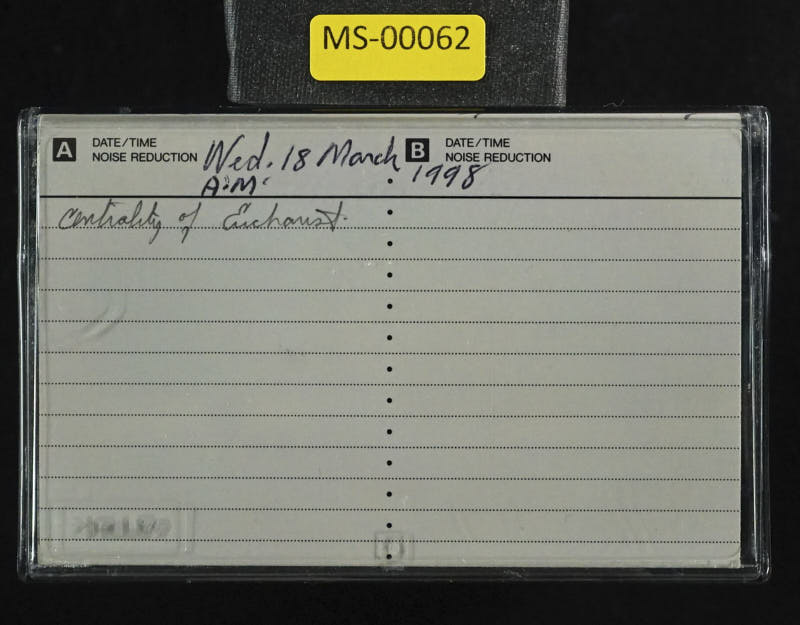
AI Vision - Possible Values from Photos:
Speaker: Abbot Justin Dzikowitz
Location: St. Pauls Abbey
Possible Title: Credulity of Enchantment
Additional text: Med. AM, D#6
@AI-Vision_v002
Where else than in a monastery could you have a presentation on pride and lust and then for a discussion talk about television? I mean, this is wonderful. I do appreciate our discussions, though. I think that some of the best part of our retreat is our ability to share and reflect upon ideas that come up. James had a very important thing. Yesterday he was mentioning that Father Jeremy Driscoll, as a sacramental from the sacramental angle is challenging or calling the fundamental theologians to do some reflection on the centrality of the Eucharist in Christian life, as I remember. And this, it's a worthwhile, it's a worthwhile challenge. We are a Eucharist church the great tendency pastorally outside of our monastic life, where, of course, the centrality of the Eucharist is obvious in our office and in our liturgy of the Eucharist.
[01:05]
But in the church at large, we run the risk of becoming either congregationalists or something else. There are things going on, and especially with the shortage or the so-called shortage of priests, that the centrality of the Eucharist and the Eucharistic church is being questioned and challenged. The whole sacramental character of approaching Christian life is, by practice, is being challenged. And let's say, this is a very interesting time. I want to thank you for the variety of weather you have here that you've provided. We've had wind and sun and clear, and now we have some ice and rain. It's a very nice experience to see these different... It's colder here than Anchorage. I just checked the paper to see what... On Friday I'm flying back to Anchorage, and I wanted to see what I'm in for.
[02:10]
I probably won't see snow on the ground. It'll be on the mountains, but probably not on the ground. They have this wonderful... period of time that they call breakup. I call it meltdown. And what happens is the angle of the sun is finally getting high enough to melt the snow. In December, it's only at the treetop, the sun, when it comes up. Now it's getting up there, and so the angle is increasing, and the snow melts, and the heat is up. It's up to 45, it said yesterday, in Anchorage. And that creates a... The snowpack begins to melt even in the city. You get... And all of the sand, and all of the... It's a volcanic sand that turns to dust. All of this comes and flows in the streets, and everyone wears wellingtons, and these boots up to their knees. It's a big mess. But it'll be interesting. Maybe it'll all be cleared up, and the flowers will be out.
[03:10]
Today, this morning, I want to talk... I want to look at these last... two stages of development and two sins. And then this evening, I want to do a wrap-up. Today is the last day for conferences because tomorrow we'll have our Mass at 9 o'clock, the Feast of St. Joseph, and it will be the end of our retreat. There's an importance in storytelling. as we have said yesterday, for healing and understanding, storytelling. And while our own stories, the story of our life, may not easily be repeated in a community that we live in year after year after year after year, there is a necessity to be able to tell the story. And it's important for newcomers into the community to know not only the stories of the men who live in the community, but the community story.
[04:18]
One of the things that we did at home in our process of having a facilitator help us face the future, we spent all three weeks telling the monastery's story. And everybody in the room was open to put out in blocks of time whatever they remembered. of the monastery's story from its foundation. All of the myths and legends and tales and facts, they were all thrown out and put and we made charts and we looked at them. A very interesting thing happened in doing that. we were able to correct and then see someone went to the archives and actually looked up records of visitations and chapters and it was really a helpful thing to sort of correct the myths that we had formulated and things that were not true and blaming certain individuals of the past for things that they were not guilty of
[05:27]
But in fact, the opposite would show when we discovered hidden heroes who looked like villains in the corporate consciousness of the group. Storytelling is an amazing, it had a healing, it had a very healing effect. And it's a very powerful thing because then movements in the community began to, you know, real energy became alive in a sense by doing that. People coming into a community need to look at their story and share their story as best we can and know the community story. Now, we did this, of course, with a guide. We were not able, we told our family of origin stories. We didn't tell too much of our spiritual stories or our development stories, the stories of our growth into manhood. These things were not done, but they could be done in groups in a community. Certainly, perhaps formation groups or in, as some monasteries have now, deaneries.
[06:35]
I know in Germany, in the Abbey of Münster-Schwarzach, it's a very big, most of the work, the individual spiritual growth, occurs within the deanery. And also the addressing, because it's a community of so many, there are at least a hundred something at home and it's a big institution. But even coping with difficulties that people have are done through deanery. It's an interesting way of, they also have deanery outings. The deanery goes on a pilgrimage together to some place or a walk. but they have a way of approaching their own spiritual development and growth in deaneries. But I think we need those kinds of experiences of groups. Some of us at home went away to do some work on our own, knowing our own stories or knowing ourselves in different ways, and it freed us up enough to be able to talk about that with the community.
[07:44]
But storytelling... sharing our story is a way of healing and growth. So, I'm going to start with a story. My stories are coming from an author. It's a woman who wrote a book on parables. I think her name is Callahan. Wonderful stories she has. They're like stories of the Desert Fathers, but we can find stories like that if we keep our eyes open. This one I enjoy very much, and so this will be an entertaining one. There was a woman who wanted peace in the world and peace in her heart and all sorts of good things. There are many women like this. She got very frustrated. The world seemed to be falling apart. She would read the paper and get depressed.
[08:47]
One day, she decided to do what the tough do when the going gets tough. She went shopping. And she went to the mall. And she picked a store at random. And she walked in and was surprised to see Jesus at the counter. Oh, she knew it was Jesus. She had seen enough holy pictures and enough icons that she didn't have to ask. She knew it was Jesus. Just like the pictures, the devotional pictures she had spent her whole life looking at. She looked again and again at him and finally got enough courage and asked, well, excuse me, are you Jesus? And he answered, I am. And she said, well, do you work here? No, Jesus replied, I own the store. Well, what do you sell here? Oh, just about anything. Anything?
[09:49]
Yeah, anything you want. What do you want? Ah, there's the question. What do you want? She said, I don't know. Jesus said, well, feel free, walk up and down the aisles, make a list. See what it is you want. And then come back and we'll see what we can do for you. Well, she did just that. She went walking around the store up and down the aisles and there she saw peace on earth, no more war, no hunger or poverty, peace in families, no more drugs, harmony, clean air, careful use of resources. Well, she made a list and she wrote furiously. By the time she got back to the counter, she had a long list. Jesus took the list, looked up at her and smiled and said, no problem. And then he bent down behind the counter and picked out all sorts of things and stood up and laid them out on the counter and they were packets.
[11:00]
What are these? The woman said. Jesus replied, seed packets. This is a catalog store. She said, you mean I don't get the finished product? No, this is the place of dreams. You come and you see what it looks like, and I give you the seeds. You plant the seeds. You go home and nurture them and help them to grow. And someone else reaps the benefits. Oh, she said, and she left the store quickly without buying anything. Our lives are perhaps reviewing our lives and looking at different ages. We can see the seeds of unfinished business, of lost hopes or dreams or things that are incomplete yet.
[12:04]
things that are imperfect disappointments and frustrations. Especially now, as we come to the last two stages, we are faced with reality, the reality of where we live. And we see that there is a lot of work that maybe we haven't picked up on yet. We don't have to finish it, but it's worth looking at. The next stage of adulthood that Erickson gives is the age of adulthood. And he says, well, that lasts from about 40 to 65, more or less. And the great crisis is generativity versus stagnation. It was Carl Jung who said that for people over 30, there are no more psychological problems. that's good for development about up to 30.
[13:05]
And as I look around the room, we can all take a deep breath of relaxation. We don't have any more psychological problems. But Jung said the problems are worse or more serious. They're spiritual problems. They're problems that touch the very meaning and purpose of our lives. He never saw anyone get better, he wrote. without some return or awakening to the real use of religion, what binds a person together in their life. So the crisis of adulthood, generativity versus stagnation, whether or not we can generate or care for what has been generated or whether or not we stagnate in our lives. Now, It's curious to see monasteries have been very alive with generativity.
[14:08]
And sometimes it's quite hidden. But if you look around your own monastery, you will see a horde of people that come here for their enrichment. And you are generating spiritual growth and enrichment in people's lives, perhaps more than most people are aware of in the community. that just another aspect of this is the landscape of the monastery and how it's cared for is a source of great hospitality and peace to people who come and visit. Just a little patch of flowers, or just the fact that you keep the entrance to the church, or just the way you keep the church. simple and focused on what really is important, the altar, the choir, and the simplicity of it, this is a rich source of simplicity in the world that needs an escape from chaos.
[15:13]
And this is a way that the monastic community is generating spiritual enrichment. You are passing on a tradition of Christianity that is as old, as our faith, to countless people who come here in different ways, in different levels. And so we see in monasteries all across the country, some of them have schools, some of them have colleges, some of them have graduate schools. There's all kinds of different ways that Benedictines and monasteries have been about generating spiritual enrichment and life, and also caring for the youth of Other people, what has been generated, also caring for the culture, for what is really worthwhile in the culture. And thus we see the arts flourishing in Benedictine communities. There's a sensitivity to what is good and what's beautiful. This is a way a community focuses on that.
[16:16]
Stagnation is a problem that makes us all shudder. It's the negative side of the crisis at this age of development. If a person is unable to invest emotionally in what is being generated or unable to sustain an interest in what has been generated, whether they are children or whether it's work or art, what sets in is this boredom or tedium or this interpersonal impoverishment which often takes the form of self-indulgence and it leads to a great problem. It leads to sloth. Now, Carl Menninger would say that sloth is the greatest of the sins.
[17:20]
Curious to see different people picking out different ones as the important ones. Sloth is not just the laziness that makes us want to lean back on a lovely spring day and enjoy the warmth of the sunshine and watch the geese fly north. Sloth, I learned once from an old monk what sloth meant when he said with a sigh, eating is such hard work. And I said... This is a capital sin. And I was unaware of that until that point of the depth and sadness to hear someone say that. Ah, eating is such hard work. Sloth or apathy. Apathy not in the good sense of the word apathy, but in the common usage of the word apathy. Or negligence or indifference or boredom or misery or dejection or idleness.
[18:24]
leads one to become dispirited and to experience a living death. In our time, it's often called burnout, which is another word for depression. And here's where the sins overlap. I'm going to have an eighth sin in a minute, which is called... melancholy that's going to be the sin of the next age but we're dealing here with sloth or with what has been called traditionally in the monastic writers acedia a lethargy a lifelessness a paralysis of the will this is what gets written about of course by cash and and has been called the noonday devil.
[19:29]
And Evagrius writes about it too. We're familiar with the passage, but it might be worth hearing again, because it can become the problem of our adulthood, and certainly it can become the problem of our monastic journey. We can be bogged down in burnout. The demon of Acedia, also called the noonday devil, is the one that causes the most serious trouble of all, says Evagrius. He presses his attack upon the monk about the fourth hour and besieges the soul until about the eighth hour. First of all, he makes it seem that the sun barely moves, if at all, and that the day is fifty hours long. Then he constrains the monk... to look constantly out the windows, to talk outside the cell, and to gaze carefully at the sun to determine how far it stands from the ninth hour, which would be lunch. And then instills in the heart of the monk a hatred for the place, a hatred for his very life, a hatred for manual labor.
[20:37]
He leads him to reflect that charity has left the brethren and that there is no one to give encouragement And should there be someone at this period who happens to offend him in some way, this too the demon uses to contribute further to his hatred. This demon drives him along the desire to desire other sites where he can more easily procure a life's necessities and more readily find work and make a real success of himself. He goes on to suggest that, after all, it's not the place that is the basis of pleasing the Lord. God is to be adored everywhere. He joins to these reflections the memories of his dear ones, of his former way of life, and he depicts life stretching out for a long period of time and brings before his mind the toil of the ascetic struggle, and as the saying has it, leaves no leaf
[21:40]
unturned to induce the monk to forsake his cell and drop out of the fight. Well, I guess we know what that's like if we've lived in monastic life a while, but Menninger, in a modern look at sloth, tells us that it is the attitude of take it easy, don't care, mind your own business. Don't get involved. It is the sin of why bother? Let somebody else do it. The car is out of gas. Let the next guy fill it up. What we don't know won't hurt us. It is the sin of not doing, of not knowing, of not finding out what we must do, in short of not caring. And there we come upon the touchstone of it.
[22:45]
It's not caring. The indifference that makes acedia the great sin, the heart of all sin, not caring. Some would call that selfishness. Some call it alienation. Some call it egocentricity. But whatever it is, it certainly is worth our attention. The final stage of life is one that we observe, most of us observe, and we look to our old people for an example. It's said in our culture that we have relegated retirement villages as the place where we put our old people with the accumulation of their wisdom. We go down to Florida and we find them riding around in golf carts and playing bingo and being silly.
[23:48]
When they really have accumulated the wealth of wisdom about what life is about and we relegate them, I don't know why that is. We may be afraid of what they will tell us. Monastic life has always cherished its elders and perhaps this is an example of giving our world or calling them to task about how to find the wisdom in the old. The last or the final stage of Erickson's scale of the journey through life, he says, is mature adulthood. He calls it 65 plus. And the battle centers on integration. the integration of all of life's work versus despair. Looking over a lifetime, and if a person has set out in search of order and meaning and a spiritual sense, it can reach its culmination in integrity in old age, an acceptance of the wholeness of life,
[25:07]
a sense of comradeship with men and women of distant times and of differing pursuits who have created sayings or works. There can be an achievement of real fellowship that crosses the ages at this stage of life. Also a sense of coherence and wholeness linking the body and mind to all of life's experience. Now, the other side of the coin, and this is very sad to see, but you can, sometimes in old people, see the despair or the inability to accept. They can only look back with regret, lamenting life and the form it took, perhaps even regretting that they were born. And the signs of that despair are a disgust or a misanthropy or a chronic contemptuous displeasure with particular institutions or people, a disgust and displeasure, which signify the individual's contempt of himself.
[26:24]
And that's where the stakes are very, very high. Now, in the traditional category of sins, gives rise to what has been called melancholy, a despair of God's creation, a lack of passion for life for its goodness and its beauty. On the other hand, what emerges in the old, if they integrate their lives, is that wisdom, which is their strengths. and their virtue. That wisdom that we so desperately need who are still on the journey. Let me just take a quick look at St. Benedict and look at seven and eight in the degrees of humility.
[27:32]
The seventh degree of humility is that the monk consider himself lower and of less account than anyone else, and this not only in verbal protestation, but also with most heartfelt inner conviction, humbling himself and saying with the prophet, I am a worm and no man, the scorn of man and the outcast of the people. After being exalted, I have been humbled and covered with confusion. And again, it is good for me that you have humbled me that I may learn your commandments. Now, here's one that can be looked upon as very, very troublesome, looking upon ourselves as a worm and an outcast. This certainly... is very difficult for people to look at and try and emulate. Perhaps the word that would be helpful in looking at this is the word devotion.
[28:38]
The sacrifice of lesser interests to greater ideals. True devotion inspires action, not merely an inner feeling of pious pleasure. In the seventh degree, we see that the sacrifice of lesser interests for greater ideals. It challenges us to maintain a constant attitude of prayer by which we remain in the presence of God. We are invited to look for the ideal in all situations. to put something into practice with the seventh degree of humility to focus on the best in our world, in our contact with friends and visitors and confreres, and focus on the best. Looking at the eighth degree of humility, the eighth degree of humility is that a monk do nothing except
[29:50]
what is commanded by the common rule of the monastery and the example of the elders that reminds me of collecting monastic sayings if you cut them short you get a very amusing collection of apothegmata monastica or if you change a word we used to collect them when we were young clerics at St. Minor We used to say, let nothing be preferred to a trip. Or, it's alright as long as it stays on the property. Here's one. The eighth degree of humility is that a monk do nothing. If you stop short and not read the rest of the sentence. Except what is commended by the common rule of the monastery and the example of the elders. Now, The word that perhaps illuminates this one for us is imagination.
[30:53]
Imagination is the employment of potentialities or the capacity to experience the ideal reality. Imagination is the perception of spiritual form behind the substance of fact. It's a challenge. Now, what is a practical suggestion for employing the eighth degree of humility an act of gratitude don't get found out. Now, there's a real practical way of employing our imagination in monastic life. Now, it's been said in a friend of mine, an old priest, his name was Father Dave, who was the one who introduced me to Alcoholics Anonymous, Dave McCarthy. He's a He's long since deceased. He had been in 17 battles in the Navy in the Pacific during World War II. Amazing guy.
[31:56]
Tough. And he was on the skits. He really had a rough, rough go of his alcoholism. And it was so funny. He brought me around to meetings, and he would tell the guys, he said, I don't know what we're going to do. We've got a monk. He said, straighten this guy out. So he brought me to my first meeting in a place called Sakasana, New Jersey. You have to be sober or it sounds like a bad word to even say that place. And he loses me at the meeting. This old Navy guy loses me. So I have to get connected with the people at the group to get a ride back. Very interesting. Anyway, he had a thing. He really believed this. He said that every day... We ought to do an act of gratitude. Do something for somebody else, really into action. Do something and don't get found out. He says, but don't let this just happen as you go along.
[32:59]
In the morning, plan it. Say that I'm going to do something for somebody else today and not get found out. He says, don't make a big deal out of this because you'll never do it. You know, if you decide to plant a rose garden for somebody, forget it. Be realistic. Get somebody a cup of coffee. Do something for somebody, but plan it ahead of time. He says, and don't get found out. If you get found out, it doesn't count. You've got to start over. Well, old Dave used to call me up on the phone and say, well, how are you doing? And sure enough, old smarty pants would say, I know what you're doing. You're doing your act of gratitude. And he would start cursing on the phone. It's a real way of getting these principles from the head into our experience. into our experience. It's a way of living monastic life.
[34:02]
So when we talk about degrees of humility, it's not just a nice theory that's in the book, but here are some practical ways of living this so that our lives can change, that we can be involved in this ongoing conversion, that we can be about a program of progress and change slowly over the years. over the weeks, over the months. But it's certainly worth our reflection and our effort. Let's stop there and open up for some comments or discussion or observations or objections. If you start doing something for somebody, it's going to be misinterpreted. The trick is not to get found out.
[35:06]
Sure. You know but it But it's like going in the kitchen and seeing that, oh, this has been left here, just putting it away. But actively doing that. It's a way of living the life and internalizing what we think about and pray about. It's really putting it into our behavior and not being a big deal, not being an obvious thing. But the trick is to think about it ahead of time. Like, what can I do that I'm not going to get found out and that I can do for someone else? It is true there's a, you know, that kind of thing between this Anton Virgo, who is a priest, psychologist, psychiatrist, and somebody in France, in this country, who
[36:29]
Anyway, Bago wrote that the degrees of humility are really reinforce the poor self-image. And this other person had a very... I mean, because it's true, I think, wrongly read, they can reinforce long-term dependency and all the rest of stuff. But this other monk wrote, you know, but the key to it is a bit of maturity, so that you're choosing to do these things, almost as you say, Because I recognize that this is helpful, you know, and otherwise I'm doing it to reinforce my own self. Right, right. But it's, you see, it's much better to go and do something that's practical and helpful for the community than to walk around saying, I'm a worm and not a man, right? Especially in our culture. I mean, we look at this and we, you know, the way... You know, he was certainly combating probably some kind of arrogance back in.
[37:34]
I don't know what made up people living in the 6th century, but there was probably some kind of arrogant attitude that this was directed at. And you're right, with the notion of mature, we can't be going around telling ourselves day in and day out that I'm a worm, I'm a worm, I'm a worm, I'm a worm. We're going to start eating dirt. if we do that, but if we are active in doing something for someone and helpful to the life of the community, it's a positive way of living the degrees of humility. I think there is a sense, when you do have some sense of maturity, well anyway, and appreciate what, if you just look at yourself, that thing that our Lord said, you know, the miracles that have been done in you have been done in Saddam, So I think we can look to ourselves and say, if other people had the advantages that I've had, racism, they would have done much more with them than I have done. But that's not comparing yourself to other so-and-so.
[38:35]
I mean, just the general. I think that can be true, and that can be a good stimulus, again, to the goodness of God and other people. But without that, it really is a dangerous thing, you should say, that we were undercutting whatever good we've done. We kind of pull it by the roots and throw it away all the time. But once we do have some sense of the goodness that we are and have, we can do this other in a very healthy way. And it's not self-destructive and anything else. It's a stimulus. But it's a dangerous thing because wrong to use it. It cuts both ways. And it also combats the danger... of falling into ascetia and melancholy as a way of life. I don't think anyone sets out to live an unintegrated life and to reach old age as a miserable person. I don't think we make a decision of that along the way that's clear.
[39:36]
Say, you know, we sign here, I'm going to end up a miserable old man. Nobody wants to do that, but it's... It's along the way that we compromise in our outlook and fall victim to beating ourselves up. But by activity, by living the life, not only thinking it or reading about it, but by trying to adjust and conform in our everyday behavior to the sense of life, and a contribution to other people, it certainly is the way of integration of our life. And the tools are there. You know, perhaps when Benedict is struggling with a worm, they were very much closer to agricultural reality. And for a healthy soil, you have to have worms. But not worms, you can find all they want, but you won't have a good control.
[40:38]
That's good. That's good. Oh, sure. Sure. You do not know the tigers or the elves. You look at the dumb veal. You see the essential. But as you said about doing a good deed, we take these things for granted. You never see the earth for working on them. But they're essential. Without it, We think that's so important to be dead. It's a funny scene that you read. I saw that movie about the Dalai Lama, one of the movies about the Dalai Lama. The Seven Days in Tibet about the Austrian who had lived in Tibet during the war. He had escaped from a prison camp. And they're going to build a theater or a study place for the Dalai Lama, and he's got everybody digging in the ground, and all of a sudden they find worms, and everything stops.
[41:40]
They're all putting the worms very carefully. They were holding them in high regard as their ancestors. That's what they were in there. system of cycle of rebirth so it stopped they had to find a way of doing foundation digging foundations without cutting up the worms sure but yeah and they create they do but I think Benedict isn't he quoting yes in the he's not he says the prophet You know, because sometimes we do feel like worlds, whether we want to or not. So we can look at it positively. When we look worthless, yeah, but even the world, without the world, there would be no elephants or whales or anything like that. Was it St.
[42:41]
Augustine who was giving thanks for all things in creation but couldn't understand why God created the mosquito? or specialization, you know. This is not my, you know, I don't have charge in this room if I want to come. And I think that this is the thing that's moderation and trying to find a balance initiative or not imposing yourself or taking the initiative, you know, but where is the right thing. And I think that so many people are afraid to make mistakes when they don't It's so easy to become, in a sense, isolated then from one another in monastic life by just saying, oh, this is that person's area and I'm not going to be at all.
[43:47]
I don't know why we do that. I guess we're afraid of... You know, but see, it happens, I think, over a period of years. We kind of back away from someone else's area of operation. But it certainly is worth considering how we might be able to be helpful to one another without, you know, just going around keeping everyone at arm's length and their job and not really... entering in, being helpful and spontaneous and imaginative about how we live our daily life.
[44:52]
Yesterday, I was reading about, I was talking about, if you think you've got the knowledge, the first part of the book goes, if you think you've got the knowledge, that's when you don't get the pick. And the second part goes. Okay. And the gist of it was to turn to God, and there you will find knowledge. And all I could think of was, and then I was reading, the other part I was reading was, I guess it's one of the monastic habits meetings, or some kind of like a woman wrote, obey God and God will obey you.
[45:54]
And now all I think of was the same thing you were talking about when you were talking about pride and loss, you also talked about identity and isolation. It meant to find your identity in power and then you can attempt to not have an autonomy that have made great promise to do things on knowledge. And I have the energy to do that. When you think you can do it yourself, that's when you learn it, or that's when you get all these other things, because then all your capital, capital, things. I was kind of surprised when I just said, I think you were calling someone, that it's on Saturday that the lust comes, meaning by that, It's the furthest away from Sunday. The more you go away from God, the more the worse comes out.
[46:58]
All these things creep in, yeah. That was a medieval way of looking at the sins and assigning them to days. Someone had researched that. In the Middle Ages, they would say that Saturday was lost because it's furthest away from Sunday. Or you're most pragmatic. more pragmatic, the more you're away from God. I was thinking when you were talking about slow and apathy and all of that, and melancholy, I think it's also good to introduce a cautionary note, especially in a community where there are a lot of older people taking medication. things like that, that isn't always, it can be a result of the things that you are being, you're taking course. I have that experience myself. You know, many of the things make you depressed, lethargic, but I think, and also as you get older, I think that the sense of weighing powers, so that you're, it's a struggle,
[48:13]
to keep on doing the things that you always used to do. One of the things that gives me great strength is watching Brother Luke, who has an indomitable will to keep on doing the things that he can do, and he makes a lot of adjustment. And there's a lot of creativity in that, a lot of generativity. It's true what you say about... you know, as people age, there is a mourning or a loss of ability to do things. And yet, there is a way of integrating and looking at the whole of life that doesn't happen at any other age. You know, I mean, you get vision from what I've seen of old people who have been integrated. They have a vision. I mean... They're at home with us and they're at home with Socrates or St.
[49:16]
Augustine. If they've read that, if that's been their pursuit of the past, they understand across the centuries in a remarkable way. And they have a camaraderie with people who have integrated their lives. And there's a freedom that comes with that that doesn't happen at earlier ages. getting older, he was moving from success to significance. Yeah, yeah. That's really, right. Right. I think that's very, very true, and I think the obligation for the person who is getting older is to... do what they can and pray as much as they can for attentiveness. Attention. Attention to yourself, attention to God, and attention to what's going on around you and your relationship to other people.
[50:22]
And there is a tradition of passing on in communities how to go old, how to get old, and how to... It's passed on. And... It's something that the elderly in the community are doing, whether they know it or not, the rest of us are watching. Maybe not so deliberately, but we're watching and we're seeing how people are growing old and how they adjust to the losses that happen when people age. Right. Even at an unconscious level, the younger people, they know, what's he doing? Another day. I use real travel monk like, well, Father, how are you doing? How lousy. How am I supposed to feel? Everything. You get the two ways are presented very clearly to a novice.
[51:25]
Yeah? Yeah. That's true. That is true. And you wonder, well, what has 50, 60, 70 years of monastic living done for this person? Well, the young person, that will be right up front. What is it about? What we do have is, Brother Richard was saying, there is a clinical depression, which is different than our ordinary reactive depression. A gerontological depression, too. Even this business of Alzheimer's and things would... We're certainly going to run into that in our own community at some point. And with other people, too, whose parents are wandering off and difficult to deal with. That seems to be a real problem again, not just because people are living so long and it doesn't seem to be an antidote. Boy, I wish anybody comes up with that, they get the Nobel Prize. We don't just go into it. But it's hard to make somebody just so many cantankerous and realize, oops, if I had Alzheimer's, I could get away with murder.
[52:29]
I got a pseudo Alzheimer's. Anybody in particular? Fortunately not yet, but boy, it's going to happen. You know, just... I think that's awesome. Nobody can predict it, but they do. It's not like one out of eight or something. But there's something very healthy about community life and monastic life in helping people age well. The tools are here. The movement through the day, the prayer, the sense of belonging, the being valued and having a place, all of this really... it really does lead to, you know, in studies of people's lives, like they're looking at communities of sisters as not only the most educated group of women in the country, but also the ones who live longest. And they're saying, well, there's a purpose in life here.
[53:34]
And it's the same with monastic communities, although people said that... men who are not married don't live long. Well, look at the notices that come through, the death notices of people that we pray for and their lives. It's very interesting. Monastic people have a purpose and just in life, and it allows life to be fuller. One of the things that I was talking with Abbot Joel at home, he's very impressed. It's the old men who, you know, in their mid-80s who are always in office, always there. And they're coming on canes and crutches and wheelchairs, but they're there. It's giving them a purpose, praying for the community.
[54:37]
It's also giving a marvelous example to the others that... there. Okay. Sure.
[55:00]
@Transcribed_UNK
@Text_v005
@Score_94.35