You are currently logged-out. You can log-in or create an account to save favorites and more. more info
Spiritual Unity in Monastic Life
AI Suggested Keywords:
Talk at Mt. Saviour
The talk explores the concept of unity among a community, specifically within a monastic setting, emphasizing that true unity stems from a shared spiritual connection rather than solely external discipline. It argues that while physical presence is essential, genuine community life requires internal commitment and an active engagement with one another's needs. The discussion also touches on maintaining stability in various community roles and the balance between personal responsibilities and communal obligations, highlighting the importance of effective communication and mutual support in fulfilling both personal and group needs.
- Bible (Genesis): References the idea of unity through an anecdote from Genesis where individuals outside Moses' camp receive the spirit, illustrating that physical presence is not the sole measure of unity.
- Father Garrigou-Lagrange (French Dominican): Mentioned for his lecture on conversion, discussing the spiritual journey and need for ongoing conversion and growth within religious life.
- Little Theresa of Lisieux: Cited to discuss the broader acceptance of human limitations and achieving spiritual intimacy with Christ through love and prayer.
- Rule of Saint Benedict (Chapter 72): Invoked for guidance on bearing with one another’s infirmities with patience, emphasizing a fundamental teaching on community life.
AI Suggested Title: Spiritual Unity in Monastic Life
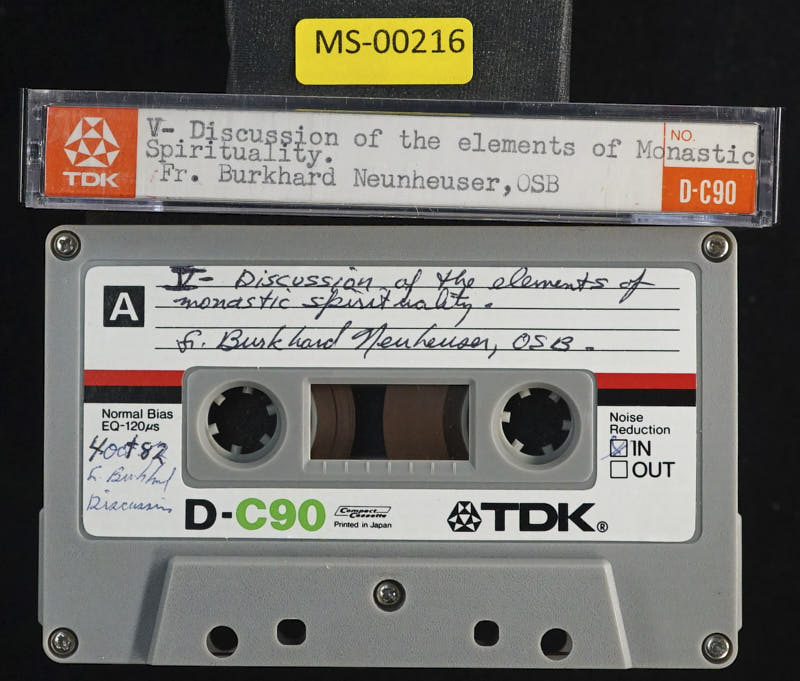

AI Vision - Possible Values from Photos:
Speaker: Fr. Burkhard Neunheuser, OSB
Possible Title: Discussion of the elements of monastic spirituality
Additional text:
@AI-Vision_v002
saying that our being together and the mystery, I would say, of unity, what it is, which we don't know really what it is. We have to be open to new ways of what being united really means. Because somehow the mystery of God is a mystery of union. But our being together at the office, our being together here, our work, our being together at meals, and so forth, is a is not just simply rooted in a discipline that is not good for monks to be outside their monasteries or that we must stay together in a disciplinary way, but it really is rooted in the mystery of the union of persons, which is the Christ, if you want. And that also, as we had in the Scriptures a week or so ago in the Genesis thing, there were two people designated who were out
[01:02]
in the camp. They weren't inside the cloud with Moses and the elders, but because they had been designated, they also received the Spirit. So that it doesn't mean, you know, physical presence here, strictly and only. But anyway, that whole idea of being together with everything, being on time for the office, on time for meals, and really being here, you know, saying that you want these brothers who are here to be, to exist, want them to be, all that. And the whole thing is, it is really rooted in that mystery of Christ or of God. It's not simply discipline. It needs a certain disciplinary thing, but that can also obscure the fact that there's a real, that that's what it's about in some way. And our being together involves not simply being here, then physically, but that internal you say, affection and at least patient bearing with one another and so on.
[02:04]
So that whole thing has to do with our particular witness as monks. Somehow we present, as did the incarnation, presented the Trinity to the world, you know, God's beloved. So we really presented that by our own. But somehow then, the reason that I, you know, be the office, the reason I would go down for a trip, the reason that somehow we really should draw up those lines to Christ, so to speak, and then, you know, prudence of, the wisdom of, you know, so on and so on. But anyway, it's much more than simply a disciplinary thing. Oh, yes, yes, yes. But it needs, you know, there's, again, this tendency for each to go our own way, to go our own thing and all that. That's a, that's a, you know, thing you have to fight, as also the simple, because I am here, everything is could have been done, just because I'm physically depressed, but my mind could be miles away, or my heart could be miles away, forgiving everything else. But we really do make visible and helpful, and assimilatable with the kingdom, or God's body.
[03:11]
So that whole notion of stability, it has to do with stability, too. But it's this mystery of unity, our being all together, which is a part of art. life is really something which enables us to reach that depth which is God's action. I would say two. The first fundament is our union with God, our Lord, to be established in Him and to be united in this community by the love of God. Also, if we bodily are not present here, Stability in congregation, in the congregation. Also if we are sent in obedience in our countries. I myself, I have been for so many years in Rome. And also sometimes, already the fifth time now in the United States. I have been so often in France and in England. I was a monarch with vagabundus.
[04:14]
And my brothers, my brothers, from a family, you say, always in the new world to come, they wish to become monks with the vow of stability and the possibility to go through the entire world. Therefore, the first would be, and I hope that I remain always a good monk of my abbey, never forgetting it. Nevertheless, I would say, after this first theological fundament, our unity in Christ, our unity in the spirit, our unity in prayer, our unity in obedience. There would be also, as a realization of that, our really standing together, doing our duty in the house, in the difficulty of every day. It's not so easy. And when I look to my confrères in my monastery,
[05:16]
We have been always filled with the greatest admiration of the simple old brothers who in their entire life did nothing else than to care for the potatoes. Collecting them and during the winter trying to take away from the potatoes the Yeah, the Utsuits, that you could eat it. Nothing else. Praying, praying, praying in this humble service. Good, good, holy sentiments. Very simple. And we, the fathers, the priests, going out, yes, preaching, but also enjoying a little bit this place here and there, and having some success, sometimes also not success. Therefore, to stay together really in the difficulty of every day and when, as was said in Rome, vita comunis penitentia maxima, this has a double meaning, I think.
[06:29]
It is terrible to stay together. It's a terrible penance to stay always together in the same place, never changing. always getting the burden each of another. And another side also, it has the meaning, if you stay really in the wonderful unity of a community, you don't need many other works. That is your parents to do it, to do it really, and also enjoying it. But sometimes it is awful. That really requires, our being here requires getting rid of all of our Not falsely, you're saying I have a rationality. But to stay here physically and not stay here spiritually going out is nothing. It would be a lie, yes. Terrible lie.
[07:32]
We have the appearance of the monks and saints and we don't be these. And therefore, I remember always, perhaps I said it already, this day in 1930, when in a reading of Father Garigou Lagrange, the great French Dominican in Rome, in a great hall, more than 100 Jews of every nation, he said, speaking about the conversions, the first conversion and the second conversion, which is the duty of our entire life, We were beginning with the first conversion. When we were children for first communion, then we were beginning the priestly life or the religious life. And then major numerus, he said in his French Latin, major numerus, omnium, radiosorum, et es aceritum, sunt anima retta date. Sunt anima retta date. The greater number of all the religious people and of all the priests are anima,
[08:39]
beings, animals, no, souls, retardate. And nothing of fire, nothing of light. Retardate. Retardate. Retarded. Yes. The meaning is souls which go on. They stay. They remain in the same place. They don't convert themselves. In their entire life, they must convert. They are never perfect. Every day again. Every day again. Today, if you hear your voice, today, again, again, again. We're talking about religious in general, right? Yeah, in general, yes, yes. But we, the young people, all we have been monks or religious or priests, candidates of, let me say, 23, 24, 25 years, we have been terrified.
[09:42]
It was a perfect silence when you said it. Yes, we were admiring his French Latin, strange Latin, but nevertheless also taken by this war. The reality is that The great army of brothers and sisters in the world. All must be saints and they are nothing. And then again, in the mercy of God, they are much. Lethargic, which is a good word. Lethargic. Lethargic. And perhaps, nevertheless, they are poor people. They are doing their duty more or less. And God will be merciful in the end. It's a little bit difficult to say so about the great army of the brothers and sisters in the world. It's dangerous to judge. I have a question.
[10:44]
You mentioned this morning and many times before that we have to share the burden of one another. Now, how can I share the burden in this life, in this particular life? Most of the time I am alone. Sharing for me is more than being in the office, being during the mass, during the meals. All the time I cannot talk. I cannot share whatever is in me with somebody else, my brother. So I would like you to give me a practical way in which I can share with Master Roger whatever it happened or happened to me. Be patient. For example, I am nervous. I see my brother cleaning his nose in a terrible way.
[11:47]
I can't eat this. There's a female in his nose. And then all my angry comes and then be, oh, it does not matter. Oh, he's eating in a terrible way. And this little, how do you get, feebleness, weaknesses of my body in a little community. We become nervous and then, oh, I am reacting against him and not do so. Or spiritually, somebody, one of my confrères wishes always to be the first. He must tell. He does not allow to another to tell his stories. Again. Here, that is... The question is about communication. Communication. To me, community life means that everybody knows somebody else's needs or wants.
[12:50]
If I belong to a community, that means that I don't have to ask my brother what he needs. I should know. You should not know? My brother's needs. I don't have to ask him. Do you need this? I just say I should know. He should know. He should know his brother's needs. He should know. Yes, he needs. How do we reach the point that we... No, everybody is sharing. For example, we learned in the monastery, we are not allowed to ask if somebody is missing on the table for the dinner. My brother must see it. Say that again? You are not allowed to ask? Yeah. Something is missing, like the bread. No, no, he's short of salad. At least we are not doing so. Sometimes, well, I have not what I need. But he's not allowed to do so. And therefore, sometimes we were also telling this little story.
[13:53]
I had a mouse in my soup. You did? No, no, no, no. It was told so, a mouse. And therefore, I could not eat it. Then nobody has seen it. And then, because I am not allowed to ask for a new soup, I asked my brother, Keith, do you have also a mouse in your soup? Oh, yeah, then I must help you. Here is a great truth. I must be attentive to the needs of my brother. I must see what he is missing. I must help him. not only just what the difficult little things in the rhetoric of you, but in every day, attentively, his health, his painful, please. The question is how? The question is how? In the office, we are alone, we don't talk.
[14:56]
We are silent all, you know, all the morning, which, for me, the best thing that we're going to speak life, to me, the silence. I am not putting the silence down. But When I work, I myself, I am alone. So when is the opportunity for us to share? But you see your confere very sad. I think also in the great silence of a very observant monastery, you can and you must ask him, why are you so sad? What do you have? Can I help you? And so in many things, Perhaps it's not so necessary to ask him, but to see at least and to help him if he needs some help. I don't know. In the chapter 72, it said we must bear the difficulties of the conference
[16:05]
of body and soul in the greatest patience, all in silence. Here, that is the work, to bear the burden of the other, to be patient, and there are so many. I think it's true in every community, although in the most powerful community, we are all different. We come from different families, and now we stay together. He is sitting, he is acting, he is speaking in a way which does not please me. I become nervous. I would like to protest against him. And then, no, no, not do... It seems also, Father Berger, that the problem that the little Teresa, Teresa of the Child Jesus, Teresa of the Ju, faced is in some way... But I realized that my humanity is, you know, is also the humanity of Christ. And it is in love, the acceptance of my own, say, limitations and situation.
[17:14]
And really in a prayer, which is not just words, but that total acceptance of the human condition for myself in prayer, that that puts me in contact with Christ, with His Spirit, with everybody, in a way that... ministering to them individually does not, I mean, that is to say, to be a social worker, you know, with 50 people who saw me today, I saw 50 people and, you know, I got them all jobs or something, that there is this different dimension, which is in our life, that is, I mean, you can be abused, and I just rationalize, as the gospel, as the epistles say, I see my brother in need. I say, go be warm. I've got to go to the choir and say my prayers for all the suffering people in the world, which is wrong. But there really is a genuine sense of which, by reason of my contact with Christ and with the Spirit and the acceptance of my situation and the prayer, that I do touch everybody, but I don't see.
[18:15]
Really, here is, again, the theological and, therefore, the most profound fundament of our situation. But nevertheless, it would be necessary to be attentive to the other and to help him. For example, sometimes in the monasteries are divided in different offices. You must take care of the library. You take care of the kitchen. You take care of the door of the monastery. Today I am free. I have nothing to do. But I see somebody who is today determined to do this of him. He said, many guests are gone. It's not my duty. I go away. No, I must help him perhaps freely. I remember a certain experience of myself. I was a very humbly office. I was teaching philosophy in my own Maria Lacta, for per se, free from every burden.
[19:17]
Nevertheless, I was nominated the third guestmaster. We had many guests. It was awful. I did not like this office. So for a certain day, I tried to go for the sixth in a way where I could not meet any guests. I go to the office. Nothing must be proposed to the office of the Word of God. And then I met our father prior. Theodore Boclaw. Father Boclaw, be so kind, there is somebody on the door. Oh, I wish to go to the sixth. And Father Pryor answered, Father Boclaw, there is still an order caritatis, order of charity, which is more, I did not say anymore, but I realized immediately, which is more important, to go to the sixth or to go to receive a guest.
[20:19]
I did it. Mourning and weeping. It's better to go to receive the guests. It's better to go to the kitchen and to work and to do everything instead to go to the office if it is necessary to help somebody. I agree with you. It's not very often. It does not happen very often, but sometimes it's happened. So it was a very good lecture for me. But you cannot be aware of all the needs of all of your brethren, only as far as you can see. Oh, yes, yes. Always with human discretion, yes. You have needs that you are not aware of. Oh, no, it's true. But some needs I must see them.
[21:19]
My hope must be open. to see the meat. Therefore, if my confrer has a mouth in his soup, I must see that. If he, no, if he is, at least in a novice state, we did it really. Today we are a little bit more liberal. If my confrer does not have a knife, he cannot eat the meat. I must see that. I must excuse myself at the end of the table when I say he did not use the, he did not take the meat because he had no knife. And so in many cases, many cases, and still today, sometimes, and then again, it's very human. Therefore, I don't, today, the borough forgot to give me wine, or apple wine we have. I cannot announce myself. My conference did not see it. But in my heart, I think, at the end of the table, he will realize it, and then I shall be the holy man.
[22:24]
It's also awful. Therefore, for myself, not see anything. I don't take the apple wine today. Nobody is seeing it, and nobody will see it later on. Only for God. Here I have a wonderful opportunity for me, myself, but per se, my brother, must have seen it. But I must not blame him then. I must immediately forgive him his trespass. And in the monastery, we don't very easily forget. The day will come when I will vindicate myself. Not so powerfully, but a little bit we are thinking so. To say that we will often have to ask our brother. I mean, somebody can't know what's in my soul and mind unless I tell them.
[23:30]
I mean, they could see maybe a face that is, you know. But unless somebody asks, I can't expect people to know what's on my mind, precisely what's bothering me, everything else. They would have to be able to approach me sometimes, at least to be able to say, you know, you seem sad for... or something of the sort, but they don't have to, maybe that's what you said when I got the impression, they should be able to know you internally as you know yourself, but you have to be able to reveal yourself, you have to ask for that. Wouldn't it be possible to have a certain time where the community can get together and really share, communicate to one another what I feel, what I like, what I don't dislike. Here I would say not too much. For example, it's not good to communicate my difficulties with everyone. I can freely speak with my superior, but to expose my inner tribulations to the entire community would not be convenient.
[24:37]
Nevertheless, if I see somebody very, very, very, how do you say, depressed if I can in a discreet way not ask him what do you have but can I help you or say him a good word only a good word that he can laugh why not I think he has a concrete saying there but I feel that there are two opportunities everyday to share the burden is that when people ask for help you know at let's say, in the refectory after lunch. And then if, you know, like today, if I don't forget, I'll ask for somebody to put the stone windows in the guest house because there are only three people. And from now on, after tomorrow, the house will be full all the time. If a while there's nobody, I will ask helpers. But at the same time, if people are not aware and they ask to pick up apples, to clean the house, to move the sheep,
[25:44]
and to rake the leaves and all that. And there are only three guests right now for all those things. I think that there's a sensitivity that has to be there to say that it's only twice a year that I ask somebody to change the storm windows, to put them out or to remove them. And I think there's a great sensitivity there. But also the other occasion every day is that There's optional recreation after Vespers all the time. And I know for myself that I'm here most of the time after Vespers, whether it's official recreation or not. And it's very rare that we see people gathering here for talking or sharing or something. And those are occasions that are missed, I feel. Sometimes that works, you know, if you work by yourself, that's one thing, very often you can, you know, complain with another one doing your work and you see that you're kind of struggling with something.
[27:00]
Very simple, you probably point, which coincides with us, if we know that you need, really, that it may fit today to put a stone window, nobody else will ask for help. because we need all the help in the stomach. But if we don't know, if I live in the laundry room, I would ask, and he need help to take out nails or to throw rocks away, he would ask. But now that we know that the main thing to put the stomach in there, nobody else will ask for help. But if we don't know, that's what I mean, communication. But sometimes it To me, sometimes that something is mentioned, you only see one or two guests, and people have a list, you know. Everybody needs help. Yeah, they want to be friends, of course. But I think sometimes I see that other people seem to have something more important than my request if I back out of my request.
[28:14]
But I think what I've written up, though, in this case, it is important, and I don't think we have an organ board or a way of doing it. For example, I can see somebody who sees a guest, and maybe every guest wouldn't want to put up a floor manager, or in this case, and to offer that guest another possibility to push a room on the floor, to sit at the desk at the front. and so on, so that without knowing that there really is a priority in the community for a job to be done, which we don't do. So that somebody could say that today I have, that you really are a bit of a loss of whether you're helping the guests and giving them another opportunity, or whether you're helping the brother. And just also, again, just how important is it? Because you might say, well, he's got Tuesday, Wednesday, Thursday, Saturday, Sunday, put the windows up, and maybe somebody would say, we've got a whole way in November or something. But unless that's done in a way that the people realize this is a high priority for me, and so forth, I think, then what happens is, it says it, you know, you feel that people would be sensitive, and you'd be a little bit irritated with this, and other people don't realize it's that important, and so they're, you know, and they kind of wonder what you're all upset about, and so on.
[29:36]
And it just kind of complicates things that helps. And lastly, we let the If I, when we ask for help, when you ask for help, you don't ask for help just for the guests. I mean, from the whole community, I think. So if I have to eat something, like I'm doing something in the laundry, which nothing has to be done, that afternoon, I can, if you ask for help, I can leave my work for something and do whatever is more important. Or would you ask for that you are asking only from the guests? No, it should be from the whole community. But I think the tendency is to think we're only asking the guests so that the community know that there are needs. But see, without in some way interposing that this is really important for us, then I think most people think, well, I've got work to do, therefore I'll do my work. So I think there is a need there. I mean, we're deficient in that.
[30:38]
department of making clear needs and priorities? At least I would say it is difficult to give the decision, which is more important, but in general to be open for the necessities of the others. It may be that in many days and many weeks there is nothing auspicious. All is going on in a very irregular way, but sometimes see, feel the burden, the necessity of somebody who needs help and then be ready to do it. The reverse is true. Some people will not accept help. They'd like to help, but you can't do it. I think you're allowed to do something. It's unable to accept help. In that case, there is nothing I can do about it. The most I can do is to let everybody know that I am willing to help. In any way, I cannot force my help, Mr. Gavillez.
[31:40]
As long as I know that you know that I am willing to help you, that's the fast I can watch. It's up to you to accept it. He said, wait, it's love. I can't tell you that I love you, but I cannot force you to accept my love. No, but there is a skill, I think, Alberto. We come to recognize the resistances of some people and able to really show them what we, you know, that we really are willing to help, yeah, and that we gain in those kinds of, if you want, communication skills, that somebody, you know, that somebody, that you really do mean it in this time and the person is... That's what I mean, that we need to even those little times of communication that we can break through our own barriers, that we, it's like we build some defense, and it's very difficult to pray to those defense, because I want to protect myself. So I build a lot of things around me.
[32:41]
I don't need any help. I can do it alone. Yeah, we've got help. That's it. I've been so proud. I really need help. But as long as somebody's not able to break that barrier that I have built myself, I cannot be helped. And I cannot try to break an issue here. I think the communication will be the first thing to try. What you said out of real life, when health was asked for and I never affected it, it never occurred to me that when brothers said I need help or so-and-so that they are talking to the fellow monks. I used to always just assume that they are talking to the guest that's present. And the reason I always kind of thought that way was that the community being so small, everybody at the beginning of the day got a work assignment. And like my brother knows that I'm already having given an assignment or I know that my brother over there has always been given an assignment.
[33:49]
So when I asked, I really never mind was even directing those comments towards brothers because I know they either were already busy on the farm or they're already busy was some already assigned task, and I can't expect them to do any more because we're so few in numbers. And maybe that wasn't a mission in my part in the sense that, you know, I've always been concerned with my own assigned task, that when somebody asked for help, I never kind of realized maybe I could stop doing what my assigned task was, going and help with what they say. You know, I always thought that mechanism was a mechanism built for whoever was free, no assigned task to do. Yeah, that's the way we're doing, Walter, to some degree. But I say I think there's a real deficient... We have a deficiency here in the utilization of time and personnel in a certain lack of structure to do that so that it can't happen easily. In other words, so that that communication can be made. There isn't a way in which, say, either work is a sign that people say what they're doing with some degree of priority so that other people could ask or not ask.
[34:59]
So we're kind of... You know, our method of coping is everybody's kind of doing what they're doing, which goes well while there's a lot to be done. But then when we slow down with things to be done, then people almost find things for themselves to do without really looking to one another. But they don't know what the other brothers need or the other brothers have typically accepting help. And so, you know, it just kind of reinforces your kind of, you know, your own, your findings keep you busy. But as I say, there has to be some way of getting this need in what we have effectively accomplished. Normally, the request that's made at dinner is directed to guests. Normally, that's what we got posted, guests. There will be an opportunity. In the sense that those are the people that would be free to do it, but I'm going to attend if some of the brothers would be able to do it. But in fact, the only time we explicitly asked the brothers as if perhaps somebody beforehand said to you, you know, I've got an urgent, like I did in Westville, in the books or whatever, if you've got an urgent thing, then you get more involved.
[36:10]
But normally, it's as I've always said, each one has its task to do, and if somebody does have an explicit urgent demand, then people will continue to do what they're doing, and then if a guest responds, fine, they don't, fine. It looks like it is very urgent, so that's the way you need it. So that's why I say people have to be more realistic. Like if I really need help today, you know, something that I would make it sound urgent enough that people would respond. Yeah, in that sense, you know, most of the things we do hear are not that urgent, even the window is going to be postponed. Something is not certain. put them up maybe in November and others, or in September, you know. And then if you put that too early, let the people remove them. And if it's too late, then the furnace keeps going.
[37:12]
But most of the works, nobody, myself, I never, you know, felt a real burden with, when it was at Dharani. It's, you know, the time that the cause of, leak, you know, the pipe, you know, the cars have leaked. There are two or four people who really work hard. But in the end, it can be postponed. But very often, I find kind of unfortunate that people don't kind of offer themselves what seems that they could. That's how I find them at times. Well, then it's more of an organizational thing, I think, isn't it? The thing, the arrangement that we have now, the dinner to work meeting kind of thing, isn't too efficient. Because none of all the details can be explained, at least we don't know that. Now, formally, we had, in some ways, there was a better way of doing it.
[38:13]
We had a work meeting, like now, after Mass, and arranged all the things for the day. The problem with that was that that got into a too prolonged kind of meeting. And everybody started reacting against one another. And so we had big, prolonged discussions. reactions to things, and then I never got to do the work. It just took too long from the meetings. I think that kind of knocked that out. And also, the people had work, and they weren't free to do anything else but that work, and so we would just kind of repeat what we were doing. But even there, it was possible to find out at that point what originally there are for today, so that when someone has to help later from guests or something, it needs to be known what was on the program for today. It's helpful in that sense. But then the prolongation of the meeting has really got killed after. The community has changed a lot since then. My experience is that we had a lot of fights that took place in those meetings, particularly some personalities that are no longer here. Certainly it's part of it all.
[39:15]
Sure. I still think there's a level of, even after you've gotten done explaining how origin you think your thing is, there's still a level of trust. that, you know, a person may not find that so-and-so's job is that important, but, you know, if you're blocked out, then you have to just go up to the person and say, you know, I don't understand. But the peer says, well, I don't know everything's that urgent, but... Now, if I got the first part of that whole thing, if he or another brother sees that his thing is urgent, and everybody else's thing can wait, I'm not sure that's healthy either. Because if another brother, let's say, you mentioned, I don't know why you ran four things now, what would you take?
[40:19]
We'll just take those five windows. There were four other things he said. Now, this could wait, this could wait, this could wait, and this could wait. It was long and cheap, but I... I could say, I got to get octa-stuffers that there's ram lamps that are intact, that got to get out of the meadows, or we're going to have something else, red lamps. And I got to get them up to so-and-so in the morning, let's say. And it's urgent. Well, he may not. The peer may not understand that. Or someone else may not understand that. Why does it have to be done now? Unless you're either in it, or unless you ask the brother, you know, I don't get bothered by it, you can't let it rest. It seems to me you either ask, or you accept the fact that the brother's got an urgent job.
[41:24]
We can just go. Let's say there are two measures that are too urgent, just move the sheet, or what we're talking about, and put the stone window. If all we go to do that, it will be done one third of the time, and then we come back and put the stone window. Everything that was urgent is be done the same day. And we do it. If the question was teamwork, cooperation and communication. How long will we take for a person to put the store window? An hour, two hours. Four people, ten people will do it in half an hour. Everybody put it with them. And then we go to the front, to move the ground, to have the other brother with the show. And both things have to be locked up to it. Both things, so we cannot be without the people. But I don't think that will happen. but we can move from here together as a community.
[42:30]
We do this, and then the whole community will do that. It's an idea that had a lot of drawbacks, I noticed. When you have too many people, it's becoming the way of each other that those who would like to talk has more opportunity to talk. has not worked and that's why I used to say that people are at work but they are not working because they were just yagging, yagging. I saw that so often that, you know, when there's a teamwork that's something that people don't seem to be aware of. Could I give you a clarification? I thought Alberto Maybe you understand the text, let's say, bear one another's burdens and so fulfill the law of Christ.
[43:31]
We think that more in a negative way, you know, sort of putting up with patience. I thought your idea of sharing was not so much in a negative way, not just enduring. I try to think positively all the time. We don't have to think about the positive. We only have to bring it up. Sharing everything good. Sharing doesn't mean with. I think that people tend to think that sharing is bad. To me, sharing everything. If I am happy, I would like to be able to share my happiness with my brother. I mean, everything. As you were right there, I was thinking it would be possible. I think we should try something organization-wise that would maximize our opportunity, our ability to use our time with people so that
[44:46]
Some of the communication priorities can get out ahead of time. That this is possible. I think we have a knowledge of somebody to help somebody else. For instance, the sign on board for this day, the retreat day, is, I think, prayer, these conferences, and personal meetings. communicating. So, you know, now, if somebody asks for help at any time, and probably would send it. I mean, for this day, I'm talking about, not tomorrow, not about now, but people are going to feel it. For instance, I thought, gee, I've got this thing next to you. There, you know, but the air is going, has an urgency, but it's still there. This is the problem.
[45:48]
Today we wouldn't do any work except nothing that really was urgent like the roof falling in or something like that. The idea of this day is to have a day retreat. I mean, if somebody would want to for an hour or so, would really feel that some kind of work keeps him away from idleness, whether I did some of the laundry, for example, or some other period, Just as a little, you know, I mean, in other words, it's not one of those Sabbaths that if anybody's touched anything. They're dead because of maybe some things we would want to do. But it should be that we take this day as a real retreat to reorient ourselves and those values, you know, the Christian living that are more important than us than simply the kind of material things that St. Benedict said, you know, that we really do. So I wouldn't think anything that was, except something that's really urgent should be done today. or else someone wanted to do something else.
[46:49]
So, we're talking about this today. That's not how I feel like this idea. And in my situation, washing, you have to wash those rooms when you put them on. It's only twice in your nose when you don't wash. And then when you have guests at those rooms, then you have to remove all their things, invade the room, remove all their things and, you know, knock at the door while they're taking down that point. And you have all kinds of complications. And it's always, it's more difficult for me just to go there when there's nobody. You know, even if I'm by myself, I do what I can and it's not a question of, I've got to be. And I know that I mentioned some of my concerns about things around buildings and things like that.
[47:52]
And when I was on the farm, I used to do that. I used to complain that after a week or two when my concerns were not kind of taken care of, then I would take care of the concern myself. It was not my domain, so to speak, but I would just grab the tractor and get get to the harvest, even though it was supposed to be something else. Those are, I think, how important is it? Like myself, just as a very concrete example, myself, today, if I had nothing to do, I would be tempted to take a tractor and put all the harvesting equipment inside the pond. I've been seeing those things for two months and I know how expensive they are to replace.
[48:55]
I mentioned to Brother Bruno, I mentioned to Brother James, I mentioned to Brother Martin, and they are all there. At some point, even if the person gives you an explanation, you read their one either accepts it or doesn't accept it. And what you don't, what you do with that, I don't really know. I mean, it may not be a good reason why you have to deal with it. I guess if you don't accept, one doesn't accept whatever a person said about something, then you know it. Then that's a problem. I don't think the answer is turn around and do it with that one person because then I'm not allowing the other person freedom and his responsibility. Then you think almost, one's not really making a judgment on the person saying, oh, he's being irresponsible.
[49:58]
One, in fact, he may have very good, he may in his mind have very good reasons for doing it. I'm not saying the person has good reason, I'm just saying in the person's mind he has good reasons for doing it. For you to open, to take on whatever it be, You mentioned that, but that's the way you walked in, you said you did it before. That's my point of the thing. It seems to me you have to leave the point for the other person to, it may be different. Yeah, but I think that it boils down to a question of judgment, which is not easy. I think when you find two or three people who agree with the problem, And the one man's responsibility doesn't seem to be doing it. I think something has to be done at that point, which is not easy. Yeah, that's another thing. Because we have other departments also, you know, people say, well, something should be done.
[51:00]
And we just kind of, you know, wait, [...] and kind of endure. Not in a very willing way. We say we can do, but we wish that the thing would be changed. That's the question of responsibility. You know, how much also is just personal responsibility or communal responsibility? I think that's the very point that Alberto brought up. We should have a way in which that can be expressed. In other words, so that whether so-and-so know that five people are really irritated about something and there's a real burden to them. That just kind of thing would help. him or them to make another way of doing the thing. Perhaps the way he wouldn't do it. But I mean, I think that does, some of these things have to be taken up so that precisely that point could be made known. But say in this case, six or seven people are really disturbed and upset by the fact that the equipment is done, okay, then there's maybe another way of arranging it.
[52:02]
In any department, they're the same way. A number of people are really upset Sometimes it's just Brother Sohn until it's upset because he doesn't want to talk. But it isn't to everybody, and they don't have an opportunity to say, you know, it bothers me too. And I say, I think we have to have something where that kind of thing can happen. And then some other possible solution, some option. Very often we don't do something because we don't want one option. But if other people bring up other options, then it will flow. But I don't think that can happen without some kind of at least that the problems get put out when somebody can feel the importance of the urgency. The priority of the people's mind. Wouldn't that be similar to the old chapter of false kind of thing, though? Well, not necessarily false, but it would be of some kind of that the people could be appraised over, you know, whether it be here, whether it be on the board,
[53:07]
The chapter idea, not the fault part. The only problem, the problem maybe is a little bit different because there's three people working on it, but where in other things you only have one person. Let's say four other people are upset for one person. At some point, someone has to make a decision. Everybody can express their upset as that person. Let's say I'm upset, let's say there's four people upset at Brother Pierre doing the starting window. So we all get together with Brother Pierre. At some point, someone has to make a decision. It's either Brother Pierre, either you allow Brother Pierre as the one in charge, of the storm windows for the guest house, however you look at it.
[54:11]
Or the superior, I guess, if he happens to be in a couple of states, but I don't know if that's the rule. No, the one space I'd say for a room that you're missing is that there would be a stage in which options are brought up. Here's the problem with volume. You just don't say, you decide or you decide, but you say, what are the options? I know. And then this group is going to generate a number of options that maybe the one person didn't think of, or even, in the same case, the one and the three person didn't think of. And once you've got some options to move with, then the state should be. I'm not saying the options work for them. I'm saying who chooses the options? Well, this would be the group where you may have to be the person that charges the department, or if it's really still bothering people, you may have to push it up higher to the chapter to myself. That's what I'm saying is, let's say the group cannot come to an agreement about the opposite. You've got four different options, and let's say you've got four different... Did you have to just upgrade the thing until the chapter takes?
[55:17]
But if it's not being known in any way, it's all... The urgency, the burden that's on the rest of the people isn't being communicated, that here we're all suffering, We're all willing to suffer needfully, but I think some of our suffering could be eased if there was a better communication procedure. I realize the fact that it's true, like Joe Corkin came the other day and he said, it's amazing how well the place looks, how it looks well kept and everything else. It's just amazing how people can do it. we should be able to take a certain amount of vibes out, good vibes out, you know, it is amazing that we're doing an amazing job. Out of that context, you know, it could be something better rather than to say, you know, the race is terrible and then, you know, make it worse. And the fact, we have a way of coping, which is, you know, moderately effective, quite effective.
[56:21]
But I think there's better ways now, again, as we shift things. And when you're doing that, you're just trying to, again, relieve the unnecessary, up your agitation and increase the flow to tell who's the chair. My only point was, I think there's, in a decision-making process, whoever makes the decision, you still got to give that person, you still got to give him the space to make that decision and to trust that that's what he's going to go with, even if you don't like it. I mean, you can make a decision and so that now somebody's X in you. That point you made is true. There's a faith, a trustless base. Without it, you can't work. Unless somebody had something, it might be a good time. What about pulling up a first paper each day on the bulletin board for people to put down the things that they feel they need help for?
[57:29]
You know, in the afternoon, people come and saw it, and then the superior looks at it and decides which is the highest priority. The difficulty for that really is that no one of us, or myself, would know sufficiently the variety of things that are being done to be able to make a decision like that, I don't think, without some kind of help. So in that way, I think it would be good if maybe we met once a week or something and planned some things in advance that were to be done, that had a priority that we all agreed on. And then it could be modified. But just simply for myself to look at it, you know, it is a variety of things. Let's say you've got house things that were given up in terms of insulation and electricity, so something like that. Brother Pierre with some things with the guest house and the people with the farm and the business office.
[58:30]
I wouldn't have the detailed knowledge of what's more important. At least it would advertise the needs, so that the public's coming along and looking at it... Yeah, I think if a thing like that was done early in the, say, at the end of the week for next week or something, as of what was to be done, that would be a good step. And then out of that we could bring in... But really what I'm saying is without some evaluative thing by a group, at least, of the community, it would be a little hard to... It would not be like these priorities meetings. Yeah, but I don't think it would have to go very long. It wouldn't take much time, but it's something that needs a little bit of evaluation. I mean, it's planning ahead. And of course, that's where priorities come in.
[59:26]
@Transcribed_UNK
@Text_v005
@Score_83.8