You are currently logged-out. You can log-in or create an account to save favorites and more. more info
Spirit-filled Transformation in Monastic Life
AI Suggested Keywords:
The talk centers on exploring the concept of "deifying light" from the prologue of the Holy Rule and its implications for contemporary monastic practice and spirituality. Key themes include the necessity for modern monasticism to recover its "pneumatic depth," the idea of participating in divine transformation or metamorphosis, and the importance of nurturing the spiritual center or heart to become 'spirit-filled' individuals.
Referenced Works:
- Rule of Saint Benedict (Prologue)
-
Discussed in terms of its phrase "Opening Our Eyes to the Deifying Light," emphasizing the transformative grace and participation in the divine.
-
"Metamorphosis" by an Orthodox Theologian
-
Describes the transfiguration's theological and artistic history, underscoring the ideal of transformation in Christ.
-
"The New Man" by Thomas Merton
-
Cited for its examination of becoming a new person in Christ through insights from Greek and Latin church fathers.
-
Article by Olivia Clement in Cistercian Studies (1979)
-
Provides the theme of monasticism's greatest challenge as recovering its charismatic and nomadic depth.
-
Article by Killian MacDonald (1947)
-
Reflects Western theology of grace and its evolution in the context of involving Syrian fathers' insights.
-
"Immortal Diamond" by Richard Rohr
-
An exploration of the deep self, though critiqued for its equating of the ego with the false self.
-
St. Seraphim of Sarov
- Referenced as exemplifying acquiring the Holy Spirit and becoming a living fountain of spiritual guidance.
Additional References:
- Evagrius
-
Noted for his aphorism that a monk is simultaneously separated from and united to all, reflecting on spiritual balance.
-
Medieval Theological Phrase
-
"God is that reality whose center is everywhere and whose circumference is nowhere," suggesting an omnipresent divine center.
-
Meister Eckhart's Sermon for St. Benedict’s Day
-
Highlights the notion that the privileged place of divine access is within the human soul.
-
Gregory the Great's Life of Benedict (Cosmic Vision)
- Parallels Benedict’s cosmic vision to the opening of eyes to deifying light, proposed as a metaphor for spiritual insight.
AI Suggested Title: "Awakening to Transformative Divine Light"
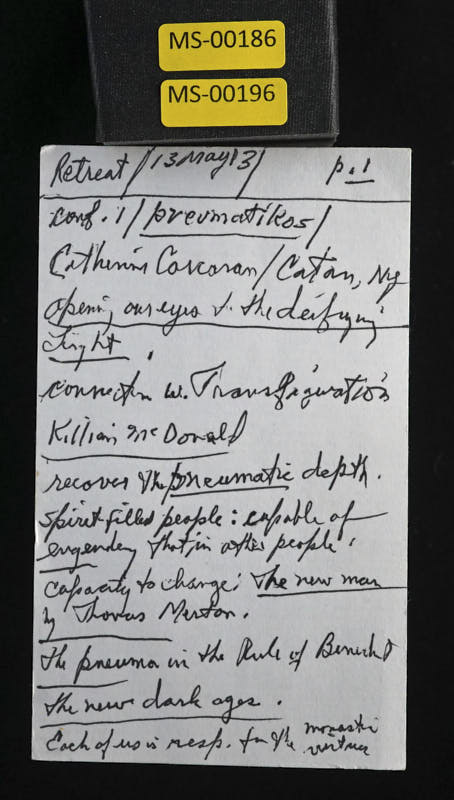




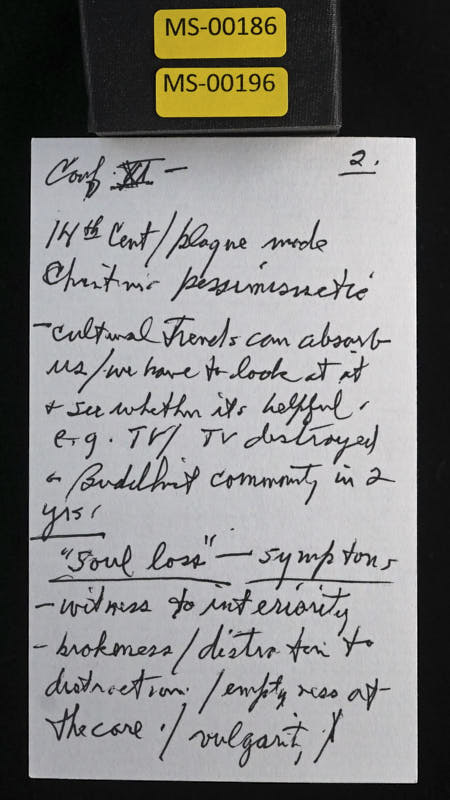

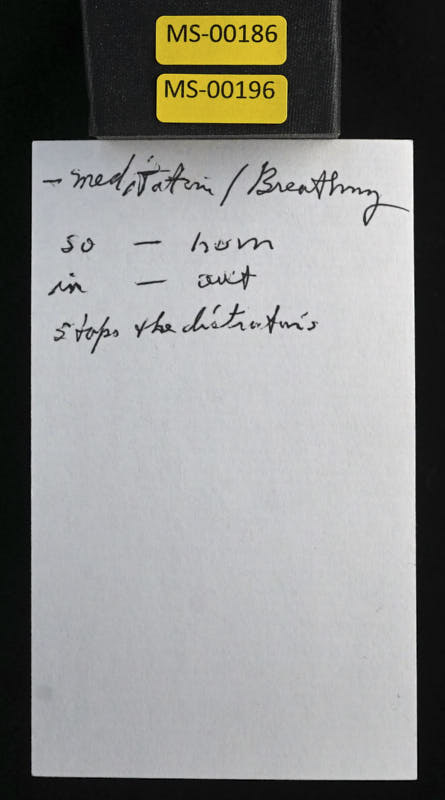
Side: A
Additional text: Retreat /13 May/ p.1, conf: 1/ pneumatillos, Catharin Corcoran/Carton, NY, opening our eyes & the clarifying light, connection w. Transfiguration, Killian McDonald, recover the pneumatic depth, Spirit filled people capable of energizing the spirit in other people, Capacity to change: The new man by Thomas Merton, The pneuma in the Rule of Benedict, The new dark ages, Each of us is responsible for the monastic venture
Side: B
Additional text: - How do you nourish the pneumatic dimension? St. Seraphim of Sarov, Widen the heart/ Fr. Charles Dumont/Ed. of the Heart/ The Inner Work, Ego careful not to construct false/ how can you die to self, if you have no self? Coincisions of Benedict, Enlarge the heart to encompass the world. Reality whose center is everywhere.
Side: C
Additional text: Opening the heart to the clarifying lights.
Side: D
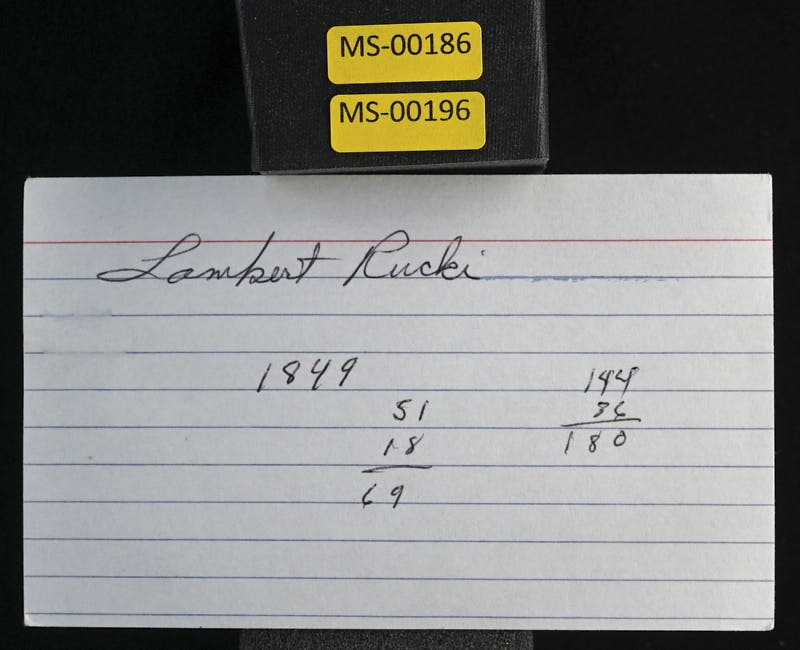
Speaker: Lambert Rucki
Additional text: 1849, 51, 18, 69, 144, 36, 180
Side: E
Additional text: Conf #7 Mor eve 13 May, How to become Spirit filled, linked with the cross bearer, To be immersed in the paschal mystery, The old man is rooted in willfulness, narcissism, Transformation and return to the Father, Going from image to likeness from glory to glory a sense of loving, Suffer can help to grow or we can choose bitterness, make me be non-conformist.
Side: F
Additional text: Experience of Russian monk giving 5 a book, Isaac of Syria, cross bearers remaining supple, nudging us to greater spirituality.
Side: G
Additional text: Conf XI/ 18 May 2013, Sr M. Donald Corcoran, Fr. Robert Dwyer Chaplain for Sr. M.O. Community, Wisdom of monastic, combine w. contemporary wisdom, How to handle the pressure of the monastic & get out in the world to preach Bounce etc., T. Mertons insights came from his prayer!, We should be aware of whats going on/ Be discerning!/ Death of Tekla de Chudis
Side: H
Additional text: Conf XII, 14th Cent/ plague mode Christian pessimistic, Cultural trends can absorb us/ we have to look at it & see whether its helpful e.g./ TV/ TV destroyed a Buddhist community in 2 yrs, Soul loss symptoms, Witness to interiority, Brokenness/ distraction for distraction!, Emptiness at the core/ vulgarity.
Side: I
Additional text: Conf XI, Telling the animals about the incarnation, Re-examine aim of monastic life, Rocks of Christ, New Life, New Zeal, Final Prayer; May the Lord Jesus\u2026, Silence not a refuge of isolation grand for interiority.
Side: J
Additional text: - Meditation/Breathing, so born, in exit, Stops the distractions.
@AI-Vision_v003
Well, we welcome Sister Arnold with us for this retreat and thank her for being here. And we'll begin by singing the hymn to the Holy Spirit. Peace. Oh, come and create the spirit of God. And obey within all our souls to the Lord and to the Lord. Son of God, thy grace, stand at me to the feeling of the heart which thou hast seen. O gift of thy voice, I thy name. It is comfort to me, I pray. The heart of life, the heart of love, the souls anointing from.
[01:10]
I like to do every sensibly part, for for thy love in every heart. Are we clever and fresh, alone without discord, Those strength and courage evermore. Through the name we love the Father and earth, And though the Son of God we did stir, Sovereign above the extract.
[02:25]
of the video camera, the sisters at home pressured me to do this because they said, you go around the country giving retreats and we never hear you. So this time they wanted to capture it. This week is truly an auspicious time for retreat, the time between Ascension and Pentecost. because we can easily be with the disciples and Mary in the upper room, ready to receive the Holy Spirit. And that fits in very well with the theme that I have for the week, which is the Holy Spirit and monasticism today. It's a very great honor for me to be invited to give your retreat. Back in the 60s, when I was a young Benedictine sister in St. Paul, I was teaching high school, and I remember reading Jubilee magazine, and reading an article about Mount Savior. So Mount Savior's been part of my monastic consciousness for all of these years.
[03:31]
And in the Mishad, I remember when we studied American monasteries, I remember we also studied the history of Mount Savior. Early in the 70s, when I was doing graduate school at Fordham University, I went to the Paraclete bookstore in New York City, which I'm sure a lot of you know, and I saw a German, well, I saw like a German priest speaking to the clerk, and I had a guest that it was Father Damasus, and I went up and introduced myself. So I had that opportunity to meet Father Damasus. I usually pray for inspiration when I'm preparing a retreat so a couple weeks ago I started praying to the Holy Spirit see what might come up the first thing that came up to my consciousness was the word giants and I thought well I'm not going to call you people giants but maybe it means that I'm challenging you to be giants to be people so spirit filled that you could be hidden giants men of the spirit you know early desert fathers
[04:49]
were described as nematikos, full of the spirit, or nematophore, which means a bearer of the spirit. And I think that's a very important ideal for us in monasteries today to recover that ideal of being a nematophore or a nematikos. I kept thinking about that word giants, and then three weeks or so ago, brought a sister from Montserrat in Spain here to see Mount Xavier. And as we were driving up the hill, somebody spied the statue of St. Benedict carved out of the tree and said, look at that giant St. Benedict. So, yes, maybe that's what it's about. Well, I'm on to be at Mount Xavier. One reason is that my great-great-great-grandmother, when she came from Ireland, was in Caton, which is right over the hill here, maybe about three miles away, I think, before she married William J. Corcoran in Corning and moved on to Minnesota.
[05:59]
And they founded the village of Corcoran, which is 20 miles west of Minneapolis. But they were married by the priest from Susquehanna, Pennsylvania, which is seven miles south of where we are now. So I have a spooky feeling that it's payback time. I'm here for some reason. And Catherine Crawford, who lived in Caton and then moved on to Minnesota, you know, it's family history, big image in our family. Another time I walked into the Paraclete bookstore, and I was in a line of three or four people to pay the clerk. And I heard the clerk say to a customer, well, I grew up in Minnesota in Onamia. And I shouted from the back of the line, oh, I have cousins in Onamia. And it was Doug Gravel. And this is the interesting thing.
[07:01]
He says, well, I'm a Gravel. I said, you are? We must be cousins, we must be related. Well, not really, but we still claim ourselves as cousins. Catherine Crawford, her niece, Marguerite Meister, married at Gravel. And so Marguerite was Doug's aunt by marriage, and not directly related to us, but we claim each other. This conference this morning will perhaps be shorter than the other conferences I give this week. The title of this conference is Opening Our Eyes to the Deifying Light. You know, that's a famous phrase from the prologue to the Holy Rule. It's from Leonard Doyle's translation. There was a bit of a controversy a number of years ago when the RB80 was done and when Patrick Berry did his translation of the rule, they both differed in their translation from Leonard Doyle's.
[08:08]
They didn't say deifying light. R.B. A.D. says the light would come from God. I prefer deified light and I think that's more faithful to the translation because it implies the Eastern theology of grace that we truly become participators of the divine. We are transfigured persons and of course the transfiguration means a lot both to this community and to our community in Windsor at your patronal feast and Damasus Winston said one time that in a special way the transfiguration is a monastic feast because the monk is to be a transfigured person who lets that light of Christ shine out to the whole world. So interestingly, if you go to European cathedrals and you go to the side altars around the main altar, usually there are mysteries in the life of Christ. And when you get to the transfiguration, They always have a statue of St.
[09:09]
Benedict there, almost always. Interesting. Because the Benedictine tradition from the 11th century on had very great connection with the Feast of the Transfiguration. The abbot of, one of the abbots of Cluny, the last great abbot of Cluny, wrote the office for the Transfiguration. So there's this connection, and it should say deifying light. I really think that says the meaning very well. This past week I happened to pick up an older article that I had in my files, an article by Killian McDonald on the life of the spirit and monastic life, and it was written in 1947, so you can imagine how old it was. And what I noticed about it, it was an interesting and very valuable article, It would be interesting to see how Killian McDonald would change it nowadays because what it reflected was a Western theology of grace that were adopted about sonship and so forth, but nothing about participation, nothing about transfiguration, about the deified light changing us.
[10:22]
So I think it reflected the much younger, 66 years ago, the much younger Killian McDonald and you know If you know his writings, he wrote a couple books later in the 80s and 90s about the Holy Spirit incorporating insights from the Syriac fathers and so forth. So to open our eyes to the deified light, Olivier Clément, who you may know, some of his books have been translated into English, Orthodox theologian in France, who frequently spoke at Notre Dame in Paris, like for Lenten series and so forth, had an article back in 1979 in Cistercian Studies called The Holy Spirit in Monasticism Today. And I take from that article not only the theme for the whole week, but also the key theme that I'd like to present to you.
[11:26]
He says, the greatest challenge... for monasticism today is that it recovered not only its charismatic, but better to say its nomadic depth. That's the greatest challenge before monasticism today, that we can do wonderful things and build buildings and sponsor conferences and whatever, do well financially, whatever, but the most important thing is that we come become deep people in the Spirit, that we recover and nourish our pneumatic depth, our depth in the Holy Spirit, to become transfigured persons, as Father Danmusson said. The two Benedictine women in my life who have most influenced me, I'd say, were both people who, I would call nomadikos, I'm not sure that's the right gender in Greek, I don't know Greek, but anyhow, spirit-filled people, people with tremendous depth of prayer and holiness.
[12:34]
You know, they both suffered tremendously in their communities, but it's not simply the fact that they suffered, but how they suffered. They consciously were suffering with Christ. They were outstanding women of monastic holiness. And that's what it means to be a namata four, a bearer of the spirit, not simply just carrying the spirit, but capable of handing it over, capable of engendering that in other people and younger generations and so forth. My favorite quotation from the New Testament is John 737. On the last and greatest day of the festival, Jesus stood there and cried out, If any person thirsts, let that person come to me, and from that person's center will flow a fountain of living water. Now the commentaries in the footnotes say, you know, does he mean himself or does he mean the person who receives the Spirit?
[13:38]
But perhaps it's both, and that's what some of the best commentaries say. that person's center will flow a fountain of living water certainly the fountain is Christ but we all drink from that fountain and then that spirit overflows to others the gifts of the spirit and so forth so we have to work on the vessel of our heart what we receive we receive the Holy Spirit that capacity for spirit in us which can grow and enlarge as Saint Benedict says in the hold on to the Holy Rule. As we run the way of God's commandments, our hearts expand so that that capacity for the Spirit can grow and grow. As a matter of fact, it's never complete. Gregory of Nyssa says that even in heaven, you know, that what he calls a pectasis, that stretching into Christ, will continue. We don't reach a plateau in heaven and then just rest there, but we have a continually growing depth of the experience of God.
[14:47]
I teach spirituality to the deacons in the Syracuse Diocese, and one of my favorite definitions of spirituality that I share with them every year is from Richard Hauser, SJ, who teaches spirituality at Creighton. He simply defines spirituality as the transformation of my spirit by the spirit of Jesus Christ. The key word there is transformation. Transformation. In Greek, it would be metamorphosis. And by the way, there's a wonderful new book, well, it's maybe three years old now, via Orthodox theologian, on the transfiguration, both the history of the artistic representation and the theology, and it's titled Metamorphosis. Radical transformation by participation. So transformation, to become a pneumatic host, to become a new person in Christ, towards that ending prayer that we had at the liturgy this morning, to give up our old ways to gain newness of life.
[15:58]
I think as Galatians, the Jerusalem Bible says, all that matters is newness of life. Of course, remember the apostles after the Transfiguration wanted to build tents and settle down and, you know, they did, you know, not ready to change. But newness of life is that openness and that capacity continually to change and be transformed. To become a new person in Christ. One of the finest books of Merton, and it's maybe just because the time that i read it really influenced me is the new man by thomas merton which is an older book but it's basically just a collection of passages it's not even like an essay it's one paragraph after another which he reflects on themes from uh... the greek and latin fathers about what it means to be a new person in christ you probably know the book by christopher uh... on uh...
[17:06]
Sophia, which is the understanding of wisdom in Thomas Merton. And he has a footnote in which he says, Thomas Merton's new man has an absolutely astounding anthropology. And that's the way I felt when I read it when I was a junior sister in St. Paul. I was reading it when I was finishing college, and I'd be waiting on a corner for a bus, and I'd be reading The New Man by Thomas Merton, taking notes. And I'd go, wow, right out loud. So, to become this new person in Christ, we'll talk about that, and especially my concluding conference this week will be about what does it mean to be filled with the Spirit? What is the change that happens? How do we grow into that newness of life? Five years ago or so, I was at the American Benedictine Academy out in Yankton, South Dakota.
[18:08]
And the main speaker was Sister Kathleen Dignan, who is head of the spirituality program at Iona. And she was talking about Merton, but she had spent a week in Merton's hermitage before she came to Yankton. And she said one of the things she decided to do in the hermitage was to read the rule of Benedict, which she is an active apostolic religious. had heard about but never read. And she said she was absolutely struck by reading the rule of Benedict, and this is what she said. The rule of Benedict may be more important in our day than in the past. You have to ask yourself the question, was she right or was she wrong? I wish I had asked her, why do you say that? In fact, some of my friends have said, why don't you contact her now and ask her, why does she say that? Well, I think it's because she recognizes how important monastic life is and how important Benedictine wisdom is in living monastic life.
[19:14]
We live in very serious times, obviously, challenging times. I want to emphasize that I'm not apocalyptic, and I certainly am basically a Christian optimist in the Tiago sense. But I think we do live in a new dark aegis, And there's an amusing comment made by Freud, actually, in the correspondence he had with Jung. They were talking about, this was in the late 30s, they both had a sense of a war coming and they had dreams which were very significant, talking about dark clouds coming over the mountains and so forth. And so they're exchanging comments in their correspondence about this and Freud writes back to Jung and says, yes, it's enough to want you to see the reinstigation of some of the cultural stupidities of the past, such as monasticism.
[20:17]
Well, obviously, we don't agree with him, but why would he think of monasticism at all, you know? I think they realized there was such disorder in society that only order in society, order in persons, you know. a return to moral order and spiritual vision and living off those values could bring some sort of redemption to the world. So it's just interesting that Freud, despite the fact that he put down monasticism, saw the significance of monasticism. There's a scholar that teaches at Catholic U, Morris Berman, who is kind of a secularized Jew, who wrote a book about American culture and is very pessimistic. He sees a new dark ages. But what does he suggest? A new kind of monasticism. Now, what he sees as a new kind of monasticism, I think, is actually part of the problem because he said they should save cultural values such as the Enlightenment.
[21:25]
Well, I think the Enlightenment may have been a good part of the problem. But again, why does he think of monasticism in the context? And this, you know, we are holding that treasure, you know, in earth and vessels now, in each one of us, you know, responsible for the monastic future and for those values and not only just knowing about them and studying them, but living them and being a living conduit of the monastic spirit to future generations. Olivia Clement, I think, is absolutely right. I would agree with him, and I agree with him not simply because of study, but out of my own experience, that the greatest challenge before monastic life today is that it recover its nomadic depth, that we again become nomadikos, spirit-filled people. So how do we nourish that nomadic depth?
[22:26]
How do we become more disposable to the spirit? One of my great saints from the monastic tradition is from the Russian Orthodox tradition is Saint Seraphim of Serov, a hermit who lived out in the woods near the river Serov, Serovka River. Very spirit-filled person, a healer and counselor and so forth. And if you don't know about Saint Seraphim of Serov, I encourage you to read the report about St. Seraphim written by one of his disciples. It's in a treasury of Russian spirituality. I'm sure you have it here in the library. But St. Seraphim always said to his disciples, the key to the spiritual life is acquiring the Holy Spirit, just being disposable, being transfigured, transformed by the Holy Spirit. And that's what made him into a living fountain.
[23:28]
of healing and spiritual direction and so forth. Many people came to see him for spiritual counsel. Even a Tsar of Russia came to see him and resigned after seeing him and became a hermit himself. You see, I don't know if you've seen icons of Saint Seraphim, but he's often pictured with a bear. Out in the woods, he had a pet bear. We have lots of bears, I'm sure you have them too, but we have them, because we have a big forest right behind us, and they've already knocked out our honey, our bees this year, and so the fellow who was shearing the honey with us took them, set them up another place on another farm. Anyhow, Seraphim had this pet bear, and a sister came out to see him one time, and there was Seraphim sitting on a fallen tree, and a bear sitting next to him, and she was sharing a sandwich with him.
[24:30]
And she got frightened, and he said, don't worry, come on over, sit down. On the other side, they all three shared the sandwich. And he says, but you may not tell anyone about this for the next 20 years. So she forgot all about it, didn't tell anybody. She was walking down the corridor in the convent one day. She looked into a room where her sister was painting Nikons. She painted... seraphim, was painting seraphim, and the sister said, oh, you should put the bear in. And she thought, oh, my God, it finally came out of my mouth. And she realized it was 20 years afterwards. He's an example and an unusual example, perhaps, but the Eastern Church, I think, has more of a sense of this. You know, Father Ephraim, who's founded many Greek monasteries in the last 20, 25 years in the United States, Obviously a spirit-filled person from whom the spirit flowed out has attracted many people to monastic life.
[25:34]
If you go down on 17 towards New York City, in the famous Rasto Diner, if you go over the hill to the south, you'll get to St. Nectarius Monastery, which is founded by Ephraim. And somebody gave them a golf course, and I got there soon after they were there. It's already flourishing with five or six vocations. So how do we open and widen the heart? That's the central question. If we are to deepen ourselves as pneumatic persons, how do we open and widen the heart? Years ago in monastic studies, I'm sure you have that in the library, and I didn't look up the issue number, but there's an article by Father Charles Dumont, a famous Cistercian, on education of the heart, that this is what monastic formation should really be about, is the education of the heart.
[26:37]
And that doesn't mean the heart in the typical American, you know, sentimental sense, superficial heart. It's the heart in the biblical sense, the leg. the spiritual center of the person, which may be in as much mind as heart. You know, in Chinese, the word heart is heart-mind, and mind is mind-heart, you know? And so they keep them together, whereas we in the West have divided heart and mind. And the Hesychastic tradition says that one of the things that happens in incessant prayer is that the mind is brought into the heart and those faculties are united. So St. Benedict says, as we run the way of God's commandments, our hearts expand. Our hearts expand. And we have overflowing love.
[27:37]
There's a term in the Desert Father stories. I was helping a poly sister once who walked was trying to put some of the Desert Father material into English, and so she did know English that well, but she knew Greek, so she was reading me, Rachel, and then talking to me, and we'd come up with a term. And the term was in Greek, which is, interestingly, it means inner work, that the Desert Fathers and Mothers talked about the inner work in the soul, you know. Evagorius talks about the struggle with the passions, okay. Inner work, interestingly, is passive, so it's really inviting the Spirit of God to work deeply in us, the transfiguration of the depth of our personality. There's lots of writing nowadays about the difference between the superficial self and the deep self, or a false self and the true self, or Merton talked a lot about finding our true identity in God.
[28:40]
Merton's book, James Finley's book, Merton's Palace of Nowhere. Everybody should read that. It's a summary of the spiritual theology of Thomas Merton. That's over 40 years old now, but it's a good summary of Merton's spiritual theology. It's all about the difference between the superficial self and the deep self. For a long time, let me say, I talked about that and would build talks on it and so forth. I moved away from that because I find what happens is that people identify the ego with the false self. And that's wrong. There's lots of good things about the ego. As a matter of fact, unless we have an ego, we can't go deeper. Because what happens, you know, if you don't have a strong ego, the ego can be overwhelmed. And the dark side of, you know, the shadow and so forth can overwhelm the ego. It won't go into the psychology. But,
[29:42]
In a recent book by Richard Rohr, which just came out this year, I believe, called Immortal Diamond, which is on the deep self, he explicitly says the ego is the false self. Well, I'm thinking of writing to him and saying, you've got to nuance that a bit. One time when Merton was director, novice master at Gethsemane, the Formation Committee met and called him in. There was a lot of criticism. in the community of what he was doing in the leadership program. And so one of the monks vigorously said to Merton, you've got to teach these young guys to die to self. And Merton's answer was very, very good. He said, how can they die to self if they don't have a self to die to? That we have to establish the people first. Nowadays people come with a great deal of brokenness and so sometimes we have to help people mend, you know, and strengthen their ego.
[30:43]
Then you can make the deeper descent into deeper parts of the self. So there's a lot of writing about the superficial self, the deep self. Thomas Keating talks about the false self system. There's a lot of value in it, but I just want to give a caution that it doesn't mean the ego is false. I used to wonder why when I give talks to lay people up in Syracuse, for example, some of the older leaders would say, oh, we don't really like that. They had a chancenist mentality that they were trying to get rid of, you know, and so they felt they were inherently evil. And to say that the ego is the false self just did not, they were trying to push themselves away from them. So, for example, Merton, Richard Rohr, Thomas Keating, James Martin, the editor of American Magazine, have all made this very important themes in their spiritual anthropology, their understanding of the person.
[31:51]
I just think it needs to be nuanced more in terms of psychology. There's an event reported by Gregory the Great in The Life of Benedict, which I think we Benedictines don't make enough of, And that's the cosmic mission of St. Benedict in the dialogues. You know, St. Gregory the Great says that towards the end of his life, Benedict went into a tower to pray. And a tower is a symbol, psychologically, in Jungian psychology, of interiority, depth, you know, solitude, going inward. He went into a tower to pray. And St. Gregory the Great, I'll paraphrase here, says, And there he saw the whole world gathered before him in a ray or sphere of light. I think that I've only seen that typified in art, not that I've been to every Benedictine monastery of men and women in the United States, but two that I can think of, Glastonbury, which is right behind their altar, and the Benedictine sisters in Mount Angel, Orga.
[33:04]
Maybe you know of other places. Maybe you've seen other artistic depictions of it. But it's very interesting, the commentary that Gregory the Great makes about that. He says, it was not that the world grew small, but that his heart was enlarged. It was not that the world grew small, but that his heart was enlarged. And I think that's the key thing to remember. That as we enlarge our heart, If you go to Schuyler, Nebraska, where the Benedictine missionary monks have, how many have been there? A few people? Nobody's been there? $15 million retreat house. It's an immense, beautiful place. It was donated by two benefactors. They don't admit that very often, but $7 million from two benefactors, two ladies. At any rate, there's a huge statue of St.
[34:04]
Benedict out by a reflecting pond. And one of the monks was showing it to me. Here's Benedict, you know, more than life-size with his hands out like this. And I thought, so different from the usual statue of St. Benedict, you know, with his hood up and, you know, finger on his legs and rather austere-looking, you know. This is so, and I said to the monk, that must have been done by an Italian. Yeah. And, you know, it's this opening of the heart and widening of the vessel of our heart, that fullness of the spirit that gives us that sense of universality with all of mankind and all of creation. This is what that experience. And we can approximate that, I think. You know, Evagrius says, the monk is separated from all but united to all, a paradox.
[35:06]
In fact, we have to separate first in order to concentrate, but then there's this wide opening. There's a phrase from medieval theology, God is that reality whose center is everywhere and whose circumference is nowhere. It's a perfect definition of God. God is that reality whose center is everywhere and whose circumference is nowhere. And so that if we go to the center of our being, the center of our heart, that we, in some sense, discover God there. Because God is in every center. And so when our center and God's center cohere, and I'd be careful in my language, because this is a deep theological question, when our center and God's center cohere, then we experience that same reality of God, that opening to totality, that universality. St. John of the Cross said in the living flame of love, my soul was wounded in its deepest center.
[36:15]
So what is the center of our being? It's the deepest center of our soul. Interestingly, Meister Eckhart, in his sermon for St. Benedict's Day, maybe not accidental, says that nowhere is God so really God as in the human soul. Now, that's bad theology, actually, you know, because God is no more real one place than another. And yet, he's making a point that perhaps the privilege place of access to God is that depth within, interiority, depth, inwardness. Yes, we can discover God in nature, other persons. We certainly have the preeminence of God in Scripture. and also in sacrament, but he's in a special way pointing to that place in us where we find the divine within. St.
[37:16]
Benedict's Cosmic Vision. There's an article, I think, that appeared back in the 70s by Hermig Well of Licochet, he was, and he probably is deceased now, I'm not sure, or retired. And he relates Benedict's cosmic vision to that phrase in the prologue, we must open our eyes to the divine light. Because he says that's what happened to Benedict in the tower, that his eyes were opened to the divine light, and he saw all reality in the light of God. Just end with a brief prayer. Come Holy Spirit, fill the hearts of your faithful. Then kindle in us the fire of your love. Send forth your spirit and we shall be created. And you shall be created.
[38:19]
I will be seeing people individually if they'd like to have a chat. And so, Papa Joseph Gabriel and I will put up a chart and people can just... So I just want to come.
[38:34]
@Transcribed_UNK
@Text_v005
@Score_93.66