You are currently logged-out. You can log-in or create an account to save favorites and more. more info
Silent Harmony: Bridging Faiths through Meditation
AI Suggested Keywords:
Christian-Buddhist Dialog
The talk discusses the Christian-Buddhist dialogue, highlighting a conference held at a Benedictine monastery with representatives from various religious traditions, focusing on contemplative practices and spiritual communion across denominations. It explores the nature of God and the universe, the reconciliation of different religious perspectives, and significant theological questions about the uniqueness of the divine, evil, theism versus pantheism, and the relationship between humanity and the ultimate reality, drawing comparisons between Christian and Buddhist concepts of God, reality, and spiritual practice.
Referenced Works:
- "Zen Catholicism" by Don Albert Graham: Discusses the integration of Zen philosophy into Catholicism, relevant for exploring contemplative practices across faiths.
- "The End of Religion" by Don Albert Graham: Examines themes of universal spirituality beyond institutionalized religions, pertinent to the discussion on ecumenical possibilities.
- "Christian Buddhist Conversations" by Don Albert Graham: Provides insights into interfaith dialogues, reflected in the conference discussions.
- "The Supreme Identity" by Alan Watts: Explores the relationship between Eastern and Western spiritual concepts, relevant to the dialogue on religious intersections.
- "Behold the Spirit" by Alan Watts: Investigates the relationship between Christianity and Eastern spirituality, aligning with the topics discussed during the talk.
- "The Founder of Christianity" by C. H. Dodd: Offers insight into the historical development of Christian theology, relevant to discussions about the perception of divine uniqueness.
- "The Cloud of Unknowing" (Anonymous): A foundational text in Christian mysticism that aligns with the Buddhist approach to realizing ultimate reality beyond conception.
- The works of Nagarjuna: Central to Buddhist philosophy, highlighting the concept of "Sunyata" or voidness, discussed as a parallel to Christian apophatic theology.
AI Suggested Title: Spiritual Harmony: Christianity Meets Buddhism

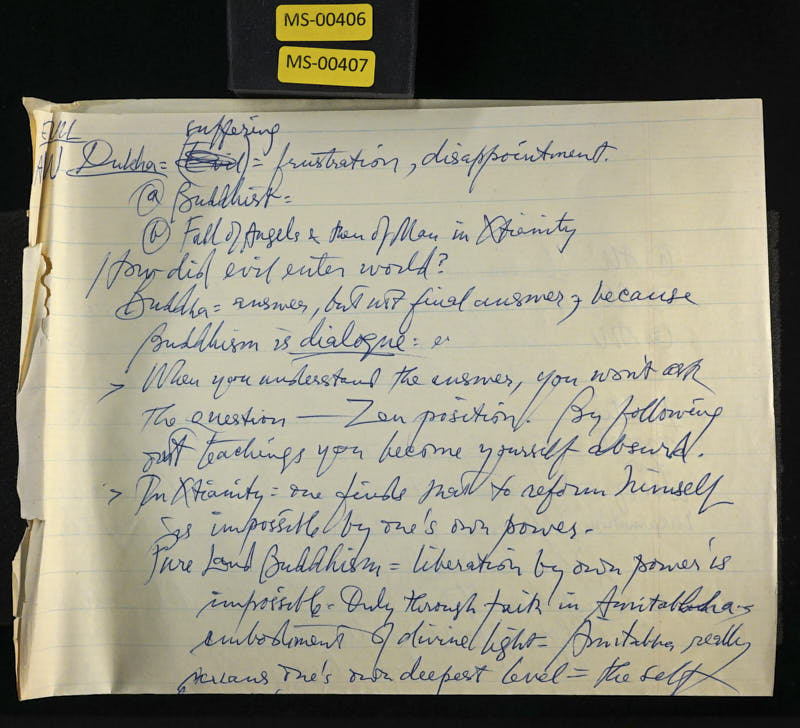




Side: I
Speaker: Alan Watts
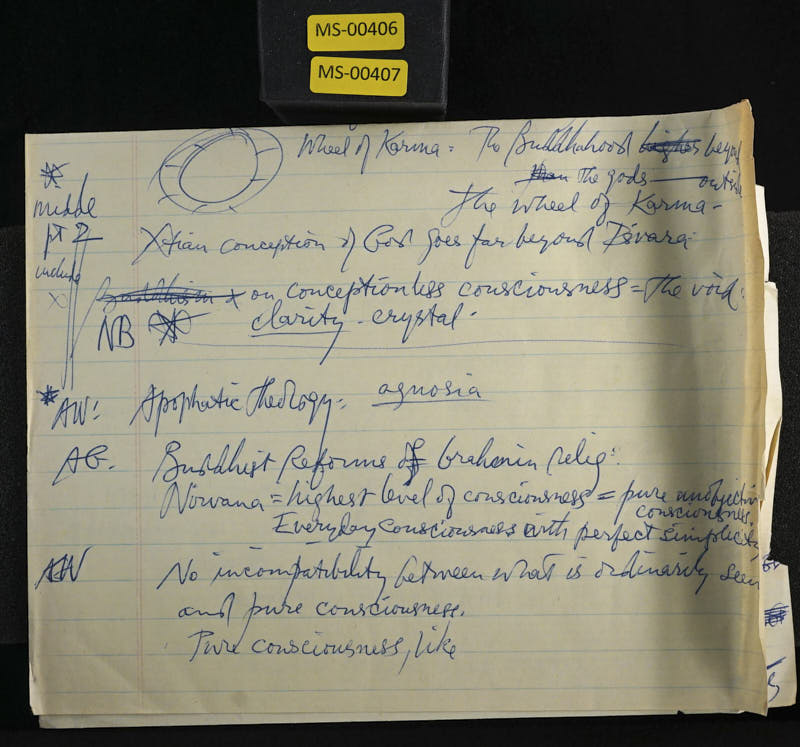
Additional text: Spiritual disciplines necessary to become the kind of people who are able to act morally. Not a question of right thinking. Not so much a matter of ideas, of practice.
Side: 2
Speaker: Alan Watts
Additional text: Wheel of Karma. The Buddhahood begins when the wheel of Karma. Apophatic Theology - agnosia.
Side: 3
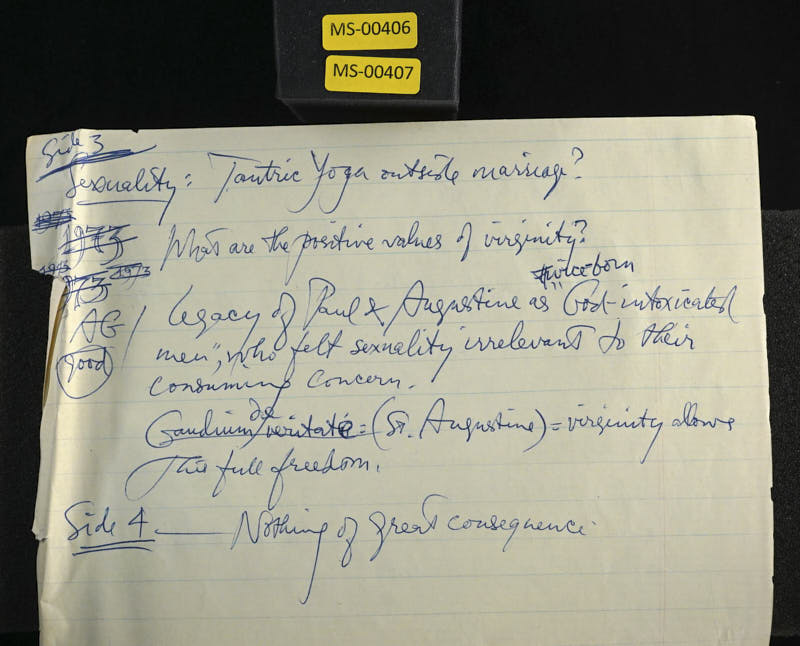
Additional text: Sexuality. Tantric Yoga outside marriage? Positive values of virginity?
Side: 4
Additional text: Nothing of great consequence.
Side: 5
Speaker: Alan Watts
Additional text: Suffering - frustration, disappointment. Buddhist response, but final answer is dialogue.
Location: Sausalito, CA
Additional text: Musical Engineering Associates
@AI-Vision_v003
Well, now, may I begin by introducing John Albert Graham of the Order of St. Benedict. I should say that he's been a friend of mine for some years, and he's the author of some important books, notably Zen, Catholicism, and The End of Religion. And what was that other one called Christian Buddhist? Conversations. Conversations with Christian Buddhist. He was for some time the prior of the Benedictine Priory of Portsmouth, Rhode Island, and we've corresponded, I suppose, since about 1952. I should explain to those of you who don't know something about the Order of St. Benedict, first of all. because it's rather important. It is the oldest monastic order in Christendom, founded by St.
[01:09]
Benedict of Nursia in about, what was it, 525 AD? About 10, I think, yes. And for that reason, it has a kind of aristocracy to it. When you're the oldest, you don't need to push yourself And so Benedictines are apt to be very cool. They're also very civilized. Their work consists in prayer, scholarship, and manual work, largely. And they are really responsible for saving the culture of the Greco-Roman world through the Dark Ages and passing it on to European civilization. They tend to live in mountains. Many of their foundations are called Mount or Monte something or other.
[02:10]
And they are also great liturgists. That is to say, specialists in the beauty of worship. One of the great centers of the liturgical movement is their monastery at Maria Lach in Germany. So I regard them as very superior people and as arbiters of taste in the aesthetics and theology of Christendom. And so it was that just a week ago the Benedictines of a monastery in the Finger Lake district of New York called Mount Saviour call together a very important conference they invited representatives of all the major religions to stay for five days with them and try to feel out the possibilities of an ecumenicity larger than Christianity
[03:32]
Represented there were the Hindus by Swami Sajidananda. And there was another Swami whose name I never learned to pronounce. It was something like Ventakasananda. There was a Zen Buddhist Roshi, Sasaki Roshi from Los Angeles, There was Baba Ramdas, the former Dick Alpert. There was the Archimandrite Callistos Ware, Eastern Orthodox representative, professor from Oxford University. There was Peer Vilayat Khan, leading Sufi, Islamic. There was Father Raimundo Panicar, professor at UC Santa Barbara, who is a Hindu Catholic priest, an incredible scholar.
[04:47]
There was Brother David of the monastery, who is a very profound theologian. There was a Father Francis Martin, who is a Catholic of the Byzantine right who belongs to an order of hermits in Canada there was a Mrs. Small a Negro lady who was a Southern Baptist and many other monks and nuns from various orders there were four Trappists and uh goodness only knows, passionists, etc., etc., about 150 people in all. And what we found out was this, that we could all do together whatever it was that was our worship.
[05:58]
In other words, we had the most amazing collective masses. Celebrations of the Eucharist. Not all were actually Eucharistic in form. Some were simply devotional services, one of which was conducted by Swami Sajidananda. Extremely beautiful. One of which was conducted by the Byzantine priest, which was way, way out. I mean, it was just gorgeous. And when they got to the kiss of peace before the communion, the place went wild. Everybody embraced everybody, and it wasn't just a kind of formal thing, it was very, very heartfelt. And then we had an ecumenical mass conducted by Professor Panikar, which was extremely beautiful. I didn't realize he was a priest until he got to the altar, and I suddenly saw he knew exactly what he was doing. And then I conducted a contemplative service where
[07:04]
We transcend words and their meaning. And so everything is done in Latin or Greek or ultra-slavonic so that the sound becomes more important than the meaning. But we got to the position where it was perfectly clear that we were all willing to share in each other's practice. Meditation practice, worship practice, or whatever it was. For example, Joshu Sasaki's sessions in Zazen were attended by just about everybody. He started at 4.30 in the morning. And the swamis came, and the trappists came, and everybody really dug that silence. And Akimandrite Callistos gave early morning sessions in what's called the Jesus Prayer. the repetition of the name of Jesus.
[08:06]
And when you get going in that, that is a real yoga. And that was extremely interesting. He had a young man, before he started, give instructions in breathing, in pranayama. So we got to the point then, when it was perfectly clear that that at a certain level, at the level of contemplation, we were not going to dispute. Now, there's a saying from old times in the Catholic Church, lex orandi, lex credendi, which means, the law of worship is the law of belief. That how the Church conducts its worship what it does, and you see the Mass is really an action.
[09:07]
An Eastern Orthodox Christian will speak of making or doing the Mass. He will not speak of attending Mass or hearing Mass. He will say, to do the liturgy. And the word Piyin is the word from which we get poetry. And poetry is therefore doing. It is creation. And so the same word, to make or do the liturgy, was what in fact we were all doing. And from this doing, doing is primary, comes the theory later, the belief. So what is in effect going on? As I see it, this is going on. There is a coming together because of the nature of intercommunication between all peoples of the world.
[10:14]
There is a coming together of all those in every religious tradition who are interested in the contemplative life, who are interested in mysticism, who are interested in the fundamental experience of union with God by whatever name called. And these people, because they... transcend talk and go into silence together are not disposed to argue because they know that that which is experienced in the state of mental silence is beyond discussion and therefore there is coming about and no one can stop it a fellowship crossing all denominational borders of those who are interested in this way of life. It is something, again, to use the old Latin terms, which is occurring de facto, as distinct from de jure. De facto means, like fait accompli, it is something being done.
[11:16]
De jure means it's legalized. It's ratified. It's authorized. Somebody, some bishop, some pope, somebody has put the rubber stamp on and said, official, imprimatur. Me loves that. So... That thought of official approval is becoming obsolete. Everybody realizes we can go ahead and do the thing and not worry about getting out everybody into a very ponderous council to discuss things, because as soon as people do that, they become like attorneys trying to decide a legal issue. And you know what happens if you want to have an amicable divorce, but you go and get lawyers. The lawyers create as much squabble as possible. and the thing therefore becomes incredibly difficult, and everybody loses their tempers, because the lawyer thinks up all kinds of contingencies that might happen and that have to be guarded against, and writes them all down in this very complex legal language, which in a way introduces all kinds of barriers and obstacles.
[12:20]
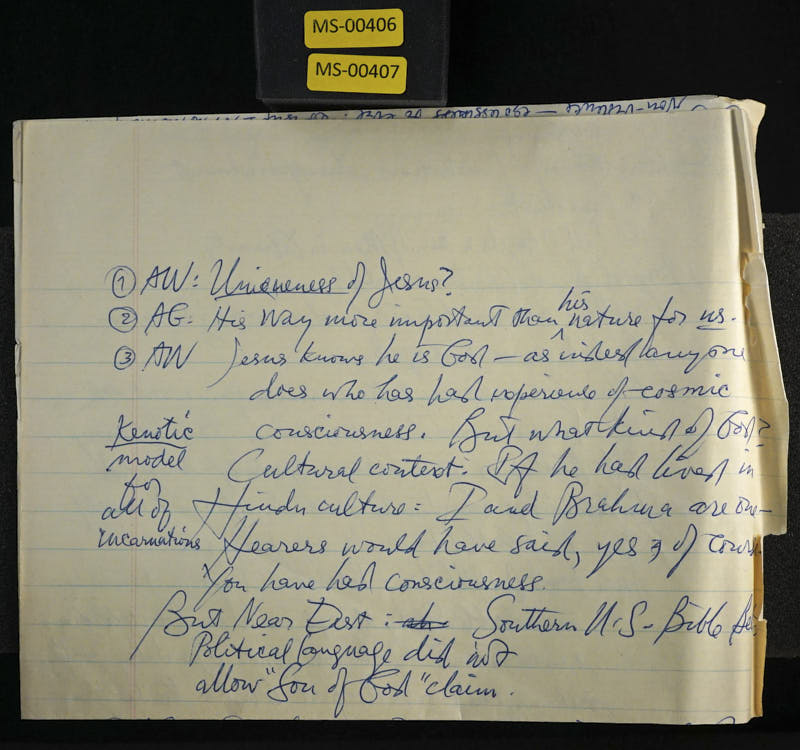
But at the end of the conference, we did sit down and say, yes, This is fine so far as our spiritual communion is concerned. We do think, however, that we ought to settle certain points in a more intellectual way. But only after we have had this communion together on the non-verbal level. And these were the following points. There were four of them. You may think of more. The first was, in what way are Christians committed to the uniqueness of Jesus Christ? That really has to be discussed. I mean, is Jesus Christ the only avatar, the only incarnation of God the Son? Or could there be others?
[13:26]
The second question was, What view are we going to take about the origination and reality of evil? Is there evil in the world in the sense of deliberate maliciousness as traditional Christianity would aver or is there only ignorance as Buddhists would maintain? The third question was the question of theism and pantheism. are we going to have to come to some agreement as to the idea of God? That's a very thorny and a very fascinating question which we can probably go into during this seminar. And the fourth, which we thought we might have to have some delay about,
[14:32]
is the thorny question of the attitude of religion to sex. Because that, of course, has become critical in the Catholic Church today where many priests are agitating to be married and where sisters are going about in civilian clothes looking extremely attractive. and for which I've slightly reproved them, by saying, don't look like a flower when you don't want a bee. So, here was the position of this conference. And I think it's a really historical event. You know, at some point in the study of history, Arnold Toynbee made this remark.
[15:35]
When 200 years hence, people look back on the 20th century, what they will find remarkable and significant about it will not be its wars, will not be its technological achievements. What they will remember as important about the 20th century was the meeting of Christianity and Buddhism. So now, I would like to start this off by going to the first question in this way. I had a long talk with the Greek Orthodox Archimandrite, who was a bit stand-upish. You know those Greek Orthodox can be very, very conservative. But he was very intelligent, very sociable and he was insisting really on he couldn't see his religion except in terms of the complete supremacy of Jesus Christ as the one and only incarnation of God
[16:58]
So I said, you know, it's a funny thing, but I prefer your exclusiveness to the exclusiveness of the Protestant fundamentalists. I don't know what it is, but it has a nicer atmosphere. But I think, could we get at the thing in this way? Let's suppose we make a translation. What does your belief in the uniqueness of Christ do to your state of consciousness? What state of consciousness does that devotion put you into? If you could come up with that and say what it does at that level, then we Buddhists and Hindus and so on could come out and talk about what our way does to our consciousness. And we might discover that it does the same thing. Because if we can discuss these things at the level of what it does to our heads, also for that matter to our bodies, we might understand each other better than talking to each other in terms of symbols and beliefs about
[18:33]
miraculous events. Now, would you care to comment on this problem? Well, by way of prefix, Alan, I would like to thank you for your introductory remarks about myself and about the Benedictine order. Of course, no individual Benedictine can, as it were, cash in on the great tradition. He has to stand on his own feet. But he has, I suppose, benefited and been limited to some extent by that tradition and enriched by it. And if he is sensible and has had a happy life, as has happened in my case, then he is very grateful for that tradition and for the situation in which he finds himself
[19:34]
I would also like to say that I don't know how to speak to or about each other, Alan, whether I should call you Professor Watts or whatever. You just call me Alan. But perhaps Alan will do. That towards that coming together of the world religion, Alan himself has been making... and is still making, and I hope will be making for many years, a very distinguished contribution. He has, in my view, an extraordinary intuitive mind, and as we all know, a very accomplished articulateness. One of his books that I read long before we ever met, The Supreme Identity, I still think is really a major theological work.
[20:35]
And also a new edition of Behold the Spirit, I would commend to anyone who is interested in the relation between Christianity and Eastern religions. I'm also, I may say, personally, particularly grateful to Alan for one encounter with another party, not here, which has its amusing aspect, but which has been a very rewarding influence in my own life. Towards the end of the 1950s, I received a letter from Harvard from somebody who was very interested in Eastern religions, who had become a Roman Catholic, and he was wanting to hold on to this distinctive doctrine of the Incarnation, but was confused about it, and that Mr. Alan Watts had advised him to come and talk with me.
[21:42]
So, of course, I was interested in inviting him down, and I thought I was going to see some learned professor, some divine from the Divinity School, instead of which it was a youngster of 19 who was quite confused and troubled. And then I started there a relationship which has continued, a fruitful relationship, for which I've got one of the very rewarding influences in one's life. Well now, Alan, about the particular question of the uniqueness of Christ, I think you yourself in your writings have put your finger on the emphatic point in saying that what we should be concerned about is not so much religion about Jesus, but the religion of Jesus, to discover what that is and to, so far as possible, realize it in ourselves.
[22:58]
I think the institutional church is in great difficulties these days because it has a tremendous tradition behind it which it wants to uphold. And the official spokesmen of the church, of course, are concerned with what has been defined in various councils, what has been said by great figures, saints and fathers of the past, and doesn't want to define itself in a position of undermining or brushing aside all that. However, Everyone, including those who assembled in those councils, was speaking merely to their own generation and according to the light they had and the expertise and the information available to them at that time. Also, in some cases, they were defending vested interests, I think,
[24:06]
I think if you look into church history at those controversies at the early councils, the Greek church, there was a good deal of rivalry between the seat of Constantinople and Alexandria and Antioch, with which these theological discussions got somewhat confused. I think that could be said, Alan. About the question of consciousness, I don't know how one can articulate in words one's state of consciousness. And that would be the difficulty for me in pursuing, precisely in those terms, that discussion. on those lines, or in that terminology. But let me say in parenthesis, and I know each other well enough, I think to be able to say that we are in basic agreement that the differences that will emerge will be, and the most interesting differences, are not radical confrontations, but little points of emphasis, perhaps, here and there.
[25:23]
I think that we have to, the church has to be much more loose in its structure, that its authoritative figures have to learn the great art of saying nothing, of being silent and letting the discussion proceed. at lower levels, and from the point of view of learning and knowledge, perhaps at more competent levels, because those with relatively few exceptions, and certainly in the Roman Church, I would say, those who speak as authoritative figures are administrators and businessmen and devoted men of God according to their lights. But they haven't had the opportunity to, many of them, to study these matters in the way they need to be studied. They don't have the light, perhaps, that is required to get at the root of the matter.
[26:30]
Well, in the case of Jesus, our Lord, I would say that the great... work before Christians today is not rigorously to defend his uniqueness as an avatar but to aim at understanding as far as possible what he did and what he said and the unique level of God consciousness that existed in the human mind of Jesus That is a perfectly orthodox way of putting it, I think. And the stress of the church and its prayers is very much what is called in the Hindu tradition the bhakti level of adoration, worship, and prayer.
[27:33]
And let it be remembered that according to the Patanjali, the great yoga expert, There are three ways, the bhakti level, the karma level of action, and the jnana level of gnosis, all, any one of which, can bring about complete realization of the divine. So that it's not a question of choosing one rather than the other, but a question of what is one's core, what is one's own tendrement. which one is strong so to sum up the moment what I would say I would say that I think we should strive to understand the level of God consciousness and God dedication that existed in the human mind Jesus Christ and to try so far as we can in our own context in our own situation to reproduce that
[28:37]
to realize it. Well now, are we going to have to take into full account a curious and rather neglected aspect of old Christian doctrine which is called the doctrine of kenosis. Roughly this means that as an incarnation of God, Jesus and such other avatars, if you want to admit that there are others, as say Sri Ramana Maharshi, Sri Ramakrishna, the Buddha, etc., etc., that insofar as they are human beings, they do not possess literal omniscience and omnipotence. and therefore, for example, that Jesus would not have been able to answer questions about the atomic theory of physics or about distant galaxies as known to us today.
[29:52]
We know that Jesus did not know, you see, that Moses didn't write the whole of the Pentateuch. He couldn't have written a book which describes his own death very well. So... There's a text in St. Paul of extraordinary importance in the Epistle to the Philippians, which translated from the Greek, not quite in accordance with what you've read in the King James or Revised Version of the Bibles, it goes like this. Let this state of consciousness be in you, which was also in Christ Jesus, who, being in the form of God, thought not identity with God a thing to be grasped, but emptied himself, this is the kenosis, meaning kenosis is self-emptying, and made himself of no reputation, and was found in fashion as a man, and became obedient to death. So you see that the idea is that in the process of God becoming man, there is an abandonment
[31:07]
of the divine prerogatives so as to become truly man because that means to accept certain limitations the possibility of pain the possibility of death and not really knowing everything so that has been fundamental really to the idea of the incarnation and if one doesn't agree with that you put yourself in the heretical position which is called monophysite which means that monophysis means of one nature, that Jesus was divine only and only human, not really. There's another called docetism, which is very close to it, which is to seem to be human. But the Church always wanted to insist that the two natures in Christ were complete, true God and true man, which was very sensible. So if that be the case, then, Jesus finds himself in a very curious cultural context.
[32:17]
Here is a human being who knows that he is God, as in fact anyone does who has had a profound experience of cosmic consciousness. But then the question arises, what kind of God are you? because there are many options in the idea of God. If Jesus had lived in India and had said to everybody that he who has seen me has seen whatever the equivalent of the father would be, the Brahma, everybody would have said, naturally, of course. We all know that everybody is a manifestation of the Brahma. But, of course, not all of us realize it. But then, perhaps you, Jesus, are one who is realized. You are a Jivan Mukta, one liberated in the flesh.
[33:21]
And so, there would have been no schmuzzle whatsoever about this claim. If he had lived in China and found language to express his experience, he would have had to go to Taoism and discovered that he was in complete... a completely harmonious expression of the Tao of the course of the universe. That would have been the language available to him. But here in Palestine, in his particular cultural context, the language available to talk about God was couched in an imagery that seems to me to have been based on the political structures of the ancient Near Eastern world the pharaohs of Egypt and the cyruses of Persia. That is to say, in terms of a monarchical conception of the government of the inverse. And therefore, for anybody in that cultural context to announce that he was an incarnation or son of God, because son of means of the nature of, sounded very, very subversive, blasphemous and impertinent.
[34:38]
The same predicament would face somebody today who lived, say, in the Bible Belt in Arkansas, who had such an interior experience because these experiences of cosmic consciousness can hit us by chance. And his only religious language is the language of the King James Bible. How is he to say what has happened? Because that's the only language available. Well, he says, I'm Jesus Christ. Come back. Well, they say, you? We know you. You're just art dokes. We've known you. You know, like they said to Jesus. Yeah, this Galilean, we know his brothers and sisters and everything. He'd be, you know, just as a hometown boy. And so they say the same thing. So this art doke says, well, that's what they said about Jesus. So they say, you're crazy. And they put him in the asylum.
[35:45]
However, you see, too, say that that was Jesus's predicament, that he really had a... he was like a person talking into a sound system, which was the only sound system available, and it distorted his voice by the nature and structure of the system. And now the question is, is this theory admissible Can we, in other words, do it under the auspices of the whole canotic theory that in incarnating as man, the Godhead will always accept to a great extent the limitations of the language and the culture of the human being in which he, it or she or whatever is incarnate? Well, by way of some complimentary... both spellings of the word, remarks.
[36:58]
So that's what you've just been saying, Alan. In a recent book that's come out by Professor C.H. Dodd, the founder of Christianity, which is, I think, very much to be recommended. It's quite a simple book, but there is vast learning behind it. I had the opportunity of reviewing it at length, or appreciating it. And one thought I'll try to bring out there, which is apropos what we've just been hearing, is a development in the mind of Jesus himself. We are told by St. Luke that he grew in wisdom, stature. In other words, that he developed. in a human way, just the same as we ourselves develop.
[38:02]
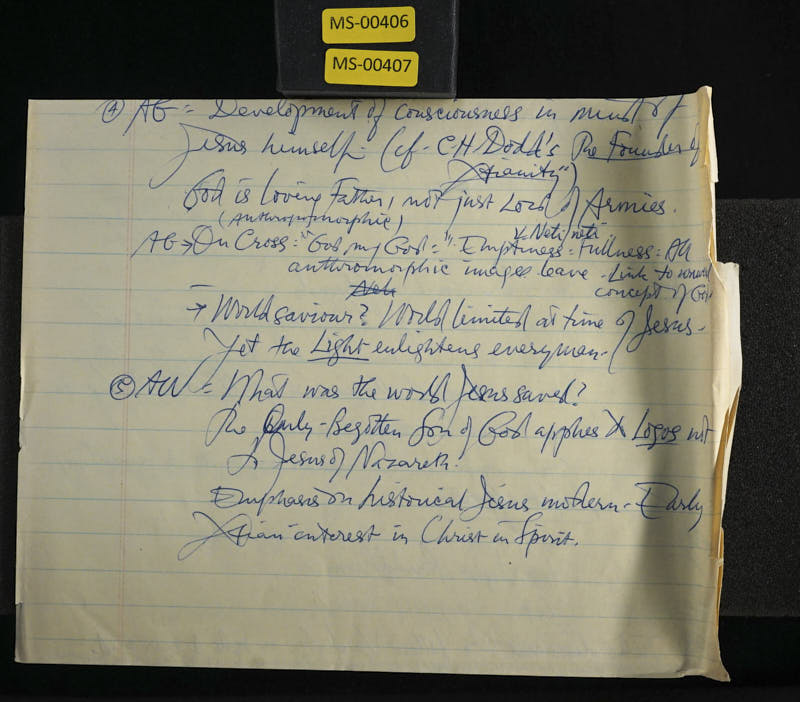
Now, he thought of God in his human mind and spoke of him in the highest level of the Old Testament theology that God was a loving Father. That had been discovered, worked out by the prophets. He was no longer the tribal Yahweh, God of the Mosaic situation, the God of armies, but he was a loving father. However, that is still in itself an anthropomorphic, that is to say, an expression based on inter-human relationships between children and their fathers. And as Archbishop Temples pointed out over many years ago, the image of a father is not necessarily attractive to everyone, particularly to young people.
[39:06]
But the mind of Jesus seems there under great pressure possibly to have developed. So that he is, in the Garden of Gethsemane, he is recorded as still using the phrase, Abba, Father, let this chalice pass from me. But on the cross, and I think this must have been a historic utterance, otherwise we would never have been handed down. He said, my God, it was my God who had deserted him, or who we felt had deserted him. Not God, but my God. his particular idea of God. And it might be, possibly, I have suggested, that the whole anthropomorphic tradition, Jewish thinking, left his mind and he was just left with the pure emptiness of the God experience, the emptiness which is also the fullness.
[40:18]
so that there is a link there with the neti, neti, the not this, not that of the Upanishads or the sunyata of Buddhism, possibly. Another relevant point is to be kept in mind. St. John speaks, and the New Testament tells us, of Jesus being the savior of the world. It has to be remembered, however, What was meant by the world in those days? The world, for the writers of the New Testament, was pretty well the Roman Empire. What bordered on the Mediterranean and the lands just touching on those, hints of deeper, more extended Africa and, of course, Europe, but not much idea of anything beyond the Atlantic. hardly any knowledge, little knowledge of India, but very little knowledge of its religion.
[41:21]
So what do we know when the New Testament writers speak of Jesus as the saviour of the world? Are we to interpret that as meaning that they thought the world as we think it? But even so, even whatever they thought about it, I see no difficulty there because if we go back again to the Johannine theology the word of God enlightens every man coming into the world and the word is consubstantial to use the phrase the same essence of God himself and that enlightens every man coming into the world every man of course every woman so that the Word of God, even in Christian terminology, underlies the Buddha nature, it seems to me, underlies the Hindu Enlightenment, and underlies the Sufi experience.
[42:33]
So along those lines, perhaps something along those lines, Alan, that we have to try and think through this thing. Am I talking energy? Yes, I think this, and this goes to you. The question, I mean, it's really amusing about what was the world that Jesus saved, because now our conception and knowledge of the world is colossal, and the nearest possible star that might support life-giving, life-supporting planets is Alpha Centauri. Well, that would take, perhaps it is, 20 million miles away. Now, are any living beings on other planets in the galaxy or other galaxies going to have to wait for missionaries coming on spaceships from Earth in order to receive the redeeming gospel? So, one might say that if it is God so loved the world and means it, that the only begotten Son would be
[43:38]
incarnate on other planets, and if on other planets, why not on other continents which were as remote from Palestine and the Mediterranean world at the time of Jesus as the moon is from us today? What about the Incas? What about the Chinese? What about the Polynesians, the Australian Aborigines? So... What one must realize, just to clear up some what I would call theological static, the phrase, the only begotten Son, does not apply to Jesus of Nazareth. It applies to the second person of the Trinity, the Logos, the Son of God. And when it is said that there is no other name under heaven whereby men may be saved except the name of Jesus, That doesn't mean the name of Jesus in the literal sense of J-E-S-U-S, or iota eta sigma, or micron epsilon sigma, or whatever other name the word may be spelled.
[44:44]
It's perfectly clear, it always has been perfectly clear, that the phrase the name of Jesus means the spirit of Jesus. Because when we pray in the name of Jesus, the name of Jesus, J-E-S-U-S, isn't just a signature on a blank check over which you can write any request and expect that it be granted. Only that prayer is granted which is the sort of prayer that Jesus would have prayed. That's the meaning of it. So the name of Jesus must not be taken literally. So on its own showing, the Bible and the creeds do not really confine us to this narrow and spiritually imperialistic view of the gospel. So if we are relieved of that, a great deal of work has to be done on theological semantics in order to clear up these problems. For example, the creed, the Nicene Creed, does not itself say what language it's talking.
[45:51]
whether it's historical language, metaphysical language, allegorical language, and so on. Because obviously when it's said that Jesus ascended into heaven and sits on the right hand of the Father, we're not going to take that literally, because we know that God the Father doesn't have a right hand. Because according to the most orthodox definitions, God has defined a spirit having neither body, parts, nor passions. So there's no right hand of God in a literal sense. Well, so obviously we're going to take that statement figuratively. Then what about born of the Virgin Mary? What kind of statement is that? Historical? Allegorical? Mythological? Suffered under Pontius Pilate sounds pretty historical. But, you see, it never says at what level these things are to be interpreted.
[46:57]
Of course, in various times and places, the Christians have seen fit to interpret it in certain ways now. It would surprise you that the idea of the historical Christ and its tremendous emphasis on historicity is quite modern. If you go back to the patristic writings of the Fathers of the Church, you'll find they were far more interested in the spiritual need of the Bible than in the literal meaning. They had four levels of meaning. Literal, moral, allegorical, and spiritual. You never hear that talked about much in modern theology. They saw all those four ways, and a writer like Oregon would say of some passages in the Old Testament that to take these literally would be absolutely curile. I mean, you know, God losing his temper and all that kind of thing, and so on.
[48:00]
So, this emphasis on historicity is relatively new. For example, look at its reflection in ecclesiastical art. The Christ of the Middle Ages and his apostles are always dressed in the clothes of the day. Or they may be dressed as priests, wearing chasuples and so on. It's only... in the 19th century, that representations of Christ began to try and be, to get historical realism. And so he's seen in the Sunday school Bibles going around dressed as an Arab, in a bonus, or something like that. Well now. I thought that this afternoon we would take up the Christian Buddhist dialogue on whatever it is that we call evil.
[49:05]
Buddhism, of course, begins with a view of evil. Namely that life as we live it is completely plagued with suffering. dukkha, the Sanskrit word which is the opposite of sukha. Sukha means sweet, and so dukkha basically means sour. A kind of experience of chronic frustration, the frustration of disappointment, aging, disease, mortality. And in general, the insecurity of life and under that the very fact that the biological order is a mutual eating society and that you cannot survive as a biological being except by murder whether you murder animals or plants makes little difference in principle
[50:25]
You can always say they don't feel. But that reminds me of the famous story of the, which is kind of German humour, of the fishermen putting worms on a hook. And somebody says, how can you do that, being so cruel to those poor worms? He said, but they're used to it. So we always find some means of saying, well, These animals that we kill are not like human beings who anticipate death and worry about it. It's just something that suddenly happens with them. But all that, I think, is a sort of rationalisation. And the experiments show, of course, that plants are extremely sensitive and may also be extraordinarily intelligent. Well, I have a long theory about that, which I won't go into now. You know, the point is that the Buddhists way of life starts out with this problem of the bad thing.
[51:32]
And so also the Jewish, Islamic and Christian religions start out with the problematic event of the fall of man. And in the theology that is preceded by the fall of the angel Lucifer whose name of course means the bearer of light and so the problem arises then is how did this thing called evil enter into the world it's of course the first of the four philosophical questions that I've proposed First is, who started it? The second is, are we going to make it? The third is, where are we going to put it? And the fourth is, who's going to clean up? So, who started it?
[52:38]
It's what the police want to know when they come around and we've been a shimozzle. Who started it? Who are we going to blame? Who are we going to finger for this? Who are we going to point out and say, you did it, you bastard? Now, from a Buddhist point of view, this question is raised, and the Buddha gives an answer. But this answer is not supposed to be the final answer, because Buddhism is structured in the form of a dialogue. There are really no such things as the doctrines of Buddhism in such a formal way as you could describe the doctrines of Christianity.
[53:39]
The Buddha does not exactly teach anything. He merely, as a guru, responds to the questions of the student in a way that is appropriate to each student. So you come and say, I'm in pain. I suffer. What should I do? So the answer is, could it be that you suffer because you desire? You desire immortality. You desire freedom from pain. You desire this, that, and the other. So if you didn't desire, maybe you wouldn't suffer. Now, in response to that, the student is supposed to go away and try not to desire. But then he will discover that he is desiring not to desire. And will go back to the Buddha and say, well, what about that?
[54:41]
And so there will be yet another teaching in store. Another, ah, suggestion. Not so much giving a teaching, it's trying an experiment. There's a parallel to that in Christianity. The first and great commandment is that thou shalt love the Lord thy God with all your heart and with all your soul and with all your mind. Now, St. Paul explains in the seventh chapter of his Epistle to the Romans that God gave the law through Moses, not in the expectation that it would be obeyed, but in order that human beings might realize that they couldn't obey it with their own effort. And that this way of holiness could not be lived out except with the aid of something called grace.
[55:47]
And that though the law came by Moses, grace came through Jesus. And therefore the commandment, Thou shalt love the Lord thy God, is what in Zen would be called a poem. It is a request for something impossible, like hear the sound of one hand. So, when you apply yourself to an attempt to obey the commandment, you find that the reason you are trying to love God is not that you do love God, but that you love yourself and would therefore like to be on the side of the big battalion, the greatest power in the universe. And so this was a question that tormented St.
[56:51]
Paul and St. Augustine and later on Martin Luther. They were all heavily influenced by St. Paul's thinking about the problem, and found themselves in this tangle, which St. Paul puts in this way, to will is present with me, but how to do that which is good, I find not. For the good that I would, I do not, and the evil that I would not, that I do. So he's in a vicious circle. So in exactly the same way, the dialogue in which the Buddha involves you shows that you're in a vicious circle. That you are desiring not to desire. That your suffering is almost the same thing as your desire not to suffer. That the panic of anxiety, will I suffer, will it be awful to die, etc.
[57:54]
Will it be awful to starve? I must go on living. I really must. I have a compulsion to go on living. And insofar as I want to be relieved of that problem, it's still, the question is part of the problem itself. The question is the problem. So that they say in Zen, when you understand the answer, you want to ask the question. Indeed, One could say that the discipline of Zen is to get people to the point where they have no further question to ask. They can't think of any question to ask. I mean, imagine for a moment that you were going to be allowed an interview with God for ten minutes, and that you had the privilege of asking one question. What would you ask? And you think it over, and you think it over, and you can imagine many questions, and then think, you really understand what the answer would be.
[58:57]
You have to get down to the final radical question, which might be, what question should I ask? What makes you think you're supposed to ask a question? So, you see it all. And you really don't know, in the end, when you follow that through, what it would be. So, we get here a methodological parallel between the two ways, the Christian way and the Buddhist way. That in both, by following out the teacher's promptings, you come to a reductio ad absurdum. A point where you become absurd.
[60:00]
In Christian terms, you find that you of your own will, although you can will, to will is present with me. Nevertheless, you can't reform your own will. Because the you that would reform it is whatever it is that's supposed to be reformed. And so there's nothing you can do. You have to, as it were, reach out to the other. Likewise, in one form of Buddhist doctrine, which is called the Pure Land School, they say pretty much the same thing in the same words. You can't reach liberation, nirvana, by your own power, by what's called jiriki in Japanese, because Every attempt to obtain liberation by your own power is a form of pride. In this day and age, you are so heavily involved in negative karma that even the good things you do are really evil.
[61:15]
When the wrong man uses the right means, the right means work in the wrong way. And therefore, it is only through the other power, kāriki, of the Buddha, Amitabha, and through faith in that embodiment of boundless light. And by calling on the name of Amitabha that you can get into a position where liberation is possible. Then people who think about it deeply will say well Amitabha of course is not some external divine being that lives in a paradise 108,000 miles to the west sitting in a garden of lotuses but Amitabha really means your own deepest level
[62:22]
that, in other words, there is in you that which is not you, the you which is not you, the self beyond the ego, the self by power of which you grow your hair, circulate the blood in your veins, constellate the shapes of your bones and pattern of the nervous system. You don't do that deliberately. Yet, in some way or other, you do it, you are it. So, the problem seems to be that something called evil enters into the picture. when we lose trust in our true nature and try to run the show by our own will.
[63:44]
This was the temptation of the Garden of Eden, that if you eat of the fruit of the tree of knowledge, you shall become as gods, knowing good and evil, or actually the Hebrew means, they're metallurgical terms. What is the right and wrong in terms of technical skill? The advantageous and the disadvantageous. As if man eats the fruit of the tree and God says, okay baby, you run it now. And see if you can manage life with your linear one-pointed conscience. Because, of course, God, as omnipotent, could be represented as the Tibetans and the Chinese and the Japanese represent Avalokiteshvara, or Kama. A being with one thousand arms, a cosmic military, who with these different arms is doing all sorts of different things.
[64:56]
See how difficult that is for us when our conscious mind wants to separate itself from in playing a feud which has six melodies on the organ, do at least two with each hand, and then two more melodies with one's feet, four and two with six, and all of them running in a way in a different rhythm. Very difficult. So we then imagine the cosmic doer And all this has to be done without thinking about it. Because thinking is a one-track process, whereas this actual cosmos is a myriad-track process. So Canon represents this. This is also what should be understood as the omnipotence of God. But when you try to comprehend that,
[66:00]
and subject it, and know it all, and control it all, in terms of the linear mind, you start to get into a mess. And so we have that primal interference with the course of the world, which has always created so much trouble. Now, but it seems to me here we get to a crucial point of difference, In the Christian theory, as we have it handed down mythologically, Lucifer, who incidentally has an angelic mind, and therefore is indeed able to transcend linear thinking, tries to take things into his own charge and teaches Adam and Eve
[67:06]
the same idea, as people are now saying, with the new Luciferian message, we can no longer trust the process of evolution to nature. Man himself must take charge of the course of evolution. And the geneticists come around. I was at a conference of geneticists where they were all talking to philosophers and theologians and saying, We now are getting into the place where we can determine what kind of human being will be grown. Please tell us what kind we should grow. See, it's the same situation. We are going to take over. Now, the Buddhists say that this arises because of ignorance. This is Sanskrit, avidya, and avidya means literally not seeing. So we would say ignorance.
[68:08]
Because when you rely on the one-pointed faculty of consciousness, when you look at anything and you focus on a thing, you ignore its context and all that goes with it. You say, I want this. But you don't know what goes with this, because you've ignored that. You've taken out of this a thing from the total fabric of the world, not seeing that anything that you pick out is, when picked out, rattled at all its edits. There are no things. There are features of the world, but they're inseparable. They all go with each other. And so then, When you ignore, in the act of trying to deal with the world piecemeal, thing by thing, change this here, change that there, change the other there, you're like the sorcerer's apprentice, who, having performed the magic, doesn't know how to make it stop.
[69:29]
And consequences occur all over the place that we're unforeseen, and we find ourselves in a mess. So the Buddhist says that was from ignorance. But there is a tendency in Christianity, on the other hand, to attribute the fall, the intransigence of Lucifer, not to ignorance but to malice, to a spirit of rebellion, hatred, hostility, which is not ignorant, but profoundly and essentially willful. I find many Christian thinkers reluctant to abandon that position. And Jews, too. Arthur Koestler is profoundly afraid of abandoning that position.
[70:33]
And when, in other words, he couldn't get a Zen priest to agree with him that Hitler was really evil in the sense of willfully malicious, and a Zen priest said rather he was an ignorant man, Kessler was infuriated because that priest would not join him into his passionate hatred of evil. Because, after all, if you have been put into a concentration camp, as he was, and all those who suffered with him, naturally there stirs up with you and you are tired of emotional hatred against the people who did this. And I find it very often in talking around that in those cases where people have been the oppressed, who have been the political sufferers, and have undergone all sorts of violence, They don't want to listen to any kind of cosmology in which good and evil are somehow ultimately reconciled.
[71:50]
They want you to stay with them forever and ever. You filthy, low-down, despicable bastards, you deserve to squirm in agony forever. this is a very tricky human problem. Well, I don't know whether I can add anything to that, Alan. I'm perhaps only saying the same thing in different words or from a slightly different point of view. But isn't it a fact that the problem of evil, as it's called, if it is a problem, stems from a different ontology or cosmology, namely that the Judeo-Christian tradition is based on a sharp differentiation between God
[73:08]
and man, the creator and the creature, and that the business of doing good, particularly for Christians, is to conform to the law of God, as revealed or proclaimed, and that the evil rests, as we know, in his failing to do that. On the other hand, the Hindu Buddhist tradition does not have that opposition between God and the creature. So that for the Hindu Buddhist tradition, we are involved in a kind of cyclic process of generation and degeneration, creation and destruction. The season following this is spring, everything in creation and blooming in the summer and dying in the autumn and being to be well dead in the winter, and that is the whole cyclic process.
[74:11]
I wonder to what extent, a really serious extent, the Hindu Buddhist tradition uses the word evil in the way that Judeo-Christian West does. As you pointed out, the heart of the matter is Dukkha, suffering, which is something inevitable. in some degree, for everybody, until they attain liberation, or Westerns would say the beatific vision. And the way to deal with that problem, according to Buddhist teaching, is to, I don't know, is to withdraw from that process as far as possible, detach oneself from it. I wonder how true it is to say that one is caught up in a kind of vicious circle that one mustn't make any effort to do that.
[75:14]
The Buddhist teaching is, I think, quite clear that one must break away from this, or put it another way, pierce through the illusion of... this process, and thinking that one is oneself a centre of it all, and thinking of oneself as an individual, losing oneself in the process, but you have to make an effort. One of Buddha's holy truths is a right effort. So I won't say if in our discussion so far we haven't perhaps underestimate the need. I don't mean for an intensive, concentrated, fierce, one-track-minded operating on something, ruthlessly, but a quiet understanding of it and an answering to some sense of responsibility for one's own path in it anyhow.
[76:23]
I think that is certainly true of the Christian tradition, that, of course, we know the urge to be mentioned to love God and to love one's neighbor. It just doesn't happen. I think it happens perhaps eventually when one sees that the whole secret of it all is that you don't have to... force yourself to love people you just have to tear your mind of ignorance and see how lovable they are but that process in itself requires effort in its preliminary stages so that we are as we pass through life it seems to me that we have to not to overlook the need for offensive that we are to some extent responsible for our situation we are to some extent responsible for how we deal with it although the essential thing I couldn't agree more is to pierce through every illusion about it and then of course the Christian answer and the Buddhist answer comes the same thing that if the outside law becomes your own law
[77:46]
And that's the Christian ideal. The spiritual man says that Paul judges all things when he is himself then identified with the Spirit. Or as Augustine puts it, love and do what you like. If you really love, you can do what you like. The reason being, of course, that what you would like to do would be in conformity with that most exacting of all laws, the rule of love. And as I understand it, on the Buddhist pattern too, there is certainly a sense of the Buddhist compassion, Karuna, the identification with everybody else, that care for other people, which should be the same, shall care for oneself, enters very much into the picture. So I just wonder if we don't need to stress a little more in this matter, not the basic difference I don't hold with any moral absolutes I don't think there are codes that could be handed out by the church and you've just got to conform to that but to see the situation cruelly and calmly ourselves and to live up to it and to act it out I think calls for quite a bit of effort at times and that we might deceive ourselves if we didn't see it that way
[79:10]
Or not? Well, of course, the right effort in Buddhist thinking is like this. If you wish to lift up a rolled-up carpet standing on its end, you don't grab it with both hands at the top and try to move it to some other place. you stoop down and put your shoulder under its center of gravity, and let the top part fall over your shoulder by its own weight, and as it does so you stand up. This is judo. Judo is using energy without straining. This is the real meaning of right effort. Because life itself, the energy of life, the energy whereby your blood circulates, and you are held together in one piece and all that kind of thing, is energy.
[80:11]
And you are energy. The question is not so much one of making an effort as skill in handling the energy. For example, it's much more intelligent to sail a boat than to row. It requires more intelligence in order to adjust your sails to the wind and to act. that a sailing creature is more intelligent than a rowing creature, because it is using energy more wisely. Would you... do you see the point of that? I see those illustrations, Alan, and I agree that it is the... that wisdom lies and... Maturity lies in using the energy, the life force, whatever word you try to use, in the appropriate direction, in the appropriate setting.
[81:20]
But so far as the empirical ego is concerned, that empirical ego which eventually has to yield to the real self but cannot be denied or written off that there is some thought and determination and effort, conscious effort, that has to be made, and perhaps sometimes by a process of trial and error it might be, but that we cannot just sit down quietly and let the whole process, as it were, work itself out. We've got to get... be a certain amount of get up and go about it, as I'm sure you'd agree. Yes, but it's a question of how you do it. Yes. Let's say getting out of bed in the morning, which for many people was an excruciating, a painful event. It doesn't happen to be so for me, but I have known circumstances under which it was difficult.
[82:28]
The only answer to it as a rule is to get out without hesitation. Do it. They always emphasize this in Zen training. Don't wait, do it. You see a work to be done anywhere, like picking something up and putting it away, etc. Just do it. Don't stop to think, will somebody else do this? Will it be difficult to do it? They'd never hesitate, just do it. But how about, how about, how would you apply all this to interpersonal relations, to be kind and thoughtful and considerate and responsible, as far as one can, to everybody with whom one comes in contact? Doesn't that require, at times, deliberate effort to do that? Well, it requires a lot of things in the sense of... Well, something I want to call intelligent considerateness.
[83:46]
Yes. So there's a lot of help that is given that doesn't really help anyone. Like a good deal of our foreign aid program. Yes. Which actually unhelps people. Kindly let me help you or you'll drown, said the monkey, putting the fish safely up a tree. There's a great deal of subtlety involved in the exercise of compassion. Buddhism calls that subtlety upaya and that means skillful means. Skillful devices for helping people on the way. And in order to exercise that skill, here's our problem. The situation of another person in difficulty is non-linear.
[84:55]
Is what? Non-linear. That is to say, there are more variables in that person's situation than we can think of at one time. When we help people according to established notions, we think about the situation in a linear way. We don't take into consideration all the variables that are involved. And in order to be able to do so, and therefore to be helpful, intelligently, we have to refer the situation to our brains rather than our minds. By that I mean I'm using mind in a very special sense. I'm using mind to represent the thought system, our ideas, which is fundamentally a literary entity.
[85:57]
our ideas, of good and bad, right and wrong, of morality, helpfulness, thoughtfulness, and so on. But the brain, with its myriads of circuits, can assess a situation far more profoundly than the mind can. Only, we are not in very good contact with our brains. And so, are always getting into messes. I mean, the whole ecological disaster is an example of this, that we are only thinking about the world in terms of the way it's described, and therefore think we can alter it in certain ways without having it work intuitively within our brains so that we have an inner sense of what is the right thing to do, and I think that's what St. Paul was really trying to get at in the idea of grace. And intelligence greater than can be encompassed by the one-at-a-time scanning process of consciousness.
[87:11]
And so, the question is how to bring that kind of intelligence, that level of intelligence, to bear on the problems of human relations. But take the Zen master and Hitler. Admittedly, everyone, any Christian theologian, would say that Hitler was obsessed with ignorance. But there was more than that to it. He was a man of tremendous force. And in view of that ignorance, that lack of full knowledge, and therefore his absorption in his own deluded ego, he sets in train a whole lot of activities stemming from himself, which in the ordinary powers of human beings, I think, would be called ego.
[88:21]
And therefore, in Christian terminology, there was a defiance of the law, of the law of God. And therefore, and to that extent, he was a rebel against God. And so therefore, I think the Zen master, I have the greatest respect to Zen masters, but I think his view was a little relaxed in that particular situation, perhaps. Well, yes, that's the funny point we're getting at. It's it. then if you transfer the whole thing into a Hindu-Buddhist framework, you see Hitler as a representative of Shiva, or what might have been called an instrument of the wrath of God. Because in the, we say, let's take Tibetan iconography, you will see paintings that are
[89:28]
as icons in places of reverence, incense burned before them, of the most appalling working beings, who have 18 arms and 18 legs, the head of a bull, and fangs and necklaces of skulls, and serpents rising around their arms, and they are trampling underfoot, all kinds of beings, animals, gods, buddhas, all kinds of things, with absolute fury and have an aureole of flame, around terrifying creatures. And so when Christians first looked at these things, they said, these people are devil worshippers. But these are not devils. They are the wrathful aspects of the Bodhisattvas and Buddhas. And so each Bodhisattva has a counterpart who is black, dark, and represents the frightening side.
[90:36]
And in the Tibetan Book of the Dead, which purports to be, has probably a deeper meaning, an account of the experiences one goes through after death. There are these different so-called bodos, or stages. The first is called the clear light. but the idea is immediately you die. You are confronted with the absolute reality, which is called the clear light. If you're not afraid of it, if you know it's your own nature, then at that moment you can be delivered. But if you are afraid of it and you withdraw from the clear light, it will, as it were, crystallize within itself the forms of the beneficent Buddhas and Bodhisattvas who are exquisite and beautiful. That seems to me a symbolic, mythical, very helpful, almost poetical way of looking at the situation from those traditions.
[91:44]
But the question seems to me important is, What do we do about it? What do we do about somebody like Hitler? What do we do about a young person who is behaving destructively and for whom we have, say, some responsibility? Our young people, or old people for that matter, Is there any justification in any kind of punishment for wrongdoing? Because punishment implies that they were responsible for the wrongdoing. Is there any justification? Or are they just to be sort of leapted or not persuaded to see a thing in a different light? Or are they to be in some way controlled or even led to see they were punished in some way? These are very... It's kind of nitty-gritty. Oh, yes, indeed. This is the whole point.
[92:49]
But, I mean, it's no good. I agree that from the Tibetan point of view, that Hitler is a rough aspect of some benign bodhisattva, if you like. But that doesn't help us when we created a world war. And there are probably many other excipient Hitlers around. If you read Solzhenitsyn's Nobel Prize address the other day, which he was recalling the spirit of Munich and how the world and this present generation, I don't necessarily agree with it, but he's a very impressive person, was arguing that we are again sliding into the spirit of Munich and just looking around at the evil things, all the violence that happens, the war that happens. I'm just looking out and not trying to do anything to stop it. Yes, but what is far more frustrating than that is there are a lot of people in this country who have made tremendous efforts to stop the war and have been absolutely frustrated.
[94:02]
The American establishment, the government, is so powerful, it is the most powerful Government that has ever existed, and therefore it can afford to let everybody have freedom of speech. Yes. It makes no difference. But that is an evil cry, isn't it? Couldn't you describe that as evil? Couldn't you say that the government is, that there are evil forces at work in the American establishment? It's just not just a case of defeatism. There's greed there. The war is being conducted because a lot of people are making money out of it. Isn't that greed, wouldn't you say? Yes, I mean, this is the whole problem the world over. We have got our eyes fixed on an abstraction called money, which we believe to be a measure of happiness and power.
[95:06]
And we are out to make that means, let's say, any absentee shareholder in an enterprise, is liable not to be in the least bit interested in how this enterprise is actually conducted, what it involves in terms of human suffering and environmental destruction, but just wants to see the report and the Wall Street Journal, which is purely figures, and so is absolutely unrelated to the operation that's going on. So then we get back, don't you see, to the basic confusion between the world as is and the world as measured, money being a measure, like inches. And so here is the confusion. And this comes under the heading of what the Buddhists mean by ignorance. Now, I would develop a point here about punishment, about what you do to restrain violence or the evildoer.
[96:17]
I would put it in this way. There are two steps in this. And the first step is to see that you, as you think you know yourself to be, cannot do anything about it. In other words, if you react to the catastrophe from the center called ego, you can do nothing but make it worse. Now, this comes out in a very practical way in, say, the teaching of judo. In the exercise of judo, which is the restraint of violence, you never oppose directly the violent force.
[97:25]
Nor do you think out how you're going to deal with it. You, instead, having realized that you can't do anything, you don't take that as a message of despair at all. You take it as the message of the fact that the you that you thought you were doesn't exist, and therefore naturally can't do anything. Then, what is going on? Who are you? What is the reality of you, suddenly? when I discover that my ego is merely an abstraction, which I'm somehow being hypnotized with, then I have to act from a different basis. That's what I'm meaning by getting away from the mind and getting to the brain. And so that when I respond to the evil, to the violence,
[98:32]
It isn't I that responds. But it is, in Chinese, the Tao that responds. Or in Christian language, it is the will of God that responds, not I. And I merely become the instrument, the obedient instrument of that intelligence, that energy. So that my response to the violent thing is more intelligent than it would be if I sort of did it on my own, or tried to do it on my own. And therefore what we get at is that we cannot solve the problems that we're discussing in terms of discussion. That in order to approach these problems, we would have to undergo a spiritual discipline to be the kind of people who could solve these problems. And that therefore all the kind of legalistic discussion of should we do this to that and what to whom requires to me a certain irrelevance.
[99:45]
Because to carry out this work, whatever it is, that has to be done to order the world, we have to be a different kind of being than what we usually are. Now naturally one can say, oh well, that's going to take a long time. But I regard remarks of that kind as a sort of postponement, a cop-out. How do you know it'll take a long time? For we shall all be changed in a moment in the twinkling of an eye. Did you want to interject something? No, but the way I understand it now is what the brain and mind, the brain, thinking, do it... is not deciding where the responsibility lies. So if you stop to think, then you're applying responsibility a lot for Hitler there.
[100:48]
Had he thought with his brain, then he certainly wouldn't have been Hitler, because he was using his mind. He'd thought out certain things and this and this. And so thinking with a fixed responsibility, then you'd run into these problems that were sort of a fluid Not really responsibility. Well, responsibility sort of changes. And then I can see where the human being can think with an omniscient flash, maybe, where he's capable of occasionally coming across with a sudden God inside, right there, like do it, like there, if there is an omniscient. you know, rather than linear, most of the time it's linear, but there is the possibility right there each time. And then the more you can do this, the more often. And then there's the evolution rather than the generation of man where we evolve.
[101:48]
And I can understand it. And then I say, yes, we are evolved now because of these flashbacks, which are kind of more often You mean the growth to maturity of each individual? Mankind as a whole. Well, in terms of interpersonal relationship and the general world situation, are we better off now than we have been in ages of history? Well, then it's looking at it historically. And, you know, there are certain matters you can look at. to a historical point of view than others, which you can't be used to describe. And it's just intuitive. And yet both are valid, but both have to be available to compete. Whereas the trouble comes when you try to make a responsibility. Well, maybe not.
[102:50]
I can see that in order to record events, I can see where they need to find responsibility. Well, what evidence would you point to? I mean, for suggesting that the human race is progressing in terms of insight. It's nonverbal now, because now it would be silent to talk about it. That's where I know, and I understand that. I think it's happening. with perhaps groups and individuals in various parts of the world. But as Jeff was referring, this tremendous war of power, the street war, the great war of power, Russia, United States, Russia, and China. Do we see it? Would we say that these countries, these conglomerates are in a better state now than they've ever been before?
[103:56]
Well, there would have to be certain individuals, and then who are these people? Who do you mean by, who are the spokesmen for these countries, whether they're being irresponsible or using their brains through their minds? Well, I would say that the industrial West, with the exception of its periodic explosions of extremely violent warfare, enjoys, in the meantime, the most incredible civil peace. After all, we don't have to keep watch every night around the house with a rifle at the ready in case some bands of brigands came by. And we don't have to carry swords on the streets, although we are getting back to that point. but we are, the price of this prosperity is that we are really eating up the world, and therefore it looks like being rather short-lived.
[105:02]
The Chinese, on the other hand, have realized that we are indeed in such a precarious situation that the answer to it is not really in laws, but in an effort, a terrific propaganda effort, to build up public morale in such a way that all individuals will cooperate. And this is the constant reiteration of Chairman Mao's little book and all this business, drumming it into the children, radio all the time, and it is, from our point of view, a colossal bore. But they think... that this building up of a cooperative morale, which we singularly lack in this country, I would say, is the only answer to the whole problem. But in a way, when I think back and read the details of medieval history, as for example in the books of C.G.
[106:14]
Colvin, we live a very much better life today than they did then, I mean in all the fundamental things of preacher comforts, even in the court of Versailles in the time of Louis XV. You can't imagine what the stench was. There's only one toilet facility in the palace that was constantly occupied by Their Majesties who took the most tremendous purgatives because of the luxurious way in which they ate. Everybody else went on the marble staircase. Everybody carried nosegates with them, bunches of flowers to put their noses into. They didn't wash. Their teeth were in a ghastly state because they had no adequate dentistry. Cities like Genoa, Venice, Rome stank to high heaven. When travelers went to Hong Kong and Peking, they were astonished at the relative
[107:17]
creature comfortness of Chinese civilization because Chinese civilization in those days say when Marco Polo first visited it couldn't believe his eyes it was much nearer to now what we consider the hygienic American suburb believe it or not and in Japan they were cleaner still if you go to rural Japan today where they still have what we call primitive toilet arrangements. The only thing that offends us is that they have a different diet, if you must. And it smells differently, but they keep everything marvellously clean. Their bathtubs are more sanitary than ours. So you say... Cleanliness is next to gardeners. Well, that's... Next. But... So, undoubtedly, if you were suddenly transported back into, say, London, as it was in 1600, you would find it profoundly offensive and very dangerous.
[108:33]
The question is, though, whether we haven't bought our comfort at too great a price, and whether it is a relatively short-lived phenomenon before... we turn California, you can watch it happen. This whole area is being turned into a desert. And it may be in another ten years that it'll just be the Dust Bowl, with weeds, crabgrass going through the concrete freeway. I think what we're getting to is that we have peace among human beings, and what the civilization is saying, with peace in the world in terms of the peace. Echosphere is not there at all. No. Right. Now here then we bring up another phase, you see, of the Christian-Buddhist dialogue. The Christians have not really admitted that animals have souls and that they are treated as...
[109:47]
beings created by God expressly for the service of man, and man is to have dominion over nature. But the Hindus and Buddhists have a principle called Ahinsa, which means innocuousness, whereby one is supposed to respect animals and even vegetables as also beings in course of becoming Buddhists. And according to the different sect or school of Buddhism, one may be a very scrupulous vegetarian, may even go so far as to carry a water streamer, so that in drinking you do not consume any little insects swimming in the water, and always keeping your eyes a little bit ahead of you on the ground when you walk so that you don't tread on any living creature that goes that far. And so you could understand that within the context of that philosophy, we would look at the world and say, well, it isn't just man's world, it's also the cat's world and the dog's world and the horse's world and the cow's world and the insect's world.
[111:07]
They all have their rightful place in it. And we have to observe the world as belonging to all its creatures. And, well, I can find precedent for taking that attitude in the Christian formulary. So all ye works of the Lord, bless ye the Lord, praise him and magnify him forever. You know, all ye powers of bitter, bless ye the Lord. But the general tendency has been for us to take over seriously the notion that man... is the head of nature, and that all things exist for his benefit. Would it like that evil, organic, and fine approach from a little different standpoint? Assuming that before man had the ability to reason in a new conventional manner that we now have, there was no legal discipline at the time, an assumption.
[112:16]
Plants, animals, and the whole world sort of Well, I think that's a good question. Let's take our intermission, and we'll pick that up immediately afterwards, because it raises a very critical point. we concluded with a somewhat interesting question as to what extent the perception of evil is a component of rational thought. One thinks of Shakespeare, there is nothing either good or ill, but thinking makes it so.
[113:20]
Now, naturally, if you get into the state of contemplation, wherein there is silence of the mind, where there is, in other words, an observation of what is without naming or judgment, but simple, very vivid awareness. In that state, not only do good and evil as contrasts disappear, as well as self and other, as well as the past and the future. All these are seen to be, in a way, extractions, divisions of the world comparable to the division of the world into northern and southern hemispheres by the equator, which, of course, exists only in imagination.
[114:25]
however useful that imagination may be for navigation. And then, of course, one could go back to Judeo-Christian mythology and say, perhaps the mystery of the fall is the moment When we confuse the world as described with the world as is. When the symbol takes over from reality. Because this is comprometent with the moment when we interfere with the world as if we were something else in the world. in the spirit of being something else in the world.
[115:28]
And in other words, the linear consciousness tries to dominate the non-linear and multidimensional field of what is going on. This is equally the moment of the loss of faith. Because it's saying, now I can't trust it anymore. I can't trust my feelings. I can't trust the inner and have to scheme it out, dominate. What do you think of that? Well, I was just mentioning to somebody privately, during the intermission, whether there's not a danger, perhaps, of our It can so easily happen about misleading ourselves by term and catchphrase.
[116:36]
It's too strong a word. I mean linear thinking, for instance. Is our thinking, to what extent is it really linear? Don't even we, we speak of circumstances altering cases. Therefore, that means that the mind isn't going forward straight away all the time, it is circulating round. And it is taking in a great many factors in all its judgments, at least it has the capacity to do so. Also, I wonder whether the whole business of reasoning, the discovery of the great Greek discovery of the the capacitive man to conceptualize and generalize and conduct a logical argument, which is, I'm sure you'll agree, one of the greatest mental discoveries in the history of the human race, though it's not everything by any means.
[117:44]
I wonder if that was really what we intend to dominate. I think man is more interested in understanding, just looking, understanding. He doesn't want perhaps the enemy parties dominate. And then when we understand the situation, and consider them carefully enough, then perhaps the suggestion of some activity, not only thought, but some ought, comes into the picture. and that we, again, are perhaps challenged to do something about it. But I wonder how strong, really, the tendency is in human nature to wish to dominate. I think the tendency to understand is stronger than the tendency to dominate. I'd like to think it was so. I don't know what the brethren or sisters of people who are here think about that.
[118:48]
Yes. What I hear you say is understand as opposed to experience. Yes, I think it is, perhaps. But again, isn't it a question again of both and and not either or. Isn't it necessary, isn't it mandatory that we understand some situation? I mean, mathematicians and physicists understand what is required to get somebody onto the moon. But they don't, they have no experience of it themselves. Therefore, I think there is a valid distinction between understanding and experiencing.
[119:58]
Aristotle himself drew that distinction three or four hundred years before Christ. He said that the ethic, in the science of ethics, the moralists can work out by syllogism, by a process of reasoning. what is required to be done. But the virtuous man or the virtuous woman, by a kind of co-nationality and experience with the situation, will know what to be done without reasoning about it. So there's two things, both of which are desirable, but sometimes it seems to me they're separated. Thus, I can, and Alan and I, we can philosophize and theologize about a good life and so on. But that doesn't necessarily mean that either of us have very much experience of it. When you speak of understanding, I guess I'm not clear of what you mean, because my first impression was when you were speaking of understanding that you were talking about looking at a given situation, and this is a question I already found, but looking at a situation and almost in a scientific way or a scientific approach to it by
[121:17]
sort of looking, what is the situation? If I do this, what will happen? What are the consequences? What are the risks involved? And to me that it's different from experiencing. And my question is, can you integrate in living, in active living? Yes, yes. I'm not, I don't know. Roughly by understanding, I mean more to philosophers call something rather speculative, looking at something, seeing what something is, and roughly how it is, and why it isn't other than it is, roughly that, by experiencing I mean receiving the whole emotional impact of what you're looking at, particularly in the case of other people, Say, a psychiatrist or a doctor would have to understand his patient, wouldn't he, without getting emotionally turned on or emotionally reacting or involved with them.
[122:29]
Whereas experiencing, as I understand, does mean an emotional involvement often highly desirable, but not always desirable. That's all in my line of thought. Am I talking any sense, from your point of view? You're talking any sense, but I guess why you found a negative way in terms of the... Yes, sure. Experience comes before understanding. Yes, I think that's right. I think that's right. Yes. Except you can get a kind of a priori, a kind of logical thinking that doesn't have very much experience behind it, but so far as deductive... Beast and ghost, you're entirely right, I'm sure. You're living through it, making the experience that the later you come to them, you look back, then you understand. Yes, yes, yes, yes. Experiencing, you know, we're just looking at or speculating and acting, isn't it, without sort of sitting back and hesitating or plotting out the consequences.
[123:35]
Acting, living, breathing, just... But you may look at something and the best response perhaps would be no response, just to look at it. Isn't that possible? It seems to me we have to differentiate certain levels. There's the experience level of contemplative awareness when there are no words, even no attempt to understand, but just to be aware of what is. Then there is experience plus understanding, where understanding implies an act of intelligence which sees related patterns.
[124:37]
For example, you can understand how to ride a bicycle. But when you do so, you may be at a loss to explain how it's done, that you understand how. Somehow your intelligence has grasped all the relationships involved in the process. You can understand all kinds of skills I could say, I understand how to speak in public, but I couldn't possibly teach it. Then beyond that, there's explanation. Explanation really means basically to lay it out flat on a plane. Explain it to me. I don't see how to do this dance. Would you draw me a diagram of the steps? That is to lay it out flat. And when we explain mathematically, the mathematician is apt to overlook the fact that he works on a sheet of paper, which is flat, plain.
[125:51]
A topologist would go to more exciting questions. What kind of surface are we doing it on? Let's say you draw a circle on a plane, and the inside is different from the outside. But if you draw a circle on a doughnut, the inside and the outside are the same. So now this universe is not a plane and therefore can never be properly explained. So at the level of explanation, it is the translation of things that can be laid out on a plane, like words. But spoken words are different from written words. Very. If I take a recording of what I've said, and somebody transcribes it and sends this back to me, there's no resemblance to what I've said at all.
[126:54]
Because it doesn't record the dimensions of tone, pause, laugh, expressions, gestures, and all those kind of non- surface things that enter into talking. But when you write, you have, by the skill of the writer, to compensate by various techniques for things that would be at your disposal if you were just speaking directly. So, however, the task of explanation which we regard so important therefore involves this distortion of the world. We get into a sort of intellectual flatland. And I think we have to realize that understanding can mean on one level comprehension which goes beyond explanation and on another level understanding is explanation.
[127:57]
The translation of what goes on into certain systems of symbols which are two-dimensional and linear. I could go into that, definitely. I mean, explanation in English is one thing, explanation in Chinese is another. Because you're using pictures in Chinese and not alphabetical words. Yes. I still have an example in my mind. talking about the power of evil, about how one acts in the face of it. And the example that you gave was that of a man having a rut with sort of effortless effort. Would you say that the action that's required for that kind of a being is the same for a moral situation, which I'm walking down the street and I see somebody killing a horse about the eyes or something, I would act in the same manner?
[129:00]
But here again, it's a matter not so much of rules as of a certain kind of practice. Let's suppose you've studied Aikido. Aikido is a kind of esoteric judo, wherein one learns how to be unattackable. And you acquire a kind of new body sense, new balances. And you learn how to achieve the most extraordinary feats of strength without using effort. It's really weird. I've watched an Aikido master throw a person without touching. Well, it depends what we mean by miracle.
[130:08]
Don't you think that we can go up, as it were, into a parallel, an illustration which is very illuminating in itself. but perhaps diverts from the actual particularised problem that concerned us. So, when our friend raised the question, what would you do if you saw us going down the street and you saw a family beating a horse over their eyes, say? Now, I would never have thought of a metal problem like that, but I just don't know what I would do. But I don't think I would... My mind would go off, say, to some judo illustration or a yang and yin and whatnot.
[131:15]
I feel I would want to do something to be quickly about a situation of that kind. That is, it seems to me, the number of a good many moral issues that come up in ordinary human life, and that you have to do something pretty forcefully and effortfully and costingly, to use Pion von Pupil's phrase. So the Aikido expert diverts the man's attention to himself as the enemy instead of the horse. so that the rage comes towards him. That he turns out to be unattackable. And if you do attack the Aikido experts, you come to greed. You fell out. Yes. Yes. Yeah.
[132:16]
Getting back to the Moigas and the... What? I... thought you were talking about was, again, back to, what is motivation at getting up in the morning? And so then, there, we never answered that in the first place, because it's an answer. Either one answer that wasn't a possibility, the only possibility that was prevented has been prevented. the question that we asked the same question again, and there wasn't an answer that you talked about. But I don't know if that is anything else. No, I thought you were asking again, but what is motivation? What motivated the Greeks to invent rationalization, conceptualize it?
[133:20]
Yes. Well, no, I don't think there's any motivation. They just saw it. That's all, but that's how the mind, in fact, worked. And then the question is whether that was a... What was that? Whether it was a... No, to dominate. But whether it was a... You know, East domination... You didn't hold that. I didn't... I don't think it was. The expectation was to dominate. they invented Logan. No, no, no, I wouldn't say that at all. Not for a moment. I wouldn't think that men like Plato and Aristotle were concerned with any domination. They were concerned to understand, to get other people to understand, and possibly point the way to what had to be done to improve the human condition as they saw it. But had they not done that, where and what might we be now? Well, that's a very big question. It's probably somebody else would have done it.
[134:21]
They drown. Buddhists have a form of logic which is even more subtle than the Aristotelian. But I think somebody should have come along sooner or later. What was it before then? You just unreported? It probably, I mean, of course, they articulated it, usually. That's the thing. As has been said in Shakespeare, what's oft been thought, but never so well expressed or something of that kind, you see. Is that all right, Adam? Well, I think that when you come to the issue now in terms of the philosophy of science, valid thought is judged by its ability to predict. The old test of the prophet.
[135:26]
And why predict? Well, there we have control, rather than understanding quite in the sense that you were using. Aristotle said that all philosophy begins with wonder. And one often wonders about things without the slightest intention of doing anything about them, but out of a kind of childish curiosity. Now, logical positivists and scientific empiricists don't really approve of that. They think that that's a sort of waste of time and that there are a lot of things that you wonder about to no purpose because you're asking unanswerable questions. And therefore you're just sort of dreaming around, goofing off. And the up-to-date philosopher in the schools today... You are right now.
[136:32]
No, I've had nothing to do with it. But the up-to-date philosophers I know. They do philosophy. That is to say, they arrive at their office with a briefcase at nine and leave it by. And thereafter, live like any accountant or banker's clerk. They don't lie awake at night wondering about the universe. They're concerning propositional logic and symbolic logic and linguistic. And so they would say, therefore, any... statement that as prediction value is a true statement, whereas any statement that has no prediction value is not therefore verifiable in terms of prediction is meaningless. This, of course, itself is an unverifiable statement.
[137:36]
which reveals the metaphysics for people who claim that they have no metaphysics. But certainly, those philosophers of science like Reichenbach, and to some extent Wittgenstein, not altogether though, and Russell, are very much attached to the idea that knowledge is control, useful knowledge at any rate. And they are really concerned with useful knowledge. And so they have departed from the Greek idea of theoria, because theory meant originally vision, and was therefore the function of a sphere, as distinct from a problem. Now, the Hebrews were not theorists because they approached the world with their ears rather than their eyes.
[138:47]
They hear the word of the Lord, they do not see the vision of God. It was the Greeks who introduced into Christianity the idea of the vision. Oh yes, there's the vision of Ezekiel, the vision of Isaiah, but by and large, The Hebrews, you will notice that when they describe any structure or design, are extremely vague about it. It's the very devil to read the Old Testament and restore from the description what Solomon's temple looked like. The description of heaven in the apocalypse, although detailed, is with regard to the general form of the thing, impossibly vague. but they were superb poets. Their mastery of words, the flow of language and everything is absolutely magnificent. So, the prophet hears, the seer sees.
[139:54]
Now the mystic, we've derived that word from the Greek too, mouin, and mouin is the finger on the lips. None is the word. Don't say. it cannot be explained or shouldn't be explained. So the mystic approaches through silence, the seer through sight, the prophet through sound. Now, when one sees, one sees all at once. When one hears, one has to wait through time for the verb at the end of a sentence that tells you what it all means or whatever it is for that cursus to be completed although Mozart was able to comprehend an entire symphony in one act at one moment curious ability he had put
[141:04]
time into eternity, so far as sound was concerned. Now, on the other hand, hearing is a marvelous sense. Therefore, I tend to use hearing as a way of introducing people to meditation, simply to listen. because there are very odd things about the sense of sound when you're not trying to put it into words, when you're not trying to make sense of it. You're just listening. What you hear is the most peculiar thing. You hear all sound emerging spontaneously from silence without any apparent cause. You hear this thing happening. And it seems to echo away, and the past becomes this echoing away, but that's all.
[142:12]
It's also going on now. So, in the sense of sound, you're in a completely present world, in an eternal now. And that world of sound is being created now. It doesn't come from the past. It comes out of now silence. Wowee! You know, that's a very different world from the one you're accustomed to. Now then, after that, the next stage is to do it with your eyes. You know, it's more difficult. Because for the eyes, things seem much more stable. The picture stays on the wall, but the symphony vanishes. And the picture stays. But you can realize after a while that what you're looking at is just like a movie. it's a vibration.
[143:13]
Well, if I may pose the problem again for today, we're going on to the Buddhist and Christian difference about God. It's ordinarily understood that Buddhists don't believe in God, and therefore that anybody who doesn't believe in God is an atheist. Now, this isn't quite true to begin with, because Buddhists, and certainly the Buddha himself, did acknowledge the existence of gods, and indeed of a supreme god known as Ishvara. And the gods and devas, or angels, were always considered to be in one of the so-called six worlds. The six worlds being at the apex, say, in the sort of 12 o'clock position.
[144:22]
The gods and the angels, in the state of supreme happiness and spiritual success, and having power and control over their lives. Opposite to them in a six attack vector were the naraka. And the naraka is being in the extreme failure and agony. And they were symbolically represented as two purgatories. We shouldn't call them hells exactly because they were temporal. One hot and one cold. the hell of fire and the hell of ice. And then the other worlds were, as you go clockwise from the realm of the gods, you came to the realm of the Ashura, and they were the wrathful divinities. The spiritual counterparts
[145:33]
of what you might call the rages of nature. They were in a way frustrated gods, on their way down from godhood, and therefore in a way furious, because if you get to the top of the wheel, the only way you can go is down. And then next to the Asura comes the realm of the animals, then again the Naraka, then the realm of Preta, who are frustrated spirits, who have enormous bellies and mouths only the size of a pin. And that's a constant appetite and no means of fulfilling it. Go up from the pretters, still going clockwise, you get the human world. And then again the devas. It is said in Buddhist lore that you can only become a Buddha from the human situation. Because if you're a god, you're too happy. If you're an Asura, you're too angry. If you're an animal, you're too dumb.
[146:34]
If you're in an anarchist state, you're too agonized. And if you're in a pretter state, you're too prostrated. But from the kind of equanimity of the human state, it is possible. And when a Buddha arises, someone who is awakened and is delivered from the six worlds, and does not have to transmigrate round the wheel anymore, the feeling is that the Buddha is higher than the gods. because the gods are still in the net of karma, in the net of action which requires further action, and the Buddha is one who goes beyond them, even beyond Ishvara. Not higher, but in another dimension. On the wheel one can only go up and down. Then there's this dimension. And so you wouldn't say that a Buddha was a spiritual success. or a spiritual failure, but beyond those opposites altogether.
[147:38]
Then we go into a deeper aspect of the problem, because it's obvious that when Christians talk about God, they are trying to talk about the absolute reality, he who is. And the Christian theology of God goes way beyond the conception of Ishvara, the Supreme Lord of the Deva world. And when we come to that point, what Buddhism feels toward absolute reality, we don't get a denial of the existence or the reality of such reality, We get only silence. We get in Mahayana Buddhism, I talk about the supreme whatever it is that is, as shunya, or shunyaka.
[148:51]
And this word means the void, or voidness. But this is not equivalent to formal nihilism in the West. Because what is regarded as void, say in the philosophy of Nagarjuna, which emerged in Buddhism about 200 AD, it is, Shunya means that all conceptions of reality are void. If you say it is eternal, if you say it is not eternal, if you say it is, if you say it isn't, all these are dualistic concepts. because you cannot form a concept except in contrast to its opposite. So if we are going to think that the highest reality transcends all oppositions, nothing can either be affirmed or denied concerning it.
[149:56]
And Nagarjuna went beyond that to say that you must negate even the concept of the void. So that is what delivers his thought from formal nihilism. When the Zen master Joshu was asked the question, what would you say to somebody who comes with you, comes to you with nothing? He replied, throw it away. So there is this expression, voiding the void. But this all has to do with the development of a state of consciousness, which is generally known as Mirvikapa, Samadhi. Nirvikaupa meaning beyond or without conception, the state of consciousness, free of any particular formulation or particular idea about the nature of reality. This would be the direct vision, the direct experience of it.
[151:01]
and it is all contained in the first step of the Noble Eightfold Path which is called Samyak Drishti normally translated right view but actually meaning complete view that is to say not a one-sided view and any view of reality as anything definable would by the nature of conceptualization be one-sided eternal contrasting with not eternal or temporal, one, or unity, contrasting with multiplicity, and void, or space, contracting with form. Although, of course, it's obvious that if you take the saying of the Shingyo or the Hridaya Sutra, that which is form, that precisely is void, that which is void, that precisely is form, you can understand that with great ease if you ask yourself what you mean by charity.
[152:12]
On the one hand we use the word charity to mean transparency, a clear day, a cloudless sky, no obstruction. On the other hand we understand charity to mean articulate form, all the details, in perfect focus. And so in this one word, clarity, we embrace two seemingly extremely different experiences, articulateness and emptiness. And we can see that the one goes with the other. When you think of a lens in perfect focus, Here is this beautifully polished, completely transparent glass and within it all the details perfectly observable. So there you have the meaning of void is form, form is void.
[153:18]
So therefore Buddhists don't believe in God, because from their point of view, believing would be a form of idolatry, of clinging to, holding to certain ideas with perhaps the thought in mind that my hope, my faith, my sanity, depends on the belief that the nature of reality is thus and so. And for the majority of Muslims, Jews, Christians, they do believe in God and they do have popular images of what God is like.
[154:25]
The image of the Father, In the three traditions, God is always automatically thought of as male. But on the other hand, there is a kind of Christian, Islamic, and indeed Judaic, underground, where we come to exactly the same situation as the Buddhists. We can describe then that in Christianity there are two approaches to the knowledge of God. One is called apophatic. That is, approach to the knowledge of God in terms of the revelation of God in nature and in the scriptures by analogy. God revealed in terms of what God is like. not in terms of what God is.
[155:29]
We do not, we are not in any way required to take seriously the notion of God as a cosmic male parent. That is only an inch. Apophatic theology speaks of God in terms of what God is not. Instead of such words as infinite, eternal, meaning without limit, and beyond time, atemporal, are apophatic words. And there's a long tradition in the history of medieval Catholic mysticism running from St. Dionysus in the 6th century to Father Augustine Baker in the 16th century doesn't go much beyond that, although you find repercussions in Jakob Gemma and William Law, and not until, again, very much later, until the same sort of thinking is picked up by Abbott Chapman and
[156:57]
people write in the 20th century now. But there's this long tradition of what is called knowing God by unknowing. The Greek word is agnosia, as distinct from gnosis. Gnosis, Gnosticism. These are Greek terms for knowledge derived from the Sanskrit Gnana, and from which, of course, we also get our knowledge, the same gna, And the Church took umbrage at the Gnostics, because the Gnostics tended to be too spiritual. You know what I mean by people who are too spiritual. They regard physical existence as a kind of degradation, and they look upon the body as an evil, as a prison. Well, the church wanted to teach that the incarnation, the word, did truly become flesh, and that the physical world was not to be regarded as an evil thing, but as the creation of God.
[158:11]
This is solidly based in Hebrew theology. So they didn't like the Gnostics, but their own mysticism said that God was known not by knowledge, that is to say, not as an object of knowledge, but by unknowing. And so there's a classical English mystical text called the cloud of unknowing, which has to do with what Dionysus spoke of as the divine darkness. This is easy enough to see. The great Hindu philosopher Shankara explained this quite clearly in a comment on the Kena Upanishad. where he said that that which knows, that which is the knower in all beings, is never an object of knowledge, just as fire doesn't burn itself. Or he might have quoted a Zen poem that says, it is like a sword that cuts but does not cut itself, like an eye that sees but does not see itself.
[159:20]
And so, God would always therefore be the subject and never the object. and therefore never conceivably something one would know in the sense of being able to perceive its outlines. You cannot perceive the outline of the infinite. But the same task is involved in the problem of being able to see your own head. It is invisible because it is the source of vision. So in the same way God is invisible as being the source of vision, the ultimate source of vision. Therefore, beyond any categorization and definition whatsoever, those medieval mystics who practiced the way of contemplation that derived from St. Dionysius wrote about it, and always came to the point where they couldn't say anything anymore, where theology disappeared into Babel.
[160:26]
And as Albert was saying yesterday, St. Thomas Aquinas at the end of his life was celebrating Mass one morning and found himself completely at his wit's end. He was very happy, very unified, harmonized with everything. But what it was, there was absolutely no means of saying. So he said, therefore, all that I have written by comparison with this understanding is a straw. Now, St. Thomas was very deeply versed in the writings of St. Dionysius. In fact, if those writings have been lost, you could restore them almost entirely from St. Thomas's quotations. But there is, you see, in Christianity, in the Christian tradition, what seems to me exactly the same process as the approach of Madhyamika Buddhism, which Nagarjuna, I was talking about, was largely responsible for.
[161:40]
And any practitioners of the two traditions would understand each other perfectly. So, What remains, though, as a kind of thorny question, is what is the relationship of an individual, whether the individual be human or animal, what is the relationship of what Christians would call a creature to this indescribable reality? The Buddhists and the Hindus would agree that basically you're it.
[162:40]
The Christians in particular want to preserve an idea of divine otherness. That what God is essentially is different from Perhaps that's not the right word, at least other than transcending any creature. And here there seems to be some kind of a gulf set which is very difficult to bridge. Now, Albert, what about that? If I could, according to my very limited understanding, just run briefly through the an outline of the development of the concept of God in our own Judeo-Christian tradition, and then move over to some remarks on the Hindu-Buddhist tradition.
[163:44]
According to what is called the Biblical revelation, God revealed himself to Moses, and that revelation was, at that time, the revelation of a god who had chosen a particular people and brought them out from the land of Egypt. And that was the original idea of salvation, redemption. He was very largely a tribal god, a god of armies, who supported his people when they corresponded with the so-called covenant. and punish them when they failed to do so. But this idea of God, thanks to the great prophets, Isaiah and Jeremiah, was much more developed and universalized and made much more in harmony with man's highest ideals of what
[164:58]
the Supreme Being should be, and dissociated somewhat from those notions, as Alan has referred to, God more or less identified as operating as a Babylonian or a Syrian or Egyptian potentate, until God becomes a loving father of the whole human race, which he was for Jesus. And then when, with the Hellenization, the Greek influence on Christianity, this idea of a universal God became linked up with the Platonic and Aristotelian notion, Platonic notion of God as the supreme being, the good, the true, the beautiful. And in Aristotle, God is the kind of the knower, the knowing of the knowing. And so developed down through Catholic theology, till you get it through Dionysus, the Areopagite, which is apophatic theology, as we've heard about, that you can know more about what God is not than you can know what exactly he is.
[166:16]
And you get the statement of Aquinas, that the highest knowledge we can have of God is to know, not just to know theoretically, but to experience that he transcends all analog. Now, in the Hindu-Buddhist tradition, as I understand it, when the Buddha appeared on the scene, he appeared among the Brahmin priesthood. The Brahmin caste thought that they really knew the whole religious scene, And there was another caste of Chatriya caste, the warrior caste, who were uneasy with these Brahmin pretensions. And the Buddha belonged to this Chatriya caste, the most outstanding member of it, the greatest person, according to Nero, who had ever appeared on the Indian scene.
[167:19]
Now, He was impatient with all this precisely goings on. With the very elaborate sacrificial system, the amount of butter that had to be poured on sacrifices in the way the incense had to be, the thoroughbred had to be wielded in the way the exact posture you had to have during prayer and all the rest. It's worth noting that in primitive Buddhism, as I understand it, and certainly in the Hinayana or Theravada school of Buddhism, there is an actual depreciation of ritual, of liturgical practice. And that is worth noting, I think, in our own consideration of these matters. I had the privilege of...
[168:21]
I've been talking with a number of people in India lately, well, a couple of years ago, and we talked about a Christian, and he said, when the Buddha appeared, there were a lot of people doing a whole lot of useless things in the name of religion. And he said, don't do any of that. And then he went on, rather amusingly, and said in the Bhagavad Gita, which is a conservative topic, The Bhagavad Gita says, Mark doesn't do any of that, but I will sublimate all that. All those nonsensical things that are being done in the name of religion. But the Buddha was a radical and wanted to sweep a whole lot of things aside. Although they came back, as inevitably, just as in Catholicism, a whole lot of things have come back, which is not there perhaps in the original religion of Jesus so a lot of things have come back particularly in Mahayana form of Buddhism that were not there in the original Buddhist message now that original Buddhist message as I understand it was its question of getting rid of
[169:49]
desire, getting rid of, and getting rid more actively of craving, getting rid of aversion, and getting rid of illusions. By desire, I think T.S. Eliot in one of his poems, it's not a question of becoming inhumanly apathetic, but of having, as Eliot puts it, not less of love, but having the love that expands beyond desire, and so liberation from the past as well as the future, though that you're living in the present. I think that's marvelous line, Eliot. Well, now, I asked several people in my travels whether the Buddha had any notion of a supreme being, and nobody could think of any text in which he spoke of a supreme being.
[171:03]
The Buddha was a man of practice. He was concerned, I show you suffering, as we touched on yesterday, and the way to the release from suffering. That was what he was concerned with. And according to tradition, his dying words were, be a lamp unto yourself. Let your true self be your illumination and work out your liberation or your salvation with diligence. Now that salvation is the attaining of what is called Navarra. are what is no vile. Gen, that word means the blowing out, the blowing out of the flame, the flame of hatred, the flame of passion and devotion, as I understand it, so that you achieve a certain, the highest, that enables you to reach, I'm not sure that Adam will agree with this,
[172:21]
the highest level of consciousness. Now, I discussed with Professor Mishra, who is the head of the Department of Philosophy in the Hindu University of Banaras, this question of Nirvana. And he took the view and argued for a very and I, up to this point, am persuaded by it. He said that for the Hindu, liberation, final liberation, meant a consciousness of awareness of the identity, the identity between the true self, our true selves, and Brahman, or God. an awareness of that or realization of that.
[173:26]
But the Buddha did not believe in Brahms, the ultimate reality. He believed that everything was in a state of flux, impermanence. So that, according to Dr. Mishra, Nirvana means, the highest degree of awareness. And it's not an awareness of anything, but just pure consciousness. Pure, absolute, unadulterated consciousness. And that is the same thing as emptiness, because it is not a consciousness of anything, of any object. And according to my understanding, that is as far as original Buddhism got. with what we could speak of as the divine, of God. It was developed later, as we heard yesterday in the Pure Land School, in the worship of Amitabha, and indeed the divinization of Buddha itself.
[174:38]
But according to my understanding, when one achieves, when one is identified, so to speak, with pure absolute consciousness, absolute awareness, that is it. That's as far as you can get. There's nothing more to be said, there's nothing more to be asked, there's nothing more to be sought for. Well, some things here are a little difficult to explain. Pure consciousness, indeed, has no object. But that doesn't mean to say that it's a blank state of mind. Like, imagine a sea of perfectly transparent but luminous yellow without any limit. It's not like that. It also isn't darkness. It's no different from the state of consciousness you're in now.
[175:41]
Except that. We are under the impression now that we are looking at objects. At things. At events. And these are ideas, concepts, by which we chop the world into pieces for purposes of discussion and communication. In reality, there are no separate things. So I've discussed this, oh, I've gone into this with Zen masters and so on, to be quite sure I'm right. Because they don't find their consciousness dissolving into some sort of undifferentiated continuum. Everything's here just as it was before, but it isn't anything. So, I think we should be wary. Some Hindus, I find, think of Nirvikalpa Samadhi as a trance, such a trance as Ramakrishna used to go into with his eyes closed, and be completely out of this world.
[176:49]
But in Zen meditation, you're always taught to keep your eyes open Likewise in Tibetan Zogchen meditation, you look straight out in front of you, you don't close your eyes. And they call those who do close their eyes denizens of the dark cavern. Because there is no, in the philosophy of non-duality, there is no incompatibility between what you're looking at now and the vision of reality. Just as, let's clarify the notion of incompatibility. A square is incompatible with a circle. But a circle is not incompatible with red or with blue, so on. So in the same way, a mirror is completely pure. This is pure consciousness.
[177:50]
But it will reflect anything you put in front of it. So Jyonsa says, the perfect man employs his mind as a mirror. It grasps nothing, it refuses nothing. It receives but does not keep. And for this reason, that kind of consciousness in Mahayana Buddhism is called the great mirror wisdom. So I think we have to be a little cautious about seeing this kind of samadhi or consciousness as a state of awareness in which the features of the world are obliterated. I agree with that, Alan. That really amplifies my own, what I was trying to say, that the so-called objects that we look at and hear and feel are intensified, perhaps, rather than minimized.
[178:51]
But it is, as I would understand it, I can only speak of the theoretical side that most of all seems to me to tarry with the realities I understand it, that it is, it's just the awareness of the highest degree of consciousness and then that leads, as you have already said in various ways and very brilliantly, to the fact that there is no real differentiation between what we're looking at and the one of what is looking and of course that is in one of the great Buddhist sutras the mind only a school sutra that explains that that it's interpreted in the west in the third way subjective idealism something of that kind But it is the breaking down of the illusion that we are standing over against what we're looking at, or what we're feeling, or what we're experiencing, instead that we are... We use the word consciousness, but I suppose that is... When one is keyed up to identification with whatever ultimate reality is.
[180:17]
That's what I'm trying to say. And I think Aristotle was right in his own, if you like, limited way in saying that the end of it all is the kind of knowledge of knowledge. Knowing that knowledge is further development of being. We tend to think of being as the ultimate category, that you can't get further than saying that something is. but you do get further with it in saying that something is known, something exists in the mind. For instance, in the Christian terminology, things exist in the Platonic way of expressing Christian theology. Any theologian, any Orthodox theologian, would be obliged to admit that epithec, including ourselves, exists more really in the mind of God, but it does exist out there. And Christian revelation, again, to play with these categories, is to see things as they exist in the mind of God and not as they exist after.
[181:30]
And there again is something of an identification. Isn't that right with the supreme being or self? Yes, it's like this. You realize that what you thought was the thinker and the feeler is one of the thoughts and feelings. After all, neurologically, everything you're looking at is fundamentally a process in your brain. The optical nerves are in the back of the head. And so you're aware of your head in terms of what you see outside, what you hear. That is an awareness of your head. Now, it becomes a Chinese box because we infer that our heads are in the world that is in them. See? So you've got, like children doing... It keeps capping itself. And so... But fundamentally, from a Buddhist point of view, there is no real differentiation between the thinker and the thought, the knower and the known.
[182:45]
Therefore, what we see, we are, as it were, an aperture, through which the universe is taking a peek at itself. Now, it's a very strange thing that the universe is capable of being aware of itself. When you come to think of it, that's quite odd. But in all systems of that kind, you might say of it that you can either know it or be it, but not both. because the system is doing something like a dog chasing its tail, or a snake swallowing its tail. That's why the Ouroboros figure is so prominent in mystical imagery. Because if God, that is to say, if knowledge,
[183:48]
consciousness were to be its own object it would become an object and all objects are objectionable as the very word implies because an object is a dead when we say you object it means you know it's like saying to someone you're just a potato You're just a machine. You're not really real. You're not alive. But every living reality is a subject. Now, it has become, over the last two centuries, fashionable for Western thought to talk about the objective world. And as we talk about it, the more we talk about the objective world, and the more we talk about looking at things objectively, we care less about it.
[184:51]
In other words, tree mounted, oh, that's just an object. It doesn't feel anything. We can take a bulldozer and smash it this way and that, and do anything we please about it. Flowers, animals, oh, they're just mechanisms. And so we mistreat everything in all directions, because... We hate objects. And then when in behavioristic psychology we turn that attitude on the operations of psychology and say, well, it's just an object. We hate ourselves. And the only thing that that objective attitude to the world can do in the long run is commit suicide, which of course is what it's all prepared to do. So the Indians, American Indians, say white manners is terrible because he does not treat the rivers and the trees and mountains as people. The attitude called animism means that you pay respect to everything as a subject.
[185:55]
That's what the Japanese mean when they speak of the kami in Shinto, of everything is a kami, or has a kami connected with it. That is to treat it as a subject with the respect that one pays to beings whom one believes to have the same kind of subjective existence as oneself. So, in this way, the objective world becomes one with the subjective. And so you don't have, as Donald said, you don't have this standing over against, this idea of confrontation, of... Boom! Knowledge is a class. As if, you see, we had some clay here, and over here we have a seal. See? Now, you've made quite an impression on me. See how that comes out in ordinary speech? He was very impressed. That's not the way the nervous system works.
[187:04]
Because the brain is not like homogeneous clay. You see, clay is a sort of undifferentiated goo. and passively receives the imprint of the seed. The brain is not like that. The brain is so structured that it not only receives information by way of input, the brain also has an output. I'll tell you what the brain is like. Let's suppose that all this around us is a system of vibrations. We are not aware of all the vibrations that are going on. Our eyes don't receive cosmic rays, ultraviolet rays, x-rays, so on. They're invisible, but the room is full. We can't see the radio that is filling this entire room because our senses select from the vibrations going on certain ones. Well, that's exactly like a harpist.
[188:08]
He's got a whole range of vibratory strings. But every time he plucks them, his fingers are in a certain pattern. and he selects those which are to be plucked and the sequence. He evokes the melody by the way his fingers are structured, by the positions they're in. So in exactly the same way, the structure of the brain and of its sense organs selects from all these vibrations what we call a visible world. And so we are, by virtue of what our structure is, evoking or creating the world that we see it. So it's no matter of being something passive that receives a rubber stamp. It is not just that we are impressed. It is that we evoke these impressions by nature of what we are and what we're doing. And so that explains why angels play harps in heaven.
[189:16]
What we just heard is, of course, the presentation of the matter, very large matter, from what I would describe as the really ultimate point of view, as it were, laced with the findings of the physicists and mathematicians. And that is, I think, the insight that we all ought to find, I would hope, be reduced to. However, I think, too, that we have to, in these matters, relate this or take account of just ordinary common sense, empirical... reactions, actions and reactions, situations, and just things to light the world of appearance.
[190:29]
We have to deal so much with appearances. Now, this Indian wisdom that so interests us, so interests me, does do that in the Bhagavad Gita, for instance, and it does do that, curiously enough, in Patanjali's treatise on yoga. We have, Alan has referred to Gnosticism, Gnosis, two spiritual people. We are, I think, we two performers here, and probably quite a few of you, are what would be described as intellectuals. That is to say, I would like to look at the thing from the ultimate philosophical intellectual viewpoint, as far as you can get with it. And that's very fine, and very necessary, and very admirable. It would be my luck doing that, trying to do it.
[191:31]
But in the ultimate religious thing, if we are interested in that, by which I mean, realizing who we are, what we are, where we are going, and what we should be doing. There are three ways, according, as I touched on earlier yesterday, which I mentioned in the Gita, and that is to say, the way of disinterested action, the way of service, of serving other people disinterested, just as part of the common scene, just the other people being just as important as we are individually. And that is what's called the way of karma, the way of karma. The way of action.
[192:34]
And then there is the way of bhakti, the way of adoration. Some the avatar, Jesus, the Buddha, some saint, perhaps, that one pours oneself out before in adoration and loses oneself before. That is the bhakti way, that is the manifest, the unmanifest becoming manifest to you, according to your factic, adorational inclination. That is the second way. Of course, these ways interlock. And the third way is the way that we have been very largely discussing, and the way that, as I understand it, Alan has been expounding in one form or another so brilliantly, is the way of
[193:39]
you know, in our old Gnosis, which is the way of knowledge. But the point I think that is worth remembering is that any one of those three ways, if practiced to the full, will lead to realization, will lead to salvation. And that helps, as I see it, to keep us to go to the ultimate, if you like, one extreme, but also to keep our feet on the ground and to keep in touch with appearances and the way things are experienced empirically and the way the world is actually carrying itself on at the present time. Am I being too square about all this? Well, now, of course, I mean, in all of these different ways, I think every great guru insists that one keep one's feet on the ground, because
[194:53]
We found this a great deal when people were experimenting with LSD and things of that kind, that they got into states of consciousness which made them disregard what we will for the moment call the practical world. People would try to fly out of windows and imagine all sorts of paranoias that they were being persecuted or chased or that they were terrified that things wouldn't retain their shape and that the world would suddenly dissolve into some other world altogether, that they would, as it were, their tuner would slip. Because, I mean, you see, the way I describe the nervous system and its structure is just the same sort of situation. as the meshing of those tuning things inside a radio.
[195:59]
And so, according to the way they're meshed, you pick up a certain wavelength. Well, you just shift it and you're on another wavelength. Now, you might shift your wavelength, you see, suddenly find yourself in a completely different world. It'd be very interesting. It'd be extreme. Well, that's what psychics play around with. And they start not twirling. Now, if you don't know what's what, you can get very confused and not know how to find the way back to your original station. And then the set sitting here, in other people's view, is regarded as having gone mad. Nobody home anymore. Right. So, this is why all gurus emphasize keeping your feet on the ground, and there's another reason for this as well, that all wisdom is available on any station. You don't have to tune in to other stations, because they won't tell you, they may give you powers, they may give you knowledge, but they won't give you wisdom, because it's like if you take a trip to a foreign country,
[197:19]
and you start as a damn fool, you're going to come back as a damn fool. You could take all kinds of psychic tricks and not increase in wisdom at all, but merely be beguiled into the idea that you're somebody very great because you've seen things that other people haven't seen. So, particularly in the Zen discipline, they are utterly discouraged doing anything like that. And if in the course of meditation Somebody does flip a switch. Masters are very, very sharply on the lookout for that. And they say, OK, you flip the switch. Disregard it. Go on. Abandon all weird...
[198:03]
@Transcribed_UNK
@Text_v005
@Score_94.32