You are currently logged-out. You can log-in or create an account to save favorites and more. more info
Silent Devotion: Balancing Faith and Ritual
AI Suggested Keywords:
Talk at Mt. Saviour
The talk addresses the concept of "The Theology of the Opposite Dei" emphasizing the importance of both communal and personal dialogue with God within the context of Saint Benedict’s teachings. It highlights the need for deep silence in prayer and the manifestation of devotion through exterior signs as described in the Latin text compared to the English interpretation, emphasizing faith over experiential feelings. The discussion underscores the balance between external solemnity and profound internal devotion in liturgical practices according to the Rule of Saint Benedict and the liturgical constitution.
Referenced works:
- Rule of Saint Benedict: Emphasized for its teachings on oratio ignita and the significance of silent prayer for monastic life.
- Sacrosanctum Concilium: Quoted to highlight the liturgy as the summit and source of church activity.
- Liturgical Constitution (number 7): Cited to argue for Christ's presence in liturgical actions and the importance of communal prayer.
- The Liturgical Constitution (numbers 6 and 9): Referenced for guidelines on conducting prayer and liturgical actions with dignity and reflection.
Key themes:
- Importance of Silence and Communal Prayer: The discussion centers on achieving a deeper connection with God through both silence and communal expressions of faith.
- Exterior and Interior Devotion: It examines how physical expressions in prayer should align with inner intentions to manifest the presence of Christ.
- Balance of Faith and Experience: Discusses the precedence of faith over seeking sensory experiences or emotions in religious practices.
- Cultural and Ritual Contexts: Commentary provided on external gestures and their significance across different traditions and interpretations within liturgical frameworks.
AI Suggested Title: Silent Devotion: Balancing Faith and Ritual
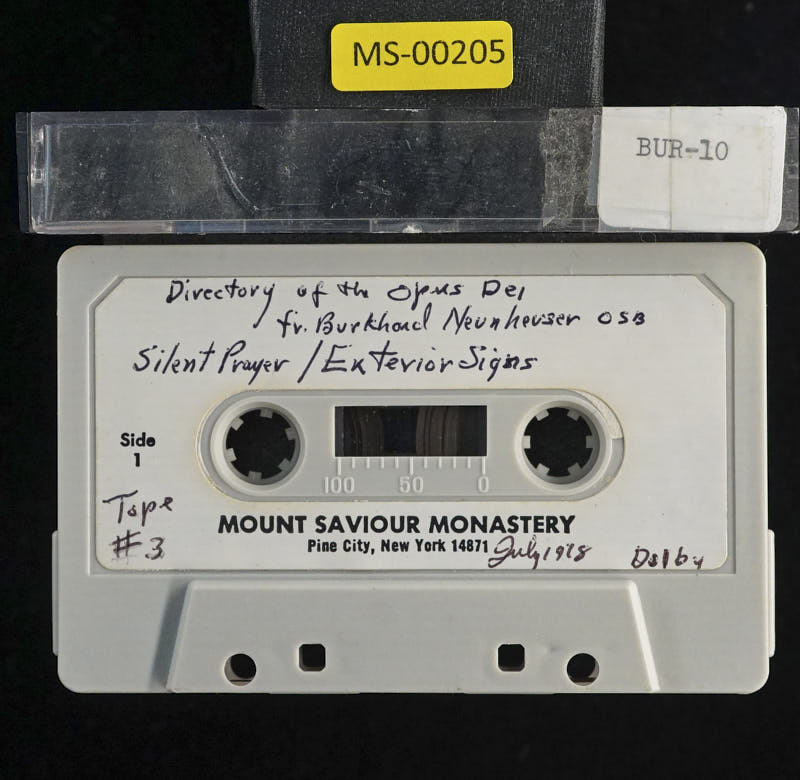
AI Vision - Possible Values from Photos:
Speaker: Fr. Burkhard Neunheuser OSB
Location: Mount Saviour Monastery
Possible Title: Directory of the Opus Dei / Silent Prayer / Exterior Signs
Additional text: Tape #3, Dolby
@AI-Vision_v002
And this first part is called the theology of the Opus Dei, the deeper theological explication of its greatness and meaning. And we heard already, nothing must be preferred to it. And this is not only a precept of monastic discipline, but we must realize that in the Opus Dei, we are governing together as the church. The local church has a representation of the entire body of Christ in this concrete place. And here we are before God in Christ, seeking and finding contact with him. But we must do it as a communion, as brothers staying together, united in one common prayer. Nevertheless, also as community, we try to have a real personal dialogue with God in Christ.
[01:03]
And all formal exterior elements must be seen as means to establish this dialogue, where we hear the word of God and where we are responding in communitarian prayer or in silence. And here I wish to add something which I forgot last time. This silent prayer, in communi brevieto oratio, very short oration only, but in silence, in very deep silence, is a first place where we are praying in this kind of prayer which is called in the rule of St. Benedict, oratio dignita, oratio pura, in intentione cordis, in lacrimies, therefore a prayer in tears, a prayer in fire, a prayer with all the intention of our heart.
[02:05]
It is impossible to persevere in such a prayer for a longer time, relatively. For five minutes is awful, impossible. But perhaps for two minutes, for one minute, for 30 seconds, pray with the greatest insistence and It would be a prayer to which we must come back again from time to time, orationi frequenta in Cumberland, where he frequently dedicated himself to the orations, and sometimes going to the church, pushed by the inspiration of the Holy Spirit to pray there shortly, but in this intention of our heart, and so forth, after the Psalms, as you are doing it from time to time, the short orations. Very important moment. And so the external elements then are nevertheless also very important.
[03:08]
Therefore, the word of God said, right, in a convenient way. Also, the English text was They need to bring it in musical forms, with instruments. But there must be room, too, for silence, real silence, where the soul, the heart, can meditate and answer in a very personal way. And I must say, after all the experience I had yesterday in this... office in the Black Church downstairs in Elmira, I must say again, to stay in this silence, in this powerful silence, to come meditate, to come pray in this way is very important. It's difficult to do it.
[04:11]
I am speaking here great words, and I don't know if it's possible to do it, but we must try to do it. to pray from our heart after having heard the word of God and answering also in communitarian prayer, in psalms, in responsorial psalms, in oration, but in this internal intention of our heart, sometimes in tears, nearly in tears. We, the modern men, I think American men, I don't know, is not able to weep, what do you say? The old men, the Italians, could do that. Nevertheless, there was an oration in the old missile to ask for tears. We are confused in the presence of the majesty of God, thinking to our sins, at least for some moments. And now we must go to the next point.
[05:16]
Therefore, to number six in the English text, seven in the Latin. The external science, sinia externa, that is the title in Latin. Men participate in the opus dei, in the work of God with their entirety, that is with soul and body, both. Attitudes and actions of the body, even with the voice itself. The voice itself must be signs of our interior devotion, for which the community, moved by the Spirit, manifests the presence of the mystery of Christ in living participation, actively and consciously. And here is also, again, a big difference, so far as I can judge and see it, between the English text
[06:17]
and the Latin text. The Latin text in number 7 says all these external, exterior attitudes of the body and the voice itself manifestant presentiam mysterii Christi, viva participazione, they are manifesting the presence of Christ presence of the mystery of Christ in this living participation actively and consciously. And the English text says, experience the presence of the mystery of Christ. So far as I can judge, the word experience is too much and too few. It is too much because we don't
[07:17]
always have the feeling of it, the experimental feeling. Sometimes we have the consolation to have it, but sometimes we stay there in faith, but dry. We don't feel anything, but we are believing to stay in the presence of God. And if we are doing so, moved by the Spirit, with this interior devotion, manifesting it in our... external, exterior attitude, in the way in which we are staying, kneeling, sitting, in which we are singing, making music, in which we stay in silence, then we are manifesting to us, to our community, and also to the other people the presence of the mystery of Christ. Sometimes not feeling it. And if we are seeking always this experience, this feeling, then we don't really seek the last, God himself.
[08:29]
We must seek God himself and the presence of the mystery of Christ, our Lord, participation in his Pascal mystery, and not consolation. God is giving us sometimes the consolation. And when some years ago, In the Abbot's Congress, there was prepared a paper for the discussions. There was also a paper made by the Experiencia Day. And one of the competent professors in spirituality and history of monarchism, Father Leroy. was violently protesting against this word, the Experiencia. He said, our Holy Father Benedict says, we must ask the postulant, if he is revered, if he is really seeking God, if he has the experience of God?
[09:32]
We don't know. Sometimes, yes. Experience is the second element. not the most important element. Therefore, perhaps I am a little bit too severe, but nevertheless, the Latin text speaks about manifestation of the presence of the mystery of Christ. The English text speaks about the experience of the presence of the mystery. Yes, sometimes we are feeling it. You know, in the higher mystic, always is that we must try to find God and not our feelings, not our sentiments, not our consolations. We must see God. We must follow him also if we don't feel anything. In his so-called, how do you say in English, dryness, in dry days, in the night,
[10:42]
Sometimes, then again, we are filled with consolation, consolated, yes, very nice. We need it. We need it as a child. Some from time to time need also some consolation by Miss Mother. But that is not important. Important is to seek God and finally to be united with him in faith, which is, as Father Anselm Stolz, one of the great monks of St. Anselmo, 30 years ago, I said this sometimes. This faith is obscure, and otherwise real anticipation of the vision of God in eternal life, but obscure. And sometimes we are feeling this obscurity with all our difficulties. Nevertheless, in all these obscure nights, we are persevering to stay in the presence of God.
[11:44]
We are believing in it. And so, believing in it and doing it, not abstaining our difficulties, we are manifesting the mystery of Christ to the community, to ourselves, and to all the people which are present. Therefore, we are doing it moved by the Holy Spirit, by the pneuma, acting as the living church. And we are doing it in communitarian prayer so that the words, the text, may penetrate in our hearts, that the psalms may implant in us the pleading and praise of all men. that our acclamations may be the echo of our conscious interior enthusiasm. Acclamations, for example. And here we must try to do it every day again. The Lord be with you. And we are answering also with you. Mechanically.
[12:46]
But you must do it. And also with you, the Spirit and God may be present in our midst. And so in many other words, praise to you, O Lord Jesus Christ. Acclamation after the gospel, mechanically, if we are sincere, every day nearly. And nevertheless, we must try to do it not mechanically, but livingly. And so with every word, with amen, and sometimes it is easy, for example, if we are bowing after the consecration on Sunday, amen, in silence, slowly. Amen. then perhaps we are feeling a little bit the reality of the presence of God. Nevertheless, also if we don't feel it, we wish to manifest the greatness of this moment by this word Amen said, in silence and in awe and in reverence and in faith and so on.
[13:48]
And so also our silence, to enter deeply in the world, giving room to the prima, to the spirit, to pray in the spirit, to answer to him. And know that English and Latin texts both together are continuing excellently with some other points. The exterior elements which make up a celebration make this a liturgical action only if there are the means of contact efficacious signs with the theological reality to which they refer. Thus, gathering together at the place of prayer is not merely obedience to a task commanded, but must express the will to act as the living church. We come together to be the church. We believe it. This is our faith, so we are the body of Christ here, present in this moment.
[14:49]
As it is said so marvelously in number seven of the liturgical constitution, in Omni Action Liturgica, Christus present is the Ecclesiature. In every liturgical action, Christ is present to his church, the Eucharist, sacraments. proclamation of the word of God, and where two or three are gathered together in the name of the Lord. He is in our presence, in our midst, present. And we come together that we are staying in this reality. We are believing it. Also, we don't feel it always. Sometimes it's nice to feel it, yes. But we don't depend from our feeling, from our experience. We are depending only from our faith. given by the spirit, in the spirit. The texts are proclaimed and in turn heard precisely with the desire to have the word penetrate the heart and so on for the song.
[15:53]
Acclamations. To be all this in page five, the celebration first must not fix the attention on itself but on the reality of the mystery. If it is fixed attention on itself, it would be an obscure sign. Said very, very well, we must make excitation. We must exercise our song. Let us enjoy as you have done it now. But tomorrow, we must know the text and the melody so that we can sing to enjoy freely with all the heart in this Trinity of Saint Benedict. And we must not only see the notes. Sometimes it's difficult to do so. And so with many other things, we must exercise, we must do our duty for certain self-verständlichkeit, a certain...
[17:02]
that we are, through the walls, through the melodies, and through our attitudes, are going to this interior reality. Otherwise, we would have an obscure sign. But this sign must not be incomprehensible. It would then be an empty sign. These signs must speak to us. And therefore, in the Reformation, after the Council, we have tried to take away all the signs which have no meanings without the commentary, that everything is speaking itself immediately to us. Otherwise, it would be an obscure sign, an anti-sign. Third, must not be carried out in a mechanical way, and we said that already. It would be an absurd sign, because it would be contrary to its end of communicating spirit and life. And in all these... in the text, the directory is insisting in this, we must not do our office in a legalistic way.
[18:16]
All the science must never be performed on a purely legalistic plane to give validity nor should its form be cold, detached, governed only by protocol of falsely hieratic, dehumanizing the action and the celebration in general. It is very easy to do so. We stay in the choir in a very solemn way, and we do think nothing. Only by custom. Ah, that's not enough. And here again, I said it already some days ago, the Latin text says more. Nevertheless, also, we must not do it attending only to the protocol in this external, exterior way.
[19:20]
Nevertheless, it must be done in the great dignity. That is a very relative measure. It may be allowed to say, in these days, I have seen some of the papals during the canon staying around the altar with hands in the pockets, during the entire canon, during the consecration itself. For me, as a European, it is powerful. How can he do so? I don't know how you are feeling, because I remember in Rome, when I was responsible for certain celebrations in the first days of the con celebration, I said to a young American confrere, you would not do it, for example, putting your hands in your pockets in the presence, speaking with the President of the United States.
[20:25]
And he answered me, why not? When the American army came to Maria Lark in March 1945, we were terrified seeing the soldiers greeting their officers. Good morning, Captain. Taking away a little bit their hearts. For a German soldier passing before his officer, good morning, Captain, impossible. And so on. Therefore, external forms are changing according to the nations, according to the cultures. It's not my right to criticize. Nevertheless, a certain dignity must be there. And we must also learn a certain dignity.
[21:28]
Which is not identical with the baroque poem. How do we say? Then also here, the celebration must be done in a certain unity. In absentia precipitationis. Precipitation must be absent. In the presence of quiet and silence. That is a little bit... Also remembering what I had seen yesterday in Elmira, it is our tradition to do it in quiet, in peace, with silence. That in the powerful majesty of silence, the word of God solemnly proclaimed can enter in our heart. We can learn from the enthusiasm of the people of yesterday to do it also in our way with enthusiasm.
[22:32]
in faith, giving ourselves and answering, and to do it in two minutes. Two minutes is very long. One minute sometimes is very long. To speak in one minute with fire to my Lord in prayer, without sleeping, without going away, is difficult. For five minutes is nearly impossible. And ten minutes Therefore, St. Benedict says, in the community, the oration, this oration in Nita, this firefall oration, must be very short, but it's relative. St. Teresa, of course, may have been able to pray so firefully also in five minutes. The poor man cannot do that. But at least two minutes or three minutes, as he is doing it. And so... also not too actualistically. And we must do it, and here again, both the texts are identical.
[23:35]
The tone of voice, the attitude, the way of pronouncing a formula and of proclaiming a reading must be supported by a true interior warmth. Which, while it shows everyone that we are present to ourselves, it's only in English, very well said, we are present to ourselves, we are spiritually present, not sleeping. Succeeds also in communicating, manifesting to ours the living presence of Christ as something perceived by us in the world and in our response, in our response given, in our attitude, in our voice, in our songs, in our silence. According to the word of Luke 24, did not our hearts burn within us as he talked to us, stay with us, Lord. It is true. Let us hear the word.
[24:36]
Let us try to answer that sometimes the fire is really in our heart so that we are feeling it. But also if we don't feel it, we are believing that God has spoken and we must answer to him and just say, I trust in you. I am hoping in you and I shall never be ashamed. And so on. Wonderful, wonderful text of this number six. The external signs manifesting our interior disposition. And then we go on. There's still how much some means? What do you think? Better to finish to make a discussion about it. No, okay. Then in number seven. Tempus validum invita orationis monarchy.
[25:38]
The strong moment, the worship, Opus Dei, is the strong moment in the life of prayer of the monk. And here also we are speaking about the common office about about the opposite day, nevertheless, the text is insisting in his reality, we must do more than to stay in the choir. We must stay in the choir, in the presence of the mystery of Christ, seeking the contact with him in efficacious way to continue. And I remember that in Rome, speaking about these problems, I have said, if we are filled with the presence of God in our... Liturgical celebration. We cannot say on the end of this celebration, thanks to God that all is finished. I can go now to eat and to drink and to read a novel. Per se, if we are filled with this presence of God in faith, feeling or not feeling, if we are filled with it, we must try to retain it, to stay always alive.
[26:46]
in this same reality, in gratiarum actione manentis, remain in thanksgiving, so far as possible. And if we must go immediately to the kitchen to prepare our breakfast, we do it in Christ. If we go to the fields to work, we do it in Christ. If we go to study, we do it in Christ, that our entire life could be in Christ Jesus. Therefore, starting from this high point where he is... According to our faith, the presence of the mystery of Christ, we must pray always. And that is corresponding to the doctrine of this liturgical constitution, where it is said, liturgy non-explet, non-exhaust the activity of the church. We must do much more, preparing ourselves and continuing. But nevertheless, liturgy remains culminant at once. the high point, the highest summit, and the source of the entire activity of the church.
[27:55]
Therefore, in the Latin text, there is also given the citation of the liturgical constitution, Sacrosanctum Concilium number 12 and number 9. Also called together, nor also we are all called to pray in community as the church, nevertheless, the monk must come to the inner room to pray to the father in secret. And therefore we are invited after this high points of our worship, of our oppost day, to continue. from time to time, moved by the inspiration of the Spirit to pray in the church, or in our room, or in the field, to pray in a formal prayer, with the invocation of God, with a short prayer.
[29:02]
To come, come, finally, through that, what you, especially the oriental monks, are calling boratio continua, to pray always. Not always in formal words, but in... attitude which is always united with our lord easily taking contact with him in everything eating blinking working sleeping and loving and in recreation not in a false piety which is always making the appearance of piety but nevertheless in every human reality in which we stay to remain united with him. But nevertheless, also, when all this is true, the worship, Opus Dei, is more than this continued worship.
[30:08]
prayer that is the high point because it is the celebration of the mystery of Christ celebrated in community in a living reality where we hear the word of God where God still speaks to his people and we are answering to him we are doing it really he is present and he speaks to us therefore Also, we must try to continue this reality. The highest point, the strongest point of this reality is given in the opposite day, where we are together, in Christ, as church, as the living church here. In a certain way, we try in all our attitudes, in all our discipline, to have this experience, to be united in Christ, to speak with God. Therefore, here in the community, In the prayer of the community, in the work of God, in the opposite day, there is a greater, more living contact with God who is present in the community.
[31:17]
According to the rule of St. Benedict, we stay in the presence of God and his angels. According to the liturgical constitution in Numero 7, Christ is always present in the liturgical acts. actions to his church according to the word of Christ, where two or three are gathered together in my name, I am in the midst of them. But the text says very well, in English and Latin, that there is more still. It's not only the presence of God, the presence of Christ, but the presence of his word of salvation. here in the contact with his Pascal mystery, to be united with his death, to be united with his resurrection, to be associated to his passion. The reality of this, our common celebration. And so far, here is the highest reality to...
[32:26]
express this, our union with the mystery of Christ, this Paschal mystery, which then, starting from this highest point, must remain, more or less, in our daily life. But we hear always again to go back to this community prayer, to be again strengthened in the presence of the mystery of Christ. And also, here is the supreme way to express our communion as brothers, According to the words of Matthew 18, 19, if two or three of you agree or it will be granted over where two or three have met together in my name, I am there among them. And this prayer must dispose as always again and again to be open for God. Finally, after the reality of these highest moments, of these strong moments in our prayer life, daily prayer life, the entire life could be really persevere in the presence of God praying to him.
[33:43]
Nevertheless, Noah, it is time to finish. Until next time. continue with the next point. But nevertheless, perhaps some minutes to a discussion. The protestations. In number three? Yeah. Yes. Yes. And I'm asking myself, you know, I just feel that something felt a little bit missing in the whole place. Like I said before, I don't know. But I found it very interesting when Newton made the remark of celebrating Canada's event.
[34:49]
and there were men standing around with their hands in their pockets. Now, I've seen such a situation, and I don't know, I think I'm really saying words, but I'm saying something else. And I've seen the minister thought, let's say, with the candles and all, and you have people standing around like this. Well, I, you know, I was in a church. And then, you see, so he starts, saw some order. And then the minister, he stops, he says, We have to stop. We have to stop.
[35:51]
God's not in here. God's not present with your hands or your pockets. Oh, no, no. Maybe, you know, God is, you know, maybe people would just say God's not present with your hands or your pockets, but, you know, God is beautiful present with his wife. The power of God is here, you know, and if we believe in the power of God, you know, we, you know, and then, And then after that stop, then they move forward, you know. Now, if the guys still stand with their hands in their pocket, you know, that's a sign to the whole community that, you know, evidently that fellow that said, well, if he spoke to the president, he would still keep his hands in his pocket, you know. And if he's doing that, you know, in some ways he's rebelling. And, you know, And if he's that rebellious and that strong, he'll do his thing with his hands and his pocket like this. Well, everybody around his brain, but it is, and that was one of the things yesterday.
[37:00]
You know, what I find is I don't find that drama, you know, in the old Latin thing, you had to have it, you know, I'm not denying silence, you know, I really believe that the Black Church has a probably, they drown out their sorrow with a lot of filling that whole space and there's no question about that. But it has that, they have that drama that somehow Yes, but first of all, I wish not to judge about this guest who did it, or this faithful, I don't know, this man. It may be that he, with his hand in the progress, has been much more present to our Lord than we, and so.
[38:06]
It's quite possible. Nevertheless, we try to stay in a certain way which are... perfectly corresponding to our faith. And therefore, we and you as community, you don't do so. You stay really well there, the community. And so on. And for yesterday, also, if they are crying and singing with a loud voice, there is a way in which these people really is united to the majesty of God. We... That's good. And we learn from these people to do our work according to our tradition also in an excellent way, the fire. Sometimes it may be this fire is expressed in a violent way. And we, in my monastery, we are singing very aloud. So that an abbot of a French monastery visiting us sometimes has said that you are singing like barbari, barbari.
[39:10]
okay, we don't sing as the Monastery of Solheim is singing, very, very, very fine, very, very, very sweet. Not sweetly, excellently, but in greater quiet. These are two different ways. There are many different ways, but we must find our way in every way. Nevertheless, we must say that our external signs, which are necessary, are corresponding to our inner devotion. We need external science. We must manifest what is in our heart, in words, in melodies, in our attitudes. Sometimes we can also agree. For example, we say, ladies, the entire community, I don't know, at least for our father, raise our hands all. I don't know if you do it. Only the priests. For example, the Sisters of Herstelle, of Odokassel, already in 30, already in 25, stand during the entire canon, did in silence at that time.
[40:27]
So why not? Until the priest was born. Is it possible to do that? Agreeing. You can say we do so and we don't. In a certain way it is better to be in agreement. All are doing so or nobody is doing so. I don't know. Somebody, when I was again speaking with a young American confriere, when I was responsible for the first conf celebration in St. Anselmo in Rome, I said to him, please, if you are the first celebrant, do what all are doing. Why? It is boyaroneese. Uniformity. It is very nice that everyone is doing what he likes to do. It is the way. He was an excellent young man. Excellent young man. But he said this. We are, in a certain way, individualists.
[41:28]
Everyone is, the one is saying so, the other is saying so, the other is saying so. It doesn't matter. It depends. actions are a problem for certain places. Some years ago, and even in some places today, you wouldn't be able to put that in hotels unless you have a check. Today, it just changed. Yeah, you are right. For some places, they still deserve the right. But that's quite bad. I don't know. And all these external attitudes in science must be quite natural expression of my interior feeling.
[42:42]
As the text said, it is not convenient that we are thinking only to my hands. Where do I do part by hand? It must be natural to do it. After having learned it, we are exercising. And then, finally, it becomes a second nature. Quasi naturalita is constituted in the ipsa bona. We are doing all these things nearly naturally. Thinking to the reality itself is taking the presence of the majesty of God. Yeah, yeah, I was thinking the thing in the King Cemetery was where the church serves. And, you know, where he stopped the whole thing. And because that power and that, and I'm not saying you can't have
[43:48]
you know, with the three things you mentioned here. You know, you said the problem about the experience of God. And I'm not saying that everything, every morning at Mass, you have to have an experience with God, otherwise Mass is not good. I'm not saying that. But what I feel has happened is that The power and the, you know, we have this new book of rites, the genius book of rites, and there's the whole rite of baptism and celebration of that, and the way of doing that, a different way to do that. And there's real power in that thing, you know, and there's drama. When we get hold of it, then we start looking and reading it.
[44:51]
Now, I would get the book of Bartolucci on this very book, and the Sacrament of Pendant. And somehow, you know, we almost use, I mean, you know, you're very dramatic in everything, in the whole thing, and your thing comes across, you see, But what happens is we use silence as an excuse. We use... We tend to take the silence thing as an excuse, you know. In some ways, real excuse for no... No, no, no. It's the only secondarian element. The first element would be to sing solemnly, to come to the church in Toitus, to stay together in the Gloria, to bow for the prayer, for the oration, to sit for the readings, and then a short moment of silence only, where we are realizing, what have we done?
[45:53]
Give me, my God. That's exactly what I'm making. You see, you start what? With the drum. you know, and then out of that drama, so to say, then the silence makes sense, you know, the wilderness, so to say, makes sense out of the drama of a real life, real thing. And what I find is, you know, and I'm not saying drama every moment, every time, perfect moment, and I realize also that we have dry moments and everything. But when you have the dry moments, you know, that what has to come before you is the drama, which comes at certain dramatic moments, and we've watched that somehow when all that went out. I don't know. Surely the liturgy, the worship of the New Testament is no more so dramatic.
[47:01]
as the Old Testamentalian liturgy, where has been the temple, where has been the sacrifices, the smoke, and so on. And our drama is much more spiritual in the adoration of God in spirit and truth, with hearing the word of God. And our sacrifice is finally limited to the Eucharistic prayer, with some bread and some wine. It's very few. Therefore, our drama is much more spiritual, but it is there, where we are gathering together, where we are singing, where we are sitting, where we are staying, where we have external signs. All this must be done in quiet, without any precipitation, in a certain dignity. And from time to time,
[48:02]
You are doing it excellently in silence after the readings. For my person, I prefer also during the offertory, not to say it aloud, but to remain in silence. Only the priest is saying these words. We were preparing the new Mass. We were fighting against these prayers because there are personal prayers introduced only during the Middle Ages. They are not old. We can change. It's meaningful to do both. Sometimes saying it, sometimes not saying it in silence. And after communion. Therefore, you have the drama, but we don't need to have this drama in the forms of the Old Testament too highly, especially because also the highest forms, the most solemn form of Baroque, are nothing in confrontation with the majesty of God. We never can realize the reality of God in a way in which we are really expressing it.
[49:12]
All are signs. And these signs must conduct, guide us to have this spiritual contact with God, where we, for a moment, are also experiencing, yes, and sometimes feeling it. We stay in the presence of God. That is remembering, is that we, when we are gathering for the upper stage, stay in the presence of God and his angels, in chapter 18 and 19 of the Holy Rule. What I've discovered is, you know, that other than the feast of Christmas and Easter, like with us, you know, almost every day else, every other thing is the same. Yes. You know, you got, like on Sunday, you got more people in the church and all that sort of thing. Nevertheless, the difference between Sunday and weekday is very great. There is a greater solemnity, there is a drama. And especially, and here is the essence, I think, of the Christian, of the New Testamentarian liturgy, every day changing the war of God.
[50:19]
In a certain very discreet external solemnity, which is different according to weekday and to Sunday, you hear the war of God. Sunday, confitio tibipata. I praise you that you have revealed that for the simple man and not for the learned man. And today, these wonderful words of the reading of the prophet about his love to Agape, every day again, again, again, again. You come across being very dramatic, you see, but I almost feel like the Sunday, the Brahma Sunday and some of the real strong feasts and so on, it's like we take them and we put that text into, it's like taking a Cadillac engine and putting it in a Ford chassis, you know, in a Ford, you know, a very big thing, a little, and it, it, and,
[51:29]
Somehow the power of the liturgy is more or less for feast to feast, season. It's more or less. Repeat. The power of the celebration of the liturgy is more or less feast to feast. I don't understand. Christmas, the Easter, the Pentecost, the Transfiguration, and then the in-between thing goes. Yes, it's true. The great solemnities are solemnitatis, where you are celebrating in a very distinguished way. And we precisely don't wish to have each Sunday the same solemnity. We have this great solemnitas, festum, Sunday as the primordialis dies festus, and the weekday, which must be very simple. And the Sunday we can... come back to liturgy in the great solemnity of Sunday day but always we are listening to the word of God and in the silence following the proclamation of the word of God where God is speaking as we are believing in faith to us again today after having heard the word of God in silence we adore and we let penetrate the word in our hearts answering
[52:54]
And we are answering sometimes with the responsorial psalm. To do it every day again. If we would do liturgy every day as we are doing it in Easter, in Christmas, we would be killed. I'm not saying that. We're not quite connected. I think Brother John will do so. you know, different ways you integrate emotion into your type of worship, different traditions. And there's one way, if you want to have an experience, a personal experience, this is why I just don't like the word drama. If you want a personal experience of an individual thing, then you can make the dramatic celebration, and maybe the individual, the individual emotional experience. But if you're coming up as a form of worship that if you want to see how is this going to make the objective reality of Christ transform a corporate group of people and be able to use it for their whole life over various years, whole different developmental times, and make that transformation permanent.
[54:13]
You don't put the emphasis on emotion, but it doesn't mean the emotions in the liturgy. through the biblical things, through the meanings, through the feast days. And then it isn't just as direct and fundamental and powerful, but it's a whole different way of assimilated and integrated as opposed to a direct experience, emotional experience. But if you're trying to be assigned to math as the primary thing, what kind of prayer transforms the corporate group of people's brain and not what kind of prayer helps a bunch of individuals get experienced. I think that's a difference between the Lord. I mean, to me, the office is set up to be a prayer for various groups of people at the corporate body to be used their whole life to transform, to make that transformation permanent. And then you have to build it on revelation and on the exposed continent of all revelation and actions of individual movements and individual development right now. I mean, I think it's a whole difference, even more, that this group has experienced
[55:18]
an emotion, and this group doesn't have an emotion, I think it's true. It's there, and it's more than recognized and integrated in a real way. And if the person doesn't feel it, I think they have to look at themselves, and how they are using it, and how they are understanding the form in front of them, and if they change themselves more, it's automatically for them. And I would say... that I'm in the process of doing. But I'm going out to make some definite experience that I have. And it's only when I go out and make these, then that I'm going to have to begin to relate to the experience here. And I just find, I don't know what you call an emotion or whatever, but I just find it It comes from the simple liturgy of every day.
[56:41]
Every day, right. And for example, if you are filled with fire after having heard the word of God, after having give the recitation of the Resposorio Psalms. In the Holy, Holy, Holy Sanctus, you can put into it your entire emotion. Lamb of God who takes away the sins of the world. Here we have the possibility to express our devotions, to participate, to sing. the feeling that you experienced that at Locke and in the whole Latin world, and that was really for real, you know. And just somehow I got the feeling that that is kind of the world that is carrying you through now. No, no. Our Latin liturgy is simple every day as yours, with the order of the 18th. Or the 16. Very, very simple, very simple. But every day again, every day. In Rome, in our Latin group, we are singing every day only curia 16 and a simple sanctus of 18 and nothing else.
[57:50]
Every day again the same. We are not able to do more. Nevertheless, in this sanctus, in this anxious day, in this Lord have mercy, you can put all your attention. When you watch tomorrow, if you see much difference, I mean, at least the St. Benedict tomorrow, and I don't think he will. And you watch tomorrow, you know. But I think, Brother John, to say, because in the liturgy, you use a certain amount of restraint, and it's so bright, maybe tranquility, that it means that emotions are just as deep, you know, it's the old thing. still water, there's one in teeth and all that. It doesn't mean the emotions there, like when Father says fire, maybe someday, you know, there is expressed externally fire, but if it isn't even expressed externally, it doesn't mean the person isn't in a real function. Just because there's a certain amount of restraint and sobriety and emotional type, it doesn't mean it's not so deep and profound.
[58:54]
And it's like with that courtship between two people. Maybe their younger years is expressed very exuberantly through that, but later the emotions are much more profound after 20 years, just in the eye contact or something, you know, and it doesn't mean all the times when you say fire has to be... But you may be right. It is true that in the reform of our liturgy after the concert, sometimes we lost the variety we had before. For example, tomorrow we shall have a gloria. And also, it must be said, the credo. I don't know if you say it or if you sing it. And formally, we had the possibility to sing, for example, tomorrow, the Gloria 2, Gloria 3. We don't do it anymore to make it possible for the faithful to sing with us. Also in St. Anselmo, we are in St. Anselmo in Rome avoiding many... possibilities to sing Gloria, that the faithfuls can participate with us.
[59:56]
And here is a certain difficulty. If you wish to invite your guests and your faithfuls, you must sing in a very simple way. You, yourself, you would like to have a greater Mary sometimes. It is possible to discuss it, yes. And I'm not You know, and I'm not, you know, saying that we're all, you know, we're not trying and all that. But I just think since the whole other liturgy went out the window, in a certain sense, changed, since this change, it no longer had the hope that it had before. It changed to a greater interior, to all this wonderful greatness of Holy Scripture. We had never before such a great, rich possibility to hear the word of God. That is our possibility today. You are right.
[60:58]
In consequence, sometimes our solemn way to express it, our external forms, has become too simple. And therefore, the Latin text was rightly insisting in a certain unity, greater unity, corresponding to the degree of the faith. which is nevertheless not the same as a baroque pompa. You must try to find a good middle way. I was raised in the cathedral's parish, and since I was the shortest older boy, I used to be in the show all the time, every Sunday, a big piece, you know, to hold the train of the bishop and all that. And we had this big display. And it was really dramatic, but I've never experienced the depth that I experienced last Easter.
[62:00]
And it was not much different than the previous Easter, but somehow I got something more of it than before. And I don't think it's with the drama that we get drama equals feelings or expedience of the other, this, I think, you know, the eternal, the hindrance to, to discover something more, more, more lasting, lasting. For the, you know, at least the beast has a crown, you know, and that has, you know, has a power, but you take these three purposes away. Nobody is taking it away. We are celebrating Easter as the great summit of the entire year. We are preparing for 40 days and are continuing for 50 days. We use a Gloria that people don't think the Gloria that we have for solemnity.
[63:12]
Most, because it was composed by monosherapine, and it's in two parts. That's the only glory we sing in two parts. And it's very nice about the idea. And therefore, it's kind of very sacred, removing that personality. And then we have the entrance that we practiced this morning. Then the sequence, St. Benedict, it never happens during the years. It's the only day that we sing that. And it may be allowed to me as a foreigner coming from outside. The power of your office is the quiet way, the simple way, the silent way in which you are doing it. It's powerful, really. And there's the feeling of the entire people here. As this Polish priest who was my student who was here for Eastern, he has ridden me enthusiast letter about the Easter Solanity.
[64:14]
I didn't mention really something the matter with me, but I find myself going out, you know, to, you know, even like this morning, you know, to make this morning things make sense a lot of it. was on the basis of what I kind of experienced before and on the outside. And you are prepared by many things to come to this common celebration where we are eating and drinking the body and the blood of the Lord, proclaiming his redemption walk in the Eucharistic prayer and saying our amen. And the daily dance, I guess I don't have such a... See, that's the distinction.
[65:25]
The daily dance, I don't have such a problem. But there's some... There's this dramatic right power. If you're silent in the quiet moment, it's home. And what I'm saying is I'm not denying the silence. I have no problem with the quiet. All of that. But there has to be, you know, in the course of the year, in the course of various celebrations or something, power. I think what we're looking for is just to come from the beginning. We can't play from the Elf. In the end time, we're going to have to make vision from the Elfland. You've got to come from the new Elfland. If you're on the end time, it's not going to be there. But I agree with you. There are degrees of solemnity. If every day office is OK, then Sunday is more.
[66:28]
And also, solemnity tomorrow is more. And a feast of apostol may be more by some melodies, by some special songs as Gloria, because we don't say Gloria every day. But if we are saying it, it is a wonderful possibility to And somebody of the Old Father of St. Anselmo said to me, we are saying so, worshiping you, adoring you, and we give thanks to you. And all this, because you are wonderful, great glory. I think I can give an example of my... what Brother John is talking about, but I think it would also bring out what Brother Daniel is saying. And I think in a certain way, I think both of them are right.
[67:35]
And we have this one text, it's introit, and it goes, it starts out, shout for God, and I don't know what the other text comes on. But It strikes me when we sing that, there's not that enthusiasm or conviction. Shout for joy, all you on earth, or whatever. But somehow, in the melody that we sing in, it's very subdued. Shout for joy, it's shout for joy. And the thing is, whether I feel really joyful or enthusiasm, you know, all this kind of thing, that because of what I'm shouting for joy, I should sing it with enthusiasm. Yeah, I think you are doing it.
[68:37]
For example, tomorrow, I have made the exercise this morning. Yes. And also, Sunday, when we were singing the interread, I had the impression that you have said it with conviction. We received your mercy in the middle of your temple. Nevertheless, also, if you are singing with the voice of angels in the most powerful way, It is not enough to realize the greatness of God. All the means are relative. You are right. I am agreeing with you. We must, for certain days, for Sundays, and for solemnities, and for feasts, we must have a greater form.
[69:38]
But also this greater form sometimes makes the impression that it is not joyful enough. We are tired. We are not able. Our voices are not very good sometimes, but we are doing our best. And if we are not able to do it really, we are doing it with our hearts. And sometimes a choir who is able to sing only with difficulty is singing nevertheless with the greatest conviction, with the greatest joy of heart. Both things are going together. But here also, we could change on Christmas in the third mass.
[70:40]
They have poor natos as nobis. The gradual is joyful, joyful, hallelujah, yes. So we are changing, yes. Mine feels in a bottle. I don't know how many people can have to get it out. I just, you know, and I've been ever working it out, you know, outside of this thing, but somehow I can't get it out. Who would go? You said how these outside experiences is what you bring to our daily notes to give you meaning or to give you that oomph. But you also recognize that there is that oomph at Christmas and Easter. And it seems like you have to take that oomph at Christmas and Easter and bring it inside and apply it to the daily notes.
[71:43]
It's like you're trying to take the hope that you feel at the black church, okay, and you say that, like in the mass morning, that's how you sort of bring it to life and you park it back to that. Well, take that hope you find at Christmas and Easter, you know, and call on that, you know. What convinced me that what we have is, It seems to be very meaningful that the comments that you have from guests, from those you just come from Sunday, they're like this. They said they never stop anything like this. And I know personally it's not that great, you know, and I would like to be better and all that. You know, but if you're thinking, you must practice, you know, and I can be, and then you must be one of the things they ask, you know, They asked if one of the requirements is that they major in music, you know, .
[72:48]
And, you know, they say that because it sounds so great. I'm sure, you know, this is far better than any of the parishes, you know, a lot of the parishes Thank you. Kava, yeah. Kava Zeleni. Madhia di Kava. I feel that in certain ways, there's three different things brought up.
[74:03]
And I wonder, when anybody else, I mean, I mean, with any human being in any situation, you kind of get bored or stale with anything. Your vision gets narrow. You don't see the whole thing again. You need to look at what you have fresh. So just by looking at that, you know, how we can look at that. So then the change itself, the literature you want to do with Loreal, you know, we're really taking advantage. Taking, you know, things like that. And also the variety of emotions that people besides the salt and the expressions and a very direct, you know, fundamental way of emotion, you know, maybe not always learning to be better than someone. So there's that, you know, and I think sometimes just seeing it again, what's there, you know, it's just like a, you know, when you're a kid, you said, you know, there's anything to eat, look at the icebox, full icebox, but there's nothing in here or something, you know, because it's not the one thing you want, but it's full of food.
[75:05]
You know, if I'm mad at that, that you just need to see. But the other things brought up, it's like it says the other day, this is what I had done before, how the formal element of your liturgy, how you do the form, have to be constantly checked. So we're going to share with you everything. You know, value. And I think that's a legitimate thing. And I feel here it's, you know, like I'm saying, there is a lot. And I look at it and see it, and I've got to get the picture again. my vision. But I think it also is an area maybe here we can look at, you know, in formal elements. You change maybe a few things or something to be done the same way in here, maybe a different melody here, a different translation. But it can't be done not on the visual. At first I thought, you know, they should be encouraged to move people right away here before we change it in the liturgy. But until you understand more, and this is the other point, more the form of court repair, You know, in the sense of the liturgy, people of varying degrees and temperaments for their whole life over a long period of time, training the corporate body that has a specific way of form that's not the same, that just because today I feel one thing, liturgy should be geared to my specific way of one, you know, that it's geared to a whole different way until you understand that form and assimilate it.
[76:31]
And that's where I feel my only degree, and that's where I agree with the form. you can be checked and maybe hear a new or a different voice so that we see the beauty that they have again. Not so much the change, but you see the beauty. But in how you integrate emotions and how you integrate yourself in prayer, there are many different traditions. In this tradition is one for the corporate body, praying over a long time to transform them, to make a permanent transformation. the way that the very few of the government do it. And that's why I disagree, I said, but in a fair group way, where those where they have their way, it's a way that it's an open ballpark. It's not nearly as if the goal of this thing, but it's a living reality. I think it's enough life to seek to describe that it's not fixed. It's not over.
[77:33]
You can't always be excited. I'm not really saying I agree. I agree. I didn't like makeup. I guess we just have to ask ourselves what we bring to the community. But then when we're there, we're just kind of doing it in a mechanical way while we find ourselves feeling or sleeping. You know, I think this whole thing is something that has to have for themselves.
[78:39]
Sometimes the things are done with the greater obvious conviction following Western. Their liturgy, it's so obvious the joy that they were expressing when they celebrated and the unity that they had. It just seems like this text says, truly manifest. And I think this actually represents a challenge. We are really manifesting by the way we stand, the way we bow, say, the doxology, whatever, are we manifesting what we do not know? And that's why I think Brother John I think we'll say the same thing about us.
[79:41]
If anybody's not going to be far away, Well, there are different levels. You know, what we bring to it. There is a zone, which I think we all feel you know, can't be proven.
[80:44]
But then I think the fourth thing really is what we're going to do. That's a strong of worship for the Jews. But the very same is the greatest You could say, according to the word of the rule, it must be so that the strong people is able to express them that they are. And also the not so strong people are not feeling to do it. For both, you must find a middle way to do it. And it's also quite possible to make it always better. But we can come back again very often still to these problems in the next numbers.
[81:56]
@Transcribed_UNK
@Text_v005
@Score_87.43