You are currently logged-out. You can log-in or create an account to save favorites and more. more info
Resurrection Unveiled: Biblical Mysteries
This talk delves into the mystery of death and resurrection within Christian and Biblical narratives, particularly highlighting its centrality to understanding the hidden mysteries in the scriptures. The discussion emphasizes discerning Christ's presence in the Old Testament and the pervasive influence of sin and demonic forces in human life and world events. Furthermore, it outlines the essential Christian doctrine of death and resurrection as foundational to spiritual life and growth, manifesting through baptism and the monastic commitment to ongoing transformation and maturity in faith.
- The Bible: The primary focus is on discerning hidden meanings within the Bible, emphasizing the works of Moses and the Prophets as indicative of Christ's expected suffering and glory.
- Isaiah Chapter 7: Noted for its limited explicit references to Mary, yet serving as a starting point for exploring her mystery across the scriptures.
- Genesis and Apocalypse: Discussed as bookends in exploring Mary's mystery and Jesus's omnipresence in biblical narratives.
- Book of Exodus: Highlighted for its symbolic representation of death and resurrection, especially through the Israelites' liberation from Egypt's bondage.
- First Epistle of St. Peter: Cited in reference to the symbolism of the flood as representing death and resurrection.
- The Screwtape Letters by C.S. Lewis: Recognized for illustrating how demonic forces subtly influence human reasoning, often unnoticed.
- The Old Testament: Viewed as a journey from sin to anticipated redemption, with themes like the Exodus, the flood, and the exile in Babylon serving as metaphors for salvation through death and resurrection.
- The Theology of the Old Testament by Fr. Daniel Liew: Mentioned as a compelling interpretation of Old Testament narratives with themes relevant to Christian understanding.
- The Psalms: Encouraged to be read in the light of death and resurrection, offering deeper insights into spiritual life.
- Freud's Theory of Religion: Briefly discussed, noting the potential subconscious motivations behind religious aspirations, seen through a lens of repressed desires.
The talk seeks to illuminate the intricate relationship between divine mystery, human nature, and spiritual redemption, underscoring the importance of continuous death to self and rise in Christ for achieving spiritual maturity.
AI Suggested Title: Resurrection Unveiled: Biblical Mysteries
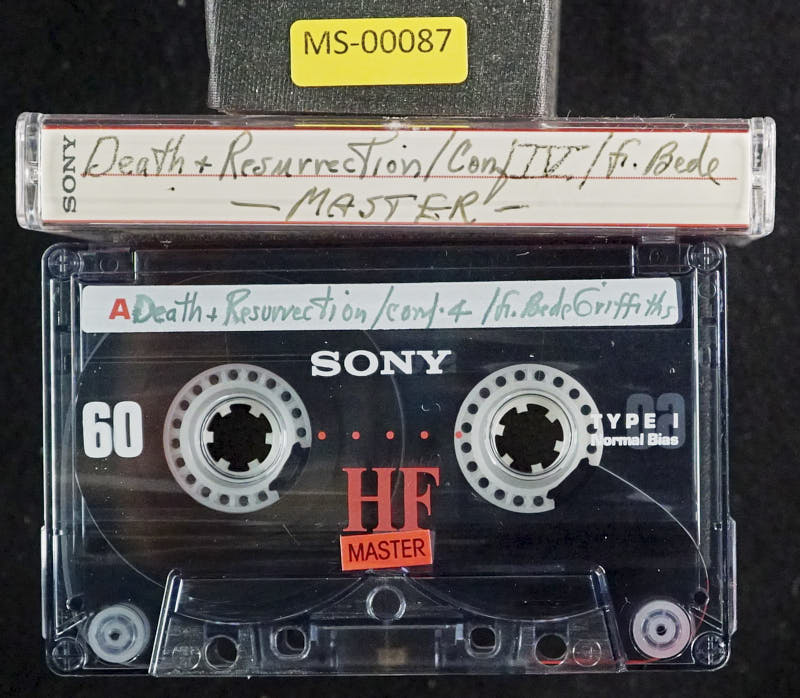
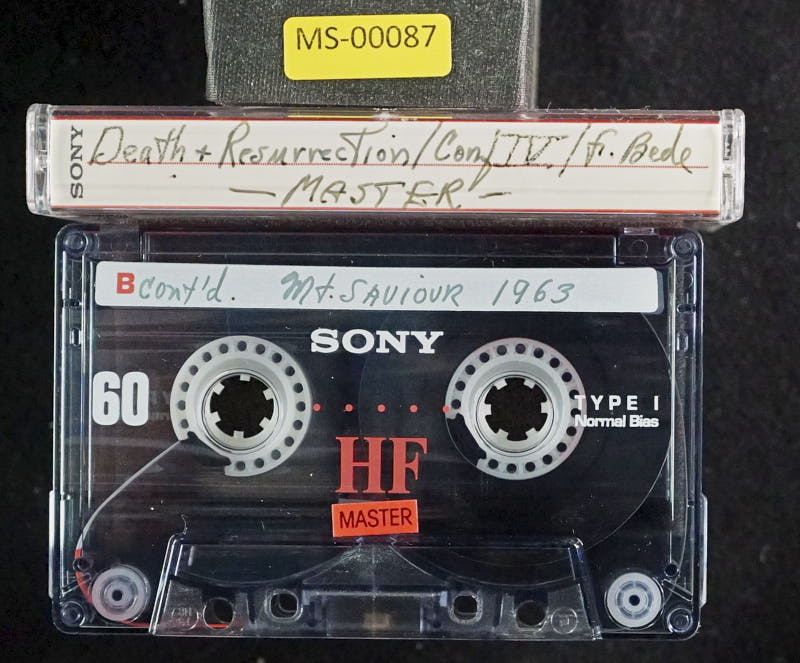

AI Vision - Possible Values from Photos:
Speaker: Fr. Bede Griffiths
Location: Mt. Saviour
Possible Title: Conf. 4 Death & Resurrection
Additional text: Copied July 1999
@AI-Vision_v002
... ... ... has been meditating on the mystery of creation and of sin. Now I want to go on to consider the mystery of death and resurrection, which, as you know, is really the central mystery of our lives, and the central mystery, I would say, of the whole biblical revelation.
[01:01]
And in following up this, theme, I think it's good for us to keep our mind on the Bible. I think we always should be trying to understand this hidden mystery in the Bible. You know, when our Lord was speaking to the disciples of Demeus, that wonderful scene after the resurrection, he reproves them because they did not know that the Son of Man had suffered and be glorified. And then Luke tells us he began to expound to them all the scriptures, beginning with Moses and the prophet, showing how they spoke of him. But I always feel that is what we are all seeking. If we could have heard that discourse, then we should have the heed to the scriptures. But I think in a very real sense that he was given to the church. that the apostles and after them the fathers had this insight into the mystery of the scriptures.
[02:07]
They could see Christ hidden. And it is really very hidden. After all, if you were to ask to pick out any text of the Old Testament which really clearly indicates the resurrection, I think you'd be rather baffled. It's a very, very hidden mystery. And yet, I'm sure, it is present from beginning to end. Incidentally, the same can be said of Our Lady. If you want to pick out a text referring explicitly to her, I rather doubt whether you will find anything beyond Isaiah chapter 7. But if you want to inquire into the mystery of an early, you can begin with Genesis, the story of Eve, and you from God, the Apocalypse, the New Jerusalem, and you'll find chief presence everywhere. So all these great mysteries are hidden, and we have to seek them out in the light of Christ. For this mystery of death and resurrection, I think we can see very, very clearly indicated.
[03:12]
First of all, we look at the biblical history. And don't let us forget, these early stories, Genesis, although we don't make them as strict history, and we know how they came into existence as the Christians of the Hebrew people gradually born in the course of many centuries. But we can quite clearly discern in them the work of divine revelation, the mystery of God dealing with men. But as you know, we have this story of the creation and the fall. And I didn't mention, I should have done yesterday, a very important... aspect of the fall, and that is the faith of the serpent and what one may call the demonic path. We were trying to think of the mystery of sin in ourselves, this hidden depth of sin, but I should really have said that when we really go into these depths, realize the hidden forces of sin in our nature,
[04:23]
We cannot but be conscious of these demonic powers. Actually, you know, many psychologists, that you wouldn't have to use the same phrase, are quite aware that there are forces in our nature which are really demonic. They're certainly not simply forces of our own personal being. They go beyond it. And I mentioned that Hitler and the forces which he let loose, which the Magnificatunist person could see, were clearly demonic forces. And we should be conscious that we're living today in a world where these demonic forces are present. And they're not yet present, unfortunately, in quite the same way as we're accustomed. Detroit Africa, even now still in some parts of India, you are conscious of demonic powers.
[05:23]
There are with the doctors and magicians who clearly have certain allows with demonic powers and do very remarkable things sometimes. But you know in these screw tape letters I think C.S. Stewart really did something very valuable there by showing us how the devil and the demons are really working in our life in a way which we don't deserve. And as he pointed out, the greatest triumph of the devil is to get people to believe that he doesn't exist. And when you remember that story of the man who went into the British Museum, and he was reading some book or other, just of general interest, And he suddenly found his conscience struck and he began to meditate on sin and the realities of his life.
[06:25]
And this was the first time he'd done it for a long time. And then the time came for lunch. And the thought occurred to him that he ought to go and have his lunch and then he thought, well, this is... very interesting, perhaps I ought to go on thinking this out." And then the thought came, oh, it must be that Kirk had some luck first, and then he would be able to think it out more clearly afterwards. And these are the various suggestions of the devil. And so he went out. And as soon as he got outside the British Museum and he saw the position of people and life going on generally, he began to think, well, that was an extraordinary thing, that I should have had those ideas in my mind. now I'm, this was just a kind of disease and now I'm getting back to real life again. And basically, oh, that meditation crossed out his mind. Well, I think that's a very good example, you see, of this action of evil, that it's the surface of life, all the
[07:37]
the buses and things going by us all the time, which, well, I'd say buses, they don't recall in the very London, you see, buses are the critical feature. So, I mean, any surface pattern of life impresses us, and we can give it real, this is real life. And then these thoughts of sin and death and the of the life, these things are hidden and they very easily seem to have just fantasies. So, that is how evil is working continually. It creates this illusion and prevents us being a tiny illusion. So we should recognize that there are all these demonic powers in nature, in ourselves, and working in human life. And we can't really see the modern world as it is unless we're prepared to see beneath the surface that these terrifying forces which are at work there.
[08:44]
When you consider simply, for instance, the number of people in America or in most countries of Europe in mental hospitals, you see what a terrible crisis of the human spirit it is. I mean, I think that is one of the most painful and difficult of all trials such as mankind and yet we know it's increasing day by day it shows the tremendous forces underneath which are not which create a kind of balance in human nature and so people lose the balance of their minds so we have to see this pattern of sin and evil and the forces of evil dominating the world. And that is the biblical view of life, isn't it? After the fall, we see Cain and Abel, his impassion, met Moose, and a man with his brother.
[09:48]
And then we are allowed to see the forces of evil prevailing of the world. And all of it, what I can say, is due to man's endeavor to be independent of God. The Bible gives us the figure of the Tower of Babel, which is very significant in that way. I think it's intended to signify this intent to build up a civilization without the assistance of God. I think he took this Tower of Babel, which is probably a ziggurat, as you know, and the ancient Babylonian cars as typical of this Babylonian civilization which was building this car up to heaven where man could dominate the world and that surely is an exact figure of what the world has been doing or has been doing but we have been doing very clearly in our own time this attempt to build up a world independently of God and you make wonderful
[10:58]
And the difficulty is that you have wonderful success when you set about it. I mean, modern science has really produced prodigious works and has advanced mankind in innumerable ways. And yet, because it is building independently of God to a large extent, it always brings with it that for every new discovery which brings new life, medicine, and so on, brings with it also the destruction, so that we have this terrible, um, um, the words of tension in our life today, that all the new forces leading a better life than mankind were at the same time building up destructive forces, which leave us all in fear of the end of the world. But I think that surely is really a working out of this biblical view of life. The man has these wonderful parts given him by God, and he uses them without reference to God.
[12:03]
Inevitably, he puts himself in the hands of evil forces, which can bring about his destruction. And therefore, the story of the flood is really very significant at that early stage of the Bible, where God looked upon the world that he created, and the whole evil was crowning over the whole world, and it repented to him that he had made the world. It's all very, um, catamorphic, of course, but it does give us a very, uh, striking view of this domination of sin and the destruction which falls upon sin. And I think we must keep that in mind. We're living in a world where we're making these great advances in science and technology. We're putting up a great civilization. And I think we must keep the balance very carefully. There is the work of God in all this, without any question. But there is also this law in all human work.
[13:08]
There is this failure to depend upon God and therefore we let in the forces of evil into everything we do and there is terrible frustration in all human endeavors. Those of you who've lived not enough through two world wars will know the sense one gets that whenever you begin to advance towards any state of peace or prosperity or a better life, something comes along and destroys it. And I think we have to face the fact that that is the condition under which we live. These forfeit of evil operate in ourselves, as we were seeing yesterday, in mankind and in the universe, and they are allowable to prevail, never finally of course, but to a large extent. And therefore we live under this dominion of evil And with this fear of destruction, a destruction which will inevitably come.
[14:11]
And so the Bible gives us this sense of sin dominating the world, of God's wrath and his judgment. And that we see going through all the Old Testament. And I think we should take that seriously, this sense of man's sin and of God's judgment. And then with that, of course, goes this mystery of redemption. But in all these judgments of God, there is a saving grace and mercy. In the flood, we have the story of Noah and his family, and one symbolic story of how the human race is saved, and with the human race, the animal creation, because God is concerned for the whole creation, And a new beginning is made. You're always having this death and destruction, and then out of it, a new beginning, death and resurrection. And the first indication of this mystery is surely there in Nere and the Flood, this mystery of death and resurrection.
[15:21]
Actually, the New Testament was very conscious of it, you know, that reference to the Flood in the first mission of St. Peter, where he says that Nere and seven others that saved with him in the ark, which was a pipe of baptism, that through these waters, which destroy, a new life comes to birth. Death and resurrection of waters are a sign of death, and they're also a sign of new life. And incidentally, I don't know whether the expert, Father Danielou, will know the significance of the number It's very interesting that he says Mr. Gnoy and seven others with him were saved in the law of the blood. And there's no doubt that eight is this mysterious number which signifies seven days the world was made and it was closed with the seventh day. But our Lord rose on the eighth day. It was calculated.
[16:22]
That's to say, it's the new day of eternity. The seven days represent the week of kind, and then comes Sunday, the eighth day of the resurrection and the new life. And therefore, the eighth day and the number eight always tell to signify the resurrection, and that is why many of the baptistries in the ancient churches were octagonal in full. And the early churches were involved in these symbolic mysteries. So, as I say, these copies, they're first the symbol of the history of death and resurrection. And then again, another of the great themes of the Old Testament is the Exodus. And then again, we have the same mystery. And then, it already is relics on the dominion of sin, of evil, enslaved in Egypt. Egypt, of course, will cleanse this world with the demonic powers which rule over it.
[17:24]
And God saves Israel from Egypt, taking them through the waters of the Red Sea, where Pharaoh and his house are drowned. The same with death and destruction comes from Egypt, and through the waters the Israelites pass to a new life. I'm sure all these themes are familiar to you, but I just want to recall them. because I think it's so important that we should always have these references in our lines. Ever since I've read these books about Daniel Rowe, who is my sort of guru, I brought my theology of the Old Testament from him, really, these themes have always been a background of my mind. And in our liturgy, as I was mentioning, the Syrian liturgy, these Old Testament themes are constantly present, and it does show how the early church lived from these mysteries. And if you know any of the ancient churches with their decorations, there are Mendes and Mary Major, I think it is in Rome, where you have a wonderful series of frescoes in which all these mysteries of the Old Testament are set round without any explanation, because the early Christians were instructed in their catechesis in these mysteries of the Old Testament.
[18:42]
It was through them, through their symbolism, that they were not allowed to understand baptism and the Eucharist and the steady death on the cross. So, Mary and the Flood, the exodus, the passage through the Red Sea, these are symbols of death and resurrection. And then we come to the supreme set for the Old Testament, really the key to the understanding of the whole, and that is the exile in Babylon. That is really the turning point. May I just recall the background to it, because I think it's so wonderfully significant to remember that God promises to Abraham that he will have this land, his inheritance, and his people shall be of the sand of the sea, and they shall settle in this land and prosper thereof. And then he promises, he gets the law under Moses and he makes a covenant.
[19:44]
He swears his covenant shall never be broken. And he leads the people into the promised land under Joshua. And he gives them David to their king. And he establishes his kingdom and he rules over the surrounding people. And then Solomon is given to build a temple. And so you see this great sort of work of God being built up. The people settled in the land, they prospered there and multiplied, they had the law established, at least in its beginnings, they had this firm covenant with God in which they passed, they had David for their king, and they are able to worship God in his temple. And it seems that all the promises of God have been fulfilled. And then immediately after Solomon, you know that the kingdom is divided, Rehoboam and Jerichoim, and dissolved upon Israel from that moment. And it gradually leaves up to the crisis.
[20:45]
Babylonian eggs out that all God's promises seem to fail. The people are driven out of the land. They eggs out from the land. Instead of multiplying and prospering, they are cut down and reduced to a remnant. There are instead of having the law, which has been promised them forever, they're deprived of, they're part of practice the law. Instead of having David for their king, their king is taken to exile, and he's eventually beheaded, and the kingship forms altogether. And finally, the temple, a very part of their religion, where they worship God, where God would come dwell in this cloud, of glory signified this presence, the temple is destroyed and all its treasures taken away. You see complete destruction of all and apparently all the promises of God. And then in the midst of this exile, in the midst of all this death, suffering, the great hope arises of the restoration.
[21:51]
And this is really the whole mystery of Christianity begins to appear. When our Lord spoke of a mystery of his resurrection. I don't doubt that it was this he had in mind. As you know, the suffering servant Isar is the figure which he took as a type of soul, which we followed actually, I'll follow it out almost to detail. So that In the midst of all this death and destruction, the prophets arise to say that the people will once more be restored to their land, once more they will prosper and grow in Ulysses, once more they will have the law established and the covenant, and they will have a king like David, and there should be a new castle which will be greater than the Temple of Solomon. So all that has been destroyed is going to rise again. And, of course, the coming of Christ was the fulfillment of all these prophecies, not in a literal sense, even the prophets expected them, but in an infinitely more marvelous sense, so that there was the reveal of the great mystery of death and resurrection.
[23:03]
And, of course, it was the refusal of the Jews to accept the death and resurrection which Christ brought. which caused them to reject them. They could not conceive that this law and this temple were not to endure forever in their form. Again, it's this mysterious law that everything that takes shape and is given form of this world must die and rise again. And it's, well, we'll see it again. It's just one great law of life that we have to learn. So there is this pattern of death and resurrection. And notice how the idea of the Messiah in the Old Testament is gradually transformed. In the Exodus, the Egyptians are all crutched. They have the wonderful soul of Deborah. Their horses and their chariots are being ground in the sea. They are already ensured the strength of this right hand. And so you get in the early books of the Bible this idea of God, the
[24:08]
God, maybe, crowned some hero who, who, who, who lead this earth sin back. And only through the history of the exile of suffering, this danger, then, did they begin to understand that victory over sin and over evil was not going to come through this Messiah trouncing over his enemies, but actually through the Messiah with suffering, starving, accepting death and resurrection. So that, then I think we have the clear pattern of death and resurrection in the Old Testament leading to renewal. And that I always see as, as I say, the real inner meaning of the Old Testament. When we begin to read it in that light, and when we read the Psalms in that light particularly, then I think it has the deepest meaning for us. Well now, there is our background that sin and death and the world, and we can only win through the resurrection, to the new life, through death.
[25:16]
Well, now, we were considering yesterday that the powers which rule over us, the powers of evil, are found principally in pride and concupiscence, right to look on it, and that they're rooted in self-love. Now, I think that's the key to this mystery of sin, that it consists in self-love. We were created for the love of God, to be centered in God, and through sin, we've fallen into self-love so that we're centered in ourselves. That is what we all experience in our lives, that without our deliberate will, we are, in fact, centered in ourselves. And that is why sin goes so deep into our nature. It penetrates the uttermost depth. And it penetrates everything. Because really, self-love enters into everything we do. And as I'm sure you realize, it enters into all our most holy desires and aspirations.
[26:21]
It's the most difficult thing, and as I said, we have to be becoming more and more controversial as we go on to penetrate this force of self-love which converts all our best intentions. We really think that we're simply desiring to serve God, to give our life for Him, but as psychologists tell us, these conscious aspirations that we have are very frequent of all ways, actually the expression of deep undercurrents, of shortened feeling, of which we're not aware, and which we have to become aware of. And it's certainly true in our religious aspirations. As you know, the difficulty of life is that several people who appear to be religious and give out the most excellent views and ideas about God and church and so on are in fact governed by quite other principles underneath and their lives don't correspond.
[27:28]
with their thoughts and their aspirations. And that is what we find in ourselves, that we have, by God's grace, we have aspirations and desires for holiness, but there's something hidden in our nature which is always perverting our desires. And I think we all become conscious of that in our own lives. I mean, when we give ourselves, we try to give ourselves to God in the natural life, we come with all sorts of good intentions, and was noted in purposes. And very often God helps us and we can make considerable progress and we think we're getting near to God. But I think we'll find there always comes a time in our life when we begin to discover the flaws in our nature. As I said, we begin to get into a purgative way. We begin to realize where our faults lie. And that is the real test of our vocation. I'm told that for many people this tends to come now some years after solemn confession.
[28:34]
I was speaking to a novice master recently and he says it's one of the difficulties they find that people will go through their vicious and simple profession and make their solemn vows and then some years, three or four years after making solemn vows, they begin to come up against the difficulties of their nature and very often that causes instability. So I think we should beware of that. We should be conscious that there are forces in our nature which are hidden and which gradually come to the surface, which may seriously disturb us. But we shouldn't be disturbed by that. We should realize that there is this imperfection in all our best motives and and ideals. When we think we're being perfectly generous and unselfish, we've rarely got deep hidden selfish motives underneath. And only very, very slowly do these faults appear in our nature.
[29:35]
And when they do, it isn't an occasion for giving up one occasion or anything, it's simply an occasion of self-knowledge, really for maturity, and become aware of the real world in which we're living. And that, I think, for all of us religious, and perhaps for all Christians and Catholics, is of tremendous importance, and perhaps what people in the world outside complain of in us, that we should be prepared for this kind of maturity, this becoming aware of the and dividends, the, what shall I call it, the black and the white in everything in the religious life, in the church and in everything. You know, many Catholics think they've got to defend the church, that every point is attacked, and they build up a kind of ideal notion of the church, which has very little relation to reality, that then when communist people come along and attack it,
[30:36]
very often on perfectly true grounds, the real fault of the church, which they've seen. The Catholic feels he must defend it at all costs, and he won't face the evil in the church. And I think the job and the council and the whole movement of the modern kind is helping us to see that, to reach a certain maturity, to be able to face the evil in the church. All the horror that the inquisition and the crusades and the religious wars and the there in any forms of evil which are always present in the church, and which are defend, and not simply a solution, but defend it always. And so it is in our religious life. When we find that there are imperatives in us, and you know Freud said that he thought all religion was simply a a sublimation of a request sexuality, that you can't express your sexual desires in a normal way, you request them in the unconscious, and they come up in the form of the love of God.
[31:42]
But of course, as a kind of church, the brain approves in it. I mean, in God, we request ourselves on one level, and we transpose these feelings on God, or if any, it's not an emotional state of the love of God, which are not experienced, and which one quite easily learned the see-through. And so, we must detect what is wrong in our attitude of God, in our attitude of the religious life, in our attitude of the church, and to be able to recognize the people who are false, that is for the church, you see, that is really with learning to know oneself and the world in which we are living to recognize the evil that is in it, and not to be overcome by it. And that is what we all have to learn. So, in this awareness of sin, we become aware of this root of self-love in our nature, which actually enters into everything and perverts our whole nature.
[32:53]
You know, the Protestant speaker, I think the total corruption of human nature, I don't know exactly what that means, but I think it's probably heretical, but in fact sense. But I think there is a certain proof in it, in this sense, that self-love does enter into all our thoughts and feelings and aspirations, and we must learn to kick that self-love. And that is why our redemption, our salvation, has to go so deep into our nature. It's got to penetrate this ultimate root of self-love and to transform that. And until that has happened, until our love has been transformed, we are not delivered. We may be freed from the guilt of sin, but still the force of sin is still working in us and may be destroying us. That is the first thing. And the second thing is this, that you quickly realize that because we are self-centered and this self-love is at the root of our being, we cannot possibly save ourselves.
[34:05]
And the more we struggle to do so, the worse we become entangled in our own selves. And that is, of course, a kind of pride, when we see all the evil in ourselves, and we want to get rid of it, and we think we can do it by ourselves. And so we oppose, of course, on ourselves, we try to control our lower nature, and all of a sudden, all the time, we're simply strengthening ourselves in this pride, this independence, you see. And that becomes the greatest obstacle for our whole spirit to progress, this And thinking we can manage our lives for ourselves, we no doubt will say, with the help of God, we put that in as the thought of to save our faces, but in fact, we're trying to save ourselves. And I think this booted idea of one's own, but it's this desire for perfection which we have in ourselves, and we want to be perfect,
[35:07]
But we want that perfection, really, to come from ourselves. We think it depends on ourselves, and so we become more and more in the crisp grip of ourselves, and actually in the grip of demons, because it is that pride when we have clues on ourselves that we become completely subject to the devil and to the forces of evil. So then we are swumming between these two, this self-love and sensuality on the one side, and then try to correct it, this force of hide, of independence, of the self-satisfaction on the other. And that is our human state between those two. And only when we realize that we can't save ourselves, that we've got to be saved by something or somebody completely outside ourselves does our real salvation begin. It's that recognition, that is repentance, that recognition of our nothingness, of our need, which draws God into us.
[36:13]
Or rather, as I was saying yesterday, the very recognition that we need God is the first action of God's grace in us, and is the means by which our hearts will be open to receive Him. So that is the death. which we all have to die. And it is self, this self-love, this pride, this self-grace to see, which is rooted in our nature, that there's a die. And all our lives as Christians and all our lives as monks, there is a continual die for that. And I think if we keep that before our lives continually, it can be a very great help. Because sometimes, you know, we speak of the cross and, and, um, so on in our lives, but we're a little vain as to where it is and what it is. But surely it is essentially, it is death, the self-love, and purport of the self. It's the death of ourselves in the sense of this self which has grown up from the principle of self-love.
[37:15]
That is what has to take place. And that, of course, is the initial mystery of baptism. When we go under the waters, or at least we should go under the waters, I always Just one day, we may be in lust and walk of the baptism again. Because it is so deeply symbolic, you see, St. Paul says, you who are baptized in Christ, were baptized into his death. We go down into the waters, and we die to this world, which is under the meaning of evil, to this self, which is under the meaning of evil. and rise again to this new life in Christ. That is our initial death for resurrection. And our Christian life is a continual renewal of our baptism, a triple of death, a good, itself, and a continual lever in Christ. And when we make our nasty protection, as you know, as we renew our baptism, we're making a final effort
[38:16]
the war, total death for ourself and man, therefore, total resurrection in Christ. And of course, it never actually ends. Right from the beginning to the end, we've always got to be dying through this principle of self-love in ourselves and always to be rising again through the grace of God, through the life of Christ coming into us. So there is the passion of our life to by patience in the sufferings of Christ that we may be unworthy of the kingdom of the Trinity put there. And therefore, after all life is advanced, it is rarely a sharing in the cross of Christ, but it's always the cross and the resurrection. And I do think they're very important. In past times, there's been a tendency to emphasize the cross, And almost to exclude the resurrection, as you know, in theology, the theology of the redemption has seen it for a large extent, and sometimes they've been almost completely as if redemption was accomplished on the cross.
[39:25]
But nowadays, theologians are seeing that the real New Testament doctrine is that the redemption was not accomplished on the cross alone, but the resurrection, the resurrection from the day. It's only completed by the resurrection, and we can never separate death and resurrection. And that, of course, is the pattern of the mass. The mass is the mystery of death and resurrection, just as baptism is. So that in all our lives we must never separate death and resurrection, and not be separating even to the extent, you know, that at the actual moment of death, the moment we surrender ourselves, the new life comes in. The very death itself is the beginning of resurrection. I think that is very important. So that we begin the initial mystery of baptism, we have to continue it all through our lives, and especially our dedication of monks is our dedication to a continual death and resurrection until the actual note of vital death
[40:33]
and resurrection and death should surely be simply the final stage of the life that she's been living all along. If we've been dying daily, as Paul says, then the pattern under which our life is lived. So, baptism, monastic profession, and then this continual dying into life. And I think we will find, in our monastic life, that if we give ourselves to God, we have no reason, you know, to impose particular properties on ourselves. I think that's also dangerous very often. People think that you've got to be crucifying yourself. But I've always found that if you simply try to live out your life under the rule, in total obedience to God, you get the most extreme whose depiction which you could possibly imagine, but not the kind which you want or expect.
[41:46]
I think you always find you come to a monastery with various ideas of what kind of trials you're going to have, but only the one you get is just the one you did not expect. And God always values exactly where our real witness lies, which we're not conscious of, and where the cross comes. So that I know our life as Benedictines may seem to an outsider, not too uncomfortable, and it's got certain amenities in it, and it's got many opportunities in it, but I'm sure you all discover, as anyone does if you the way you've lived it for a few years, that within this, our exterior, there are all the means of crucifixion which are required for our human nature. There is the wonderful mystery of grace in there, that the sufferings are proportional to us according to our capacity, if we make them surrender. So,
[42:47]
In our very life, in our obedience to the rule, in these apparently sinful tasks which we're given to do, we find the mystery of the cross, we find death, and we should always at the same time find this direction. That is the real joy of a monastic community and the real joy of a Christian, isn't it, that this capacity to rise to suffering, to to die and the life, the only way I can express it, Jeff, that in the moment of self-surrender, to pain, to suffering, to frustration of this life, we find this new life in Christ. So, there I'd like to suggest that the mystery of death and resurrection revealed to us in the scriptures, that the basic pattern of the scriptures of God's revelation and of the redemption in Christ. That mystery is regarding us in baptism, and the Eucharist, the Mass, is the continual renewal of the mystery in our midst.
[43:58]
So that day by day we can enter more deeply into that death, into that resurrection. And then our last life is the actual theater in which this mystery is accomplished for us. And as I say, all the means of this Christian mystery of present in the monastery. We've not got to look outside and we've not got to fashion anything particularly for ourselves. The surrender to God in our life brings with it death, brings with it resurrection. And so in our monastic life we find the fulfillment of this Christian mystery in us. And then let us add that As this self-doubt goes to the root of our being and affects all our nature, so this new life in Christ goes to the root of our being and affects everything in our nature.
[44:59]
It affects our whole body and our whole soul. We mustn't think of anything outside Christ. And, you know, in the monastic life, we... we have our rituals, we possess from this place to that, and we have our customs, the way we hold our hands, and so on. For all these things, part of the discipline of the body, and surely there should be an expression of this Christ-like in us. And people do feel it, I mean, when you first come to the monastery, that you are impressed with this atmosphere of grace, if you like. And surely that is something the modern world has lost. People are all, everything is done for convenience, for utility, and it's very affected in that way, but it just lacks grace. Grace in both senses, actually. But in the Monash of Charlie, we do find that grace.
[46:01]
We find the grace of God penetrating the body and giving it the beauty which should belong with the actions of the body. And so all our life, our whole being, has to be penetrated by his grace. And that is our task, to let grace penetrate deeper and deeper, not to be satisfied with grace on a certain level but to allow it to take possession of our whole being so that this root of self-love is virtually eliminated by the force of Christ's life coming into us and making the love of Christ really the dominating force, the guiding power of our life and taking possession of our whole being. And then ultimately, of course, this life of Christ will so penetrate our bodies that they will be raised up to a new life. We must never lose sight for that final resurrection.
[47:04]
We go from death into life step by step there, but we're moving toward the day when grace will so penetrate our whole being that the whole body will be raised up to this new life in the resurrection. And I think for us as humans, That should be constantly before our eyes. And Benedict says, let the big dead constantly before our eyes. But let us also keep the resurrection constantly before our eyes. We're living in this space of time between the first and the second coming of Christ. We're living in a world which has wonderful powers and forces in it, which is nevertheless doomed to destruction. We must keep that perspective. However great the world is, and however great are the past to live, it's yet doomed to destruction. People are dying every day, and we have this, which I think is very symbolic, you know, this threat of destruction. People find it very terrible that
[48:06]
we should be afraid of the destruction of the world, but it isn't really the way in which the church has grown out from the beginning. You know, the early Christians quite definitely expected the end of the world at any time. And the recent Justin Norton, he tells the Romans quite clearly that in a few years the whole world is going to be gone by far. And that expectation went on century after century as fundamentally. It is true, isn't it? I mean, as Peter says, one day in his sight, a thousand years in his sight, about a day. And the world is a number of the sentence of destruction. That is, the glory of the blood. As when our Lord came and said, the kingdom of God is a plan. It's always a plan that destruction is coming. And we want those who've been enlightened by God, as Mary was, to know that that destruction is coming and to know that the new life has also come and will be revealed finally. after the destruction. So we're living in this new light of the resurrection.
[49:11]
It's already begun in us, and we're looking forward to its completion in the world to come. And beyond all our experience of this world and our taking part in the work of this world, which we have to do, surely as months we should continually have in mind this this in which we are moving, this new life of the resurrection, so that we are living always in the hook that will fill. But this death which we try now and this new life which we have now will, is moving always to its time. She cried in life before the birth of the day of darkness. For this life, what he do is drowns those bodies. The life may be enabled to take the life that must be saved.
[50:13]
Enjoy.
[50:16]
@Transcribed_UNK
@Text_v005
@Score_89.06