You are currently logged-out. You can log-in or create an account to save favorites and more. more info
Paths of Monastic Pluralism
Early Monasticism
The talk explores early monasticism through the story of Paseus and Isaias, two brothers who chose divergent monastic paths, illustrating the pluralism within monastic life. It emphasizes that both paths, inspired by Old Testament figures, are equally valid forms of monastic living. The discourse transitions to the life and influence of Pachomius, highlighting his establishment of cenobitic monasticism in Upper Egypt and discussing various literature that documents his contributions.
Referenced Works:
- The Rule of Pachomius: Translated by Jerome, significant for its influence on Western monastic rules and its emphasis on cenobitic community life.
- The Liber Orsiasius: Provides insights into the spiritual and theological underpinnings of Pachomian monasticism.
- Pachomiana Latina by Boom: A critical edition of the Latin translations of Pachomian texts.
- Vita Prima Pachomii: Offers scriptural meditations used in Pachomian catechetical instruction.
- The Desert is a City by Derek Chitty: Discusses the monastic and catechetical practices of Pachomian communities.
This material provides an in-depth look at foundational monastic thought and practice, serving as a basis for studying the evolution and diversity of monastic life.
AI Suggested Title: Paths of Monastic Pluralism

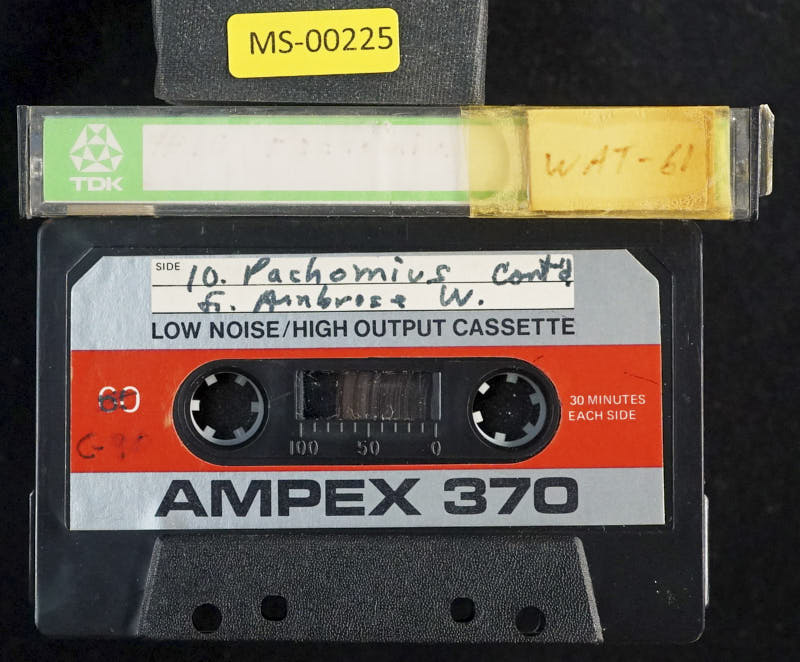
AI Vision - Possible Values from Photos:
Side: A
Speaker: Ambrose Wathen
Possible Title: Pachomius
Additional text:
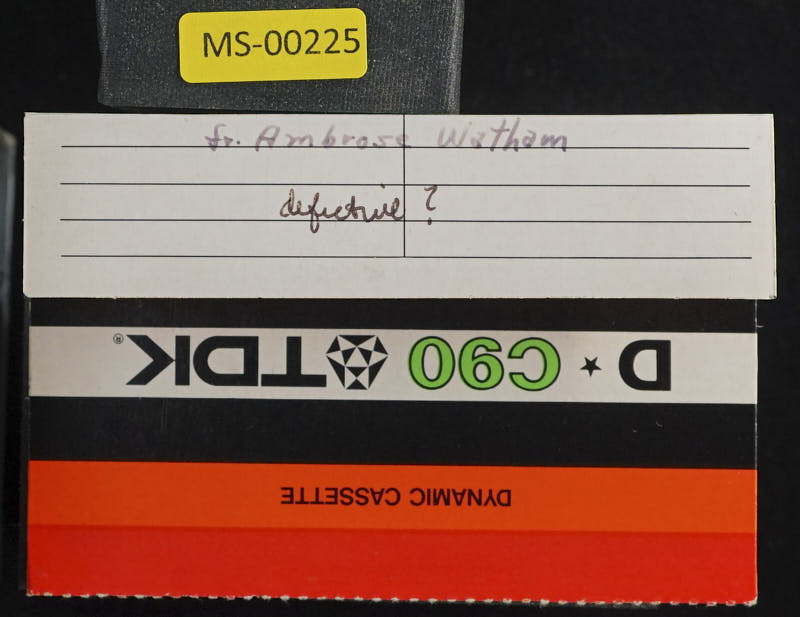
Side: B
Speaker: Ambrose Wathen
Possible Title: Pachomius Contd
Additional text: defective?
@AI-Vision_v002
this afternoon, I want to take this story from the Laoziak history, which I think is a very important story, and that's the story of Paceus and Isaias. And I'd like to read it and comment on it, and I'd like to have some of your reflections, too, afterwards. Also there were Paceus and Isaias, sons of a Spanish merchant. When their father died, they divided the estate they held. namely 5,000 coins, clothes, and slaves. They deliberated and planned together, brother, what kind of life shall we be? The prospect of monastic life pleased them, but they found themselves in disagreement. For when they had divided the property, each had in mind to please God, but by taking different ways of life. are interested in monastic life. And this monastic life is something to please God.
[01:02]
But they have different ways of life in mind. Continue the text. Now the one shared everything among the monasteries, churches, and prisons. He learned a trade so that he might provide bread for himself, and he spent his time at ascetic practices and prayer. The other, however, made no distribution of his share. but built a monastery for himself and took in a few brethren. Then he took in every stranger, every invalid, every old man, and every poor one as well, setting up three or four tables every Saturday and Sunday. In this way, he spent his money. It was quite different approach to what they're going to do. One of them gives everything away in this aesthetic life. The other one uses his money and builds hospitals and places of asylum. And so already you have a different approach to monastic life. They both talk about the prospect of monastic life.
[02:05]
One of them would be sort of a solitude, and the other one would be more service. So two different approaches. After they both were dead, various pronouncements were made about them as though they had both been perfect. Some preferred one, some the other. Notice the rivalry beginning between the descendants of these two people. Then rivalry developed among the brethren in regard to the eulogies or to their prayers. They went to the blessed Pambo and entrusted the judgment to him, thinking to learn from him which was the better way of life. He told them both were perfect. One showed the work of Abraham the other of Elijah. The Syriac version clarifies a point here. It says, one man made manifest the works of Abraham by his hospitality, the other the self-denial of Elijah.
[03:07]
One faction said, by your feet, we implore you, how can they be equal? And this group considered the ascetic the greater and insisted that he did what the gospel commended, selling all and giving to the poor, and every hour, both day and night, tarried the cross and followed the Savior even in his prayers. But the others argued heatedly, saying that Isaiah had shared everything with the needy and even used to sit on the highways and gather together the oppressed. Not only did he relieve his own soul, but many others as well by tending the sick and helping them. Tambor told them, Again I say to you, they are both equal i firmly insist to each of you that the one if he had not lived so aesthetically would not be worthy to be compared with the goodness of the other as for the other he refreshed strangers and thereby himself as well and even if he appeared to carry the load of toil he had also its relief thereafter wait until i have a revelation from god and then come back and learn it they returned some days later and he told them
[04:22]
I saw both of them standing in paradise in the presence of God. What do you think about that text? Brother Joel? Well, I think it's a good illustration that there are biblical foundations of both types of life. Equally pleasing to God depending on which one you're called to. What about from the point of view of monasticism? Which one of these lives is monastic? And I think that's the brilliant point of this story, the pluralism of monastic way of life. See, there's nothing in the story saying that one lived a monastic life and one did what we would call an apostolic life. But both of them lived a monastic life, but there's two different forms of monastic life. Which is the most perfect? But, Joe? I don't think you could take any one that was more perfect.
[05:23]
What does the story say? They were both choosing to die. Yeah, and here you find the followers of both people rivalry among themselves saying, well, this is the better way of life. And so they go to Abbott Campbell, and Abbott Campbell says, no, they're both equal. And they insist. And I think this is what you see throughout the history of religious life or monastic life. You know, this rivalry. We've got the more pure form. We've got the... the authentic way of life. Ours is the more perfect way. And the followers trying to argue that it's better. And he said, no, they're both equal. And then he says he saw both of them in the presence of God equal. So both forms of life are legitimate forms, authentic forms of the monastic way of life, which is the following of the gospel. I think it's very interesting that he says that one of them was more of Abraham and the other one more Elijah.
[06:24]
Both of them are based on Old Testament figures. Both forms of life are a realization of the Old Testament prophets. But the service-oriented life is a life which reflects Abraham because of his hospitality. See how they use the Old Testament? Whereas Elijah is reflected by the essay. Remember in the life of Anthony, where it said that the life of Anthony would be a good rear for any monk. that in the Anchoritic tradition. And here you find this Anchorite, he is represented by Elijah. I think this is a very important story showing the pluralism in monastic origins and already the beginning of rivalries, which you find especially in the 19th and 20th century. Well, not too many years ago, the Trappists and the Benedictines. We're at it. Which one is the more perfect monastic way of life? And this story just very simply solves that problem.
[07:28]
They're both equal. They're both perfect in the sight of God. That's why I think the story is important. Any observations? Well, today we want to go into Pogomis. And in Pocomius, as an introduction, I want to give you sort of a historical sketch of Pocomius. Then we'll go into the sources of Pocomian monasticism to see all the different documents that are there. Now, I've already given you the rule and the Lever Orsiace. That's just two documents from this whole corpus of monastic literature. And then we'll go more specifically into a theology of monastic life in Pocomius. First of all, Pocomius' historical sketch of his life. He was born around 292 in Upper Egypt, near Esna, to be called where Upper Egypt is in what we would call Southern Egypt, or up around closer to Ethiopia in the area of the Tavanese.
[08:39]
So he was born here at Esna, you see on the map, way up in Upper Egypt, of pagan parents. Now, this is an important point. Remember that we've made a distinction between Upper and Lower Egypt, that Pocomius' origin is in Upper Egypt, Anthony's origin is in Middle and Lower Egypt. And I think that there's a real difference in spirituality and monastic theology, which you can divide that way too. Anthony in Lower Egypt is greatly influenced by the Hellenism of Alexandria. and sees more geographically located towards Alexandria. Whereas Pachomius will stay in other Egypt, his influence will be there. And although Jerome translates a rule of Pachomius for a group of monks at Canopus near Alexandria. So notice his influence is also around Alexandria. And that's where we get this Latin translation of the Pachomian rule.
[09:40]
Jerome translated it from monks there. Pocomius' spirituality shows little influence of the Alexandrian school of origin of Evagrius, and he's much more oriented towards Sinai and Palestine. If you would go from the Tebyad and go to, well, a little bit northeast, you would hit Palestine more than Alexandria. And that's almost the axis of Pocomian spirituality, more Palestinian than Alexandrian. When he was 20 years old, and of course a pagan in the Tebead, he was conscripted for Maximum's last war against Lithinius. So this war that happens right before the end of the persecutions. And as a pagan, he was taken down the Nile and quartered at Luxor. And there with these other young men who had been conscripted for the army, he was kept overnight.
[10:42]
And Christians brought them food and drink to these young men. And that was his first contact with Christians. And he said, well, what is a Christian? And then the life says that the definition is given. They are men who bear the name of Christ, the only begotten Son of God, and do all good to all men, hoping in him who made heaven and earth and us men. So that's the definition they give of a Christian. and his first contact with Christians. Soon after that, the war was over, so these young men were released. They never had to go to Rome or overseas. And Peconeus returned to the Tebiac. And then he was baptized at Cenoboschium, which you see on your map. Now, Cenoboschium, we found out through historical studies, is a center of the Gnostic religion in Egypt in the third century. He is baptized and he promises to serve the will of God and to serve and love men.
[11:49]
This Cenoboscium, as I mentioned, is a center of Gnosticism in Egypt. Does everybody understand what Gnosticism is? It's sort of heresy in the early church, and especially Gnosis means knowledge, and they had the idea that they had some sort of special, brilliant knowledge which allowed them salvation. And it's a very complicated sort of perishing. There's many different sects. But there are many fragments of Gnostic literature discovered here at Cenoboskiun, dating from the 3rd and 4th century. Now, some people have questioned whether or not this Gnostic influence has made an influence on Poconius, whether he might be a little bit Gnostic, a little bit heretical. Certainly, it's an interesting thing that this is the milieu and the background out of which he comes. But Pachomius certainly is not a Gnostic. In fact, we find him extremely orthodox, which may tell us that it's a Catholic reaction against the heresy.
[12:57]
In 320, Pachomius found his first monastery for common life in Upper Egypt. That is a Cenobian, that's a word The Cenobium comes from the Greek word koinos bios, which means comet life. And so he founds the Cenobium at Tavanese. Now the Coptic lives, and there's many lives of Pocomius, as we'll take a look at when we see the sources, says that Pocomius spent three years as a solitary after his conversion before he established his Cenobium. So notice they say first he's a hermit, then he becomes a Cenobite. Think about the dialogues of Gregory the Great and Benedict. Benedict is first a hermit, and then the people come to him, and that's why he sets up a synovium. It's the same sort of thing that you find in the life of Pachomius in the Coptic version. However, these lives are probably very highly colored by later conditions and traditions, because Pachomius probably never was what we would call a hermit.
[14:05]
Originally, he did live under the direction of an old ascetic by the name of Palaemon. But this Palaemon was an elder who had disciples under him and underneath him, sort of a semi-Arabidical life or even in a Cenobitic life. So his first contact with monastic life was not the desert as such, but in community. Pachomius always had a Cenobitic mentality, never had an Anchoritic mentality. He wanted to serve God and man, both of them together. And if we look at his writings, there's no anchoritic mentality or spirituality. For instance, there's no indication in the writings of Pachomius that the hermit's way of life was the perfect monastic life, which we'll find in John Cashion, very strong. He said, we don't find this in Pachomius. According to tradition, an angel appeared to Pachomius and said to him, the will of God is to minister to the race of men, to reconcile them to him.
[15:12]
So God's will for Pachomius was that he ministered, that he served mankind. Pachomius taught his disciples primarily by example rather than by precept. He was a very practical man and at the same time a spiritual doctor and a pastor, a shepherd of souls. And he spent his life in service for the salvation of his brothers. So one of the things that you find in Pachomian lives is that he didn't reign, but he was a humble servant. It sort of reminds you of the rule of Benedict where it says in chapter 64, the abbot is not to preside over just monks, but he's rather to profit them. He's to be their servant, not their king. And so Procomius, in order to realize this, he took care of all the needs of the Synovians. Procomius would prepare the table. He sowed and watered the vegetables. He answered the door. He tended the sick.
[16:14]
He did all these things in the Synovians. Here the leader of the group. Because he wanted his disciples to be free from care. He wanted to do all these jobs so that they could be free from care. He says, strive, brethren, to attain that where unto you have been called to meditate the Psalms and the lessons from the rest of the Bible, especially the gospel. And I myself find rest in serving God and you according to God's command. So he says, I'll take care of the normal routine of things. You meditate on the gospel and the psalm. In 337, Pocomius moved his headquarters to Papua. down there, a little bit sort of east of Tabanisi, which quickly became the largest single monastery in the community. Now, in the whole congregation of Pocomian monasteries, there were nine monasteries for men and two monasteries for women.
[17:18]
And these were very populated monasteries. You can remember we saw in the Lausiac history there were 7,000 monks. Now probably more than that, at least Jerome says that there were more than that. Now a rule is attributed to Poconius, a rule that I gave you to take a look at. The rule we have is probably the result of a further development of the first disciples of Poconius. So it's probably written maybe by his disciples, but it certainly reflects his practical mentality. Poconius died in 346. Notice he was born in 292 after Anthony. He dies in 346, just a little bit before Anthony, 10 years before him. So he was only about 22 when he found his first monastery? Well, let me check that date. He was 20 when he became a Christian, which would have been about 310 or 12.
[18:20]
He was 320 when he found his first monastery, so he's less than 30 years old. Now in 337, when Pocomius moved to Bebou, he left his disciple Theodore, who was 30 years old, as the head of Tabanisi. So Tabanisi becomes a superior, I mean Theodore becomes a superior to Tabanisi. And Theodore was very soon acting as the second for Pocomius, what we would call a prior, the second in command, for all of the monasteries. Pocomius seemed to have wanted Theodore to succeed him as superior. But instead, due to a bit of jealousy in the community, a man by the name of Orsiasius succeeded Pocomius. And this Orsiasius ruled for 12 years. And then he asked Theodore to become his co-adjutor. And so Theodore was brought really into the organization of the superior.
[19:26]
into the administration of the monasteries. Theodore died in 368, and then Orsiasius took over again. So it's a little confusing here about the line of authority in the successors of Pachomius. The most important thing is that there were three men who were responsible for most of the Pachomian literature. Pachomius himself, Orsiasius, so I gave you a copy of the Lever Orsiasius, and Theodore. Now, later on, there's another important figure in Pocomian monasticism that you may have met by the name of Schnudy. You've read that that was a city. You'd find Schnudy mentioned there. Schnudy, around 383, became the superior at the White Convent at Atripa, which is in that general area of Tappanisi. And he died in 466. Now, Shenoudi was a rigorous and a reformer. And many people compared him to Benedict of Aniyam.
[20:28]
He was really a rigorous. For instance, there's one of the stories about Shenoudi that when a monk disobeying, they would, of course, give him corporal punishment. Well, on this occasion, they beat this monk to death. And the monks just picked him up and carried him to the cemetery and buried him. And he went about that business. But Schnuti was a very serious and rigorous person. He was not a very attractive person. So that tells us something about the life of Bercomius. Now I'd like to look at the Bercomian literature, the monastic sources of Bercomian corpus documents. The ancient sources of Pachomian monasticism can be classified in various ways. For instance, there's the lives of Pachomius, and there's all sorts of various versions of these lives, the rules, the catechesis, and the letters. The most recent and probably the best and most critical study of the sources is found in the thesis by Armand de Vuc, the abbot of Mitasani in Canada, who did his doctoral thesis in Rome.
[21:38]
in the liturgical institute. And it hasn't been translated into English yet, but it is supposed to be translated eventually. It's called the Liturgy in Procomian Cenobitism in the fourth century. And the whole first half of the thesis is a study of the sources and trying to sort them out before it goes into the theology of the liturgy itself. There's another classification which is made according to the author of the source. And this classification follows Heinrich Blocht, who is also a very known scholar in Pocomian monasticism, in an article called Pocomius and His Disciples, which is in a collection of essays called Theology of Monastic Life in French, which we have also at the library. Now, the critical editions of Pocomian sources are found in a man by the name Foum, B-O-O-N, who has a book called Pacomiana Latina, where he gets all of the Latin texts that Jerome translated and gives a critical edition of that.
[22:46]
And then another man by the name of Lefort, who has written the works of St. Pacomius and his disciples in French. Let's take a look, first of all, at the writings of Pacomius. First of all is the rule. And that rule, as you have seen, is composed of four parts, called the precepta, which we would just say precepts, the precepta at instituta, the precepta at quae judicia, and the precepta at legis. So there's four different little sections to this rule. Originally, this was in Coptic, but now we only have fragments of the Coptic rule left. We don't have a complete rule in Coptic. However, Jerome translated it in 404 in the Latin. And that's what we had. And this was well known in the West. See, 404, Canada could easily have known it. And the critical edition, of course, is in Boone.
[23:48]
Besides the rule of Pocomius, we have eight of his letters, three of his discourses, which are called Verba, and then an admonition of Pocomius. And all of these are found in the Latin of Jerome. that in the Coptic original, we find two fragments of a catechesis and some fragments of a word called the excerpta. Not exactly what the excerpta is, I'm not sure, but we do have some Coptic fragments. So that's what we have from Pocomius. With regard to Theodore, who was the preferred disciple of Pocomius and governed the whole congregation as coadjutor of Orsiasius, we have, first of all, a letter to all the monasteries, a sort of a pastoral letter to all of his monasteries. That's in Latin by Jerome and found in Boone. Then there are Coptic fragments of a catechesis. And to give you an example of that, a couple of years ago in monastic studies, they translated a little bit of one of these
[24:50]
and I'd like to read at least the first part to you and pay attention because I see if you can make some comments on it. It is the Lord who established the holy koinonia through which he made the life of the apostles known to men who desire to be like them before the Lord of all forever. Indeed the apostles left everything behind them and went after Christ with all their hearts. They were constant with him in trials and they partook in his death on the cross. Hence they deserve to receive places on the 12 thrones of glory and to judge the 12 tribes of Israel. What strikes you in that text? Anything? Monasticism as a suffering experience comes. All right, and the sufferings of the cross of Jesus Christ. Remember in the rule of Benedict at the end of the prologue, you will participate by patience in the monastery. through perseverance in the monastery in the sufferings of Christ.
[25:54]
So that's one of the ideas. What is the basic model of monastic life according to that text? Christ? No. The Apostles. The Apostles. The monastic life is the apostolic life. And notice he calls it, and this is a word we're going to come up with, the holy koinonia, the holy fellowship. a group of believers and of course the idea of koinonia is a very biblical concept but here he says it is the lord himself who established the holy koinonia and what is the holy koinonia it's through this koinonia of fellowship the life of the apostles is known to man so the holy koinonia which is the monastic way of life which the lord has established is that which allows us to know the apostolic way of life and through the apostolic way of life then we are like them who follow the Lord forever. And so like the apostles, we leave everything. We go after Christ with all our hearts. They were constant with him in trials and partook in his death on the cross.
[26:59]
And thus they deserve to share in reigning with him over the tribes of Israel. Notice the theology of monastic life here, the apostolic life, which we'll see in John Cashin. He has the myth of the apostolic origin. of the centipedic life in two places in his works. But here you see that this understanding of monastic life for Theodore, for the Pocomian monks, was that it is the apostolic life founded by Christ himself. We are living the life of the apostles. We are doing the same things they did, leaving everything, following Christ, sharing in his death. That would tend to somewhat exclude the... Anchorite in white, isn't it? Well, see, one of the things about the Comunic literature, they're not concerned about the Anchorite. Well, I mean, just from what was saying there, it would seem hard to fit the Anchorite into that. And that's why, when we get to Basil, you see, Basil has no use for the Anchorite in white. Because he said, how can you live your Christian communion alone?
[28:02]
And so he said that there's no ecclesiology in that. Suggesting, this is what Basil was saying, there is no ecclesiology for the Aramidic life. Therefore it can't be the most perfect. And then he continues in this little phrase, from the newest to the eldest, let us observe the precepts of the man of God, Apopachomius. Now we've got to observe his precepts. The first he said this is the apostolic life and what it means. Now how do we fulfill that? By fulfilling the precepts of Apopachomius. Let us observe the smallest ones as well as the greatest, so that we may all be granted mercy. For he, Piconius, labored greatly, and even those who were shameless were ashamed before such a man. Let us remember that he spent 38 years without any respite, night and day, according to what we have heard. Let us observe his precepts in full conformity to the law he imposed on us. Let us love the life of our Father so that we may share in the glory God has reserved to him in the world beyond and forever.
[29:14]
Notice the emphasis on fidelity to tradition. Pachomius has set up the way of life. We are to follow it. And just as he entered into glory following this way of life, we will enter into glory. But the whole fidelity to tradition, which the rule is the articulation of. So it tells us something about the meaning of the rule. in the monastic way of life. This is what we would call the writings of Orsiacius. After 346, which is the date of Pocomius's death, she became the Abbot General for 12 years. Then he died in 387. After the 12 years, Theodore became the poor ruler, and then later on Orsiacius became Abbot General again. Now we have in the collection two of his letters in Coptic, a number of catechism in Coptic, regulations in Coptic, and this regulation is probably a commentary on the rule of Pachomia, that's what we could call it.
[30:16]
We have a dialogue between Orsiasius and two deacons from Alexandria, and then we have the Liber Orsiasis, in Latin by Jerome, which is sort of a spiritual testament which is invaluable for understanding Pachomia and monasticism. category would be the lives of Pocomius. And here we must use these lives with great caution. Now in your book that you read, Joe, on the Paradise and the Bodies of Anonymous, there was a section of Pocomius in there. But that's a tradition of the life and also to some extent of the rule, a Syrian tradition. Viliou has an excellent treatment in his thesis on these various lives. There are Greek and Coptic versions which are available in excellent edition. namely men like Halkin and, again, the fourth. Now, we don't want to go into the lives because it's an awful complicated area. There are lives in Arabic, Syriac, Coptic, Greek, and some even haven't been translated into Latin.
[31:19]
And there's various, various in these lives, and it's a very complicated area. Notice from these four categories how wealthy this tradition is. It's just got an awful, this ancient monastic tradition, which has all of this source material for it. And it's only in the last few years that people have really become interested in Poconian monasticism, and have broken down a number of the prejudicial statements that have been made about Poconians. But a person who's studying in monastic sources today, the end thing is to study Poconians. One of my great desires to learn Coptic so that I can read some of the Coptic literature. Someday maybe I'll be able to do that. Right now I have to stick to the Latin text and the Latin English translation. I want to make some further observations on these sources now. First of all, the rule. This rule was originally written in Coptic and about a fourth of it remains in Coptic fragments.
[32:24]
The early Greek translation from Coptic to Greek from which Jerome probably translated into Latin has completely disappeared. In 404, Jerome translated this rule into Latin for the monks of Pocomius who were following Pocomian monasticism northeast of Alexandria at Canopus. He probably translated it from the Greek text, which is gone. Now this rule had a great influence in the West. For instance, in the West we find a rule called the Regula Orientalis, which is also known as the Regula Vigilius. Now, Regula Orientalis, the Eastern rule, probably because it reflects Pocomian rule and Eastern rule, and it's called the Regula Vigilius, or the rule of Vigilius, because it has been attributed to the deacon Vigilius. This rule, this Regula Orientalis, or Regula Vigilius, shows a strong literary dependence on the rule of Pocomius, the Jerome translated into Latin.
[33:31]
In fact, almost one-fourth of the text of that rule is word-to-word of the rule of Pocomius. This Regula Orientalis was written in Gaul, in France, around 420. But he was born before Jerome translated the rule of Pocomius. The Oriental rule uses it already in 420 as a Western rule, so we see the influence of the Pocomian rule in Western monasticism. The rule of Pocomius also influenced Cesarius of Aries, who wrote his rules between 520 and 534, at the same time as Benedictus writing. It also, the rule of Pocomius, influenced the rule of Benedict, neither itself or through the regular oriental, and probably itself, because Don Cuthbert Butler, in his citation of sources for the rule of Benedict, indicates 26 passages of the rule of Benedict that are indebted to the rule of Poconius.
[34:36]
Now this is a source for the rule of Benedict, which I think it's important for us to look at. Benedict of Anian in the ninth century gives us the text of this ancient rule in his collection of the various fathers. Rules of the Various Fathers, and in his Concordia Regularum. He's famous for two works, Codex Regularum, which is a collection of rules, Codex of Rules. So he collected all of the ancient rules, one of them being the Rule of Pacumas. He also has what he calls the Concordia Regularum, in which he goes through the Rule of Benedict, and after each text of the Rule of Benedict, he gives all of the parallel citations from ancient rules. Now this, of course, is in Latin, but it's a very interesting text to take a look at. Jerome's text, as I mentioned, consists of four parts. The precepts, the precepts and institutions, the precepts and penal statutes, and the precepts and the laws.
[35:38]
Altogether, the rule has 193 sections of paragraphs. If you've read them, most of them are pretty short. Some of them are rather long. For instance, in the precepts and institutes, 18 is about a page and a half, which is a rather peculiar pair of that compared to the rest of them. And these deal in detail with the conditions of monastic life. Now, I'd like to give you a brief analysis of the four sections of the rule according to Armand Ilyut. And this is following up. Now, this is disputed by many people, and it's questioned whether this is the best explanation for the Lula Pocomius or not. The precepta, the precepts, consists of 144 paragraphs. And Bilyeu says it's easy to distinguish independent groups of precepts. And these have just merely been juxtaposed or stuck together.
[36:42]
He says there are one, two, three, four, five, Six groups of precepts just stuck together. And he says all of these groups terminate with a conclusion that is quite similar. So if you brought your rule, take a look at precept eight. And there you see these life-giving precepts have been handed down from our superiors. These are the precepts which our superiors have handed down. That's almost a different statement than what it continues later on. Just as these eight have been handed down by our superiors. Look at 14. And concerning these, everything that's gone before, if anyone has forgotten or hesitated to say something, that one shall be corrected for neglect and forgetfulness. So he says, These are the precepts which one is correctable.
[37:43]
Now, in age, he has the same idea of correction, but it's a correction. See, if in the time of singing or praying in the middle of the reading, someone should speak or laugh, let him immediately loosen his belt, and with a bowed neck and hands, press down, he shall stand before the altar and be rebuked by the head of the monastery. And this is the same thing that is to take place when they are gathered for eating. So it's sort of keep all of these precepts or this is going to happen to you. That's the same thing you read in 14. Keep all of these precepts that have gone before, or you will be corrected for neglect and forgetfulness. Look at 22. The last sentence. The person who neglects one of these commands shall be subject to the above-mentioned correction. So the next little group, you've got to keep them, or you're going to be subjected to correction. 48. If any of these orders or precepts has been overlooked or neglected by anyone, let him be corrected by rebuke only. Notice how the same thing is coming up over and over again.
[38:45]
103. It's a big jump there. If anyone has allowed his garment to be in the sun past noon, he shall be rebuked for the negligence when the brothers are called together. Then, if anyone has scorned contemptuously any of the above rules... shall be corrected within a fitting with within a fitting referendum the same thing and in 144 the last one whoever passes over any of these commands contemptuously and with no doubt of negligence shall do penance so that he shall be strong enough to possess the kingdom of heaven you see what he's pointing out that these are the same thing and then he said these are indications that these are just little collections that at the end of the collection always says These are the precepts that have to be kept or you're going to be corrected by it. And so what this is is a collection of these little pieces all put together. These six precepts all refer to the precepts which immediately have preceded them and say that they must be kept.
[39:54]
And anyone who fails to do so is to be punished. Thus he says there are six groups of precepts in the precepta. He says from one to seven, Describe the attitude of the monk at the synaxis, or the assembly of prayer. What he also says in the Latin text, the collecta. Now, I've been doing some analysis of the rule, and I'm going to show you another approach to this, which this is the basis of my own approach to it, but I think it gives us some sort of clue to how to approach this rule. So whether it's exactly correct or not isn't a question, but I think it's showing a good methodology. He says one to seven then has to do with prayer. So when you read these things, you see, then you can see that in that context, they all have to do with coming together in common prayer. Then eight to 13, again treats of the synaxis or the assembly or the collector in general and the satisfaction of those who come late, what satisfaction they must make.
[40:59]
14 to 22, concerns the synaxis or the assembly on Sunday and the catechism. So really you could say that from 1 to 22 is all about the synaxis with three little separations in it. But that's all. If you read from 1 to 22, remember you're reading about the collective, the synaxis, and also the disputation. And that make more sense as you read some of the things because you're, well, how does that fit in there? Then from 22 to 103, two sections there, treat of various questions, the duties of the weekly servers, meals, sleeping, guests, many different things. Then 104 to 144 seem to have been a later addition, developing a number of preceding precepts, so it's tapped on. Take, for instance, a look at precept 40,
[42:00]
which is in the first part, and keep your finger there, and then look at 105. See, 40 says, if infirmity is given as an excuse, the prior of the house shall approach the service of the sick, and from them he shall obtain what is necessary. Then look at 105. If any of the brothers has been injured or struck, and then will not lie down on the small couch, but walks around while injured, If that sick one has a need for anything, especially for clothes or a cloak or any other utensil, the prior of the house shall go to those to whom the garments of the brothers have been entrusted, and he shall take and give. And when the sick one is healed, he shall return those things immediately. Basically the same concept. The superior is supposed to take care of the infer. And there are a number of indications of this kind of repetition in this last section. Now, in each section, there is a general tendency to pass from one subject to the next, not with any rigorous logic, but merely an association of ideas.
[43:11]
And one of the things I'm trying to do now as I go through this rule is trying to see the big blocks in a better perspective. And I think I've almost got it, which I'll share with you the next time. And I think it shows you how that one thing sort of leads to the next. As Viliou points out, for instance, There's a section from 27 to 39 on the refectory and nourishment in general. So from 27 to 39, it talks about eating and the refectory. And this leads right then to the nourishment of the sick, and from that it leads to the sick in general, in 40 to 48. See how the progress goes? Talk about nourishment and food. When we talk about feeding the sick, then we treat the sick. In the same way, the paragraph on the admission of postulants, which is number 49, which is a very beautiful paragraph, and you could compare that with chapter 58 of the rule of Benedict, that passes on to the admission of visitors.
[44:13]
So you admit somebody in the community as a monk. Now what do you do with visitors? So you go to 50 about visitors. Then you have the question of visits in general from 51 to 53, followed by the question of home visits, And that goes on into the question of going outside of the monastery to work. Be outside of a strain of consciousness, a strain of consciousness here. So that takes care of the precepts. Now let's take a look at the precepts and the instituta. Here we have a prologue and 18 paragraphs. And these 18 paragraphs of the precepts and institutes are addressed to the weekly servers and to the head of the house. So it's addressed to what they call the prepositus and the hebdomadarians. And these heads of the house and the weekly servers are responsible for convoking the synaxis, or the assembly, and for organizing the common work of the brothers.
[45:22]
So that's what this section is going to treat. This section begins with a very beautiful spiritual prologue. And here's one of the areas in the rule of Pachomia that you find some spirituality sort of articulated, which we'll take a look at as we go into the theology. And then it goes into a series of precepts, which all have begun with the phrase that you see at the end of the prologue, this is the ministry or the service which the ministers of the church ought to fulfill. So these are ministers in this little church, the holy church, the holy koinonia. The precepts that follow are taken from the sections of the precepts, where it was a question of weekly servers. So what it does is take out the weekly servers precepts and put them all together. And also from another section called the precepts and the judgments, which comes up later. So what this section really is, is drawing from that first section of the rule and the third section of the rule and putting them in one place.
[46:26]
And they all refer to the house master. and to the weekly service. So it may be a later development. That's to you's point of view. Now there's an argument on that. Another scholar maintains that the precepts are the first, and the others are later additions, repeating the precepts. The other scholar maintains just the opposite. And it's a woman, and she says that the precepts and institutes, precepts and laws and the precepts and judgments are the first original rule, and the precepts repeat them. Dear friends, do you remember that when we were discussing Psalm 3, verse 6, I lied down? For instance, precept 18, precept in Instinct 18, is so different than anything else that we find in this rule.
[47:28]
he says it must come from a different milieu in fact this precept institute 18 is almost what we would call a little catechism especially this end part of him where he curses the people who don't obey this thing the terminology is quite different in the precepts and institute than it is in the precepts for instance in the precepts the weekly server is called the arconomos or the hebdomadaria And the head of the house is called the provost, or prepositus. Whereas in the precepts and institutes, the head of the house is called the iconomos, what the weekly server was called in the first one. And the weekly server is called the deacon or the minister. So there's a difference in terminology, and this is all part of the problem of analysis. Now we look at the precepts and judgment, the third section of the rule. This is a prologue and 16 paragraphs.
[48:31]
In a very synthetic and well-constructive way, this presents sort of the penitential or penal code, which contains elements already found in the precept. So you take out the penal aspects and put them all together in a penal code. For instance, in the precepts, one finds that satisfactions are demanded for failures and faults at prayer, at table, and at work. And this is the basic germ for the development of penal code. And this code shows then a further evolution and development and is later than what is found just in the precepts. Now this is all Desu's argument for the development of this. We could compare this penal code with sort of a penitential code that we find in John Cashin in Institute's book four. So monastic rules generally have a penal code in it. the rule of Benedict as a penal code, because there's two sections to the penal code in the rule of Benedict. Finally, the precepts and laws, 15 paragraphs, which are very similar to the precepts and judgments.
[49:38]
They collect and develop the precepts on the domestic synaxis, or the assembly, and on the head of the house, and are later development and product of evolution. For instance, if you look at Institute 17, and then look at Laws 14, you can see what he would call an evolution. Laws 14 and Institute 17. Notice in 17, if all the brothers who are in one house have seen the prior being too negligent or correcting the brothers harshly and exceeding the measure of the monastery, they shall refer this to the father and he shall repute them. So if there's some sort of grievance against the spirit.
[50:38]
Now notice the development in 14. If any one of the brothers is sad because of the prior of his house, or if the prior has a quarrel against one of the brothers, brothers of a proven faith and conversion, it's a very interesting statement, probate conversatio nis et fidei, which we discussed this summer with the God de conversatio, and it's a phrase sort of used by the Reel of Benedict, ought to hear them and judge between them. But if the father of the monastery is absent or has gone on a journey, they shall wait for him unless they see that he is delayed outside for a long time, in which case they shall proceed to judge the case between the prior and the brother, lest sadness arise because the judgment has been suspended too long. Now, it's the procedure that they're saying now. And the prior and the subject and those who are the judges shall do all things according to the fear of God and do nothing which would give occasion to any discord. See, there is obviously a development.
[51:40]
if the abbot or the father is gone, you can still go through this process, and you can get brothers of good repeat, which are the judges in this case. With regard to the catechesis, now all three men, Pogomius, Theodore, and Osasius, have left us catechesis, of which at least there are fragments. And one of them, I read to you, the catechesis of Theodore. These may be examples of the so-called disputatio, which is given three times a week by the provost. Look in your precepts. 19. In the morning at each house, after the prayers are finished, they shall not return immediately to their cells, but they shall discuss among themselves what they heard the priors discussing, and then they shall go to their cells. So the seniors, the provost, the propositus, gives a discussion, a disputatio, a catechitis, and as they go back to themselves, they discuss along the way.
[52:47]
So they share a reflection. Look at 20. The priors of all the houses shall have three discussions each week, three conferences each week. And whether they are sitting or standing in these discussions, the brothers shall not change the order of seniority. according to the order of the house and the man within the house. 21. If anyone has fallen asleep while he is sitting during a talk given by the prior of the house or the head of the monastery, immediately he shall be compelled to rise and shall stand for a time until he is told to sit again. Sounds like one of the techniques in the seminary of old days or in classroom technique. And 22. When the signal has sounded for them to gather and hear the commands of the superiors, no one shall perish. Now, Terry, nor shall anyone light a fire before the discussion is finished. The person who neglects one at his command shall be subject to the above-mentioned correction. But those treat of this three times a week conference by the superior.
[53:49]
Chitty says in The Desert of the City, Within each monastery, three weekly instructions or catechesis would be given by the stewards. one on Saturdays and two on Sundays, and two on Wednesdays and Fridays by the housemaster. So he says different people give them. So on Saturday and Sunday, it's the stewards of the hebdomadarians, but on Wednesdays and Fridays, it's the provost or housemaster. He also says those of Pachomius are marked by their intensely scriptural character. For instance, there is one recorded in the Vita Primar, the first life of Pachomius, in chapter 56 and 57. simply gives a series of scriptural quotations as the heads of meditation on the central dogmas of the faith. At the end, the leader would rise up to pray with the brothers that they might ever remember the word of God unto salvation. And each would return to his own house in silence, meditating what he had heard and getting it by heart.
[54:54]
So basically what it is, is the exposition of sacred scripture. And one of the things that is discovered in the catechesis is that the predominance of sacred scripture. Now, if you've read the Hebrew Orsiasius, which is sort of a big catechesis, you notice over and over and over again, the citations from sacred scripture. And that's the basis, basic content of these catechesis. It tells us something, I guess, about the methodology of monastic conferences. It's sort of a foreign age in those scripture texts, for this present community, which tells us something about the theology of homelands and preaching. Isn't it kind of strange, though, that there's scripture is hardly ever. That one last section is the only part where I saw scripture quoted in the rule. Actually quoted, yes. But for instance, now in that 18th, That last section of 18, that's just heavy with scriptural allusions.
[55:55]
And there are a number of scriptural allusions in the thing, but no quotation of scripture, no. I was just, you know, the earlier, like Benedict and Master and sources will always, you know, use that as direct quotation basis for what they're doing. But see, you've got to understand the literary form of this rule. It merely is trying to articulate little details of what to do. And a lot of it is based on a scriptural doctrine, but they don't spell it out. See, Benedict and the Master are a rule in the sense that they not only give details, but they give a theology and a spirituality of an active life. It's a later development. Whereas this is very primitive. What you find here is you find the rule with the details. You find the catechism giving the spirituality. Benedict and the Master have combined these two forms into the one rule. And that's why it's very important for Pocomian monasticism that you can't just go to the rule, but you've got to go to the Liber Orsiaceus.
[56:57]
You've got to go to these catechesis. So, for instance, our methodology would be to go to the rule and to the Liber Orsiaceus, not prepared to go to many of the catechesis. But anybody who does studies on this usually quotes from all of these different sources to see the full picture. That's why the sources are very important. And one thing could be misrepresented, really. We understand it in the full context. Now, the next time, we'll take a brief look at the Libera Orsiasius, and then we'll start going through an analysis of the rule and the Libera Orsiasius, and seeing what kind of theology of monastic life we can gain from these documents. I find pocromial literature just Well, I'd be thrilled.
[57:48]
@Transcribed_UNK
@Text_v005
@Score_93.89