You are currently logged-out. You can log-in or create an account to save favorites and more. more info
Pacomius: Scriptural Foundations of Monasticism
AI Suggested Keywords:
Early Monasticism
The talk delves into the theology of monastic life according to Pacomius, referencing articles by Heinrich Bacht, which examine Pacomian contributions distinct from both Antony and Basil. It explores three main aspects: the foundations of monastic life, its goals, and practical aspects of implementation. The discussion emphasizes Pacomius's role in formalizing monasticism through a balanced rule that upholds individuality, scripture's paramount importance in monastic piety, and the distinct nature of Pacomian spirituality compared to the Evagrian and Cassian traditions prevalent in Western mysticism.
Referenced Works:
- Pacomius and His Disciples in the Fourth Century by Heinrich Bacht: A pivotal study illustrating Pacomius' influential role in monastic traditions distinct from those of Antony and Basil, highlighting Pacomius as a central figure in developing coenobitic life.
- The Law of Return to the Sources by Heinrich Bacht: Explores certain aspects of Pacomian monastic ideals, presenting a spiritual framework reliant on scripture, contrary to the philosophical focus prevalent in other monastic traditions.
Other Important References:
- Vita Actualis or Vita Activa versus Vita Theoretica: Discussed in relation to Evagrian and Cassian mysticism, these terms delineate the monastic progression from active virtue cultivation to contemplative life, contrasting with Pacomian practice.
- Evagrius Ponticus and John Cassian: Referenced for their development of Western ascetic and mystical thought, forming a backdrop against which Pacomius's distinct, scripture-focused spirituality is examined.
- The Rule of Pacomius: Highlighted for its focus on spiritual experience underpinned by biblical precepts, forming the basis for communal monastic life that values individuality and scriptural meditation.
- Liber Orsiasius: An essential text used alongside Pacomian rules to further understand the spirituality and theological underpinnings of Pacomian monasticism.
The themes discussed elaborate on the careful balance Pacomius maintained between regulation and personal spirituality, emphasizing the differences with contemporaneous Alexandrian influences while asserting a tradition of scripture-centric practice and monastic living.
AI Suggested Title: Pacomius: Scriptural Foundations of Monasticism
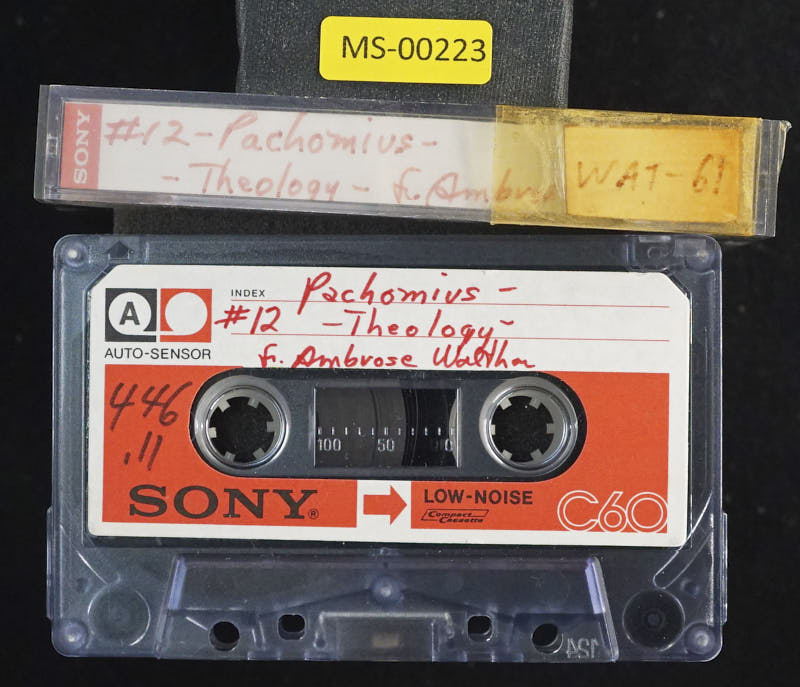
AI Vision - Possible Values from Photos:
Speaker: Ambrose Wathen
Possible Title: Pachomius - Theology
Additional text: #12
Location:
@AI-Vision_v002
We're ready to go into the theology of monastic life according to Pachomius. Now, what I'm going to give you is the articles by a man by the name of Heinrich Bauch, D-A-C-H-T, and he's one of the important Pachomian scholars. And he wrote an article called Pachomius and His Disciples in the Fourth Century, which appears in a very fine volume of Theology of Monastic Life, which is a study of various fathers. I'm sorry, but it's in French, but it's got some excellent articles in it, and I've used it on a number of other occasions. And then he's got another article, which is a sequel to that article, called The Law of Return to the Sources, or Certain Aspects of the Monastic Ideal of Pocomius, and that's in the Revue Maupignon, which is also a French article.
[01:02]
Now, I put the two articles together so that you have the whole perspective is that there are three main points. The basis of monastic life, and then secondly, the goals of monastic life, and then thirdly, monastic themes, or the practical aspect of monastic life. So those are the three main points. The basis, and then it goes into formal and material principles, and then the goals, and then the themes. One of the things that he begins with is it's saying that a lot of monastic historians have always considered Pachomius as sort of a bridge between Anthony and Basil. And this has been based upon the translation of the rule of Pachomius by Jerome, so this may have been what influenced Basil and got into Palestine, into Asia Minor. But modern studies have shown that this is not a good explanation, that probably Basil didn't really know Pachomius.
[02:04]
And Brazilian Cenobitism is almost an independent phenomenon from Pachomian Cenobitism. And so you don't have Anthony, Pachomius, and then a full flower named Basil, and carried on Benedict. That's not the kind of movement that you have to take. That Pachomius stands in his own right, really, and so does Basil. One of the things that we see in Pachomian literature is that Pachomius is compared to a great legislator like, for instance, in the Old Testament, like Moses. And even though in the Pachomian literature it seems as though they accept that monastic life was founded before Pachomius, it's really Pachomius who is going to formulate it and legislate for it. And he is the one then who really gives enthusiastic movement to synobitism. But he's not the one who begins it and then Basil picks it up.
[03:05]
That's one of the points that's being raised. In his own right, he is a developer of synobitism. The rule shows that Pachomius was a very practical man and also a man of action and that he knew how to be balanced in his judgments. between the extremes of regulation and severity and also laxity. So it would be incorrect to characterize Herodipokomis as being over-rigid or over-extreme, because it certainly isn't in the time in which it's written. And he shows a great respect for individuality. Now, the rule is not a theological document. Remember, when we look at Pocomian monasticism, we have to look to the Liber Orsiesius for the spirituality more than to the rule. But the rule does presuppose a spiritual experience and a certain theologizing which underlies it. So we can reflect upon it that way.
[04:06]
But it is especially with the other documents like Catechesis and the Liber Orsiesius which we fill out the spiritual theology of Pocomians. So when we take a look at the monastic theology of Pocomius, all of these things will be considered. Now, Bach, in his articles, refers to the rule, the various catechesis, which are in Greek and in Coptic and Latin, and also the Liber Arsiasius. Now, I didn't have a copy of the catechesis, so I had to sort of keep that out of our discussion. And just, we'll look at certain texts in the Rule and in the Libra Orsiaceus. But remember that Bach uses the fullness of the Pachomian documents. He says there are three points which show the importance of Pachomian monastic piety and also the permanence of these values. And the first important point is, which we'll see more in detail later, is the close relationship
[05:13]
of the spiritual ideal of Pachomius with sacred scripture. And this, of course, is a perennial principle that monastic life is based on scripture. In contrast to that, the reformers of the 16th century claimed that monasticism was based on roots outside of and foreign to sacred scripture. And that's one of the reasons the reformers rejected monasticism. because he said it's not in Scripture. It's not based on sacred Scripture. But if we look at Pachomius and his disciples, we see that they not only cite sacred Scripture and know it, but their whole purpose of life is to live by it and to follow the directions of sacred Scripture. It's definitely based on sacred Scripture. And in this, Pachomius is in keeping with Basil and all of monastic tradition. The second important point about Pocomian monastic piety is that these writings are still relevant because they show a similarity to the question of monasticism in the church today and throughout history.
[06:27]
So some of the same things they struggled with and their relationship to the whole church are still questions that we have to struggle with. And many of the traditional founders of religious orders have appealed to Pocomius. Even people like Ignatius of Biola had a great respect for the Egyptian monks and for Pocomius. The third important point, which I've mentioned to you before, is that Pocomian monastic writings put us into contact with a spirituality which is different than the spirituality around Alexandria, what we call Antonian spirituality. It's a different type of spirituality. Around Alexandria, in the desert of the Skeet, and in Nittria, in the desert of the cells, Antonio monasticism is more or less Hellenized, or Christianity which has been Hellenized, which uses philosophical concepts for its development of spirituality. Now, the one who has really fully developed that would be people like Evagrius of Pontus and John Cashin, which is in its scriptural spirituality
[07:38]
greatly influenced by Greek philosophy. Pokromos puts us into another type of spirituality. He is not influenced, at least to the extent of those Narvanians, by this Greek philosophy. In fact, we find in Pokromian texts a rejection of what we call originism, the theologian of Alexandria, on whom all of these people depend. And so this puts us in another type of spirituality. For instance, Evagrius is the incontested master of the Syrian and Byzantine mysticism, and has greatly influenced the mysticism and asceticism of the West. This is one of the things that we've discovered in the past few years, that our spirituality in the West is basically Evagrian, Cassian spirituality. Now we see a new spirituality, a different spirituality in Bacomian spirituality, which tells us that this isn't the only spirituality that is valid for asceticism and monasticism and religious life.
[08:45]
Let me make sure that this is clear. Bacomian monasticism stands apart, an uninfluenced by Antonian spirituality, which has influenced Evagrius, Cassian, and which Western... Western mysticism has its roots in John Cashin, Evagrius, Anthony, that whole school. And really has been sort of predominated by this whole system of spirituality. Poconius is a different spirituality than that. He doesn't fall into that same school. And that's why he's so valuable to study. The difference in spirituality is in the... difference between the Centrobedic way of life and the Arametic way of life? No, not totally. And some of the points, for instance, I hope that we'll point out the difference, where there's a real difference. For instance, there's one thing that is different. In Evangelius and in John Cashin, when you study, especially John Cashin, you get into this theme of the vita octualis, or vita octiva, or the active life, as contrasted to the
[10:01]
what is the word they use, the theoretical life. So you have the practical life and the theoretical life. Now these are technical spiritual terms. The active life is the life of virtue. The theoretical life is the life of contemplation. You pass through the active life to the life of contemplation. And this is the basic... schema or pattern that you find in most Western mysticism or most Western spirituality. And for instance, take an example. I'm sure you've heard of the spirituality, the three stages of spirituality. The purgative way. What is the next one? The illuminative. The illuminative. And then what does it define? The unitive way. That is basically evadering, cation mentality. You purify yourself on vices, then you get illuminated by by the wisdom of God and take on virtues, and finally you end up in union with God.
[11:04]
Now, I'm not saying that's a wrong category, but that's only one category of thought. And that was, in many ways, based on Cashion and Evagrian system of spirituality. Another very important concept in Evagrian Cashion spirituality is apathia or detachment. Evagrian Cashion spirituality. The classical term, apathia. This is what you try to get. That detachment from all sorts of emotions and everything else that you just were in God's hands and whatever he wanted to do with you, that's fine. I'm not condemning that, Joel. Apathia. We have a little apathy. Apathy. Apathy is the English word, but that gives the wrong nuance to what this word really means. Apathia means without passions, without emotions. Detachment, I think, is the better word.
[12:06]
Now, this is strong in Western spirituality, even in somebody as contemporary as Francis de Sales. Don't ask for anything, don't refuse anything. The famous dictum of Francis de Sales. But this is the basically Evagrian, Cassian theory of apathia. Now, we don't find these terms nor this emphasis in Pocomian spirituality. That's the point that this man is making. And as we go through, maybe some of this will come out a little bit clearer, you know, what the emphasis is on if it's not on this. See, it's not, for instance, that Pocomius knew the concept of apathia and says, well, I don't like that concept. I'll develop another. It's just that he was unaware of it. because of this rejection of that whole school, that whole Alexandrian school. So they didn't develop spirituality in the same categories, with the same mental construct.
[13:09]
It's a different mental construct. That's what's so revealing about the thing. Now, it doesn't mean that Pogomius wasn't influenced at all by Alexandrian theology. because there were close contacts between Poclonian monasticism and Alexandria. For instance, the boats going up and down the Nile, and there was close contact with the patriarchs of Alexandria. But Poclonius doesn't take on their theological tendencies to the same extent as the people in northern Egypt does. And besides that, Evagrius came to the Sceet up around Alexandria in 382 and lived there until 399. Well, Pocomius and Theodore had already been dead for some time. So they're not going to be influenced by Evagrius, who influences John Cashin, as the writings in the north are going to be influenced. Now, true, the life of Anthony is before that, too.
[14:10]
But the sayings of the fathers and John Cashin, Palladius, these people are all after Evagrius and influenced by him. Thus it is not by chance, says Bach, that the categories which are so characteristic of Evagrius, for instance, apathia, another one is hesychia, which we have the term hesychism, which means the ones who, well, it's a, the hesychists are prayers, and hesychism means tranquility, quiet, silence. So the whole prayer of silence fits into the hesychist tradition. The hesychist tradition is one that develops very strongly at Mount Sinai, not Athos, in about the 12th century, or even earlier than that, with Gregory Paulimus. But in the Oriental Church, you have the Hesychist monastic tradition. Well, this term, Hesachia, comes from evadrius, tranquility, quiet, peace, silence.
[15:15]
Also, the distinction between praxis and theoria, which is so classical in John Cashin, And which, of course, many people say, then you see in the rule of Benedict. And that's where it gets complicated because they say, well, then the Cenobitic life is the active life which prepares for the theoretic life, which is the Aramidic life. So the Cenobitic life is a prep school for the Aramidic life. See how all that is tied up together. Is anything that's making any sense so far? I mean, it's coming across to you where it seems to be a bit more complicated all the time. So, I think it would be very good for us to take a closer look at Bacomian spirituality and see just what its spirituality is about. Now, in doing this occasionally, maybe we can make some comments about how it is different from the other, but that's not the primary purpose. It's not going to be a comparative study. It's just looking at Bacomian spirituality in itself. The first point, then, the first major section is the foundations or basins
[16:23]
of monastic life. And under there we have two main sections, what we call formal principles and material principles of Pachomian spirituality. Now, formal principles means the things which give it its form, give it its shape, and the material is the stuff that it's made of. So when we look at the formal principles, Bach says there are two things which give it its shape or form, and that is scripture and tradition. That's what really gives a shape and form to Gokomian spirituality. When we get to the stuff that it's made of, or the material principles, he's going to talk about three. One of the contents of the spirituality is the image or concept of God, then the idea of who man is, and then an attitude towards the world. So do you see the difference when he's saying formal and material? Let's look at the formal first. the shape, the form, which is given to the spirituality.
[17:27]
First of all, sacred scripture. Scripture played a very important and essential role in all of ancient monasticism. And Pachomian spirituality, which is anti-Evagrian, is impregnated with the Bible and is almost unilaterally dependent on sacred scripture. If we look at the rule in the precepta, we find that this is put into practice by recommending that the monk memorize scripture and meditate or recite biblical texts. So the monk had to learn scripture by heart. Look at Precept 13. See, it's the house... We saw that text before in their prayer service.
[18:34]
They have to be able to just spill out something from memory from sacred scripture. So you better have it in your mind when you get there. And you don't just, on the way to church, you don't memorize a text. but you've got scripture just pouring over in your mind so that when you come to prayer, you just recite a text. Or look at 49, which we saw before too. When someone comes to the cave of the monastery wishing to renounce the world and be added to the number of the brothers, he shall not be at liberty to enter. And then notice he's kept at the door for a few days and there he's taught the Lord's prayer and as many songs as he can learn. So he already begins memorizing this altar as soon as he gets there. And in 122, while they are sitting at home, they are not permitted to engage in secular talk. But if the housemaster has taught something from Scripture, they ought, on the other hand, to ruminate on it among themselves, relating what they have heard or what they can remember.
[19:43]
So they sit there ruminating on what he's taught them from sacred scripture while they're sitting in their little cells. Then 139. Here that refers again to a person who's just come to the monastery like 49 did. But notice here it specifies more of a quantity what he has to learn. The person who comes to the monastery uninstructed shall be given... 20 psalms or two of the apostles' epistles or some other part of Scripture. And then you see he's made to learn to read so that he can read the sacred Scripture. And then look at 140. No one whosoever shall be in the monastery who does not learn to read and does not retain something from Scripture. The minimum is the New Testament and the Psalter. So here we see that Scripture is not only the basis of the rule, but it's the very meat of the monk's daily life, what he's supposed to be reflecting upon.
[20:47]
And I think we pointed out before in the Liber Orsiasius in 51 and 52, the same thing comes up at the end of Orsiasius' testament. See, let us have a care for the reading and learning of the scriptures. and let us always be engaged in their meditation. So both of those texts, 51 and 52, are on this constant meditation and learning of sacred scripture. Now, meditate on scripture probably means a recitation of biblical texts rather than what we would call mental prayer. And this is what we find in ancient monastasism. Meditare usually has the idea that you are mumbling a text of sacred scripture. just repeating it over and over again. It's sort of like the technique of the Jesus prayer. And just say the Jesus prayer over and over again. That's what you do with sacred scripture to a certain extent.
[21:50]
You just mumble it to yourself. That's the concept of meditare. And so you ruminate on it. It's not meditopsi or meditare in ancient texts. It's not the concept of contemplation that we have or some sort of cerebral meditation. but actual using the tongue and lips to repeat sacred scripture. And you're supposed to do this just over and over again. Is that what I always thought of Benedictine? God meditare, for instance, one of the ways of meditare, which we get from the rule of Benedict, is nexio divina, is meditatio. You just re-pour over the text and stop and reflect upon it, or you just pour over the structured text and just repeat it. You see, Benedict doesn't emphasize much about meditale, as we see that the rule of Pecognos does. For instance, if we look at some of these texts in the rule of Pecognos, these are absent from the rule of Benedict.
[22:55]
Now, I'm not saying that Benedict looks against it, but he doesn't legislate. For instance, if you look at Precept 3, When he hears the sound of the trumpet summoning him to the assembly, he is to leave his cell immediately, meditating on something from Scripture to the very door of the assembly hall. So while he's going from his room to church, he is meditating on sacred Scripture. And he's repeating in his mind and with his mouth, but very quietly, something from sacred Scripture. Or if you look at Precept 6, The one who's standing ahead on the step has clapped for the prayer to end. No one, whatever, he may be turning over in his mind from Scripture, may delay and rising. So during this quiet prayer, before this, the sign is given for everybody to rise, to pray, that somebody collects the prayer, they're pouring over something from sacred Scripture, turning something over in their mind. Again in Precept 13,
[23:57]
about sitting and standing. See, something comes out from memory, the same idea of meditation. In Precept 28, when the assembly is dismissed, remember we saw that the assembly is the collecta, the prayer service, all living for their cells or part of the factory shall meditate on something conscripture. Now Benedict, recall, when you leave the collecta or the opus Dei, demands silence. He doesn't say that you can't meditate, but he doesn't specify that you're supposed to meditate. See, this one says that you are to meditate on something from sacred scripture. And notice this. No one shall have his head covered during the meditation. So you can't have your capucho while you're meditating on sacred scripture. Now, what the significance of that is, I'm not sure. Notice in 37. See, after dinner or after the meal, somebody stands at the refectory door and hands out goodies or little desserts. The one who hands out sweets to the brothers at the dining room door should meditate on something from Scripture as he does so.
[25:03]
So instead of standing there chit-chatting with everybody and saying, well, here's a goodie for you today, Brother Joel, why, who stands there? And he hands them out, but he's meditating on sacred Scripture. And 59. See, notice that all the time he's constantly repeating this, meditate on sacred Scripture. When all the houses convene, the master of the first house shall precede all the others and shall go on behind in order of house and member. They shall not speak together, but each one shall meditate on something from Scripture. So when they all come together for their convocation, they don't just chit-chat with one another, but everybody meditates. So it seems quite obvious. that Scripture is very important in their lives. They're constantly supposed to be ruminating on everything that they're doing. In certain passages of the rule, there's also care taken that a regulation which is made is related to a regulation from sacred Scripture.
[26:11]
For instance, if you look at Precept 51, When people come to the gate of the monastery, they shall be received a special honor. Then their feet should be washed according to the gospel precept. So now, you see, he's using the gospel to back up a practice. So you not only meditate on the gospel, you not only memorize it, but now the very things that you do are based on the gospel precept. And it's the same way that prudent attitude with accepting of women guests in 52 where it says if seculars are the weak are more fragile creatures that is women come to the gate ye shall be received in a different place according to their sex and the wishes of the master this is a reference to the first epistle of Peter chapter 3 verse 7 about treatment of women are the weaker sex in the
[27:15]
Prologue to the Precepta et Instituta, which is the second part of the view. It is expressly stated that one acts according to the teaching of the elders and the doctrine of sacred scripture. So, for instance, in the prologue it says, how the assembly should be made and the brothers gathered together to hear the word of God according to the rules of the elders. and the teaching of holy scriptures. So it's scripture that tells us how to come together. And those who are in charge, the superiors of the monastery, must follow scripture as a rule. So, for instance, right at the end of that introduction, you see, those who serve or those who minister, the superiors, will follow the rule of the scriptures. So scripture is the rule for the community. We've seen that whenever the rule takes on a literary form of a catechesis, that the scripture citations seem to abound.
[28:23]
So, for instance, if you look at Precepts and Institutes 18, which is quite different than all of the others, notice how long it is. Now, if you read that, I'm sure right away, some of them become obvious to you that they're based on scripture passages. And it's even more obvious At the end of that 18, he goes into the curses. If you look there, may he be visited by the annihilation of Heli and his sons. That's a reference to the sacred scripture. The curse of David called down by Doe, the sign with which Cain was marked. Almost every line there is an Old Testament reference. And so this has the literary form of a catechesis. And it's in catechesis especially that scripture just sort of tumbles over itself. In the 72 lines of this text of paragraph 18 of Preception Instituta, there are not less than 16 different books of the Bible used, cited, or alluded to.
[29:30]
And just in this one paragraph, 16 books of the Bible, and especially the Old Testament. This same style is found in the various catecheses of Pachomius, Theodore, and Orseusius. For instance, there's an example of, well, there's a fragment of a first catechesis of Pachomius, which consists of 26 printed pages. And there are 52 citations or allusions to Scripture. So every page has two citations or allusions. 31 from the Old Testament and 21 from the New Testament. It's just a Scripture collage, is all it is. Thus, we see that the Pocomian monks and the superiors, Pocomius, Leodola, Orsiasius, had a profound knowledge of sacred scripture. I think, recall what we've seen from the Liber Orsiasius. Remember, you noted how it just seems like it's just constantly quoting sacred scripture, which indicates their great familiarity with sacred scripture.
[30:30]
The constant and many ways that the Bible is used may seem to be merely external when you first look at it. You're just using the Bible for proof texts. And, for instance, we wouldn't appreciate too much the allegorical interpretation that is given sometimes. We don't always see why this text is used to prove something. We had the same problem with the rule of Benedict. But this kind of a view doesn't do justice to the author's For these Poconian monks, monastic life was inspired by the Bible, not only in abstract principles, but by living examples. And so the saints and the important figures of the Old and the New Testament were put before the monk as the examples of the monastic life. And so you recall that text that I quoted you from a catechesis of Theodore on the Holy Karnonia, where it clearly says that, where the apostles... It is the Lord who established the holy koinonia, through which he made the life of the apostles known to man, who desired to be like them before the Lord of all forever.
[31:48]
Indeed, the apostles left everything behind them and went after Christ with all our hearts. So we're leaving everything and following Christ with all our hearts, just like the apostles. They were constant with him in trials and they partook in his death on the cross. And that's what we're doing, too. So he's presenting the apostles as the ones to imitate the monastic life. And over and over again in these monastic texts of Procomius, the prophets, the elders, the apostles are presented as the models for monastic life. Thus, the Bible furnishes the goal, the motives, and the principles of monastic life and offers the saints as living examples. So all you need like Benedict says in chapter 73, all you need is the Old and New Testament for a perfect rule of life. And so, at the root of this, is the conviction that the Bible, the words of Scripture, are not just merely God's words in the abstract, but they are the living word of God here and now.
[32:59]
I think this is beautifully exemplified in that opening phrase from... the Liber Orsiesius. Listen, O Israel. You know, he's quoting Baruch, and he's saying, this is what God is saying to us today. Which I think is a very excellent methodological principle for the use of sacred scripture in Lectio Divina, in homilies, and everything else. God is speaking to us today as he spoke to our fathers in these very words. And in the Liber Orsiesius, he quotes from Romans 15, 4, where we read, everything written before our time was written for our instruction, that we might derive hope from the lessons of patience and the words and encouragement of the Scriptures. Paul says that in Romans. And then, Orsiasius refers back to that when he says that all of the things that are being said in Scripture are being said to us today.
[34:00]
So Ossiosius exhorts the monks to recognize in the dispositions of the rule the will of God and to obey them punctually. Because God speaks in Scripture and also in this rule. This is a way that God speaks to us. But it is especially, of course, in sacred Scripture and in all the commandments that God has given us. Since rule is drawn from Scripture, then the rule becomes a holy commandment like Scripture itself. and demands obedience. So the first formal principle of the monastic spirituality is sacred scripture. That gives the Ocomian monasticism its form. People have to memorize a thing. The precepts of the rule are dependent upon precepts from the gospel. We live in imitation of the people in the Bible. So you see how the scripture is really what Gives the form. Now the second formal principle of Pocomian monasticism is continuity with the authorities of monastic tradition.
[35:12]
So now the other forming principle is tradition. What did our fathers do? That's the way we're supposed to live today. For instance, we saw at the beginning of the precepts and institutes where it says that there's a reference to the doctrine of scripture. and the precepts of the elders. So if you recall, according to the rules of the elders and the teaching of Holy Scriptures, so Scriptures on tradition, the teaching of the elders, that's the way we're supposed to live. Thus, the precepts of the elders give the obligatory norms for monastic conduct. And the provosts, or the superiors, give judgment when they do. They do so according to the precepts of the elders and the law of God. So, for instance, a precept in Institute 18, it says, when you judge, follow the precepts of the elders and the law of God, which has been preached in all of the world.
[36:21]
Notice, precepts of the elders and scripture. These elders, their precepts, who were they? Well, usually what they're specifically talking about would be the rule of Pocomius. You can define it that way. See, that's one of the things that Orsiacius is saying over and over again. Our father Pocomius left us his precepts and his rule. And you can cross-prefer a lot of the stuff said in the Libra Orsiacius back to the rule of Pocomius. Besides that, it's probably an oral tradition. See, which... See, a rule is usually written down after you've developed a custom or a tradition. Now, these things have been passed down in the catechesis and in the way of life. So these are the precepts of the elders too. And that's why a lot of times you can't understand the rule because we don't understand a context that is being specified. I'm sure, you know, we just don't know what that rule means.
[37:23]
But the living tradition, precepts of the elders handed down from novice master to novice, that would have given the context in which these could be understood. We could take, for instance, some of our rubrics today. You just give this rubric to somebody who doesn't live in our context, you know, monastic rubric. You say, well, I don't understand what you're talking about. For instance, this isn't such a good example, but there used to be an old rubric whenever you walked, you took your hands under the scapula. Now, suppose you just wrote that down. Keep your hands under your scapula. And then somebody 2,000 years from now picks that up and says, what are they talking about? When are you supposed to keep your hands under your scapula? If you have to keep your hands under your scapula all the time, you can't eat. But see, that's not what that rule meant. You know, when you were in procession or any time like that, you kept your hands under your scapula. You see, you have to see the context in which it's used. For his disciples, Pocomius is the interpreter of the will of God and, in a way, the sum of monastic tradition.
[38:34]
So it's really Pocomius. And this is what comes up over and over again in Libra Orsiesius. For instance, in paragraph 12 of Libra Orsiesius, he says, Therefore, dearest brothers, who live in this Cenobitic life and follow the precepts which had been given at one time, by our Holy Father, Pocomius, who instituted the synovium. And let us give thanks to God for this. As he passed it down or handed it down, so we are to live. So it's really Pocomius, who is the legislator and the one who initiated the tradition and has passed it down. Let us not forget what was once given to us. That is, the traditions of our fathers. by which we may ascend to the heavenly kingdom. So monks are members of the family of Christ and sons of Pachomius.
[39:36]
And the basic tradition that has been handed down is that they should be, then, the family of the Lord and sons of Pachomius, and thus disciples in the Sinobium. Monks are to keep the law of God, which they have received through monastic tradition, that is, through Pocomius, in Leva Orsiacius 46. Not only is Pocomius offered by Porsiacius as the norm for monastic life, but also all those who have preceded us in the Lord. And so in paragraph 47 of the Leva Orsiacius, Let us therefore be imitators of the saints. Now let us forget the institutions which our father taught us while he was still in the body. Now is he talking about all of the saints, the holy ones who have preceded us, we are to imitate them.
[40:37]
So novices or young people in the community should follow the example of the elders in the community. Now that can be a dangerous situation, I think, as we well know. But that's what he's saying. And that puts a responsibility on the seniors in the community to give a good example. Because it's what the seniors do is the way the young people are going to learn to live their monastic life. I think we're here at a point that's extremely important about tradition in a community. That an older monk was responsible to hand on to the younger people the fullness of monastic tradition. And I think that The younger people are being cheated when the older people throw stuff out the window because the older people don't understand it and are reacting against it instead of trying to understand it. Now, I'm not arguing for blind following a tradition.
[41:38]
And this is a complicated area. But I think it's awful that a person in monastic life will prejudice a younger monk against something just because the older monk doesn't see it as meaningful and doesn't try to see it as meaningful. Does anyone make any sense to you? You see the point I'm trying to make? I see the point, but I think it's true. Well, no, just for experience, it seems that it's not following through like that, that the youngers are becoming that much prejudiced against what the older ones show out. But, for instance, let's take an example outside of a community and take a look at the church and the handing on a tradition. So one of the things I see that is very dangerous, let's take, for instance, Eucharistic piety. We have been handed down the tradition of Eucharistic piety with a whole baggage of things from the Middle Ages, for instance, private masses, benediction, 40 hours, many things like that.
[42:48]
Now, suppose a person comes along today and says, okay, I'm not going to accept that baggage. I think that the caution that I'm trying to say is, be careful that when you discard those things, you don't discard what is at the core, because the Eucharist was handed down to us within the context of that baggage. And if I want to be sure that I hand down the fullness of the Eucharist to the next generation, which is my responsibility, Don't destroy it by initiating it. Now, I don't think we shouldn't be critical of the tradition, but make sure that we don't do something horrible. That's my point. Or just a vacuum. So that we've thrown everything out and have not put anything in its place. And so there's a discontinuity in tradition. Am I coming across too strong? You see the point that I'm trying to get made. Yeah, I see.
[43:49]
I think what's happening today, Mike, and that's why I sort of agree with you. See, you all are very blessed. Read in your training in the monastic way of life. And I was very blessed to be, you know, 16 years ago with my novice master. He gave me a great love for monastic tradition, the monastic sources, not in the detail that we're going to need, but for the scripture and for the liturgy. But you can imagine a person coming into, say, a community. And the people say, well, you just go ahead and live the monastic life. And they get no content, no instruction on the riches of the tradition. So they can make no judgment. And so nothing makes any sense to them. They say, well, sure, well, why do we do that? Just because our fathers did. And that's why I think studying about it is extremely important. To keep the tradition alive and purified.
[44:53]
Well, see, this is what I was trying to say. You know, there is that movement, and if you recognize it, people want it to eliminate so much of things. But my experience with the formation is, it's not a reaction against, but somewhat close to it. Some of this... Of elimination. Of elimination. Yeah. But... See, I think that that, and I see a certain, I don't want to call it reaction, but I know what other word to use, in all the way across the church. It's not a re-entrenchment of old things, but picking up things that we discarded without too much thought. Sort of a reaction to the reaction? Yeah, but I don't, see, I think it's a much more sane approach. I think that there's real serious study going on, for instance, in liturgy, in monastic life, and people are seeing values which before they discarded these things because they didn't understand the values.
[46:02]
I don't see, for instance, today in liturgical practice, because I'm not in, maybe in the mainstream, but some of these dumb things that were done five or six years ago in the sake of relevance. You know, the balloons and all that kind of stuff. You don't hear much about this anymore. You do some places on the fringe of things. But those are people who are really out of it. And you don't find good, solid liturgists trying to be gimmicks like that. And yet at the same time, for instance, what we experience here in our community is doing things which... Like the Luchinarian... Now, which is an ancient practice. And here we begin to see the value of it, and we like it, we enjoy it. And that's the kind of thing that I see going on. But for this, for a real purified tradition, there has to be education and real serious study to know what you're good.
[47:13]
And that's the whole purpose of what we're going through these sources for it. To see the beauty of a tradition and not just to blindly react against something. What is scripture to a monk? We're talking about various tideship traditions, the more essential ones like what is scripture to a monk? as well as what is the habit to a monk? Well, I think that this comes into play when you begin talking about tradition. And a lot of studies have been done theologically on this, Joel. For instance, Congari has written Tradition and the Traditions. And this was the whole problem of the Council of Trent. What are the apostolic traditions? Which the Reformers were saying that you've taken on stuff like incense and candles and sacramentals, and you're claiming this is apostolic traditions.
[48:15]
I think tradition constantly has to be purified because it grows and they start adding things on. So, for instance, what is essential in our monastic tradition today? And there will be dispute about that. For instance, is the habit essential to the monastic tradition? My theory, through the study I've done, is that the very act of traditio is symbolized by the giving of the habit. The whole concept of gesture comes into play here. A man comes to the monastery. He renounces the world, as we see in Poconius, by taking off his secular clothes. He is incorporated into the community and handed over the tradition to which he must respond by being clothed with the monastic habit. Now, the problem I see today is how are we going to express that without making it too intellectual, too cerebral?
[49:26]
You bring somebody into a group and you give them their government. You have incorporated them into the community. And you have handed on to them the responsibility, the joys of the love. So I don't think that the habit question is irrelevant to the whole problem. You know, that's one thing, you know, I've noticed, you know, and I enjoy or I like about novices not receiving a habit. You know, it is kind of an interim period and you're learning. And you're learning those traditions which are being presented to you. There's not a full incorporation yet. Right. You see, that's in keeping with the best tradition. Then it doesn't give the habit to the monk. until he makes his profession. And we just read it the other night in the reflection. And so what we did in the past, we gave the habit of the novitiate, which doesn't make any sense.
[50:27]
Well, how did that start? I have a suspicion that all is in that complication of canon law about a novice being canonically a religious. So he has all the rights and privileges of being a religious. Well, then he gets the habit too. So I think it's all mixed up in all this big pot. And when you go back to the tradition itself, or Benedict's articulation of the tradition, you see, well, it does make a lot of sense. You don't give the novice the habit. You give the person who makes a commitment to the community, who surrenders his goods in this action... into the community, and then receives from the community the things that he needs, that's when you're giving the habit. And so, see, the giving of the habit is not just an arbitrary sign. I think it's very important.
[51:29]
I think, you know, what you were saying, it fits in better that, you know, you receive, or you're taking on those traditions that you've been exposed to now, and now you're... You're taking them on and you're incorporated. You're really a member of this community. And the act of handing on is really symbolized in monastic profession ceremonies by the giving of the habit. This is where the community hands on to its new member the riches of its life. It's saying something about what the whole life is going to be about. I wonder how many people realize that when they add a quote to novice. But you see, Joel, that's why the study of the sources and the tradition is extremely important to understand what we're doing. So that people would just argue and say, well, it doesn't make any sense for that, for the avid to give a man a habit because we wear what we want to wear anyhow.
[52:32]
But I'm saying that using little things like that, there's something very important to issue and at stake. which we ought to reflect upon before we so flippantly say, well, throw the habit out and look. I think I mentioned to you that I was at a professional ceremony of nuns, and the whole thing was verbal. It was really cerebral. Everybody read from a text at a microphone, and that was the end of the professional ceremony. There was no embodiment. And it was just... empty in my mind. Now, I think, boy, we really get my potpourri together. This is the same problem I think that we have to be careful of in liturgy. That liturgy doesn't just become a verbal and a cerebral experience, but that it is an embodied experience. So, incense and candles and all of these things. And what the danger is that we make incense some sort of intellectual symbol.
[53:37]
Well, it bleeds such and such. I think I've told you before, if you don't understand what incense is about, there's nobody who's going to tell you what incense is about. And incense is going to tell you what it's about, but you don't understand incense. You don't have to have an explanation of incense. Now, it's good to reflect upon it, and you get a deeper understanding of it. But it's the same way, if the habit doesn't say anything to people, you're not going to be able to explain it to them too well. And yet, because clothes do say something very important psychologically to everybody. You know, even the people who say it doesn't make any difference, just watch what they wear. It's quite obvious that clothes are important. We really have But occasionally, I suppose, it's good. I made some clear points, though.
[54:39]
Yeah. And what I'm afraid of is I've over-reacted to remember things, but that's sort of typical. But the point is, Bokongi monasticism tradition was important. You will see. And if you recall this summer, we talked about stability, and one of the articles on stability said that it's tied up with tradition. That stability means that you receive from your community the riches of your life, and that in your continuity, you hand it on to the next people. And that's where stability enables this to take place. The person is there receiving and handing on at the same time. And I think that tradition is a very important concept to reflect upon about the meaning of what monastic life is. Now, on the other hand, see, All the traditions we have received are not of the same value. And so we must be critical. And there I would recommend you reflect again on that saying of Jesus in the gospel.
[55:41]
You have made the tradition of your fathers more important than the tradition of God. So you've got tradition in both ways. And so he's saying that you have to be critical of tradition. and make sure that you have a priority of values in your tradition. So it's just not blind adherence to tradition. That's not my position at all. But it seemed like that this tradition would have to carry on certain, you know, not just concepts and styles of life, with embodiments, gestures, Different little things like that. Not just, you know, the most manner of living, but other, you know, physical type or material type of tradition. The way you do things. Yeah, the way you do things. The customs of a community. That that would be carried on. Yeah, but you see, what I think the problem has been in the past is that we had the embodiment without any understanding of why the embodiment.
[56:50]
And that's why the understanding is extremely important. And so the people who received the embodiment maybe didn't reflect upon it themselves, or weren't given a sufficient reflection upon it, so that it was just stupid, it was just formalism, and so they threw it out. There's a lot of studies philosophically and theologically on the whole question of tradition. And one of the things I think that is the point that is made, be very careful that you don't throw out... a form of tradition because you don't understand it. So you throw it out for that reason. Beware that when you... because when you do that, you may be throwing out a kernel of life which has been encrusted over with formalism. The better thing to do instead of throwing it out is to penetrate it, reflect upon it, and see what's at stake before you make a decision. And that's why I think prudence is necessary. Don't you just kind of feel that... Well, for this can be the days of reacting without sufficient or deep looking into the matter that is over, that if we start throwing things out or even bringing them back, it's going to be after a lot of thought.
[58:05]
Well, I feel that in general, because of the man who is our addict, we've been very prudent in most of these things, very cautious, maybe over-cautious at times. I think that we've been very blessed with this man who we have as Adam right now. You know, it shows another danger, too, though, that there was or is a reaction against a lot that's been handed down. It could say something that when you so load a tradition with so much, that nobody's going to be able to sort and to understand all that's being attempted to be handed on, that the tradition would sing in that a certain amount of simplicity within the tradition. It collapses of its own weight. I mean, I think a very good example of that is the pontificals of 20 years ago.
[59:07]
They have collapsed because of their own weight. And now there's, you know, the simplicity and the directness. of liturgical ceremonies is much more clear. But this is a constant process. We're beginning to grow again into the teaching. And pretty soon it may collapse in its own weight. And then there will be a purification. But in all of this, I think we have to see what is leaving the thread, the core. And for instance, here it's, what is the basic tradition? It goes back to the first point. The simplicity of sacred scripture. It seems like it's that current tradition that each, you know, succeeding generation has to embody in their own way, and then that in turn, no one's going to be handed down, but that has to be subject to these... And that's why the people who talk about the tradition, you see, the problem is, is not in the tradition, but is in the making it personal,
[60:11]
accepting it, absorbing it, understanding it, so that when you hand it down, it's intelligible, so that it is living and not just a dead weight. Well, it would seem then that, well, to me, that this is necessary, that each generation has to build up its traditions. The next generation is going to maybe knock them down. But for us, we'd have to, you know, there's going to be that core tradition that's carrying through. But for us, we have to take that core tradition and embody it the way that's meaningful to us. I see. I agree with that. It's made historical in our context. I think we have to do that. The next generation has to evaluate that and maybe knock it or build it or whatever. But it has to become... All right, Mike, but I think that we have to be careful that we don't give the same weight to the... the embodiment that you're talking about as the core.
[61:13]
Yeah, the core can be handed on. See, and that's some of the problem I see in the past. But see, each generation, though, has to examine the embodiment that the preceding generation gave that core and see, is this still meaningful? Does it still embody, you know, that core for us? Is this a, you know, a valid embodiment? Right. And then if not, it has to be purged away and then their own. Right. But at the same time, a constant studying of that core and trying to purify it and see what's really at stake. Now, I agree with that very much. I often wonder, after your book, the things you brought out about Benedict's monks talking and... and the kind of looseness you feel about, say, Pachoni and respect for the individual, how things became so rigid, how the discipline became so strict about, you know, you still see movies sometimes or documentation of other monasteries in the east where capuches go up at a certain place and no silence at all, a very strict abbot and...
[62:33]
Well, I think that that's where the study of history is extremely important. For instance, to concretize your question, why the Cistercian Reform? You know, what were they really about? Were they really going back to the rule? Now, my contention is no. No? That they didn't go back to the rule of Benedict, but they went back behind the rule of Benedict, or... further back into history, and went to northern Egyptian monastic spirituality. I've always heard that the Cistercian reform, not as going back to the rule, but of a corruption of the rule. Well, I think... I mean, the word corruption, you know, has to be... I think that they went to the ruler Benedict and...
[63:33]
@Transcribed_UNK
@Text_v005
@Score_93.0