You are currently logged-out. You can log-in or create an account to save favorites and more. more info
Pacomian Spirituality and Monastic Community
AI Suggested Keywords:
Early Monasticism
The talk explores early monasticism with a focus on Pacomian spirituality, emphasizing its biblical foundation and core theological principles. Discussions examine the image of God, the monk's relationship with the world, and community life (koinonia) as central to monastic practices, highlighting themes of imitation of Christ, spiritual combat, and obedience.
- Liber Orsiesius: A foundational text in Pacomian spirituality that addresses the community's moral and religious challenges and emphasizes the monastic duty to uphold God's law.
- Precepts and Institutes: Pacomian text detailing community regulations and the importance of obedience to heavenly law, with a focus on the consequences of breaking such laws.
- Rule of Benedict: Referenced to draw parallels on the biblical notion of fear of God and its implications for monastic spirituality, illustrating similarities in community obedience.
- The Apostle Paul: Cited to align monastic teachings with biblical love and spiritual resilience, reinforcing the notion of living out the teachings of Christ.
- Examples from the Old Testament: Used to stress the continuity of spiritual practice, where Old Testament laws serve as moral and spiritual guidelines for monastic life.
The talk further contrasts northern and southern Egyptian theologies, explores concepts of Christian renunciation versus secular engagement, and underlines the monastic path to salvation and community-oriented spiritual goals.
AI Suggested Title: Pacomian Spirituality and Monastic Community
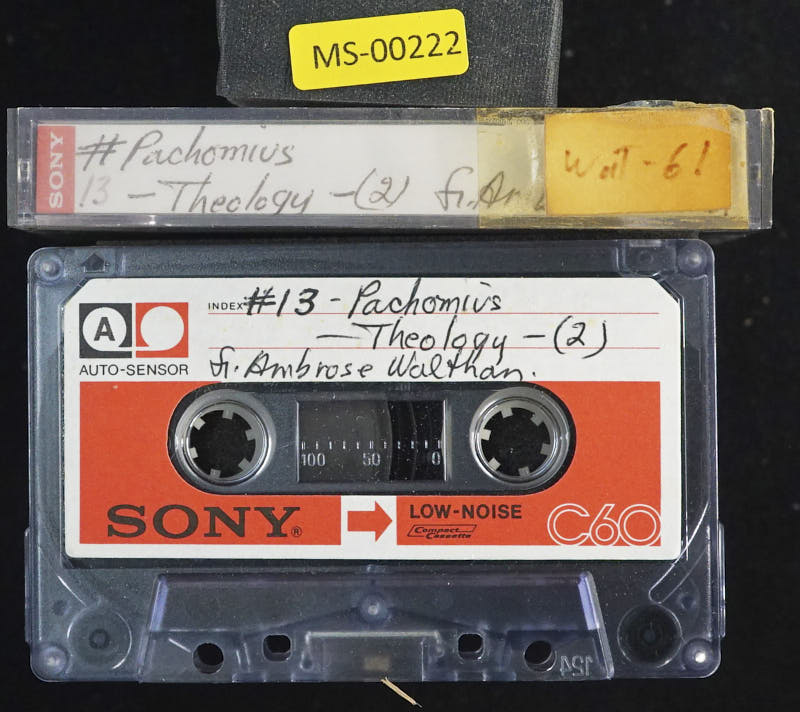

AI Vision - Possible Values from Photos:
Speaker: Ambrose Wathen
Possible Title: Pachomius - Theology 2
Additional text: 446 1.12
@AI-Vision_v002
with Pachomius. If I recall, we were looking at Pachomian spirituality of monasticism and we went through the foundations of monastic life, the formal principles. Do you remember what the formal principles were? Scripture and tradition. Scripture and tradition. And now we want to look at what this author calls material principles. of Pachomian spirituality. When we talk about the formal principles, it's that which gives me the form or the shape to the monastic way of life. And when he talks about material principles or Pachomian spirituality, he means that the basic theological intuitions which lie at the core of Pachomian spirituality and on which the spirituality and monastic life is built. And he's going to talk about three of these basic intuitions.
[01:03]
The image and concept of God, and then the concept of man, and then an attitude towards the world. And I guess, you know, as we study monastic theology, these basically are some questions we can ask about any monastic spirituality. So the first one is, what is the image of God that we see presented in Ocomian spirituality? One of the things that we noted before is that Pachomian spirituality is heavily biblical. So it's not going to surprise us very much that the concept of God is going to be very biblical too. And we've noticed, for instance, that in the texts, almost all of the books of the Old and New Testament are used in the Pachomian texts. But in some ways... Old Testament is used more than New Testament. And that's the image of God which is presented in the Pocomian text.
[02:05]
It's really going to take on sort of an Old Testament slam. The God that is presented seems to be a God of justice and judgment, of law and of anger, before whom man must stand as a sinner. Now, there's going to be some softening down of that, but that's the thing that I don't think we should be too surprised if it comes through the strongest. If you remember the Liber Orsinesi, it begins with that quotation from Baruch of the Old Testament and uses heavy Old Testament images and themes. In many ways, there's an emphasis on the severity of the God of Sinai and the jealous God of the Old Testament and of the prophets. This is especially in the... The law, the rule of Pachomius, if you recall, what is it, paragraph 18 of the second section, that long list of curses in there. And you get this idea of the judging God of the Old Testament. Whereas in the Liber Orsiasius, that's where you really find the sort of softening down and the love and mercy of God is brought out much more in the Liber Orsiasius.
[03:15]
In Precept and Institute 18, One of the things that it said there, it says, let him not fear death but God. This phrase shows the mentality of the monks to fidelity to monastic life. That it is God who they should fear. And we see also in other texts that it is God who is the basis of this law. For instance, in that same text we read, do not let him break the bond which was built in heaven and which is to be observed on earth. Notice, you know, the law, and this is a thing that you get in Pachomian monasticism, that the law comes through Pachomius, but it's a heavenly law. You may recall in Palladius, I think it's in Palladius where you get this, the theme of the angelic rule. which was delivered to Pocomius from the angels, but on a bronze tablet.
[04:22]
Remember that, Mike? And you have this whole thing of the angelic law from heaven, which is now put into practice by the Pocomian monks. Well, now, since the law is from heaven, then God is going to make sure that it is kept. And to break that law is to break the law of God. So since God's law is inviolable, breaking it will result in severe punishment. And that's where we come then to that famous text in Precepts and Institutes 18, that long series of curses against somebody who breaks the law. Precepts and Institutes? It's the second section, Precepts and Institutes, paragraph 18. It's talking about the provost of the monastery, and it's telling him what he should be like. So he shouldn't be drunk. And then it goes down a whole list of things that he shouldn't do.
[05:22]
And at the end of that, if he neglects any of these, they shall render him measure as measured, and he shall receive in proportion to his duty. And then all of these curses that come up may be visited by the annihilation of Eli and his sons. We've just been reading about Eli and his sons in the first book of Samuel. The curse David called down on Doe, the sign with which King was marked, the burial of the ass spoken of by Jeremiah, the fate of the sinners swallowed in the crevice. That's probably that allusion to the Nathan and the Byron in the desert. The death of the Canaanites, the crushing of a snake as a spring. The wearing away of the sand on the beach. These are probably allusions to prophetic literature. the breaking of the marvelous staff of Isaiah. So notice all of these curses called and very Old Testament-ish in all of this. However, it must be noted that the very following paragraph, so the beginning of the precepts and the judgments, notice what it says there, that the fullness of the law is love.
[06:44]
And after all of these Old Testament references to the law and to curses, then the very next paragraph says in Latin, Plenitude Old Ages Caritas, which is the introduction to a section, what we would call a penitential section, or a penal code of excommunications, which that basically is the precepts and judgments. So notice he begins a concept of judgment and of punishment, with this beautiful concept of the fullness of the law is really love. And it also follows that long section on those Old Testament cursors. And it's a little sort of jammed hidden in this other thing. All of the stuff of the Old Testament, which is brought down on your head if you don't obey. And then to obey these things, if you don't, you receive the punishment. Nevertheless, the fullness of this law is really love. which I think tells us something about the whole meaning of a monastic rule. It's just like the same thing that the Apostle Paul says over and over again, the completion, the fullness, you really fulfill the law when you obey the law of love.
[07:56]
And it tells us something also for the legislator why there would be such a thing as excommunication. See, it's not just vindictive, but it's geared to learning to love. And so through this method, one learns the lessons, proper lessons of love. Sort of like absence makes the heart groove fondue or something? Well, it's more like Paul says in Corinthian, you know, the man was handed over to Satan so that he might be saved. See, it's not a vindictive thing. Excommunication in the ancient church is not vindictive, but it's salvific. And that's why I think that this is a, This text here shows us the meaning of a penal code. It's in order that we might fulfill the law, which is really love. You remember that the Liber Arsiasius, which is this dying testament of the Abbot General, is a complaint against religious and moral decadence.
[08:59]
Remember we saw that the problems in the community were, they were hoarding property, they were leaving wills, and spirits weren't correcting. juniors, and everybody was letting everybody go their own way without any mutual support and mutual correction. Now, if you recall also, the beginning of that is a quotation from Babuk. Hear, O Israel, the commandments of life, with your ears receive and understand prudence. How is it, O Israel, that you are in the land of enemies? You have grown old in a foreign land. You are defiled with the dead. You have gallied with those who are in hell, and you have left the fountain of wisdom. If you had walked by the way of God, perhaps you would be living in peace. Notice then he says that Baruch said these to the people in Babylon, but he's also talking to us. He continues on that we must not be forgetful either of the law of God.
[10:05]
You see, he's identifying the monastic community with the people of God, and they must keep the law as the people of God did. And so what comes from this is that the way God treated the chosen people of old is a type of how he's going to treat people today. One of the things I think is implicit in here is an understanding of the use of the Old Testament by monks and in the Christian church. See, it's not just something from the past. But when you read Baruch, you read it to yourself, or when you read the prophets. And so it's the living Word of God now for the monastic community. We are the ones who are hearing what God speaks through the Old Testament, which I think is a very important point of what is the Old Testament for us? Is it just some interesting relic of the past? Or is it the now of God speaking and in this situation, to the monastic community, who is the new Israel.
[11:09]
So he doesn't use the term new Israel. But that's the idea you get, that the monastic community is the new Israel. So remember what we talked about, the difference between northern theology and southern theology in Egypt. And I mentioned to you that the Colmian spirituality is much more biblical. I think we're beginning to see this constant allusion to the Old Testament. We're living the life of the prophets and the apostles, and God is speaking to us as he spoke to our fathers in the desert and in the apostolic community. And that also explains, I think, why there's this strong Old Testament image of God, because it's such a biblical spirituality. Just in passing, I think in the rule of Benedict, this whole concept of the fear of God which is so strong in the spiritual doctrine section.
[12:09]
I think it's really from the Old Testament that we can get some idea of what Benedict really means by the fear of God. Because the fear of God in the Old Testament is not just a servile fear, but fear is equated with love and with obedience. It's a very rich concept. So we must beware of mistaking God's patience for indulgence and ignorance. What he is really doing is calling us to repentance. And so Orsiasius says in paragraph three, therefore we must not fall into forgetfulness and think that the patience of God really is that he is ignorant of what we're doing. Rather that he is leading us to conversion The man who is blessed fears the Lord, and he will be corrected and amended and taught by the Lord's law.
[13:14]
Notice this whole idea of teaching, of patience on the part of God. And the monk is to recall that Jesus Christ will return in judgment. If you look at paragraph 10 of the leader Orsiasius, All those to whom the care of the brethren is entrusted should prepare themselves for the coming of the Savior and his fearful judgment. That's a theme that's strong in the rule of Benedict with regard to the abbot. Let him constantly be aware of the judgment the Lord will bring and make the abbot make an account of what he's done. And the same way with the monks too, they must always remember the day of death and judgment. But it is also noted that Orsiasia softens the divine threats with an allusion to the gentleness of the Lord.
[14:16]
In paragraph 3 and 8. Notice it begins, Since such is the kindness of our Lord and Savior that he provokes us to salvation, that has turned our hearts to him, because now is the hour we should awaken from the sleep. Just constant allusions to the gentleness. the Apostle Paul into the whole New and Old Testament. With regard to Pachomian concept of man, now it's rather difficult in the Pachomian literature to find a good synthetic view of man, but this author, Bach, nevertheless tries to do something, and very briefly what he says is that man is a creature, and this is well understood in Pocomian mentality, that man must be obedient to God. And just as the patriarchs, Abraham, Isaac, Jacob, and Joseph, submitted to God, so the monk, notice here again this theme of, we are now living the light of the patriarchs.
[15:26]
Man is in constant danger of sin. And, of course, sin is personified in the devil. So the monk must fight against sin. However, you don't get in Pachomian spirituality a pessimism of corrupted nature. But there is this aspect that man must fight against the devil, the aspect of combat. Now, we've seen that very strong, you recall, in the life of Anthony, where a monastic life could almost be defined. It's a combat against the devil. But remember in the life of Anthony that it was to manifest the victory of Jesus Christ. But we have also in Pocomian literature this theme of combat against the devil and against sin. And so the monk must always be on guard against the attacks of the devil. Now the way he fights against the devil and make sure that he's vigilant against the devil is through his prayer,
[16:27]
his tears, which is a word which would refer to prayer, the exercise of humility, fasting, and vigils. So it begins to tell us what the monastic routine is about. That's the vigilance and the armor that you use fighting the devil. But in all of this, you must have confidence in the Savior. This, of course, is very strong, as you recall, in the life of Anthony. Now, thirdly, with regard to an attitude towards the world, it shouldn't be surprising that because of the heavy biblical approach of Pocomius, that eschatological themes play a very important role in the spirituality. One of the emphases is on judgment, as we've seen, so the concept of heaven and hell. and where you're going in the future. If we take a look at the concept of world, I think we see that there are two different concepts of world in Bacomius.
[17:38]
You know, the concept of world is very ambivalent, and it can be used in a good as well as a bad sense. But Bacomius shows two different ideas of this. First of all, the world is the context in which the Christian leads his life. and in which this combat of the devil takes place. So it's the broader context of our existence. And of course, this broader context is considered a little dangerous because it is the devil works through this context. But the second concept of world is contrasted to what we would say monastery versus world. So everything which is not specifically to do with the monastery, is called world. And here we have the idea that the monk must renounce everything which is outside of the monastery, so renunciation.
[18:39]
He must separate himself from attachments which would lead him away from his monastic life. One of the concepts of the anchorites, and even the word anchorite comes from that, is withdrawal, anachoresis in Greek. Now, this word is not found in the Cenobitic tradition too much. The anchorite's approach to the world is to withdraw from the world. What we find in Lecomian literature is the response of the monk, the Cenobite, to the world is not withdrawal as such. I mean, this isn't emphasized, but rather renunciation. I suppose in basis maybe you say, well, it comes out to the same thing. But you see, you're not running from the world, you're not withdrawing from it, but you're standing in it and renouncing it. It's a subtle point, but I think it helps us when we talk about the whole concept of our relationship to the world.
[19:45]
It's not for us as Anabites withdrawal from the world. Rather, one has to renounce one's own property, the right to marry and have one's own family. And what one does as a Cenobite, a Bacomian Cenobite, is enter into a holy fellowship, a holy koinonia. If you look at Precept 49, it's that paragraph which talks about somebody who comes to the monastery and wants to join. See, there's two important elements in this person's coming. If someone comes to the gate of the monastery wishing to renounce the world, and then notice a second part of it, and be added to the number of the brothers. See, it's sort of a two-fold desire to renounce the world, but it's just not a negative thing. You want to join the brothers.
[20:46]
And I think this is extremely important in the Pocomian spirituality. You're joining a holy koinonia. You're not just renouncing the world, but you're joining something positive. For the Anchorites, renunciation of the world is realized by a flight from men and total separation from men. But you see, Vicenobite doesn't flee from men, but he joins men. It's quite a different mentality. This society is not the world, but rather is a society which lives in imitation of the college of apostles and prophets. And so, for instance, in Precept 1, we saw that the one who comes to the monastery into the assembly of the saints sits in the congregation of the brothers. He comes to a holy assembly, a holy koinonia.
[21:50]
He sits among the brothers. So he's not withdrawing from society when he enters the Sinopium. We also saw in precepts and institutes in the prologue where it says, it talks about how the collective, the assembly, is to be done and how brothers are to be brought together to hear the word of God. Let them stand in the measure of truth and the tradition of the apostles and the prophets. imitating the congregation of them in the house of God. So you come together imitating the apostles, the prophets and the apostles. Now, Pocomus is quite concerned about what we would call a worldly spirit entering and invading the monastery. And this may explain some of the regulations for visitors who come to the monastery. That especially women, they're to be received, but... You recall they're to be received in a separate place, especially if they stay overnight, if they come late at night.
[22:52]
And when monks come back from the outside, if they've been outside the monastery for a while, they're not supposed to speak of what has happened. And when they're working together, they're not supposed to speak of secular matters, but rather meditate on scripture. Remember this legislation about not speaking what's happened outside the monastery, we find in the Rule of Benedict. it can be interpreted as being sort of a protection against worldly invasion in a monastery. That's one interpretation of it, at least. So Bach says that separation from the world is an essential presupposition of monastic life. And then he says that this is expressed symbolically in putting off of the secular clothes and the imposition of the monastic habits. And so, for instance, in Precept 49, we see that where after the person joins the brothers, he wants to renounce his parents and his own faculties or property.
[23:55]
Then he is stripped of his secular vestments and given the monastic habit. You notice that it's all tied up together. He renounces his property, his family. He wants to join the community of the brothers. So... He takes off his secular clothes as a sign of the first. The sign of the second that he's entered into the community is the putting on of the monastic habit. And if he should leave the monastery, then he's given back his secular clothes. And so this is a real symbol of what's taking place in the man's life. Now this whole problem of separation being an essential aspect of monastic life What do you think about that, Mike? Well, you know, just from having gone to school and everything, there's so much...
[25:05]
that occupies your time, so much little petty things, so many things that really don't count. And even if you're, you know, I think a person outside stopped and thought about it, you know, you just get caught up in a hustle and a bustle that distracts you and you don't have the time to collect yourself for interior peace, for quiet, for calm, in order to pray. And I think that's an important thing, and I think it's important not only for the monk, but for, you know, for the Christian as well. And, you know, I think it's from that, this hustle and bustle, that the monk is separating himself. Not, like I say, not from society, not from, you know, not from human encounter, from human love or anything, but from this... More of a trying to get things in perspective, which is too difficult to do when you're being pounded from all sides.
[26:16]
What you're saying is that it's really something positive that we're doing rather than something negative. Yeah. We want something. We want to spend time in prayer. We want to spend time with one another. We want to spend time in holy reading, serving each other. In order to have the time to do that, we've got to let go some of the distraction and dissipation. Otherwise, we won't have time for that. And so, the way I would formulate it is that separation is a consequence of what we want to do. If we really want to do that, for instance, if you want to spend time in prayer every day, then you better not spend five hours watching television plus your regular work because you're not going to find time for prayer. You're not going to find the energy to do it. So it's not a condemnation, say, for instance, of television, but it's saying, what are the priority? What do I really want to do? So I withdraw. You don't have to withdraw totally from a thing like that, but you withdraw from it insofar as if you don't do that, you're not going to have the time to do the thing you really want to do.
[27:28]
Joe? I think the idea of attitude has to be brought to this too, because you can bring the hustle and bustle right with you within the monastic compound. And your job can get ahead of you. There's a beautiful phrase in, I think it's St. Ambrose and a number of the fathers, that fuga mundi, flight from the world, is really flight towards Christ. So he is not like from something, but it's like towards a person. Now, if you move towards a person, we talk about relativity, you are withdrawing from something else. Now, what I'm suggesting is that, see, I don't agree with the thesis that an essential note of monastic light is separation from the world. And if you wanted to define monastic light, you would say it is...
[28:35]
first of all, separation from the world, and then you would continue on. I wouldn't define monastic life as a withdrawal, but because of what you want, and for Pocomius, you want to join a holy fellowship, then because of that, you do withdraw. So it's a consequence. It's not what establishes monastic life, but it's a consequence of what monastic life is. And that's why I think it's extremely important, this separation. But it's not a pejorative or negative concept. And it shouldn't be emphasized, but the positive thrust, in my mind, should be emphasized. So that, see, it's no condemnation of the goods of creation, of television, of radio, or anything. None of this is bad. It's all good. But it's a matter of of what you really want to do, where you really want to spend your time.
[29:36]
As we mentioned that Pachomius gives a sort of symbolic explanation of this renunciation of the world and entrance into the community by the monastic ceremony of changing garments. Now some people have suggested, in Pachomius there is real no profession formula But this may already be indicative of what we would call a profession formula. You go through this rite and you are, by that rite, covenanting with the community and the community is accepting you and you have been incorporated. So there's no idea of a juridic vow formula. And this tells us that, see, the monks, they didn't think of juridically. But if you went through this ritual, this rite, You're bound to this community and they're bound to you. Let's take a look now at the goals of monastic life, which is the second big subdivision in the whole presentation.
[30:48]
For instance, the first one we had the foundations of monastic life and the formal and material principles, and now we have the goals of monastic life. The first goal is that a monk is just a true Christian. He's doing nothing more than living the gospel. That's all that he pretends to do. Now, grant it in a specific way, with a particular structure of life, pattern of behavior. Remember that statement about the fullness of the law is love, and that's the basic Christian law, the law of love. So that's... the fullness of monastic law too. And then we saw later on in another place in the prologue of the precepts and institutes that they may be freed from the error of soul and glorify God in the light of the living. So what the monastic life is is a call to the freedom of being a Christian.
[31:51]
And the purpose of the rule is to realize this for the monk, this freedom of being a Christian. Secondly, we could say that the goal of monastic life, well, the question would be, is it to seek perfection? And I don't want to go into a lot of detail on that, but it seems as though we would say that for the northern Egyptians, a concept is perfection. Now, I don't want to characterize their monasticism, but perfection is very important in the scheme, for instance, of cash and of invaderies. You seek perfection. But it seems as though in Pocomius, this term isn't used. Rather, what one seeks is salvation. Now, you say, well, there's not a whole lot of difference between the two. But it does show a little bit of a nuance. What you're interested in is experiencing the salvation brought us by Jesus Christ rather than individual perfection.
[32:53]
And this salvation is acquired by patient endurance, and not in one day, but over years. You get into the whole concept of conversatio, which we looked at, and stability, which we looked at this summer. This path to salvation is established by the holy koinonia, the holy fellowship. And that's why you enter the holy koinonia, so that in this koinonia, you might be brought to salvation. And one proceeds in this... path of salvation by the example of the great figures of the Old and the New Testament. The third goal that we could speak of monastic light is the holy koinonia itself. And this really gives the tonality to Pocomian spirituality, this emphasis on fellowship, holy koinonia, the brotherhood.
[33:56]
See, in Pachomian monastic spirituality, there's very little place and very little emphasis on personal perfection. And so, for instance, the Neovagrian idea of apathia, or complete detachment, is not strong at all in Pachomius. It's not found at all. Another thing that Pachomius mentions is that the fullness of the ideal will only be realized in heaven. So if there is perfection of a sort, it's going to be realized in the koinonia of heaven. It is really the koinonia which is the proper and distinctive characteristic of Cenobitic goal, to live here on earth in the holy community. And so mutual assistance as one struggles for salvation
[34:57]
undergirds and maintains this idea of community. Peace with one's brothers is a guarantee of peace with God and an experience of a peace with God. And this holy koinonia is modeled on the apostolic life, which is simply a life of poverty and of imitation of Jesus Christ. Fraternal edification is an essential element. of the law upon which the koinonia rests. So we must edify one another, build one another up. Recall the Libra Orsinesius, that's one of the main problems. You're not supporting each other. You're not building each other up. You're not correcting each other. You can't say, well, I'm going to take care of myself, let these other people go. We are responsible for each other. So the whole thing of co-responsibility is really strong in here. To me, the most beautiful aspect of Pachomian monastasism is this idea of the koinonia.
[35:59]
We want to join or we want to become a monk because we want to live with one another. I think I've mentioned to you that somebody has characterized Pachomian monks as Cenobites or those who wash one another's feet. They want to serve one another, and that's why they join the holy koinonia. Monks are called to the liberty in Christ, but this freedom and this liberty is realized in mutual service. And so Orsiasius, in paragraph 26, quotes from the epistle to the Galatians, a beautiful phrase, you were called in freedom, not in the freedom which will give rise to the flesh, but serve one another in love. Notice the idea of liberty and service. We realize our liberty, our freedom in Christ, by serving one another. Now this koinonia is the house of God and it is the work of God.
[37:04]
And so the monk must surrender to the monastic order of life because he surrenders to what goes on in the house of God. And so it's something bigger than just his own perfection. Now this is going to be important when we look later on at the concept of cenobitic obedience as contrasted to anchoritic obedience. So the law of love, love of God and love of neighbor, is the core of Pocomian spirituality. And from this law flows all the monastic obligations and the style of life. So really the purpose of the cenobitic way of life is love. is simply love, love of God and love of one another. And that very simply is the holy koinonia. I just get enraptured by this idea of the holy koinonia. Remember that text we saw from Theodore? I think I showed it to you from his catechesis. where he talked about the holy koinonia is an imitation of the apostles who left all to follow Jesus Christ and be crucified with him.
[38:14]
And so we have left all to follow Christ and be crucified with him in poverty. We are living in the fellowship as the apostles live in the presence of Christ with one another. And therefore, we don't just exploit each other for our own perfection. But what we're really called to do, rather than use one another, is to serve one another. And this is what I think Pocomian spirituality is so strong on. And I see that this is in the rule of Benedict. Let's take a look at some monastic themes in Pocomian spirituality. That's the third big major point. The first point under that is that monastic life is an imitation of Christ. Now, the rule of Pocomius doesn't mention the name Jesus Christ.
[39:22]
But in many of the catechesis, there is reference to the only begotten Son, King Jesus, who fights for the faithful. and the whole aspect of the Word of God taken flesh, and the Virgin Mary. So many of these things of which we would talk about, Christological themes, are found in the catechesis. But you see, we wouldn't suspect to have them really in the rule, because it's not the type of writing that it is. Jesus Christ is Savior and God, the Word and Son of the living God. He lives in us through faith. And for instance, we see in the Liber Orsiasius, Paragraph 20. And the life which we live in Christ, we always live. And so he refers to Romans chapter 5. And those who wish to live this life in Christ must live as a good soldier of Christ, accepting suffering with Christ, and so come to his glory.
[40:24]
That's a thing which comes out strong in the rule of Benedict, that end of the prologue. By patient perseverance in the monastery, Until death, we will come into his glory. But the Liberos Iacius does talk about the monks as being soldiers of Christ. Let us work, therefore, as good soldiers of Christ. And this is paragraph 34. And observe that which is written to us. No one fights for God and gets involved in things of this world world, but rather he fights so that he might please the one who he's fighting for. Notice the concept of military, which is also strong in the rule of Benedict. If, however, one contends in a contest, he doesn't necessarily, he's not necessarily crowned unless he fights according to laws and according to the way, legitimately, according to the way he should.
[41:32]
We, however, will be glorified in the name of the Lord our God. But it's the concept of struggle, of fighting under Christ, and thus imitating Christ. Look at, I should keep looking back a little, instead of trying to transfer as we go along, but look at paragraph 50 of Believer Orsiasius. And it's a second paragraph. And we dwelling in the monastery and associated to each other by mutual love, let us be zealous so that we may deserve to have the fellowship of the Holy Fathers in this life and likewise may participate in their future also, knowing that it behooves us to be fellow sufferers with Christ. That's really a rich statement there. We're associated to each other in mutual love.
[42:35]
the fellowship of the Holy Fathers, and then double-sufferers with Christ. And it really coined only on every angle, with one another, with our fathers, and with Christ. And to know that without tribulations and difficulties, no victory is obtained. So we are in the synopedic life, realizing the death and resurrection of Christ. That is the way it is realized for us, by our synopedic way of life. I don't know if you've read the Bishop's statement about the renewal of the American, the spirituality of the American priest. You know, they reduce the spirituality to our experience and living out of the death and resurrection of Jesus Christ. And no matter what Christian way of life a person follows, basically it's that experience of the death and resurrection of Christ. And for the Cenobites, That experience is going to be in community, in mutual support and love of one another.
[43:42]
As you see, for an anchorite, he is also going to die and rise with Christ. But in the terrors of solitude, we do it in the rubbing together as centipides, which has its own modality of death and resurrection. We are the source of death for one another. a real crucifixion for one another, but we're also the source of resurrection for one another. This is in the synovium, in the Holy Colonia, is where we are realizing the death and resurrection of Christ, not in spite of it, but that is the realization of it for us. Now, because one lives in Christ, then one must also imitate Christ and suffer as Christ did. according to one of the catechesis of Pocomius, to be a monk is nothing other than to be a perfect disciple of Christ. The monk shares in the suffering of Christ by his monastic life in the Sinopium.
[44:42]
He follows Christ by renouncing the world, by joining the holy fellowship, and thus imitating the love and humility of Christ. The second point is if there's going to be combat with the devil. Some of these specific monastic temptations are going to be, especially in a koinonia, are defiance against authority, lying, duplicity, stupidity, a spirit of mercantilism, and laziness. Now, these are the kind of things that are going to be constant temptations for people living in the koinonia, to defy authority, to really lie to one another, to misrepresent ourselves, to put on a false front. To be untrustworthy. And Ruddy says a spirit of mercantilism. To try to make some sort of where you want to gain something by transacting with other people.
[45:49]
So if you have something, you can bargain with other people. And this kind of stuff goes on in community life. And it's going to be a constant temptation to make a profit. at the expense of other people. And, of course, laziness. Everything is provided for you. Why worry? And so you don't share your load. I'd like to briefly conclude this with some reflections on obedience, the free service of obedience. A monk who is called to the koinonia, submits to the rule. And so everything he does from morning to evening is under obedience. It is sort of legislated. Now, this is in Pocomia. It might be over-legislated, but everything is legislated for in the rule of Pocomia. So all the minutiae are taken up. The monk gets determined. The monk gets up when the tuba calls him to get up to go to the assembly.
[46:53]
He's not permitted to walk anywhere he wants to outside of his cell, but he goes right to the assembly. He's not to circulate at his own fancy throughout the monastery unless he has permission. We get the impression that almost all personal initiative is severely punished. Now, I'm not recommending this, but I'm saying this is what it seems like in Pocomius. But one certainly gets the impression that the monk must always be obedient. And thus we have the penitential code. If he disobeys any of these things, he's punished for it. Why must a monk be so obedient and why is everything prescribed for? Because he's living in a koinonia, something which transcends his own ideas of things and his own needs. There's something bigger than him. For an anchorite, Obedience is primarily so that he can diminish his own self-will.
[47:56]
And thus, as we looked at it this summer, the anchorite, putting himself under a master, will be given some strange commands to see if he really is renouncing his own will. A Cenobite is not looking just for his own perfection in obedience, but for the common good of the koinonia. And thus, for instance, a superior in the Cenobium can't just tell the Cenobite to do anything. but must always command in relationship to the good of the koinonia. And so there shouldn't be just arbitrary commands in a synogium, as, for instance, it could be in a master-disciple relationship in the desert. But the obedience of a Cenobite is always related to the common good of the community, and thus he's protected. All of these little details... protect him really as well as tell him what to do but the superior just can't arbitrarily make him do something in virtue of obedience because the Cenobite is protected by the common good which is protected by the rule of the monastery and the tradition of the monastery and so there's really a difference in Cenobitic obedience and Anchoritic obedience Anchoritic obedience is geared primarily to individual perfection
[49:21]
Whereas centipedic obedience is geared towards the common good, the perfection, the salvation of everyone involved. And that's why I think in the rule of Benedict, you get this development of the concept of mutual obedience. We must be obedient to what we hold in common, to one another's needs, to the needs of all of us together. And so rugged individualism in the centipedic life is not the ideal. but rather to give in to one another. You would seem that that would demand initiative. Obedience wouldn't be just to what's laid down in the rule, but if your obedience is to a way of life and to the needs of the brothers, that to sit back and wait until you receive a command would seem to be shirking the obedience to the way of life. that the true obedience would then demand initiative. I mean, you know, going out when you see something that could be done or needs to be done.
[50:25]
I agree with that very much, Mike. And so I'm not saying that the Pocomian idea we should just transfer it to us, because I don't. I think there are many things that need to be developed here. But I think he's got something at the basis which is very important. You know, obedience to the common good. That this is where the obedience is geared. And this is then judged by something bigger than the individual. It's not just what I need or what I think the Spirit is calling me to. Now, I see that initiative is very important for the world. And then I wonder if in Pocomium literature, see, this is Bach's interpretation, and maybe it's not, the interpretation is not full enough. Because take a look at the Libra Orsiesius, where he says you must take responsibility for one another, which is a type of initiative that You can't just sit back and say, well, let the person go. I'm going to obey the rule as far as I'm concerned. But you are responsible for one another. So I would say that maybe Bach is a little exaggerated or doesn't see the full picture, but maybe there is a certain initiative aspect in Pachomian monasticism.
[51:33]
I don't think there's any need to say that Pachomian had the full picture of the thing. and so to over-defend him. But there is that sense of co-responsibility which just right away says there must be some initiative. And so possibly that's a good insight that maybe this, that Bach's interpretation is a little severe, a little one-sided. With that, we'll come to the end of our reflections on monastic life in Plachomian literature, what we find there is that there are three themes that are strong in the spirituality, imitation of Christ, combat with the devil, and obedience. But then what we see also is that in Plachomian spirituality, all of this is sort of put together or molded together with that central concept of koinonia,
[52:38]
And that's really the thing to develop when you talk about the monastic spirituality of Pocomian monasticism. It's a spirituality of fellowship, of living together the life of the apostles and the prophets, of wanting to live together, rejoicing in one another's presence, serving one another, because that is the realization of salvation for the monk. And so you see there's We shouldn't be surprised that in Pocomian monasticism, there's none of this trust to leave the synovium to go into the desert to be a hermit. This is really foreign to Pocomian monasticism. There's no idea that as you perfect yourself, you would want to go off into the desert. You're already living in the sphere of salvation together. And so now this is an enduring... process thing, which must be worked out throughout your whole life, and which will be perfected only in heaven. With that, we'll conclude Prochromius.
[53:42]
I don't remember for sure what we're going to take next. Do you remember what... I think I said I would go to Syria and Qumran. I believe so. Well, I think it's Qumran first and then... And then Syria. But we'll have some reflections on Qumran because I think we're prepared for that in a way now. And then we'll go into Syria and then we'll come back to Kashin, I guess. And it depends on how much time I have to prepare. I'd love to go into Basel, but I have to do some preparation on that. And I don't know if I'm going to find time this semester or not. But we'll do Qumran then the next time.
[54:27]
@Transcribed_UNK
@Text_v005
@Score_95.92