You are currently logged-out. You can log-in or create an account to save favorites and more. more info
Obedience and Community in Monastic Life
AI Suggested Keywords:
The talk focuses on the concept of renunciation within monastic communities, highlighting key practices such as obedience, humility, and asceticism through the lens of early Christian monastic experiences, particularly those of Pachomius. It emphasizes the importance of communal life, spiritual discipline, and the balance between strict adherence to practices and the individual needs. The discussion illustrates how these practices are grounded in scriptural authority and the communal pursuit of becoming closer to God.
- Philippians 2:8: Referenced as an example of Christ's humility and obedience, demonstrating the model for monastic life.
- Scripture as a Rule: Emphasized as the foundation for answering temptations and spiritual challenges, as seen in the lives of monks like Anthony.
- Benedict's Rule: Mentioned in relation to monastic guidelines and the importance of obedience over bodily asceticism.
- Acts of the Apostles: Cited as the ideal model for monastic community life where all is held in common.
- Pascha and Fasting Practices: Discussed in the context of monastic observances and the importance of following communal rules for collective spiritual development.
- Obedience as Central to Renunciation: Explored as a fundamental principle, rather than renunciation for its own sake, aligning with the will of God and communal harmony.
- The Role of the Superior: Explored through examples from Pachomius, highlighting the responsibility balanced with equality and service to others.
- Concerns over Material and Spiritual Charity: The community’s focus on balancing material needs with spiritual growth without giving privilege to superiors.
AI Suggested Title: Obedience and Community in Monastic Life
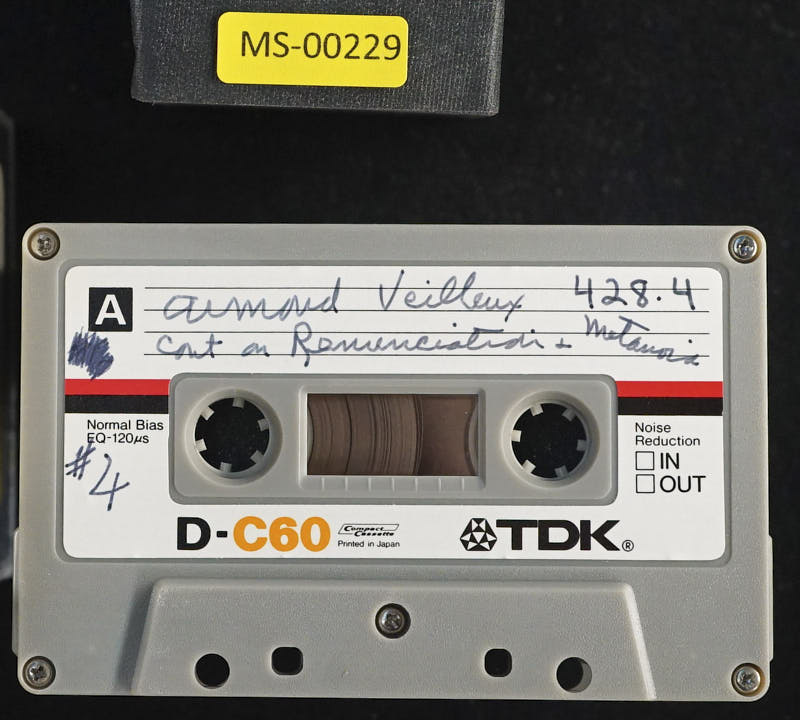
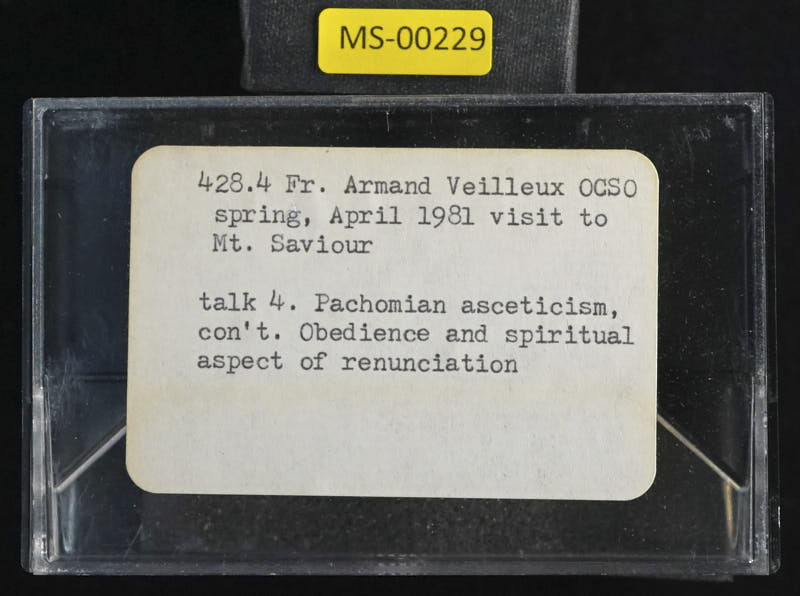
AI Vision - Possible Values from Photos:
Speaker: Armand Veilleux
Location: Mt. Saviour
Possible Title: Pachomian Asceticism, Obedience and Spiritual Aspect of Renunciation
Additional text: 428.4
@AI-Vision_v002
you know something. Our communists and his disciples lived and understood the asceticism, especially various forms of renunciation. And the last thing I mentioned was renunciation. We were honors to pride, various forms of pride, who are important in the community, and so on. There are a few examples of tribe existing in the community, of sinners, like every community. And as I mentioned, I think it's early morning. The first group decided, Pacumius, was a very homogenous group.
[01:03]
And they had a strong cohesion in itself. And when the second generation started coming, it was too easy for them to accept the new generation. And we have the example that when Pacumius asked what he had been in, community for a few years, but he was the third grade. And he asked him to give the instruction to the whole community in his place. And about 10 of the old men went up, asked the young man to teach them, old men, in the years. The Catholics, this was finished. He brought them back and reviewed them, several.
[02:04]
And he said, and he asked them, where do you think is the beginning of every evil from? Because that's what I said. The beginning of every evil in the world is from tribe. And he gave an example in the scripture. And of course, he gave the example of Philippians. the two eight example of Christ, who was God and made himself obedient to cross. Here you have the navigation, example of Christ, cross. There is another text when the demons try to show potential in his heart. How come your censors, all wicked ones? You cannot carry me away. with your for I know my sins is conscious of being a sin. And here, you see also that we fight against temptations always with scripture.
[03:12]
The same thing in the life of Anthony. Every temptation. Anthony has always worked on the scripture to answer. This is our third example to answer. Each one answers each one of the temptations from the scripture. The scripture is the first rule, the only rule of remark. But it also is a weapon to answer the attacks. But if the superior must be very humble in exercising its authority, The humidity of the will be expressed in his obedience. And there are beautiful texts in the testament for Jesus, about obedience.
[04:18]
For example, you can read the paragraph 19. The is almost a tablet composed of text from the scripture. We have a number of quotation, about 600 quotations on book. And all the books are the oldest and the newest of 50 paragraphs. Rejoice in the Lord. I repeat, rejoice. Be subject. to the fathers, to your fathers in all obedience, that obedience shall be enjoyed, not something faithful. Rejoice in the Lord and be subject to your fathers in all obedience without murmuring or wivering thoughts. Murmur is one of the sins that Fear, most, is always warning his thoughts against memory.
[05:23]
And Benedict will do the same thing. Temptation to which ones are easily exposed. Without memory or wavering thoughts, bring simplicity of power to your good deeds. It's not enough to do good deeds, but to do them with purity of or simplicity of power. Purity of or simplicity of power is the same thing. The simplicity of the part is the is opposed to the deep skip, the part which is divided between this or that, the revering part. And this unity of part is characteristic of the month. The month is the one who was only one orientation, One goal is not . It's not going one side to the other, but it's going straight.
[06:28]
The root, at the name of the month, in Syria, means the etymology of the root is the that goes straight to the root. So the one that goes straight to its goal, simplicity apart. Simply, it's purely apart. Bringing simplicity apart to you will be that filled with virtue and the fear of God, you may be made worthy of his adoption. All goal is to become sons of God. Obey your superiors and be subject to them for they are keeping watch over your souls, can give that account for you. It's a tradition used by Benedict also. You have to obey yourself, but they are the ones who are keeping watch over your souls.
[07:32]
But they have to give that account very much. Now, there are many other texts where obedience is shown as superior to fasting. or to any type of bodily ascesis. So the bodily ascesis is inferior to other virtues, which are much more important, like obedience, for example, and other things that are in the scripture. And there is one story in the heroic life, number 64. He was a brother. who was engaging in great practices and harsh asses. But he was doing so blessed for God, but for vain glory. And Thakomius took him aside and told him, it is written, I have come down from heaven, not to do my own will, but to do the will of the one who sent me. Obedient to the will of God, it's much more important than all the other forces.
[08:40]
that what the signal is given admitted to all the brothers to be you too you go to one you shall eat a little and whatever food they eat you start to take a little of it too I'll do not without eating your food I'll go without eating your food but at evening when the signal is given again let us go and eat properly the rule of fasting we're not too harsh but in the community And it cannot be as harsh as what a hermit can do on his own, because you have to take account of various possibilities on the capacity of each one. There was two meals except on the days of fasting. This was Wednesday and Friday, and it was only one meal after the . The other day, there were two meals, one at noon and one And it seems that the brothers could skip .
[09:45]
And so is telling him, well, let's do . And don't take your fear, but take something, a little bit of . Be simple. And that's much more important to be obedient than to do And there are many other examples from this. One day, came to and asked him about the fast during the Pascha. What they call the Pascha is what we call the Holy Greek. The Pascha goes from Monday to Saturday. And what we call Easter is the day of the Resurrection, or the day of the Job.
[10:47]
But the Pascha, that means Passover, is the preparation. We go through penance with Christ, through fasting, and in the reading of the Scripture, and we prepare ourselves to celebrate the Job, the Resurrection, during the night from Saturday to Sunday. And all the points from all the monasteries came to the Sanctuary Monastery for that celebration for the whole week. The practice of the church was to spend the last two days, Friday and Saturday, without beating. The technical term was to join . That meant not to beat at all. So that meant that they paid the Thursday evening And then the next meal was . But there was some practice in the early church. Some people will join three days, four days, or five days of the whole week.
[11:51]
And we see testimonies of that . But the general rule was to join only the last two days. So comes to ask him what to do. It would be better. So yes, . And says, no, the best thing is just to follow the rule of the church so as to keep your strength to be faithful to the things that are commanded to us in the scripture, , continuous prayer, and to walk in order to be able to give balance to the poor. So those are things that are commanded to us in the scripture.
[12:52]
And it's better to do that than to pass, and not to have the strength to follow those things. So there is a scale of value there. Of course, there are many examples of being faithful, obedient to the covenant. The superior is the one who is entrusted with the care for all the brothers. But apart from that care, he's just one of the brothers. And he has to follow the rule like anybody else. And the life is very carefully showing very often was just one of my brothers. He was living in one of the houses. Although he was the super general recipient of all the monasteries, he was living in one monastery.
[13:57]
And in that monastery, he was one member, one family. And for all his personal thing, to get pulled, to get through, he was just dependent. on . Just as the brothers were established in separate houses and had in each house somewhat responsible for them as a father, Pycomius also belonged to a house. He was not any different from the brothers. He didn't have the authority to rule on his own to take a garment from the leader of the community. He brought the housemaster of the house to which he belonged, who took it from him for him. According to the religion of the brothers, he had established Shonka. So the recreation that Bacomus established, he took them from the scripture, took his inspiration from the scripture, and he considered that those were from God. So he was subjected to them like . And the schism that happened in the community after the death of Bacomus was caused partly by the revolt
[15:07]
of Apollonius, who refused to be subjected to and also by his . If Vermont must renounce his family, ponderous, titles, and to be forbidden, all the more must renounce all the sins his life through conversion. A methanaya that has to be realized, not only at the moment he enters the monastery, but all through his life. Methanaya is at the center of the monastic. Mon is a human being. As such is a sin. And he has to do this conversion of his life. And the conversion is the real deep conversion of the heart is a gift from God. God gives the conversion of the heart. But you have to dispose yourself by going away from sin.
[16:12]
And that if you were away from sin, Galilee will transform your heart so that your heart will be converted towards him. And the beautiful, like I mentioned often, the testament of the Parcheiasis is, from beginning to end, a long call to repentance. And it's a call to communal repentance to the whole community. not only the individual, but community, to realize that it is that particularly faithful to God. It's God. And that's to turn God more fully. Because what is important is to do the holy with God. Their idea is that man was created by God. at the image of God. And with that image, he received all the fruits of the spirit, the fruits of the spirit of the virtues.
[17:14]
And there is advice corresponding to each of the virtues of their skin. And so the devil is always watching us, trying to take away from us one of the virtues, one of the fruits of the spirit. and to put in its place one of his own fruits, the fruit of evil. And if you let the devil enter into your house, into your soul, by letting him put one fruit of evil in you, then he has entered there, and he can become a master of the whole place. So the important thing is to try to keep all of the fruits of the spirit that we have received from God. And if we, at last run, try to recover it as soon as possible by parents who wish we'd become worthy of perceiving the gift of metanoia from God. Because if we remain in one sin, although it may be a very tiny sin, the devil has its place in us.
[18:27]
But I would like to move to the next part of this talk about the spiritual character of renunciation, the Christian character of renunciation. Although we find a very austere type of tachypism in Pakhomet monasteries, But sources make it very clear that bodily mortification are without any value if they are not accompanied by humility, obedience, chastity, and all the other virtues. And also that they must be subordinated to other more important spiritual realities. For example, in a Greek fragment published, fragment that was discovered by Duraget three years ago in the museum.
[19:44]
There is the example of a monk who was very faithful to other wolves, but then became one who negligent, and then became disobeyed. And this was the beginning of all series of saints and a lot of dislocation. Well, fortunately, he was converted. But only he tells his own history. And it begins like this. There are many monks who have left behind father and mother, brothers and sisters, family and relatives, servants and maids, friends and acquaintances, means and possessions, everything for the salvation of their souls, whose first commitment and entry to the monastery were , but who finished . This happened to them because they did not give themselves to a pure obedience and unsolicitously touch. If you don't have the obedience, all your other virtues are .
[20:49]
For example, the ,, 10 old men who practice a wonderful ascetical life, particularly . What were the augurus? They could be brought to understanding and repentance only through Procomius admonition, fasting, and prayers. Procomius showed to them that all their assesives were suitable for any time . Another one was the victim of the liberal and expelled from the monastery by Procomius, because although he had practiced great mortification during nine years, he had remained in a curate. It is sinning in one, against one virtue. Another brother was punishing the other, according to a vision that Michael Muse received, because although he had been very acidic, he had remained spiteful and disobedient.
[21:55]
Michael Muse used to warn his monks against excessive fasting. that may render someone incapable of observing of the precepts of the gospel. That's the text I mentioned a few minutes ago. And I can just add to what I said. We should keep to the Lord of the Church, and not try to do more, so that we might still have the strength to accomplish without thinking the things we are commanded to do, namely, And he adds somewhere there that, well, there are a lot of people. And this text can be a late addition. The time there was tension between the eromidical orientation and synonymidical orientation.
[22:57]
We're sure that this will apply this better. And is supposed to have said that, well, there are a lot of people who live in solitude and spend many days without eating. But we find that they don't practice charity. They consider themselves as superior to all the others. This question is important. because a suggestion of an exaggerated assaysis may come from the devil. So the devil may suggest to someone to fast very much, to do a lot of prayer about what is requested, so that the man will become weak, and then he will become easy, trick-working. So here is the .
[24:05]
Again, I will instruct you by a parable about the brothers who are the least in the who did not get themselves up to the great practices and to an excessive assesist, but walked simply in the purity of their bodies and their hearts, and according to the established rule with obedience and . So he's comparing cinematic life to hermitic life. And lastly, those who are at least in the cinematic lecture, just fulfilling simply the room without doing anything extraordinary. In the view of people who live as Israelites, their way of life does not seem perfect, and they are looked upon as the people. They are far superior to those who live as Israelites, for they walk in the obligingness the apostles walk in. But there is another form of renunciation, both individual and collective, which is very important for , is renunciation to material position, what we call today .
[25:16]
And we can follow through the . The first group of men who gather the ,, and ,, retain a form of private ownership. Each one was self-supporting and managed his own efforts, but they will provide their share of all their common material needs, either for food or to provide hospitality to the strangers who came to them. Patelius, after seven years with his father, Palamon, went one day to pray for the desert in the desert abandoned village of Tapanes. And there, he had inspiration. So Pakalius goes back to Palamon and tell him that Palamon is very sad because he loves Pakalius very much. But this is a will of God. So I will go with you and build your son.
[26:20]
They make the agreement. We will visit each other. Pakalius will come to visit Palamon. And then Patomuz is set up there. And then a group of people, peasants, come around the village, note that Patomuz is there, and they come to live with him. And he organized them in a kind of very loose type of community. or celebrate, each one makes his own leap. But they put something in common. . This is the first type of community he lives with them. And of course, this is not a perfect .
[27:24]
It is according to the Acts of the Apostles, They were one part, and one soul, and everything they own was held in common. Not one of them said that, then again, it was a specific point. Those texts of the Acts of the Apostles, the summaries of the Acts of the Apostles, the description of the life of the early church, were always the ideal for every type of synaptic church. Every reform of synaptic type is always taken those days. So those were the ideal. How is it that they did not quite expect at the beginning? The diographer explained that if he consented to that mitigated form of community life, it was because he could see that they were not yet ready to bind themselves together in a perfect community life. Upatongu respects where each one is at. It does not impose to anyone something that he does not yet respect.
[28:28]
of which he does that he is not yet able. Even with his second group of brothers, he will serve. He will do all the service himself. And they will ask him, what do we do? How do we work? He will say, because you are not yet strong enough in this life to be able to serve each other. But in a community of brothers who have really renounced the world, there is no place for private ownership of any sort. The essential things that a brother may have in his position are described in detail in the loop. There are a few more or less the same description as Benedict gives the various piece of clothing. And they are distributed by part of the monastery and the master.
[29:29]
And in the words, he said, the description, the list. And if you find anything more than it, you shall take it without contradiction. And if someone has more than he needs, he shall bring what he has. He doesn't need to the store without being warned by his superior. He should not wait to be warned by his superior. If you have something in your possession that you are not using, then there shall be the disposal of the boss master from the second where someone met. No one was allowed to receive any gift from his family without special permission. If someone presents himself at the door of the monastery and says he will like to see his brother or his relative, if he brought him some of the foods which are allowed to be eaten in the monastery, He may not receive them himself, but he shall tell the proper who shall receive the people. If anyone living under a master in the house of the monastery, unlocking none of the things he is allowed to have in the monastery, if he has a father and a brother or a close friend, he is not to receive anything at all from them, neither human nor mental, nor anything.
[30:49]
But if it is true that he has less than what is prescribed, The entire fault and punishment shall fall from the past possible. This is what the Testaments are in right to extract everything they really need from the community, the obligation to provide them with everything they really need. And that obligation rested on the superiors. First of all, our CISs warned them that they must care for the bodily need of the brothers, as well as for their spiritual need. Do not refresh them, brothers, in their bodily needs without giving them spiritual nourishment. Or again, do not teach them spiritual things while oppressing them in their bodily needs, namely food and clothing. For the kind of superior, you are responsible for your brothers in everything. It is not enough to take care of their spiritual needs and forget their bodily needs, or vice versa.
[31:49]
But give them food for soul and body of love. and give them the opportunity for negligence. So the negligence is the group of all the sins, all the virtues. Someone must be always vigilant. The root of all the virtues is vigilance, to be awakened, to be awakened to the will of God, and also to what the devil can be working against you. The moment you start being vigilant, then you become ledged. And this is the beginning of all the sins. Or what is this justice of ours, that we oppress the brothers which walk while we enjoy leisure, or that we impose on them a yoke which we are unable to bear? So the superior is not in a privileged position.
[32:52]
His position is a position of responsibility. Therefore, if you are the fathers of the monasteries, and therefore, along one section of that ,, is telling superiors their responsibility. And it's one paragraph for the superior in the monastery, and then the second in the monastery, and then he speaks to the past master. And then he speaks to the second and the master. And then he speaks to the other . And to be united in uniformity . Therefore, you are the father of . If you see that any brother lack something and are part of the trust, do not neglect them, knowing that you shall render an account for all the . over which the Holy Spirit has placed you, to watch over and to shepherd the Church of God, which he brought with his own blood.
[33:57]
You see here, R.C. Jesus is using the worship of Church of God as the name of the communion. In the document text, you don't find long theological elaboration about the monastery of the Church. But you see that. They are using, when they speak of the community, they are using all the figures, symbols, that the New Testament, you speaking about church, the pastor, the Church of God. And the Holy Spirit's place you to watch over, to shepherd the Church of God, and the Church of God that he has bought with his own blood. An authentic community like Kikwaras, a real unity. and they've had some form of uniformity. We have already seen how all the brothers received the same amount of small things, especially clothes and food, that they had the provision to keep in their position.
[35:00]
This was, according to RCS, a concrete means of expressing the mutual love of brothers who had one same time. We should live in unity and have all the same things. It should be a type of uniformity among us, because we are all sons of the same power. Therefore, brothers, let us be equal, from the least to the greatest. So the least to the greatest, it can mean the least, the ordinary man who just come to the ministry. And the great one is the one who was the . And that comes from the fact that which is . And use to designate any type of authority . The word ,, which means great.
[36:05]
The word great can translate superior, can translate governor, and translate king . The least oriquitous can mean the one who was . Can mean also perhaps those who were from when they come to us, whether rich or true, that means what you were before you came. First, let us be equal, perfect in harmony and humility, so that it can be said. us, as well, the man who gathered lunch and the other, the man who got a little, didn't go short. It's a funny education. That's exactly about the manner. Let no one look after his own pleasure when he sees a brother living in poverty and hardship. Unity is for charity.
[37:08]
When you see that your brother is needing something, you should not look after your own pleasure. can easily translate this thing nowadays . How can we look at the power on the measure when three quarters of the mankind are living under poverty. Let this saying of the prophet be told Did the one God that created all of you have been at all one Father? Why has each of you abandoned his Father to us profiting the covenant of your fathers? Judah has been forsaken, and abomination has been committed in Israel. So we are one Father, one God. And he has the care for all of us in the same. So why did we abandon our Father, one God?
[38:13]
care so much. As for the superior, you must have an equal care for all. I will say it again and again, and will repeat, take care not to love, sound, and hate, take others to sustain this world, and delete the fact, lest your point be found wisdom, and all your sweet be loves. Benefit the same definition. Be careful not to love what no one did. And the superior himself was to receive the same treatment as any other brother. Pacomius gave the example to Militon, refusing to receive a special treatment even when he was very sick, even in his deathbed. And when he was very sick, and brought a nice blanket to cover him. And he said, he refused. And he said, because we have to administer the labor and the needs of the brothers, then we have the right to give ourselves ease.
[39:20]
Where is now the fear of God? Have you just now visited the huts of the brothers to see whether there was anyone in there who was sick? And he says, why should I be nicer than any other brother who are sick like me? But he refused all the special freedom. Theodore, Arceus, remembered the example received by the communists, and he exhorted the superiors not to turn the ministry into a personal advantage. If a person through a ministry or the administration of the monastery is trusted makes a profit out of it, that is, if he lays hold of something and turns it to his personal comfort, this must be considered a crime and a sacrifice. He packed an office in my community. And if I use that to get some personal profit, this is a crime and a second.
[40:24]
For by doing this, he despises those who cannot not, but are rich in blessed power. Let of may it be lost, but it causes the risks to be lost. For to those who live in the carnage of and turn something from common news to their own. When they leave this body, they shall be remembered that you receive good things during your life. The gospel takes about the new. The poor man and the... So he said, if you live in a community and you are used to your common, they put... to your personal use, the things that were forecoming use. Then, when you were alive at the judgment, we would be, remember that you received good things, personal, while your brothers were falling fast and abstinent and sweeping from accessing effort.
[41:29]
Then look at those who had been unchewful and forsaken the prison plan to obtain the life to come, while you are put in full tolerance and misery, because you did not want to. here on the wall of the gospel. If you establish a difference between you and the brothers during life, then the difference will remain in the other way around. But there is this stress. There is stress put out equality. But at the same time, There's a counterpoint, which is the consideration for the individual needs. And if there was a need for something special, . And that would be . So there is always this physical balance in the . It's very demanding at the same time, very for the needs of the individual.
[42:39]
The equality, uniformity, will not have any real cushion if it is not total balanced by the culture. Especially . I think this could give you a whole idea of the . Certainly at the beginning, it did not. But when the community became larger security.
[44:02]
And there's a temptation to become rich. But at some point, the Padre Theodore, they felt rehabilitation. And that was one of the reasons that they got to school. But the example you mentioned, what was at the late period of the Patreum, it seemed to be very little, just what they needed. And where they found them, where they showed they were And there is a text, three other mentioned, that at some point, during time, the products were dying. There was something for accusing the minister of having brought those out together.
[45:05]
You said, like, the forms of renunciation. One renounced parents and then material things, and then honors and important roles in community and so forth. Now, was the part on obedience, the renunciation of self, or even make that up separately, or did they, how did They do that when I say it themselves. That's mostly in terms of obedience, and on to the day that they even use that kind of terminology and expression. They don't use the expression, . Yeah, the pronunciation to one's own will. That's obedience. To be entirely faithful to the will of God, that's the basis of the position.
[46:05]
The will of God is the will. The will of God is expressed in the great works, through the common life, through the world, the God's common life, and through the people who are in the community. But there is no idea of killing something. being totally conformed to a world that is greater than that. Something emotional positive. It's not a negative thing. It's a positive conformity that will allow me to be completely myself, to make all the fruits of the spirit that are parts of myself. God has created me with his image, and his image is composed of others. I receive them. I am responsible for cultivating them and make them grow.
[47:11]
And I make them grow by being faithful to the whole world of God. That's a way of becoming my real son. So my personal world would be something which would be going against that. That I am. And that will is something which is sowed in me by the little. It's not only myself. It's something that comes from outside. And that little tries to move me. I have always to sense the organ of sin. And since my old sin, there's always some seed of little me. So I have always to become Congress is expressed beautifully in a short narrative in a small text from the Vatican manuscript.
[48:25]
Some people doubt whether it's really or not. I don't know whether it came from or not. The fact that it was . And it's supposed to be at the very beginning of the foundation. And one day, there was a fight between brothers. One gave a stab to the other, and the other, instead of presenting at the cheek, present his own hands. And two brothers were brought to Pacumius, and Pacumius was still a youngster player of very silver. And he expelled the first one from the military, because it was a sin against Sherry, very serious.
[49:27]
And then he excommunicated the second law for two weeks. And then something happened that was very classic. We found similar stuff in the place. There was an old man who was 85. And the old man said, if Baconeus expelled his brother because he's a sinner, I'm a sinner too, so I have to leave. And if anybody is not a sinner, he may stay with Baconeus. And everybody was. So we brought that back to church. It was a kind of service of reconciliation. And then we stayed alone in the church to pray. And then a lot of text with scripture came to his mind, and especially the text of our father, . as with those who are sent against us and so on.
[50:28]
And then said to himself, if brothers come to the monastery because they are sinners in order to do penance, what right do I have to expel them because they are sinners? They come because they are sinners. So I showed that in order to have a place where to do penance and to receive the gift of . So I don't have any right to expel them. So the monastery is a place of sinners, but sinners who are trying to conquer the victim, to reach . But while sinners are trying to become sect. He said, There is not much of that, I think.
[51:36]
There is There's no treatment of spiritual attention. In the room, that doesn't express the spirit cavity very well. It's just a series of precepts, very dry precepts. If you want to see the spirit cavity, you have to go to the line. But many of those precepts are very concerned about the danger. of . And almost actually, it was in the society of the time. And so you see .. So you have a lot of precepts.
[52:53]
warning against that. But you don't have any text talking, beauty, or culture. But you have a lot of text recognition that a lot deal with this. At that point, a lot deal with that. This is mentioned just by . So you put color. You see the color line. who was the spiritual father, who was a very strong man, a very harsh assesist. And went back to his camp in the monastery and asked to be .. He refused. Because, like ,, you shouldn't accept it, visibly. Of course, if someone has gone to the desert in order to live the life of a solid children prayer, he does not like to be father who isn't like anybody.
[53:55]
He will accept some point only if you realize that a person is really serious about it. So, went back to me, he knocked on the door. And immediately the old man looked out through a window, saw him, and said, roughly, why are you knocking? For he was abrupt in speech. And see, he's very loud. But then, when the fact He accepted Pecoglius, and when he speaks about his love for it. When the old man said that he held out until the time of the Synecris, he was very glad of his obedience, and he rejoiced in his salvation. And when Pecoglius hears the call of the angel, telling him to build his monastery in .
[55:01]
He goes and says ,, and said to him, is this it, that after these seven years you are born with me, born with me with such obedience, you two are not going to live in my own . how many adults will be done. And there is a lot I can use. You have this very harsh assesist, abrupt character, and very tender. Those examples are quite pretty. And when came, he was very young. There is a place for it.
[56:11]
But there is no mention of it. All the brothers took over each other. Did the disciples have an anthony? No, no. It was just one man who lived sort of a life outside of his village, in the outstruck of his village. All the acid days were brewing at the time. Well, they were infected by arianism.
[57:18]
Oh, they were concerned because the time Pocomius set up his community was part of the Aryan struggle. And Latinasius was expelled for, for example, every other year of West Africa. He came for a few years of West Africa. At least twice he went to hit the Demons. And the Demons were extremely concerned about being critical to the architecture and to the orthodoxy. We were extremely architects at that time. And they were so there. They were not intelligent. So they were blinding people to the architecture. But during the time of at initial school, that saved them.
[58:18]
But later on, when the patriarch, the country will become variant, months will be brought into, not variant, sorry. Later on, when the patriarchs will become manifest. So all the months will become because of their . And they didn't have the theoretical formation to make any distinction themselves. So at that time, they were extremely conscious of defending themselves against any Christian or Aryan who were suspicious of already .
[59:17]
@Transcribed_UNK
@Text_v005
@Score_87.34