You are currently logged-out. You can log-in or create an account to save favorites and more. more info
Myths Unveiled: Journey to the Eternal
The talk discusses the significance of myths in exploring deep existential questions, particularly focusing on the "creation myth" and the "hero myth," which address "Who am I?" and "What is life all about?" respectively. It emphasizes the concept of the "double realm" from Rainer Maria Rilke, describing life as a unity encompassing both temporal and eternal aspects. The narrative critiques societal power structures and contrasts them with monastic and early Christian communities that embody nonviolence, cooperation, and shared values, reflective of Jesus's teachings as a revolutionary figure. The hero myth is explored through Joseph Campbell's framework in "The Hero with a Thousand Faces," illustrating the journey of a hero through distinct phases, culminating in transformation and the celebration of life. This theme is exemplified with classic stories like Little Red Riding Hood and Orpheus, illustrating the process of dying into a greater life, embodying courage, trust, and faith.
Referenced Works:
- The Hero with a Thousand Faces by Joseph Campbell
-
This foundational text analyzes the universal patterns found in hero myths across cultures, illustrating the psychological stages of the hero's journey, thereby framing the narrative structure explored in the talk.
-
Rainer Maria Rilke’s concept of the "double realm"
-
Cited as part of Danvers' history, this notion of a unified realm with dual aspects underpins the talk’s discussion on the coexistence of time-bound and eternal dimensions in human existence.
-
Rilke's Sonnets to Orpheus
-
Referenced in the context of the Orpheus myth, these poems highlight themes of transformation, art, and spiritual rebirth, providing a cultural and philosophical context to the hero narrative.
-
Reference to the Gospel narrative
-
The narrative of Jesus Christ as a hero is drawn upon to illustrate themes of identification, sacrifice, and transformation central to the Christian understanding of life’s ultimate purpose.
-
C.S. Lewis's perspective on myth becoming history
- This view is mentioned concerning the narrative structure of the Christ story, indicating how myths transform into lived religious experiences.
AI Suggested Title: Myths Unveiled: Journey to the Eternal
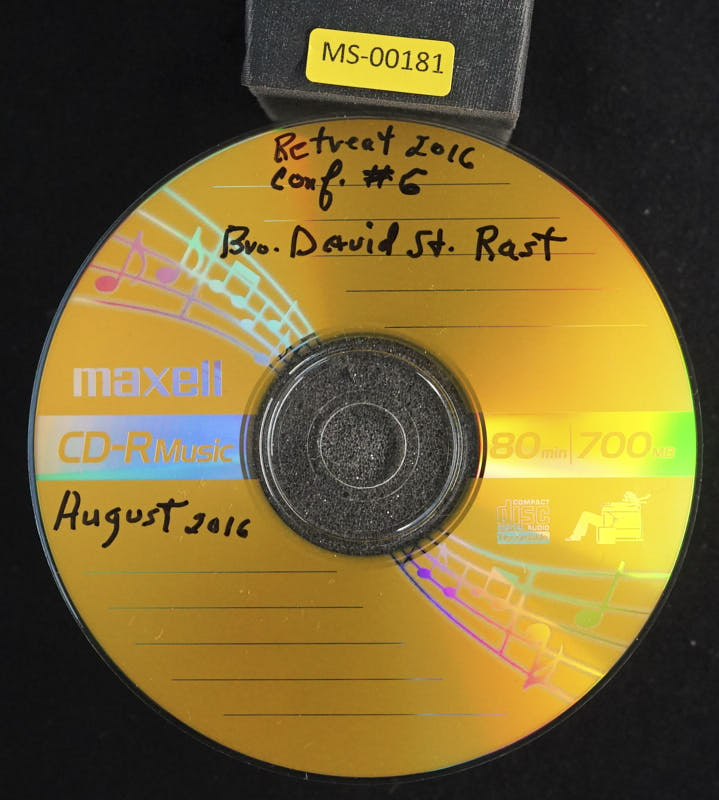
AI Vision - Possible Values from Photos:
Speaker: Daivd St. Rast
Location: undefined
Possible Title: Retreat 2016 conf. #6
Additional text: maxell, CD-R Music
@AI-Vision_v002
Yes, I mean, today's merciless made me appreciate how warmly I've been welcomed here, how good and how pleasant we live. Brothers are born, and I want to take this opportunity to thank you again for that long reception and love. the name of the Father and the Son and the Holy Spirit. So this morning we spoke about one of the two great myths, the creation myths. And we are speaking about myths because they give us a wonderful opportunity to go really deep because they are the great answers to the great questions of the human heart.
[01:08]
That is how we have defined, so to say, a message, a great poetic question and one of the great questions, poetic answer to one of the great questions of the human heart. And how this will all, tied in with monastic living, I tried to point it out step by step, but I think sort of the full picture emerges, of course, only in the course of our sharing here. So what was the most important aspect of this morning's presentation was first of all, that we live in this double realm. I didn't mention this word, double realm. It is a word that was coined by the poet Rainer Maria Wintke, who was very important for the Danversons.
[02:15]
He would often quote him. And that's one of his key terms. And it means a unity. This is not two realms or two halves of one realm. It is one realm of which we can see two different things under two different aspects. In our case, this double realm is our human life here on Earth and under one aspect We speak of it as I, each one of us, because this I is in time and space, it has a beginning and an ending, and another aspect we speak of it as self, I myself. But the two are a unity. It's not a lower story and an upper story or two halves or something. It's really one integral unity that is at the same time material and in time and space and immaterial and eternal, in time and eternal, eternal.
[03:33]
In the now, we will have to say more about this now and eternity. I haven't spoken about that yet. But we live in this double realm. And as long as we remember it, sort of in the background, like we remember our name, all goes well because this self is what unites us all. It's the Christ self within us. And as long as we keep this in mind, in the back of our minds, we will act out of that, and that makes a completely different interaction between people if we are just aware that we're just playing different roles. But basically, we are one. This is Christ playing to the Father, playing to the Father, playing to the Father, dancing before the Father, like eternal wisdom, the divine wisdom that plays and dances before the Father.
[04:35]
The image was also very important to Father Damascus. And as long as we keep this in mind, everything goes well, both personally for us and in the community. But the moment we forget it, this eye dribbles up and becomes the little ego, fearful, that's the first thing, and out of this fear aggressive and becomes a rival to all others and becomes greedy because it's fearful that there isn't enough around and this is bad enough for the individual but when a society is now run by egos, it is a violent society, a fearful society, and a rivalrous society, and a greedy society, and that is unfortunately what characterizes our society today, and has characterized that power pyramid
[05:55]
Ever since our civilization began 5,000 years ago, in the book that we are reading in the refectory there, again and again, very clear references to this power pyramid and to the chosen people, God's plan as being something completely different than this power structure. Once you learn to it, you hear it again and again in the book. pay attention to that. It's really interesting. It's all there. And we saw then that the opposite of this power pyramid is a network. It's a network structure which is exactly what Jesus had in mind for the kingdom of God, for this little community in in the midst of whom God reigned.
[06:56]
That was the kingdom of God. These little communities that he established. It wasn't just one. According to contemporary exegesis, he was wandering around with the disciples and in different places he had these little groups of disciples that were sedentary. And there... God's law ruled and not the Roman law. That ultimately brought him into trouble because he undermined, very successfully, undermined this power structure. And that Jesus was crucified shows that this was not a religious issue. There were religious issues at this time, but... in the telling and particularly then in theological reflections, it has not always come out so clearly that the reason for crucifixion was always subversion of the order of the state.
[08:10]
That was the only reason. And there were actually only two of people crucified, slaves that were run away, because everything was built on slavery, and if a slave ran away, that was a rift in the social structure, so it destroyed the social order. And revolutionaries, and Jesus was a revolutionary, and when he foretold his death on the cross, which is historically, of course we have it in the Bible, in the New Testament, in the Gospels, but it is also historically quite likely that he anticipated that he would be crucified because that was the just under this unjust structure, the so-called just punishment for exactly what he did he undermined this power structure he said among you it should be different the greatest among you should be the servant of all and then we and that is characterized through not fear but trust faith it's a faith community faith in God trust in life it's a
[09:39]
non-violent community it's a cooperative community instead of rivalry and it's a sharing community instead of king and that characterizes both the little communities that Jesus established in his lifetime and the Jerusalem community after his birth in the Acts of the Apostles and the monastic communities that always hop back to the community in Jerusalem and thereby to the Kingdom of God as Jesus foresaw it. And if we live that way, we will provide that important service which the monastic community at all times, every monastic community, is supposed to provide for the church, for the church structure, the institutional church, that is always in great danger to turn into a power pyramid, to provide another form of Christian living.
[10:55]
And that is why we have all these people coming to monasteries who very often... pretty sure that must be here the same thing, but it certainly is in Austria, in the monastery, and everywhere I come across monasteries, people come who would have nothing to do with the official church. Prior, who died in Austria says, at the Sunday Mass, we have probably two-thirds of the people that have left the church, unchurched. In Austria, you know, you have to pay church taxes, and so it's very clear how you're in or out. If you don't pay the taxes, you're out. It's a very unfortunate situation. Hitler started it, you see, and he thought if people had to pay taxes for being in the church, then they would all leave the church, but nobody left. Everybody was very happy to pay these taxes just to spite him.
[11:59]
But then when the war was over, the bishops found it so convenient that they continued this. It's a terrible situation now. The mailman comes every week and brings a bag of weapons and says, another 500 have left the church. It's terrible. But this is the situation. They have not left Christ. They love Jesus and they have not left Christian living or values, but they don't want to have anything to do with this power structure of the official church. And we provide churching for the unchurched. In various ways, this is true of all the monsters, and that is one of the most important aspects of our hospitality. Hospitality is, among other things, hospitality to one another.
[13:03]
within the community we are hospitable to one another we receive one another with openness with love we look for what does the other one need and this sort of thing but the monastery and the community as a whole is open to progress and one of the most important things that we provide is the experience of a community that is not a power structure but is I think kingdom of God as Jesus envisioned the Jerusalem community or the early Franciscan communities again and again in the church the monasteries were not the only ones because they too turned into power structures everywhere and had to be reformed over and over again there were many many different ways in which this idea of the kingdom of God was revised, and it was always nonviolent, fearless, nonviolent, faith community cooperating and sharing.
[14:21]
Dorothy Day, the Catholic worker, for instance, that's a good example in our own time. And the monastery is called to be that, and the way we receive people of course one receives them with kindness and kindness is exactly what you do when you are yourself I myself you know that everybody is of the same kind because we are live in Christ and Christ lives in us and out of the same kind comes the kindness that is how one behaves to those with whom one belongs together that's morality so all this springs out of the creation myth of the question who am I and I am
[15:24]
at the same time nothing and alive with the Spirit of God alive with the Spirit of God and the community itself pummeled thinking of itself as nothing but alive with the Spirit of God and sharing that and welcoming everybody who comes and now we come to the second which is the answer to the second great question. The first question was, who am I? And I asked you to anticipate what is the second question. Probably one could give a variety of answers that would not be wrong, but maybe sort of the simplest way that I found to say it is what is life all about?
[16:30]
If you have these two questions answered, everything flows. Who am I and what is life all about? People ask that forever and ever. What really is this life all about? And the answer to that question is the hero myth. the myth of the hero. And it exists in thousands and ten thousands of forms, very, very different from one another. But just as the creation myth, myth of origin, exists in many forms and have one basic pattern, so also the hero myth has one clear pattern that is repeated and sometimes more successfully, sometimes less successfully, and we will see what successful means in this context for the storyteller.
[17:33]
The great researcher in myth, the great anthropologist of our time He wrote a book called The Hero with a Thousand Faces. Hero with a Thousand Faces. This one hero, that is the human being living, but has a thousand faces. That was Joseph Camber. He's very well-known and had a television series about his work that was well-known. You're familiar with me. Joseph Campbell wrote this important book, The Hero with a Thousand Faces. And in this book it shows this pattern that repeats itself over and over again. And I will first give you the simplest form and then flesh it out a little bit.
[18:46]
It has three One can break it down in smaller units, but basically there's three phases. The first phase of this movement, the first phase of this movement is that the hero is singled out, singled out, and singled out for identification. Singled out means The hero must be somebody special because what's the point in telling a story about a nobody? So the hero, the storyteller tries to make the hero special, but not so special that it becomes a freak. You have to be able to identify with the hero because this is the story about you. So special, sing it out, but for identification.
[19:49]
And this first phase leads to the hero going out. Going out, that means going out from the accustomed environment, going out from the community. Hero goes out. That is always there in one form or the other. are sometimes obvious, sometimes not. I can illustrate these three steps on the fairy tale, because fairy tales are very frequently hero myths that have sort of been told and told and told and then come down to nursery proportions and are told to the children. But we find many. hero myth among fairy tales, and Little Red Riding Hood would be a good example. Everybody knows it's a good example for the hero myth. First phase, Little Red Riding Hood is sing it out.
[20:53]
He's a special little girl because she has this little hat that her grandmother has given her, a very special hat. So little girls to whom this story is told can certainly identify with her, but she is still special, and she has this little fed riding hood, a jeweled cap. And she goes out. She's sent out by her mother to go into the forest and to visit her grandmother. It's very dangerous, the forest. The fairy tale comes from the time when in Europe the forests were really very dangerous areas where there were robbers and there were wolves and there were wild animals and so the mother cautions little red riding would be very careful especially with wolves and when these wolves come Just run. Don't talk with him and don't get involved in that move.
[21:56]
That's the first phase, tip-by-tree. Nero singled out for identification and goes out. In this case, into the middle part of the Nero myth is the Greek word is the argon. The battle. disaster even. And the middle part is, the essence of the middle part is that the hero has now to deal with something which he cannot get under control, but has to deal with. He can't evade it, but he can't control it either. He has to deal with it. And of course the two typical situations in human life where we have to deal with something that we cannot manage is love and death. Therefore, love or death or love and death are usually the forms in which the storyteller tells the middle part.
[23:10]
In the case of Middle Red Riding Hood, And she does meet the wolf. She is not obedient to the grandmother. The wolf says, look at all these nice flowers. You can bring the grandmother a bouquet of flowers. Why don't you bring her some flowers? And so she starts picking flowers. And meanwhile, the wolf sneaks into the house of the grandmother. She has told him exactly where she lives and so forth. Sneaks in. and eats the grandmother, puts on the nightgown of the grandmother, under the lap of the grandmother, and lies in bed. And then Little Riding Hood comes and is surprised, the grandmother doesn't really look, the patient doesn't really look. The grandmother, why do you have such a long nose? And the woman says, I can smell you better.
[24:13]
A grandmother, why do you have such a big eye? Well, they can see you better. And then she said, uncautiously, she said, A grandmother, why do you have such a big teeth? And the woman said, that they can snap you better and eat up. That is bad. in a childhood proportion, but it is exactly what you would expect at that point of the theorem. It's in the middle of it. It has to be there. And one can see, but I will say this later. I will go again about into these three phases a little more in detail, that the theorem has to be dead, has to be dead. And not just dead, but as children say, dead, dead, dead. Completely dead. That's what happens. And then comes the third phase. The third phase is to get summarized.
[25:21]
The hero is dead and yet lives. And comes back to the community, says it's gone out from the community, now it comes back to the community as life bringer. So in the case of Little Red Riding Hood, the hunter comes, saves the situation, slips open the body, the belly of the The wolf, the grandmother hops out and is happy. Little Riding Hood hops out and is ready. They call all the neighbors and now they eat the cake that was in the basket of Little Red Riding Hood and they drink the wine. This is very important that one doesn't forget to tell the children that part of the story because that is the good ending. And everyone is celebrating life together. That is... And that is always the end of the hero story that everybody is celebrating life together as a community.
[26:31]
Now, a little more about these phases, because if you compare the different stories, and I said there were thousands of them, if you compare them, you see what the... storyteller considered successful, what they were driving at. Just as I said this morning, in the creation myth, they were trying to make that nothing as nothing as possible. It's difficult in the story. So here, in the first phase, they are trying to make the hero really special. And it's for us particularly, in our context here, and also in the context in which Father Damascus used to speak about it, it is very important to see what the different storytellers use to make the hero so special.
[27:41]
And it begins already with the conception of the hero. And very frequently, the hero is conceived by a virgin. This is not unusual. In fact, that is a very frequent sort of feature of the hero story. particularly also with Native American hero stories. A sun ray will hit the mother and then she conceives from the sun ray a child that is the son of the sun. The sun boy is one of those stories. Or the mother will go along and have a pepper in her mouth because that before chewing gum, we still did that as kids. Kids actually when we were hiking, you take a pepper in the mouth and you sort of move it around and keep your saliva running.
[28:45]
And so this Indian version also goes around and then accidentally she stumbles and swallows the stone. And this stone, so she conceives this hero and this stone boy, and he becomes a rock of a man and he only needs to throw himself on somebody. His enemies are squashed. This is one of those stories. So conception, special conception is one of those ways in which it's not always a virginal conception, but from an animal, for instance, totem animals. Then, special pregnancy. For instance, the child would already do special things while he's still in the womb of the mother.
[29:48]
The best image is John the Baptist, you know, who recognizes his cousin, the Savior, in this childhood story, according to Luke. In Montserrat, I never was in Montserrat, but I suppose some of you were in Montserrat. In Montserrat, there is a statue of the visitation. In the Middle Ages that was very popular to have statues of the visitation, especially on church doors, on one door the Virgin and on the other door Elizabeth. And then they had the babies carved on the bellies of the mothers. And sometimes they had a little glass window and you saw the babies sitting inside. And in Montserrat There is a little St.
[30:51]
John the Baptist sitting inside the belly of St. Elizabeth, and he shows his joy by playing a violin. It's an epitome of a spiritual pregnancy. He shows his joy by making music there and rejoicing in the room. Then special births. Very frequently the hero is born in a place where one isn't normally born. The mother can't give birth, can't give birth, has to go to some other place. Buddha, for instance. There are also lots of births of childhood stories, heroes. childhood stories about Buddha, his mother has to go under a special tree in the garden and give birth to him and gives birth to him out of her side, comes out of the side of the garden. So special birth.
[31:53]
Then as soon as the child is born, he's already special. Hercules is born and he's still in diapers and he... is so strong that he tears a dragon into pieces. A strong child and a wise child. Of course, again, the 12-year-old Jesus in the temple fits here very well. Those are ways in which the gospel tellers, the evangelists, showed that Jesus is our hero. That was the way of saying that, and people at the time understood that very well. That was sort of the way one told stories. Now, at the time of Father Damascus, we would explain the fact that the Christ story was cast into this
[33:03]
hero mode by saying with C.S. Lewis, C.S. Lewis put that into writing for the first time as far as I know, that humankind dreamed about the coming, the coming hero. It was a dream and in a thousand forms they dreamed and then the dream became reality. or the myth became history. That was the way we spoke about it. Nowadays, exegetes would rather approach it in a different way and would say, well, they started with the insight that Jesus was our hero and then gave the story or added to the story, this childhood story, that would... singing him out as special for identification. Then the second phrase, and I said already that in the second phrase, the storyteller thinks he or she is successful when they make the hero as dead as possible.
[34:17]
And it isn't enough that he's dead, but has to be if it's very successful, torn to pieces, just torn to pieces, cut up, annihilated, and yet he lives. We have that, of course, the Lamb that was slain, and behold, he lives. And we have that too. And that points to, again, to Jesus as our hero. And then the third, and yet he lives, leads already to the third phase where the hero comes as life-bringer. And that can also take a great variety of forms. And I will tell you still one other myth. Little Red Riding Hood is really very sort of...
[35:22]
childish form of telling about it but one great myth that was also important to Father Damasus was the myth of Orpheus it's a rather complex myth but a very beautiful story and also connected again with Rilke because Rilke one of his most important cycle of poems is the sonnets to Orpheus and And so the figure of Orpheus was very important. And Orpheus was often taken by the early Christians in Rome, the statues of Orpheus were taken, and adapted to be Christ's statues. And the Good Shepherd that we have up there is inspired by this fact. But Orpheus often has a lyre, and this one has a sheep. The Good Shepherd also came in there, but Orpheus had the lyre, and Christ was the one who praises the Father.
[36:32]
He sings the eternal praise before the Father. And that Orpheus has a myth. The first phrase is that Orpheus... is singing out already because he was half divine. He was the son of a muse. That's why he was a great musician and of a prince in Gratia. So he's a prince and a great musician. And he is a greater musician than anybody, any other living musician. In fact, He moves not only the hearts of humans, but he moves animals, and the wild animals become tame when Orpheus plays, and the trees uproot themselves and start dancing. He's a very successful musician.
[37:33]
And he also is very blessed by marrying Duvidesi, who is a beautiful woman, and they are very happy together, and they are newly married, and she is still with her bridesmaids, dancing in the meadow, and steps on a viper that bites her, and she dies. And that is now the end of this first happy phase. But we can, as human beings, identify us with this loss, this joy and with the loss. And then Orpha is so sad that he decides to follow his wife into the middle world. Then he goes out now from the life, from the world of the living into the
[38:38]
world on the bed and he finds an entrance and he goes down into the netherworld and he says I will sing before Pluto and I will move the heart of Pluto and I will sing before Persephone because Pluto had raped and taking away Persephone and taking her down in the netherworld, so she had experienced what a early death means, I will move them, I will sing for them. And so he sings down there and he so moved everybody, all the dead souls down there, that they all weep. And Milton describes that very, very beautifully. He says, love bid my eyes love bid the soul of prophesies to sing such notes as wobbled to the string
[39:59]
drew iron tears from Pluto's cheeks and made hell grand, what love would seek. Iron tears, the god of the netherworld, the god of death. He can't reap human tears, but iron tears, a beautiful, beautiful image. And he granted that privilege that he could take a ridicule back up on loan because he said, I only want her on loan. She died too soon. She should live out her life. Then you can have her back. So he came up on loan and the only condition is on the way up you must not look back. Only when you are in the sunlight and until you are in daylight and back in the world of living then you can look at her but you must not look at her before that and so it's very difficult to go to place the liar hopes that she's following him she listens for the footsteps she's not so sure but he stays with his bow and does not turn back
[41:28]
and he gets into the sunlight. And in the sunlight, assuming he's in the sunlight, he turns around, but she is not in the sunlight yet. She's still in the shade. He didn't wait until she was in the sunlight. And so he just sees her raving and disappearing back down into the middle. So it's one of the hero stories where... He's not so successful, but with her, he dies, of course. He dies with her, in a sense, and from then on, he sings only very sad melodies, and everything reads that he is singing, and he stays faithful to her, and he refuses to really even look at any other woman. And now, this is still all part of the central phase of this human race.
[42:35]
Now, the menace, the women that celebrate this race of Bacchus, they are frenzied, drunk with wine and frenzied and wild. They are so angered by him because he is faithful to Eurydice that they are into pieces, limb from limb. And that is now the climax of this central phase. And now comes the third phase. Yes, he is dead, but his head, which they have torn off, floats down the river, still singing. And his lyre is taken up by Zeus into the sky and becomes one of the constellations. And Rilke says, this is a beautiful interpretation, he was not torn to pieces and left there.
[43:43]
He was distributed as communion is distributed. And now he sings in the rocks and in the lions and everything. Don't ask who sings. Wherever there is singing, it's worthless that sings. Wherever there is singing, it's worthless that sings. So that is very different and very much more complex. hero myth, to give me an example of that. But our question is now, how can we take out of this type of story the answer? How can we simplify the answer to the question, what is life all about? And of course, one should wash out one's mouth every time one does that because one should leave the story, that would be the right thing.
[44:48]
But for our purposes one can say what it all amounts to is that life is all about dying into greater fullness of life. That's what it is, dying into greater fullness of life. That is verified by human experience over and over. Who of us can't remember a situation in our life way back somewhere that was really like a death? Maybe more difficult than physically death, real dying. Now, many years later, we look at it and it was the beginning of a new kind of life. And we would not have this life in its fullness if it hadn't been for this death.
[45:53]
And this happens not only once, maybe once or twice in a lifetime in a real big way, but many times in a little bit. In everyday life you have to die to something and come... And if you... have the courage to die, you come alive in a new way. And courage comes from the word core, heart. So if you have the heart, don't say so deep in English, if you have the heart, you really go with it. But there are two different attitudes that we can have to this dying or to this anxiety or this fright into which we come when something like that threatens. We can either courageously go with it, trusting in life, life would get me there, or we can resist it.
[46:58]
And resistance is fear. So we must distinguish between anxiety and fear, between being frightened and being fearful. We cannot help being frightened. If something frightening happens, we are frightened. If something frightening happens, we are anxious. That is not under our control. But we can go with it in courage and trust and faith, or we can resist it. And what happens when you resist it? You get stuck in a narrow spot, if you resist. And, of course, this is the way we came into this life. We have all come to a very narrow birth canal than was our first birth. And probably the feelings, the bodily feelings that we have when we get anxious go back to our earliest experiences as babies when we were born. It's renewed every time we get into a narrow spot, as we call it, a narrow spot.
[48:05]
But then, at that time, instinctively, we still went simply through and were born. And every time we now do it willingly, trusting in life, we also are born into a new life. And we can even project that to the greatest anxiety, that's the fear of death, the fright of death. And we can fear death and... then we're already stuck in it long before it comes. Or we can simply trust. Faith will bring me through. I don't know what's on the other side, except whenever I have died, I have died into a greater life, so that I trust the God of life in whose hands I am will also bring me on the other side of that narrow path, the narrowest of all, into fullness of life. And in that respect, this distinction between anxiety and fear is very important.
[49:13]
The emphasis on faith is very important and trust and courage. And our hero is Jesus Christ, the one that has shown us what it means to be human. And the gospel story of Jesus being singled out for every human being to identify with, dying, a gruesome death, and behold, he lives, resurrection. That is the history, the story of our hero. And we will see tomorrow and the next day how this plays out in our life. and ritual, and ritual within life, because those are other steps, but there would be too much tactic that on one evening, for this evening only, the question, what is life all about, is answered by a story, many, many different stories, also the gospel story, in a way that says, life is all about
[50:32]
dying into greater lives, over and over. And let's take that into sleep, which is also a little bad. Sleep is a little bad. We have to let go. Many people suffer from sleeplessness because they fear. This is in the sense of A little frightening when it's dark and you close your eyes and you're gone. And so for most, to us, fortunately, we have courage and so instinctively we do it. But some people get sleepless because they resist it. They resist and let them go. So when we pray in our compliment, Heed us through the night, Heed us through the night. That is this courage to die a little dead and come and be born the next day.
[51:35]
Glory be to the Father, through the Son, in the Holy Spirit, as it was in the beginning, with now and ever shall be, world without end. Amen.
[51:58]
@Transcribed_UNK
@Text_v005
@Score_93.53