You are currently logged-out. You can log-in or create an account to save favorites and more. more info
Mysteries Unveiled: Liturgy's Living Legacy
AI Suggested Keywords:
Talk at Mt. Saviour
The talk explores the influence of Otto Casel's theology of liturgical mysteries and its impact on monastic communities, particularly focusing on the Abbey of Maria Laach. The discussion highlights the enduring significance of liturgy as both a sacred action and the source of Christian life, drawing connections between historical practices at Maria Laach and contemporary liturgical reforms. It emphasizes the Abbey's role in fostering liturgical renewal and notes the contributions of key figures in the liturgical movement.
- Otto Casel: A central figure in the theology of liturgical mysteries, advocating for the presence of Christ in liturgical actions and shaping the liturgical renewal movement.
- Ecclesia Orans: A publication series initiated to promote liturgical scholarship, featuring early works of Otto Casel, including "The Memorial of Our Lord in the Old Liturgy."
- Romano Guardini's "The Spirit of Liturgy": Influential in envisioning liturgy as a form of play devoted to worship and contemplation, instilling a sense of spiritual presence.
- Pius X's Motu Proprio "Tra le Sollecitudini": A decree emphasizing liturgy as vital to Christian life, foundational to 20th-century liturgical renewal.
- Vatican Council Documents: Particularly the "Sacrosanctum Concilium," echoing Casel’s ideas about the presence of Christ in the liturgy, establishing liturgical action as a pivotal Church activity.
- Mysterium: A collection of essays by the monks of Maria Laach, furthering the development of the theology of mystery.
- Theologische Realenzyklopädie: An encyclopedia in which Otto Casel's theological contributions are documented, solidifying his influence on liturgical theology.
AI Suggested Title: Mysteries Unveiled: Liturgy's Living Legacy
AI Vision - Possible Values from Photos:
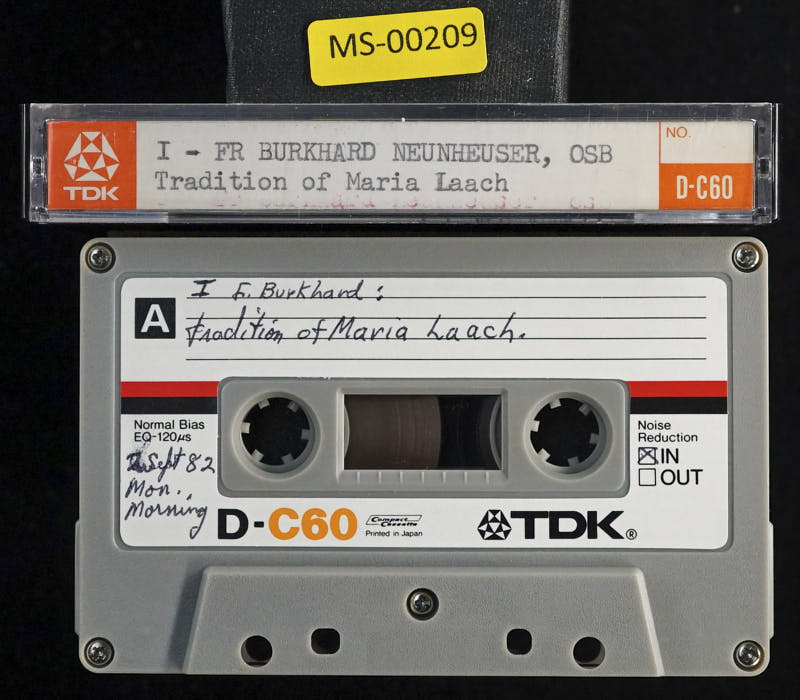
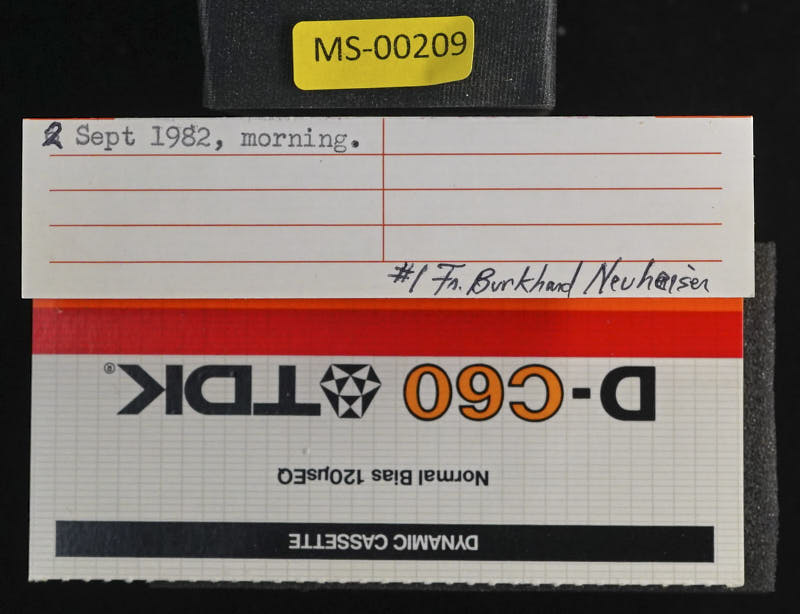
Speaker: Fr. Burkhard Neunheuser, OSB
Location: Mt. Saviour
Possible Title: Tradition of Maria Laach
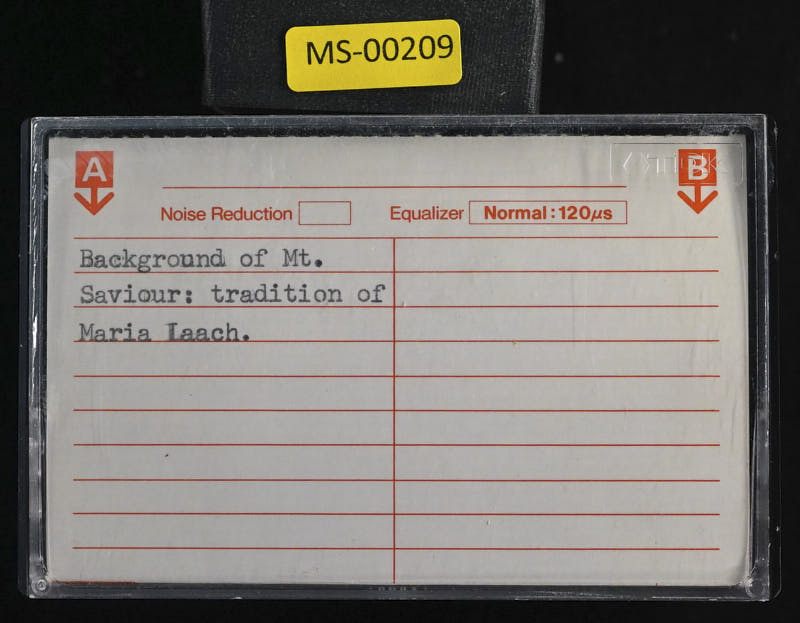
Additional Text: Background of Mt. Saviour: tradition of Maria Laach, morning
@AI-Vision_v002
My dear Paraval, I am speaking trembling and feeling, especially because I cannot speak very well English, and you must protest if my language is not enough, if you cannot understand me. On the other side, I am convinced that the tradition in which you are founded is very important And this tradition is related in a very great deal also to Maria Lark, to my Abbey. Therefore, I must speak about this Abbey, not to glorify myself in no way, not to glorify my Abbey, but because the Lord has taken us as his instrument to announce the gospel. Therefore, I speak to you, my dear, following the invitation of Father Martin, and he asked me to give you what I can of that tradition, especially as it influenced Father Damasus, therefore, to speak about , something about the monastical ideal of these fathers, both as ideal and as realized in our monastery.
[01:24]
And it is a very good war of the providence of God that today, there are 36 years that Father Albert Ilde von Zerweggen died, 2nd of September. This great man. And now, in preparing myself to these conferences, I could see I could see that I, in all my visits to the States since 1963, I have spoken about this topic, Odo Castle and the Theology of Mysteries. It's very strange. Allow me to speak shortly about these visits. I was beginning in Minnesota, in St. Joseph, to the sisters of St. Benedict there and St.
[02:25]
Claude. In the same year, I have spoken about this topic in St. Benoit Olak in Canada. Then later on in 74, I could speak about it in the Abbey of Gethsemane and other Trappist Abbes in Guadalupe in Oregon and Genesee. And in Worship 1976, I could write about Odo Castle in retrospect. And evidently, I have spoken about all these topics also in Europe, especially in Italy, in Rome, in Sant'Anselmo, during many years. And not I alone, nearly all the professors in the liturgical institute in Sant'Anselmo, in a certain way, were very much faithful to the ideas of Odo Castle, especially my predecessor as president of the Riturgical Institute, Father Salvatore Marsili, the Abbot of Finalpia.
[03:26]
I could speak about it also in Padua, in this Institute of Pastoral Liturgy in 69 until 77. In Spain, 79. and in France, 80, and of course in Germany, 1709, to all the sisters, not all the sisters, but many sisters, young sisters, novices of the Benedictine convents in Germany, and finally also in this Theologische Real Encyclopädie of the Protestant Theology in modern work, excellent work in many, many volumes, and there I could write a short synthesis of Odo Kassel, his life, his work, and the influence he had. In all these attempts or trials, I tried to realize the splendid words of the Vatican Council in the liturgical constitution, Saxo Sanctum Concilium,
[04:30]
Liturgy is a sacred action. Therefore, liturgy, worship, is a sacred action which could not be to which nothing is similar, nothing is greater than this sacred action. Now, other action of the church is so great as the liturgical action in which the work of redemption is given present. This is a word of the council, but here is the entire doctrine of Odo Castle really taken and presented with the authority of a council to say so. the greatest efficacy so that liturgy also, it is not enough to celebrate liturgy.
[05:35]
Nevertheless, liturgy, this sacred action, is culminate from the highest point, the highest reality of every walk of the church and the source, the fountain, from which all the activity of the church is coming. And then also in some of the instruction, After the council, the Roman authority said the intention of the reform of the liturgy is not so much to change texts and forms, but to obtain this pastoral action, which could be obtained with Mysterium Pascale Vivendo Ex Primatur, that the Pascal mystery could be realized, exercised vitally. in an authentic celebration, and at the same time so that after this celebration our entire life is impressed, is formed by the paschal mystery of Christ, therefore of his death and his resurrection.
[06:45]
And in all these deliberations, some words of the Holy Scripture, can give you the synthesis, the summa, the entire riches of this vision. For example, in the epistle to the Colossians, first chapter 26 and 27, the apostle says, my office is to announce to deliver his message in fall, to announce the secret hidden for long ages and through many generations, but now disclosed to God's people to whom it was his will to make it known, to make known how rich and glorious it is among all nations. The secret is this, Christ in you, the hope of a glory to come.
[07:50]
that is the translation of the Greek text in the Oxford Bible modern edition but the tradition is not right it's not enough according to our vision of the castle in Maria Lark it may be allowed to take the original text first in Greek at least the most important word in 2 in 1 27 In Latin...
[08:59]
Christus in vobis. Therefore, the English translation here, the modern translation, has translated too verbally the riches of this sacrament, of this mysterion. Secret is not enough. Secret is to fear. It is better to take with Ojo Kassel the original text because it is speaking more clearly and more vigorously the mysterion the riches of this mystery of glory and the mystery is precisely Christ in you as hope of glory and to come. And then again, in the same epistle to the Colossians 2, 2, again, the translation here says, I want them to continue in good heart and in the unity of love and to come to the full wealth of conviction which understanding brings and God's secret.
[10:25]
No, not only God's secrets. a hidden truth, but more still, the mystery of God. And the mystery of God is Christ himself, nothing else. That is the word of St. Paul in this epistle. And here is also the substance of all the theology of Odo Kassel. In all his books, in all his words, in his entire theology, to which we also dedicated our life in Maria Lack during many years, is this to announce the mystery of God, which is Christ, Christ present, the presence of Christ in you, as the hope of the eschatological glory, which must come still. Therefore, these ideas are... the central topic of all our work in Maria Lark.
[11:29]
Therefore, now I must speak about it, about this monastery of Maria Lark, which is one of the roofs, which is one of the fundaments in which is founded your monastery here in Montsevio, with Fr. Damasus Winsen. And again, it is for me a little bit difficult to speak about it, because I must glorify this monastery. Yes, we did it. And always speaking in all these visits in the States, in all these years I have taught in Rome and in my speech in France, in Spain, in Germany, I was always realizing that here really is not our merit, but the grace of God who has given us the possibility to speak about this central heart. this internal riches of the work of God which is his mystery to speak with the first chapter to Ephesians therein lies the richness of God's free grace
[12:48]
which love is imparting full wisdom and insight, he has made known to us his hidden purpose, mysterion, hidden purpose, his hidden will, his hidden action, such was his will and pleasure, determined beforehand in Christ to be put in effect if the time was ripe, namely that the universe, all in heaven and on earth, may be brought into unity in Christ. In Greek, bring all the things together to unity as church under the head who is Christ. And this... effect, this work, was conceived from all the eternity in God, sacramento voluntatis sua, the mysterion, two telemeters or two, the mystery of his will, conceived in all the eternity in God, to be fulfilled in the fullness of times in Christ, not only for him personally, but so that the entire world would be brought together in unity under Christ as head.
[14:09]
This is the gospel, to say so, of Christ, and our entire intention in all these years in Maria Lache has been to announce this gospel, to announce the possibility to share in it, in our liturgical celebration, so that... celebrating, acting our worship, we realize this work conceived from all the eternity, realized in Christ in the fullness of time, given to us in the church, to be realized in every sacred mystery, in the sacraments, in every action of worship. No, to be realized furthermore in the entire life, in the hope, that all this may be realized finally in the eternal kingdom of God.
[15:15]
One mystery for maternity in Christ, now in the church, for to be fulfilled in the age to come. No, we were talking about this in this monastery of Maria Lark. Therefore, I must speak for a while about this monastery, which is really a famous one. Not because we, feeble men, are working there, but because God has chosen us. And this monastery, so famous one in the entire world, you could say, is one of the fondaments of your monastery here. This monastery is famous, you know it first, and therefore so many thousands and thousands of visitors every year come to see us in Maria Lague of our wonderful scenery, the lake and woods with dears. and sometimes wild swine, what's that in English, I don't know, swine. No, terrible, dangerous animals.
[16:20]
Okay, and our fields made millions years before by volcanic explosions and so on. But in this wonderful scenery, there is this marvelous church from the 11th, 12th century during eighth change of this concert without any fire, without any war, and so on. A wonderful realization of the Frankish German spirit of the Middle Age. A little church, not so great as Cluny, but in a certain way, a very modest realization of this powerful spirit of Cluny in the Middle Age. Frankish German. France and Germany, together. Not only one possibility, but one possibility to show the greatness of the work of Christ in the middle of the world. And this church had its monastery during 800 years, or 700 years, until it was suppressed by Napoleon in 1802.
[17:36]
It was not a great monastery, not a very important monastery. Nevertheless, we have some good witnesses about his work in the 12th and the 13th century, very famous also in the 16th century. Nevertheless, it was not a great abbey as Reichenau, as St. Gallen and Einzeilen and other monasteries in the Middle Ages in Germany. Please. Please. No, no, no. It was an independent German abbey which followed in the first centuries a little bit Cluny, but it has never been an independent monastery of Cluny. And later on, on the end of the 15th century, until the suppression under Napoleon, it was a member of the famous North German congregation of Burstfeld. But then it was suppressed. remaining private position, and became in the first time famous, it's very strange in the entire world, by the Jesuits, who have taken this monastery in 1963, and made it collegio maximum, the very great college of the Jesuits in Germany, with many important works, which really for the first time made famous this monastery in the entire world.
[18:58]
Collectio Lachensis, a collection of the Acts of the First Vatican Council, Philosophia d'Ascensis, a modernistic philosophy of St. Thomas in Latin, cursus sacra scripturae, edited by Knabenbauer and other fathers, and also by the very important periodical Stimmen aus Maria Lark, Voices of Maria Lark. Okay, so they worked there, but only for 10 years. And then in the Prussian Kulturkampf, the conflict between Bismarck and the Church, the Jews and all the other orders, religious orders must leave Germany, also the Benedictines. But meanwhile, the Benedictines and the Dominicans and all the other orders could come back. The Jews could not come back. and therefore protesting against their expulsion, they continued to call this review Stimmen der Zeit, the most important catholic periodical for long people in Germany,
[20:24]
But then the Jesuits could not come back. They remained there as owners for the administration. But they could not work there. Therefore, in 1992, they sold it to the Benedictines of Byron. And now we were beginning as Benedictines there. Therefore, we are more or less a young monastery, only 90 years. But again, we were followed by the grace of God. who has inclined the former emperor, the last emperor of Germany, William II, to help us. We could buy the property, the farm of this monastery only because the emperor himself has said to us, you will have the church. The Jesuits never have used the church. They didn't need it so much because they were studying only and working only and preaching only and not so much praying. Or perhaps privately, but not in office.
[21:28]
Therefore, the emperor said, you will get it. And a half a year after that, we have taken the farm. We could also go into the church. The emperor has visited very often. And at that time, 1900, 1910, before the First War, the favor, how do you say, the grade of the emperor was of the greatest importance for the monastery. And this favor of the emperor was also the reason that the first abbot, a very holy man, Bensler, monk of Beuron, became the bishop of Metz, the only one German bishop in Lorraine in Metz in this German time until 1919. And he was so great and so sent as bishop, we are thinking always still it could be possible to canonize him at once. And he is still not forgotten in Metz itself by the people there. Also, he was a German. He was fighting also against the German generals during the First War that his French-speaking diocesians could have their worship in French, so that the generals more or less wished to arrest him.
[22:40]
And when then the French people came, they asked him to sing in the cathedral of Metz for the victory. And he said, no, not for the victory, for the peace, because I have all the German diocesians. Therefore, a man of justice, a real martyr, then he must leave the country. So, and the second abbot was a young monk of Beuron, Fidelis von Stötzingen, who then in 13 was elected abbot primate, successor of Hildebrand de Henting. Therefore, already by the first two abbots, this monastery became a monastery of a certain glory, to say so. But then we had the third abbot, Ilde von Herwegen, who died 36 years ago in this day, today. And we... must be thankful to him, because all what we have today, we have received it more or less from him.
[23:47]
He was a very great man. And you can see it in this little booklet, which we published in the occasion of his 100th birthday in 1974, with the title, What do you think the church could be? What do you think about the church? Was halted hier von der Kirche. with some wonderful sermons which wish to illustrate his greatness of Abbot Urban Baum, of Pater Emanuel von Severus, and especially also of a professor of trio who give appreciation of him after the Second Vatican Council. Was he, what? No. After the council, Abbot Ildefons Herweg, and today still, 36 years after his death, could signify for us. It would be very nice, because it's written in German, to translate it sometimes in English.
[24:49]
The importance of Abad Herwegen. For the moment, for me, it's impossible to insist too much in his personality. I wish to insist more in his work. The importance is that he, from the first beginning, already before he became abbot, was insisting in the necessity of a liturgical apostolate. He is not the first to have insisted in it. All what we have received, all what or which we have, we received it from Belgium. Mont César, Kaisersberg, Lambert Baudouin, who in 1909, in the wonderful Congress in Malin, was insisting in liturgy as the source of the entire Christian life. It's more or less the same word which was pronounced already by Pius X in 1903. But nobody was attending to it.
[25:58]
It was a word which is given from the Pope some weeks after that he became Pope. in the motto proprio tra le solitudini, where he insisted in the necessity of reformation of the Gregorian chant. And at the same time, he says, liturgy is indispensable, is the very necessary source and fountain of everyday Christian life, real, authentical celebration of liturgy. Nobody was attending to it. Nobody was understanding it. And also the wonderful decrees of Pius X about the Holy Communion were not understood in a liturgical way. You remember perhaps the Older that in that time we were receiving very often Holy Communion before the Mass, outside the Mass. In my young years I have seen in some parishes this custom that after the consecration a second priest came, took the blessed sacrament from the tabernacle and distributed Holy Communion.
[27:01]
Meanwhile, the priest was continuing his Mass and the faithful had no contact with it. Only after 1909, after Lambert Baudouin, we were insisting we must receive Holy Communion as our wonderful participation in the sacrifice of Christ present here in the Mass. So, Lambert Baudouin was insisting in it and the Belgian people with the activity of this French and Dutch-speaking people, this activity was able to make a wonderful success, already giving origin to a very famous controversy. The Jesuits, believing in the first moment, in that time, today they are liturgists as we, but in that time they were feeling that all their Methods, exercises of St. Ignace, were destroyed by this liturgical movement.
[28:02]
They were fighting against Lambert Boudouin and against other monks who were explaining the wonderful possibilities of this liturgical conception. It was nearly a danger of death, but the first war then stopped all these controversies. Nevertheless, Abad-Inde von Herwegen has taken... the inspiration of this Belgium work since 1913 when he was elected abbot. And for the first time, he could collect some young students to participate in the liturgical celebration of the Holy Week. Good Friday, the great visual of Easton, and between these young students have been very important men who later on became leaders of the European nations. Heinrich Brüning, the last chancellor of the Republic of Weimar, and Robert Schumann, after the Second War, minister of the Foreign Affairs of France.
[29:11]
He was of Metz. Therefore, you can see that in the first beginning already, liturgy was conceived as a source of Christian activity, of Christian life, of Christian witness outside, not only in the peaceful meditation inside of the church, but authentical celebration of liturgy to share in the work of Christ presently here in the liturgy that we are able to live this mystery also as witnesses of Christ in the world, dying to sin, living in Christ. So he was beginning. And when he became abbot, immediately in 14, before the war still, he was celebrating together with the Academica Verband, the Association of Catholic Academical People, students and also professional men, in the Holy Week. And he was repeating this through all the years until the Second War, in the times between the two wars.
[30:17]
The World War First, in the first moment, was stopping this activity. But already in the end of the first, during the First War, Eastern, Abad Herbegin and his monks were beginning then apostolate, the liturgical apostolate in a new way with these wonderful collections, Ecclesia Orans, the praying church. And the first volume of this collection was Romano Guardini, The Spirit of Liturgy. I don't know if you have read this wonderful book, which for us in 20 years, has been the inspiring book to vitalize to bring to life liturgy when he was speaking about liturgy as play where we stay before God not seeking any concrete business successes but only to
[31:35]
internal sense very important, wonderful work to stay before God it may be stupid to do so because it would be better to make money but no, no, no, we stay for God to adore him, to worship him we know here is the source and the fountain of every our activity so he was beginning in Eastern 1918 with this work And then immediately later, still before the end of the war, one of his monks was beginning the Liturgie Wissenschaftlichen Quellen und Forschungen, sources and studies of history of liturgy, with the addition of a sacramentary, showing the intention of the liturgical work. And... After the war, this then was going on and followed in 21 by the first volume of the Jahrbuch für Liturgie Wissenschaft, Anniversary for Liturgical Science, indicted by Otto Kassel.
[32:45]
And also, Father Otto Kassel himself, before the end of the war, was publishing in the second volume of Ecclesia Urans his first great work, The Memorial of Our Lord in the Old Liturgy. where he for the first time was showing that in the liturgy we are celebrating the memorial of our Lord. Memorial not in a subjective meaning, but memorial so that what we are recalling is really present. Therefore, already the substance of his later entire theology of the mystery presence. And so on. The abbot, together with his monks, was beginning this work of liturgical apostolate for a greater Christian public and also for learned people, both in both lines.
[33:51]
And he continued so during his entire time as abbot from 18 until 18. the beginning of War II, with his entire monastery. And here again, there is the providence of God. He was a great man, a very important man. And without him, perhaps, it would not have been possible to do so. But he had the chance to have a great, no, not army, no, a great number of monks to helping always. And you know some of these monks. One of the greatest has been his prior, My novice master, novice master of Father Damasus, Albert Hammonstede, perhaps somebody of you, of the older, has known him, because he was sent together with Father Damasus and Father Leo von Rutloff in 1938 to the States to seek for us a place of refuge for the case that Hitler would suppress us.
[34:55]
He was the great man who could inspire us with love to liturgy and with the great sense of liturgy, also in a very human way. Abbot Herbig sometimes was a, how do you say, in English, hierarchical figure. He was more human, very nice, very kind, filled also with reinish humor of Cologne and so on. Very human man, excellent man. And then, together with him, all these learned people. This was, first of all, Cunebert Mohlberg, the great editor of the old sacramentaries, not only in 1918, but then later on, and especially still after the Second War in Rome. in the studia, no, in the Reum Ecclesiasticum Documenta, in the edition of the Sacramentarium Leonianum, Sacramentum Veronense, Gallicanum Vetus, Gothicum, and Gelasianum Vetus, of four important sacramentaries, and many others still before the Second War.
[36:20]
And with Kuhnberg-Molberg then, the great Udo Kassler, from whom we must speak more still later. And then still some other learned people, Stefan Hilpisch, with his history of the Benedictine order, and his smaller books about the history of monks and of sisters have been translated also in English. He was my, how do you say in English, the second... the helper of the master in my young years. A wonderful man too. All are excellent. And if I said Arbeit Habenstiese was a man of Rheinisch humor, a good man, a human man, he was also sometimes a little bit pessimist. Meanwhile, father... Stefan Hildbesch was filled always with optimism. Therefore, all these people could work together in the same way to help to realize the great propositions of the Abbot Ildefelsherwegen.
[37:23]
And then still another man who is not so new in the world, but he is very competent for the history of the congregation of Bursfeld, Paulus Volk. All these are dead now. But then there were many authors still who were working from all these old, wonderful men who then, especially after the war, became novices and were working. I must name still Father Urban Baum, later Abbot, one of the successors, the second successor of Abbot in the France, the great man who has published one of our most important German missiles before the Vatican Council. Desiderio Schmitz, who was the great cellar of that time, and also cellar after the Second War, he must leave Germany in consequence of some conflicts with the Nazi, and then he became the great cellar of Brazil, Rio de Janeiro.
[38:33]
And Father Damasus, when he founded here, the house wished to have him here too as cellar, but he preferred to remain in Germany. Therefore, he was one of the great sellers of that time, and without his ecumenical foundation, it would not have been possible to work all this, to make all these things. And then many offers still from all these men, and then Damasus Winsen, evidently. He was one of the most excellent young novices and young monks in that time, And he was together with me in the noviciate. We were studying together in Rome for many years. We have been ordained in the same day. And we were teaching philosophy both in our philosophical school in Maria Lack for the entire Balconist congregation, also with many young monks of Fort Augustus.
[39:38]
Anselm and Ansgar and Karouf and all these people. And then he was the greatest philosopher in our monastery, a very spiritual man, spiritually rich in his retreats for priests. And for my opinion, he was so great that if he would have been remained in Maria Lark, I suppose that he would have been elected successor of Abad Ildefons in 1946. But then he left Germany, sent to the States to seek a place of refuge. And he has written to me in that time that it's the first great sacrifice which I must bring for Maria Lark to go away from it, to go to the States to try to find here a new place First, great sacrifice. I bring it because I like my monastery and wish to help it that it could persevere.
[40:44]
Later on, after the war, when we had no more intention to continue because we wished to remain in Germany, there was no more danger to be suppressed. He then has seen the great possibilities given in the States and he remained here with permission of the abbot. You know these difficulties of him in Regina Laudy's and connected it. And then, finally, in 1951, founding this monastery. And in all this work, which is illustrated by these names, by many others still, we can say we to show the importance of liturgy in our studies, in our apostolic work, especially also in our life, in a very authentical celebration of liturgy in our monastery, in our retreats given to the people, and especially in one way, which is one of the most important realizations of our liturgical ideas,
[42:03]
In the crypta of our monastery, a very nice crypta of the Romanist church of the 11th century, in 21, Father Albert Hammelstede, the prior and novice master, for the first time in Germany was celebrating the Missa Dialogata, the dialogue mess, Missa Recitata. We have been not the people who... was inventing it, because also here, the first beginning must have been in Belgium. But in Germany, we have been the first. In the same time, celebrating the mass facing the people. For the first time in the entire history of Germany, because meanwhile, in Rome, it was always so. Until today, in the papal masses, when the pope is celebrating Messi, he is facing the people. But in Germany, never, because after the eighth 9th, 10th century, the altar was put against the wall or with a relic shrine here on it.
[43:14]
It was not possible to face the people. Therefore, for the first time we did it, to realize a greater community in our liturgical celebration. And he did it first only with the novices, a great novices. He was the novices of Urban Desiderio Schmitz, Urban Bonn, Damaso Swinson, Odor Haiming, still today alive. And then later on I too came to it, but I came later, I was younger. And every day we did it, realizing so the possibility of real, authentical... Eucharistic celebration. No more as our laborer was in that time must do it. There were a hundred men, wonderful men, masters in their craft work, hand work. They were assisting to a private mess, a silent mess in the church. On the high altar, very distant, in silence, no communication to the altar.
[44:22]
receiving Holy Communion from the altar of the Blessed Sacrament, in the other direction, from the tabernacle. And some of the old good brothers said, we don't participate, we don't share in this heretical Mass in the Crypta. Verse 4, 21, every day, every day, we were celebrating Mass, everyone bringing his host during the Offertory to the altar himself, 10 years. with the young cleric, sometimes 15 or 20, everyone went to the altar, brought the house to the altar, receiving it back in time of communion, in hoc sarco, Sancto Comercio, and this wonderful transmutation, the body of Christ. And sometimes, very often, Father Payer, Albert Hamner, was speaking there. But this time, he tried to get the labor of us. And really in 24, for the first time during Lent, he, Albert Hampstede, together with the master of the brothers, Simon Stricker, could realize to bring together all these men, 100, more than 100, every morning in Lent 24.
[45:40]
And every morning before the mess, he or Father Simon were speaking, explaining the mess. We all stayed. And sometimes they were speaking so long that already the sign for the second series of messes was given when they were speaking still. And then we must continue to say the mess. It was marvelous. And so this mess became famous in the entire Rhineland. And especially young people, young boys came. We came from the great cities, Düsseldorf and Essen, looking to this catacombs mess, mess of catacombs. It was not catacombs, but it seems to be so. And then we tried to imitate it in the great cities, together with the example given in Rottenfels by Romano Guardini. And therefore sometimes we call this mess Krypta-messe of Laag, or Burgmesse of the quickborn of the Catholic Youth Movement of the Castle of Rottenfels. In every case, we tried to imitate it. And the young people came. And so became this mess very famous, always more famous, in all our retreats.
[46:46]
Every morning, the men of retreat, masters, students, boys, could share needs. And also the priests, in the last day, at least. And it became so famous, this mess in the Krypton. that in the time of Nazi, it was said every young Catholic boy at least once must have been present in the Kryptomies of Lach to receive the spirit of resistance of, what do you say in English, of spirit of war against the paganism of the Nazi, of Hitler, and so on. Therefore, in all these ways, we tried to stay together. Abbot, his monks, the Barovas Owls, still in two classes, it's true, in the solemn liturgy and his wonderful private liturgy in the Krypta, with the dream, with the hope that it could be possible to come share in one coming day
[48:02]
in the solemn liturgy in the upper church, receiving Holy Communion there, because in the High Mass there was not Holy Communion. Therefore, when we must be ordained priests, sometimes we were inviting our lay monks. They could continue to receive Holy Communion in a real Eucharist. We must say our private Mass, as Martin Luther said it, our Winkelmesse, our little Mass, almost in an angle, and could not participate in the High Mass. It was not possible. Only the deacons and subdeacons received with time the permissions to receive Holy Communion in this High Mass. And then they must remain in, how do you say, in the union, in fasting, totally from four in the morning until half past eleven, when the Mass was finished. we did it in that time, to have this possibility to share really in the liturgy, and so on.
[49:08]
But no, the entire community is staying together to be really a church in this place. Therefore, on the one hand, studying, preaching, insisting in liturgical apostolate, Then staying together in liturgical celebrations so far, it was possible in that time according to the liturgical laws of that time. And staying together as community in these good years, until 1939, sometimes 150, 160, 170. And then the second war stopped all these possibilities. And we could not continue to work outside. And then we must also arrange our timetable, because according to a very famous word of this national socialism, the wheels must go on.
[50:20]
to obtain the victory, we could no more say the high mess at 9 o'clock. We must walk the entire day for the victory, to say so. And therefore, we used this necessity to celebrate our high mess very quickly in the morning, half past 7 or 8 o'clock, where it was still possible to God's providence is always marvelous. But between these monks who were working with the abbot together, receiving his conferences, the entire community once a week.
[51:25]
The choir amongst the priests still offered two times in the week, and his directions. and studying with our apostolate, trying to stay together in fraternal love. Between all this, there was one monk who still was more famous than all of us, and that is Otto Kassel. He was a student of the university in Bonn, brought to our monastery by Herbert Herwegen, who was studying too there. And then he was finishing his studies with a doctorate in the University of Bonn about the mystery silence of the old Greek philosophers in 1917. And then his first great books, The Memorial of Our Lord in the Old Liturgy, Liturgy as Celebration of Mystery,
[52:28]
And in the edition of the Jahrbuch, of the Annuary of Liturgical Science, where he was exposing his idea. And the fundamental point of his idea is, in our liturgical celebration, the work of redemption is made present. so that we can share in it, that we can die with our Lord, to live with him. That is the mystery of God, which is Christ. Christ, who died, who has risen. In him are all the richness of wisdom and grace. Therefore, we must celebrate liturgy to can share in his work, to be redeemed, to be children of God, to be members of the kingdom of God, and so on, in the hope of the eschatological fulfillment of all such things.
[53:34]
And we were trying to study these points, and also in common works, collecting the different studies of the monks in little books, And therefore, in 1925, we made the edition of a small book, Mysterium. Only the title, Mysterium. Collected works, collected studies, collected papers of the monks of Maria Lark. The theology of mystery was always collected with the name of our monastery. And here, Odo Kassel, Abertherwegen, Athanasius Wintersich, And some others were presenting their ideas, always insisting in this explanation of the mystery of God, which is conceived from all the eternity, prepared by the works of God in the Old Testament,
[54:36]
fulfilled in the fullness of time in Christ, in his death, in incarnation, death and resurrection, to be celebrated, to be actualized in our liturgical mysteries, in our liturgical celebrations, in all the sacraments, that it could persevere and continue in our daily life, in the hope that it could be fulfilled in the eschatological kingdom of God. All this one mystery of God, Christ Jesus in the church, Realized by us in the honor of God. But this idea was not yet quite ripe. And therefore, 25 was beginning a terrible controversy, which again made this work new in entire Germany and in the world, especially between the Benedictines and the Jesuits, Umberg, Hansens in Rome, and so on. Sometimes it was awful. But Otto Kassel always fighting in great works defending himself.
[55:41]
We were helping him, never losing the courage. Meanwhile, we sometimes could nearly lose the courage. I remember when Umberg has written his second great article against Kassel. He said in the end, all... what he has said about the presence of the work of God of Christ in the liturgical action is a fata morgana. What do you say? Fata morgana. Nothing. A dream. And I remember still the place where Father Albert Hammershede told to me, terrible article of Umberg, all is fata morgana. I answered him, oh, I don't believe it. Terrible. Always. sprung against him and it's very strange today all these things are forgotten he was persevering he must correct something and we still after his death were correcting some points of which is but the final the great essential essence
[56:53]
of his doctrine remained and was crowned in a wonderful way by the Vatican Council. If you read in the Tutorial Constitution, Numero 5, Numero 6, Numero 7, until 10, you will see that. Well, for example, in Numero 7 is it Christus presents as the Omni The Christ is present in every action of the church. First of all, in the Eucharist, in the community, in the president, and especially under the species of bread and wine, substantially. He is present in every sacramental actions because he is baptizing. He is present when the word of God solemnly is read in the church. He is present when two or three are collected together to pray. He is in the midst of them. Therefore, because liturgy is so great by the presence of God, liturgy is sacred action in its eminent sense, culminate funds, and you must share in it to be real Christians.
[58:03]
More or less, the Vatican Council has... approved not the entire doctrine of castle is too much to say but at least the last intention of it is the most important point and no I must finish this time already I wish to say only our great possibility has been to announce this gospel in the sense of these words of the apostle in the first and second chapter of the epistles of the Colossians in the sense, in the meaning of this declaration of the Vatican Council. Our difficulty today, after the Council is today, we are no more pronouncing the great word for years and years, for 10 and 20 and 30 years. Everyone knows it. So for today, our announcement is no more so important. Our duty today is to persevere in it.
[59:04]
to live it, to remain faithful. Also, there are big difficulties. And now the time is finished. And persevering in the big crisis we had after the council, you know, we left. No, we lost at least 20 years. from the younger people who went after the Second War to us. We had wonderful young people after the war. The best of them have left us. Why? I don't know it. But nevertheless, we must continue to live according to this wonderful vision which was given to us in that time. one of the great fundaments of Father Damasus. And still when I was in Delbatten in these days, Albert President Martin told me the remembrance of Damasus Winsen and of Albert Hammelstede and Leo von Rutloff in their lectures in Delbatten seminary is still alive in the clergy people.
[60:16]
clergy and people of that region there. It was the great gospel in that time, which Father Damasus brought here to Mount Savio, where you too must continue to live this intention, the presence of the mystery of Christ in our liturgical mysteries, to announce it to the people, to live it here in this a small community as a witness of the greatness of God. And perhaps we could continue to speak about it still in our possibilities.
[60:50]
@Transcribed_UNK
@Text_v005
@Score_96.73