You are currently logged-out. You can log-in or create an account to save favorites and more. more info
Monastic Harmony: Tradition and Community
AI Suggested Keywords:
The talk explores the rich spiritual and architectural heritage of Benedictine and Cistercian abbeys, emphasizing their role in embodying Saint Benedict's vision of community, prayer, and balance. It examines the vows of obedience, stability, and conversatio morum as integral to the Benedictine way, illustrating how these commitments foster a dynamic relationship between individual spiritual growth and communal living. The discussion also highlights the significance of integrating ordinary life with spiritual practice, as exemplified through the monastic community's engagement with the surrounding world.
Referenced Works and Authors:
-
The Rule of Saint Benedict: Central to the talk, this foundational text offers guidance on community living, personal growth, and spiritual discipline, emphasizing the vows of obedience, stability, and conversatio morum.
-
Thomas Norton: Cited for his reflections on the simplicity and prayerful nature of Cistercian churches, particularly the Church of Saint-Laurent, which embody monastic ideals.
-
Elis Peters' Novels: Highlighted for depicting how Benedictine abbeys are integrated into local life, reflecting the monastic commitment to social engagement and stewardship.
-
Modern Art in Monastic Contexts: References to artworks by Mother Concordia and Osanyi underscore the continuity of monastic tradition and community involvement in contemporary practice.
-
Historical Anecdotes: The narrative includes examples of medieval monastic achievements, such as hydraulic engineering innovations, demonstrating practical applications of monastic principles.
AI Suggested Title: Monastic Harmony: Tradition and Community
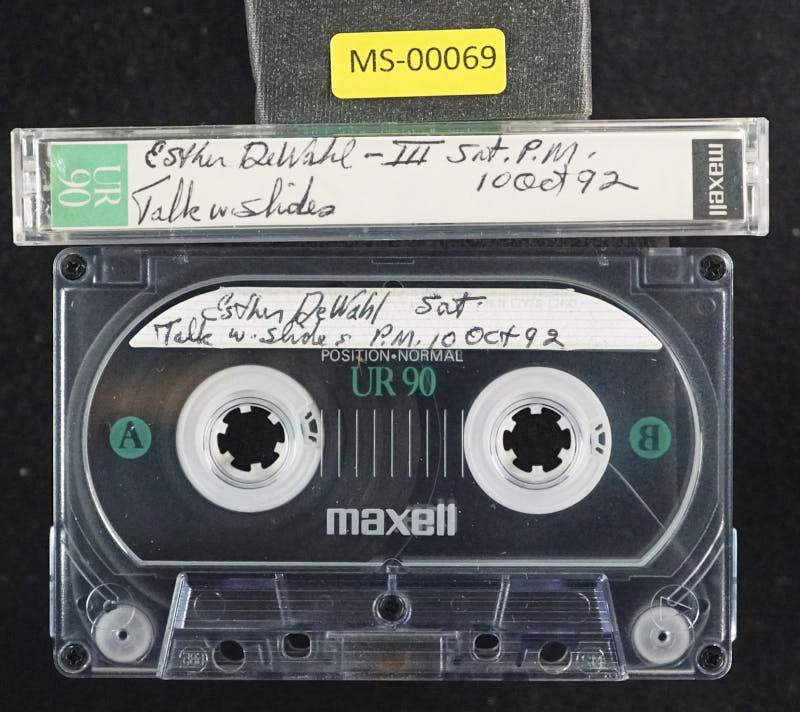

AI Vision - Possible Values from Photos:
Speaker: Esther DeWaal
Possible Title: Talk w Shido, III Sat. P.M.
Additional text: III, P.M.
@AI-Vision_v002
This was not a place where I took other people as well. Far too dangerous. I wasn't sure that people had no effect for heights. But that secret in the roof space that there are above the walls, between the stone walls and the roof. And then, most exciting of all, it happened again, if you like. Always one of God's surprises in the most practical way. After that first year in Pantry, I thought it was time I had a dishwasher. It's not so usual to see. They had a difficulty in trying to plug it in. So they were lifting up the brain covers all the way around the house. And they did pick up brain covers in a bed of geraniums and reveal that down below... were the great tunnels which had supported the medieval water system which had been built in the middle of the 12th century.
[01:02]
So in no time at all, as long as I was exploring the heights, I was also exploring this extraordinary succession of subterranean tunnels which went all the way under the cathedral carrying lead pipes as part of the Benedictine water system. So one way and another, that building really taught me, brought me really close within touching distance of that medieval monastic community, brought me closer to their daily life and to their vision, if you like. Now what I'm going to do this evening, is not to give you a tour of the best Benedictine and Sustertian abbeys, anything like that. I'm going to show you slides. And by the way, the slides on the whole are not taken by me.
[02:08]
I did the text, but the slides, which some of them are quite lovely, I think, were taken by them. somebody else, so I can't be responsible for the slides. I disclaim any credit there. What I may do is to look at a succession, if you like, of images from Benedictine and Cistercian abbeys, mainly in Europe and in England. They will be anonymous. They will be corporate they will be essentially images which I hope will help us to deepen and to enrich this exploration together of the Benedictine way. And yet at the same time as I'm doing this, part of me really is almost in revolt against that because
[03:13]
There are so many words, and in some way, the importance of what happens this evening will be the way which it touches any of you beyond words in which it speaks to your own subconscious. So really, my final word is to just read you something that Thomas Merton wrote. about the Church of Saint-Lonc, which is a very simple, extraordinarily beautiful Cistercium Church in Provence. A church like Saint-Lonc is born of prayer, is prayer. Its simplicity and its energy tell us what our prayer should be. The churches of our fathers expressed their silence.
[04:19]
There was nothing superfluous, nothing useless. They did not waste words with God or with men. And in their buildings, they did not waste anything either. What I really embarked on this weekend is in some way a journey, a pilgrimage. Because we're all of us on a journey, an inner journey which answers a deep need in all of us.
[05:21]
And a journey such as this is as old and as new as history. We all of us need take time apart, just as surely as did the pilgrims who, in the 10th century, climbed this hill, this mountain top to this remote Benedictine monastery. Time to encounter ourselves and to encounter God in prayer, in study, in solitude and in silence. Ultimately, each of us is solitary, a hermit, and yet we are also part of a community. And again, a weekend like this allows us both to live with ourselves and also to join with others in community.
[06:28]
purpose of our exploration is a particular and a peculiar purpose. It is to explore, to enter again into the gift of Benedict to us all. His vision of the world, which we find expressed in his rule. a vision which breaks down the barriers and the sad divisions in the church. For the rule comes from the undivided church and it points us forward to the undivided church of the future. It's a vision too which breaks down geographical divides and divides of time.
[07:32]
So we find a unity between a modern Benedictine community today, worshipping Bernard in the modern chapel built by a contemporary Japanese architect, and a community in France. Actually, this is Saint-Benoît-sur-Loire, where they continue a living tradition of a thousand years and more. There is still somehow a harmony and a sense of unity between these buildings. A Benedictine Abbey today is still a place of pilgrimage. a strength from the past, and a promise for the future. Speaking to all of us, monastic and lay, Christian and non-Christian, men and women, to all who will hear of the way to our own deepest and fullest humanity,
[08:54]
a way of healing and wholeness, which is also a way to God. I believe that a building such as this, a great Benedictine monastic church, that we can look on that as an icon, something which is beautiful in itself and which reveals truths beyond itself. It can speak to us if we allow ourselves to enter into it, or the vision which inspired the men and women of medieval Christendom. whose minds conceived these buildings and whose hands fashioned them.
[10:03]
And so we find this quite amazing range of architecture and aesthetic triumph. They range from a monastic community high in the foothills of the Pyrenees, to a monastic church, gentle, pastoral, quietly in a marked town, to a splendid abbey church built for women in the 12th century, or a great Spanish Abbey which became a centre of learning and a place where Arabic texts were translated. But as we know each one of us, make our own inner journey, we shall encounter many holy places.
[11:18]
places where prayer has made their valid, places which will deepen for us our sense of participation in this one great tradition which over 1,500 years has crossed all divides of time and of place. I want to begin our journey tonight by reflecting on those three vows that I was talking about this morning. As we stand now in this place of simplicity and austerity, we recall that the first word of the world is listen. listening to God and responding to him, the dialogue which lies at the heart of the sub-Benedict's way to God, so that each day begins with this urgent reminder, today, hear my voice.
[12:39]
Listening to God inquire at the office above all in the Psalms, listening to God in the oratory and in the silence of our own hearts. God speaks to us all and he speaks to us all above all in his word. But he also speaks to us through creation, through the created world itself, through the world of his making. Through the men and women of his creating, so that we listen to our brothers and our sisters,
[13:43]
but through also the material things which we handle with reverence and respect. So as we reflect on the totality of the many ways in which God is reaching us, the whole of ourselves, body and mind and spirit, so we reflect too that The response to listening with the ear of the heart comes from a heart overflowing with love, so that our response is yes, that free, open, willing yes, which is essentially what the vow of obedience is all about. And now, thinking about the vow of stability, we stand in a crypt, a great, simple, austere, 12th century crypt.
[15:03]
Here is the womb, if you like, the depths, the lowest part, the part which keeps firm the rest makes possible everything else that it supports. The vow of stability is the vow of standing still, of not running away, of staying in the depths of our own being, which is where the encounter with God and with the true self Staying still. Staying firm. How fundamental and how basic a need it is for all of us to be earthed, to be rooted, to be grounded in
[16:14]
the person who we are and the place in which we find ourselves so that we hold ourselves still at the still point of the turning world. But St. Benedict That monster of paradox and holding two things together asks us also to journey on, to move on, to climb these warm steps. For the vow of conversatio morum is essentially the counterpoise to the vow of stability, and it is the vow to follow Christ
[17:15]
wherever that may take us. The stone pillar stands firm at the center of the spiral stairs so that those steps which take us up or take us down are held in place by that central pillar. Conversatio Morum is the vow that tells us that we may expect to move into the dark or into the light. It is the vow that tells us that we may have to go through many narrow doors. It is the vow above all which presents us with the paschal mystery of death and life, of dying and new birth.
[18:31]
As we stand in these simple choisters, they show us light and shade and movement on. And we reflect how basic and how fundamental this understanding of this vow is, the call to journey on, the pilgrimage, the quest. On entering the community, the novice will lay those three vows on the altar and will say, she should pay me, accept me, oh Lord. This acceptance which we all of us need, if we are to become the full and free person,
[19:43]
made in the image of Christ. For Sir Benedict tells us to take off the mask and drop the pretense and place the whole of our complex, often contradictory selves before him. Because it is only by encountering myself, in all honesty, the naked self the self no longer playing roles, the atom in myself with all my vulnerabilities, sin and weakness and my discordant and disparate elements that I can then start to build up the whole. The honesty that I feel that this self-acceptance asks of me, I find reflected in four sides of the capital of a pillar in one of the great Benedictine Romanae scripts.
[21:02]
And it begins with this extraordinarily joyful and lighthearted scene, which is a celebration of life because it is in fact a couple of jesters and one is balanced on the other's head and is throwing a fish into a bowl and the next one is also a cheerful and smiling creature with a curly trail and a great grimace and then then the mood changes and we see strange devouring creatures if you like elemental forces of the unconscious. Until finally, on the fourth side, there is a double-headed monster, including male and female features. And so here, too, like Adam, again, we all stand
[22:10]
Each one of us in our total humanity. The light and the dark. The masculine and the feminine. The joyous and the frightening. The life enhancing and the life denying. These vows. We said this morning, allow me to encounter much about my own humanity, but the great importance is that all the time, they point me beyond myself to price. That in obedience, I think of Christ the word. In stability, Christ the rock.
[23:14]
In conversatio moro, Christ the way. For the rule all the time points beyond itself to Christ. Christ is the beginning and the end. Christ stands at the head of every avenue. The name of Christ on every page. This is Christ the Pentographer, the Lord the All-Powerful. The Christ in the apse of the Abbey Churches looks down on the monks and on their liturgical life. And in return, all eyes turn to him and all hearts and minds converge in him.
[24:19]
This is the Christ who reaches out to all creation and not least to the men and women of his creating, accepting each and every one of us for our own unique individual worth. For the life that the rule lays down is life together, life in community. And living with one another, as Sir Benedict knows only too well, is never easy. But he's trying to help us to hold the proper balance between the individual parts and the whole.
[25:20]
And here as we stand under the vaults of a great medieval monastic church, we can, as it were, see that message spelled out in stone. is red and white and color and arch. Hairful light is the Pauline analogy of the body of Christ. The right relationships which allow each element to fulfill its own particular individual part and to contribute to the harmonious building up of the whole. A 13th century abbot preached here, under this vault, on this theme.
[26:26]
Being many we are one body, members of one another. And our spirit gives life to our whole body through the members and joints and brings about a mutual peace. And yet, we should never forget what makes possible this unity. Here we see, indeed we can almost feel the thrust and the counter-thrust, the never-ending tension, the vaults and columns and arches and walls and ribs and capitals, all locked into this unceasing play. This interplay and interdependence of differing forces
[27:33]
the unremitting tensions of opposites. And there, in the middle, the boss, held still at the point of tension, holding the keystone, holding the point of balance. between the two divergent streams, becoming the point of equilibrium. And as we look at this one particular piece down, I think that that in itself as a symbol reminds us of
[28:35]
the truth and that is how costly it is to live with these tensions that it is demanding even to the point of being sacrificial this holding together of the parts that make up the whole Whether in a community, or whether within our own selves, or whether within one of these great monastic buildings, it's possible only through patience, through perseverance. Every element in one of these great Abbey churches has been brought into relationship with the whole, not in any easy way, no shortcuts, but simply by relentless hard work, through commitment, through staying there, through simply, if you like, the steadfastness of the Psalms,
[30:03]
the refusal to give up because we are in it for the long haul. It is this commitment, this steadfastness, which makes possible the harmony, the balance, and the good order. The choices above all, it always seems to me, speak of that harmony. But they also speak to us of something else as well. They remind us of movement to and from centered spaces.
[31:06]
They serve as the link line, bringing into a relationship all those different parts of the building which serve the needs of body and mind and spirit. So that particular Benedictine rhythm of recognizing that we are all tri-part beings, and that we must respect the demands of body and mind and spirit and allow each of those elements to become a way to God. So those oysters link up the places, the parts of the buildings, which are essentially speak to us of the worthiness of our bodies, the dormitory.
[32:08]
For Benedict would have us respect the body, and he is clear that enough sleep is important. Just as, and perhaps this is the most absurd monastic kitchen ever, I have to admit. that food is important. Food is to be taken seriously. Concessions and allowances when they are needed. A real nurturing of the body. None of the idea, the puritan idea, but somehow the body is to be dismissed, denied, or trampled upon. But if you feed the body, you also feed the mind.
[33:10]
Time set apart for alexia divina, for study, the respect for scholarship, for money and the care lavished on the scriptorium. The scribe and the artist held in high repute, the way in which throughout the dark ages Benedictine monasteries and Benedictine scholars kept the light of life alight in Europe. But then, body, mind, and spirit, at the sound of the bell, dropped everything. Opus Dei, the work of God the praise of God. The church runs along one side of the choisters and it anchors the rest.
[34:17]
Everything ultimately depends upon the life of prayer. And so in the Middle Ages, a great Abbey Church Tower will dominate the town, will dominate the surrounding countryside, because there that tower is saying simply, this is the most important thing in life. Prayer is the root. Prayer is the fruit. Prayer is the foundation. Prayer is the aim and purpose. Contemplative prayer lies at the heart of Benedict's way to God.
[35:19]
But here again, as so often, there is a paradox and there is a tension. the roll. And if we're now to climb that great tower and look in alternative directions, I think we can see it spelled out before our eyes. We look in one direction along the line of the roofs, and we see an added church situated in the middle of a small market town, the red roofs of the houses, a busy, prosperous little town. We look in the other direction. We see, though, the roofs making the sign of the cross, and the roofs are lying against trees.
[36:26]
So here we have the marketplace and the desert can we have the life of hospitality be open to all who come and the life of enclosure the marketplace and hospitality for Benedictine life is no escape from the world, rather it is the daily and the ordinary becoming the way to God, so that we handle the kitchen implements, the garden tools, whatever it may be in our daily life, with much respect and reverence as if they were the sacred
[37:30]
vessels of the altar. Look at an aerial view of a medieval monastic abbey and you will see how complex it is and how much it is integrated into the life that surrounds it. And indeed I think one of the best things that Ellis Peters has done in is to give that feeling that an abbey is not apart from local life, but local life flows in and out of it. The Prior's Chair, where the chapter meets to deal with matters of administration and efficiency balancing the books, looking after the property, making sure that things add up.
[38:36]
That is Benedictine responsible reality. There is property to maintain, tiles on the roof to be looked after. There is responsible stewardship and harvesting. Cultivation of the soil. Responsible use of new technology. Responsible use of technology so that in 1154 and enterprising prior brings piped water to his community of a hundred monks. A pioneer in hydraulic engineering, he's able to bring the water down in leaded pipes, carrying it to a succession of condits, serving the infirmary, serving the abbey, serving the townspeople, feeding the monastic life, and then
[39:54]
finally flowing out into the town ditch. Done so efficiently that at the time of the Black Death, when throughout England and Europe, the population was decimated, only one month out of a community of a hundred or more died here. Here is real handling of the material things of God's giving with real care and forward-looking responsibility. But of course, handling of people as well. Let everyone who comes be received as Christ. The door is open, hospitality, and not only hospitality to the poor, the sick, and the needy, also to the lonely and the widowed, so that widowed queen may find refuge to end her days in a Benedictine community.
[41:17]
From the highest to the lowest, there is no distinction of person. Let whoever comes be received as Christ. So here is a life lived out as an integral part of the surrounding neighborhood and region. An involvement of social security and hospitality and farming and land maintenance and respectable technology. Benedictine life takes the ordinary and the mundane and doesn't try to escape from any of its responsibilities or burdens, but rather to make them a way to God. So now, as our pilgrimage begins to come to an end, let us now kneel at the shrine of our Holy Father, Sir Benedict, at Fleury, and there light a candle in gratitude for what Sir Benedict
[42:51]
and his rule has meant in our own lives and for what he promises us in the time that lies ahead. For each one of us, the rule opens up a way to God And for each one of us, that will be very different. The longer we stay with the rule, the more we come to discover its riches, its contrasts, its paradox. It steps.
[43:52]
But they are all held together, interconnected. They become vibrant and they become full of energy. That energy which Benedict holds out to us in the prologue. above all we find in the law, a pointer towards a way that is life-giving, a promise of healing and of wholeness, so that we don't live disintegrated or distracted, torn apart, but that we find a unifying principle, that theme of integration and order and rhythm that I tried to speak of yesterday evening.
[44:57]
That holding together in balance of the three vows that we looked at this morning, the balance of body and mind and spirit, the balance of right relationship with ourselves, with others, with the world, and with God. That unity which Benedict holds out is also, I believe, a unity of the Church and of the Kingdom that we all work and pray for, so that our lines of denominational division may disappear before the unity of our worship together.
[46:16]
And so I show you the statue of Our Lady made by Mother Concordia, who is a Benedictine prioress. It was made in 1982 so that it could be placed in St. Anselm's Crypt at Canterbury in time for the visit of the Pope. And it was placed there one evening when Andre Luth and a number of monks from Mont Descartes were there living in the cathedral precincts and saying that their offices in the cathedral said that the first thing that happened on the day in which that statue, a modern statue was placed in a 12th century crypt was that the monks of Mondeca sang the Salve Regina.
[47:20]
Old and new, past and present, and a promise of the future. Commitment. to living out the insights of Benedict in our life, then we must be forward-looking and outward-looking. And so here are two modern windows made by the modern Hungarian artist Osany, placed in a Benedictine Abbey church to speak first of all of salvation, salvation to all. If we see the face of Christ in all who come, then we are committed to work in our own day against any injustice or anything that will demean the dignity of each individual person.
[48:38]
as made in the image of Christ. And the peace window for Pax is a Benedictine watchword, so too we are committed to the making of peace in our immediate communities and immediate responsibility, but also peace in a wider context in today's world. A candle burns, and may that flame speak to the church and to the world of what this Benedictine vision and insight can bring in healing and wholeness to us, to the church, to the world.
[49:43]
May we pray that the unity, the integration, and the harmony of Benedictine understanding becomes more and more a power for healing, for the transformation of ourselves and society. And that this spirit of St. Benedict may speak anew to us in our generation, as it has spoken in the past through so many changing times and seasons. O God, who has given us our Holy Father, Saint Benedict, to be a burning and a shining light in the church for 1,500 years.
[50:48]
Look with your grace on those of us gathered here tonight as we attempt to make his holy rule our guide as we live out our differing vacations and callings. inflame us, each one, with Benedict's spirit of fervent love, with his sense of passion and urgency, with his sense of patience and perseverance, that we may also in our generation Keep the light and inspiration of that way alive for ourselves, for the church, and for the world.
[51:56]
We ask this in the name of that Christ of whom all the time. set better date point source.
[52:13]
@Transcribed_UNK
@Text_v005
@Score_98.21