You are currently logged-out. You can log-in or create an account to save favorites and more. more info
Monastic Harmony Through Eucharistic Unity
AI Suggested Keywords:
Talk at Mt. Saviour
This talk discusses the relationship between monastic life and the Eucharist, emphasizing that the Eucharistic celebration is universal and not distinctively monastic. The discussion traces the historical development of Eucharistic practices and theology, illustrating how monks traditionally celebrated the Eucharist in alignment with contemporary Christian practices and the broader Church's directives, especially post-Vatican II reforms.
-
Otto van Castle, "Les anciens moines ont-ils célébré la liturgie?": An article questioning whether early monks celebrated liturgy similarly to later monastic communities.
-
Armand Veilleux, "La liturgie des moines Pacomia": An exploration of how 4th-century monks of Pachomius conducted liturgical celebrations comparable to wider Christian practices of that era.
-
Angelus Häusling, "Mönchskonvent und Eucharistiefeier": A study detailing monastic Eucharistic celebrations in the early Middle Ages, disputing the notion of mass multiplication for personal piety.
-
St. Benedict's Rule: Discussed to demonstrate that monastic Eucharistic practices were in line with general Christian practices, with infrequent masses compared to modern standards.
-
Eucharistic Mysterium (1967): An instruction post-Vatican II highlighting the unified celebration of the Eucharist as a communal act, with significant theological emphasis on the post-conciliar liturgical reforms.
-
St. Paul’s First Letter to the Corinthians: Referenced to illustrate early Eucharistic practices and understanding, highlighting the invocation of God and thanksgiving as key components.
-
Acts of the Apostles, chapter 2 and 20: Used to describe early Christian Eucharistic gatherings, emphasizing unity and communal aspects of the practice.
-
St. Augustine’s Writings: Cited to emphasize the theological concept of unity within the Eucharist, referring to the community as the body of Christ.
-
Radramnus of Corby and Pascasius Radbertus Eucharistic Controversy: Mentioned in context of theological debates on the reality of the Eucharistic body during the Carolingian period.
-
Doctrine of Transubstantiation: Discussed in relation to the medieval theological focus on the real presence of Christ in the Eucharist, evolving liturgical practices, and Eucharistic adoration.
AI Suggested Title: Monastic Roots in Universal Eucharist


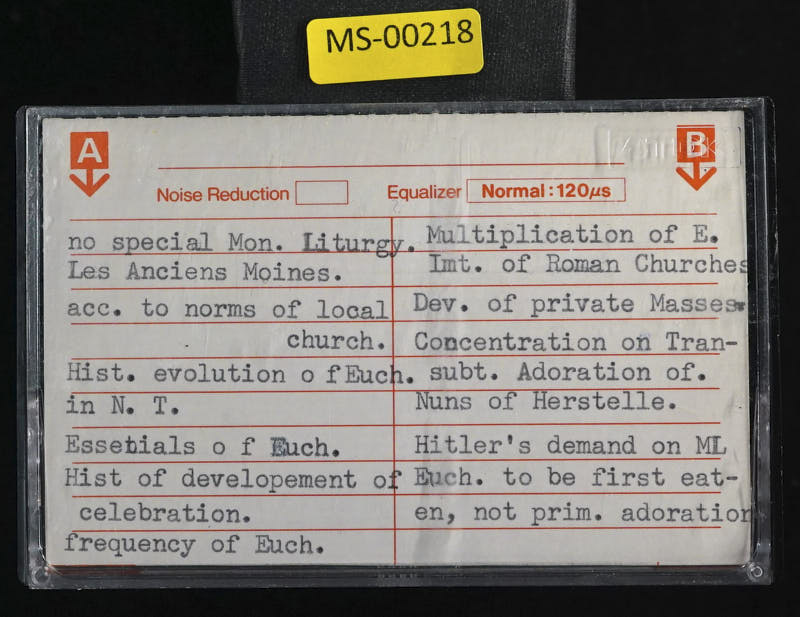

Speaker: Fr. Burkhard Neunheuser, OSB
Possible Title: Monastic Community Eucharist
Additional text: VI, 13 Oct 82 A.M.
Possible Title: continued
Additional text:
@AI-Vision_v003
My dear brothers, I thought to speak to you, so far as I am able to do it, about monastic Eucharist, therefore the relation between our monastic life, monastic community, monks, and the celebration of the Eucharist. And I thought to give some remarks for the introduction, and then a summary of the historical evolution of Eucharistic prayer and praxis, and then the third point, our Eucharistic piety and behavior as it is resulting from this historical view. I am not sure if I succeed to do it Theologically, my first remark for introduction would be there is no special Eucharist for monks.
[01:07]
Eucharist is the celebration of a local church. Local church in perfect meaning is only the church with his bishop or with the representative of the bishop. a local church, a community, which is under the guidance of this hierarchical representative celebrating the memorial of our Lord to be the church, to be the body of Christ. United together in the celebration of the memorial of the death and resurrection of our Lord and united together in the in eating one blood, the body of our Lord. And I would like to say it in a certain way against a very famous abbot, great friend of us, abbot Elysius Dekos of Steenbrugge in Belgium, who has written an excellent article in the memorial of Otto Kassel
[02:23]
the old monks in the first century did celebrate liturgy in the same way as Solène and Boyron and Maria Lark are celebrating liturgy. Of course, the answer must be for him And also a little bit he was right. No, he did not do so, as Solheim and Beuron and Maria Larkin are modern times. But nevertheless, he was a little bit exaggerated. And therefore, I was against it. And one of my best students in Rome was from the same opinion. And he was a trappist. who also do not celebrate liturgies as Hollen and Beuron and Maria Lark are doing it.
[03:25]
He later on became abbot. He has written an excellent book, Armand Veilleux, La Liturgie des Moines Pacomniens du IVe siècle, The Liturgie of the Monks of Pacomnius in the IV century. And his dissertation, and we were both always enjoying it, who can say the old monks celebrated liturgy, but not in a special way as made for monks, but took as every Christian in the fourth century did it. There was no distinction. Monks were celebrating liturgy as the entire Christian people did it. And therefore, I am using very much this dissertation of Armand Veilleux about the liturgy of St.
[04:36]
Pacomius in the 4th century. But also I am using then for the next consideration a book of my own confere, one of our best and learned monks we have today, Angelus Häusling, Mönchkonvent und Eucharistiefeier, the convent of monks and the celebration of Eucharist in the early Middle Age. We shall speak about it later on. Therefore, from all this, no, I would insist again in this sentence, there is no distinction in the way in which monks are celebrating Eucharist from the neighborhood. And we could say the same also in a certain way if we look to the rule of St.
[05:38]
Benedict and the rule of the master. We could say problems of the monastic conventional mass in an essay written in Downside Review in 1969. but also then written in this splendid edition of the Hall of St. Benedict proposed by the American Benedict in 1981, the Hall of St. Benedict, in this year of jubilee, where Bourguet says, at most it is possible that the conventual mass in St. Benedict's monastery was celebrated on Sundays.
[06:42]
and feast days. But perhaps mass was celebrated less often, even without a fixed regularity, according to the custom of that time that people was coming together on the first day of the week, on the Sunday, to celebrate the memory of the Lord. So it is also in the monastery. And also that is not very sure. In the rule of the master, the situation According to Vogue and also all the other people who is competent in this matter in the hood of the Master, the Eucharistic celebration may have been so that the monks went on Sundays to the parish church to celebrate their liturgy together with the people of God. And during the week... According also to our old custom, there is not Holy Communion in a special service in the monastery, without Mass.
[07:45]
Therefore, they have taken the Eucharist and made a communion service. It's not absolutely true, but more or less we could say it was so. On another side, Saint Benedict does not speak about it in no way. It seems nearly so that because he did not insist in this possibility to receive Holy Communion in a communion service outside of the Mass, because he didn't speak about it, he did not visit. And I would say immediately the idea to renounce to the daily celebration of Mass and to receive Holy Communion, as perhaps they did it, in the rule of the master would be a terrible anachronism today, no more possible for us. But St. Benedict does not speak about the rule, and the commentators are all from the same opinion, also in this American edition of the rule of St.
[08:51]
Benedict. He does not speak about Eucharist. It is nearly scandalous that he does not speak about it. Meanwhile, we say Eucharist is the highest form of liturgical celebration, summit, and fountain of every Christian and monastic life. But St. Benedict does not speak about it. Therefore, again, this seems to me an approbation, a proof for the fact St. Benedict and the old monks celebrated liturgy in the same way as every Christian did it in that time. But no, if St. Benedict did so, if St. Pacomius did so in the 4th century, St. Benedict in the 6th century, then we could say, and in reality, the history shows the same, today too we must celebrate Eucharist, we, the monks,
[09:53]
in the way in which today the Church of God is celebrating Eucharist, according to all the results of the modern liturgical movement, approved by the pokes, and finally by the Second Vatican Council. And we must celebrate Eucharist as the Church today wishes it to do, we shall speak about it still, according to the post-concilia liturgical reform. And in a special way, according to this marvelous instruction given by our papal commission, in which I had to the honor to be consultor, Eucharistic Mysterium, Eucharistico Mysterium of 67, where the, how do we say in English, the man who was really Writing, inspiring, redacting the text was Cipriano Vagaggini, our great master and professor of theology in St.
[11:05]
Anselmo in Rome. Very fine fellow, confere. Therefore, in this instruction, The Church has given us the idea of Eucharistic celebration in theory and praxis as we must do it today, also we the monks. But it is only to give a certain introduction, nearly an a priori, first remark as the fundament of all our following considerations. And now, in the second point, I wish to give a summary of the historical evolution of the Eucharistic piety and praxis. Perhaps you know that all already, but it would be convenient to insist in this. Therefore, how was the Eucharistic celebration in the New Testament in the apostolic time? You remember the most important texts, perhaps,
[12:14]
In a certain way, one of the oldest texts about Eucharistic celebration is given to us in the first letter of St. Paul to the Corinthians, because in a certain way, all the Gospels are a little bit later where The apostles are describing the institution of the Eucharist. Therefore, St. Paul speaks about it in this first letter, in chapter 11. The Lord has taken in the night when he was betrayed, bread and wine, and has said, this is my body, this is my blood, and so on. You know the text. But I wish to insist more in the text he gives in chapter 10, 16, where he says... the chalice of eulogia, of benediction. And in Hebrew, now we must speak a little bit Hebrew, the chalice of berakah, of this wonderful Jewish prayer, which we...
[13:27]
It's difficult to translate this. In Latin, the chalice of the Berlaka, over which we are pronouncing the Berlaka. Berlaka is a word, a substantive, composed by three letters. B, R, and K. And it appears also in a word you know all, Baruch, Baruch, Baruch. Baruch Atan. And this is, you are glorified. Blessed are you, Lord. There is a wonderful prayer of the Old Testament which occurs very often, very often. Blessed are you, Lord, because you have done wonderful deeds. Glory to you. The substantive of this... and this word is the technical word for this Jewish prayer.
[14:42]
And the exegesis says today, this form to pray is one of the most marvelous elements given to us by the greatness of the Old Testament, heritage of the Old Testament. Praise be to God, who has done so marvelous deeds in the Old Testament. Glory to you. Therefore, invocation of the name of God, glorifying him, recalling his wonderful works he has done for us, and the final doxology, And you find in every text in the New Testament where they are speaking about the institution of the Eucharist, where they are speaking about the celebration of Eucharist, they use this word, eulogia, benediction, or Eucharistia, thanksgiving. And this is the Greek translation of this wonderful Hebrew element which is composed by...
[15:48]
by these three parts, invocation of God, thanksgiving him, praising him, the memorial of his wonderful works, and the final doxology. And therefore, if we today are celebrating the Eucharist doing what the Lord has told us, then we are beginning with the invocation of the name of God, thanksgiving him in the preface, in the Eucharistic prayer. And then we are recalling in preface in Eucharistic prayer the wonderful works of God as we are doing it, for example, in the fourth Eucharistic prayer. A wonderful description of the entire work of redemption in the Old Testament, in the redemption in Christ Jesus given to us in the church. In the same way, you have... in this totality in the second Eucharistic prayer, which is a modern transformation of the Eucharistic prayer of Saint Hippolyte of the beginning of the third century, therefore the oldest form we have.
[16:51]
Also here, in a very short form, Thanksgiving to God, description of his wonderful walk, in the center, the institution of the Eucharist, and the memorial of death and resurrection of our Lord, and the final doxology by him, through him, with him to be Almighty Father, all honor and glory. Therefore, here is the essence of the Eucharist, also found in that time. And the text in chapter 10 is so, the chalice of benediction, of berakar, over which we are proclaiming this berakar prayer. This chalice is the communication with the blood of Christ. And the bread which we are breaking is the participation of the body of the Lord. And because there is only one bread, we, being many, nevertheless, are one body.
[17:58]
This is the wonderful meaning of the apostle here. We are celebrating this Eucharist, pronouncing the Eucharistic prayer, eating the one bread to be one bread, to be one body, to be the body of the Lord. And you remember that Augustine later on, in the most excellent way, is insisting in his unity so that he can say, the bread you see on the altar are you, you are the body which is on the altar. Eucharistic body, ecclesiastical body, unity. Eating this one bread, eating this one body of our Lord, we become, we are the body of our Lord. Therefore, so is the celebration of the Eucharist in the apostolic times. Coming together, pronouncing this thanksgiving prayer in the honor of God, recalling the works of God which are fulfilled finally in death and resurrection of our Lord, given to us, this is a final doxology, and then eat body and blood to become one unity, the body of Christ in this local church.
[19:21]
And you see then the result of this theology in the Acts of the Apostles, chapter 2, 42. All the first Christians were persevering in the doctrine of the Apostles in the communion, being united, in the fractiopanis, in the breaking of the bread, and in the prayers. Unity of all, in the doctrine of the apostles, in eating the Eucharistic bread, in the fractiopanas, in the breaking of bread, and in prayers. And again, you see then the concrete praxis as they did it. Everyday eating is, but it's not very clear what they have really taken.
[20:26]
Every day, the Eucharistic bread, sometimes only eating together. Thanksgiving to God, in a normal meal. But then, in chapter 20, where the Apostle is in Truas, in his travel, Una Sabbati, in the first day of the week, after the Sabbat. Here you have one of the first documentations of the Sunday. Kyriake, day of the Lord. Therefore, in the first day of the week, in the first day after the Sabbath, later on called in the day of the Lord, we came together to breed the bread. And you remember, Paul was speaking so long, this young man was sleeping, falling down, nearly killed. and St. Paul then brought him back to life, and then later on he was speaking again, discussing, making the homily, and also making the Eucharistic prayer, and finally they have eaten the communion, therefore the entire Mass.
[21:41]
During the entire night they were celebrating Eucharist on the first day. Therefore, in a certain way you could say, according to this view text, which I have shortly now given to you, They were celebrating Eucharist, at least on the first day of the week, on the Sunday, coming together to be the one body of Christ in this place, in unity, in love. And they did it so that after having heard the word of God, not yet written, but announced by the Apostle, they... or the priest, the apostle, was pronouncing this beraka, this thanksgiving prayer to God the Father, recalling the wonderful deeds, wonderful works of God fulfilled in Christ with a final doxology. And so they continued during the centuries.
[22:44]
celebrating the Kyriake, the day of the Lord. So just St. Ignatius, in the beginning of the second century, could say we are Kyriazontes and non-Sabbatizontes. We are people who are celebrating the first day of the week, the Sunday, the last day, and no more the Sabbath. It is difficult to translate it in a modern language. We are Kyriazontes. People who are celebrating the Kyriake, the day of the Kyrios, of the Lord. And we are no more people who are celebrating the Sabbath, the Sabbath. Therefore, insisting in the Sunday. And especially, they were insisting in one Sunday, the Sunday of Resurrection, Pascha, Pascha Vigil. The oldest text of celebration of a day in the year is perhaps from 140 in Apocalypse writing Epistola Apostolorum.
[24:06]
They are speaking about this celebration of the Pascha day, Easter day. After a long vigil, in which they were reading the Old Testament prophecies. They were recalling the death and the resurrection of our Lord to come take the Eucharistic bread in joyful thanksgiving prayer in the morning. Therefore, the entire work of Christ brought together in this Eucharistic celebration, word of God, Eucharistic prayer, thanksgiving to God, eating and drinking, and that's all in the memory of our Lord in this Easter Sunday in spring times. And so we have Eucharistic celebration in this solemnity of Easter and in every Sunday and very quickly also during the second or third century in some days which have been dedicated
[25:13]
to the memory of the martyrs. Therefore, in the first centuries, not every day, the Eucharist. Sunday, especially one Sunday, Easter Sunday, and some days also in the weeks, in the memories, in some memories of the martyrs. Later on, in the fourth, fifth, sixth century, We have in the Ordo Romanus, the first Ordo Romanus, in a wonderful description of papal mass in Rome, splendid picture of the solemn celebration of Eucharist again on Easter Sunday, with all the splendor of the Roman bishop, of the Bishop of Rome, perhaps a little bit too rich already. So, more or less, the evolution of Eucharistic celebration in the first five centuries.
[26:23]
In the same times, for the monks who were going away from the world, from the great cities, cities of the bishops in the desert, we must say, with Armand Veilleux, They were celebrating the Eucharist as the Christian people in their neighborhood did it. They were also on Sundays, perhaps, according to and the rule of the master, going to the parish church to celebrate with these Christian peoples every Sunday, every Kyriake, every Lord's Day, the Mass, the Eucharist, and Easter, and so on. And nevertheless, in the rule of St. Benedict, nearly nothing, nothing.
[27:24]
Therefore, we must suppose, more or less, also for St. Benedict, there was no mess every day, but in some days, or in the parish church, or perhaps also, because St. Benedict says that the abbot can do so that one or two of his monks could be ordained priests to be able to celebrate Eucharist also in the monastery in the monastery itself but not every day there is no great probability that St. Benedict had a communion service outside of the Mass but this situation of a very simple Eucharistic celebration only on Sundays, as in certain feast days, was not persevering. The benedictine monks in the early Middle Ages, therefore in the fifth, no, no, no, fifth, in the seventh, eighth, ninth century, celebrated
[28:43]
in their great monasteries with hundreds and hundreds of monks, the Eucharist, in a systematical disposition of different mass celebrations, a certain multiplication of mass, but not in the way we have known it in our younger years, 50, 60, 70 years ago, but in a different way, in a certain way, in a very liturgical way, And that is described in excellent form by my confere, Angelus Häusling, in his book, if the German title, Mönchkonvent and Eucharistiefeier. Eine Studie über die Messe in der abendländischen Klosterlithurgie des frühen Mittelalters und zur Geschichte der Meshäufigkeit. Monastic Convent and Eucharistic Celebration –
[29:44]
a study on the Mass in the Occidental liturgy of the monasteries in the early Middle Age, and a contribution to the history of the frequency of celebration of Mass. He has written his big book, his daughter dissertations, made under the guidance of Father Josef Andreas Jungmann, the Jesuit, the famous liturgist in Innsbruck, at university in Austria. And he has written his book also a little bit against another book of a professor of liturgy in the University of Bonn, Otto Nussbaum, who has said this terrible theory because there have been too many monks, priests, too many priest monks, they must celebrate mass.
[30:48]
Therefore, first was the ordination of monks. And then they must exercise their office in many, many, many, many mass celebrations, private mass celebrations. He said, no, it's not so. But because these great monasteries wish to imitate Rome High Mass of the Pope, and many Masses in the different sanctuaries of the city, in the Titles, in Santa Maria Maggiore, in St. Paul, in Holy Cross, in St. Sebastiano, and in St. Lawrence. Therefore, if you wish to imitate this situation, a central Mass, or and many mass in many sanctuaries of the saints. Therefore, they wish to do the same, to have in the basilica of the monastery a high mass. And the different chapels, little chapels, also other masses.
[31:52]
And because they wish to have this system of the totality of a great liturgical city, it was necessary to ordain monks, not to celebrate private masses, but only to fulfill the service necessary to have a totality of a liturgical city as an imitation of the wonderful model of every Christian local church, the Church of Rome. It may seem to us very strange to think so, but he could prove by certain elements that is also in the 6th, 7th, 18th century. He says it's also very interesting to know that in the 10th century, for Cluny in Germany, for Cluny and for Germany, the Anglo-Saxon houses in England, there are already a Misa Matotina, a morning mess, a Misa Major,
[33:02]
the high mass, sometimes also a third mass in Brayon for the deaths and so on. But the same is already in the 8th and 7th century for Benedict of Aniane, for Adderhard in Corby, for Angelbert of Tintula, all these for Benedictine monks. There is a complete system of several conventual masses. altogether one church celebrating the mystery of Christ. And because this liturgy needs a great number of priests, many monks must be ordained. The reason of this growing number of prized monks, priest monks, is not as Nussbaum said it in his book, Monastery, Priest Monks and Private Mass, 61, only subjective piety multiplying the number of masses, not only the increasing possibility of the rule of St.
[34:11]
Benedict that the abbot may ordain some monks to priests, but the desire to celebrate solemnly liturgy in the way of the liturgy of the city of Rome. I think this thesis of my confine Angelus Häusling is right. But here again, I give this example only to show monks were celebrating Eucharist in the different times according to the mentality of their times. As in that times, it was custom to do it. Now, in this early Middle Age, following the example of Rome. But after having done so, and these splendid Benedictine centuries of the 8th, 9th, 10th century, then during the Middle Age, this system was more or less a little bit degenerating.
[35:16]
Can you say so? It was a degeneration, therefore falling down, that the people, the monks, forgot this totality of liturgical celebration in imitation of of the great Christian city of Rome, but they did it finally so that every priest was saying his mess privately, really privately, only to be a pious man recalling the work of Christ and to come privately share in it. And therefore they really celebrated private messes in great number, in personal piety of the priest alone, as we have done it in our younger years, and as you have done it here so far, we can see it in the crypta still.
[36:16]
I think many altars in the beginning, I think you have celebrated messes in every altar. I think at least, okay, so, yeah. But then, after, and together with this certain degeneration, no more great ideal of a Christian city, which in different sanctuaries, in different churches, is celebrating the one mystery of Christ. Together, And with this wonderful picture more or less degenerated, there was another evolution, not very good. The people also in our Benedictine monasteries in the 9th and 10th century were thinking about the reality of the Eucharistic bread.
[37:23]
What is that? Is it only a sign? of the body of Christ, or it is really the body of Christ born by Mary the Virgin and crucified on the cross. That is the famous dispute concerning the reality of the Eucharistic meal. In the first controversy in the time of Charles the Great, in the 8th and 9th century between Radramnus of Corby and St. Pascasius Radbertus. Meanwhile, Radramnus was more of the opinion in not rightly understanding St.
[38:25]
Augustine was insisting only in the symbolic meaning of this body of Christ. Pascasius was very much insisting in the reality of the body of Christ. Therefore, he is one of the great masters for us and to show us the greatness and the real meaning of our Catholic faith that we are eating the real body of our Lord. And later on, against a heretical interpretation of the idea of Radramnus, which was still more or less Catholic, therefore against the heretical view of Beringa of Tours in the 10th century, 11th century, they tried, especially Benedictine theologians, finally the entire church, to define the reality of the body of Christ by the doctrine of the transubstantiation. Transubstantiation.
[39:26]
The substance is changed, the accidents are remaining. And it was possible to speak so because they were using the terminology of Aristoteles, who is discerning, separating the substance of the thing from the accidents only. Therefore, transubstantiation, the substance is changed. But the accidents are remaining. And all have been happy, more or less, about this doctrine in the 11th and 12th century. And so much that then they said, oh, we could not enjoy enough the reality. of this body of our Lord, which is by the transubstantiation made really present here. And therefore, we wish to see after the moment when the transubstantiation is made the body of our Lord. And therefore, at the end of the 11th century, for the first time, we hear in Paris that the body of our Lord is shown, that everyone can see it and must adore it.
[40:35]
And so, to be short, I must say, entire intention of the theologians in these centuries and the piety of the entire people of God was directed no more towards the totality of Eucharistic celebration as a sacrifice in which we are recalling the death and the resurrection of our Lord, but of this miracle of the transubstantiation, adoration of the blessed sacrament. And this theory was going on in the next centuries, more and more, together with the multiplication of the masses, seen now as private celebration of the personal piety of every priest who must do it every day, alone. Sometimes 12, as in my monastery, priests together in the same time, in different 12 altars, celebrate his mass, I celebrate my mass, perhaps with a server,
[41:40]
at least in the old times. Today we are allowed to do it also without self, as they are doing it now in Rome, in many of the seminaries in Rome, in an awful way. Therefore, every priest is doing his Mass, and the people is assisting in silence, passively, looking especially to the host to alert it. And more and more, they don't receive for the communion, perhaps the spiritual communion, but adoring the sacrament, also outside with the benediction. And this is always more and more with visitations. And before St. Thomas was introduced, the Feast of Corpus Domini. Also, this entire new Eucharistic piety and theology concentrated towards the adoration of the sacrament with a procession or with a feast to adore the body of our Lord, to concentrate our piety on it and to make the great procession later on to show it to the entire world.
[43:00]
This piety growing from the 10th, 11th century on, was then by nearly 1,000 years characterizing our Catholic piety. And the monks were following, celebrating every morning with the Eucharist, worshiping against the tabernacle. And in my young years, with many Eucharistic blessings, with the Eucharistic position, and so on. The monks were doing the same, what the entire people of God was doing. For 1,000 years, this way to see Eucharist was the official norm for mass celebration. High mass, in which nobody was receiving Holy Communion, very often the second mass, We had two so-called Missa Conventualis after praying for the dead every month, or in certain occasions, a second Missa Conventualis Convent Mass, and also Masses for spatial groups.
[44:21]
And next to this common liturgy, the High Mass and the Second High Mass, and perhaps another Mass for special groups, there have been many Masses of the priests in the morning. Before Communion Mass, and you remember perhaps also, as we had in my young years in the monastery, we had a High Mass, nobody was celebrating, receiving Holy Communion, and the Communion Mass in the morning, where you, in a silent private Mass, received the Holy Eucharist. The first to go against this painful distinction has been the sisters. In our great abyss, St. Kildegard in Eibingen, in my younger years, we had always two fathers. One father to celebrate the high mess, and the second father to say the communion mess in the morning. In Herstelle,
[45:25]
In St. Hildegard, in St. Holy Cross, where Father Otto Castle was supplanted, there was only one priest. Therefore, the sisters have been constrained to receive for the communion. It is one mass. And when we, as younger partners to help him, came to Holy Cross in Herstelle, we were admiring this possibility. One Mass where the entire community is sharing in the memorial of our Lord, celebrating his memorial, memorial of his death and resurrection, sharing in his sacrifice, and receiving Holy Communion. They have done it in the first century. The entire community, the entire people of God, in one mass, in one Eucharist, eating one bread to be the one body of Christ, to be the church in this place.
[46:28]
We, in my monastery, we could not do it immediately so. But we, in my monastery, we were realizing the greatness of this new vision, according to the liturgical movement of 2009, after Lambert-Baudouin in Louvain. We were realizing this great vision, new and old vision, in our dialogue mess in the crypta. It was not a high mess. We must, after the communion mess in the crypta, At 6 o'clock, they must go to the high mass at 9 o'clock without communion. But in the dialogue mass, the novitiates all together, sometimes the union monks also, and after 24, also the entire community of the lay monks, lay followers, we were together in this wonderful mass in which we actively could share all, answering, praying together.
[47:32]
offering the sacrifice, eating the Holy Communion. With the desire, and I remember very well, I have written in a certain location, perhaps in 24, 25, a letter to my Father Abad Ildefons, who was for holidays outside. Father Abad, it would be so marvelous that in one day we could do what we have done in the Krypta, the upper church, saying one mass, all participating, And as he even got the communion, Father Albert Ildefons said then to Father Prior Albert Hammelstede, the letter of Father Burkhardt was not yet mature, immature. It was too quickly. It was not yet possible. It was not allowed to do so in 24. We did it for the first time, thanks to Adolf Hitler, it's very strange, during the war. When we, by necessity to make a good image before the Führer, walking the entire day, we must say our High Mass at 8 o'clock.
[48:44]
And then we could receive Holy Communion at 8 o'clock because it was not too difficult to be without breakfast from 5 o'clock in the morning to 9 o'clock. We could persevere so long in 8 o'clock. And it was not time to a dialogue mess. Therefore, one mess only in the high mess. Therefore, we thank you to the Führer, to Hitler, that we could realize this wonderful vision in one mess, all together, eating and drinking. No, drinking not yet. It was too early. I think we could do it only after the Second Vatican Council. So, therefore, you say that the monks were following all during the centuries the way in which the entire church was seeing Eucharist changing.
[49:50]
Not the essential, you could say, but nevertheless the practical way and the medieval way. which we preserved through 1,000 years, was not the best one. And we were preserving it not only through 1,000 years, but after the Lutheran Reformation, after the Council of Trent, we were still underlining this view against the Protestant negations. And therefore, we were remaining in this way until the liturgical movement has shown us the necessity to insist again in a communitarian celebration with the desire that also the priest would be able to share in it. In the first years, it was not possible. I remember sometimes very well when our younger monks had been ordained priests.
[50:52]
I remember especially from Odolo Heiming. still alive today, some years before me, he was in a certain way sad to be ordained priest. Then when he was ordained priest, he could no more share in the communitarian celebration of the dialogue mess in the crypta. He must celebrate his mess privately in the morning with the high mess where it was not possible to receive for the communion. Therefore, in a certain way, the priest was excluded from the communitarian celebration. Nevertheless, the liturgical movement has shown us the ideal, and with time, through the dialogue mess, and through the example of the sisters in the great sisters' convents, finally, with the Second Vatican Council and the post-conciliar reform, and with this wonderful instruction of 67 Eucharistical Mysterium, we have
[51:53]
taken again the possibility to celebrate Mass. We, the monks, as the entire Church today is doing it, coming all together, priests and not priests, to share in one Eucharistic celebration as the presence of the sacrifice of Christ, not a second sacrifice, but one... only one sacrifice of the cross, made present here, nor for us, and then eating and drinking the Eucharistic meal to be united with Christ and to be united between us, to be the local church on this place. To console as the entire body of Christ, united in love, united in Eucharistic celebration, can enter into the mystery of Christ in its totality. a wonderful possibility.
[52:54]
And now, I would say it is too late. I must finish because now, if you allow in another time, another conference, I could give you the continuation of it, our Deucharistic piety and behavior following from this historical vision. no special way for monks to celebrate Eucharist, but we must do it in the way in which today the church is saying it. More or less reforming our view of Eucharist. Insisting in this wonderful right ordo valorum, in this right order of the values. First, the sacrifice. Second, Holy Communion.
[53:58]
And then, real presence, too, because we don't wish to forget the wonderful theological acquisition of the Middle Age that in the Eucharistic bread really is the body of Christ present preserved for the Sikhs in the tabernacle. And therefore, because this is really the body of Christ, we must adore it. A certain veneration to the blessed sacrament also for us would be convenient. But not so as we did it a little stupidly before the liturgical movement, so that some sisters sometimes have said the mass is nothing else than, excuse me, it is a terrible expression, but we use it very often, so the mass is nothing else. than a mean or machine, we said, to make presents the Lord for the Eucharistic blessing in the afternoon. It's not the real vision of the Mass.
[55:02]
But we must speak about it still. Therefore, in the right order, insisting in the Eucharistic sacrifice, in the Eucharistic celebration, Eucharistic communion, eating, drinking, The sacrament was instituted not to be worshipped, to be adored, but to be eaten. And only as Pius XII has said it, in consequence, because we must preserve the sacrament, the real sacrament of the body of Christ for the sick people, because it's the real body, we must adore it. But it's not the first intention to adore it. And so on. If you allow, we could speak about it in another occasion. OK. Two questions. Didn't, in the fourth century, didn't they, you often see it in the Epiphanian monasteries, they came together on Saturday and Sunday to celebrate the sex of history.
[56:07]
For the moment, I'm not able to give you an answer. says in his book, speak only about the Sunday. But it would be quite possible that if you are insisting in Saturday celebration, that there have been twice the Eucharist celebration. But I don't believe it. More or less, I think Saturday and Sunday united are in a certain way A repetition of Easter vigil. Beginning on Saturday, after a night vigil, you come to the Eucharist celebration as the coronation of all. But I could not give you a last explanation. I must see the text. In every way, if it was so, then the monks were doing what also the people did. No spatial way for monks. And a second. The second question. It seems in the early church, and likewise, I think in the role of the Master, the Eucharist, the sacred mysteries, were followed by a meal.
[57:19]
A meal that got together and had a meal. When did this, first of all, what was the significance of the meal, the full significance of joining that together? And how did that sort of phase out? I don't believe that the monks did it. No, no, no. There is no text who could show us that the monks immediately after Holy Communion were sharing in a common meal because they did not speak. but that is already four centuries later, and I am quite convinced that this wonderful picture of the Acts of the Apostles, where they were taking together meals in joy, joining it with the breaking of bread, very quickly ended. It is realizing the greatness of Eucharist.
[58:22]
They were separating the... meal, the joyful meal from the Eucharistic celebration, as you can see already in the first letter to the Corinthians. Coming together, eating and drinking, all together, together with the Eucharistic memorial, was the temptation to eat too much. And somebody was remaining without a meal. Therefore, very quickly, after this letter, let me see, in the end of the first century, they were already separating. And the Eucharistic meal from a profane meal. And the only possibility is, as more or less also the monks did, we are celebrating Eucharist. And later on, our meal in the refectory or in the houses, one hour later, is a joyful meal in where we're joining together as we are doing it in every monastery, also the trappists. Also the Trappists, in perfect silence, after the Eucharist celebration, meet together at 12 o'clock in the Refugee in a joyful meal in silence.
[59:36]
But you can see the union between meal and Eucharist to take food together in joy was finished in the end of the first, beginning of the second century. that the past didn't exist at that time, because it seems that they were making the memorial. Where was that? With St. Paul, when he said what he did. He did it together, yes. Yeah, it seems to be mixed. Mixed, mixed, mixed, really mixed, yes. Therefore, according to the Jewish custom, you come together, beginning Europe, normal meal with a benediction. Blessed are you, Lord. You have given food to our fathers. Glory to you. And then they are eating. And during the meal, with a second or third challenge, they were again saying, blessed are you, Lord.
[60:41]
You have given to our fathers the bread. You have given... by our Lord, this wonderful bread of Eucharist, and this is the body given for us, broken on the cross, glory to you. And then again, over the chalice, and all this, we are doing it now explicitly in memory of your death and resurrection, continuing to ease the drink, And in the meal itself, also in the highest point of it, eating not only normal meal, normal food, but also special food. But they changed it later, very quickly after the first letter to the Corinthians. The fast didn't seem to, did it exist enough with the Father in the Church, the Eucharistic fast? Eucharistic fast, also later. For the moment, I could not say once they introduced it.
[61:42]
Not in the first century, not in the second, but in the moment when they were realizing the Eucharistic celebration itself is so great that we must make a subtle separation. I think the Eucharistic fast is coming from the custom very old, already in the second century, from the total fast in the Pascal days. They were celebrating Holy Friday, and from Friday to Easter night, eating nothing, more or less 40 hours. And this fast was finished by the joyful Easter meal in the morning of the Easter Sunday. And this custom later on was taken for every Sunday, because every Sunday is a little Pascal celebration. Therefore, no more so terribly 40 hours, but at least the first meal on the day must be the Eucharistic meal. It's a good, splendid evolution of a second period, second, third century, very quickly already.
[62:54]
But I think they must finish this time.
[62:57]
@Transcribed_UNK
@Text_v005
@Score_95.37