You are currently logged-out. You can log-in or create an account to save favorites and more. more info
Monastic Harmony in a Global Context
AI Suggested Keywords:
The talk explores the evolving nature of monastic life across diverse cultural contexts, particularly emphasizing the need for continuous re-evaluation of foundational monastic principles amidst rapid global changes. It highlights an experimental approach to monastic life in India, aligning it with contemplative practices rooted in both Christian and Eastern traditions, while underscoring the potential for a symbiotic relationship between Hindu monastic traditions and Christian contemplative practices. The aim is to forge a universal understanding of monasticism that integrates ancient Eastern wisdom with Western Christian traditions, contributing to a more unified vision of the Church and its global mission.
Referenced Works and Concepts:
-
St. Benedict's Rule: Central to the talk is the application of St. Benedict's Rule, designed to guide monks in living a life focused on prayer and work in community settings. It is emphasized as a foundational text for understanding the contemplative tradition within Christian monasteries.
-
Laws of Manu: This ancient Indian text outlines the principles of Sannyasa, a stage of renunciation in Hindu philosophy. It is mentioned to draw parallels between Christian and Hindu practices of renunciation and contemplation.
-
Patterns of Comparative Religion by Mircea Eliade: The work is referenced as a significant study on how religious practices across various cultures are fundamentally centered around finding a spiritual core, underscoring a universal human inclination towards experiencing divinity.
-
St. Paul’s Second Epistle to the Corinthians: The phrase "I tis in Christo kynetesis" is highlighted, translating to "If anyone is in Christ, the new creation has come." This is discussed in terms of the Christian vocation and the transformative potential of living in Christ as a central theme.
-
Hindu and Buddhist Monastic Traditions: These are discussed in the context of their longstanding spiritual practices and the lessons they offer to contemporary Christian monastic communities, suggesting a dialogue and mutual enrichment between Eastern and Western monastic practices.
Overall, the talk encourages a cross-cultural understanding and adaptation of monastic traditions to meet contemporary spiritual challenges, advocating for a holistic integration of diverse spiritual insights into the monastic vocation.
AI Suggested Title: "Monastic Harmony in a Global Context"
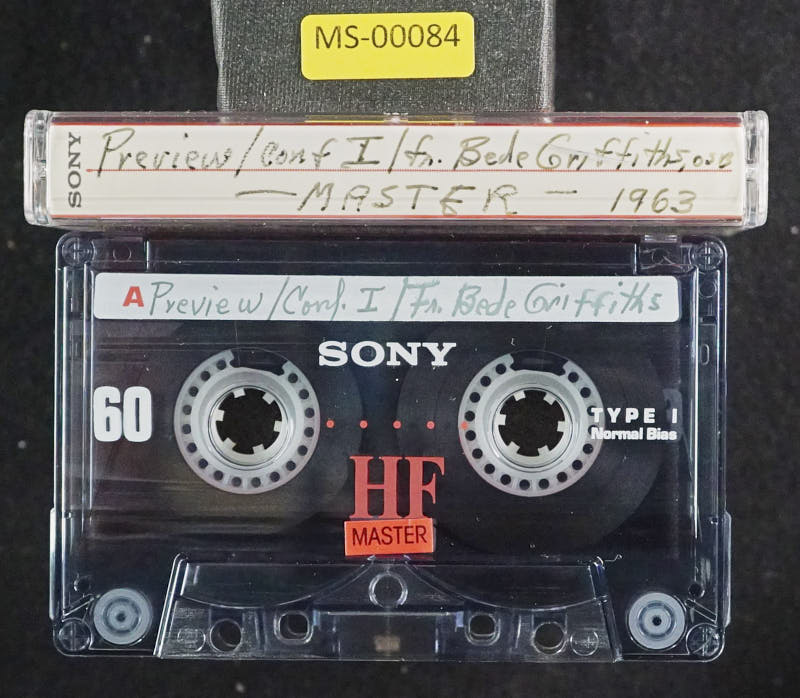
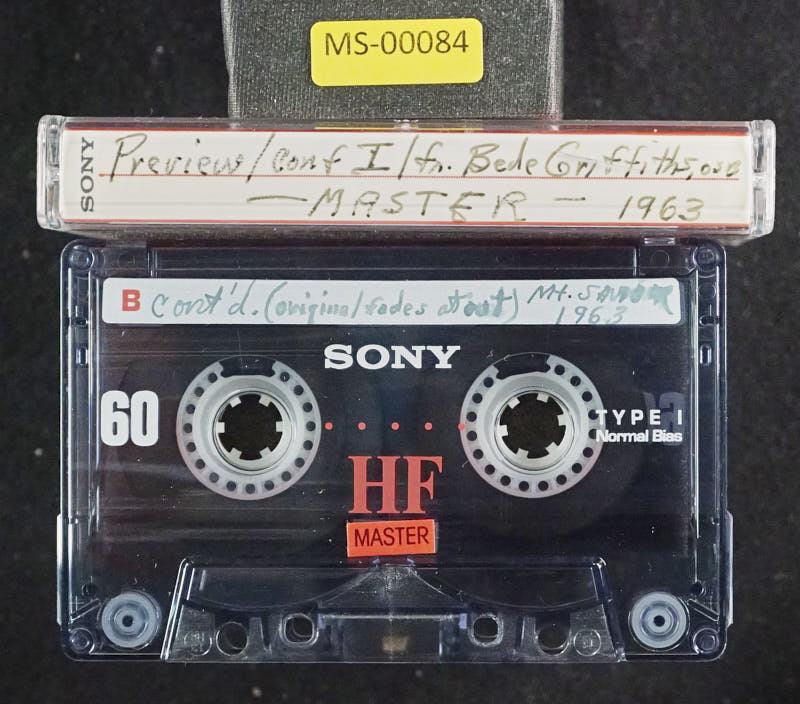
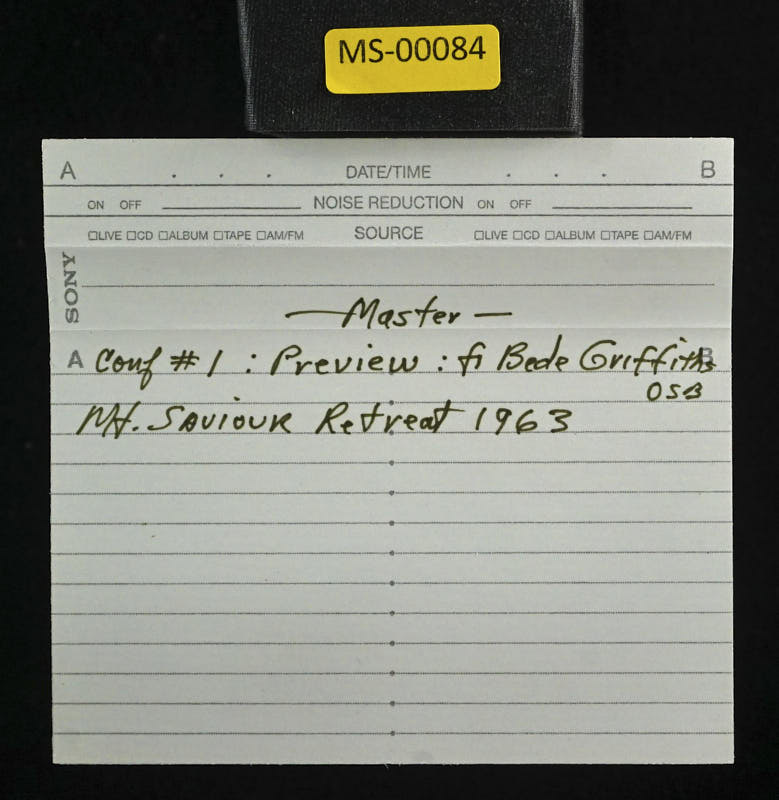
AI Vision - Possible Values from Photos:
Speaker: Bede Griffiths
Location: Mt. Saviour Retreat
Possible Title: Conf I. Preview/original fades out
Additional text: Master
@AI-Vision_v002
and brothers, it's a very great privilege for me to come and visit you again with my Savior. I've had a great deal of your monastery, a remote monastery in India, and I feel that something very significant, if I may say so, in this meeting with Stream, We are experimenting in the monastic life in South India, as you, I think, are experimenting in the monastic life in America. And though the circumstances of our life are very different, I feel sure that we are really faced with the same problems. The fundamental problems of, we may say, the Christian life in the world today, whether it's Far East or in the United States and the particular problems of the monastic life and in particular the contemplative life in the world today.
[01:10]
I think you all feel, as I know we do, that we have to rethink all our principles. The principles are there that the world in which we have to live has changed, that is changing day by day so rapidly that we have continually to be rethinking our fundamental principles. And I think you'll agree that that should be the purpose of a retreat. Sometimes when I was a younger monk, I used to think that a retreat in the monastery really wasn't very necessary. We were in retreat the rest of our lives. And in fact, I must honestly say that sometimes... I used to go up and retreat at a distraction. We had some worldly Jesuits who were the one who spent the whole week to entertain us with many amusing stories very often, and gave us a glimpse of the outside world, and then we went to town again for a fantastic life.
[02:14]
Well, now, I don't regret exactly the purpose of a retreat, and as I grow older, I feel more and more convinced that we have year by year, almost day by day, to be asking ourselves, what I think Sir Bernard used to ask himself, why did you come here? What is the purpose of our life? And as I say, it's not a superficial question at all, because that radical change that's taking place in the world, in the church, And therefore, in the whole place of monastic life within the Church and the world, that I feel we need to make a very, very deep study of our principles and a very deep questioning of our own parts as to what is our real intention. And I don't think this is at all easy. And I would like to say at the beginning that I have not come fair with any retreat
[03:17]
sort of regularly prepared, I really want to think out these principles together with you during this retreat, because it is something in which I and my companion, Father Francis, are engaged day by day, and something which I'm sure you also are engaged, and it is really a question of thinking these things out together. So that is really simply the program which I've set for me. I'd be very glad to see any of you when you'd like to come to my room, or rather, I think, to St. Joseph's Library, where I can be available. It was suggested that the best time would be in the morning, after the conference, at about 11.30, and in the evening, for best of the... So I would be very grateful, actually, for that kind of contact, because I do feel a retreat is something which we have to share.
[04:28]
And a retreat, the author really has to learn as much as he has to teach. And I certainly feel that in regard to myself. As I say, we are experimenting in our life in India, and quite honestly, we are roping our way from day to day. And I think you also are certainly a growing community with problems arising day by day, which have to be faith. And I think there is something very close in our different positions. But first of all, for this reason, you know my own community, actually, still is the Abbey of Prinnage in Doctershire in England. And this monastery was originally founded, as some of you may not know it, in Church of England. It was an attempt to restore the Benedictine life to the Church of England. The founder, Herbert Carlyle, the very revocable man,
[05:32]
And he had this vision before him, and he started this monastic life on very, very sound lines. He went back past Eddick, England, and he learnt the main principles there. And then he started his work. And they followed very, very closely the customs of the Roman church. even having, celebrating the Immaculate Conception and the Assumption, having benediction of the Blessed Sacrament, and in fact living exactly like Catholic monks. And this eventually led to a crisis. They found that they could not continue their life in that way within the Church of England, and they had to make up their minds either to give up what had become the most sacred place, practices and bleeps, or else to make her submission to Rome.
[06:33]
And a very remarkable scene, the whole community, with two exceptions, I think, individually made that decision to submit to Rome, that took place in 1913. And when the community was received, like past the 10th, He allowed them to keep all their customs and traditions, and among them there were three which I think made interest to you. The first was that they were a contemplative community. As you know, most Benedictines have adopted some form of active apostolate for very good reasons in most cases, but This community was founded to live a contemplative life, and that has always been our tradition, and therefore I feel we have a very close forum. We were trying within the Catholic Church to live this contemplative life according to the rules of St.
[07:38]
Benedict, neither of Cistercians nor as the Benedict in the English congregation, which is very much like the American congregation. So I should say that your problems here are very much what has always been, to steer this rather critical middle course. And I must say, we often get novices who met us on the one side, Cisterciums, on the other side, to the English Benedictines, and it wasn't always easy to follow the middle. But I still think that it is a very, very important work to the Church today. The students obviously have a very great vision and are doing a very great work, especially in America now, and the English Benedictines and the American Benedictines in general are obviously doing a great work. But there is a place, I feel sure, for this kind of contemplative life, simply based on the rules of the Benedict,
[08:40]
and trying to adapt it in all that is necessary to the circumstances of the world in which we live. Well, that has been our attempt at Greenwich all these years, and I was 30 years nearly, 25 at least, as a monk at Greenwich before I went out to India. So that on this point of a contemplative life, I feel we have a very close bond and so that while we try to see the purpose of our life together, I think we shall see very much eye to eye. Another custom which they had in this community from the beginning was of professing monks to the choir who would not be priests. We did have, or rather we later introduced, lay brothers. But the principle has always been that you come to the monastery to be a monk and the priesthood is something which is added to your monastic vocation.
[09:47]
It is not an essential part of it. And that again, I think you're following the same principle and it is being very widely recognized throughout the church today that that is the monastic tradition and where it is possible we should try to return to it. And let's say in our monastery in India we are making that a very firm rule. We have known it for others and the fold, the postulants come to us to be monks and they are trained in their monastic vocation and the priestly vocation is made quite subordinate to that. The other point we have, which is not of so much importance and has certain significance, is that we wrote a white habit. That was the custom in the community in the Anglican days, and we retained it when the community became Catholic. And it has a certain significance, I think, in that it was intended partly to be a sign of devotion to Our Lady, but partly also to be a sign of this dedication to confrontation.
[10:54]
And so those three principles were rather basic, I think, in our life, and each of them was an indication of this attempt to renew the Benedictine life. within the church without taking on any external work and without adding anything to the rule so there I think we have as I say very much in common and in our monastery in India we have been following the same principles we have tried to adapt ourselves more radically to circumstances of life in India I won't say very much about those because they don't concern you so much. Perhaps I may mention, and I'm sure it's a cause of surprise, it's not a consternation, but the habit which I wear is an adaptation to the normal dress which is drawn by what is called a sannyasi in India.
[12:08]
A sannyasa means renunciation. And it goes back actually to the laws of Narnu, the ancient code of laws in India, 500 BC at least, which laid down rules for sannyasis, that is, people who had renounced the world altogether in order to seek in Hindu terms for moksha or liberation, but which in our terms is very near to what St. Benedict meant by seeking God, a light which is simply devoted to seeking God. I think you can say that is what a sannyasi is in the eyes of the devout Hindu. Well, they've had this tradition for many, over 2,000 years, and it is very deep in Indian life. And we felt that coming up there to live this life of congregation, not as missionaries as nearly all Catholic priests to come, but as contemplatives to live a life of prayer, contemplation, or dedication to God, we were answering to this call of sannyasa.
[13:20]
And in fact, we find that is how a monk is normally described in our part of the world. When a fostering comes to us, he says, I want to be a sannyasi. So, there we feel we are making a link with this ancient tradition of India. And I'd like just to show, give you some idea of the significance of this, because though it may seem a little remote from our own lives, I think you'll see that it really has a very definite bearing on there. And the reason for it, perhaps, is this, that we are now living, as we all recognize, in one world, We can't really legislate for the church in America apart from the church in India or in any other part of the world. And we are all involved in this same new world which is coming into being with its many different facets and aspects.
[14:24]
And as I said, we all have to face this problem which confronts us wherever we are. Well, now, I believe that the tradition of monasticism in India, particularly the Hindu, but also the Buddhist tradition, has very much to teach us. I don't honestly think that the Church could go on into the new world without taking into serious consideration this wonderful tradition of monasticism, going back at least to 500 or 600 BC. with a continuous growth through all these centuries and still very much alive all over India. I think I've been told that there are several hundred thousand ashrams, that is, monasteries of one thought or another in India. That may be an exaggeration, but there are certainly several hundred thousand sannyasis living this kind of life, so that you could see that it's still a very powerful influence in the whole life of the country.
[15:31]
And as I say, I believe that the Church in these coming years cannot remain European, cannot remain American. It has got to bring into the life of the Christians as a whole these traditions of the East. I think we've reached that period in the history of the Church and in the history of humanity. And really, it's a wonderful period they wish to be living, where East and West are meeting. They've grown up apart, Hinduism apart, Buddhism apart, Christianity apart, and now the kindness comes when they can no longer live apart. The Hindus need us. I'm firmly convinced of that, and I think also the Church needs to learn from this Eastern tradition. So, as I say, that is something which we all have. learn from this Eastern tradition if we are to grow to the fullness of our own monastic life.
[16:35]
And that is what I want to put before you in the course of these conferences, simply to share our experience of the monastic life in India with you and to see where we can learn from one another. Well, now, when we consider this East of Galician, I think what strikes us most strongly is the singleness of purpose, the awareness of a goal which is to pass beyond this world, to renounce this world, in order to experience the fullness of life in God. I think that is the best way one can express it, that India has for all her history been seeking God in the sense not simply to learn about God, but to actually to share in the life and being of God.
[17:39]
That has really been the goal of Indian asceticism and Indian religious life, from the very earliest times. And I like to think that the time is coming now when India will find Christ and will find in Him and through Him the fulfillment of this quest. So far, we can say India has stopped to make Christ, but now the meeting must take place. And when it does, it will be the influence of this England tradition, but it will also be an immeasurable enrichment of our fascist tradition, so that those two things will work together. Now, in this dedication to the knowledge of God, knowledge of God, not in the sense of abstract speculative knowledge, but experimental knowledge, of a mystical knowledge of God.
[18:40]
There we have, as I say, the root of this whole movement of religious life in India, and that, surely, is what we, as Benedictine monks and conservatives, are trying to recover in this very difficult world, which we did, especially here for you in the United States. We're living in a world which is moving always and very rapidly in the opposite direction. Everybody is moving outwards. You can say that the world of Europe from the Renaissance has been moving outwards. This study of nature, identity through the different sciences, more and more comprehensive, more and more complex, more and more wonderful, really, in its discoveries, is always taking us outwards into the world of ascenses, the world of matter, actually in our course into exploration of the world of matter further and further. the moon and places beyond, and always our minds are being moved in that direction, so that when we seek God in the interior depth of our soul, which is not the Indians and us, it always is seeking, and not the monk of St.
[19:55]
Benedict, has to see, we are moving against the times. I think that is our great difficulty. When you read the history of the early monks, the time of St. Anthony, or St. Omius, or St. Benedict, or St. Basil, you feel that they were simply being swept along on the tide. Everybody was going out into the desert. And you found everything you could want there. And you know this wonderful story, these thousands of men going out from a civilization very like our own, I think, our own civilization of the fourth century was the nearest thing in past history to the present. It was the greatest advance in material civilization which the world has seen, but it breathed this reaction and there was this surge of life in the desert to find God in solitude and in retirement. Well, now, when we seek the same thing now, we do not find ourselves working with the kind but against it.
[20:57]
I think that is one of our great difficulties, and that is why we have to use all our resources, as it were, to try and find the right direction, to try and find the means which will help us to reach this goal. So I would say that this Indian tradition helps us to see how this quest for God, this quest to know God in the interior of the soul, is something very fundamental in human nature. It's not something simply Christian. It's something fundamental in human nature, which has had this wonderful development all through the East, through all these centuries. as something which was canalized in Europe, in the Christian tradition, by the monks of the East, and then above all by Saint Benedict, and which has come down to us in our Benedictine tradition.
[21:58]
And we are really trying, I think we will agree, to go back to St. Benedict, go back to the rule, to go back to the sources of St. Benedict and East, Antony's and Hermes, the battle of all those he mentioned, passion's lives, to try to find this secret of life, this secret of seeking for God, which they possess so clearly. And that is a very difficult task, as I say, because we're working against the time. If we go out and have large schools and colleges, parishes, and do external work, we're carried along very easily. But the moment we try to go back and benefit back to the early monasticism, back to the contemplative life, we find ourselves working against the times and therefore confronted with many difficulties. And I think probably not only as a community, but each individual mark.
[23:02]
feels the strain and the stress of that now. It is not easy to live a contemplative life in this twentieth century, and that is why we need to think very deeply on it and try to get our bearings as to how we ought to do it. Well, now, I suggest that we can take from this indivision an awareness of the depth of this impulse in human nature. I think that is something to keep in our minds. We're not doing something eccentric. We're not doing something which is actually peculiar to Christianity. I do think that this impulse to know God experimentally, to experience in the depth of the soul the reality of God's presence is something which is very, very deep in human nature, I would be inclined to say that you can find it in the most, at least primitive religion of which we have any knowledge.
[24:05]
It seems to me really that is the basis of religion, that man in the innermost depth of his path, tried this awareness of God's presence. It was, I think, a sign of his... of original paradise. We'll come back to that theme, which I think is very important for domestic life, that man is aware in the dim depth of his own consciousness that at one time he enjoys the fullness of his presence of God. But still in primitive man, we see quite clearly the signs of that awareness. He was aware of the reality of God in his life, And all his religion was really concerned with finding means to bring himself into the presence of God, into the experience of that divine mystery. I don't want to go into the details of comparative religion, but I'm sure many of you know the principles of primitive life, for instance, the primitive dogs.
[25:13]
It was all religious means by which you separate yourself from the external world, and by certain rhythmical patterns you sometimes inscribe on the ground, or certain rhythmical patterns in the dance, or by certain poetic devices, whatever it may be, you are always seeking to find this inner center of life. I feel that that is the key. to ancient religion. All their rituals and sacrifices, in their dance and their song, they were seeking this inner center of life. Mercia Elias, the great Romanian student of comparative religion, has brought this out very wonderfully in his book, The Pattern of Comparative Religion, and there I think one can see beyond any question how this idea has governed mankind from the very beginning of its history. So I would say, therefore, that we are dealing with something which is most fundamental in the human soul when it has to desire to know God in the center of his being and discover that inner center where he is once more
[26:32]
harmony with God and with the universe. And now this is a very important thing, that in our search for God, we are not going away from this life and from this world. We are finding a center in which a part of this world, a part of our human lives, and a part of this modern civilization can find its center. and its point of harmony and control. That is what we're really seeking in our monastic life. We're trying to find a center of which we can live and in which and through which we can integrate all our human experience of this present age. And there surely is something which we as monks can do for the church and for the world. church needs her missionaries and her preachers and her teachers and all the other work that is being done. But she needs, I think, now perhaps more than ever, she needs the principles of the maleistic life to bring her back to the center where we are, as I say, in harmony with God and with our fellow men, and I may also say in harmony with the creative universe.
[27:54]
It is at this center that all things return to their original harmony. And you know, the ancient perception of the monastic life was a return to paradise. The paradise is precisely this unity of mankind in harmony with God, in harmony with the study of men, and in harmony with the whole created universe. We often give the illustrations of the early monks who have such charming relations with animals. which is a very good example of this kind of restoration of paradise. So that is what I would like to suggest to you, that we're living in this new and complex world. We cannot try to build our lives the path there in America or there in India. We have to consider that we're citizens of one world, all alike are facing the same kind of problems in different circumstances, and these problems of the modern world are problems of the church as a whole the church cannot separate herself from anything that is taking place in the modern world or from anything which has taken place in the past in these ancient cultures
[29:13]
That, I think, is a very, very definite, clear work of the Church in the future to bring the truth of these ancient cultures, Hindu, Buddhist, and Muslim, and the primitive cultures of Africa and Indonesia, etc., into their true relation with Christ. We've got to learn to see how Christ is the fulfillment of all man's religious strivings from the beginning of the world, from the most primitive religions through the most developed religions, up till it finally reaches its consummation in the church. So that our perspective must embrace the whole world geographically, we must see that we are working together towards this end, and it must embrace the whole world in time. We must go right there to the past and see how all things and all men and all religion is gradually converging on Christ. And we are placed here in the church
[30:14]
and in our monastery, at the center. That is what I feel we must discover in our life, and in our monastic life in particular, this should be the center upon which everything converges. And there to no worthy work of the monasteries in the ancient world, they were always regarded as centers, very simply in the way that people think in a monastery you find God. And in India, you know, we're very conscious of that. The Indians are very simple people with very primitive religion, many of the poor, but with a very definite consciousness that God is a reality who has to be sought and to be found. And he can be found especially in holy men and in holy men. We go and set up a monastery there in India. All the people around, Quite spontaneous. They feel this is a place where God is present.
[31:15]
And they will come, you know, and bring their children to receive a blessing. When they're ill, they're still not due to taking them to a doctor. They will often take them, first of all, to a priest or a holy man. And it's very like the atmosphere at times. It's very like a Christian, you know. It's rather overwhelming at times to see the whole simplicity of faith. But there it is, this awareness of the reality of God and of God's presence in a holy place where people are engaged in dedicating their life to him. Well, now, surely there was always traditionally the place of a monastery. It is a holy place where men are seeking God and where God will normally be found. And so for each of us as monks, surely, Our cost is to try to realize this holiness, if you may say so, of our vocation, that within this monastery, we have to find this center.
[32:19]
We have to bring our own personal human eyes into harmony with that of our brethren, into harmony with that of the Catholics in our neighborhood and the people that are seeking our health, in harmony with the whole church in America. And then we have as I say, to extend our gaze. Nowadays, we can't think of the Church, the visible Roman Catholic Church, apart from the much wider unity of Christians. And again, we can't think of this wider unity of Christians apart from the still wider unity of all men who are seeking God in one way or another in different religions or even without religions. Wherever men are seeking God, there are at least potential members of the Church of Christ. And so, this center must be a place where we look out on the whole world and we're aware of our relationship to everybody in the world, here in America, there in India, covering all Asia and Africa, and the whole of this new world which is coming into being.
[33:33]
And we won't find a really living center to our own lives unless it embraces all mankind. That is, I feel, the Christian vocation today to realize our calling to witness to Christ as the head of all mankind, not all. separating anyone, because he by his incarnation has taken on himself our human nature, and there is nothing human which is separated or divided from him. And that is our work, to realize in ourselves and to help others to realize through our lives this call of Christ to all men without any exception. To the wonderful praise of one of the early fathers, which some of you may know, which I think very well describes the ideal of a monk. A monk is one who has separated himself from all men in order that he may be united to all men.
[34:38]
And I think that very well expressed is this ideal which we should look for. We must, and we'll go into this, I hope in more detail, separate ourselves from the world. It's no good thinking that you've simply got to give yourself to the world, to be engaged, as they say. That is a certain aspect and a necessary aspect of Christian life. But it's impossible to be engaged in the right way unless we first of all made this separation. For every Christian, let's say in some ways, for a monk it is fundamental. We separate from the world, we construct this center, as they say, this place apart, where we are no longer subject to these outer influences which may draw us away from God. And within this center, we can concentrate our lives upon God and upon our own relation to God. And then on that center and within that center, we must be able to find our true relationship to one another, to the whole church, to the whole Christian world, to the whole of mankind.
[35:48]
That is how I like to see a monastery. We mustn't have any... being in our ideal which falls short of that. I think that we should be living the Christian life here in this world today to the fullest extent. And that is the theme I want to take, actually, for our conferences, the saying of St. Paul in the 2 Corinthians In Greek it goes, I put it like that because if anybody knows Greek, they'll know it. It's so perfect, you can hardly translate it. Literally, if anyone in Christ, a new creation. To me, it's a tremendously dramatic expression of the Christian vocation. What does it mean to be in Christ? It means a new creation. And that is the theme I would like to follow up in these conferences to see how being in Christ involves this participation in a new creation and how this new creation embraces the whole of mankind and we must also add the whole of the creative universe.
[37:08]
In it and through it, Christ is bringing all things to completion. It's God's good pleasure, as Paul says, to bring all things to a head even again. That is how we should talk on our Christian vocation, and that is how surely we must talk on our monastic vocation. To be a monk is simply to consecrate our life holy Christ and only to this work of Christ, to the reunion of all men and of all things in him. But that reunion could only take place if it first of all takes place in ourselves. We have to find this center in ourselves. Each one individually has to find this inner center of his being where he is really deeply related to Christ. I think it's finding that inner center from which we can live our whole life. That is the real work of a monk, which we have to take up day by day.
[38:11]
And I've been a monk for 33 years, I think it is now, and I have to begin it all and regain day by day. It's such an immense task, and yet surely the one which we can be always before us to be working towards this center, never to be content with any kind of external performance of any kind, external performance, or the external performance of any good work whatsoever, but this interior relationship to Christ, personal relationship in the depths of our souls, in which and through which alone we could find our right relationship to our brethren and to the world. That is our task, to be seeking that inner center. And so that I'll take as the general theme, and into it I hope, as I say, we can weave all the different elements in the monastic life, particularly those which concern us most.
[39:19]
And as I say, I will be grateful for your cooperation in this. indicate to me where your particular difficulty has died and how we can work out this problem together, then I think the retreat may be helpful for us all. Because, again, I would say, I feel a retreat is the work of God, it's the work of the Holy Spirit in a community, and a retreat giver should really only be a kind of conductor, through which this grace which God has in store for you may be conducted. It's essentially a channel. And let us leave tonight on that. Oh, that God has purpose for you here in this monastery and for each of you, you are going to speak to the place in the monastery that he can take place for you. Oh, sorry.
[40:23]
It's the world. [...]
[40:35]
@Transcribed_UNK
@Text_v005
@Score_92.58