You are currently logged-out. You can log-in or create an account to save favorites and more. more info
Monastic Consensus: Dialogue and Decision
The talk is a comprehensive exploration of community dialogue practices and decision-making processes in a monastic setting, detailing the procedural methodologies used, such as discernment sessions and house meetings. It describes how policy decisions are discussed within the community and outlines specific steps leading to consensus or decision-making, involving the entire community while also recognizing the authoritative role of the abbess. The discussion often references the use of tools like questionnaires, and the influence of Brother Ronnie Fogarty's methods for improving community consensus processes.
Referenced Works and Concepts:
-
Brother Ronnie Fogarty's Methods: Mentioned as an influential figure whose techniques for fostering dialogue and discernment within monastic communities have been adopted, emphasizing listening and structured, non-opinion-based reasoning during decision sessions.
-
St. Benedict's Rule: Implicitly referred to in the discussion of balancing democratic dialogue with the traditional authoritative role of an abbess, an important text in understanding the monastic way and community structure.
-
Vatican II Reforms: Referenced as the catalyst for changes in decision-making processes within religious communities, highlighting a shift towards more inclusive community involvement.
These works and concepts are central to understanding the transformation of monastic decision-making and dialogue practices as discussed in the talk.
AI Suggested Title: Monastic Consensus: Dialogue and Decision
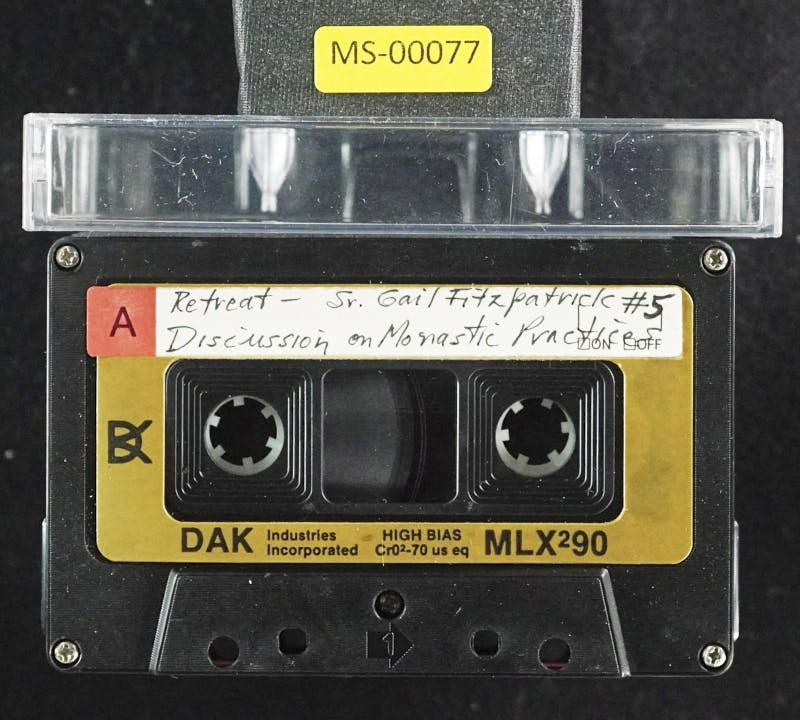
AI Vision - Possible Values from Photos:
Speaker: Sr. Gail Fitzpatrick
Possible Title: Discussion on Monastic Practice
Additional text: Retreat #5
Speaker: Sr. Gail Fitzpatrick
Possible Title: Discussion on Monastic Practice
Additional text: Retreat #5 Contd
@AI-Vision_v002
Do you want to introduce this, Father Martin? I just asked, Sister had a conference, or has a conference, but we just thought, maybe since this is the last night, that we might open it to some questions about some practices that they have in Mississippi, or the other sisters, what they have found that's helpful in keeping the tradition moving with a and rage and so on and so forth. I think that have been helpful to you, particularly, as many other officers, about things that you have a lot of work for, what it is, what kind of work can out. And if others have any questions. Maybe if there's any particular thing that you're interested in, any particular practice or aspect of life that you'd like to ask about first, that might help to get us started. One thing is the famous meeting. What kind of meetings do you have?
[01:01]
Community? Or... You don't mean in the order? No, no, I mean... Within the community? Okay. Well, we would have... There's a variety of kinds of meetings. We could have a chapter meeting, and that would only be for something very serious, like voting for a new member to make profession, or... spending a lot of money or something like that. We don't use the chapter a lot. We have community meetings more. I have a council, and I meet with my monastic council every week for approximately an hour. If we don't have business, we just don't meet. But the meeting is on the books for every week. We are 24. Five, I believe. There's the priorist, the novice mistress, and the sellerer are by office.
[02:07]
There's one elected member by the community and one appointed member, five. And the appointed and elected change every two years. Then the most frequent meeting Well, no, the council meeting would be the most frequent. But we have a community dialogue. If we're having a series of dialogues, it would usually be once a week on Saturday afternoon. And we would usually run it for maybe, well, as long as we need, maybe three weeks, four weeks, depends on what the subject matter is. And then we would take a break. So we don't have a community dialogue every week throughout the year. Yes. Well, usually what we use the dialogue for is deciding policies, community policies.
[03:17]
If we're dealing with a particular question, like now I just mentioned We're going to change our Psalter and we're going to go into a different size book and so forth. Usually what we would do in that case is I would just have a very informal meeting of the community just to kind of pull ideas, hear where people are on the subject. Then probably call for volunteers for a committee. And the committee would study the question, get further along on the ideas, and then present a suggestion to the community. That's usually what we would do for a specific question like that. But for, well, for example, two years ago we had a series of dialogues. One was on renovation of our church. Our church was, we did not have enough places for the community. So we had to decide whether to do a major renovation, which was to break through a wall and build or use the space we had
[04:23]
It would mean that we would have to be a little bit closer together and get new stalls, but to use the space we had. So that was a very serious dialogue, and it took quite a while. It was a serious question. And what we did with that was to use a process of discernment that we have learned with Brother Ronnie Fogarty. Maybe you'd like to describe that. Do you want to go into the description of the process without too much detail? The whole process, but just kind of briefly. Yeah, okay. Give it a shot. As I recall, first of all, we would sometimes... It's most helpful if we can come even on something like that. There's generally a great deal of preparation. There would often be a committee formed to prepare stuff for the dialogues of that nature.
[05:25]
We would have a couple of meetings probably just again to toss around ideas to see where people are on the subject. Then the committee would... do something to try to organize after that step. That was a problem, too. Yeah, that's right. Actually, what we did at that time was then try to... We do certain things with questionnaires, for example. At that time, when we did the chapel renovation ones last year, we had a bunch of questionnaires out for people to... check off different things. These were rather quite concrete details in this particular case, like, do you like the present size of the altar? Would you want it smaller? You know, yes, no, this kind of thing. We went through a lot of that to get a feel for where the community was on different issues. They weren't votes of any sort. They were to sort out what were the hot issues from what were the issues in which there already was a fair deal of consensus.
[06:33]
Then actually when, and we spent quite a lot of time then trying to work through all of these ones dialoguing, and when Ronnie came he wasn't convinced that had really been the best procedure. And what he did, of course he has a very great gift for this sort of thing, in just the space of about one dialogue really, he tried to sort out what he felt were, what's the thing in which obviously fairly agreed needs to be done, and obviously something needed to be done to make at least more stalls, you know, to make more room in the church. What there was some hope of doing, which was rearranging the sanctuary, mostly for liturgical reasons, and what would be nice but was really sort of the lowest priority, which was doing things with our guest chapel, which was the most difficult for a number of reasons. So his suggestion in retrospect was that it would be helpful to have something like that, where you can try to get a feel for what are the most crucial, what's the community's real priority on it.
[07:40]
And he's always very insistent that whoever be moderating, or especially all the people on the committee, really, would really be listening for where is the whole community on this question? You know, what do you really hear the group saying on a particular issue? When you say moderator, do you mean the person moderating meeting itself? Yeah. Or overseeing the whole process with the forum questionnaires? Usually that would be the same person for us. I think most of the time... But we do have a moderator for the dialogue itself, and that person... A dialogue, a series of meetings on one particular subject. And it will be the same moderators. We have a group of moderators, about five, but the sisters take the turns moderating because it's a hard job and we don't want any one person, and not all people have skills for it. So we want to develop the skills in a few people. And usually for the really important ones, Gail would not moderate because we need her to do other things.
[08:47]
But that moderator would work with the committee in the preparation of the dialogues. But then in the dialogue, the moderator does the moderator. Yeah. And it depends, too, for some topics. Like some it winds up being the moderator having more to do, and others the committee does more. It just seems to depend on the topic. And then from that, what did we do next? And we went into the actual discernment on some of those questions, I think, which... Well, one method of discernment that we've used a few times that Brother Ronnie recommended to us, and this is after you already have a fairly good feel for what is the real question, you know, what's the concrete question we need to ask. And one method that we've used that he suggested to us was you have... You have sessions. We have very short sessions. I don't think we did this on the chapel renovation one. It was, which one was it? The foundations question we did this one.
[09:48]
The general one. The general one, okay. Where we'd have a series of actually quite short meetings. It was amazing how quickly we got this done. Quite short meetings where everyone would have to come with reasons for, let's say, for... doing a major renovation, for example. And everyone would have to come with a list of either mental or written, although we found it often worked better if they were written out ahead of time, of reasons. And then the floor would be open. Now, he stressed that this was not opinions, this was not feelings, this was not any of those sorts of things, but just real good reasons for doing this. And it was all right, and then it was pretty much open to whoever wanted to mention reasons until all the reasons were exhausted. Now, we asked him, you know, is it good to say a reason more than once? You know, supposing someone else has already said a reason that I have, should I repeat my reason?
[10:51]
And he was rather discreet on his answer to this one. He said, if you feel it's already been heard, then don't say it again. But if you feel that in some way, you know, and by being heard, he doesn't mean, he wouldn't mean that, well, you know, convinced. Not that people aren't convinced by it. That's not the question. But if it's, once it's been clearly heard, whether people agree or don't agree, then that's sufficient. So actually, those only took about 10 or 15 minutes, really, to do that. And then we'd come back at another time and do the opposite side of the same question. The person says... makes a statement and that's it. Not necessarily. It might wind up being that only, you know, eight or ten people would speak at a meeting like that sometimes because... I would just like to add the reason for this. The reason is that we all try to...
[11:53]
understand everyone's points of view, understand the reasons behind. So if, for example, I really feel that the church renovation should go on, and I know that there are several people who think we shouldn't have any church renovation, he wants me to understand why those sisters don't want to have a church renovation. So when we come to do the pros, we call them the pros, everyone... hopefully, will be able to give prose, even if my own position is against it. And that's the value of this session, that I hear everybody speaking for this thing, knowing that not everybody really is for it. And it causes a great deal of peace and calm in the community when we do this. And we're not perfect at it. things that we don't do exactly right. But I do think that if we keep working at this particular aspect, it's very helpful.
[12:56]
Then you're supposed to do the cons first. You begin with the cons. And hopefully everybody would have several reasons against this particular proposal. And you verbalize it. And it's good that those who are for it, especially, would verbalize a con so that You just feel that people are not fighting, that I'm able to even express, honestly, a con that I see to this proposal, even though I personally am for it. So you go through those two sessions. Brother Ronnie Fogarty. He's an Australian Marist who's helped us deal with dialogues. Yeah. One further question. The description of the short length of time that takes the state of those things, I assume you're not using those so-called reflective listening techniques where somebody always... No, not on this.
[14:03]
No. So strictly you say it out. And there's no dialogue about it. This is a very specific kind of a thing. That kind of thing would have already happened, where you dialogue and... talking back and forth, listening to each other and so forth. But this is a very specific session where it's only set out. That's all. And nobody comments on anything. In fact, that's very important that you don't comment on what people say. Questions for clarification are fine, of course, but that's not the same thing. Then from there, we would just... come together for an actual vote on it. And before taking the vote, which actually I don't think Ronnie likes the word vote at all. And he's, oddly enough, not that much, he doesn't encourage using the word consensus either. The way he sees it is that it's corporately making a decision. And what would happen would be each one is expected to prayerfully discern
[15:11]
what she feels the spirit is saying to the community at this time on this question, on the basis of what she's heard to date. So when we would come then to do this, well, let's say at the meeting where the decision will be in a more or less made, I mean, the superior takes the final decision really, but in so far as the community is coming to this final point, The way we've done it is to pass out pieces of paper which just say on them, the proposition is stated rather clearly. And then we just say, having prayed and discerned or something like that, my opinion at this time is, and it's yes or no, quite simple. So then we just collect all the votes. And this is actually one of the trickiest parts of it, really. Collect them all in one place and then... person just opens them all and reads them out, yes, no, no, yes, and so on.
[16:13]
And they're not counted. And that's part of it. The notion is to get a feel of where the Spirit is moving the community at this time. And after the first one, They would be, you know, just usually a couple of minutes for people to pray for a few minutes and just hear what, you know, reflect on with the Spirit, with what they've heard in that, in those reading, those pieces of paper. And at that point, then we would hand them out again another lot a second time and do it over again, always at least twice. And the point is to see if there is movement in the community the second time around, and if so, what direction it's going in. That can be quite tricky for the person doing it to discern where it's a good point to stop with that, where it's clear that things are still moving or are not still moving. And then sometimes, depending on the question, it can be up to the superior to decide, yes, I have enough information to go on, or no, I don't have enough information to go on. I should... I should add that we'd only do this process for very important questions.
[17:16]
I mean, it's a long process, as you can see. So it's for those questions that really affect our life. But for other questions, we would probably just dialogue. And then depending on the tone and the dialogue, whether it's strongly divided or quite simple, we'd either just have a checklist or... Well, yeah, usually we don't have show of hands if it's of any importance, but sometimes we do. But very often a checklist afterwards, after the dialogue. We try not to make decisions at the dialogue. Usually if we dialogue something and there's a full discussion, we wait for a few days or at least 24 hours before taking a boat. So it sounds very complicated, but It's not for the more normal questions that we're facing.
[18:18]
But if it's an important question, we usually give a good amount of time to it. You mean, how do we know that we have to face this? Well, there's different things that can happen. Like the church renovation, I mean, we just knew, everybody knew we had to do something. And so I would probably formulate the question, what should we do? But we all knew we had to do something. Questions can arise. We do one thing that I could describe, and this will answer part of your question. We have a house meeting four times a year. And that house meeting... is supposed to be a time when we can look at our various practices in the community and kind of revitalize, see how we're doing. And it's not quite the same as the speech in silence reposition.
[19:21]
And the way we set it up is that I usually choose the topic, but I often ask the council for input if it's not clear. that there's a topic we need to talk about. Or I could ask the community to just jot down anything they have in mind and let me know. So then I would choose the main topic of the House meeting. And we would put out in our common rooms some papers. And anyone can write any question about that particular topic that they'd like us to talk about. And then there is another set of papers put out where people can write anything at all about any question that they're finding difficulties with. And it's from that, things may emerge on those papers that indicate that we need to dialogue something. And that's one way that things would emerge. Yeah, it would be as if you put a couple of pieces of blank paper.
[20:24]
Yeah, yeah. Or some of it can be pretty, you know, we handle pretty trivial stuff, too, in these house meetings. A reminder that we do not run water in the dormitory after 8 at night. And we wouldn't dialogue that. But some things can come up that would be of more importance. Or people would write notes to either Gail or the monastic council saying, you know, I'm concerned about XYB that's going on. Could we talk about this as a community sometime? Mm-hmm. So that's about it for meetings. We try not to have meetings during our fall. September to December, we're very busy at Candy. And people find that it's too much. You know, you need a little break on the weekends. And so we try not to have dialogues because they are draining. They take an emotional energy.
[21:28]
One thing maybe that I'd add, too, in the... There's a great deal of work that goes into preparing them, a lot, really, the way we do it. At least the major ones, you know, our more major dialogues take a great deal of work on the part of the moderator and committee ahead of time and, you know, discerning where the community is and where to go with that. So what actually happens there is really only part of it, really. Well, just formulating where to go, because, for example, at the dialogue itself, we wouldn't discuss where do we go from here on this question. You know, that kind of procedural question is very much left up to the moderator and committee. So, you know, it can happen, of course, as I'm sure you all know very well, it can happen in a dialogue that things go in a completely unexpected or different direction, you know, or something breaks open at the meeting that you never expected to happen or come up. Well, then it would be the committee would have to decide, all right, you know, now this has happened.
[22:30]
Except for things that you'd have to handle on the spot during the dialogue, which can happen too. And then it's just the moderator's ad hoc decision. But other than that, you know, it may be quite unclear where things are or where they're going at the end of a meeting. And it would be up to the committee to decide, well, okay, what do we do to handle all this stuff that we have now? That's right. But anybody would be free to write them suggestions, too, yeah, or comments. And sometimes people do, but really not a whole lot. Or a special topic, it would be a special committee, right. It's a committee where you select for people. I mean, you ask the people who want to be on it. Yeah, sometimes I might ask somebody, especially if nobody bothers you.
[23:32]
But it's better to have people who want to, you know, be involved in that question because they're going to be more interested. So you'd have a one-a-week council meeting, and then about four times a year, And four times a year, a speech in silence, which is different. We described that. That's right. That's right. No, we don't. We used to. We used to have what we called strike of work. Did you have something like that? Strike of work? Yeah. After prime, right. Yeah, the distribution of the daily work in a chapter. We used that daily chapter. And that was at prime.
[24:34]
Now, we stopped that when we stopped prime. And we, I think they did have strike of work at Rentham for a long time after that, which was a very handy thing. It used to be like right after the mass when people would be going out to work. And they'd all just gather And for us, it was our call room. And if there were any announcements to make or just changes in the work or something, you could verbally do that very easily. But at Mississippi, we never inaugurated that. So there isn't any daily meeting. So if I have something I really want to tell people, either I'll ask them to come in to chat to them after Mass for a few minutes, or I might just do it in the factory. up a note we have we write a lot of notes yes no we don't what we one one thing you might i maybe i mentioned this the other night um we do have a long-term guest program did i mention that um and that's been a very very fine program
[25:44]
We're running out of space in our dormitory, so we may not be able to continue it too much longer. But any woman, a religious or a laywoman, married, whatever, may come and live within the community. We prefer that it not be less than four weeks, preferably more, and not more than six months. And she lives totally integrated into the community, comes to everything. She may come to choir if she prefers not to, that's fine, but she's welcome to. So far, no one has chosen not to. The long-term guest works in the morning. We work for a long period in the morning, and then several days a week for two hours in the afternoon, and other days no work in the afternoon. The long-term guest only works in the morning. And we do have the provision that if she doesn't want to work, you know, someone might be wanting to write a book or just not do anything, then we'd have to ask them to have some little stipend for that.
[26:57]
But otherwise, there's no money exchange. And so far, well, we try to have only one at a time because the community is rather small and there is a certain amount of... caring for the person and just checking to make sure she's okay and so forth. So we feel we can't handle more than one. But we would overlap if one has been there three months and she's coming to the end and someone else wants to start. We'd overlap. But we usually don't have two straight at the same time. So those women would be present at chapter. They come to everything. They wouldn't be coming to dialogues. They wouldn't come to... those kinds of meetings. Our postulants don't come to dialogues, and first-year novices. We kind of discern towards the end of the first year with the novice whether she's ready to come into the dialogues, because some are dying to, and some don't want to get near them, so it depends on the person.
[28:03]
Did your visitors come to your long-term guests, come to your chapter? Yes. By chapters, you just mean your chapter talks. Not on the chapter we meet. It's a community chapter. Yeah, chapter talk. Oh yes, excuse me, not a chapter meeting. Oh yeah, yeah, excuse me. How long has this been going on? What is the origin of it? Of what? The whole dialogue process, is it unique to our monastery? No, it's not unique to our monastery. I would say it's been going on for us, well really, since Vatican II. We started it probably four years after Vatican II, and we started with a professor from a local college coming out and just helping us with group dynamics or just the basics of dialogue. She was the first person that helped us because it seemed as though the church was asking us to
[29:10]
change our structure of how we made decisions in a religious community and to involve the whole community in that decision making. And so we needed some help in going about that. And since then, we've worked ourselves and we've had different people help us. I would say Ronnie Fogarty has been the most influential. But we had already been dialoguing before he started coming to us. And I suppose the tension in dialogue and in relation to our understanding of authority in the rule of St. Benedict is, well, just how does a dialogical process, which is more democratic, relate to the understanding of obedience and the place of the abbess in the rule of Benedict. And that's why...
[30:13]
Kathleen made the distinction, and Brother Ronnie is very strong on this distinction, that we dialogue and really try to involve, that everyone in the community is involved in trying to listen to the movement of the spirit within the community. And we come to a certain point in that. And then in most cases, the abbot or the abbot makes the decision, takes the decision. Sometimes you could dialogue a question up to a certain point and then have the chapter formally vote the decision. There are different ways that you can actually come to the decision-making. But it's been an important way for a community to take responsibility for itself. And so that's why we started it. Salome professed. could actually vote, if it was a question that, there's some questions that the chapter has to take a vote on, expenditures of a certain amount of money, for example.
[31:21]
What are some others the chapter has to vote on? Yeah, well, we'd never dialogue that question. Foundation, yeah, foundation would be another very good example. And that's one that will be coming up for us pretty soon. So we would never just discuss that question or decide it within the chapter. We would have the whole community dialogue that question. But then at a certain point, that question has to be decided by a chapter vote. You see what I mean? The relation between the two. Something else just came up. that you might be interested in? Oh, yeah, I know. It's the way we handle formation decisions or the process of community involvement in formation.
[32:28]
Are you interested in that? Did novices come to the council? Did novices have a council interview? I don't remember the council meeting, so I don't know. I'm trying to remember. Well, I do. Okay, I think we do. The postulants don't meet anyone except the novice, mistress, and abbess, and we make the decision as to whether we have a council vote on whether they will go on to receive the habit. Novices have a year and a half novitiate. And at the end, two years, at the end, they are interviewed by the council. And the council can ask them anything. It's a friendly interview. It's not, you know, you have to come up with all the right answers. It's more, how are you, and how are you doing, and how are things going for you. But it's to give the council a chance to get to know the novices.
[33:33]
Yeah, and then that's a chapter vote on whether the novice goes on to profession. Then at the end of the first year of profession... Excuse me, didn't we have a meeting with Chris before her profession? The chapter? Yeah, chapter meeting, I thought. Oh, maybe that's what we changed. It used to be the council. Yeah. Okay, so at the end of the novicia, okay, the novice has the first chapter... meeting with the chapter. It used to be the council, but we changed it. And so it's the same idea. The chapter meets with the novice. And it's the same atmosphere. It's friendly. The novice is nervous usually, but they never get... They always come out feeling okay. Yes. Yeah. Okay. It is. Is that useful, actually? Yes. It is in that it gets the novice used to meeting with the group, because as we go along, they get a little bit more serious.
[34:39]
So that that meeting before solemn profession is quite important. But the first meeting is more that the profess get the chance to talk to the novice in a way that we don't usually. But it also gives the novice the feeling of meeting with the group. Oh, yeah, they do at work and all around. They don't have the freedom to have long conversations with the professed. Yeah, just brief little exchanges and the novices and professed all work together. So there's a lot of interchange, but you don't have a long, serious conversation. whether they're professed usually. It could happen, but not usually. Oh, okay, then we'll move on.
[35:41]
So that's okay. After she's professed, the end of the first year after profession, then we have the evaluation. I have a secretary who takes care of all these things. But anyway, either after the first year or the second year. We have a written evaluation, and many monks' monasteries in the States are doing this. Not all, but that's where we got the idea. And we have a questionnaire that the professed herself fills out for herself, and then we give to all the other professed. And there are questions like, Does Sister seem to be functioning well in community meetings? Is she able to contribute to community meetings? Is she generous at work? Is she joyful? Does she seem to have good health? And then there are questions about, would you name what you feel are Sister's strongest points?
[36:48]
Are there areas that you feel Sister needs to work on? This is not a meeting. This is a questionnaire. It's filled out in private. And it's given to me. I'm the only one that sees them. And people do sign their names so that it's not anonymous. So then I collate the whole thing. I read them all. and I fill out my own, and then I collate it. Then I meet with the person, and I go over it, but I only give her a feel for what the responses were. I don't say, now, 17 people said this and 10 people said that. I would never do that. But I say, it seems as though this is going pretty well. And I usually take the one that she filled out and Hopefully, it's going to be pretty much like what the ones that profess filled out.
[37:51]
And if it isn't, if she thinks she's doing terribly in this area and everybody else or most of the other sisters think she's doing real well, then I'd be sure to point that out to her or vice versa. And it does give people a good feel for how they're doing in community and kind of explicitates the expectations that the community has. then, before solemn profession. That's the last interview. Is there another interview with the chapter before the solemn profession? Maybe there is. Now I'm mixed up. See, of course it can depend too, because we have a minimum of three years of simple profession, but a maximum of us in canon law. So... Well, there may be another meeting, I'm not sure. But anyway, when a person asks for solemn profession, then they would come to the chapter again.
[38:53]
And that interview is quite important. And I think there are two, because what we've said is that the second of the interviews with the chapter is the one where people should verbally or publicly or at least... person to person, mention things that they may feel are difficulties. They don't do that with a novices. They don't point out any problem areas. It's simply to get to know them. But at that second one, if there's something that's still troublesome, then it should be brought out. But we meet first, I with the chapter, and they would mention that if they think they need to do it. And if I... or the junior mistress feel that it really would be very bad to bring that up at this point, then I would just say that, and they wouldn't. But otherwise... And also, it gives the other sisters a chance to say, well, I really don't see that.
[39:53]
And if you have a lot of people saying that doesn't seem to be a problem, then we might say, well, maybe this isn't the time to mention. Just one other thing about that, too. At least I know I would expect that if... At least a lot of times you would expect that there's not going to be a whole lot of shock. So presumably this is something that people have had the courage to say to the sister already on a one-to-one basis. It would be pretty strange if all of a sudden she heard from 10 people about some major difficulty that nobody had had to bring to her attention personally. And then the last one, it's not supposed to be a time for bringing up a whole lot of problems. They should have been brought up a long time ago. But it is the actual preparation for the voting for solemn profession. Well, in those brief moments before she comes in, they could.
[41:03]
But it's only in view of preparing for a meeting with her. It's to get away from that, that we do it the way we do it. Because in the old days, the chapter did meet to talk about someone before a profession. And that became very odious, at least in our order, that they wanted to do away with those meetings of talking about persons. So that's why we changed to this system. Because there's some kind of a need to come together before you take such an important vote. so that you'd have the opportunity of voicing a concern or of hearing how others are viewing this person. The questionnaire process is done only once. Only once, yeah. It could. In some instances it was. In my experience it wasn't. But I'm talking about the order. At that moment I was talking about the order.
[42:07]
And just the whole idea of talking about a person who's absent became problematic in our order anyway. After the person has had her interview, don't we all stay and talk? Yeah, for a couple of minutes at the end. But that's not quite the same as having a full meeting. I can't tell you too much of what other communities do. Every community is very free to set up their own way. But that written questionnaire is an idea that came from several monks' monasteries. And the meeting with the professed, I gleaned from the first general chapter that I ever went to. I asked a lot of abbesses all over the world, really, that I could manage to communicate with. what they do. And many of them were doing something similar to this in France and in other parts of the world.
[43:14]
No, no. It's at the end of the first year that we do the questionnaire. And then at the end of the second year, we have the second interview. And then before Salon Profession, we have the third interview. There's one interview at the end of the novitiate. And then she makes profession, and then after a year is the questionnaire, and then after another year is another interview, and then it could go on for two or three years before the final interview. The chapter and the novice. That's after the first year. At the end of the novice.
[44:15]
There's another meeting with the council. No, no, no, don't confuse. It's confused. Maybe I could just write it out. Yes. Yeah. I don't know how much they are the same, but we drew up ours basing it on two others that we had seen. So... During the noviceship? Well, the whole basic formation. the feeling of the community toward them, or how they're doing towards the community. What is it? Well, if there are some... Okay. Just observing things, or is it also getting a thing, making you know what monasticity is about, what the basic... Well, basically, the novice maestrious job...
[45:34]
would be teaching and individual personal formation, which I suppose you can call spiritual. She has classes in the rule, the vows, history of the order. No, excuse me, that comes later. She doesn't teach that. She teaches, yeah, just a simple liturgical formation. not a real course in liturgy. And then during the novitiate, the novitiate just doesn't teach it, but there's also basic introduction to the Psalms and history of the order. Okay. Yeah, history of the order. And let's see, anything else? On the novitiate with the novitiate for a fashion market. They meet once a week, I think, as postulants and first-year novices with the novice directors alone, once a week.
[46:58]
And I think in the second year, depending on the person and on her needs, The novice missus tries to kind of move it into a once every other week. But sometimes, you know, the young person really needs a little more, so she would continue on. She's very flexible in that, but that's what we felt would be a good thing, is in that second year of the initiative, she was seeing them every other week. But she's always around, you know, they can always ask to see her. But for the regular leading, that's what it would be. Yes, very much. We look more towards the juniorate as the time for more serious study. And then the militia, it's more the formation of the individual and just a kind of an introduction into certain things like scripture and liturgy and things like that.
[48:03]
But it's definitely not an academic approach. How would I define? Formation. How would we define formation? I think I'm going to ask Brother Martin to answer that one. Yeah, and the assimilation of monastic values, personally assimilating monastic values. So the formation is the presentation of the monastic values as values, and then helping the person to actually integrate those values into her life personally.
[49:08]
And it's a lifelong process, but that's where I would see the beginning. the nucleus, I think. Some are and some aren't. We have an age limit. I think 23 is our bottom and 40 is our top. Now at 23, They may be real mature, and some are, and some aren't. Or they may be mature in some areas and not mature in other areas. So part of this whole formation is also going to be basic human development. And that's a big part. And that would be more on the individual, one-to-one level, dealing with a person.
[50:11]
We don't have any classes. though it might not be a bad idea, maturity and things like that, but it would be more dealing with the person and how she's dealing with life and with the other novices and her ability to take responsibility at work and things like that. Yes, I'm supposed to. I got real bad about it. for a time. I try to meet with the novices together once a month and have a class, some kind of a class. I usually just spontaneously decide what the class is going to be about. For several years, I would give a course or a series of classes to the novices on the Psalms, and it would be maybe six weeks, seven weeks, eight weeks. And I really like to do that, but I sometimes get too tied up and I can't do it.
[51:13]
So then I just meet with them and talk about anything. But then I meet with them individually once every three weeks. I usually see all the sisters. I'm available to see all the sisters, but I try to see the novices at least once every three weeks. Yeah, well, we have a Juniorate. Now, that's something that we hadn't always had. Usually the monks always had that, or I guess they called it the Scholasticate or something like that. But as nuns, we didn't really, when I left an initiate, we just kind of plunged right into the professed community. But we've realized that people need a transitional time. So we've established, and I think most of our monasteries have a Juniorate. We have a Junior Director, and The junior director is not the same as the novice mistress.
[52:15]
She doesn't have the same kind of a responsibility for the professed sister. That sister is professed in the community, and she's responsible to the community. But the junior director is responsible for the study program for each individual, and we worked as a formation team to set up the study program. She also sees... is available to see the juniors. I think it's like every two weeks or maybe less for the older juniors and more for the younger juniors. It depends. Sometimes it's tutorial, depending on how many juniors we have at a given time needing to study a given subject. Or sometimes it could be two or three in a class. It just depends on how many we have. Because we, you know, as I'm sure with you, people enter at staggered times, so we don't always have a group.
[53:24]
And some teachers are better at tutorial. We have one sister who's a very good teacher of Patristics or the Cistercian Fathers, but she teaches best tutorial if she doesn't do well in a big class. So, you know, it'll... depend on what the subject is also. But we do have a series of subjects that everybody is supposed to study at one time or another, in one way or another. Because another thing that I would see very important in junior formation is the fact that, you know, with professor members of the community, people are free to approach them with corrections, which normally you wouldn't do with labs. But normally they would go through the labs directly. That's just learning that kind of interaction and handling community members. I think that's the crucial part of the junior formation. One thing our junior director said to me lately was that she considered one of her tasks to be, to help the junior come to a good relationship with the superior.
[54:28]
And, you know, she has to kind of be weaned for her relationship. I don't know if you were aware of that. She felt one of her responsibilities was to and with the foster relationship with the community. So they tend to be where outside of this could be tied into a line. The martyr of the community. That's the hardest job. Oh, my, that's hard. Well, Kathleen was doing it for a while. used to do was to have a work secretary and she used to have to work out the work schedules for everybody and post them like weekly so just last year we tried very hard to move into what we call a stable work chart which was a chart that has all the things that have to be done and the people that can do them and it has to be on a daily basis
[55:37]
It worked out for a week. And Kathleen has a wonderful mind for doing things like that. So she and another sister are the ones that got it started. And we're in the, actually we haven't been in it a whole year yet. We're still in the, you know, trying out stage, but I think it's going to work. But we still have to have a work coordinator. So for when people are sick or going to be away for a while and need a substitute, that work coordinator has to make the adjustments on the work chart. So that is just, we have about three that change off during the year to take that job. Yeah. Monday morning, for example, Monday morning, so-and-so cooks the candy, so-and-so's in the kitchen, so-and-so's in the garden, that sort of thing. Monday afternoon, hold the shelf.
[56:41]
It's for the entire season. We do it seasonally. This is how it can happen every week for the next four months. But also, we tend to be very... Whoever's in charge of the work really can sort of... We're all pretty dependent on what her decision is. There are very few people who have the sorts of jobs in the community, and they will just automatically be doing their work. Most people are relatively dependent on what you know, what the work situation is for not being able to work. I'm going to say that people, you know, really the bookkeeper and the cook. And the seller, the housekeeper. But even the housekeeper, yes, but in terms of the work assignments, for example, well, she may have to cook candy once, you know, one day, and she may have to work in production another day, so...
[57:49]
So in that sense, people with other jobs, partly because, I guess, of the nature of our candy industry, it requires almost everybody's help. So no matter what your responsibility is, you just make it ask to do that. But there are quite a few people who, on the work chart, you'll see next to their name, your work, your work, your work. Quite a few people, that will happen. No, those jobs would change less often. The novice mistress. I haven't changed the novice mistress since I've been here. It's hard to change that particular job. The other jobs would change often. What? No, they change, but not real often. No, no, no. We had to change ours recently, but... The other bookkeeper had been in for many years, and I presume this one will be in for many years because it takes a long time to learn that job.
[58:57]
She was the first bookkeeper. She's still involved with the books, but she's not the actual accountant now. There's a new one. Did you not? Yeah. Yeah, that's right. What kind of work are you on? You gave up on it? Not entirely. We're not actually working on the farm, but we are running the farm. So it requires management. And sometimes there are jobs that we have to do fencing and cleaning out a certain pasture or something. We have the candy. We have maintenance of grounds, which is pretty vast. A lot of lawn mowing. We have an orchard tree trimming. Yeah, several big gardens. And then the normal housework, liturgy, and those things.
[60:02]
I don't think we need this on the...
[60:09]
@Transcribed_UNK
@Text_v005
@Score_91.66