You are currently logged-out. You can log-in or create an account to save favorites and more. more info
Living the Monastic Life Together
AI Suggested Keywords:
Early Monasticism
The talk examines early monasticism through an exploration of the Pacomian Rule, highlighting the organization and the communal life of monks as well as their liturgical practices. It details how the rule governs various aspects of monastic life, such as prayer schedules, work assignments, community hierarchy, and the process of joining the monastic community, emphasizing the importance of communal living and shared responsibilities.
Referenced Works:
- The Pacomian Rule: A foundational text for monastic communities, outlining the daily structure of life, community obligations, and liturgical practices.
- Jerome's Translation: The version of the Pacomian Rule translated by Jerome, integral for understanding fourth-century monastic practice.
- Rule of Benedict: Compared to the Pacomian Rule in their structuring of monastic community and practices, particularly regarding stability and community hierarchy.
- The Rule of Augustine: Referenced for its similarity in describing community dynamics and the idea of spiritual unity, or in unum congregati.
- Liber Orsiesius: Provides supplementary theological insights into the spiritual and communal values underpinning the Pacomian Rule.
Key Concepts:
- Koinonia: A term indicating the fellowship and communal bond among monks, highlighting their commitment and covenant within the brotherhood.
- Collecta/Synaxis: Refers to the assemblies for communal prayer, emphasizing their importance in the monastic schedule.
- Conventus: Describes an assembly or gathering of monks, underscoring the union of brothers bound by mutual commitment.
These elements collectively reflect the structured and communal nature of early monasticism as set forth in the Pacomian Rule, serving as a pivotal framework for later monastic practices.
AI Suggested Title: Living the Monastic Life Together
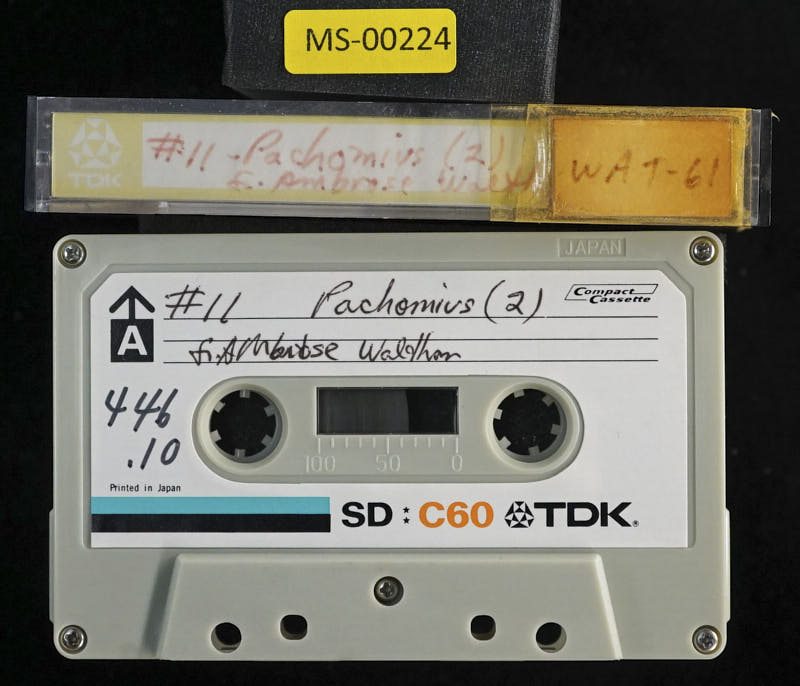
AI Vision - Possible Values from Photos:
Speaker: Ambrose Wathen
Possible Title: Pachomius 2
Additional text: 446 10
@AI-Vision_v002
Today we're going to do a little analysis of the rule of Pocomius. The first thing is that I haven't been able to clearly get some sort of outline, but I'd just like to show you a suggested outline that is apparent from just going through the rule, and that is, the first eighteen rules of the praecetta all pertain to The collecta. Now we'll see what the collecta is. That's the liturgical meaning. It's an axis. Get that door. And so it has to do with order, recitation, the weaving that they do, punishment for tardiness, mistakes, and for leaving. But those first 18 are all on the collecta. And then right away it goes into what the monks do after the morning collecta in 19th. After you come out of the morning collector, what do you do?
[01:02]
And then the conferences. And then it goes into work assignments because that must be what follows next after morning prayers work. Or then in 28, it's possible that after a collector, especially the noon collector, you go to the refectory. So that's the other alternative. Then you go to work in the morning or you go to meals. So 28 on down the line has to do with the rules for eating. In 40, they begin dealing with people that are sick and the care that is taken for the sick. So from 40 to 48 is with regard to the sick. And then with 49, you begin with that entrance into the monastery for anybody. And then it takes up the problem of guests and visits to relatives and work outside and goes on into work. And work continues on up until 66.
[02:03]
And then there's a small little group of 67 to 70 on washing your clothes, which is associated with work. Then 71 to 80 goes back to eating regulations. And 81 to 83 to possessions. And the rest of it is pretty much just helter-skelter things. There are a few little blocks that are... interesting like there's a section on the bakers in 116 and 117 and then on the the sailors and the Bodhi and 118 and 119 and then a section on the tunerals 127 to 129 so it's it's pretty difficult to see any complete order in that thing but I think the beginning of it you see an order you have the collector then you have For one collection in the morning, you go to work, or for the afternoon, for the noon collection, you go to eating. So then it develops that. Now, what I would like to begin with today is taking a look at some of the terms or community or fraternity in the precepts of Echomius.
[03:20]
And we'll just take a look at the first part of the rule, the precepta, and see what we can find there. The term communio is used only once, and that's in 136. Precept 136. Now, what this word is in Coptic, I'm not sure, but Jerome translates it communio. And here in this translation, I've got another translation that you've got, which the one I have is done by a monk at Mount Xavier. And I think there's a better translation there, but I think it's probably basically the same. 136, when one who has left the koinonia of the brothers, what word is used in that translation? It's the admonition to the brother. 136? He leaves against the admonitions of the brother, then has done penance and come back. It doesn't even have the nuance of communion or koinonia.
[04:21]
But one who has left the koinonia of the brothers, and afterwards, having done penance, shall not return to his rank without the senior's orders. Notice that the brothers then... together are a holy koinonia, something which I've mentioned to you a number of times, that this is a concept in Pocomius. It's a fellowship of brothers, that brothers are bound together in fellowship, in communion, and there is a union one with another as brothers are united. Now, one who has joined this holy koinonia cannot arbitrarily leave. I mean, he's pledged himself, he's committed himself, he's sort of entered into covenant. He's bound to his brothers. And thus, if he leaves, afterwards, if he wants to come back, he has to do penance. He must repent for the sin that he's committed against the community. So, it shows that joining the koinonia, you're related to your brothers in sort of a covenant or a pact, an agreement.
[05:30]
which one has a responsibility towards the other ones. They just can't pull out whenever they want to. And so one's movements are no longer totally at their disposal. They're bound to this group of people. And only proper authority in the fellowship can reinstate the one who is returning. So the senior has to give the order and let him return to his rank or not to his rank. So it tells us something about authority in a community, that the senior or the superior acts in the name of everyone. Notice also that in this koinonia, or fellowship, there is rank or order. Belonging to the brotherhood, one has rights as well as obligations and position within the community. So from this little text, I think we see a number of things about the idea of community, of koinonia. Now the other term is which is used, is congregari and congregatio.
[06:35]
These are terms which Benedict uses for the community, congregatio. He never uses communitas. He always says the congregatio fratrum. But congregatio is used only once in the Rule of Hocomnius, and that's in paragraph 27. The master of the house fulfilling the week and the one who will take the following week and the head of the monastery shall have the responsibility of seeing to what work has been omitted or neglected. They shall have the mats that are usually spread out on the pavement in the assembly shaken out and shall keep a record of the cords twisted per week, noting the sum on their tablets, to keep it for the time of the annual congregatio or convention. When an accounting is to be made and the sins of all forgiven. There's a yearly meeting of all of the monks, of all of the monasteries.
[07:36]
In fact, it's held twice a year. At Easter time and in the month of August. And at Easter time is for the common celebration of the Easter mysteries, everybody together. And in August it's more or less a financial chapter. We make reports on all the economic things in the monastery. And notice this thing, though, has two purposes, this annual convention. It's for accountability for work, so the material aspect of the monastery, and it also is with regard to forgiveness of sins, so it has a spiritual aspect to it, this congregatio, the gathering together of everyone. So the congregatio is concerned with material and spiritual relationships of brothers. Both of them are important. It's not just a spiritual communion. It's not just an economic society. It's both of these things. Now the term congregare, which is the verb, is used twice in 36...
[08:43]
The one who strikes the signal and gathers the brothers for their meal should meditate while striking. It's actually the one who congregate fratres, who brings them together into a congregation. And then in 59, you have it used again. When all the houses convened, the masters of the first house shall precede all others. And in the Latin text, in unum congregate, all the houses gather together in unity. And this is very interesting because in the Latin, when you use an accusative, it shows motion. In unum congregate. So you're joined in two, in motion towards unity. And this is very similar to a statement in the rule of Augustine. which I think is a beautiful thing. Augustine's Preceptum begins, Primum Procter Quod in Unum Estis Congregati.
[09:55]
Because of the fact that we are congregated, or you are congregated in one. And what it really is, is the notion of motion into one, which tells us something about the dynamic aspect of our life together. We are moving into unity. I think it's a very subtle thing. I think it's a very beautiful thing. The word used most frequently in this precepta for the society of the monks is the Latin word conventus. And now, conventus has a basic meaning of a meeting or an assembly. And it refers to persons united for social intercourse, council, religious celebration, discussion, or instruction. The word can also be used to indicate a compact agreement or a covenant which binds the individuals together. Now this usage may be at the base of the use in the precepta, that these people are bound together in covenant relationship.
[10:58]
If so, then conventus implies the union of brothers who have bound themselves to one another in covenant or in mutual agreement. So the whole idea of karninia again, the people who have committed themselves to one another. I think what's coming out, at least with my bias, is that you don't commit yourself to an institution. You commit yourself to one another. You bind yourself and pledge yourself to one another that you're going to share your life together, that you're going to do things together. You don't pledge yourself to follow just an objective routine that somebody else happens to be following also. But it's this horizontal leap, which I think is so important, and which I think is really basically Pocomian monasticism, as we saw when we looked at the Lever or Ciesius. This was the whole aspect of responsibility for one another. Conventus is used six times.
[11:59]
And every time it is used, it's always used with the specification of the term brothers. So it's always Conventus Fraterum. So this assembly of brothers, except in one case where it is specified by omnium, or the conventus of all. But it always uses, you know, very interestingly, it always specifies the conventus of the brothers. This emphasizes, I think, that it is a union of brothers, not just a random grouping, not an assembly of mutually disinterested persons, but made up of men who recognize each other as brothers. And how is it used? It's used three times for the group which is joined in prayer. So, for instance, in paragraph one, it is used. The uninstructed coming into the assembly of the saints and given his rank by the porter of the gate of the monastery, once provided with a place to sit in the congregation of the brothers, in the conventus fratrum,
[13:05]
shall not be permitted to change place or rank or sitting until the archilochos, that is, his own housemaster, has moved him to the place properly he is. So it's used in that text there that the brothers joined together in prayer is the conventus prompt room. Also in paragraph 13, it's used again with regard to prayer. Those should not be chosen who stand on the step and in the congregation of all give out something from a written text, but all in their order of sitting and standing shall spin out what by command they have committed to memory. But that's in the congregation of all, the conventus omnium. So again this term is used with regard to the brothers joined in prayer. And in paragraph fifty-one, towards the end of it.
[14:12]
If at the time of prayer and assembly they wish to join the conventus fratrum, the congregation of the brothers, and are of the same faith, the guest porter or the guest master shall inform the father of the monastery, and they shall be brought to prayer. So the brothers joined together in prayer especially are called a conventus fratrum, that is a meeting or an assembly, those bound together by pact, by covenant, praying together. It is used once with regard to common eating in paragraph 8. At the very end, the same shall be done in the congregation of the brothers when they are assembled to eat. So in the conventus fratrum, when they're eating together. Once it's used for the assembly where brothers hear conferences of the elders or holy reading in 1.38. Everything they have heard talked of in the congregation of the brothers, they shall necessarily be obliged to talk over among themselves, particularly the instructions of the housemasters given on the fasts.
[15:25]
So again, the brothers join together, realizing their unity with one another, their assembly, their covenant with one another, as they're joined together listening to instructions. Once it's used for the community itself in 137, When somebody who's gone AWOL wants to return, when he has returned to the congregation of the brothers, he shall not be permitted to enter the house or take his rank without the senior's order. There it's conventus proctum. From these terms in precepts, it's very difficult to develop much of a monastic theology or community theology in the rule of Pocomius. And I think the theology will have to be developed on a much broader basis, and that's why I think the Liber Orsiatius that we looked at last time is very important for the understanding of what is this community.
[16:35]
What is this holy koinonia? See, the words are merely sort of alluded to in the rule. But I think the deeper reflection on it comes from looking at the Liber Orsiasius, where we saw that it is the new Israel, the house of God, all of these images of the Old Testament. This is what the community is. And also from various catechesis. And maybe... Only in looking at this larger picture of Pachomian monasticism can we really develop a theology of community in Pachomian monasticism. Do you have any observations about this? Well, two. One, that I noticed that when we get a death notice from Europe, they usually sign up the Avid and Convent or Conventors. Conventors. I thought about that. But it's a Latin word which means assembly or congregation or community. I was thinking, too, you're talking about the horizontal relation of members of the community.
[17:38]
Does that kind of bring stability to your mind? In what way, Joe? That our stability is to the house as we are. Without us, there is no monastic house. And if something should happen, we should move. We'd all have to say, move together. We recall in the Rural Benedict, it's stabilitas in congregazione. It's stability in the community. It's not so much stability as we saw this summer in a place. But what you're really bound to, what you're faithful to, stabilized in, is in your horizontal relationships. That's the thing that's important. I think that's the characteristic of Benedict and monastic. You don't move around from house to house, not because of the houses, but because you don't change people all the time. You work out your salvation with one another through thick and thin. Now, the other word that I have had a chance to look up, and I got a whole lot of them I want to look up, but I just haven't had the time,
[18:55]
is the term collecta, which is a very important term in the precepta. Well, I've noted to you that the first 18 paragraphs are all on the collecta. Now, this collecta is a translation of the Greek word synaxis. And I don't know what the Coptic word is. It's probably synaxis or something like that, which is specifically talking about the liturgical assembly. So that's what we're talking about. When they come together to pray. The precepta begins with 18 paragraphs which concern this collecta or assembly. And in total, throughout the whole precepta, there are about 30 paragraphs out of 144 which refer to the collecta. The collecta is the assembly of the monks for common prayer. That is where they come together for psalmody, silent prayer together, and for scripture reading, what we would call the Opus Dei. And I think that's the weight that this word has.
[19:58]
Now, the collecta, according to the precepta, and this is in a disputed area now, because, for instance, Armand Viliu, who's done the study on Pachomian liturgy in the 4th and 5th century, sees it a little differently than what I'm going to present it to you. And it's disputed by a lot of people. I'm just taking the precepta to see what we can find from here. The collecta, according to this text that we have by Jerome, takes place four times a day. The first time it takes place is in the morning. Look at precept 19. In the morning, in the individual houses, once the prayers have been finished, they shall not return right away to their own selves. but they shall share among themselves what they have heard the masters giving out when they shall go into their cubicles. That's in the morning, once the collecta, the prayers have been finished.
[21:00]
Now, I don't know how that translates it in your text. It probably says assembly or something. It says prayers. When the prayers. Well, that's, it's actually, if I'm not, well, I don't have the Latin text real close, but the collecta there. And look at 24. After the morning prayer, The weekly server whose work it is shall ask the chief of the monastery about the various things he believes necessary. So notice again, there is this morning prayer and it referred to it in two places. This collecta also takes place at midday before the noon meal. Look at paragraph nine. When the trumpet blast has sounded for the daytime assembly, so this is the collector during the day, the one who comes after the first oration shall be punished by the scolding of the senior. Now there's no proof that this talking about during the daytime is not the morning, but it just says the collector during the day.
[22:06]
Look at 23. He shall not be able to give the signal for bringing the midday assembly together or for the six evening prayers. So here specifically it talks about a midday collecta. And then in 28, when the assembly, the collecta is dismissed, all leaving for their cells or for the refectory shall meditate on something from scripture. Now, what this says is that when the collect is over, you either go back to your cell or you go to the refectory. Well, we see in another place that the only time you go to the refectory is at noon or in the evening. So this doesn't refer to the morning synaxis or the morning collecta. It must refer to either the noonday meal or the evening meal. And I think that this is another one that refers to the noonday. Look at 1.11.
[23:08]
No one may go before the signal is given for eating except for urgent work. In the Latin text it says, and even so may not except for urgent need go before noon to the various workshops when the brothers are summoned to eat. So it specifies that the brothers are summoned to eat at noon. Now the other one said that when they come out of the collecta, they either go to their cell or to the refectory. So putting these two together, I see that there is a collecta, a synaxis, at noontime. Now this is in disagreement with Deleu, who says there's only one in the morning and in the evening. But I think that this rule indicates that there is one also at noontime. Then again there's one at desperate time or in the evening in 121. Whoever arrives later than the first of the six evening prayers or who cannot be heard or who has spoken to his neighbor or lad shall once order has been established make satisfaction for the rest of the prayers.
[24:35]
So for the evening prayers and then again in 126. After the six prayers when all separate to go to sleep It shall not be lawful apart from the case of necessity for anyone to leave his cubicle. So after these evening prayers, apparently they go to bed. Now, there's also one, it seems, during the night time. Look at paragraph five. If the signal has sounded at night, you must not stand at the fire, usually lighted to warm bodies and keep off the cold, nor should you sit idle in the assembly, in the collector. but with a quick hand you shall prepare strands for the warp of mats. So it's the nighttime collector that they're talking about. And then again in paragraph 10. At night, however, to grant a bit more to the weakness of the body, the one who arrives after the third oration will be punished in the same order, both at the assembly and at the meal. See, if you look at 9, it talks about the daytime assembly.
[25:40]
when one comes after the first oration. And then in 10, it talks about the night assembly, when because of the weakness of man, you can come after the third oration. So it's obviously two different times. Now, the way I put these things together then, is that seemingly there are four prayer periods a day. There's the dawn, the noon, the vesper time, and the vigils during the night. Now, as I say, this is highly disputed, and I'm reading these in a different way than other people who are reading them. Yeah, this number five, paragraph five, I don't know if, from what I gather, they're working while they're praying. Yes, we're going to take a look at that. And this, of course, this is also disputed too, but this is something that I think is very clear in the rule that they're busy doing things while they're praying. There is no excuse for not attending common prayer.
[26:45]
Look at 141. No one should find occasions for himself not to go to the assembly, to chanting, or to prayer. So there is no excuse for not going to the collective. And there is punishment for coming late, as we've seen in 9 and 10. For instance, if you come after the first oration at the daytime or the third oration at the nighttime. Now, this is a problem. What do you mean by the first oration and the third oration? This is another complicated issue. No one may leave the collector without the permission of the superior. Look at 11. When the brothers are praying in the assembly, no one shall leave without the order of the seniors, and unless he has asked and been permitted to go out for the necessities of nature. You just don't get up and leave. One is to come to the collecta immediately when the signal is made.
[27:49]
Look at paragraph three. When he hears the sound of the trumpet summoning him to the assembly, he is to leave his cell immediately. And then notice, meditating on something from Scripture to the very door of the assembly hall. So as they come to the assembly, they're to be meditating. And he must be very careful when he enters the assembly hall. Notice number four. When he has entered the assembly place on the way to where he is to sit or stand, he shall not tread upon the reeds that have been wet down and ready for rope making. See, here's another indication if they've got everything ready to go. And so that when you come into the oratory, you come in very cautiously so you don't walk on these things. Not even the slightest loss should come to the monastery through one's carelessness. If he is there too early, he prepares the strands for making mats. I think we saw that in one of the others. Whereas if he got there too early, he's supposed to sit there and start making mats.
[28:53]
This translation leaves that section about... to get out altogether. I mean, you know about, it just says when he comes in, let him be careful not to hurt anything at the bottom of the monastery. It didn't mention anything about reeds or mats or working. Yeah, I'm not sure if that's all from the same Latin text. That might be from me. No, and this is from the critical Latin text of Boone. And I've never really checked them that closely. Now, during the prayer, the monks make ropes. Look at number four, which we've seen, where he doesn't tread on these things when it comes into the oratory. Look at number seven. No one may look at another twisting strands or pray. With the light of his eyes cast down, he is attend to his own work. Remember, all of these first 18 are on the collective, and this is a rule in that context. So that while you're at the collective, you don't want somebody else making his mats.
[29:56]
You sit there and you make your own mats and you pray. And look at number 12. No one may distribute reeds for rope making except the weekly minister. If he is detained by reasonable work, the direction of the senior shall be resorted to. Again in number 23. Without the order of the chief of the monastery, the hebdomadary shall not have the power to give cord or any other implement to anyone. And unless the farmer so orders, he shall not be able to give the signal for bringing the midday assembly together or for the six evening prayers. Notice in the context he talks about praying as well as about giving the things necessary to make these things. And in number 27, The master of the house fulfilling the week and the one who will take the following week and the head of the monastery shall have the responsibility of seeing to what work has been omitted or neglected. They shall have the mats that are usually... We also see in number five that they're making mats.
[31:03]
But with quick hand you shall prepare the strands for the warp of mats. Now the ropes which they made are probably used on the monastery boats which plied an aisle. Look at 118 and 119. You see, it's a very clever way of doing things. You're praying and you're preparing also for your work. See, in 118, as regards the boats, no one should cast off his craft, including rowboats, without the chief of the monastery. Aboard ship, no one should go to the bilge to sleep, and a secular is not brought aboard to sleep. And then in 119, the weaker sex, the vasa infirmiora, shall not sail with them unless it happens that the father of the monastery should so order. So obviously the monastery has boats, and these boats need ropes to take care of them. And the mats are probably used, first of all, to cover the floor of the oratory, the collecta. If you look, I think we saw that before, but if you look in 27,
[32:13]
They shall have the mats that are usually spread out on the pavement in the assembly shaken out. So in the assembly hall, you have these mats on the floor. And this is probably for the idea of prostration, but somebody shakes them out. Well, you sit there and you make them at the same time. It's really a good economic, I suppose, or efficiency way of doing things. You're praying, you're making your mats, and then you fall on them and pray on them and shake them out and everything is taken care of. the same way with the ropes, or they're used in their sleeping chair. Apparently the monks didn't sleep in a bed, but they had some sort of a reclining chair. If you look at paragraph 88, when they come together for sleep, they shall not speak to one another. If one awakens from sleep after a dream and is thirsty, and a day of fast has begun, he shall not presume to drink. Besides the theon, that is the rush mat, one shall spread absolutely nothing on the sleeping chair.
[33:24]
So they spread these mats on this chair, whatever this thing is. No details about it. So in the collector, apparently they are making ropes and mats. At least that's the impression I get from the rule. Now upon entrance into the community room, A monk is given assigned plates in the collecta. Look at paragraph one. The uninstructed, that means the one who hasn't been instructed in the ways of the monastery, the novice or the postulant, coming into the assembly of the saints and given his rank by the porter at the gate of the monastery, once provided with a place to sit in the congregation of the brothers, shall not be permitted to change place or rank of sitting. until the Ophiuchos, that is his own housemaster, has moved him to the place properly his. So everybody has their place in the collecta, sort of like a stazio, and that's your place, and you get it when you enter the monastery, and that's where you go until they tell you to change places.
[34:30]
The same thing is found in paragraph 49. If someone comes to the gate of the monastery wishing to renounce the world, then look down at the bottom there. He shall be handed over to the gatekeeper so that at the time of prayer he may bring him before all the brothers. So the porter brings this new man into the assembly of the brothers. He shall sit where he is told. So he's given a place to sit in the collector. They have their own spot. And this place where he is assigned in the collecta is the sign of his rank or the establishment of order among the brothers. So notice there's definitely an order within the community, very similar to the rule of Benedict, which you may recall in the rule of the master, there's no order like that. The abbot can ship people around any way he wants to. But here we see the order is established by the entrance into the community.
[35:32]
In this assigned spot, The monk sits in all decorum and modesty. So look at number two. And I think that you have to understand number two in relationship to number one. That's why you have to see these things together. Because just by itself, it doesn't make much sense. So while he's in the collecta, sitting in his place where he's assigned, he shall sit with all decorum and refinement, tucking under his buttocks the lower edge of the hide that hangs over his shoulder, down his sleeve. carefully drawing his garment, the sleeveless linen tunic called leviton, so that it covers his knees. That is how specific and detailed it gets, but you sit there with decorum and modesty. You just don't flop down and cross your leg and yawn and make yourself at home, but you sit there in prayer in a very refined and vaporous manner. Arranging the cloak which he wears at this time, So it says that he arranged his cloak.
[36:35]
Now look for that cloak back in 91. Sort of gives you, I think, a clue to what this thing is. No one shall walk about the monastery or go to the assembly or the refectory not wearing the cow and the hide. See, in this one it says the edge of the hide that hangs over his shoulder. So there's some sort of a skin. that they wear. And apparently they only wear it when they go to church and when they go to the refectory. There's some sort of confusion here about when you wear particular garments. But there are times when you wear certain ones and not... It's sort of like the military uniform of the day. Now you put this on and now you take it off. And when you're doing that, you don't wear this. When you're doing that, you wear that. Which is sort of... complicated in a way, and you wonder if it's not sort of ritualistic. But these garments had a meaning then, and they were associated with particular actions.
[37:39]
He also has a special linen neckerchief, which is called in the Paleo law. Look at 61 and 102. First of all, 61. No one shall bring his linen neckerchief with him to work unless the senior permits it. No one shall use this cloth walking about the monastery after the assembly. So you get the impression that this linen neckerchief of some sort was worn only at the collector. But now if we look at 102, it says, No one may go to the assembly or to eat wearing work shoes... or neckerchief, so they can't wear it when they go to the assembly or to eat. So I don't know how to explain this if it's one of these contradictory things within the rule that they just added on later legislation and you don't know what it means, or either in the fields or in the monastery. But the impression you get is that there were times and places for wearing different things.
[38:46]
I get the general impression that this little neckerchief is worn only at the collect-up. And then we see that at the collecta and at meals, the monks go without shoes. They go barefoot at both the collecta and at meals. And the shoes are usually just for field work. The collecta consists of psalmody, prayer, reading or recitation of the scripture passage, not only reading, but recitation by heart. So let's take a look at, first of all, the psalmody, what this collective consists of. And have you been through this with Father Patrick about Pocomius? No. At all? I hope I'm not stealing your matter then. But if you look at paragraph 8, and remember this is in that early part where it's all about the collecta.
[39:50]
Here are the rules of life handed down to us by the elders. If it happens that during psalmody or prayer or in the midst of reading, so notice you've got the three different things there, psalmody, prayer, and reading. Someone should speak or laugh. He shall remove his signature there on the spot and neck bow down and heads kept down. He shall stand before the altar and be chastised by the chief of the monastery. The same shall be done in the congregation of the brothers when they assemble to eat. So he takes off his signature, and I guess he gives it to the superior, and then he bends over, and he gets it right there where he's made the mistake. But the point is that you have psalmody, prayer, and reading. Also look at verse 15. This is on Sundays, and on Sundays apparently the liturgy is a little different. And one of the things about on Sunday that there are specific people who do things rather than you just take your turn.
[40:51]
On Sundays or at the time of the offering, that is when there's the celebration of the Eucharist, none of the hebdomadary shall be absent from his seat in the covered place. I don't know what the covered place is. It must be a special presbyterium or something like that. Making response to the psalmist. So they are the ones who respond to the psalmist. Now, I think that's an interesting notation, telling you maybe how the psalms are executed, that somebody prays them individually and people respond to them. It's hard to say exactly what that means. Then also in verse 16, again, psalmody is mentioned, I mean in paragraph 16, No one has the right to sing except the house master. That's really to sing songs in the Latin. And in paragraph 17, whenever the seniors may be singing, that is, reading the Psalter, and one misses his turn, he shall immediately be subjected to the order of penance and chastisement before the altar.
[42:03]
In 141 and 142, again, there is mention of psalmody. No one should find occasions for himself not to go to the assembly, the collector, to chanting or to prayer. That chanting is, in Latin, psalmody. Whether he, number 142, whether he is aboard a ship or in a monastery, in the fields, or on a trip, or in whatever service he may be, he shall not let the hour of prayer and psalmody pass by. So, it's obvious that there's psalmody in this thing. Now, this is what, I guess I should I sort of disagree with the way you has presented the liturgical service of the early Pocomian monks, where he says it's merely coming together and reciting scripture passages without any special psalmody. Now, that may be the case in the very earliest, and so he argues for that. But I think by the time that Jerome translates this rule, and this rule is earlier than 404 because that's the date of translation, already they have psalmody in their prayers.
[43:09]
Then also they have what we call just prayer. And there's a number of different texts that indicate that. For instance, we saw 9 and 10. It talks about the first oration and the third oration. If you come after the first or after the third. So there's a type of thing which is not just psalmody, but which we would call oration. In paragraph 19, in the morning in the individual houses, once the prayers have been finished, They shall not return right away to their own selves. And then we saw in 141 and 142 the same thing. Then reading. And in number eight, which had all three of them, psalmody, prayer, reading. Or a recitation of scripture passage. For instance, Scripture 13 and 14. The house hebdomadary. Those should not be chosen who stand on the step and in the congregation of all. Give out something from a written text.
[44:13]
But all in their order of sitting and standing shall spin out what by command they have committed to memory. So everybody's supposed to just call on somebody or it goes down the rank. And for the scripture part of the thing, instead of reading from a text, you just... say something from memory, from sacred scripture. Now, what we see in Pocomian monasticism is everybody had to memorize the New Testament, so it was no problem. I mean, everybody knew it, and they could just get up and recite something. Or in 14, if any of these forgets anything and hesitates in reciting, he shall undergo punishment for his carelessness and for forgetfulness. So it's your turn and you get it. Well, you just go out in the middle of the choir and take off your cincture and get it. And then you go back to your place. So they recite them by heart. And you see this also in 139 and 140.
[45:16]
That 139 is important from that point of view because whoever has come into the monastery uninstructed shall first be taught what he must observe. And when so far... He has agreed to all of it. Notice that he's told what he has to do. Then he agrees to it. Then they shall give him 20 psalms or two of the apostles' pistols or some other part of scripture. And he's got to memorize it. And then if he's illiterate, then he has to go through an education and learn how to read. So everybody in a monastery knows how to read. Look at 140. No one whosoever shall be in the monastery who does not learn to read and does not retain something from Scripture, the minimum is the New Testament and the Psalter. So it's another indication of the Psalter. Everybody had to know the Psalter by heart, so they must have used it then. And then these New Testament texts that they could just get up and recite.
[46:16]
Now this recitation of Scripture, or what we would call the reading aspect, even though it's by heart, is done by all in turn according to their rank. that is, in their seating order. And when they recite Scripture, they stand on the step. This may be an indication of what we would call an amble, a special place that they go up and they recite Scripture from it, or at a lectern. Now, during the recitation of the Scripture passage, the monks are probably seated. Now, the rubrics are not too clear in the rule. At the end of the silent prayer, monks all rise together when the signal is given. At least that's what it says in the text. So it may be that during this prayer, they were prostrate, because it definitely says they'd get up at the end of it. During the psalmody and scripture passages, the monks then are probably seated, weaving their mats and ropes and not looking about. And then the only indication of quantity, beside this rubric, is that there are six prayers at Vespers.
[47:22]
Which is, you sort of get the idea that They're sitting there for psalmody, and then they prostrate for quiet prayer. They stand up, and then somebody collects the prayer, and then they sit down, and somebody recites from Scripture. And this is a thing that goes on and on through how many other patterns there are. And the only indication of quantity of this is that there are six prayers at Vespers, if you look at 121. whoever arrives later than the first of the six evening prayers. So there are six of them then, and that's the only indication of quantity that we have. Now, coming late to the collector, one is punished both in the collector and in the refectory. So you get it both times. You get it in church, and then when you go to the refectory for meals, you get it again.
[48:24]
If he speaks or laughs during the service, He removes his signature and is immediately chastised, and again chastised in the refectory. So there's two mistakes you can make. Come on late, and then when you get there, you start cutting up, and you start laughing or talking. Besides that, if he should forget or hesitate in recitation, he also has to undergo punishment. So notice the penal code with regard to this. Now Sunday is a special day, for it is the day on which the Oblatio is offered. as we see in 16 and 18. On Sundays and in the collecta in which the offering is to be made, no one has the right to sing except the housemaster and the seniors of the monastery who are of certain rank. Notice it's a special occasion. Only the superiors are really the ones who sing. And that's on Sunday or the day that you have the oblatio, which is the Eucharist probably. And also in 18. The one who, without the command of the senior, leaves the assembly in which the oblatio is to be made shall be chastised immediately.
[49:32]
The seniors of the monastery minister in a special way at this service, and no one may leave it unless it's been ordered to. Now some reflections on this. From the rule, we shouldn't expect some sort of articulated spirituality of common prayer because it's a monastic rule and it doesn't go into that. But I think we can conclude to certain points. The collecta is the first thing to be treated in the rule. Right away the rule starts out with the collecta, with common prayer. So it seems to be of primary importance. It's the first thing that comes to mind when you, well, the first thing you legislate for is the brothers praying together. Another thing is that one-fifth of the rule concerns rules for the collector. That is, 30 out of 144 paragraphs have to do with the collector, which shows that it's a rather important thing in their life. Now, there's no excuse for missing prayer or for being late, so it shows that prayer is very important in their life.
[50:40]
And reverence, respect, and decorum. are very important, even how you sit with your clothes, it's very important, and that you don't laugh and cut up, that you don't look around, that you pay attention. And there are rather severe punishments for mistakes, lack of attention, and disrespect or levity, which indicates again the importance. Now, it seems to me that all of these indications lead out to what the rule of Benedict formulates very simply as, let nothing be preferred to the work of God. And it doesn't say that in words as it does in the rule of Benedict. But all of these indications of importance seems to, it's the same thing. At least that's the way I feel. Do you have any observations or questions about this? Now, when you get into this with Father Patel, if you go into Pocomius, you might see it from a different angle and a different point of view. But this is what I see, at least in the rule of Pocomius.
[51:43]
Very briefly, I want to make you familiar with a study by Ladutz, who wrote his study of Pocomian monasticism around the turn of the century. And it's a study of Pocomian synovatism during the fourth century and the first half of the fifth century. It's in French, and it was a classic. And it was one of the only studies in Pocomius up until the last few years, when more people have been studying it. It's a pretty big book, but there's only one section which I feel is rather important for us, and that's he sort of explains the Pocomian rules. Now, many of the things he says through further analysis and study are not exactly the same way as he would have presented it way back then, because he didn't have a critical text and many other things. And there's just a few things I'd... briefly like to point out so that the next time we can go into Pocomian spirituality and theology in monastic life.
[52:53]
But for instance, he points out that in the rule, some obvious thing, the monastery was surrounded by a cloister wall because one of the rules says that the monk is not allowed to walk outside of the wall. So right away that tells us there's a wall surrounding the monastery and that within the enclosure that he, what he talks about, you find place where the monks live, their little cells were living in, the church, probably the refectory, an infirmary. You see, there's a whole section on the infirmary and the regulations for infirmary, and the infirmary has its own kitchen. And we also know that somewhere in the monastery there was a guesthouse, and that the guesthouse for the women was separated from the guesthouse for the men. Because it says that even if women come, they should be accepted, but not within the community, but in a more separated place. He talks about the monastic habit, and this may be of interest to you.
[53:58]
For instance, look at Precept 81, which will give you an indication of the habit. There are a number of indications. In his house and cell, no one should have anything but what is prescribed by the common law of the monastery. No woolen tunic, no cloak, no soft sheepskin with unshorn wool, not even a few coins, no little pillow or various other conveniences. Only what has been distributed by the father of the monastery through the housemasters. This is their equipment. Two levitons. Now, a leviton is a tunic usually without sleeves, so it just means a tunic. plus one used one. So apparently they have two of them, plus an old one. So three, really. A longish linen cloth for the neck and shoulders, that sort of kerchief that we talked about. The hive that hangs from the shoulder.
[55:01]
Now, I don't know exactly what purpose that thing was, but apparently they wore it at choir. Two cowls, or what we would call cuculas, and probably just a capuch aspect. A pair of shoes, a cincture, and a stack. They all had a stamp. If you find any more than this, you shall remove it without any objection. This is addressed to the superiors of the community. If they go and, I guess, are searching in somebody's cell and they find more than that, then you just take it away and the guy doesn't have any right to say anything. But that tells you what their address would be like. And then we've noticed, for instance, if they go barefoot usually, and at least to... to meals, and to prayer. Do you think going barefoot was some sort of penance for them? No, I really think that it was probably the custom in Egypt that you just went barefoot. I was thinking of that hot sand. Well, you see, when they went outside to work in the fields, they wore shoes or sandals.
[56:05]
But inside, they went barefoot. Now, I don't know really why. But I would imagine this was more or less the custom. That's another thing to be noticed is the type of work that they have. There's all sorts of work. We've seen that there must be sailors. There's a section on the bakers, because when they're baking bread, they're not supposed to talk but sing psalms. There's fields where they go work, and a number of the rules say that you can't go to the garden and pick up even an apple from under the tree and eat it, except at the time to eat, so they must have had an orchard of some sort. and a vegetable garden. So all of the kind of things that we associated with a good medieval monastery, all of these things they would have had. And I think the strictest laws are no eating except in common, and no possession of anything but what everybody else has. Now that goes back to what we saw in the Libra Orsiasius, this insistence that we hold everything in common.
[57:07]
And I think that... Really there, you're at the core of Cenobitic life. That you share everything with one another. And that nobody has anything that anybody else doesn't have. Now, of course, Benedict says if somebody needs more, they have more. But everything is shared in common. And I really feel that this is the core of common life. The sharing of goods. What we would call also poverty. No, the personal poverty. I don't have a thing. But I share from the common goods of everybody else. And this is very strict in Pocomian monasticism. Take a look at 49, which is rather classical because it would be very similar to chapter 58 of the Rule of Benedict. And someday you might just want to compare the two. If someone comes to the gate of the monastery wishing to renounce the world and be added to the number of the brothers, he shall not be at liberty to enter. Now I notice two things which I think are very important. He comes to renounce the world
[58:10]
So he's leaving something, but he's going to something. He wants to be added to the number of the brothers. So it's not merely a negative thing. He's positively wanting to join the holy koinonia. Now, he can't join the holy koinonia without leaving the world. But you see, it's a two-fold action, which is all one. But I think it would be wrong to overemphasize that our entrance into the monastic life is to renounce the world. because that leaves a vacuum on the other side. And I don't think Pocomius does that. So you're renouncing the world, but you're going into the number of the brothers. That's what you really want. First, the father of a monastery shall be informed of him, and he shall remain outside a few days at the door. So he's left outside at the door, just like in the rule of Benedict. You leave him in the guest house for a while. Try their spirits. And if he taught the Lord's prayer and as many psalms as he can learn, So he's not idle while he's there, but he's being taught the Lord's Prayer.
[59:11]
He shall have a care to make himself known. And what does he have to make known? Has he done something wrong and troubled by fear, suddenly run off? So is he running away from something? Is he trying to escape? Is he under some sort of influence? Can he renounce his family and his own will? If they see that he is suitable in all these respects, he shall then be taught the rest of the monastic discipline, what he must do. whom he must serve both in the assembly of the brothers and in the house to which he is assigned, as well as in the order of eating. Instructive to perfection in every good work, he may be admitted to the brotherhood. Then they shall strip him there of his secular clothing, garb him with the habit of monks. He shall be handed over to the gatekeeper so that at the time of prayer he may bring him before all the brothers. He shall sit where he is told. The clothing he had brought with him shall be given to those in charge and brought to storage, where it shall be at the disposition of the chief of the monastery.
[60:14]
Notice how very similar, it's a sort of primitive form of a later development in the rule of penitent, but very similar to it. Are there any questions about... Well, there's some interesting notations in the rule, which I'm sure you come across and wonder about. The next time we will go more into theology of Prochromian monasticism from its analysis of two very fine articles on it. Then we'll see more or less what the thinking behind this rule is. We'll look at it better. Okay?
[60:58]
@Transcribed_UNK
@Text_v005
@Score_95.79