You are currently logged-out. You can log-in or create an account to save favorites and more. more info
Living Community, Embracing Individual Worth
AI Suggested Keywords:
The talk focuses on the Rule of Saint Benedict, emphasizing its teachings on community life and individual worth. The discussion highlights the importance of acknowledging each individual's unique value and the challenges of loving and living together without succumbing to societal labels or divisions. It draws parallels between Benedict’s approach to community, forgiveness, and the insights of other spiritual thinkers as solutions to modern societal issues of division and lack of forgiveness.
- The Rule of Saint Benedict: St. Benedict’s teachings on living in a community highlight the necessity of valuing each person as they are, advocating for love without idealistic or escapist expectations.
- Original Blessing by Matthew Fox: Mentioned as a counterpoint to traditional Christian teachings that emphasize sin and unworthiness, suggesting the focus should be on inherent human value.
- Community and Growth by Jean Vanier: Reflects on the importance of love and forgiveness, citing Vanier's work on fostering communities for people with disabilities as exemplifying these principles.
- Thomas Merton: Referenced for insights on the mystery and individuality of people, discussing the spiritual privacy that should be respected in love.
- Henri Nouwen: Quoted for his perspective on balancing protection and freedom in caregiving, using the metaphor of cupped hands to describe nurturing relationships.
- Ezekiel 34: Cited to illustrate the shepherding care that Benedict exemplifies, paralleling Christ’s teachings on nurturing and healing broken relationships.
- C. Day Lewis: His writings on parenting and the importance of letting go are used to illustrate the wisdom in allowing loved ones the freedom to grow.
- Stephen Biko: His approach to forgiveness, despite suffering under apartheid, serves as an example of the transformative power of forgiveness.
AI Suggested Title: Living Community, Embracing Individual Worth

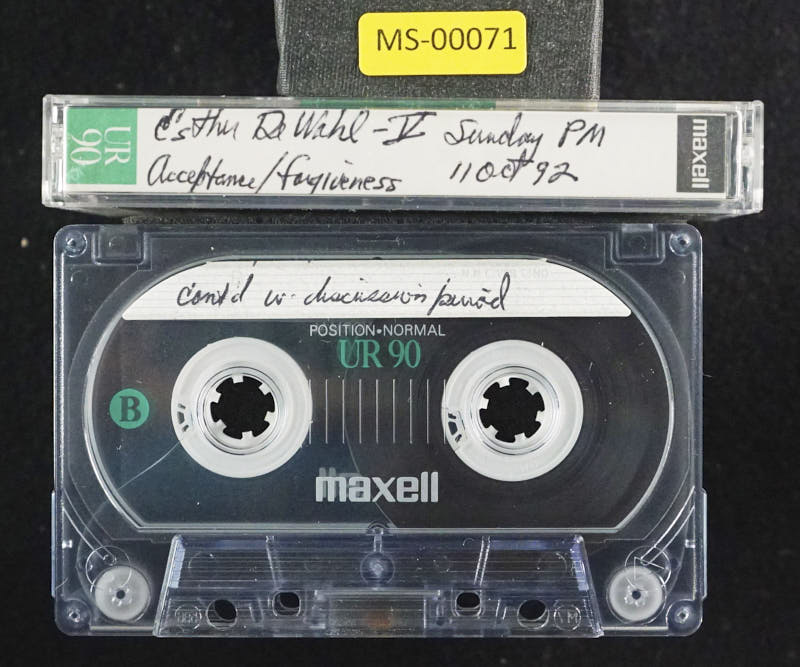
AI Vision - Possible Values from Photos:
Speaker: Sr. Ishpriya
Possible Title: Acceptance/Forgiveness
Additional text: Contd w/ ducharmein/gained
@AI-Vision_v002
The Rule of St Benedict is really about life and community, life together, living with other people, loving them as they need to be loved. It's about that fitting together that the slides last night, I think, tried to show us, how the individual joints and elements of the building are integrated into one harmonious whole and how costly that is. I think it is because St. Benedict knows about and writes about living in the community that he spoke to me at a time when family life was at its most intense and demanding and inescapable.
[01:03]
And I think that's one of the reasons why I'm so grateful to him. Because he tells us about this hard work of loving in a way that isn't escapist or romantic. He doesn't put huge expectations on it, but he really tackles it with his usual honesty and down-to-earth realism. Now, if we look on the rule as a codebook of love, then the starting point is really absurdly simple. It is that we must love each one, each unique, separate, individual person as they are and not as they are not.
[02:13]
This is the starting point of everything that the rule has to tell us about relationships and it takes us back once more to those extraordinary and amazing opening words that this book about community living is yet addressed to each one of us. My son, my daughter, the unique child of a loving creator father. So the starting point is the worth of each individual. But so often in the history of Christendom, theologians and teachers have not made that their starting point. They've dwelt on the sin and on the unworthiness of men and women. And so, in passing, I must just say, that is why Matthew Fox has rushed in to fill up that vacuum.
[03:20]
and tell us about original blessing. I think that a great deal of what he has to say I would question. But it is really a comment on what the teaching has been that he has had to bring in that corrective. were as if we had listened to what St. Benedict has to tell us, just as if we had really heard what there is in Christ's teaching, and of all, Benedict is nothing except declaring to us what there is in the gospel. We would know that we, each one of us, have real value wherever we are, whoever we are. And Benedict doesn't merely say this. He lives it out. Everything that he tells us in the text of the rule comes out of his lived out experience.
[04:27]
It is hardly one experience too. We know a little bit from what St. Gregory tells us in the dialogues. about what life was like at Monte Cassino when he gathered together that first family of brothers living there. And these men come out of an Italy of warring tribes and of social demarcation in which you are simply marked for life. Your place... in society is determined at birth by the external marks of this strong hierarchical society. And now Benedict does this improbable thing. He's gathering together slaves and freemen and proud aristocratic Romans and wild Goths and barbarians.
[05:31]
He's gathering together illiterate peasants with those who have academic records. He's gathering those who are landowners with those who till the soil. And as again we know from what we learn about their life in the dialogues, it wasn't always easy. There was a great deal of tension. Who should I be serving him, says a proud aristocrat, standing and looking at somebody who comes from a lower social origin. And Benedict spins round and challenges him and says, thoughts like that are of the devil. Now, Benedict doesn't easily invoke the devil. It has to be very, very serious indeed for him to be saying that. So he is letting all these disparate people live together and accept the worth of each single one of them.
[06:43]
How amazing this is and how liberating. And although it's so obvious, I think we must just stay with it for a moment. because so much has gone wrong, perhaps in our own lives, perhaps in our local communities, certainly in society as a whole, because of the denial of self-worth. I suppose I could see it particularly clearly as one can sometimes at a distance from one's own situation because it is ultimately very dramatic there. In the visits that I made to South Africa when it was a society built on apartheid and that was what I saw, precisely that, the denial
[07:48]
of the unique worth of each individual. And it was very tempted to come back, and at that time I was living in London, to come back and point the finger and talk about the evil of apartheid and what I had seen in terms of social and racial discrimination. But if I was really honest, That was something that I saw in London, actually in subtler form, but I'm not sure that it wasn't possibly more cruel because it was more hidden, the way that it is lived out in Western society. A city like London is a relentless city, a city which labels puts people into little boxes, judges them, dismisses them.
[08:54]
There are social divisions. There are class divisions. There are divides of rich and poor. We play a very subtle game. We can tell by where you went to school or which part of London you're living in or just how you dress or the job you're doing. A great deal are about your social, your educational background. And we tie labels on people and thereby we imprison them in our assessment of them and thereby we also denigrate them. and deny them their own true worth as a brother or a sister in Christ.
[09:58]
For that's at the heart of what Benedict is telling us about how we accept, receive, and love another person. Let everyone who comes be received as one. for in Christ's eyes there are no people who don't matter or who matter less each one of us is brother and sister in Christ we are all one in Christ we are all equal in Christ in love. But I think it's also important to get this right. Bernard, it isn't saying that there won't be differences between people.
[11:01]
There's no leveling down into some sort of neat, rather deadening unity, because there are differences of a physical and a psychological kind, because there are the gifts of the Holy Spirit to each one of us. Everyone has his own gift from God, one this and another that, he says in chapter 40, quoting 1 Corinthians. But he is sensitive to varying individual needs and gifts and capacities. And it's seen particularly in that famous example of the wine in chapter 40. Because there are endless examples in the rule of allowances and concessions, because all the time Benedict is saying to everybody in his community, you're special.
[12:02]
You're special because you're old. You're special because you're young. You're special because you're sick. Everyone is special, unique, but it is the end of all labels. There is no distinction of status. There is no preferential treatment for the clergy. No one is excused kitchen duty and the washing up. in the face of the social distinctions and the racial divisions of his day, it is quite amazing. He is telling the world and he is living out the fact that everyone is sacred and each person has a right to develop to his or her full potential. And none of us has to do anything to prove our worth.
[13:08]
We don't have to achieve, we don't have to claim, we don't have to demonstrate our worth. It is a gift of unconditional love. And one of the most gentle marks of respect for my own individual worth, which I've come to appreciate, is Benedict's reluctance to intrude too closely into the private prayer life of his monks, to direct too closely the pattern of their inward prayer. And here is a sensitivity, a reticence about people, which I come increasingly to appreciate in a world and in a climate of the church at the moment, which seems rather to like to direct, literally, control, suggest.
[14:23]
He draws back... Here is space, here is freedom. He leaves us each free to find our own unique way to God in prayer. And in these years in which I see an increasing growth in technology, technique about prayer, I think we see Benedict's insights about freedom, and not trying to direct even more urgently than ever before. I suppose really everything that I'm saying is really a commentary on what I was saying this morning about reverence, respect, handling with care, handling material things with care, but also handling people.
[15:27]
with care as well. That's no bad definition of chastity, which is something that applies in its widest and in its most profound implications to all of us. It means distancing myself, both literally and figuratively, because it is only too easy to crush, to impose, to manipulate. We have to respect the mystery that each person is. If each person is made in the image of Christ, then ultimately each one of us is a mystery and we must... draw back in the face of that mystery. Thomas Merton writes about this at one point.
[16:34]
A person is a person insofar as he has a secret and is a solitude of his own that cannot be communicated to anyone else. I will love that which most makes him a person, the secrecy, the hiddenness, which God alone can penetrate and understand. A love that breaks into the spiritual privacy of another is no... true love at all. It seeks to destroy, rather, what is best in him and what is most intimately his.
[17:37]
How gentle the abbot is in his handling of the brothers. in the community. And this portrait of the abbot also tells us about Christ, but is also the exemplar for each one of us in the way in which we are to behave to one another. Benedict uses the familiar image of the shepherd. And just because it's so familiar, I think sometimes we have to jolt ourselves. Look at it afresh. Because we've lost something of the immediacy which the early church felt here. For what the crucifix is for us today, the shepherd was in the early church.
[18:46]
The cross, the gallows, far too shocking to use of Christ. And the catacombs show us instead paintings and sculptures of the good shepherd. And that was how they saw and felt Christ. Christ amongst us as a shepherd. can never be general, abstract, impersonal. A shepherd calls each one by his name. He knows them and they know him. All the riches of that passage in Ezekiel 34. I'm going to look after my flock, myself. I'll look for the lost one Bring back the stray. Bandage the wounded. Make the weak strong. I shall be a true shepherd to them.
[19:53]
And when things go wrong, when someone has fallen into sin, the shepherd... so gently tries to put into operation a healing of that wounded person. Gently he begins with the oil of encouragement. But it may well be that he has to go on to the cauterizing iron And finally, even that he may have to apply the knife of amputation. And it is no good shrinking from this. Here, Benedict is telling us something that is profoundly important.
[20:58]
And as always, he doesn't shrink from something which is difficult. He says... there's often a very real danger that you may want to protect another person from themselves, that you may want to collude, that you may not want to face a person with any sort of honesty about what they are doing to themselves, what they are doing to other people. And Benedict knows that it is... quite wrong indeed it is treating a person in a patronizing way as less than responsible less than to a person who can stand firmly on their own feet to over protect and so we have to stand aside and help that person to take responsibility for themselves
[22:08]
And we have to find the right very delicate balance of concern which doesn't stifle, which doesn't over protect. I like the way in which Henry Nouwen tells us about Jean Vanier. who was the founder of the Lush Communities for the Mentally Handicapped, must have helped thousands of people who would otherwise not have been able to have any chance to live lives of full human dignity. How he feels about these people in his charge. When Jean Vanier... speaks of the place that he tries to give to these people. He often stretches out his arms and he cups his hand as if he's holding a small wounded bird.
[23:11]
And he asks, what will happen if I open my hand fully? And we say, the bird will try to flutter its wings and it'll fall and die. And he asks again, but... What will happen if I close my hand? And we say, the bird will be crushed and die. And then he smiles and says, the right place is like my cupped hand, neither totally open nor totally closed. That is the space where growth can take place. The abbot knows about healing and that things can go wrong. Twice a day, at Lord's and at Vespers, the monks say the Lord's Prayer aloud.
[24:17]
So they make this pledge to one another, forgive us as we forgive. Commitment to continual forgiveness is an essential, constitutive part of their life. And how much Benedict knows about human nature, about human relationships in giving this central place to forgiveness. Unless we forgive... We are enslaved to the past. We are in chains, caught up in resentment, hurtful memories, and there is nothing that uses up our energy more than going on thinking again and again about the old hurts, the wounds,
[25:22]
that inner conversation by which the old sores are kept open and we mull over injustice, resentment, like a cancer inside ourselves. And Benedict says, root all this out. He knows it's no good just lopping it off at the top, the sort of shortcut gardening. You must root it up because, he says, beware of the thorns of contention. And again, another good phrase, because we all know how thorns choke the new, young, green growth. So forgive. Renew the covenant. Begin over again. Bring it out into the open. Repressed anger is destructive.
[26:24]
Deal with it, deal with it here and now. But he also knows that forgiveness isn't as easy as it seems. He knows that we may have to forgive time and time and time again. And in a world which likes forgiveness, Quick answers and easy solutions. It's no bad thing to be reminded that this matter of healing of hearts is a slow business. Not one simple, one-time act of the will. But it is absolutely essential. Not even saints can live with saints on this earth without some anguish, writes Thomas Martin, and I've no doubt again that he must write that out of his own personal experience of community life.
[27:29]
As long as we are on earth, the love that unites us will also bring us suffering by our very contact with one another. And so because of this, he describes love, shared love, love in family, love in community, as being the resetting of a body of broken bones, which is a phrase that I rather like. And I like it because it is also, again, shows us just how demanding and costly it's going to be, resetting bones. But again, how much Benedict knows in giving this central place to forgiveness, however demanding and however
[28:40]
And how really essential it is. We can only be healed through forgiveness. We can only gain freedom through forgiveness. That, again, is something that I found in Jean Vanier, in that very amazing book that he's written, Community and Growth, which tells us so much about so much that he is wise there, coming out of his own experience of living in the large communities. And again, in my time in South Africa, how much I discovered South Africans know about forgiveness. There's an African joke story about forgiveness. Father, I've sinned again. God, I don't remember the first time.
[29:42]
And Stephen B. Coe, L. Red Stubbs tells us, constantly eschewed any hatred, bitterness or resentment because he would laugh and say, these take too much time. I haven't enough energy. Or another African in prison without trial in Namibia, spending years in solitary confinement and undergoing torture, wrote this. Forgiveness means to me a new start in a hopeless situation so that the things of the past no longer control the actions of the present.
[30:48]
Forgiveness is a breakthrough from the darkness of hate into the light of love. When I started to forgive, I could feel the release inside me. To forgive means that I have to look inside of myself and I have to see where I can change. And this asks so much of us that we need the power of the Holy Spirit to be able to open up like that.
[31:49]
We need the confidence of the knowledge of a loving Father who is always ready to forgive, who stands there, the figure of the Father, forgiving, accepting and bringing home the prodigal with unconditional forgiveness, unconditional love and unconditional acceptance. So love, this whole matter of loving, is both tender and tough. The two are actually juxtaposed at one point in the rule in two consecutive chapters. And one of the things that is often the most tough for us to live out in loving
[33:05]
relationships is to admit the limitations of loving, the limitations of our means of helping another. In chapter 21, when we're shown the case of a brother who wants to leave the monastery, the abbot and that is each of us in a comparable situation in our own lives, hands him over, knows that there comes a time, an appropriate time, when it is right to draw back, to disappear, and instead to hand over the person that one loves, to leave him in other hands, the hands of of those who can handle it better than we can ourselves.
[34:11]
Now, it's very difficult, very often, to live out a love which lets the other go free. And yet, it is immensely wise to recognize this. The best thing we can do for those we love is to help them to escape from us, is what Baron von Hugo once said. And that is a real action of love. It comes out of deep caring and concern. It comes out of the recognition. of the other as that unique creation whom we cannot hope, must not hope, to in any way control, possess, manipulate.
[35:23]
To love someone is to allow that person to exist and to withdraw so that the other may increase. I think we can see it, those of us who are parents, with particular clarity in the case of our children. And there are those lines of C. Day Lewis writing about the relationship between parents and children. Selfhood begins with a walking away and love is proved in the letting go. We also have to live it out in other relationships too, between husband and wife, between friends, in a parish, in a teaching situation, wherever it may be.
[36:26]
There's a very nice Celtic blessing which comes to mind when I'm talking about this. A Celtic mother has, perhaps she's in the Outer Hebrides, watches her sons and daughters. The time comes that they must leave home. And she sends them out with a blessing that is almost a physical blessing. Be the great God between thy two shoulders to protect thee in thy coming and in thy going and the spirit on thee ever pouring. And the paradox is, as mothers come to know, that if we have the courage to let our sons go free,
[37:34]
without manipulation, without trying to play games, then at some time we shall find one another again on a level that we could never have imagined. And so this is the final point that I'm making this evening that Benedict knows about loving and letting go. And that is after all at the heart of God's love for each of us and God's love for the world. Loving and letting go is an expression of love at its fullest and at its truest. God loving to the uttermost and then letting go his very own son, holds out to us all the possibility of being the recipient of that very same love.
[38:47]
Because it is the mark of the very greatest respect that God can show to us to give us the freedom to accept or to reject his love and so a love which frees a love which forgives comes out of that very simple starting point the deep reverence respect handling with care that we show to each person as the unique creature, creation of a God who is himself, love.
[39:54]
Perhaps if somebody has something they want to discuss, I'll sit here between now and said that if anyone wants to, they come and find me here. Otherwise, people can just walk off in. Yes. I'll unhook myself. Benedict's idea of rooting... Forgiveness, rooting the thorns of bitterness out by the loose. It's an image, I think, that comes from one of the pastorals who needs some bitterness. It's been the experience of a lot of, and it's been the experience here in other monasteries, I've talked to people, that a lot of the traditional forms we seem to inherit, like chapter faults, in fact, don't seem to do a very good job of that.
[41:01]
Everybody seems to wonder about that one. How exactly do you arrive at forgiveness and reconciliation in community life? Well, you see, luckily my brief is only to know about the text of the rule. Mercifully, I don't know about monasticism, much less. having any brief to tell any monastic community how it should live out its life. I just suppose that really what we hang on to is the recognition that... And it's the approach, the inward disposition, which means that true forgiveness has to go very, very, very deep.
[42:07]
I think if most of us are honest, it is really deeply shocking how difficult it is to forgive and how admitting that is so far removed from the the sort of person that I actually would rather like to think I am. So this whole question of forgiveness is really a very tough one to deal with. aren't able to apply that discipline. And the real problem in here is how we replace that with something which is sensibilism, crystal, and adapted to our own mentality.
[43:20]
Because we don't, like he said in one place, that you don't excommunicate someone who doesn't recognize the seriousness of that pen, as I don't think anybody does. Most people enjoy being by themselves. Being excluded at a certain time, just doesn't have today what can it be today? Maybe we're the opposite. that somebody was really ashamed, and it involved someone with a rock and [...] a rock
[44:24]
That's one thing that we all labor with, is how do you begin that process of correction in a way that it seemed like Benedict did it quickly. But once in a while, you do get the notion that some of these folks were a little less sophisticated. I mean, if you couldn't let the seniors have a dinner by themselves without somebody watching the kids who was in a food fight. It's a little bit like college. Anyway, it's a real good college as well. Because it's a very beautiful art one. And it fits, which is what I'm seeing now. It fits. I don't know any place that other than it's in just all kind of groups get to understand and support, correct, and that way.
[45:28]
We certainly don't have anything really that we could, you know, offer as an angle, but in any way, we can track this as well. Well, I can only make a sort of parallel with family life and say, in my experience, this is really one of the most... difficult things to get right. And I guess one just holds on to the ideal and the whole purpose and the sort of disposition of the heart and the sense of direction which is towards healing and freeing and make sure that don't sort of get trapped into anything which might short circuit that or be negative and just, you know, try not to lose sight of the end.
[46:30]
I think also we have a plan on what it is to be a benedict being true sometimes today in the point that God is not exactly the worst In Benedict's time, as he is today in our time, in Benedict's time, I think in the culture of Benedict's time, God was the center of all the things to all the people. Whereas today, God is somewhat removed from our lives. Therefore, as Robert Martin was saying, it's rather difficult to apply discipline. So that this idea of God, power, is in God. It's difficult to find that today. I'd say not even if you look at the marketplace, if you look at a workplace, where it seems to be that there's no cohesion.
[47:47]
you know, in an office setting. If you don't have a boss who maybe acts like an advocate, then what I find is you have just, you know, cells. You have individual cells walking around an office, yet very often it goes into kind of residual bitterness and petty fighting and jealousies because there's no one at the top kind of just demanding that, you know, And what I find is that there really is no sense of community. And you're there every day for eight and a half, nine and a half hours, sometimes longer. And then trying to work in that community with any kind of spirit of technology. What can you do? Do you approach everyone and say, forgive me? Or have I hurt you? There's just no common approach that I think is brought in that kind of circumstance. And I've experienced that in a couple of times.
[48:50]
You just kind of feel like a loss. And yet, what you're talking about in the school office, you know, you can see that it's that wrong. There's a lot of forgiveness that's needed. There's a lot of hurt. You know, there's all kinds of things that are flowing through the office, and I met people dressed. And yet, it cries out for this kind of person-to-person connection and respect and reverence and all the things that you've been discussing today. And I'll tell you, that's some of the toughest stuff I've seen. Because it's very much what I've seen, it's I've got my, you get, you know, it's kind of the active phase and getting somehow focused on what, you know, you were talking about, some commonality, you know, matrix of, you know, yeah, et cetera. faith or spirit or something like that that might have existed back then. There's nothing there. You don't want to get the individual.
[49:58]
In the last second, I was particularly thinking of it in the last second because even in the last system, I think we have moved away from the perception of what Benedict was thinking, perhaps, in the New England Trafford, to what was written in those days. So what might we make an error of interpreting something which is extremely simple and complicating it beyond recognition? So a simple thing. It's so complicated. And I would work on that in our Western culture. It would be complicated. I love this. Could you say, if God were seen as truly central, then something like forgiveness would be much simpler?
[51:01]
What? If God were truly central, then something like forgiveness would be much simpler? If God were central, I'd estimate it would be. I love it. To me, I don't even remember them at this. To think, well, we don't trust them. You never trust them to hurt them. And I think this is the most difficult help. If they need something, I want to say, what if I read to help them, to give it for them? And that's not really the expectation. What about the doormat possibilities?
[52:03]
I don't necessarily agree with that. Again, yeah, yeah. I just think that there's a masochism. I think, too, the tendency sometimes might let the other person grow to get locked in the world at the current period, you know, I don't know if I'm going to see the questions in the middle. Perhaps that is on the other side. I was thinking of the one life that I just said about all this life. I have existed for some time in that time in Athens, you know, everybody's out for themselves. A great deal of a difference. And it's It's a miraculous development in that one of our colleagues became ill with AIDS. And it transformed the whole community into a community of profound love for one another, trying to help a person, admiring his tenacity and will.
[53:12]
And we've been sort of mourning ahead of time. And when it finally happened, the grief was profound. The whole group was transformed. It was kind of suffering. And the forgiveness that was involved in this person, it was all forgotten and people would find all of themselves trying to be kind and generous and loving. I was amazed at what happened to this group. That's very moving. Thank you for telling us that. You cannot give what you do not have. If you have not known forgiveness, that we cannot give it. And that's all that you gave tonight, that kind of meant to me.
[54:16]
Because I know all the fictions of God. I've touched something, I feel a little bit, but it activates mental level when forgiveness comes. It's like a child of a father of a mother, but it's not experienced forgiveness from death. So, when I heard you speaking to the house, then give. You cannot give. Which is why the prayer of the novice is so significant, saying, because it's only accepting oneself and then loving oneself, taking on board what is almost impossible to take on board, the idea of unconditional love. and then forgiving oneself.
[55:23]
All these flow, don't they? Exactly from one's own. Recognising one's own work and celebrating that with endless gratitude for the amazing generosity of the God who loves, accepts and forgives us and inside of that world. and with that abundance that we can then, in turn, hand it back. There's a quotation that states that our love of God is the love of a person we love for Jesus. And if we can't forgive that person, a beloved person who chose a lesser degree of love for God, You know, I was saying to the sister next to me that maybe there's something wrong with me.
[56:25]
But I never had a hard time to get from people. I had a very kind father and mother. And the only person who could hurt if you don't forgive me is yourself. But just to admit that you're wrong or to say that you love the person or accept me for the way they are, it's... Certainly failure to forgive leaves us in chains, doesn't it, to the past and not free. Those go together, don't they, in the gospel. Christ is always good. Forgive the person and accept them freely and say, you know, now you're forgiven. Go out with energy to do my work in the world.
[57:31]
I found it rather encouraging that we made it sound like the houses of forgiveness because we want to I think we want to forgive, because we want to get rid of the burden of not forgiving. But it's not very easy sometimes, especially if one feels betrayed, particularly in the case when you're mentioning Thomas Merton, and that special place that we have with it ourselves. And when someone for us has been true to the public place, it feels almost like a great burden. Well, I don't think it's a process, but I wonder sometimes if you forget that you have to open yourself again to a person who is not aware of what they've known.
[58:34]
Well, can you work toward perhaps forgiveness? It's always very difficult, isn't it, to hold the right position between being really vulnerable and open and yet a very proper self-protection which doesn't allow oneself to be raped again. One wants to be open because it's so joyous to me. It's very pleasant to be on the fence of the terrible way to live. I should say that balance between... In the Bethlehem tradition, I think there's something
[59:46]
Arian also, you know, his forgiveness, it also related to confrontation, you mentioned. I mean, there is that tradition of confronting, disciplined, and cauterize and detain. But some people will not be . They are in denial. And they are blessed in the guilt, as I learned. That might be that to struggle more through this. Yes, but peace with Benedict is really tough, isn't it? Don't give the kits of peace unless, you know, admit your enemies, drag it out to the open, face it, because Otherwise, they're not doing anybody any good.
[60:49]
And work through it. That is big. Not giving a false peace is one of the instincts of good works. It's difficult, but it's necessary for the person. It comes back to this honesty again. No shortcuts, no easy. Otherwise, in a sense, we're saying that a person can't be honest. And then some people can't. He said, if there's injury, the man in AA said, well, somebody asked him about the program. And he said, well, about half the people really injured a little bit well. And about a quarter of them would stumble and bump in the walls of the wagon and so forth, but they'll make it. But a quarter of them won't make it. He said, because they can't be honest with themselves. That's the marvelous. reason that we can't be honest with ourselves.
[61:51]
There's no hope. Other people can't do it, of course. I mean, our respect to the . But the wonderful thing about people who hope that, you know, everybody will be saved, that Christ coming into each of our people that lead in hell that all of a sudden recognizes something. We're built to respond. But there is that safe and positive lies. We're just in the line. We just cannot be honest with ourselves. That takes a lot of forgiveness, too. Part of it, we've already recognized that we're not being honest. We're afraid to be honest with ourselves. And other people aren't that afraid often to be honest with us and still support us and love us and finally admit it to ourselves. It's only being forgiven that's what we've done. We ask for forgiveness. what malice there was in our offense, but in being forgiven, that's only recognized.
[62:53]
But of course, it means we begin at least to accept it. It is a process. I think the situation, as I mentioned, if you have someone up the chain who you really, you know, there's a lot of stuff that's kind of floating around because it's not being dealt with. And that's the kind of position you're in. Is it part of, I know, if the abbot's not doing a job, right? So I don't know in the section where we're all about the equivalent, but they don't have it. But in a situation like that, that's kind of where it is. At least that's what I thought about myself. It's my current situation. Did you just forget once I... where did you actually go and pick five?
[63:55]
First thing, I got a sock. Yeah. Now, I've asked more for those of you who are still on a vacation, we'll be at nine here, and then we'll have the confidence up there. I think about the balance between and the world as we all go out. I just want to say thank you very much indeed, and I hope to have this opportunity again.
[65:12]
That's not my call. Right. Right. But who knows? Yes. Who knows? Yes. We hate to see what that was for. Anyway, that's great. Thank you. [...] I've done little things, you know, to break through soil, you know.
[66:22]
So some of that is done, but even some of that. And so then I say,
[66:38]
@Transcribed_UNK
@Text_v005
@Score_74.74