You are currently logged-out. You can log-in or create an account to save favorites and more. more info
Liturgical Prayers: Tradition and Community
Talk at Mt. Saviour
The talk primarily addresses the structure of prayers during mass, focusing on the inclusion and role of intercessions, the handling of petitions, and the broader implications of liturgical practice. It discusses the flexibility in prayer order, especially regarding the positioning of the prayers for the faithful within the mass, and emphasizes the importance of community maturity in managing orations. Additionally, the discussion touches on logistical aspects of managing intentions during services and highlights various ways to ensure communion remains a meaningful part of the liturgy.
- Gregory the Great's Influence:
-
Refers to the inclusion of specific prayers in the Canon, tracing back to practices during Gregory the Great's time, indicating historical continuity in liturgy.
-
Liturgy of Milan (Ambrosian Rite):
-
Mentions that certain liturgical prayers are still practiced on specific days, highlighting regional liturgical variations.
-
Trappist Liturgy:
-
References the practice and structure of Trappist prayers that influence current discussions on spiritual maturity and the formality of community prayers.
-
Roman Missal and Rubrics:
-
Discusses how the antiphons in the Roman Missal are used during communion to enhance the spiritual experience and ensure proper liturgical function.
-
Theological Framework for Communion:
- Explores the traditional and theological roles of ministers during communion, reflecting on the order of receiving the body and blood and community involvement in these rituals.
AI Suggested Title: Liturgical Prayers: Tradition and Community

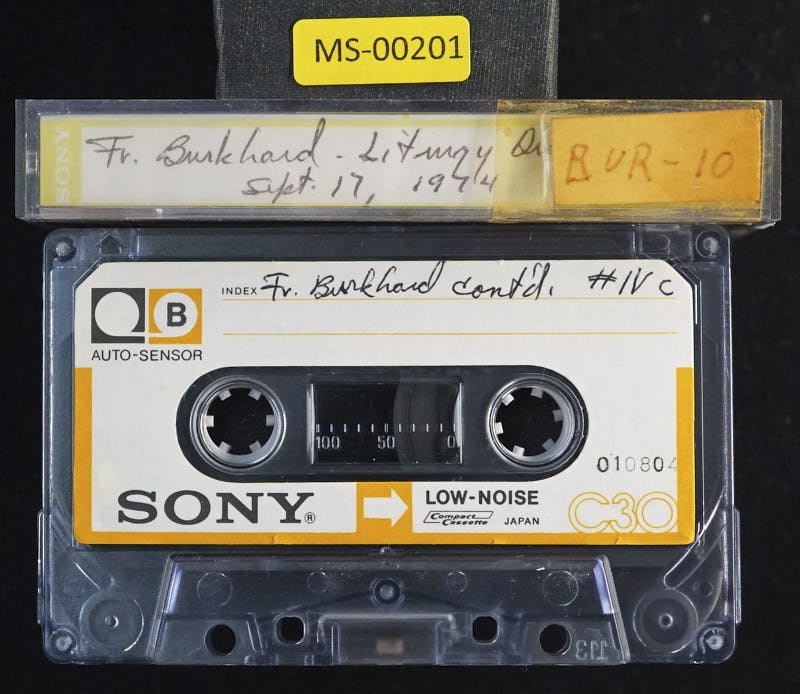
AI Vision - Possible Values from Photos:
Speaker: Fr. Burkhard
Additional text: Liturgy D Part 1, #:IV C, 384
Speaker: Fr. Burkhard
Additional text: Litury D Part 2, #:II B, 384
@AI-Vision_v002
In a certain way, your right is optional. I don't know for the moment. Yes, but also here, only as the homily, you must do it, but if you don't do it, it's also okay. We are no person. Let me see. No person. Somebody is coming out of there. Which is your, your little curse? On Sundays and solemnities, no, there's a provision of faith.
[01:06]
No, no, no, no, it's not right. Homily, generation. It is appropriate that this prayer be included in all masses celebrated in the congregation. Appropriate, therefore, it's no strong obligation, but it's convenient to do. sometimes, for sake of simplicity and variation, we could leave it out. Yes. Here are big difficulties, and we are feeling it. We have introduced again the prayer for the faithful. Also, we have this prayer in the canon, and you have it still with the diptychs. And we have it, too, after Gregory the Great in the Curie, where it was formerly And still in the liturgy of Melon, of Ambrosian liturgy, it is still there in some days.
[02:09]
Therefore, we have to now try three times the prayer for the faithfuls. You could say, if you have the canon, in the canon, the intercessions, you don't need it there. If you have it in both these places, you don't need it in the beginning. Or if you have it in the beginning, you don't need it in other places. Therefore, a certain liberty is possible. Oh no, there's another thing because when the Lord says we must pray always and never be tired he speaks firstly about the intercession we must pray day and night so as this widow who finally comes to take the just so we must take God If he finally is fearing us, always playing, but in different ways. And here, again, you could change sometimes, but nevertheless, during the weekend, informal, everyone is doing this intercession.
[03:23]
It's very nice. Sometimes that's the most difficult part. Sometimes that's the most difficult part. There is in this number, Father Martin gave me, about lycology of the Trappists, excellent relations about these prayers, about the difficulties and literary obligations we must have. for this prayer. In a certain way, the maturity of a community, so these people say, is manifested precisely in these orations. For example, we are addressing our oration to the Father. Then we must not pray to the Lord, not confuse the persons, as we sometimes are doing, and so on. And we must not make an homily from our prayers. And so very short. Nevertheless, in the same way, they are insisting shortly and in a noble way.
[04:27]
In a certain good form. And so on. They are good, perhaps a little bit accelerated, but it's worthwhile to think about that. Maria likely don't have the courage to do it. All churches do great. Therefore, our Father Prior, every day again, every night again, is doing it in a very excellent way, three things. In Canada, they had to say three, a celebrant makes three petitions, but it's really well said. Well said. Well composed. You know what it means. And As expression of the feeling of the community. These people, the man who makes it, must not speak only alone. He must speak in the name of all. And therefore he must also see and feel the necessity of the community. But on the other side, it's also possible that everyone is speaking.
[05:31]
And they say, not too fine that nobody is fearing to speak. Nevertheless, we must be able to... to express ourselves in a very, very good way. It's difficult. Or another possibility. They are suggesting everyone can, also the faithfuls, can put their intentions in the paper, giving these to the person who must formulate it and judge about the possibility to say it. Not everything can be said. Maybe as a practical thing, I would tend to suggest that if people have names, just put them in a diptych. Then, you know, for the divorce of Mrs. Miller. Okay. It's impossible. Yeah, you're trying to spray about that. Yeah, but I... But, you know, to say that in church... It's impossible. No, no. But you can say about the family.
[06:32]
Yeah. The Glow family or... I don't know. Everybody knows there is a divorce, but you say only the name. You cannot speak. We are praying for the divorced family. That's what happened. And if a name like that, if somebody wants to put a name, put it in a diptych, you know. My solution to this would be I'd get to see the individual person and correct that rather than we'd wind up with enormous diptychs again. Yeah, your idea is an over the angel. No, not. You have spoken already, perhaps, already the diptychs today are too long. So far as I can understand, you give always the names of every intention celebrated on the day, no? Yes. We've been through several stages at the present time. That's what we are doing. But formally, you did more. No, we did only seven people. Oh, and this was a number, seven people only. A limit of seven, limit of seven dead. Always had to be seven. And it must be seven.
[07:33]
Oh, you don't. Say, Bob, please, that's John Deere. Yeah. And then in recent times, we've had some trouble with some minor . And they don't hear the name . So we said, well, maybe the best way to solve that is. That is a good solution, yes. And also, to make a little bit personal our terrible way to make applications, very often we receive in Maria Lack our intention papers, what intention is your name, Dantes? Who is somebody in Canada or the United States? I don't know. I never know who he was and what they are. No, here, we hear the name and we know about the personal intention. At least you can say that in the community to the name of these people. It is a very important thing.
[08:44]
You are right. It's the same in our churches. Also, we sometimes are suffering because people wishes to hear the name. That is more important than to receive for the communion and to go to the Mass, and only the name must be proclaimed. But nevertheless, if they are receiving Holy Communion, if they are present, they have a real spiritual right to hear the name. And they come to the Mass, yes. Okay, that is okay. That is natural and convenient, yes. Of course, we never know whether they're coming or not. But we must insist, you must come yourself. That is more important than to be called in your name. Please. Yes, it's one way to avoid this terrible long list.
[09:47]
But here's a different situation, perhaps. But the situation was, for example, formally, we lost at least five minutes with these proclamations before the homily. And now with the modern system of bulletins, you print it, and you are free to start immediately with the homily. Again, five minutes. Monday. And sometimes we had to say two messages, three messages every day. 17 or 21 names to the end of the week. Do we have some more things on the mass at this moment?
[10:48]
No, this is part of it, actually. The ritual would be very interesting if you can avoid duplicating at least the names. You know, those who want to pray for somebody, if they put it in the tip-tick, shut your mouth. You know, it would be very clear to me. And then sometimes we already, like I remember when this eek died, you know, then when I said notice, I said, for the faithful departed especially, the eeks, you know, was a neighbor. Here, Father Raphael was protesting always to speak so. You cannot pray. He was furious when he heard it. You cannot pray for all the faithful, especially for Mr. So-and-so. You must say, vice versa, let us pray for Mr. So-and-so and all the faithful, because we are praying for everyone. It's a little bit exaggerated, but... It's one of the reasons because somebody, Father Raphael, is sick...
[11:52]
When the prior is not formulating the intentions as he is judging, it would be right. I think these are little details that bother people at Mass. Yes, yes. Per se, we must insist in this order. Here, the rupees are very clear. In every prayer of the faithful in the Mass, you must pray for the Church, for the world, for the peace, and for the poor, the sufferings. And then you can go to your private intention. In a certain way, Per se, it would be, because it's too difficult for the faithful to do so, that you, or the celebrant, he himself, or the deacon, or our celebrant, is formalizing these three intentions, for Pope Paul, for our bishop, no, in a certain general intention, not always for the Pope, because we are calling him in the canon, for the sinners of the bishops, for the United States, for the presidents,
[13:10]
and for all the sick in the hospital of Elmira or somebody. And then you are free to go on. Please. You are thinking, what can I say? I think those would have to be formulated by the celibate, unless we try to do that every week. People themselves, the community could get used to praying. Well, they might get used to it, but up to now, I think when you've made the suggestion, now let's break the world, that people understood what we're... What is the role, Janice? Now I would say it would be good that the community itself, therefore more or less one, the celebrant or the assistant, I don't know, the accolade, he is preparing one, two, three intentions.
[14:17]
The child and the world and the poor and the suffering. Two or three. And then time for the offer. You can go in the same way and another way and special intentions. for such a family. I wonder what people would feel if, like, one person was in charge of that. Oh, you can make a proclamation. We wish to make it so... You said that Brother Pierre was in charge of the prayer of the faithful, and that if anyone had an intention that they wanted for Mass in the morning, they should see Brother Pierre the night before and tell him what it is and that he couldn't. No. I would say so. One is preparing, and then all the authors are free to add their own intentions. To add, yes. In the same way as until now. Until seven, six, seven, eight, nine, not too much, but nevertheless.
[15:21]
And then the first element must have the discretion, the possibility to judge when it is time to finish. Okay. Someone remarked on him, it sounded like a bullet board. Yeah, an announcement. And they are insisting, too, you must not make this prayer so that it is a bulletin board. For example, a thousand years ago, no, 80 years ago, our brother in South Carolina, Charlotte. Don't die in 1970. in 1954 during the war. Oh, yes. We are speaking about for the deceased of the great airplane catastrophe of yesterday. Somebody, what was it? They must ask. They don't know it. But not say too much for the great catastrophe where 55 persons died in Luxembourg, et cetera.
[16:29]
As I, when I heard with the Trappist in Gethsemane, the display for the presidents. There is something, the presidents. I heard about the resignation in this way. It comes up as a communion in this more practical thing, I guess. We have to work it out ourselves. We've done, well, let's say downstairs in the crypt. I think you may memorize it. Can you hear it? I don't know. In the crypt, we often pass the path. Yes, yes. And it's very small, very informal. Oh, yes. But then we get upstairs. And we have this formal way of doing it as we do it on Sunday.
[17:46]
The other way is when it's just a small group around the altar, let's see how the priests go around. We mentioned this a couple days ago. Our bread is thick. It takes you a while to eat the bread. And you'd rather have the bread swallowed and then get the wine. I must say, I have seen it now very often that somebody, also from the community, is receiving the blood, taking the chalice, and then eat. I don't see the deal for that. When you've got a whole mouth full of mushrooms, you're afraid of mushrooms. Then it's more easy to eat. It's easier. Per se, I would say, it is Why couldn't you go forward and have the chalices on the side?
[18:51]
This is the altar. That is possible, yes. We are doing so. They were too big for a little. Oh, yes, yes. But again here, I can understand it very well, but nevertheless for a child also, take the bread and eat the child and immediately takes the chalice, but nevertheless they don't drink, they have feelings, they are only touching with their lips the chalice and this. But if you are drinking, immediately it's much more easy to eat the bread. And I would say in a certain way, liturgically, you must first take the body and then the blood and not which versa. And otherwise, you remember, I have seen this child taking the bread, taking the chalice, and then it went away with the blood in the hand. In general, you think it's better if ministers minister the
[20:02]
Per se, according to the old tradition, yes, not only tradition, but also according to theology, the minister, the priest, or the deacon is the instrument to give this wonderful and holy food. We don't take it ourselves. No. This idea, for example, is also In a certain distinction given by the rubrics, if a bishop celebrates the Mass, he gives the bread to the priest, conservant priest. If no bishop is there, per se, the priest must take it himself. He does not receive it from another, according to his office in the ministry in the Church. Not so important. And therefore, I don't like to go around with the pattern. Also, I am agreeing, if you have an informal group in the Krypta, a very small group, there's no difficulty to do it.
[21:04]
I remember when I saw during the symposium, we had a big group in the Krypta, but the price was the first celebrant and so on. Then we, the priest sent on the altar, we received the pattern, we took it, okay. And then I saw again, give me the chalice. Ah, a sister took it. First time I saw a sister going away with the chalice. No, no, no, no, no. Then I told him, I have nothing to say here. And finally, after 30, 40 communions, the sister came with the chalice and brought it back to the altar. Oh, no, okay, today I'm accustomed to it. The fact that the priest had you know, presided over the mass, provided... You are a knight, you are a knight. For example, you are a knight. Therefore, I would not, yes, I would not insist too much in it, because in my monastery, it is so, the priests give the bread, and priests, other consultants, give the chalice.
[22:16]
But in other monasteries, in Herstelle, the priests give the bread, And the two chalices stay on the both sides, and the sisters come and drink. And if the wine is finished, they take the big bottle of the consecrated wine and put it in themselves. Therefore, it's possible. There is no deacon. If you have a deacon, the deacon is the classic minister of the chalice. Therefore, I would say the deacon must do it. But you don't have a deacon. Therefore, you can do it yourself. in the same way if you can take the blood you can take also you could just take also the blood I think here the difficulty with the communion of passing the pattern is that many felt forced to receive in some ways or in the community for the faithful not the guests
[23:21]
Because we had Protestant ministers too. Yes, you are right. Therefore, to avoid all these difficulties, normally it is better, but again, in a small group, informal small group, you know everyone. You know there is no Protestant ministers. You can do it. But I would not do it in a great, in a big church. No, no, no, no. As we did it with the Swami, who received for the communion then, because the bread was going around. Yes, we do it still. You have no real minister of the chalice now. If we have ministers, then we have deacons. But today, consultants. And to make it quickly, we have one who gives the bread and generally three consultants who give the chalice.
[24:25]
It's very quick. There's no... You go around the altar without any stop. They have four chalices. One with the hose and four chalices. Yes, yes. But people come two by two to the settlement when he gives one... Oh, yes. All these forms are legitimate. No difficulty. with the difficulty we're talking about, not so much the distribution problem, but the fact that it doesn't give you enough time to eat the body before you move to the blood press. Yes, first you must take the body and then... Yeah, but the problem was it still hasn't dissolved. The problem was, you know, eating and then drinking the blood with your mouth full of... Yeah, it's not impossible. I, for my person, I've been in Rome, we make it so we, the priest comes to the altar, here's the bread, here's the chalice.
[25:33]
We must go immediately. I don't explicitly, not wait, immediately after my bread, I take the chalice. It's not difficulty, it's more easy. You are feeling, but this fear is not justified, I think. You are feeling that some of your But they are remaining anxious. You could say it is not very noble to drink with the mouth filled. Not polite, yes. We don't understand right next. You could say perhaps we must distribute the Holy Communion a little bit more langsam.
[26:34]
Slowly, slowly, slowly, slowly, not so quick. They must have time. In peace, in peace, wait a little bit, put the bread on this side. Like a squirrel, that's what they look like. OK. I would say we can do that in a very human way. The Lord says, which signifies in English, who is really chewing, eating my body. He said, so we can do so, we must do so. But we are still in this old mentality, we must be... That he cared for not to touch it with our teeth. Yeah, okay, not so near, yes. Oh yes.
[27:44]
It's more like to respond, amen, when he says the blood of Christ. Also that. But nevertheless, here, amen, they must say it immediately. And men don't say it. You could touch, perhaps, also the question of the communion, of the song of communion. Father Gary also said that in Christ of the Desert, don't say the communion. But he says, too, it would be convenient to do it here because the community is greater. But during the week, if you don't think, I could understand that. Nevertheless, the idea of this is our point of view. the idea of the communion song is to give a suggestion for the reality of this moment. Here we are realizing in a very high point the reality of our Eucharistic celebration.
[28:50]
No, therefore, also, if you don't sing, it would be enough, but one, you must do it. And here you can use, without any difficulty of singing or speaking, the first telegram, the antiphon of the Roman Missal, which is very adapted to this moment. Therefore, if you would not sing, also a canticle, or one antiphon, some antiphon, not the same. At least the first telegram must say, and no, you must ask when, This Antiphon. No. Come and taste how good is the Lord. Perhaps after he has taken the bread and the blood himself, before he goes to the papers, he solemnly says, in this case, if there is no song, this Antiphon. He must not, but it's convenient to do.
[29:54]
And more or less also, the communion song must be said. Why not? It just seems that to say something. Ah, to say with insistence. Then you can take it, this antiphon, to eat and to drink with the idea of this word. Ah, it is quite justified. Only the offertorium, if it is not sung, must be cannot, must not be said. But for the, so far as I see, here it is quite different. Let me see. The song during the communion of the priest and people expresses the spiritual union of the communicants who join their voices in a single song.
[30:56]
An antiphon from the Roman gradual, with or without a psalm, an antiphon with a psalm from the simple gradual, or another suitable song approved by the confidence of bishops may be used. It is sung, etc. If there is no singing, the antiphon in the missal is recited either by the people, by some of them, or by a reader, not necessarily by the first sermon. Otherwise, if this is not possible or not done, the priest himself says it after he receives communion and before he gives communion to the congregation with the intention that everyone is doing it in this mentality of today. See, the rubric says he does so, so for per se, it's so. If you don't do it. It just seems to me that an antiphon or something like that is meant to be sung.
[32:09]
It's not sung. No, no.
[32:12]
@Transcribed_UNK
@Text_v005
@Score_84.03