You are currently logged-out. You can log-in or create an account to save favorites and more. more info
Intimate Encounters with the Divine
The talk explores the critical importance of the "I-Thou" relationship in Benedictine spirituality, using biblical references and personal experiences to illustrate a profound connection with Christ. The discussion highlights the necessity of deep personal intimacy with God as foundational for a well-ordered spiritual life and community living. Key takeaways include the importance of scriptural engagement, Centering Prayer, and the insights of Brother Lawrence on divine presence and fasting.
Referenced Works:
- Epistle to the Romans: Chapter 8 is cited to emphasize the inseparable love of Christ.
- The Book of Ecclesiastes: Referenced to illustrate personal restlessness and spiritual searching.
- Acts of the Apostles: The invocation of Jesus' name in spiritual practice is discussed, supported by scriptural instances of its power.
- The Practice of the Presence of God by Brother Lawrence of the Resurrection: Discussed for its insights on living in constant awareness of Divine presence.
- Song of Songs: Used metaphorically to describe the deep yearning and love of the soul for Christ.
- The Rule of Saint Benedict: The prologue and chapter 73 are emphasized for their focus on the individual's relationship with God within community life.
- Life Together by Dietrich Bonhoeffer: Quoted to illustrate the balance between solitude and community in spiritual practice.
The text underscores the importance of a personal lodestar experience guiding spiritual life with practices like Centering Prayer and Lectio Divina while maintaining community interconnectedness.
AI Suggested Title: Intimate Encounters with the Divine
AI Vision - Possible Values from Photos:
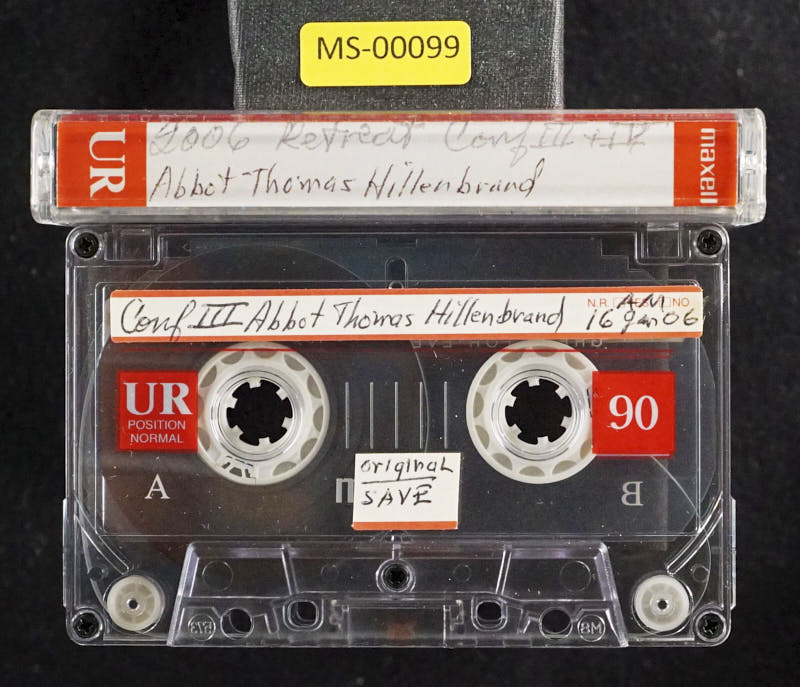
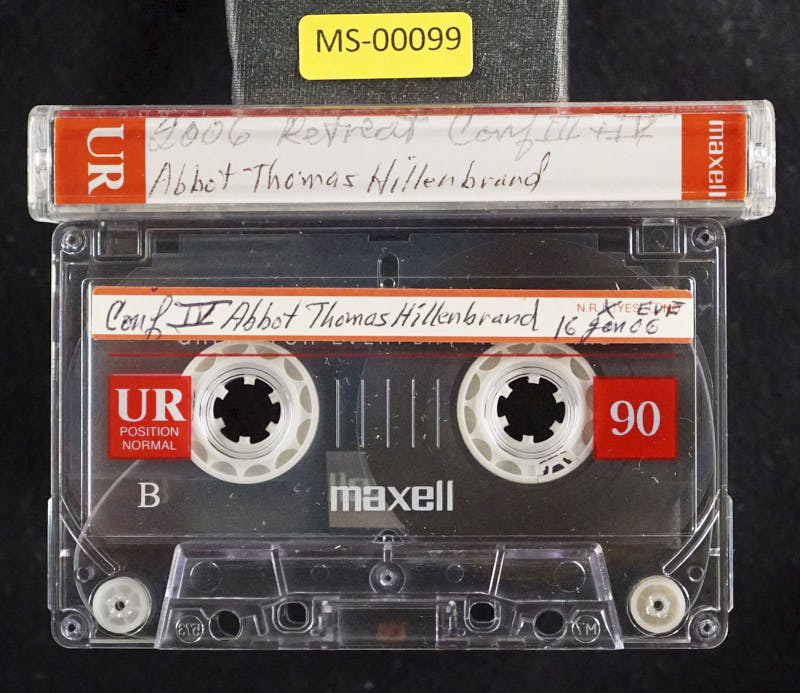
Speaker: Abbot Thomas Hillenbrand
Possible Title: Revival Conf
Additional text: Conf III
@AI-Vision_v002
Two talks from this date
Okay. Well, good morning. These two conferences today are going to be on that first step, the I-thou. And I'm going to spend two conferences on this particular step because it's so important. As I said, if we get tripped up on this step, we're going to fall flat on our face on the other four steps. So it's important that we at least get a good idea of what this first step is all about. And so it's going... We're going to concentrate on that I-Thou relationship, that intimacy with Jesus. I'd like just to read a section from the Epistle to the Romans, which really just says it all. Certain sections of Paul that you can understand really does say it all in this sense. for this particular conference, this section from chapter 8 of the letter to the Romans.
[01:08]
What will separate us from the love of Christ? Will anguish or distress or persecution or famine or nakedness or peril or the sword? As it is written, for your sake we are being slain all the day long. We are looked upon as sheep to be slaughtered. Knowing all these things, we conquer overwhelmingly through him who loved us. For I am convinced that neither death nor life, nor angels, nor principalities, nor present things, nor future things, nor powers, nor height, nor depth, nor any other creature will be able to separate us from the love of God in Christ Jesus our Lord. That's a pretty powerful statement. And Paul, of course, experienced that, I think, certainly in his own life. And I guess I could say in a certain way, I experienced it in my own life. And so this first part of the talk is going to be, if you excuse me, a little autobiographical sketch.
[02:17]
Hopefully, Char's into the point. But what I... One of the... This particular experience I'm going to describe to you about my own life, it boils down to what I call a lodestar experience. For some reason or other, that term lodestar stuck in my mind, so I really had to go to the dictionary to get a complete description of the lodestar. What it is? Well, basically it's a star, but it's a guiding star. I suppose very much like the star over the crib, over Bethlehem, the star that guided the Magi was a lodestar. But a star that leads or guides one's course. Or it can be someone or something that serves as a guiding star or as a focus of hope, as in some lodestar experience.
[03:21]
a guiding principle or ideal? Well, for me, it was basically an experience in my own life. Five years after my ordination, I was out of the monastery, basically. I was two years at San Anselmo, so I was really in a monastic environment, but it was pretty much a study environment as well with international students. But three years after, after the two years of San Juan, I went to Notre Dame for three years to study liturgy. So there I was really pretty much in a university environment that was more or less religious, more run by the Holy Cross Fathers. But it was pretty much an environment that was non-monastic, I'd have to say. The first year I lived with some priest in an abandoned convent in South Bend.
[04:26]
But then two years after that, for those two years following that, I was a Dharm prefect. And I have to say that during those three years, I had a good time. I studied. There's no question about that. But I also socialized and went to parties now and then and prayed a little. So I would think I'd... I can put those steps down from step one to I, thou, to the top step to holy leisure or recreation or enjoying one another's company, hospitality. I was probably at five at that particular stage of my life, and I'm not too sure where number one was. I did pray. There was no question about that, and I kept fairly faithful to my prayer hours and to mass and so forth, but But I think I'd have to say that those priorities were a little bit messed up in my own life. That was the time, of course, we were questioning everything shortly after Vatican to the late 60s.
[05:35]
Everything was pretty much up for grabs. We had 13 in our liturgy class, which was... masters and doctoral program. And a good number of them were diocesan priests. There was three of us who were religious, Father Hugh Teich from conception and another priest who was a Jesuit. Actually, at the end of those three years, there was only the three of us left in the priesthood. That's how much of an accident went on there among the other priests that were in the program with us. But there was quite a bit of turmoil. Of course, the Vietnam War was on. There were campus riots and so forth. But after those three years, I was getting pretty tired of my studies. Just getting pretty tired of studying, period. And the abbot, at the end of those three years, called me back to be novice master and head of the liturgy at Blue Cloud.
[06:44]
So I was anxious to come back. That was 1970. When I got back to Blue Cloud, I was not as happy as I thought I would be. I think it had a lot to do with my experiences at Notre Dame, where I was more free, could do what I wanted to do, wasn't beholding to anybody in particular except myself. And I really realized, I think probably for the first time in my life, in my monastic life, that... that I was free. The abbot didn't have a chain around my leg, you know, with a big ball on it, and he had the key to it, and he says, you can only go so far. It was like, I could walk out that door and not come back. Walk out the front door of the monastery and just keep going. And that certainly crossed my mind. There was no question about that. And even the notion of escaping or getting out of the monastery became even more... strong in my own mind um after the first year i was back because i was novice master and we had about six or seven novices and at the end of the year there was none left after that so they all there was no one left in the in the novitiate they all made their exit from the community uh and then
[08:06]
Then, too, that was coupled, of course, with the liturgy, and I just couldn't understand why the whole community wasn't just, you know, so attentive to every word that came out of my mouth on the liturgy, as if I was the expert on liturgy, and they weren't. And so whatever I said, I felt they should do, period. And they didn't. Or they just rebelled. I don't blame them the way I was probably putting it across. I would rebel too. But I presented it in such a way that it was so convincing, my arguments for all the changes in the liturgy, that everybody simply had to go along with it. Well, they didn't. So I was really throwing a pretty... good-sized pity party for myself. And I tell people I liken my mentality at that point very much like from the book of Ecclesiastes.
[09:09]
I said to myself, come now, let me try you with pleasure and enjoyment of good things. There is nothing better for a person than to eat and drink and provide himself with good things by his labors. So I was longing for the... flesh pots of Egypt, so to speak, where I was sitting there in the monastery. And I think basically, in my own mind, I was simply bored, bored with monastic life after my experience at Notre Dame, and not too interested in praying, and that certainly wasn't a high priority on my list. I was restless, discontented, frustrated. with the novices and the lack of acceptance of my liturgical ideas. So I was throwing a major pity party for myself. Sort of like the comedian Roger Dangerfield said, I get no respect. That's what I felt.
[10:11]
I get no respect around here. So in talking to my own self and... It's not always good just to talk to yourself, right? I kept telling myself, well, boy, if the right woman comes along, I'm out of here. It wasn't like I was on the prowl, but I was certainly looking for the right woman to come along just to get me out of this situation or I could ride off into the sunset with her, so to speak. So I brought this up to my spiritual director who was the abbot at the time, Abbott Allen. He's a very... kind of rock of Gibraltar type of person when it comes to his faith, to his monastic ideas. Not a very emotive person, but just a straight shooter. Not much frills and fluffiness in his spirituality. It was pretty hard-hitting in a good way. So I told him that. I said, I'd very much like to fall in love with a woman and get out of this place.
[11:14]
And then he just looked right at me and And it just knocked me off my feet. He said, well, have you fallen in love with Christ? I thought, woo, no, I really haven't given that much thought lately. But he said, you've got to fall in love with Christ, basically, is what he said. And so he said, I want you to... for the next month or so, next four weeks, for 30 minutes, just go into the chapel and open up the scriptures and read it and sit in front of the Blessed Sacrament and read the scriptures. Well, I did that. Obedience is an important part. It always has been an important part of my life, even though I would kick against the gold at times. But it was very painful, those first two weeks of reading scriptures in front of the Blessed Sacrament for 30 minutes. I thought, God, this is a long time. I likened it to eating cardboard.
[12:16]
It was not tasteful at all. It wasn't delectable, spiritually delectable for sure. But during that time, when I was reading the scriptures, I don't know how long, it was five minutes, ten minutes, but I had just this incredible experience of the... the presence of Christ with me I mean that he was real he wasn't a figment of my imagination or he wasn't this dusty figure who who walked the roads of Palestine 2,000 years ago but I had incredible experience that he was real and present to me right there wasn't a vision I didn't float off the ground or anything like that but And it was like the scriptures, too. It was like the scriptures were no longer a book out there, but it was very much of a living word, a presence in my hands, so to speak.
[13:17]
It's almost hard to describe it because all I just know is that Christ, at that point, became very, very present and very real to me. And it was something I knew I would never be able to shake off, ever, ever. So it was a sharp but incredible experience for my own life. And it's sort of like Samuel, just getting back to that, taking time to listen to the Lord. Speak, Lord, your servant is listening. Basically, I suppose that's what I was saying during all that time when I was reading the scriptures. He's saying, speak, Lord, your servant is listening. And he spoke. just like he spoke, well not exactly like he spoke to Samuel, but you've got that feeling of St. Paul too, when he talks about, you know, Christ loved me and gave himself up for me.
[14:19]
I know it looks rather selfish and self-centered, but in some ways our spiritual life has to be centered on self. That's what this whole I-thou is, but it's the thou that takes charge. The I is certainly there. But also that notion from the prophet, I have called you by name. So that was a very, very incredible experience for me. And that's what I really would liken to, a lodestar experience. Because, you know, our lives are basically a series of little bits of ups and downs. Hopefully they're not really high. and lows, but they are. There are ups and downs in life. That's part of it. So whether my life was up or whether it was down or back up again or down, I could always focus back on that experience that Christ was with me, that he was walking with me.
[15:21]
So basically, what did I learn from that experience? Well, Well, number one, when you're confused or in doubt or when you're mixed up, you have to find a good spiritual director. In fact, you need a good spiritual director, period. But particularly in those moments when a person is really struggling and confused, to get a good spiritual director, one who will really speak the truth to you. And oftentimes pride can block this thing. I can figure this out by myself. I don't need somebody else to help me. I'm not a baby anymore. Well, yeah, we are. We're always children. We're always in need of people to guide us. There's always going to be someone out there whom we need to talk to and so that person can feed back to us an honest answer. St. Benedict talks about that too, you know, the spiritual...
[16:24]
Father, the one who we can confess our sinful and base desires to be open and honest with. As someone said, if you have yourself for a counselor, you have a fool. And that's certainly true. So the need of a spiritual director is essential in the journey, in the monastic journey, and in this I-Thou relationship as well. And number two, time alone. Time alone with the Lord each day is essential. Quality time. And I really do mean that. Not leftover time. Not when I have a spare moment. But you've got the best time of the day to give to the Lord. The time when you're most alert, when you have the most energy. That should be given to the Lord. And number three, the importance of the scriptures. It is the living Word of God to develop a real, real hunger for the Word of God daily.
[17:26]
It's a staple reading for the lexio, for the monastic lexio. All the other scripture books, well, they're just books. They are written by human authors. But the scriptures is the Word of God and... And it's important that we go to the Scriptures and make that the center of our Lectio. And number four, I'm convinced that this experience that I had of Christ's presence, being present to me, everyone has that in some way or another during their journey. It might be more intellectual for some, or it might be more of the heart for others, depending on their own personality. But to have that... experience of Christ in their life, walking with them, being with them, very real to them, comes to everybody in some way or the other.
[18:27]
Oftentimes, you know, the alcoholic would tell you, well, you know, when you hit bottom, that's when you really, it's an experience there too. I mean, it's a turnaround experience for a lot of them. When they say they hit bottom, maybe that's part of it of that experience so what keeps this low star experience alive for me basically two things and it's important to keep that alive the two things are centering prayer And Lectio, the reading of scriptures, particularly the sacred scriptures. Well, Centering Prayer, I remember, I think, Thomas Keating and Mother Angelica got into it over this, if I'm not mistaken.
[19:37]
But she claimed Centering Prayer was sort of a New Age type of prayer. And Thomas Keating took issue with her quite strongly tracing all the way back to the early church fathers. And it can be traced back. It certainly can be traced back to cash and purity of heart, that kind of thing. So I try to encourage people, of course, everybody I talk to, to at least try a century in prayer. I'm sure... A lot of you are probably doing it already or something similar, but you want to just pass those. I give this more to the lay people, but a simplified version of my approach to centering prayer and to kind of visualize it for them. But as you know, centering prayer is extremely simple. And so I tell people, if you want to
[20:41]
Try it and get into it. Just try it for 30 minutes for 30 days, pretty much. 10 minutes of scripture and 20 minutes of centering. Most experts, though, on centering prayer, if you want to call them that, experts. Did you get a copy? We'll say that you should do it twice a day, 20 minutes a day. Number one is pick a time, a place, and a position. Pick a time of the day that you're alert and rested. Hopefully you can pick a time at the beginning of the day, at the end of the day. Ideally, I think it should be 30 minutes twice a day. Take a relaxed but erect position, whether it's in a nice chair or whatever, or not too uncomfortable. And of course a quiet place where you're not going to be interrupted.
[21:42]
by telephones or traffic or whatever, then I suggest that they do holy reading just for 10 minutes. My Centering Prayer schedule is pretty much centered around like morning prayer and evening prayer of lauds and vespers. So I use that as my reading time, sacred reading time or prayer time. And then I just go into Centering Prayer after that. But it creates an environment for your prayer, for your own mind. If you open up the scripture, I tell people when you open up the scriptures, open up your heart. Just open it. Don't become critical of what you're reading or trying to analyze it, but just open it and read the scriptures for 10 minutes, enough to settle yourself down and to create a sacred environment in your own heart. And then I tell them to use the word Jesus. A lot of centering prayer people will say, well, you should pray over the word you're going to use. The more I read the scriptures, especially the Acts of the Apostles, the more I see that the name Jesus is very powerful, just pronouncing the name Jesus.
[22:50]
If you read the first ten chapters of the Acts of the Apostles, you can't help but see and underline every time the word Jesus is used. It's used either to drive out demons or it's used to heal people. Well, I think we need both of that in our lives. We need our demons driven out, but we also need to be healed. And the name of Jesus is used by the apostles in those two circumstances in a very powerful and strong way. And then, of course, I connected with breathing, because I think that's important, too. Just to breathe in and out on the two syllables of Jesus. You know, like, Jesus. Just breathe in one syllable on G, and then out on Jesus. And just... Do that over and over again until you're just focused on that name. And like I say, when distractions come in, just quietly put them out. Just quietly and then come back to the word Jesus again. For today's meditation, it was interesting.
[23:55]
I don't know how it's connected necessarily to the scriptures that we read for the Mass, but in the Magnificat book... It's a quote from Brother Lawrence of the Resurrection. I'm sure some of you have heard of Brother Lawrence and he talks very much about the presence of God. But in this particular reading, the title of it is Before the Bridegroom. I suppose that's where it's connected to the gospel today. But he says this, and I found it very powerful because he brought in not only the presence of God, of being in the presence of God, but also the importance of fasting, which is not my strong suit, but I know it's important to fast. And I like the way he put it because he tells you not to get on these huge marathons of fasting, but just do little things. I cannot understand how religious people can live contented lives without the practice of the presence of God.
[25:02]
For myself, I withdraw as much as I can to the deepest recesses of my soul with him. And while I am thus with him, I fear nothing. But the least turning away from him is hell for me. This exercise does not weary the body. As a matter of fact, it is appropriate from time to time and even often to deprive it of many little harmless and allowable pleasures. For God does not allow us so entirely devoted to Him to have any other pleasure than with Him. This is entirely reasonable. I am not saying that to do this it is necessary to curb oneself unreasonably. No, we must serve God in a holy freedom. We must do our work faithfully, without distress or anxiety. Recalling our mind to God calmly and tranquilly whenever we find it distracted from Him, which is basically centering prayer.
[26:07]
Recalling your mind to God calmly and tranquilly whenever we find it distracted from Him. It is necessary, however, to put our complete trust in God, putting aside all other cares, even certain devotions, which, though very good in themselves, are often engaged in for the wrong reasons, since these devotions are only the means to attain the end. Do not be discouraged by the resistance you will encounter from your human nature. You must go against your human inclinations. Often in the beginning you will think that you are wasting time, but you must go on, be determined, and persevere in it until death, despite all all the difficulties. And so what I do for my lexio, for my scripture reading is I basically use the monastic lectionary readings or scripture that we read during the office.
[27:18]
Right now we're in year two in ordinary time when we're reading the book of Genesis. But there's also the year one. Of course, year two follows the even years, and year one follows the odd years. But on year two, weeks one through five is the book of Genesis. What I like to do is just simply read the whole book because the readings that we get in the office are just excerpts from the book of Genesis. We don't get the whole book. So oftentimes what I'll do for my Lectio is just... Put a bookmarker on the book of Genesis for weeks one through five and just read the whole book of Genesis. Or sometimes, and I think we have enough time to do that, is on the flip side is year one for our day time is that's weeks one through four is the book of Romans. So you can either read the Genesis or you read both of them if you have time. Thank you. So that...
[28:22]
These two sheets, I think, can at least give you a little brief outline of both centering prayer and the importance of Lectio Scripture. Any reflections or comments on that first part? I might go into a little bit of the second part of this I vow so I don't overload you this afternoon or this evening at the last conference. For the Lawrence of the Resurrection? Now that I don't know.
[29:25]
Was he? Yeah. He was a lay brother that worked in the kitchen or something, didn't he? Or was that the one? Yeah. Is that one of his books? Prayer of the Presence of God? You could type it in on Google. Something would come up there, I'm sure. Can you? Yeah, I'm sure you could. Yeah, it's amazing. Somebody accused me of being anti-intellectual. You mean about centering prayer, you mean? No, no. Or just presence? And practicing the presence of... I know. It's kind of sad, isn't it, when people come across with those kind of objections.
[30:32]
I used to have the same brother when I was in the seminary. This group from Brooklyn came, busloads of women and After they left, my book was gone. So you lost it. You never got it back, huh? Well, another part... I don't want to say this now, but I didn't put him up to this. You didn't put me up to it. No, I've been trying to push this. the title of Senderinger because it does, it's a new title and that makes sense.
[31:36]
Yeah, right, you're right. I read the first silent prayer. Yeah. And it's old and basic. You know, we don't realize that we've got workshops on this. When I'm talking, I'm in charge of the situation. And that includes talking to God. And God has got nothing to say because I'm going to talk. Mm-hmm. So we don't realize that we're praising God, thanking God, or asking for help, or whatever it is. As good as it is, and we need to do it, or Christ said to do it, we're in charge. And this prayer is simply, I'm consenting to the presence and the action of God in my life for 30 minutes, after twice a day. And, excuse me, don't shut up. One, it's an awful picture of Christ knocking on the door with a ladder. It's a God awful picture, but you can look at it long enough. You realize there's no handle on the outside of the door. You have to open it on the inside.
[32:36]
In other words, if we don't open it ourselves and invite him, he won't come in. The worst thing God ever did was knock St. Paul over, because we all think that's the way it should happen to me. And until it happens, then I'm free. And the second thing is, I've forgotten this, but the other thing, which is the elderly couple, six people, overlooking a lake, not in a word, and there's a very vibrant nonverbal communication. And they don't need the same age, and we don't need the same age, but it's all anyway. And just to allow them to be present. It seems that actually the worst, the most difficult thing about this kind of prayer is that it's so customly simple, and we always gussy things up. Right. It was our mother, Eve, who, when the devil said to her, I understand you're standing in the trees of the garden.
[33:40]
She said, not we can't eat them. We can't touch them. And God didn't want to touch the garden, but she had it at her. It's because I wouldn't have to speak a lot more, so that I would stand. Or because she taught me, though, I already started it. And not even taught you. No. But at any rate, it's so simple, we mess it up. And it is really simple to allow, and most of the time, we don't allow anybody in any way. We're in charge of whatever we're doing, and we keep talking so that we got control, and it took. I had to say that same thing myself. Basil Pennington gave us our retreat back in 86, and he talks about century and prayer. And I tried it. I was a chaplain at Mt. Marty College at the time, so I went back and tried it.
[34:41]
I think I tried it for about a month, maybe. And I said, oh heck, heck with that. So I didn't pick it up until I was elected to have it. Then I was grabbing for everything. I told people, how were you elected? I said, I have no idea. I think I had to go to the bathroom and raise my hand. They said, you're it. Something like that. But you really, at least for me at least, when I was elected, I thought... You know, I need God, I really need God's help now. And I was almost desperate. And so I went back to the sentry of prayer. Well, a good priest friend of mine, actually, he went back to it too. And we both started writing about it without knowing that we'd gone back to sentry of prayer together. We kind of support each other in our spiritual journeys. And so it was kind of interesting that he was going back to sentry of prayer or entering into sentry of prayer at the same time I was going back to it. talk about it but uh maybe you're right centering prayer might not be good maybe purity of heart would be good uh as far as what it does because it it really is just cleansing your heart of everything so god can so the spirit can just kind of bubble up because you know since baptism and confirmation when
[36:01]
You know, we're clothed with the Spirit. We're living in the Spirit. It's just a matter of releasing the Holy Spirit from within us, really, and allowing the Spirit to breathe through all the pores of our being instead of blocking them. But, you know, our minds are terribly active. The minute our alarm goes off and somebody said, I was talking to somebody on the airplane just coming over here. We were talking about Centrum Prayer. And he got into it because he just left Hazelden because he was reading a million little pieces. And I said, well, I just finished that book. But it's about a recovering alcoholic. Well, he was an extreme alcoholic addict. But he was really interested in trying to meditate. And so I was trying to explain it a very simple way of what Centering Prayer was all about. And... Just letting him slow down.
[37:05]
He said, well, yeah. He says, my mind was busy even before I woke up. I was already thinking about stuff I needed to do even before I woke up. He said, I've never had a decent night's sleep in my entire life. Most of the time because I went to bed drunk. But he didn't. So I tell people, you know, the minute the alarm goes up and you wake up, the first thing you should do is pray. That's the first thing. One of the best penances the confessor gave to me one time was, for the next week, I want you, when you get out of bed in the morning, just kneel down and say the Our Father. I thought, wow. Well, I was so sleepy. I just kind of rolled out of bed and slide to the floor and start praying the Our Father. But that's a good idea. He told me to do it for a week. I've been doing it ever since. That's been five or six years ago now. But just to get out and say a prayer. I mean, a good prayer, the prayer that Jesus taught us.
[38:08]
And then, of course, then pray. Of course, do some prayers really early on. I have a friend of mine from the Twin Cities. She comes over for retreats. Oh, I just, Lord, when I get up in the morning just to go jogging, it's the best thing I can meditate on. He says... well, why don't you pray first before you jog? She said, huh? Just pray first. Say your prayers first. That's the most important. I mean, jogging is what you're doing for you, and it's good for your meditation maybe or whatever, but just get up and pray and meditate directly. Don't throw in jogging right off the bat or whatever. She said, okay, I'll try that. I'll go into a little bit because it'll get too long otherwise the conference this afternoon and this continues this I-thou relationship and that's basically what I'm talking about here relationships are important for us in our life we're social animals we can't live life without relating to people we need people in our lives that's
[39:25]
I mean, we're born into a society. We're born into a society. Hopefully people are born into a society of a mother and a father and some siblings. But to feel whole and complete, we need to relate to people, others. And I'm convinced that's why, for me at least, the monastic way of life as a Cenobite is the most important for that reason because I need relationships in my life. We need friends. We need friends, close friends, to share the deeper and more personal elements of our life. Friendship is an extremely important element in the spiritual journey. All you have to do is read the book of Syrac and some of those beautiful chapters there on friendship. A good friend is one in a thousand, he says, and it's true. But we can't pass through this world without relating to people and we can't pass through this world without bumping into people too i mean that you'll say well because we do we get bumped around as well and generally relationships are good and healthy but sometimes relationships get all messed up and we know that from the scandals in the church where boundaries are broken emotionally sexually spiritually um
[40:46]
And there's hurts and there's betrayals, selfishness, and there's sin in relationships. So the devil can play havoc in these relationships. And all the more important reason why centering prayer or that relationship, that I-thou relationship is so important because it becomes very much like the guiding star, like the center of gravity that keeps our life together, keeps it in orbit on us flying off into space. So if we have no spiritual center, no reference point to work out from, we're like a ship without a rudder. We're just going to go anywhere. We're just going to float all over this ocean of life and not have any direction at all. Whereas this intimacy with Christ really gives us the direction that we need and desire, basically. So how do we go about making Christ the center of our life?
[41:49]
Well, I already mentioned to you, well, for me, it's meditation or centering prayer and lectio. But just to develop that a little bit, time. Time is really precious. We know that. People say, I just don't have time anymore. My sister-in-law said one time, it was a very insightful statement, I thought she said, when we were younger, when Pete and I were younger, we had more time than money. And now we have more money than time. There's a lot of cases when people get older, they do have more, they're comfortably financial out of them, but all of a sudden they don't have any time to do things. They don't have enough time in the day. But the prologue is filled with this sense of urgency in the prologue of the rule. A sense of peace-filled urgency, I really say, to hasten.
[42:51]
It's amazing how often Benedict uses the word hasten or to run in the prologue. But he also uses it at the end, in chapter 73. So like I said, I keep tying those two together because it's like what they call inclusion, little parenthesis that put the whole rule together, the prologue on this end and chapter 73 on that end. And they basically have some of the same themes running through them. So for Benedict, time is important. Monks should not be idle. So to spend time with another person is very important. just from the human point of view, to spend time with another person and to be present, totally present to that person, is really important. It really tells that person how important they are. It makes them feel good that you're willing to be with them, spend time with them, and to give them your attention. And I think this is particularly the case with old people and little children, those two ends of the social spectrum. But old people, while they're kind of going into their twilight years and
[43:57]
But it's really important to spend time with them. And the little children, too, because they'll think, well, adults don't care about my life. But to be interested in little children as well. But take time and listen to them, even though what they say either is older people or younger people is not going to really maybe get you excited or turned on or interested because, well, the older people... They're losing it, and the young people don't have the intelligence yet to carry on an adult conversation. But just to make those two spectrums of the social ladder feel that they're important, just listen to them. And I can remember, this came home to me very much so because... I'm German, and when you talk about German, you're talking about schedules, and you're talking about time for everything. But I was on the reservation, and being a German with a schedule on a reservation is...
[45:00]
You're really out of your element. There's no question about that with the Native Americans. Schedules for them really mean very little at all. If you're going to start Mass at 8 o'clock, well, they'll be there about 8, 10, 8, 15, sort of like in Guatemala as well. Same mentality is there. I'm not saying it's bad. It's just that's their mentality compared to mine. In fact, I think theirs is a little bit better because they tend to run on people time rather than on... chronological time or the people are important to them if they're talking to somebody well they might be late for something else but talking to this person is important well one time I was on the reservation and I was there for four years in North in North Dakota Fort Totten Reservation near Devil's Lake North Dakota and so my schedule was I had mass at 11 o'clock in the morning And then after that, well, the morning was pretty much taken up with my desk work, which it still is to a certain extent. But I did all my letter writing or preparation for sermons or whatever.
[46:01]
And then I had Mass at 11, and at 11 I went over to the elderly home to eat lunch. And I thought, this is great. I can kill two birds with one stone. I can get my lunch, which... I wasn't that great of a cook. I didn't like to cook that much. And then I could also visit with the elderly people there. So I was there visiting with them. And, well, 1 o'clock, it usually was my time to get up and go to get my mail then down at the post office. So 1 o'clock came, and I was still there visiting with a group of elderly ladies. And I said, well, I better go get my mail. And Mary said, now, Father, you just sit down here and visit with us for a while. Aren't we worthwhile enough to visit with? I mean, she really put me in my place. Old people can do so well. So I kind of slunk back down in my chair and sat there like a chasing little boy at school. But I got the point. But what really made it more even beautiful yet is that she had this nice image that she used. She says, you know, Father, you're like a mosquito.
[47:03]
And I said, what do you mean by that? She says, well, you land and eat and take off. Is that right? Continue with the first step on the five steps towards a vibrant Benedictine spirituality and I'd like to continue and close with this in this conference with that theme. One is the imitation of Christ in all of this as far as relationships go and how do we keep What's the ordering of relationships? And I found it really fascinating just looking through the scriptures and his relationships, Christ and his relationships. So I ended up just drawing concentric circles kind of to give me an idea of when I was reading the scriptures, obviously the gospels, of the various relationships that Christ had to people in general.
[48:20]
And I put them in concentric circles. So the one outer circle there is Jesus' relationship with the public, just how, you know, preaching to the people. 5,000 and so forth, or you're getting in a boat teaching the multitudes. So Jesus is related to a big public. And so I would just... That's the most general relationship he has with people in society. And I think it's important to remember that Jesus, you know, being human... had different relationships with different people. You just have to have that. Some people you're closer to, other people you're more distant from, and so forth. So the public, really, the ones he preached to, he was the most distant from. They were in the thousands. But then there's another circle that gets closer to him, and that one I would classify as the disciples.
[49:22]
Those were in the hundreds. as we know, Jesus' disciples, and they were probably in every town where he was, where he gathered. The disciples would also follow him from town to town, from what I gather from reading the Scriptures. But then there's another circle that's a little bit more intense in relationship with Jesus, and that is the Twelve, the Apostles. But it's interesting, even within the Twelve, of course, there's a special group of the inner circle, well, one of the inner circles with Jesus, of Peter, James, and John. The ones he went up to Mount Tabor with, the ones he took into the Garden of Gethsemane, a little further in. So he had a closer relationship with those three apostles. Like I said, obviously, Jesus being human,
[50:26]
can't relate equally to everybody. There has to be a hierarchy in his own relationships. So that was another part of that same circle there that I would classify being intimate friends with Jesus would be Mary, Martha, and Lazarus, the three, the friends of Jesus, as they're called. And I always like that in our book, Benedictine calendar in the Ordo. I don't know if you have it in the Cassinese, but we have it in the Swiss Americans. Mary, Martha, and Lazarus are hosts of Jesus. That's how we celebrate that. We don't just celebrate the Feast of Martha, which some calendars do. But we celebrate all three, Mary, Martha, and Lazarus. And the title of that feast is the Host of Jesus, which is... I think really nice for the Benedictines, for us as Benedictines, to celebrate hospitality personified in these three people.
[51:29]
But, of course, the more intimate circle for Jesus is, of course, Mary and Joseph, with whom he related to for 30-some years, at least, with Mary. I don't know how many years with Joseph. So those are the relationships that Jesus had, I think, from reading the Scriptures, from reading the Gospels. But the interesting thing, as I said, the most intimate of all was right there, and that was with the Father. Jesus' relationship with the Father. Because, you know, when we first hear Jesus speaking, which is at the age of 12, the very first words that come out of his mouth are, do you not know I must be about my Father's business? So that was his driving force throughout life, his relationship with the Father. And surely the 30 years of the hidden life were nothing else but this development of this intense relationship with his Father because that drove him in everything he did and in all of his relationships.
[52:42]
So not even his good Jewish mother Mary could stand in between that relationship that he had with the Father. So then I think that should give us a kind of a paradigm for how do we deal with our relationships? How do we work those out? Well, I think it's important that we work them out in relationship with that intimacy with Christ, which has to be at the very center of our life. As monastics, as monks, as celibates, that intimacy with the Lord has to be the one relationship that that gives direction to and a criteria for how we relate to all other people in our life. So, as I said, it was sort of like the center of gravity for him, which the other relationships orbited around, that relationship with his father.
[53:48]
And that comes out very strongly in chapters 14 through 17 of the Gospel of John, of course, as we all know. But he also, throughout life, he just didn't... He had to work at that relationship to being human. And it's just like we had to work at our relationship with Christ. But he had to work at it too. And in Luke's gospel, it's very interesting. Luke uses a Greek word. I don't know the exact Greek word and you'd probably forget it if I gave it to you anyway because it's not that important. But the Greek word means as was his custom. It's a Greek word. It's just specific for Luke. He only uses it twice. And it's interesting. He uses it at the very beginning of his gospel in Luke when Jesus went into the temple. as was his custom. So he was accustomed to praying with others. I'm bringing this up because it shows you this balance that Jesus had between praying alone and praying with others.
[54:54]
So in the beginning of Luke's gospel, Jesus went into the temple as was his custom. But at the very end of Luke's gospel, in the agony in the garden, he went to the Mount of Olives and as was his custom. So he also went off alone by himself. So that too is important. Not only the relationships that Jesus had and how those relationships were kept in order around the primary relationship with his father, but also in his own prayer life, how he prayed with others in community, but he also took time alone to be with his father in private. And we know the many of the circumstances that come out in Jesus' life. Early in the morning when he was at Peter's house, when he cured Peter's mother-in-law, early in the morning the next day he went out and they had to look for him because he was out in some mountaintop praying alone. So the disciples went to look for him.
[55:56]
And he spent all night in prayer sometimes when they were out. The disciples went out on the boat, and he left them to go out by themselves. He went up to the mountains and spent the night in prayer. And of course, the 40 days in the desert before his public life, what was that? Nothing other than trying to deepen and hope that this intimacy with the Father would take root in a deeper way, as it should. And as I already mentioned to you about... It's the time in the temple. But I'd like to just bring up some examples of people in my life that I've ran into over my years in ministry who I felt had a very intimate relationship with Jesus, with God. One of them was Sister Freda. She was a Benedictine nun who lived just down the road from us in Watertown, South Dakota. Sister Frida came in one time when she's since passed away. She came in one time to go to confession to me, and she came in with the ordinary standard, bless me, Father, I have sinned.
[57:00]
And it was face-to-face, so she was sitting there in a chair. Well, she was fairly old, and she pretty crippled up, probably in her 80s, I guess. But it was just a delightful sister when she smiled, her whole face lit up. But she came in to confession, and she said, bless me, Father, for I have sinned. And then all of a sudden, she just started talking to Jesus. Jesus, I just want to let you know how sorry I am. And then she started confessing her sins and just talking right. And I started looking over my shoulder. I thought... Where's Jesus? She was talking that Jesus was there, of course. I mean, I should know that. But she had such a deep faith that Jesus was present that she just bypassed me in a good way and just started talking directly to Jesus and carrying on this conversation, asking Jesus forgiveness and talking about her own sinfulness or brokenness. I thought, that is really amazing. I kept thinking, Why can't I do that? Why can't I? And the other incidents happened in Guatemala with the native Guatemalans.
[58:07]
I was down visiting with my brother. He was four years ahead of me in the monastic life. He was a prior in Guatemala. He died early down there at the age of 43. But one time I was down there visiting him and he, we were going, it was a Christmas time, we were going through one of the churches there in one of the small towns. And there was a lady sitting there in front of the crib, and she had just brought in some corn to offer to Mary and the baby Jesus. That's kind of their offering. They would bring corn in or whatever they could afford, just so she put the corn there. But she was sitting back on her heels, which oftentimes they would do in front of the crib, just kneel on the floor, then sit back on there. And she was just going on and on and catching. And I asked my brother what she was saying, and he said, well, I can't catch it all. He knew she pretty well. He said, well, I can't catch it all, but all I know is she's bawling the Blessed Virgin out for something. But she was just carrying on, just going right at it. And here we were walking through, and she could care less.
[59:11]
Again, if it was me, I would look around and say, well, if there's nobody here, I might just say a few words out loud. But they're not self-conscious at all, especially when it comes to prayer. What you see is what you get. And they talk to the saints and talk to God just as we should, the present in front of them. And one of them was in the shrine in Escapolis, and one of our priests who was helping out in the shrine in Escapolis, Escapulis, overheard a man came in and was kneeling in front of the statue of the Sacred Heart and apologizing to Jesus for cutting down one of his trees. He said, I'm sorry I cut down one of your trees right by my house, but... I really had to do it because the roof was leaking. I needed some lumber to put on my roof, and I also needed some firewood for the house. So he was sitting there, kneeling there, apologizing to Jesus for cutting down that tree.
[60:18]
But that's that intimacy that I think we all need to work on. So the question is, you know, what should we do? Well, I... If we want to fall in love with Jesus, we've got to spend time with the Lord. There's no question about that. As two people who fall in love, the only way they keep that love alive is by spending quality time with each other and being absorbed in each other's presence, being absorbed with the other. I think we can learn a lot from people who are madly in love or what they say, obsessed with the other person. We should become obsessed with Jesus in a good way. Not, like they would say, Jesus freaks where we beat everybody over the head with our religion, but just within our own heart that we fall madly in love with Christ and do everything we can to keep that alive. And I think one of the most beautiful books that can...
[61:21]
Help us on that is the Song of Songs, which is a beautiful love poem between the bride and the bridegroom. As Father James talks so much about in his sermon on the bridegroom and the bride, that we are the bride and Christ is the bridegroom, basically. But to read that poem with that in mind, that our soul is like the bride that's ever looking for Christ. searching for Christ in all the byways and highways of the city. So I'd like to close this section with a little quote from the Song of Songs to show how absorbed the bride is with the bridegroom. Chapter 3 of the Song of Songs. On my bed I sought him whom my heart loves. That statement right there is important for all of us, I think, that even at night when we're falling asleep or even during the night, that our mind is drawn to Christ, to the presence of God in our life.
[62:28]
So on my bed I sought him whom my heart loves. I will rise then and go about the city and the streets and crossings. I will seek him whom my heart loves. I found him whom my heart loves. I took hold of him and would not let him go. The cold of him would not let him go. And in chapter 5, I was sleeping, but my heart kept vigil. I think that's one of the most beautiful phrases. I was sleeping, but my heart kept vigil. And when we go to bed at night, our heart keeps vigil, knowing that we're in the presence of the Lord. We're in the presence of Christ. I heard my lover knocking. So that Bernard of Clairvaux has... volumes on the Song of Songs, commentary on the Song of Songs. Now, putting this aside then, going right into the rule itself, and continuing that I-Thou theme, as I mentioned to you, the two places in the rule of Benedict,
[63:43]
The prologue and chapter 73, they're inclusive chapters or inclusive sections of the rule, the prologue, which is the prologue. And the 73 really could be considered the epilogue. But both of those sections deal... with an I-thou theme. Because they use, as I mentioned to you, the second person singular you, whoever you are. Listen, my son, to the precepts of your master and incline the ear of your heart. So the first two paragraphs of the prologue are... involved as the individual and the master.
[64:45]
To you, my words are now addressed. Whoever you are who, renouncing your own will, take up the most powerful and brilliant armor of obedience in order to fight for Christ, our true King. One of the... I oftentimes like to pick members of the community who personify for me some of the Benedictine values that I'm looking for. And at least for the prologue, this familiarity with God, this familiar tone, was exemplified for me and our father Dan, who lived to be 92 years old. And he was a missionary, kind of a crusty old guy, but very childlike and very... a person with whom there is no guile, sort of like what Jesus said of Nathaniel. So he exemplifies that for me.
[65:49]
Plus also, he was always hastening to the work of God, which brings out kind of the theme of the prologue, running or hastening. Whenever the bell would ring for the work of God, boy, he'd make a determined effort to get there. And he was just pumping his arms and his legs to get there. to the work of God. But anyway, I had to bring him back from the missions because he was a pretty bad driver towards the end, at least. He drove in the Devil's Lake. He drove his car to the Devil's Lake. So it was 15 feet underwater. But only Father Dan and the angels could, you know, they're watching over him. It could only happen to Father Dan because God's angels were watching him. In the middle of a landlocked state like North Dakota, The person right behind Father Dan in the car was a Navy frogman. And so he jumped out of his car and rescued him, pulled him out. And he was 15 feet underwater.
[66:49]
So he was just sitting there in the car. And the Navy guy went down there and pulled him. Lucky Father Dan was thin. He could pull him through the window. But anyway, I had to take his license away. He was not happy with that. But he would ride the stationary bike in the exercise room or the treadmill. And it usually registered the miles. But he could never read them right. And so when it would register .02 for like two-tenths of a mile, he would tell everybody that he just rode the bike 20 miles. He says, yeah, here I can. Here I am. I can ride a bike 20 miles, and the abbot won't let me drive a car around the block. Because he could really get ticked off on that, taking his license away or his keys away. One time he was going to the swimming pool in town carrying all of his baggage with him because he had fins and he had a life preserver in there and everything else.
[67:57]
So he was carrying this big bag going through the lobby because somebody was going to pick him up. And he got into the lobby and with this big bag and he looked around and there were some people there that were visitors just came in. And so he dropped the bag and he said, oh hell, now I've got to do hospitality. So he was right out in front with everything else. And then he showed the people around and they had a great time apparently. One time he was coming back from the carpenter shop carrying a block of wood for some kind of a project he had in his room because his room was a sight to behold. So he was coming up and stepping up with this piece of wood. And one of the monks trying to be friendly to him was going to ask him how he was doing. And Father Dan thought, he said, what are you doing? And he got really mad. He threw the board down. He says, I'll tell you what I'm doing. Everybody wants to know what I'm doing. I'll tell you what I'm doing. And the monk said, no, Father Dan, I asked you, how are you doing?
[68:59]
He said, oh, I'm doing fine. Thank you. And he walked up. Then he walked up the steps. But that was Father Dan. But he personified for me in many ways this familiarity that Benedict talks about was, listen, my son, to the precepts of your message. Father Dan was just that kind of person who was very, like once a novice, always a novice. But what we have in the prologue is this grand theme of salvation history. that really is touched upon in the first two sharp paragraphs of the opening, namely that paradise was lost through disobedience, and now we have to regain paradise through obedience. Paradise was lost through the disobedience of Adam, and the new Adam, Christ, regained paradise, and we have to return to that paradise that was lost by our first parents.
[70:03]
So Benedict is not letting the individual off the hook here. He says, I'm addressing you. I'm addressing you personally, whoever you are, to take up this challenge. So even though we're called individually by the Master in the prologue to respond, And to return to the Father, we do it in community. Because then, of course, right after, like I said, right after the prologue, what do we have? Well, we have legislation for community. We have, he's writing a rule for centibites. The next chapter is on the abbot. And the other chapter then is on the taking counsel. So he moves right out from that I, thou theme in the prologue right into a theme of living in community. I'd like just to kind of buzz through quickly some of the main points of the prologue to give you an idea of the steps that we must take to return to the Father, to return to God.
[71:27]
First of all, pray. Pray before you begin any good work, pray. St. Benedict says that. Secondly, I'm just going to go down and list them. One, two, three, four, and so forth. Secondly, Benedict in the prologue tells us to rise from sleep, to rise from the sleep of sin and open our eyes to the light and our ears to hear God's voice. And then we are to run on the path of God's commandments. Again, you get back to that theme of running, of hastening. The third point is we are to become workers. clothed with faith and good works, who desire eternal life and so set out on the road of life, guided by the Gospels. And then the fourth element in the prologue is what does God tell his workers to do? Then Benedict gives a few spiritual fervorinos of what the workers are to do. First of all, to walk without blemish, to be just and honest in your dealings with others.
[72:33]
don't wrong anyone, dash evil thoughts against the rock, which is Christ. And if we put all of these spiritual fervorinos into practice, we will be building our house on solid rock. And then the fifth element is we are to give time, we are given time now by God to put our good intentions into action, to be obedient to God's instructions, and to do that which will profit us for all eternity. I think that's one of the most powerful statements in the rule, to do now that which will profit you for all eternity. In other words, that's part of the haste. God's given us time, but we're to do now what will profit us for all eternity. So the sixth element then in the prologue is, we're setting up a school of the Lord's service to amend faults and safeguard love. It will be hard at first, but don't run away. you will be rewarded in time.
[73:35]
And as he says, but as we progress in this way of life and in faith, we shall run with heart enlarged and with an unspeakable sweetness of love on the way of God's commandments. I think we all would have to admit that in our years in community life, if we really have tried to be as faithful as we can, that And we've come to that point where our hearts are enlarged and we run with an unspeakable sweetness of love on the way of God's commandments. And then finally, then we get to chapter 73, which is a closing chapter of this I-Thou theme. And what's interesting in chapter 73, as well as in the rule, the rule starts out talking with this you. It's a singular you, as I said. And Benedict is addressing you, whoever you are, And then after he gets into that, then he slips into this we. So then he goes into the community itself that we're a part of.
[74:37]
And then in the closing chapter, chapter 73, the first paragraph is all about we. So he's still talking about the theme of community. But then the very last paragraph of the rule, he goes back to the you again. That starts off in the very first paragraphs of the prologue. Whoever you may be then, whoever you are, hastening to your heavenly country, fulfill with the aid of Christ at least the rules which we have drawn up for beginners. And then you shall come with the help of God's providence to those loftier summits of doctrine and virtue of which we have spoken above. So community is important for those who wish to be Cenobites. And all the details of community are laid out in the rule. But more important than community for each one of us is this intimacy with the Lord.
[75:44]
We're still alone. Nobody else inhabits this body of mine except me. Even though I need my brothers for support, we're still alone. We still have to make decisions within ourselves for our own life, for our own future, for our own relationships. Nobody can answer for me. I have to answer for myself. In fact, this comes out in John chapter 16, where Jesus says, An hour is coming, has indeed already come, when you will be scattered, and each will go his way, leaving me quite alone. Yet I can never be alone. The Father is with me. That should be pretty much our sense of I can never really be alone. The Father is always with me. God is always with me. I'd like to close then with a quote from Dietrich Bonhoeffer who talks about the day alone.
[76:48]
Actually, in his book, Life Together, he talks about the day alone, but also the day with others. So this is that tension in all of us. We have a day alone and we need to be alone with who we are. But we also have a day with others, which is community living. This is part of Solitude and Silence. Let him who cannot be alone beware of community. He will only do harm to himself and to the community. Alone you stood before God when he called you. Alone you had to answer that call. Alone you had to struggle and pray and alone you will die and give an account to God. You cannot escape from yourself for God has singled you out. If you refuse to be alone, you are rejecting Christ's call to you and you can have no part in the community of those who are called. The challenge of death comes to us all and no one can die for another.
[77:52]
Everyone must fight his own battle with death by himself alone. I will not be with you then, nor you with me. He was quoting Luther in that last one. But then he says, but the reverse is also true. Let him who is not in community beware of being alone. And so we will take up community tomorrow. That's the other side of this dialogue that we all are engaged in, this dialogue with God. We dialogue with God as an individual. But if we're part of a Benedictine community, we also dialogue with God in community, in relationship with others. And so both are necessary. But I've stressed, that's why I've stressed, though, the I, thou, because that is foundational. If we don't have that, then we're all going to get tangled up in community in the wrong way and in relationships in the wrong way, too, for that matter.
[78:52]
But that first step, it was critical, is critical. For all of us. Amen. 7.15? Okay. 7.15, just like tonight. Well, more or less. In between 7 and 7.15. No, you weren't late.
[79:56]
Yeah, you can leave the knee aloud. What do you think are some of the positive things in our culture that we can sort of foster to earth as well? So we need it and we need it. We [...] need it. Positive things in what? In our culture. In the culture? Well, I think the culture is desperately in need of how do people live together in peace? Both starting with the family and in countries and in schools. The violence and wars just kind of boggles my mind sometimes, the violence that goes on in schools or on the streets of our cities.
[81:06]
And I don't know how you can address that directly except by offering a haven of peace where people come and see, where people can live together in relative harmony and really practice loving one another, caring for one another. That sensitivity that I think oftentimes is lacking. People are becoming very individualistic, very self-serving, very angry. There's just a lot of stuff that's going on in our culture that needs to be addressed. But I think if we just... If we really stay faithful, as Vatican II says, to the charism of your founder, just go back to your roots, or we need to go back to our roots of our founder and recapture. And like I said, that's what the Oblates are really telling us to do because not only do they see it and experience it, but they're writing books about it and producing DVDs and everything else about that life.
[82:15]
And we sit here on this gold mine of spiritual treasures, and sometimes, like I said, we miss it. We've been in it so long, we take it for granted, and we shouldn't. We need to keep working at it. Yeah. Yeah. Yeah. I don't understand.
[83:21]
I guess I started living together, isn't it? I think so. Everybody does nothing. I think most people know us. Yeah, and the people that come here for retreats or work with you and that kind of thing, I think never underestimate the power that a community is trying to live the gospel. Never underestimate the power that it can produce in the area. And I think there is a spiritual revival going on even amidst all the terrible stuff that's happening in our country and other countries.
[84:26]
Because in one direction we're going, we're hell-bent going to hell. And the other direction there's this really, I think, a very small but strong group of people who are saying, enough of that, I've had it, and I can't take it anymore. The remnant, exactly, yeah, right. We're doing our best, though, I think. We're doing our best. You're right, though. That goodness really can't be just... And we should be a living testimony of that, that goodness in our own lives.
[85:29]
American culture is very generous as far as, you know, giving when something happens, people give a lot of money. But at the same time, when there's no tragedy, they just don't care. Last week, by mistake, there's a program that I record called Religion and Ethics. They talk about religious religion and the faith that And they changed the program, but I didn't know. And what came out was the way they raised kids, you know, in Japan, in the car, how they became. And they were saying that in Japan, right from the start, the little kids learn how to care for each other. And, well, you know, they were showing
[86:37]
It's the same situation here. But when there's a fight, you know, the supervisor or the moderator who is in charge, they say, don't do that again. You know, separate the kids. Don't do damage. Never do that again. And in Japan, you saw the supervisor, you just look at the two kids fighting at what got hurt. And by the one who got hurt, he went and started to cry. And then the other one discovered that he was by himself. And, you know, and the other was crying. And you see that this kid go and go right to the level that the other one wasn't able. And he leaned on the table also and apologized. Oh, the kid that hurt him? Yeah. He came back. And they're just about three years old, you know. Yeah. And they say... This is no intervention.
[87:38]
The kids can take care of themselves. And it became another little situation. The two-year-old, you know, this group that was from two-year-old to five, in that group, the two-year-old wanted to go pee. But he goes to the teacher. He said he wanted to go pee. The teacher assigned to five-year-old, go with him. And the... And here you went there, you see it. And they say the little kid took care of the two-year-old, you know, before that he did soil himself, you know, as he did a job at the toilet party. And the point was that when they are older, they take care of each other. And, well, here the paper's independent, you know.
[88:42]
I'll talk, you know. Well, yeah, most of them are from one-child families anyway, or two maybe. So they don't grow up caring. You know, and have those large families. You had to care for each other, take care of each other, and the mother couldn't do it all. It's too bad we can't. carry that over though, even if they're from small families where they can come to a classroom and help each other. Yeah, and also our culture is a lot of one child or something like two. We have in a committee, we have here the president of Sacred Garden University and he was here, the last night he told us that they discovered that 70% of all of their students never shared a room with anybody else.
[89:44]
70%? 70% of their students. Boy, then you put it... Yeah. Boy, but that causes a problem. Gosh. Yeah. Yeah, climbing over people. Well, we got a compliment at 815 then? Well, that's good.
[91:04]
Although I kept one person awake one time. I kept Brother Bruno awake. He said, it's so peaceful. The end in peace and quiet at the end of the day. I said, but I kept you awake in my first talk. You stayed awake till 12. To 12 midnight, thinking about this. Just not giving them how it called me. You know, sometimes... They would come from the city, and the first night they couldn't sleep while it was so quiet. Yeah. Oh, yeah. They still sit there sometimes. Yeah, we had a couple of young priests who came and made the retreat at our place, and they came on Sunday afternoon, and one of them said, I didn't get to sleep until Tuesday. I mean, you know, really sleep, because I was so wound up. I couldn't unwind. He comes from a big parish, and so...
[92:08]
It takes a while to unwind. Do you come from a large city? Yes, Minneapolis. Oh, Minneapolis, yeah. Yeah, that's a big... Nice, but hectic. Right. You know, I'm so used to rural life, I have a hard time adjusting to city life. Even though it had a huge railroad joint, you know, in Minneapolis. In Minneapolis? Minneapolis. Uh-huh. I didn't think it was that hectic a city back in the 50s. You were from New York. Yes, that's a big difference. There's nothing that could compare to New York. Who said I was comparing it to New York? How were you? Long Island. Long Island. Rural. Rural? But it's true that when I went to Minneapolis about 10, 15 years ago, it was totally different to me.
[93:14]
When I had to go through to, how did you say that was elbow like? Yeah, it was. Yeah, he was an elbow like that. He was an elbow like that. I went to go get this $400 mask I have for my feet from Hank's elbow like that. Could be a more like Minnesota. There is one. And I just, I was totally taken by all these random malls. I said, gee, I don't remember any of this. Mall of America? Of course, St. Paul was even more quiet. It should be on what it is now. It's still, right, right. They have been one of the biggest malls. Mall of America. Yeah, what is that? Right, that was the one I used, the cart and the mall, or something like that, I don't know. It was a big sign for that. I saw the airport. I said, gee, I don't even recognize that.
[94:13]
@Transcribed_UNK
@Text_v005
@Score_92.8