You are currently logged-out. You can log-in or create an account to save favorites and more. more info
Icons and Intensity in Spiritual Life
The talk explores the role of spiritual intensity in monastic life, drawing from biblical references and the teachings of historical Christian figures to emphasize commitment and zeal. It discusses the contemplative and prophetic aspects of spirituality, referencing Benedictine contemplation as a lifestyle habitus rather than a method, and highlights the significance of discernment in monastic practice. The speaker examines the Rule of St. Benedict, particularly focusing on chapters 72 and 73, to illustrate the cultivation of zeal, love, and wisdom.
- "The Nature and Dignity of Love" by William of St. Thierry: The reference to stirring the coals of commitment is drawn from this work, which metaphorically connects to renewing spiritual fervor.
- Mystical Passion by William Backemeyer: Cited as a source for understanding the necessity of maintaining spiritual desire under daily stress.
- Rule of St. Benedict: Chapters 72 and 73 are analyzed to underscore essential practices like zeal and dedication; the text is interpreted as a guide to deeper spirituality and love.
- "Seeking God" by Esther de Waal: Helps recover the sense of a "listening heart" as central to Benedictine contemplation, interpreting contemplative practice as innate rather than structured.
- French Dictionary of Spirituality: Mentioned for its extensive entry on discernment, contrasting Ignatian and Benedictine practices in terms of methodological rigor.
- Chapter 7 of the Holy Rule: Placed in dialogue with Chapters 72 and 73 to highlight the importance of love and wisdom as enduring virtues within Benedictine tradition.
- Benedictine and monastic discernment: Explored as an embodied lifestyle "habitus," distinct from Ignatian rule-based discernment, reflecting a broader historical tradition.
AI Suggested Title: Fanning the Flames of Monastic Zeal
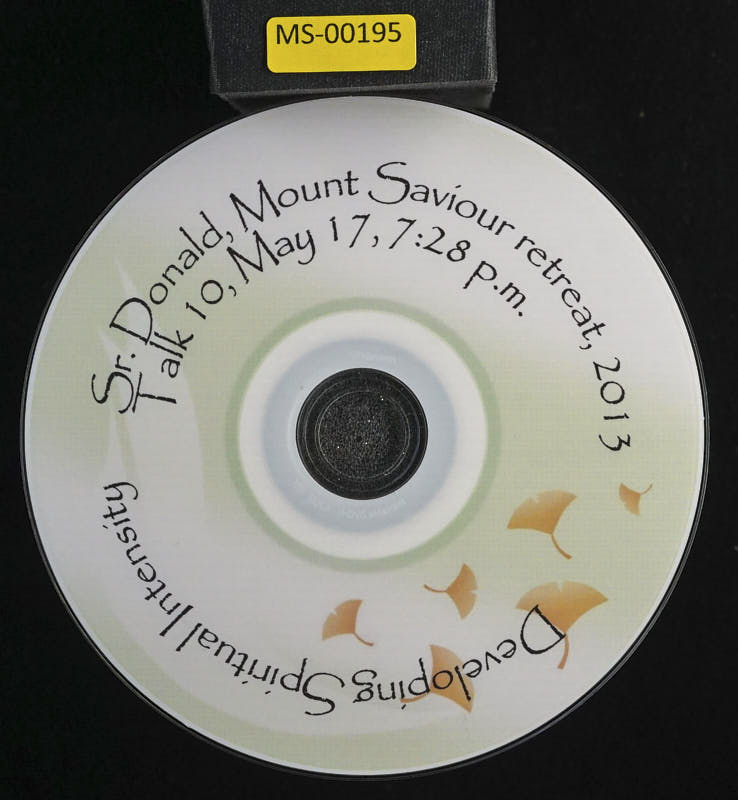
Side: A
Speaker: Sr. Donald
Location: Mount Saviour Monastery
Possible Title: Developing Spiritual Intensity: Talk 10
Additional text: 7:28 p.m.
@AI-Vision_v003
I hope that the Trinity Icon Meditation today was helpful for you, and I just gave it as something to spur you on to look for your own ways of prayer that work for you. St. Paul says, Jesus is the icon of the invisible God. And once you understand icons, that's a very meaningful phrase because an icon makes present the mystery it's representing. I think that the purpose of a monastic retreat is to stir the coals of our commitment. And William of St. Thierry uses that image in the beginning of his little book, The Nature and Dignity of Love, that occasionally we have to stir the coals and arouse the fire. And so that I think this retreat, I had hoped it would help you increase your... commitment and your enthusiasm and your practice.
[01:00]
St. Benedict says that the holy rule is a little rule for beginners, and I told that to our older French sister one time, and she says, ah, yes, but the holy rule, she has one big yoga. One big yoga. You know, yoga comes from Yush in Sanskrit, which means a yoke, something you take on, and it's... It's for for pulling a load so the holy rule is one big yoga I gave a workshop for a formation group at Albany one time and it was about a five-day workshop and There were maybe five or six different communities sending young people postulants novices juniors for this workshop And after about four days I said to them any questions and one little Daughter of Charity raised her hand and said, what's the one thing you would say to us for four days of influence? And I thought, my God, she's a Zen master.
[02:02]
But it's interesting what came out of me. I said, well, the one thing I would say to you is develop spiritual intensity. Develop spiritual intensity. Make that commitment and that passion you have for the seeking of God just to mount and intensify it. Some of you may have read in the past, Mystical Passion by William, what's his name, McNamara. It's a fine book, I think, you know, about that we have to have an intensity of desire in us that could mount and intensify and increase. But, you know, with the everyday stress and load that we have, those coals can get, embers can just get cool and covered over. So that's what a retreat should help us to do. I remember hearing a meditation that Father Bruno Barnhart gave one time, and I'm recalling it from memory, so I may not have it completely altogether, but he said in Eastern Churches, the central image on the Akonistasis is Christ, and on one side is Mary, and on the other side is John the Baptist.
[03:17]
And he said, it reflects the two parts of our spiritual life, Mary representing the contemplative, the open heart, the holding in her heart, the pondering of all things in her heart, the receptive, the receptive. On the other side, John the Baptist represents the prophetic, the ascetic archetype, direct pointing, you know, he must increase, I must decrease. There's a wonderful statue of St. John the Baptist at Collegeville which some of you may have seen, where it's a Doris Caesar carving of St. John the Baptist, and he's just holding one figure out, and he's a very, very lean ascetic figure. Gerard Cavigny has a wonderful homily on John the Baptist, and I didn't bring it along, but it goes, you know, from Matthew 11. What did you go out in the desert to see? A reed shaking in the wind? You know, that John is now, you know, just...
[04:21]
wishy-washy figure, you know, he's just this iron-steel intense dedication. And so those are the two aspects of our vocation. To be, I wouldn't say passive, but to be receptive, and then to be intensely dedicated and strong. Last evening, I sort of skipped over the question of contemplation, and I'd just like to comment on it a little bit more. The Benedictines, I think, the listening heart, the Lev Shumeya, that's Benedictine contemplation. Cultivating the listening heart. It was Esther DeWall who, in her book Seeking God, helped us recover that sense of the listening heart as the key to our life. So it's not a method. It's not a laying out of steps or anything like that. Sometimes Kenny may say that Benedictines are allergic to method. We're not known for being very instrumental in our spirituality of laying out points and things like that.
[05:29]
That comes in high medieval and later spirituality. We're not good on the instrumental level, but we teach a way of life. We teach a way of life that's solidly rooted in mainline Christian spirituality, scripture, liturgy. Contemplation for us as Benedictines is what I would call, to use a scholastic term, a habitus. It's a continual inclination that we have always with us, something different from habit. It's deeper and more permeating. A habitus, the contemplation contemplative lifestyle, is always with us. I think it's a little bit similar to the question of discernment, you know. We usually think of, well, the Ignatian tradition teaches discernment and lays out steps and the method and so forth. Some people think Ignatius invented discernment, but it goes way back, you know, to Paul.
[06:31]
And the article in the French Dictionary of Spirituality about discernment is huge. I mean, it runs on for 50, 60 pages of very small print. But Benedictine, I was asked one time when I was teaching a course with a Jesuit if I would talk about Benedictine discernment compared to Ignatian discernment. And I only had a week to prepare it. But what I came to is that what Ignatius added was the rules of discernment, which he distilled from the tradition, whereas Benedictine and monastic discernment is just this habitus. just this inclination, and more of a tradition of discretion, weighing things, but not so much of a method. I'd like to comment on chapter 72 of the Holy Rule, on the good zeal which monks ought to have.
[07:34]
When I was a young Benedictine, I heard about a novice... St. John's Abbey in Collegeville who was the table reader and when he was reading the section on the rule for the day he read on the good zeal which monks ought to have emphasis on ought I think that zeal is about fire it's about intensity it's about enthusiasm and behind all of that is the energy of the Holy Spirit zeal is fire, intensity, enthusiasm, commitment, dedication. And scholars say that chapter 72, perhaps, they think, was intended by Benedict to be the last chapter of the rule, and that 73 was added later. Mary Foreman says that chapter 72 on the good seal that it looks out to have is Benedict's hand to love.
[08:37]
which is an interesting way to look at it. She gave a course at Collegeville two summers or three summers ago in the summer program in monastic studies, just on chapter 72. It was titled, Benedict Cian to Love. Chapter 72 says that we must practice with most fervent love depending on the translation you're looking at. And interestingly, that came up in the noon reading, I think, today. And here are the elements of the fervent love that Benedict challenges us to do. First, to anticipate one another in love. The whole element of reverence that I talked about the other day, which in my list of Benedictine elements of spirituality, I put reverence first. Okay, it's so fundamental. And I think it's the liturgical spirit that teaches us reverence.
[09:39]
So to anticipate one another in law. Second, to endure one another's infirmities, whether of body or soul or character. I spent a long time when I was doing my dissertation studying the saints of the Desert Fathers. And what most struck me in the teaching of the Desert Fathers To me, the sexual teaching was non-judgment, not to judge others. It just is all over. There's this wonderful story about some monk who had committed a sin or whatever, some sort of scandal, and the Abba hears about it and hears that the whole community was criticizing him and takes a bucket of sand and puts holes in it and walks in front of the community and says, this is what your gossip is doing. destructive, it's going all over. Third, mutual obedience, really listening to the other.
[10:41]
Obedience means to listen intently, obagiri, and the mutual obedience. Fourth, the phrase which is very beautiful, to tender the charity of brotherhood chastely. Tender the charity of brotherhood chastely. Fifth, to love their abbot with sincere and humble charity. Sixth, to prefer nothing whatever to Christ, one of the Benedictine models. Sort of puts it all together. And seventh, may he bring us all together to life everlasting. I would say when the tribes go up to Jerusalem, I'm going with the Benedictine tribe, and then if there's Franciscans in the class, I say to them, they'll go up as a bad-tapped group and we'll go up in procession. They won't have any organization that will be, you know, clowns and, you know, rag, rag, the beggars and so forth.
[11:48]
The Benedictines will go chanting in procession. Chapter 73 of the Holy Rule, and you know, Placidus A, in the article I talked about in the American Benedictine Review, when he talks about the Luke Coda, at the end of chapter 7 on humility, he says a little coda points to chapter 73, that the full observance of holiness is not established here. That's the chapter in which Benedict refers to the rule as a little rule for beginners and encourages people to go on. It's not very explicit about that. Again, it's not where there's anything really instrumental, except he gives a story of bibliography, read the Fathers and Basil and so forth. And I think You know, that's important because classically monks have been readers. They say that the three most important rooms in the monastery are the chapel, the kitchen, and the library. They're all about nourishment. They're all about nourishment.
[12:48]
Body, mind, soul. Chapel nourishes soul, refectory nourishes body, and library nourishes soul. nourishes our mind. Okay. Funny little saying about the medieval commentators not very well known in the 12th century when monastic and scholastic theology were beginning to have a tension with each other. And he was trying to explain to somebody the difference between monks and the new kind of theology. And he says, well, the monks pray and read. They pray and read two things. The scholastics simply read. They don't pray. It wasn't a very kind comment. And I was at a conference one time with some theologians. I said, nowadays, they neither pray nor read. They just go to conferences. Maybe that's not very kind either. All right.
[13:50]
I want to underscore that Benedictine monastic life draws us to two wells. to wisdom and love. And that's pointed to in chapter 73, the last chapter of the Holy Rule. This little rule for beginners at last will reach the summits of wisdom and virtue. Now, it doesn't say love, but Placidus A sort of pulls that question of virtue apart. And he said, virtue, and I think he's probably reading a Greek translation of the rule, is dinamis, which means power, and virtue means power. And he says the dynamis, the dynamis, the real dynamis is love. Love is the energy. So you could read that as the two wells being wisdom and love. Keep those two wells in mind because I'm going to conclude with it tomorrow. I think that's important because, you know, the Buddhists, the Buddhists say that enlightenment is wisdom and love, particularly the Tibetans talked about wisdom and love.
[14:59]
and the transformation, enlightenment process, as they called it, the inner marriage of wisdom and love. I'm going to talk about that in the conclusion tomorrow. So Placid de Zay says that the little coda at the end of chapter seven points to the prologue, as we run the way of the commandments, our hearts expand with unspeakable love, and to chapter 73, of growing into deep wisdom and deep love. Tomorrow's conference, I'm going to talk about the monk in the world, or monasticism in the world, and how the Holy Spirit fits into all of that. And I'd also like to have some discussion tomorrow, so I encourage you to think over tonight some possible discussion questions, reflections that you may have. I didn't get a bibliography together for you, but I'd like to eventually send you a bibliography.
[16:03]
I don't know how soon I'll be able to get to it, but sometime within the next month or so, maybe I'll get to it. Finally, I'd like to end with a poem by a sister from the College of St. Catherine, where I went to school, about the energy of the Holy Spirit and the freedom. You know, I said that 2 Corinthians 3.18 is sort of the key passage in the New Testament for me about transformation. Now where the Spirit of the Lord is, there is freedom. And we with unveiled faces are transformed from glory to glory. This poem is titled, When the Spirit Next. When the Spirit Next embrace me, catch me, bones and all, in her wild wing, while ride out older and older in her half-mask, her universe and love, of love. Her pinpoint stars, how free, how utter dark, her reeling light, how nearly laughing unashamed.
[17:05]
A little bit like E.E. Cummings, you know. But it's that freeing energy of the Spirit and the energy that nudges us forward. One of the prayers we had at liturgy this evening, you know, about, you know, The concern about the world and where the worlds will be, and that's what we're going to talk about tomorrow morning. When the spirit next embrace me, catch me, bones and all, in her wild wing, I'll ride out, bolder, bolder, in her how vast universe of love, her pinpoint stars, how free, how utter dark, her reeling light, how nearly laughing, unashamed. have a last conference tomorrow and have some discussion after it.
[17:53]
@Transcribed_UNK
@Text_v005
@Score_95.0