You are currently logged-out. You can log-in or create an account to save favorites and more. more info
Humility's Path to Spiritual Growth
AI Suggested Keywords:
The talk explores the balance between the pursuit of spiritual perfection and the acceptance of imperfection, highlighting that striving excessively for perfection can hinder spiritual growth. It emphasizes the virtues of humility, compassion, and self-awareness as pathways to genuine spiritual progress, using stories and teachings from the Desert Fathers, Saint Benedict, and Saint Paul to illustrate these concepts. The discussion also addresses the need for community and individual goals, noting the potential conflicts between personal expectations and communal values.
Referenced Works and Authors:
- Erik Erikson's Stages of Development: Discussed as a framework for understanding personal growth and the spiritual journey; noted for its use in formation conferences globally.
- Saint Paul's Letters: Cited as examples of valuing grace and acknowledging human weaknesses, emphasizing divine grace over the rigid pursuit of perfection.
- Desert Fathers' Stories: Used to illustrate lessons on judgment, humility, and spiritual imperfection as part of the early Christian monastic wisdom tradition.
- Saint Benedict's Rule: Examined particularly regarding the degrees of humility, emphasizing restraint in speech and community life as essential components of spiritual discipline.
- The story of Diogenes and Aristippus: Illustrated the theme of living simply and rejecting societal expectations for personal spiritual enrichment.
- Eternal Mantra Story: Provided as an allegory to demonstrate the conflict between keeping spiritual wisdom exclusive versus sharing it compassionately, underlining the transformative power of compassion.
- Orthodox "Fool for Christ" Tradition: Mentioned to demonstrate the acceptance and value of unorthodox paths to spiritual insight, especially within Russian Orthodoxy.
The talk covers a wide array of teachings and perspectives centered on the spirituality of imperfection, emphasizing that grace and compassion guide the journey beyond stringent perfectionism.
AI Suggested Title: Embracing Imperfection for Spiritual Growth


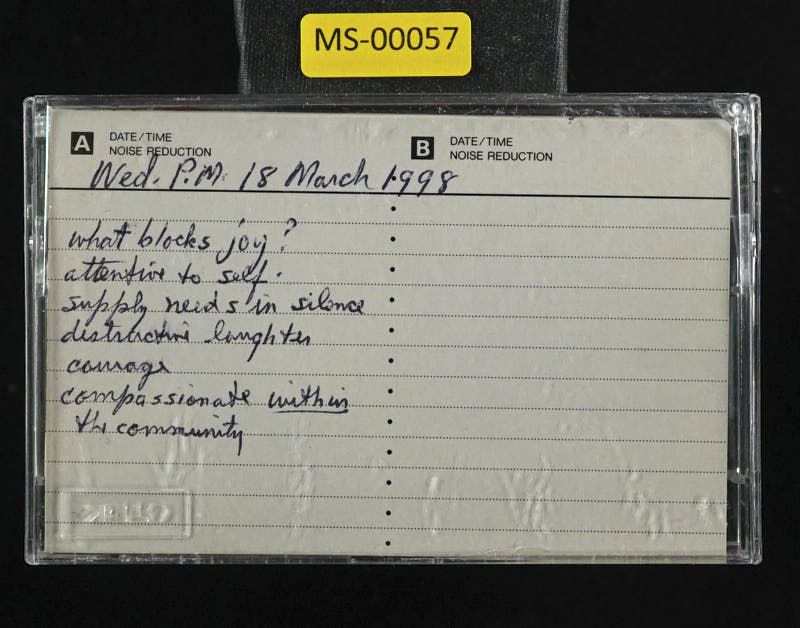
Speaker: Abbot Justin Dzikowicz, OSB
Location: #N/A
Additional_text:
#7 Abbot Justin D. of St Pauls
what blocks joy?
attention to self
supply needs in silence
distractions enlighten
courage
compassionate within the community
Speaker: Abbot Justin Dzikowicz, OSB
Location: #N/A
Additional_text:
#7 contd
Wed. eve. 18 Mar. 1998
@AI-Vision_v003
Send him on his way. We've done that. We have the pole. Is that what this is? It's modeled after. All right. Well, we've come to the... We've gone through the sins and we looked at stages of development. And this overview of Ericsson is helpful because everybody's using it. I was looking in one of the magazines today and seeing that that's what they're presenting in formation conferences in the third world. They're looking at Ericsson's stages of development as a groundwork for formation. They're worthwhile for us to review our own sacred journey, our own pilgrimage to life, and ask ourselves, well, where are we going? And the sins, well, the list of sins is somewhat helpful to look at, but that's only half the story.
[01:04]
We know that there's corresponding virtues, and we are challenged to find in our lives what our sins are, what the things are that block us from growth and development and happiness and fulfillment and joy in our Christian journey. And And likewise, we're asked to find what are the things that give life, that really give us life? What are the virtues on our own spiritual journey that lead to life? So in the end, it doesn't matter if we have seven or eight or 12 sins or virtues. We need to discover what it is that lets us grow, that helps us really develop. One of the great blocks and one of the things to perhaps reflect on before telling some more stories is that all too often we have been brought up in pursuit of perfection, whatever that means.
[02:09]
And somehow that's ingrained in us. If there's anything that can kill our spiritual life, it's the pursuit of perfection. because we're not going to get there. We're going to just be frustrated. We're going to be put into a corner. That doesn't mean we should try to make progress. That doesn't mean we should just give up. But the pursuit of perfection is like a death to spiritual life. Often that quotation from Matthew is misunderstood. Be compassionate as your Father in heaven is compassionate. Perfection, the best thing we could do perhaps is lower some of the expectations and goals we place on ourselves. We beat ourselves up with them. There is a whole tradition of the spirituality of imperfection. That's the spirituality that starts in the desert and it's the wisdom tradition that's woven throughout Christian literature.
[03:13]
One of my favorite desert stories is the one about the young monks who realize the old hermit has got a mistress out there on the corner of the wadi or wherever they are. And they go to the Abba and they say, and all these rumors are starting that that old hermit's got a mistress out in his hermitage and blah, blah, blah. So the Abba gets out there early. They're all going out to shame the old hermit. And the Abba gets out there and he gets the woman in a barrel and he's sitting on top of the barrel. And they come in and he tells them, well, search around here. Now make sure you look under the bed. Check that cupboard. And he's going on and on. And finally, in their fervor, the young monks don't find any woman hiding in the hermitage. And so they're crestfallen. And he gives them a lesson on judging, on judging, which is so deadly to spiritual life. And it's also a lesson on perfectionism.
[04:17]
But he doesn't let the old hermit off the hook. After the young ones go back and are upset that they couldn't find and shame this old hermit, he tells the guy, he says, be attentive to yourself. And there's the word from the Abba. Be attentive to yourself. In other words, that we need to be attentive to ourselves. We don't have to strangle ourselves in the pursuit of perfection because it'll be an exercise in futility. Every page of St. Paul is the glorying in his weakness because he knows that it's all grace. He's tried the law and he knows that it doesn't give life. Every word, every page you can find. St. Paul's theme is that it's grace. It's God doing what we can't do.
[05:19]
Once upon a time, there was a teacher, a guru, who had many followers, and they came from all over to listen, to learn wisdom and enlightenment, to be liberated from their desires and needs. There were classes. and one-on-one apprenticeships. At the end of the students' teaching, the master would send them out into the world to share their learning and their knowledge with others as masters in their own right. And just before they left, he would give them the gift of the mantra of life and death. Phrase by phrase, he would teach them until they had learned it by heart. That he would tell them as long as they said this mantra faithfully, they would be blessed. That its power would give them insight and clarity and allow them to discern the truth when all around them there were lies and shadows. That its power would keep them from despair and give them hope in the midst of misery and hopelessness.
[06:27]
That its power would strengthen their faith and one day save their souls and give them everlasting life. the disciples were grateful and humbled by the gift of the mantra of life and death. And he warned them never to teach anyone else the mantra. It was for them alone, those who had been enlightened. And so for years and years, students finished their studies, they were given the mantra, they went out into the world to share their wisdom and to pray their mantra in secret. One day, a young man... came to the master, ready to go out into the world, he too was taught the mantra and humbled by the enormity of the gift that he was given. However, when the master warned him not to share the mantra with anyone, he asked why. The master looked long and hard at him.
[07:29]
If you share this mantra with others, then what it was to do for you will be handed over to them, and you will live in darkness, even when the light is all around you. You will know only despair and misery of body and soul all your life. You will stumble over the truth and be confused endlessly. Worst of all, you will lose your faith, you will lose your soul, you will be damned forever. The disciple turned white and shook visibly and nodded and left the master's presence. But he was troubled in spirit. Finally he decided what he had to do. He went to the nearest large city and gathered the multitudes about him, teaching and enthralling them with his stories and wisdom. Then he taught them the mantra, line by line, phrase by phrase, just as his master had taught him.
[08:42]
There was a hush, and people left whispering the mantra to themselves. A number of the master's disciples were in the crowd. They were horrified at the man's actions. He had disobeyed the master. He had betrayed his community. He had given away the wisdom and the gift to the ignorant and the unenlightened. They immediately went back to the master and told him what had happened. They asked him, Master, are you going to punish him for what he has done? The master looked at them sadly and said, I do not have to. He will be punished terribly. He knew what his fate would be if he shared the mantra of life, with those who were not enlightened? For him, it has become the mantra of death. He will live in darkness and despair without hope or knowledge of the truth. He will live isolated, alone, without comfort or faith.
[09:47]
And he will die terribly and even lose his own soul. How could I possibly punish him? He knew what he was choosing. And with those words the old master rose and gathered his few belongings and began to walk away. Master, one disciple asked, where are you going? And the master looked at all of them sadly and spoke, I am going to that man who gave away my gift of the mantra of life and death. Why? they chorused. because, he said, out of all my students, he alone learned wisdom and compassion. Now that man is my master. And he left them to follow the man who walked now in darkness and despair, who had chosen compassion over wisdom and knowledge. There's a saying among the rabbis of the East, Eastern Europe, that God is an earthquake, not an uncle.
[11:09]
And that sometimes God comes crashing into the experience of our lives to shake us. It's not what we expected. It's not what we want. That God comes like an earthquake, not an uncle. And the surprise is that grace can do what we can't. Again and again we hear echoes of that kind of story. The philosopher Diogenes was sitting on a curbstone eating bread and lentils for supper. He was seen by the philosopher Aristippus who lived comfortfully comfortably by flattering the king. Said Aristopoulos, if you would learn to be subservient to the king, you would not have to live on lentils. Said Diogenes, learn to live on lentils and you will not have to cultivate the king.
[12:15]
There's a story of a Polish rabbi around the turn of the century visiting or a tourist from the United States visited him. And he was astonished to see that the rabbi's house was just a simple room filled with books. The only furniture was a table and a bench. Rabbi, where is your furniture? asked the tourist. Where's yours? said the rabbi. Mine? I'm only a visitor here. So am I, said the rabbi. There is a tradition of wisdom that is passed down in stories, in little glimpses of what life can be like. We can find them in all kinds of places. But the point is, none of us are going to have a picture-perfect monastic life. None of us are going to have a picture-perfect Christian life. It is often in grappling with sin,
[13:21]
and grappling with imperfection and accepting ourselves and God's grace that we make any progress. Let's take just a quick look at the last four degrees of humility and then open up for some discussion. Maybe you can tell me your favorite Desert Father story. The ninth degree of humility... Let's read the old text. On the ninth degree of humility is that a monk restrain his tongue and keep silence, not speaking until he is questioned. For Scripture shows that in much speaking there's no escape from sin, and that the talkative man is not stable on the earth. So we're not supposed to talk, St. Benedict says, that in much talking there's no stability. What can we do with that? How can we look at that and make it come alive in our practice?
[14:22]
The word that perhaps is helpful to understand this is challenge. To make our ideals bear fruit in the garden of living. An inner life is developed by silence. In silence the mind is forced to focus within rather than without. In our silence, here's a practical suggestion to make this come alive. Try and notice something in the monastery where you can be of service. Try to make an improvement and see if it takes hold. Don't demand participation. Implement a small, very very slight improvement in silence. It might be just the way something is done.
[15:46]
around the house without necessarily stepping on someone else's turf. It might be just ordering something, but to do it out of silence, a challenge. The tenth degree of humility is that the monk be not ready and quick to laugh, for it is written, the fool lifts up his voice in laughter. The word that may be helpful here is master. We know that St.
[16:56]
Benedict in this degree of humility is focusing on the kind of divisive laughter that destroys community. That requires a certain kind of mastership of our spiritual life. Mastership is an expansion of our vision. We have to try and imagine how we can use that mastership in a practical sense in the monastery. The suggestion given is that in attending a ceremony, enter into the ceremony as one who has mastered an appreciation of the unity of humanity. whenever we're at a ceremony, a special occasion, a special ceremony, enter into it with an appreciation of the unity of humanity.
[18:10]
It's a challenge to stretch our inner vision. Let's look at the eleventh degree of humility. The eleventh degree of humility is that when a monk speaks, he do so gently and without laughter, humbly and seriously, in few and sensible words, and that he not be noisy in speech. It is written, a wise man is known in fewness of words. Here the word that might be helpful in implementing or in looking for a new life in the eleventh degree of humility is the word courage. and again, in practice of what to do, how to implement this into a behavior, is can you find a way to act spontaneously for the greater good.
[19:12]
The last degree of humility is that a monk not only have humility in his heart, but also by his very appearance, making it always manifest to those who see him. That is to say, whether he is at the work of God, in the oratory, in the monastery, in the garden, on the road, in the fields, anywhere else, whether sitting, walking, standing, he should always have his head bowed and his eyes toward the ground, feeling the guilt of his sins at every moment. He should consider himself already present at the dread judgment and constantly say in his heart with the public and in the gospel, with his eyes fixed on the earth, Lord, I am a sinner. and not worthy to lift up my eyes to heaven. And again with the prophet, I am bowed down and humbled everywhere. Benedict very wisely knows that climbing the ladder of humility, it shows in the body.
[20:26]
He doesn't mean this as a put-down of a person, but he does recognize that it does show. It is a way of preaching. It's a way of giving example. Now, the word here in showing that, our lives are called to show inspiration to people. That when people see us, that our very bodies and our bearing can portray the spiritual life. Now, the great practical way of being an inspiration or the way of implementing this behavior or practicing it is to find a way to be compassionate by lending an ear to someone in need of spiritual comfort in the community. It's so easy to go around and be an ear for everybody that comes by the door, but to try and be compassionate to someone who needs spiritual comfort in the community.
[21:41]
What a quiet way of practicing humility within the midst of the brethren. Well, let's stop there. And let's open up for some discussion or observation or maybe some of your own stories of your own experience or things that have helped you on the way. I know in my own case the great earthquake in my life was being confronted with my alcoholism as a very young monk. And I was tapped on my shoulder one day at lunch and the abbot said, I want to see you in my office after you finish your lunch. And I said to myself, oh good, this guy has finally recognized my talent. He's going to appoint me to some big physician. Well, I get in his office and he says, I've determined you've got a problem. And talk about an earthquake.
[22:44]
There was the earthquake. But in the earthquake, somehow, there was a breakthrough that shaking sometimes getting our attention in our experience is a wake up or a surprise that God is doing what we can't do I think it continues though they aren't necessarily dramatic Sometimes they are, but they're not always traumatic. But that in our experience, that's the place where we find the manifestation of God. It's easier to think about it than it is to find it in the experience.
[23:46]
You know, I was talking with Brother Stephen yesterday. And correct me if I'm wrong, if I'm not expressing it correctly. But a lot of these things, we have to be careful about analysis. Because analysis in itself can keep us away from experience, reality. And we should be all so open. You shouldn't block it out. But to depend, we seek to live in an age that loves analysis and self-analytical, which, by the way, just concentrates you on yourself more and more and more. At least you become more and more frustrated because you see more and more your own imperfections. And compassion, like you say, brings you out of yourself for others. Regardless of your imperfection, you push them aside in order to be compassionate. But sometimes it's just in the living of each moment and that you learn the wisdom.
[24:52]
You know, like Diogenes eating lentils by the curbside. The other guy was living in a palace. Diogenes learned by eating lentils. Christ himself. So we were talking about just like in relating to one another, just to live the moment and even the mistakes, that's fine. but be leery also of analyzing too much because you can't get lost in the analysis. I mean, our age is no big thing to brag about being self-aware, because just look at Auschwitz, nuclear bombs, famine, and all of these things coming along also with the psychological studies and everything, and we're still killing each other. Sure. more effectively and more efficiently each day. So it isn't a solution either in itself, which we have a tendency to think it is.
[25:55]
in the past. Not so much the future or the present, but the past. The past is not supposed to let go. There's nothing you can do. Not the past. Not with the future or the present. You also talked about expectation. As you said, we are all expectation. I wish that to happen. Unfortunately, we live according to the expectations of the other people, as a dialysis priest. If I were to live my life as a priest, according to my own self-expectation, I would be not happy with myself. But then, the public, they have their own expectations of what the life of the priest should be, yet themselves are the priests. Who set these expectations for them?
[27:19]
When I came in here, I had my own expectations of what I wanted to see. Even though I was a monk, I had never been in the monastery for a long time. So, where do we draw, where is the, how do we marry the two? The people's expectation, the community's expectation, with the individual expectation. The community groups, Here they have their own gurus, which should be manifest to each of the members of the community. In the dialysis situation, I don't know what the goal is, except to preach the word. I don't know how much the bishop has in the post. I don't know, there's nothing that I know. And so if the individual member don't know the group gurus, then they have to play against. So what that thing we're talking about, I think it's making the goal of the community manifest.
[28:22]
And at the same time, the goal of the individual, because each of them here, they've got a whole little thing. Which, if the prior doesn't get to know, to fulfill that little thing, then the good goals will suffer. Now back to the state government. Each civil [...] We have something we call the mission statement that is to help as a group
[29:49]
This is what we stand for. But now, as an individual, then some people may be more nervous to follow the mission statement, but others will be less nervous. And in fact, my hope is that the spiritual director will be helping individuals too. Well, in the monastery, that becomes, there is a corporate expectation that that the leadership in the person of whoever the leader is, but also the other forms of leadership in community life, give a common direction to the monastery. And that becomes known. That becomes known by living it, by the experience of what is expected and how to do it. So there's a flow that the monastery life takes and that people... conform to that.
[30:50]
It's always amusing and it's sometimes humorous when the novice or the person comes into the situation and doesn't realize the flow of how things go and stands out sometimes like an innocence. But it's amusing sometimes. But the monastery does take a direction. We have a... a way that we go to God. Now, it's certainly contained in the rule that we're given a whole, there's a whole monastic culture, a whole way that we assimilate over a long time. And the danger is if we become perfectionists, if we just begin looking for the letter of the law, And I think that's very destructive to growth, to our spiritual growth. And that's where I was saying that we need to lower expectations because sometimes we suffer at our own tyranny, you know, that I've got to do this thing absolutely perfect.
[32:04]
And, you know, and we don't do it. That our vocation is a gift from God. that our experience of life in the monastery is one of grace and God is present. And oftentimes God can be found in the surprise or in the things that don't work out or in the failure or in the difficulty or in the struggle and even coming up against our own sins that we find that God is the one and not ourselves who can overcome them. And that's That's probably, I guess, one of life's, I guess, you know, we don't like that. We would like to do, we would like to achieve. And our culture really forces us to be achievers and to do things. But we find out that God's doing more than we are aware of. Also train the disciples to help them suffer, all that can suffer, except that dangerous memory of the capture of the Christ, the seizure, the torments, the death, the resurrection.
[33:25]
They cannot focus on that now. How can we entertain such a memory, a living memory of the Christ? So when I don't do well in the parish, I think it's a problem of faith. I don't look at the seven, these things we call capital sins. I look at faith that I am lacking in faith. I don't internalize sufficiently that same dangerous memory that the disciples have of all that happened to the Christ. They are not alone. They have escaped. They went poor. What then? Christ himself awakened them after the resurrection. How can he awaken me as a spirit? I don't know if this is on work track or let's understand God.
[34:35]
I don't know if you've served me correctly. In the last retrieved book, what the retrieved book was called then, we would make the time to read and share this. Ended with compassion as well. It's not more on the line. What I've heard, sometimes, compassion is the key. I would like to do it to Christmas. I couldn't help but think that one of the timelines would perfectly seem to be most attentive is reading the Passion. just comes across to me that you're not analyzing you're just coming out of yourself giving of yourself and what little you give of yourself I see little comparatively
[36:04]
God and Jade his own son. I was thinking earlier, not knowing you were going to end with this. I'm not sure if it's God who wanted to hit me. So he sends his son. Because, oh I know, I was walking out doing anything, doing the heck. So I was just thinking to myself, made a statement to myself that God understands me. I've heard people say to me, how can God understand me? He's up there and I'm down here. God sends his son to be one of the prophets.
[37:17]
I should say, God becomes one of those men in his son in order to help us understand that he does understand. He's been through it. He wants us. He gives up himself the other words come from compassion. All I can think of is, it's a beautiful word, to end the treatment, or to end any, you know, into a life experience. I just was struck by it. It's a word you can't analyze. It's just, it's like, you give your life. Right, but it's easy to recognize when you experience it. Right, right. Brother Aleta said that about not to be over-analyzing, analyzing the situation.
[38:27]
That's correct, because in the story, Abba Amonas tells the delinquent monk, the lustful monk, be watchful, meaning be attentive, pay attention. Right away I was thinking, to pay attention is conscious living, the way we understand it today. And I thought, well, the reason why I fail at conscious living so much is I don't have enough humility. Because the Delta Gora oracle, you know that saying, you don't know thyself, really means to know your place in the scheme of things. It isn't a question of having a lot of analytic, factual knowledge about yourself and your behavior. It's really about how you fit into the scheme of things and relate to other people. So if I fail at conscious living, aren't failing because of lack of humility and lack of compassion. You know, I think that Zen, Koens are so powerful because just in a few words and sentences, they hit you with that, like there is one where they teach and send you, the Buddha is a dog,
[39:42]
and that's your colon, and you go and meditate on that, which would be like saying, like Christ is a piece of dirt. Go meditate on that. And the idea is to shock beyond the idea that we can define, clarify, understand, and we're not dealing with anything rational, because compassion is not rational. The death of the God-man is not rational. We can never understand that. We can never understand it. It's not logical. You have to go beyond that logic to surrender. And in a sense, the steps of humility lead us to that. Right. And you're so right about... We live in an age of analysis. An example that comes to my mind is that victimization in our culture is used and people are analyzing their experience and discovering that they have been victims in so many different ways.
[40:45]
And what the analysis leads to is an opportunity to blame or to target an excuse for their present experience, and it leaves them stuck as a victim, which strikes me as the example of just analyzing, let's say, one's upbringing. and one discovers that somehow they were physically, emotionally, sexually somehow abused, and then that's the reason why they can't do anything, and it becomes a stance of blaming rather than conscious living, which says, oh, you have to put this aside now. It can be looked at as an explanation, but it cannot be a rut in which you can stay in. It's sad to see that, and some people are blaming, Oh, it's common among some to see that, oh, my father or my mother was alcoholic and that's why I can't do anything in my life.
[41:49]
It's like, well, get over it and get a life and get on with living somehow. Yeah, but sometimes the analysis keeps on going. The other day, I forget which conference, remember when he was talking... And you said that even governments now are learning that the problem in Yugoslavia and everything... Oh, right. ...is an irrational act of love, of compassion, right? That's it. The only way out of that situation. Like that babushka, the Nazi that may have shot her own son. Right. The only way out of it. But that is knowledge. Real knowledge. It's amazing. When we stop knowing, it's when we know. We had the film here. When Mr. Smith went to Japan to learn Zen, experience so many months in a Zen monastery. So when he first got there, the sensei called him in, and he said, so, you know, what are you with your other life?
[42:51]
And he said, I'm a philosopher. And he said, oh, poor man. And then at the end, when he was getting time for it, you know, to... was so angry because he felt he was being ignored and they were making it so difficult for him. So when he finally goes in to see him again, he spits it all out and the man just looks at him and he says, why don't you try and go beyond that? And he realized in that moment what it was all about. There's a little... There's a little passage here about, I was reading about Merton, who met a Zen novice who finished his first year of living in the monastery, in the Zen monastery. And Merton asked the novice what he learned in that year. And he was expecting to hear encounters with enlightenment, discoveries of the spirit, perhaps even altered states of consciousness.
[43:57]
But the novice replied that during his first year in the contemplative life, He had learned to open and close doors. And Merton enjoyed that, it said. He used that again and again. He retold the story for an exemplified play at its very best, doing the ordinary while being absorbed in it intensely and utterly and finding in the simple things avenue to wisdom. That... You hear stories like that in monasteries about people learning to open and close doors. In my own house we have problems with skunks. Oh. They come and eat the garbage. One year they killed, I didn't like any of it, but they shot about 18 of them. But eventually skunks are very productive, so they do follow the biblical injunction and they do multiply. Oh yes, skunks. So they come back after a while.
[44:59]
But the thing is, you should have heard the discussions in chapter, you know, those damn skunks around again, eating the garbage and everything. Now, somebody got up and said, now really, you know, who is really the one that's stupid here? The skunk for being a skunk, or we for expecting the skunk to be rational enough to leave our garbage alone. You know? And... A lot of times that's the way we are. We left the garbage out, we didn't cover it, and it was the skunk's fault, so we went out and shot 18 of them instead of putting our garbage in proper containers. And we do so much of that with our own knowledge. What did you guys shoot? We have groundhog problems. I used to shoot them out the window. Oh, rats.
[46:05]
Oh, rats. Some guy was visiting us, and then they were setting out mousetraps, and I found a baby mousetraps, and I was feeding it milk. And the guy is here, and then he says, you know, this is amazing. Brother Blaze was just setting traps to kill the mice, and here you are. You found the baby, and you're feeding it milk. I said, it's part of monastic life, it's a mystery. But that compassion, boy, that's very powerful. You have to go beyond understanding to understand God. But compassion, I think it's spontaneous. What do you mean by spontaneous? Spontaneous. You see, spontaneous, I don't think it means it just happens. and yet it happens. It happens as an experience of grace, but somehow it's consonant with the person's history.
[47:08]
Spontaneity requires, I think, preparation somehow for us to really be... In other words, that sometimes we will have the ability to meet a situation in a creative way that we surprise ourselves. that there's a difficulty with a brother, let's say, in the community living, that there's a real problem. And somehow an opportunity comes up in which we're able to overcome the wall of separation. And yet it's not something that's alien to us, that it comes from our practice of attempting to live monastic life and be open to God. that somehow a solution comes. Because I have an example of two brothers. You tell it, Joe, one of them would laugh right away.
[48:10]
Oh, yeah. The other one would take a while. Maybe he'd laugh or maybe not. I mean, the other was very, the one that didn't laugh was very intellectual. He had, what I think is to analyze whether that was worth laughing at. The other one got it. Yeah. By the way, I mean, that's what I'm saying about analyzing things too much of it. The idea of culture that you were talking about, monastic culture, and that creates, like the Lectio and everything, that creates the basic foundation that it pops out then spontaneously, like it's memorizing the song, Or more, the Our Father, when we were little. You know, we memorized it. Geez, I remember I hated that when I was in school. The poor Marist brothers, and I loved them dearly.
[49:12]
But forcing me to memorize the Hail Mary, the Our Father. Still know them in Spanish. Don't know a lot of the prayers in English, but I know them in Spanish. But in crucial times, those things are about just at the right time. At the moment, I hated it. The discipline and everything. But then it becomes a part of you. Is that what you mean? Spontaneity is there, but you have to prepare the groundwork for the right type of spontaneity. I think it's more a question of experience. Having learned to laugh at things so that you don't have to put it through your mind to see whether it's worth laughing. I don't know how to put it. I mean, I find much more compatible, or I like more the person that just laughs right away. Without, yes. Without, and the other one that has to, well, hey.
[50:12]
Maybe it's not funny, maybe it's funny, maybe it's not a joke, maybe it's a joke. You can see it just in the hesitation. I mean, for me. The other guy you talked to him or something, I enjoy laughing right away. I mean, what is there in that? I don't think it's so much the question of them having an intellectual background, but it's having an exercise in doing, or with other people, I don't know what, knowing people, or... I think, Paul, a young one, but I was going to say, isn't there a sort of, we have to have a tolerance I respect the individual differences. Firstly, we remember we're not all construct the same way. And I read, he was speaking up here. Colonius says, the advice of the way of people, he says, somewhat often I don't self-esteem.
[51:15]
And that means that when we make a self-analysis, we recognize the totality of our psyche, not that it's ourcomings at all. That's a very good point. I heard a conference once by a monk, an old monk who said he had a nightmare and his nightmare was that in his dream he was walking through the monastery and everyone he met was himself. And he said, what a horrible experience that was. Everywhere he turned, all the other monks were himself. And he said, thank God for the variety and the differences in people to take us away from ourselves.
[52:25]
That's part of being human. Imagine, I guess when it's just when you said imagine, never made a mistake, never made anything. But an awful lot of people rip themselves apart if they don't come up with a certain standard. They don't come out number one. That's what the atrocities were. Present day society, you know. The emphasis on women. Somebody has to be number one. He must be number one. I remember at a school shop when I was in grade school and there was a little guy, I guess it was in a gymnastic class or something, the instructor was trying to get run up. Well, somebody used to be last. Well, that's a good idea, actually. Do you know that the Orthodox tradition, the idea of being a fool for Christ, that everyone... In Orthodox spirituality, the whole tradition is valid that you become a fool for Christ, literally, so that people will think that you're nuts, and you do stupid things, and people will think that you're nuts, and yet they have had a lot of their greatest saints are like that.
[53:54]
They do stupid things. Or you think that they're stupid, but there's a lot of wisdom behind that. No, no, the orthodox, the Russians have it. It's a valid category. You know, they're not monks, they're not, it's sort of like the ancient of virgins, you know, and widows and things. They have the fools. It's primarily Russians. But they have been famous Russians that were very foolish, apparently, and people will go to them to learn wisdom. But they do stupid things, you know, like we were kidding about dyeing our hair magenta and canary yellow for Easter Sunday and show up at the mass with our hair dyed that color. Stupid things like that. But there is a wisdom, you know, at the right time in the wrong, not at the wrong place, but at the right time in the right place, You say something like this and you find, you know, there's a lot of tension to something that somebody stupid like that.
[54:58]
Everyone relaxes. Nobody pays attention to that person. They think, oh, they're very foolish. Exactly the opposite. There was much wisdom there. And that's the part of their tradition. So the motto of it, be a fool. With moderation. Everything in moderation. Well, no, not everything. Most everything in moderation. So, thank you. Thank you. Enjoyed being here with you. Good. I'm going to go back for about six weeks I have to get organized and I have to do some correspondence. And what I'm going to do then, I'm going to drive out and I'm going to spend two months at Christ in the Desert as a transitional time.
[56:06]
And I'm also very interested in having that time in the desert to do some reflection and preparation for the next phase, which will be working with... with some of the young people in South Africa and Namibia in helping them with their formation. That won't be until January, but in the meantime I have to learn German. Now I can understand it, but I have to learn it systematically so I can speak it easier. I can order a meal in a restaurant and find the subway, but the future, there's some request to work in this formation of the the young juniors in a program in Europe, so I'll be in Germany, I'm going to have to know German better to deal with that. They're required to use English, but what if one of them gets a toothache and I have to figure out how to get them to the Zahnarzt, you know, auf Deutsch, and that can be awful.
[57:13]
if you don't know the language well enough. You know, you call up on the phone. I remember one of the abbots called up. I had him call up the airline on the phone and ask them, ask them, I said, if they speak English. And the answer that the woman gave on the phone is, Naturlich, selbstverständlich. And she's answering in German instead of in English. But I have to learn it well enough to be able to handle that. So that's the things I'm up to. Anchorage will be in the midst of slush or volcanic dust. Were you driving all the way to Alaska? I drove up. I drove to Alaska last March. 5,000 miles. Did you take that highway that they talked about in the National Geographic thing? The Alaska Highway. The only way. It's the only road. It's one of the last great adventures. Well, the community gave me a Subaru Outback, which is unbelievable.
[58:23]
It's all-wheel drive, and it's... I only had one problem with it. One day I went out, and I was on what they call black ice, the stuff that you don't know it's ice, and it really is. I was going down. I was going 35 miles an hour. I hit the brake. I was going sideways down a main road in Anchorage, and I said, I didn't know what to do. It was absolutely an experience of helplessness and into your hands, oh Lord, because I didn't know if we were going to overturn or go in a ditch or hit another car, but it just straightened out after what seemed like an eternity. Every other car in Anchorage seems to be a Subaru. Do they clean their roads well? No. They probably do better here. Wow. With all of that money? Well, they drive on ice. They clean them at night after it's all packed down and you have ice for days sometimes. Did you ever try bluffing?
[59:27]
No.
[59:41]
@Transcribed_UNK
@Text_v005
@Score_85.46