You are currently logged-out. You can log-in or create an account to save favorites and more. more info
Forgiveness and Transformation in Faith
AI Suggested Keywords:
The talk focuses on the biblical narrative of Jacob and Esau, highlighting themes of forgiveness and transformation as central to the human experience and spiritual journey. It discusses Joseph's story as a continuation of Jacob's journey, emphasizing forgiveness over revenge. The talk draws parallels with the New Testament, notably the parable of the Prodigal Son, and examines obedience and community life from a Benedictine perspective, underscoring the importance of mutual respect and zeal in monastic life.
- The Bible
- Genesis: The narrative of Jacob’s transformation and reconciliation with Esau serves as a model for forgiveness and spiritual growth.
-
Luke 15: Parable of the Prodigal Son is used to draw parallels with Jacob's story, illustrating themes of forgiveness and familial reconciliation.
-
Saint Benedict's Rule for Monasteries
-
Chapters 71 and 72: Discuss the concept of mutual obedience and good zeal, emphasizing community life and spirituality in a religious setting.
-
Thomas Merton's Writings
-
Reflection on sainthood and compassion as keys to understanding and fostering human connections beyond judgments.
-
John Henry Newman's Reflections
-
On vocation and divine purpose, suggesting each individual has a unique mission or role within God’s greater design.
-
Goethe's Writings
- Explores human transformation, emphasizing the potential for personal growth and development in elevated expectations.
This talk serves as a comprehensive reflection on the intersection of biblical narratives, monastic teachings, and philosophical musings on human potential and community dynamics.
AI Suggested Title: Forgiveness and Transformation in Faith
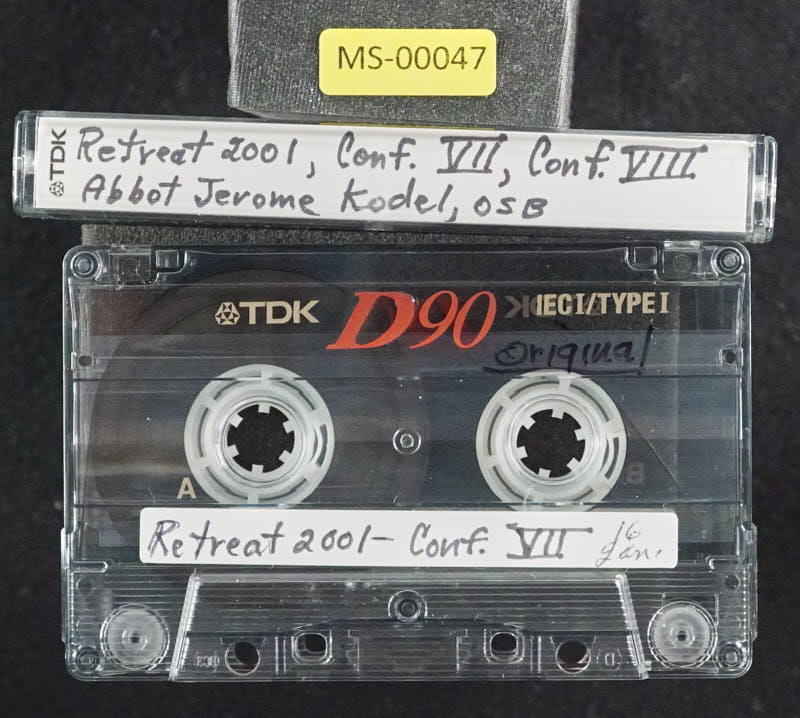
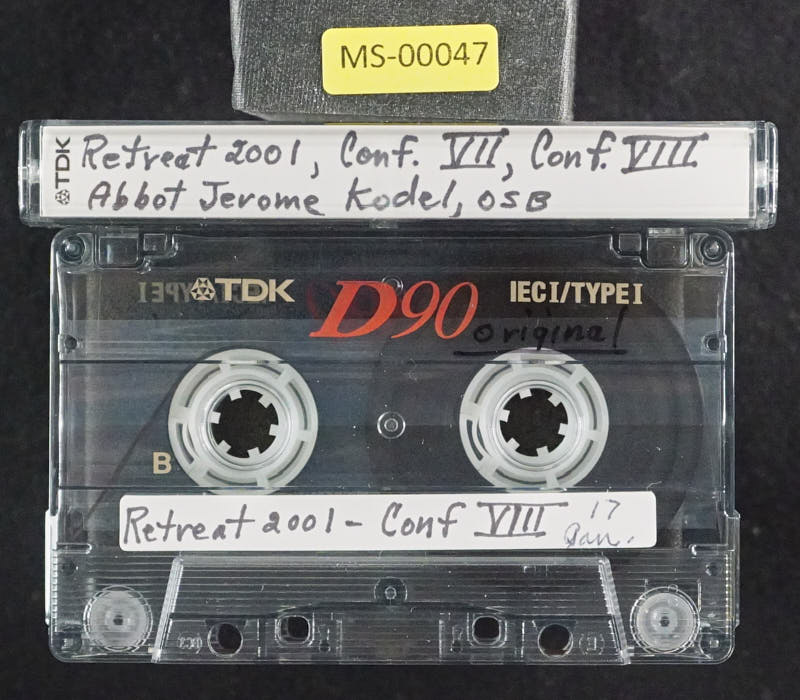
AI Vision - Possible Values from Photos:
Speaker: Abbot Jerome Kodell, OSB
Possible Title: Retreat 2001, Conf. VII, Conf. VIII
Additional text: original, 16 Jan 7:15 PM, 17 Jan 7:45 AM
@AI-Vision_v002
We saw that when we broke this morning, Jacob had just come from the time with Laban and now he was heading out to meet Esau and he was extremely afraid and he prayed that God would take care of him. However, after he prayed, He selected from his flocks the following presents for his brother Esau, 200 she-goats, 20 he-goats, 200 ewes, 20 rams, 30 milk camels and their young, 40 cows, 10 bulls, 20 she-asses, and 10 he-asses. Just a little token of his esteem. And this, after that prayer, his prayer was really this, oh Lord, I put all my trust in you, but I have to be realistic. It's that sort of prayer. And so he prepares and he says in his mind, if I first appease him with gifts that precede me, then later when I face him, perhaps he will forgive me.
[01:10]
Of course, he's afraid that Esau with 400 men coming will get even. And so he sees him coming and here is, there's already, we see a change in Jacob because it says he divided the children among Leah, Rachel and the two maidservants putting the maids and their children first, Leah and her children next, and Rachel and Joseph last. He himself went on ahead of them, bowing to the ground seven times. So the old Jacob would have come last. He would put everybody in front of him to take the brunt of it, but he goes first. And what happens next is going to change his life. And he's not going to be able to understand it at this time, but it's such a shock to him that it affects his whole life. It's the turning point of his life. He has had, God has sent into his life Rachel to make him love, to make him vulnerable. Laban to give him the same treatment he's been giving everyone else.
[02:16]
And now Esau is going to change him. Because what happens? He thinks Esau's going to kill him. Instead, Esau ran to meet him, embraced him, and flinging himself on his neck, kissed him as he wept. And we find that Esau is far ahead of Jacob on the journey of life, which is a journey of forgiveness. That Esau has forgiven Jacob so long ago, and so deeply that he doesn't even remember the offense. At least there's no evidence. It's never mentioned. And Esau is just glad to see Jacob. Jacob, however, because he is not that far along, doesn't trust it. He thinks that Esau is playing a trick. And so he can't really handle it at that point. Now, it's right here that something very important is happening in the story.
[03:21]
And I think... there begins to be connections with the prodigal son parable of Jesus. And I believe that Jesus' prodigal son story is in many ways a reflection, a meditation on the Jacob story. Because the same thing, almost exactly the same wording takes place when the young man comes back home. This is Luke 15. His father caught sight of him and was deeply moved. He ran out to meet him. threw his arms around his neck and kissed him. The same thing. And the young man is expecting completely the opposite. And so Esau looks around and he says, who are these people? Well, they're my children and wives. And then he says, what did you intend with all these flocks that I encountered? And Jacob answered, it was to gain my Lord's favor. I have plenty. replied Esau.
[04:24]
You should keep what is yours, brother. No, I beg you, said Jacob. If you will do me the favor, please accept this gift from me. Now, there's a little negotiation going on here because in that culture, if you accept a gift from someone, you can't kill them. So Jacob is very concerned. But also, the next thing he says is, To come into your presence is for me like coming into the presence of God. This is really true. This is a visitation from God for him. Now, you're familiar, I know, with the story of Jacob wrestling with the mysterious figure in the night. I just passed over that because it's put right into this section, and I think it's put here as an interpretation of what's happening, that what Jacob is wrestling with is God, but it's also with Esau. Esau is taking the place of God.
[05:25]
In fact, when he takes off, Jacob named the place Peniel, which means face of God. Because I've seen God face to face, yet my life has been spared. And then as we know, he left Peniel or Penuel and he limped because of his hip. He has been changed and he will never walk the same way. but he doesn't know what has happened to him. And so Esau says the next morning, or let's break camp and go together. Jacob is terrified of that. And he says, my Lord, you can see the children are frail. If overdriven in my flocks, if overdriven for a single day, the whole flock will die. You please go ahead of me while I proceed more slowly at the pace of the livestock and the pace of my children. I will join my Lord in Seir. And then Esau says, let me at least put at your disposal a few of my men.
[06:26]
Jacob says, please indulge me in this, my Lord. So Esau goes to Seir. And as soon as he gets over the sand dune, Jacob goes to Sukkoth because he doesn't trust what has happened. But this has affected him deeply. And as he said, I've seen God face to face. He doesn't realize what he's doing, but he has. Then he goes back to Shechem, or to Bethel. And at Bethel, he receives the blessing of God again. And, oh, wait a minute. Before I get there, I want to say this because it's very important. When he wrestles with this mysterious figure in the night, at dawn, The figure asks, the angel asks him, what is your name? Now, the last time somebody asked Jacob that, he lied.
[07:30]
He said, I'm Esau. This time he says, I am Jacob, which is an admission of being the grabby one, who he is. As soon as he says that, he is told, you will be Israel, the one who has contended with God. And now you're ready. They're right on the border. He's ready to take his place as the father of the people. And so he moves on into Israel. And he goes back to Bethel. There he gets rid of the foreign gods they've been carrying. He puts on new clothes, something like, this is probably the antecedent of a religious profession, baptism. God gives him a new name and then repeats the promise. So he's ready. And then... At the end of chapter 35, Isaac dies, and we see after a full life, he dies as an old man and was taken to his kinsmen. And then it just says his sons, Esau and Jacob, buried him.
[08:31]
So they're back together. So it's kind of come full circle. Now the rest of the story of Jacob, and he's not finished yet, takes place or is embedded in the story of Joseph, which begins in chapter 37. At this time, we introduce to Jacob as an old man. He's mellowed somewhat. He's even a loving father. He's concerned about his sons out in the field. He loves Joseph, of course, most of all. But he singles out Joseph, and that will cause him a lot of trouble. because he really doesn't know how to deal with his children, but he loves them all. And as we know, the brothers cannot handle the fact that he loves Joseph and also that Joseph is such a twerp and tells them that they're going to bow.
[09:33]
He has this dream where they're going to bow down to him. And so they are going to kill him. Then they put him in the well. to die then they sell him into slavery and they bring back his coat of many colors that has been dipped in the blood of an animal and they tell their father your son has been killed so the deep wounds going on here and Joseph of course has the evidence and he believes it he didn't have DNA at that time so the story progresses and you know how the I'm not going to tell all that story because it's just what refers to Jacob Joseph goes down, eventually becomes the right-hand man of the Pharaoh in charge of distribution of food during the famine. The famine is extremely terrible in Israel, and so the brothers finally tell Jacob, we have to go to Egypt and get something to eat. So he sends them down, and Joseph recognizes them but doesn't give himself away, and he tells them they don't take Benjamin down because now Jacob has transferred his main
[10:42]
affection from joseph to benjamin he hasn't learned anything yet and so joseph demands that they bring he said don't you have a younger brother they say yes he said well i want to see him and at first jacob because he's still selfish won't let benjamin go even though it would mean into the family but eventually after enough trouble and remember this is all about the wilderness trouble eventually brings him to his senses and to his knees and he sends he sends, uh, Benjamin down and he says, if my son will, um, is going to die, then I will just die and I will put up with it. If I'm to suffer bereavement, I will suffer it. And, um, then, then the scene goes to where Joseph, uh, they come down, they bring Benjamin and Joseph reveals to them who he is. And, um, And there, of course, just as in the case when Esau came to meet Jacob, the brothers are extremely afraid because they know what they did to him.
[11:48]
And they're sure that he's going to kill them or punish them or throw them in prison. But he, just like Esau, is way ahead of them. He has forgiven them. And he's not going to do anything to them. He wants to help them, but they can't see it. And he tells them, when you go back home, bring your brother, bring your father, bring our father. And on the way, no recriminations. Don't be fighting and talking about what happened. He doesn't mention it at all. So they get back to Jacob and they tell him, Joseph is still alive. In fact, it is he who is ruler of all the land of Egypt. He was dumbfounded. He could not believe them. But when they recounted him all that Joseph had told them and when he saw the wagons that Joseph had sent, for his transport, the spirit of their father Jacob revived. Now here's the next connection with the prodigal son. Because it is enough, said Israel, my son Joseph is still alive.
[12:53]
I must go and see him before I die. Now Jacob at this point doesn't say anything to them about what they did. He doesn't say, you lied to me. You told me that Joseph was dead. He doesn't bring it up because now in this last step, he has made the journey to the same place that he saw Joseph have beyond enmity, beyond hatred, over into forgiveness, into life. And he says what the father of the prodigal son said when the elder brother didn't want the younger brother to be received. And he says, we have to celebrate and rejoice. This brother of yours was dead and has come back to life. It's all about life. Don't be digging back there in the past. It doesn't make any difference because the whole thing now is about life. And that's what Jacob says.
[13:54]
He says, it is enough. My son Joseph is still alive. That's enough. I must go and see him before I die. And he doesn't see anything else. And they go. But at this point, for the first time since he wrestled with the angel and was given a new name, the name of the father of the people, this is the first time his name is used. It says, the spirit of their father Jacob revived. It is enough, said Israel. My son Joseph is alive. So he now has come to the stature to be the father of the people. And then things go on. He comes down there. He talks to the Pharaoh. And then he has this prayer, which we just read, where he thanks God for being his shepherd. And he calls him the angel who has delivered me from all harm. And then at the end of chapter 49, he drew his feet into his bed, breathed his last and was taken to his kindred.
[14:57]
So he decided my life is complete. So he puts his feet up and says, I'm not getting out of this bed. And he doesn't. Of course, he gives promises to his children and so forth. And that's the end of the story of Jacob. It started out in the womb, you know, where he was fighting. And then all of these things about the cheating his brother, lying to his father, letting his mother be cursed, and then going over there. and starting to be worked on by God through these people, through Rachel, through Laban, and especially through Esau, he finally gets the message about what life is all about. He finally gets past all of this manipulation, self-centeredness, deception, hatred, and revenge. He gets beyond, they're all beyond revenge. And then he finally can put his feet up and say, it's over.
[16:00]
and he can be called Israel because now he is worthy to be the father of the people. But that's the end of chapter 49, and Genesis has 50 chapters. The 50th chapter is the epilogue, and the epilogue is about us. It's about the sons or the children, the sons of Jacob. Because after Jacob dies, they're still on the journey. They're still full of enmity. They're still full of suspicion. And so after he dies, they're afraid. They don't believe that Joseph has really forgiven them. They think that Joseph is playing an act until Jacob dies so that he can take his revenge and not hurt his father's feelings. But they don't believe he's forgiven them. It's impossible because if you haven't learned how to forgive, it's hard to understand forgiveness. If you haven't learned to love, you can't cope and you don't believe it. because you think everybody is like you.
[17:02]
And so here's what they do. Now that their father was dead, Joseph's brothers became fearful and thought, suppose Joseph has been nursing a grudge against us. See, it's eating it. And now plans to pay us back in full for all the wrong we did him. But Joseph has forgotten all that. So they approached Joseph and they said, and here you can, You can see them making this up as they go. Before your father died, he gave us these instructions. You shall say to Joseph, Jacob begs you to forgive the criminal wrongdoing of your brothers who treated you so cruelly. Please, therefore, forgive the crime that we, the servant of your father's God, committed. And they put in a little commercial for themselves right there. The servants of your father's God. You know, we're both serving the same God, so we're all buddies. When they spoke these words to him, Joseph broke into tears because he sees that the gulf is so great. He can't reach them.
[18:04]
They, however, think that he's sad because he's going to have to kill them. Then his brothers proceeded to fling themselves down before him and said, let us be your slaves. Remember the prodigal son story? The same pattern. Let me be your hired hand. He can't cope. He can't believe that he deserves to be accepted. And so he can't deal with it. And this is the same thing here. They can't believe that they deserve or that Jacob, that Joseph will treat them fairly. Now, what's going to happen is that Joseph is going to be their slave, which is the pattern. It's the same as a pattern of Jesus. He became our slave, our servant, the suffering servant. We can't serve him because of our enmity and hatred and sin until he serves us and frees us. Joseph replied to them, have no fear. Can I take the place of God? See, it's very ironic because just as Esau with Jacob, he is taking the place of God.
[19:07]
He is taking the place of God. Even though you meant harm to me, God meant it for good to achieve his present end, the survival of many people. So he's got the long range view. Therefore, have no fear. I will provide for you and for your children. So he's going to be their servant. By thus speaking kindly to them, he reassured them. So this is the way the story is. The journey is a journey to be able to love. The journey to understand that life is what it's all about, not recriminations about the past, not getting even, not revenge. It's about learning how to forgive And Esau somehow got ahead of Jacob on that journey. Joseph got ahead of Jacob on that journey. But Jacob finally made it.
[20:08]
Now in the final chapter, though, the question is, what about the children? What about us? What about the next generation? Well, we've all got to make the journey. And it's up for grabs whether this group or our group will do it because nobody can do it for you. It's like that bumper sticker that said, God has no grandchildren, only children. And so you can't get it through your father or your mother. And this is the story that leads right to the gospel that those who have come to understand forgiveness and therefore the heart of love become the servants and the slaves of those who are still on the journey. And often they get killed for it. as Jesus did. He forgave, he was full of love, people couldn't handle it, and they had to get rid of him. So the beat goes on. I've got a couple of quotations here that are kind of interpretive of what happens.
[21:16]
This is on the whole idea of human transformation, something like what we read this morning from from Archbishop Bloom. This is from the German poet Goethe. If we take people as they are, we make them worse. If we treat them as if they were what they ought to be, we help them become what they are capable of becoming. Of course, that's been proved many times in this century with psychological, not testing, but testing. programs where people didn't know you know these schools where they they ran these blind programs where teachers were told this is a very bright boy here this is not very bright this is pretty bright and the teacher treated them the way they were told and didn't make any difference what their their natural ability were the ones that the teacher was told were smart and good students actually became good students and the ones he was told were really dull actually became dull or at least they were
[22:21]
It wasn't 100%, but it was pretty interesting. And here's one from Thomas Merton. The saints are what they are, not because their sanctity makes them admirable to others, but because the gift of sainthood makes it possible for them to admire others. It gives them a clarity of compassion that can find good in the most terrible criminals. It delivers them from the burden of judging others, condemning others. It teaches them to bring the good out of others, by compassion, mercy, and pardon. So this is a very tremendous biblical model for the journey, the wilderness journey, and for God's action behind the scenes, bringing the right people into your life. And the ones you need may not be the ones you want. For example, of course, Jacob wanted Rachel. but he didn't like Laban and he certainly was afraid of Esau.
[23:24]
But those were the people that made it possible for God to get to him, God to get through to him. And the same thing in our own lives. We have to trust that God is bringing the right people and we have to just trust as we go. Some of those people are gonna be very hard on us and we don't know why. And we won't know why until it's over. You've heard this, I'm gonna read two more. I'm sure you've heard this one from John Henry Newman about vocation. God has created me to do him some definite service. He has committed some work to me, which he has not committed to another. I have my mission. I may never know it in this life, but I shall be told it in the next. I am a link in a chain. a bond of connection between persons. He has not created me for naught. I shall do good.
[24:26]
I shall do his work. I shall be an angel of peace, a preacher of truth in my own place while not intending it if I do but keep his commandments. Therefore, I will trust him. Whatever, wherever I am, I can never be thrown away. If I am in sickness, my sickness may serve him. In perplexity, my perplexity may serve him. If I am in sorrow, my sorrow may serve him. He does nothing in vain. He knows what he is about. He may take away my friends. He may throw me among strangers. He may make me feel desolate, make my spirit sink, hide my future from me still. He knows what he is about. And then there's a meditation that is called my name.
[25:32]
This will be the last one. I guess you're kind of curious as to who I am. I don't have a regular name. My name depends on you. Call me whatever is in your mind. If you are thinking about something that happened a long time ago, somebody asked you a question. You did not know the answer. That is my name. Perhaps it was raining very hard. That is my name. Or somebody wanted you to do something. You did it. Then they told you that what you did was wrong. Sorry for the mistake. And you had to do something else. That is my name. Perhaps it was a game that you played when you were a child or something that came idly into your mind when you were old and sitting in a chair near the window. That is my name. Or you walked someplace.
[26:32]
There were flowers all around. That is my name. Perhaps you stared into a river. There was somebody near you who loved you. They were about to touch you. You could feel this before it happened. Then it happened. That is my name. Or you were eating something good and for a second forgot what you were eating, but still went on knowing it was good. That is my name. Or you felt bad when she said that thing to you. She could have told it to somebody else, someone who was more familiar with her problems, but she said it to you. That is my name. Perhaps you were lying in bed, almost ready to go to sleep And you laughed at something, a joke unto yourself, a good way to end the day. That is my name. Glory be to the Father, and to the Son, and to the Holy Spirit.
[27:33]
Okay. Oh, yeah. Oh, yeah. So would you say grace over our... Yes, we certainly will. Dear Lord, you're with us. You're on the journey with us in this retreat. We thank you for the opportunity tonight to celebrate your presence among us. We ask you to bless all that we have to share and our sharing of it through Christ our Lord. Amen. Okay. wilderness journey we live the life of the rule and as we progress in this way of life and faith we shall run on the path of God's commandments our hearts overflowing with the inexpressible delight of love it's a way a journey I want to talk about this last conference
[28:48]
Chapter 72 of The Rule, The Good Zeal of Monks. In various ways, this chapter is looked on as the mature fruit of St. Benedict's meditation on what the life of the monk should be. And the lot already called it a synthesis of the rule. Over the time I've been here, I've been happy to be able to read an article. by Sister Aquanata Beckman, which we don't have at Subiaco, on this chapter. And she, too, calls it the high point of the rule or even the climax of the rule. At our Abbey, we read this at the Investiture of Novices, not so much, I think, to enlighten the novice, but to remind us all of what we have professed. Just as there is a wicked zeal of bitterness...
[29:50]
which separates from God and leads to hell. So there is a good zeal which separates from evil and leads to God and everlasting life. This then is the good zeal which monks must foster with fervent love. They should each try to be the first to show respect to the other, supporting with the greatest patience one another's weaknesses. of body and behavior, and earnestly competing in obedience to one another. No one is to pursue what he judges better for himself, but instead what he judges better for someone else. To their fellow monks they show the pure love of brothers, to God-loving fear, to their unfeigned and humble love. Let them prefer nothing whatever to Christ, and may he bring us all together to everlasting life. That last sentence is really the last sentence of the rule.
[30:55]
Chapter 73 is the epilogue. But that he may bring us all together to everlasting life so that we... It's a community endeavor to go to heaven, not just an individual pursuit. And this is really where St. Benedict's emphasis on the community life was very strong. And this chapter, of course, as I just read, contains so many tremendous important ingredients, mutual respect, patience, mutual obedience, fraternal love, reverence of God, love of the superior, preferring nothing whatever to Christ. And it's only the second chapter in the rule which has the idea not the idea maybe, but the phrasing of mutual obedience. Chapter 71, right before that, and chapter 72.
[31:57]
Mutual obedience, they both in a way center on it and there might be a good case that good zeal is in a way equal to mutual obedience or focuses in mutual obedience. Sister Aquanata says that the good zeal that Christ in person is the good zeal or is personified in the good zeal. The good zeal, of course, is equated with most fervent love and so that this chapter is said to be to start where chapter 7 on humility leaves off that you get to the point of love in the 12th step, and here it's expressed even more fully in chapter 72. Obedience, chapter 71 says, is a blessing to be shown by all, a bonum, a gift to God and one another.
[33:11]
And obedience is the way we go to God. And an obedient monk is Himself is a blessing to everyone inside and outside the monastery. The image is given of Jesus obedient unto death in the steps of humility. An obedient person, an obedient monk is a sacrament of Christ for the church and for the world. Abraham in Genesis is told, In you all nations of the earth shall find blessing. And the thing that's emphasized in Abraham, of course, is obedience. He's constantly called as a witness by St. Paul and other places in the New Testament. In you all the nations of the earth shall find blessing. Whereas just the opposite, a disobedient monk, of course, is the opposite.
[34:16]
of the sacrament of Christ and is the opposite of a blessing and is a burden. Obedience, of course, is a blessing to the monk himself. And we have the famous statement of Dante, in his will is our peace. There are a couple of sayings that apply here. I don't know where these came from. They're kind of adages. God gives the best gifts to those who leave the choice to him. Then there's a negative one that says, if you are always trying to get what you deserve, you will get what you deserve. In the beginning of chapter 71, Benedict has a rather startling statement. Obedience is a blessing to be shown by all not only to the abbot, but also to one another as brothers, since we know that it is by this way of obedience that we go to God.
[35:26]
It's not only by obedience to the superior. It says, not only to the abbot, but also to one another as brothers, since we know that it is by this way of obedience that we go to God. Benedictine obedience, therefore, is not fulfilled simply by obeying the commands of the superior or any superior. In a way, I think this is an undeveloped part of the teaching of the rule, at least as far as it affects the whole church. I believe that religious life and maybe even further than that has been affected a whole lot by the concept of obedience, religious obedience or religious life obedience that was enunciated by the Jesuits and the Dominicans in the post-Reformation. But that Benedictine obedience is much broader and you can't just have blind obedience to your superior, but you have to be obedient.
[36:43]
in a much broader way. It says that mutual obedience includes the commands of others besides the abbot. In fact, chapter 71 has been noted, seems to draw back from what it says in the first sentence and go back to the model of obedience that was more typical of the desert and not so much a community obedience. But it wants to, I think, Benedict wants to lay down clearly, he's not saying that you can get around obedience to the superior by saying you're obedient to someone else. It's always in the context of what would be called vertical obedience that you have horizontal obedience. But mutual obedience is mainly, I think, sensitivity and availability to the needs of one another, spoken and unspoken, And often the unspoken need is expressed in weakness.
[37:47]
We have to put up with one another. These verses 5 and 6 may be, like as in the Psalms and sometimes in this literature also, may be just two versions of the same thing. Supporting with greatest patience one another's weaknesses in body or behavior and earnestly competing in obedience to one another. I believe that obedience to one another might be expressed as supporting with the greatest patience one another's weaknesses of body or behavior. Because God shows his will to us day by day, minute by minute, through a life in the community, which minute by minute, is often the needs of one another who represent Christ. Because Christ is present, dominates the whole idea of the rule, present in these abbot, the old, the young, the sick, the guest, everyone.
[38:53]
Competing in obedience to one another, no one pursuing what he judges better for himself, but instead what he judges better for someone else. Mutual obedience, I think, is a central part of what we understand by stability. We have made a covenant with this particular group of people called together by God, and it's this life and this group that mediates God's will to me so that providence or God's design or God's call has put me together and with this particular group and this is a plan that will was made long ago and the consequences will last forever because our eternal destinies are entwined so I have to be sensitive part of my stability my mutual obedience is to be sensitive to the moods the needs the problems the sickness the pressures the weaknesses of my brothers whether they're physical or
[40:07]
emotional or even spiritual, supporting with the greatest patience one another's weaknesses of body or behavior. And of course, others have the responsibility of doing the same for me. And in a community, not speaking of this community, which I don't know, but most community, I know my community, we have different types of people. We have people who borrow things but never return them. We have people who cannot notice that they've got mud on their shoes when they walk on a clean floor. We've got people who never sign up to help. They always have to be assigned. We've got people that don't clean up and so they smell like a camel sometimes in choir. We have people who are never on time and the only way you can make them be on time is to fake them out. We have people that are capable of
[41:08]
but unreliable. And we have people that are very reliable, but not very capable. And when you've got somebody who's both capable and reliable, you have something. We have people who can't hit the urinal. We have people who will take the last thing and leave an empty dish in the icebox. And we always know that we happen to get behind the person who always takes the thing I wanted on the tray. But these are the real down-to-earth daily issues of stability, mutual obedience, and good zeal. So you will not be an obedient Benedictine in the sense of the rule simply by doing what you're told.
[42:10]
You also have to be alert to need. You have to be alert to responding to the people who live with you. And so this is the deep listening that's mentioned in the very first word, the rule, listen. And often, as Job says, it's by suffering that our ears are opened But listening is really the fruit of prayer. It's the purpose of Lectio Divina to be able to see, really see, divine seeing, divine reading, reading the world, reading the signs of the times, reading the community, reading your life, reading the needs of others. It's real. It's contemplation, seeing God in the world. So this, of course, is all... is all just an expression, a precision of the gospel, which is all about love.
[43:17]
And as Paul says, there's only one love, one rule. Everything else is secondary. And Jesus says, the great commandment, love God, love your neighbor. Now love, to love everyone, sounds impossible. And in modern understanding of love, it is impossible because we don't feel that way toward everyone. But love in the gospel and in the rule means simply to do what is best for the other and to want what is best for the other. Whether the other deserves it or not and whether you like him or not. So it's a matter of the will, not a matter of the emotion. And you can love everyone because you can do what is best for everyone and want what is best for everyone. And it's in the practical day by day, minute by minute, doing what is best for the other and wanting what is best for the other.
[44:22]
Sometimes the other needs a compliment. Sometimes the other needs a rebuke. So mutual obedience makes us available to be used by God for the needs of these brothers who have given themselves to God with me and who have been given to me by God as my way to God. So it's a challenge that Benedict says really in that where he says, it's by this way of obedience that we go to God that these brothers that have been given to us are our way to God. And whether we can respond to that or not is the question. and is the challenge. There was a desert father who was asked about two monks, one who fasted and prayed for six days in his cell, the other who tended the sick. The father said, if that brother who carries his fast for six days were to hang himself up by his nostrils, he could not equal the other who does service to the sick.
[45:35]
Of course, that's... also one-sided, but the point is made. On private ownership, Benedict says, monks may not have the free disposal even of their own bodies and wills. Now, in a modern context or sensibility, that sounds completely off the wall. But in Benedict's understanding of good zeal, community life, through obedience, it makes very good sense. We have in our community... We still have a couple of chapters. I don't know if you do here. It's different than it used to be, but once a month we'll have a little chance for people to ask forgiveness for ways they will fit in the community. And always one of the brothers is asked to give a little homily on something from the rule or something from the gospel. And a few years ago, one of the brothers got up and he read something on the... I think out of Romans, on the love of God.
[46:39]
And then he said, he said, I want each of you to ask yourselves, when is the last time one of the members of the community asked you for a favor? He said, if you don't remember, you're in trouble. Because the people who are available get asked. The people who are not available don't get asked. And the people who are available are not mainly the people who are free or the people who are not busy. They're often the busiest ones. But the people who are available you know because of experience and after a while you stop asking the ones who aren't available. Very good point. There's a story about Thomas Jefferson that It was in the springtime, and he was riding on horseback with a number of his advisors, and it had been a lot of rain, and they had to come to this creek that had risen, and it was very high, and horses were going to have to get across by maybe even swimming.
[47:56]
But certainly it was too deep to walk across, and there was a man standing there who was waiting to get across, and he couldn't get across, he didn't have a horse. And when this group came up, He went up to the president and said, sir, may I ride along behind you? And Jefferson said, sure. So he got up and rode across. And when he got to the other side, he put him down and they were going to go on. But the Jefferson and the group went on. But a couple of the people in his entourage held back and they scolded this man. They said, why in the world didn't you ask one of us? why did you have to ask the president to take you across the creek? And he said, oh, he said, I didn't know it was the president. And he said, why did you ask him? He said, he was the only one in the group that looked like he had yes written on his face. When I was teaching this to a novices, one of them said he saw this little sign in somebody's yard.
[49:02]
It said, to each his own, Now leave me alone. And another one then came up with this. He said, it was a bumper sticker. My family and friends, I wish them well. The rest of you can go to hell. So a different attitude. Now there are some, the whole idea of course is incarnation. Incarnation is a very practical thing where salvation comes through people. obviously, first of all, Jesus Christ, but it also passes along day by day. We mediate salvation to one another and certainly in a community of covenant. And so there are things like the eighth step humility that a monk does only what is endorsed by the common rule of the monastery and the example set by his elders. That isn't meant to be a shackle. but it is meant to get us into the community completely, not always to be standing slightly back in judgment, which is a terrible attitude, but to get into the schedule, into the observance, and not to spend your life in sort of a passive aggression all the time as the judge, but incorporate into the community.
[50:23]
Jesus became completely one of us, and we're called to... incorporate ourselves completely into this group. And a big problem that's mentioned these days with vocation work is that because of the great curse, in a way, of individualism in the world, especially in the Western world, that it's very hard for people to become part of a group and not to, in a way, always stand aloof And that there are people that come to the door of monasteries who are not really looking to become part of the group that's already there, but to tailor the group to meet their own needs. And so they're looking for a place where they don't have to change and where they can simply be what they want to be, but have a sort of a pleasant place to live while they're doing it. And the idea, of course, of community life is to... is to incorporate yourself into something that's already there and to let it help you mold yourself or be molded toward the kingdom and the idea of the church.
[51:33]
This is also an idea of the church. And the Catholic idea of the church is that there is a tradition, that we fit into something which is going, not recreating or starting something new every time. The extreme Protestant tradition ideal is that you find a group with which you can do your own thing. Find a group which sees it the way you do, worships the way you like, and then you're able to go Jesus and me to the kingdom. But community is a completely different thing. So we have to be willing as part of the good zeal and mutual obedience to be part of what's going on. Sometimes there's an addiction to be different. And I know I've seen monks who can never do what they're assigned, but always something a little bit different, even if it's harder, because they can't really be told what to do.
[52:41]
And of course, most sinister is what I mentioned. The most sinister offense against mutual obedience and community is passive aggression, holding yourself aloof, from what's been decided on and really drawing attention to yourself is different. Also in mutual obedience, it's an act of charity to take care of your own self, to take care of your own health, your physical health, your psychological health, and especially your spiritual health. And to be concerned that If you are going to be diminished, which we all are, it will not be because of you. You will do the best you can to be as completely healthy in the Lord's service as you can. Next year, I may not be what I am this year, but that shouldn't be my fault. That should be the diminishment somehow of the Lord or by the Lord in my life.
[53:44]
This is mutual obedience for the good of the brothers to be the best we can be. for as long as we can be. In the rule, I wanted to get to this point. In the rule, in chapter 13, there's an emphasis on the Lord's Prayer, which we pray at least twice every day, maybe three or four times. And Benedict's ID said the celebration of laws and vespers must never pass by without the superiors reciting the entire Lord's Prayer, excuse me, at the end for all to hear, because thorns of contention are likely to spring up. Thus warned by the pledge they make to one another in the very words of this prayer, forgive us as we forgive. they may cleanse themselves of this kind of vice."
[54:48]
Benedict is using the Lord's Prayer as a kind of covenant renewal, a kind of opportunity to express forgiveness before the Lord for the lacks that we have done. It even calls this the offenses against the community, this kind of vice. And so every day we have opportunities to recommit ourselves to the covenant, to God and one another, and to renew by dedication this central Benedictine Christian virtue of love. And so as we end this retreat, encourage you and I read you again a few of these these things from the good zeal this then is the good zeal which monks must foster with fervent love they should each try to be the first to show respect to the other supporting with the greatest patience one another's weaknesses of body or behavior and earnestly competing in obedience to one another
[56:12]
No one is to pursue what he judges better for himself, but instead what he judges better for someone else. To their fellow monks, they show the pure love of brothers. To God, loving fear. To their abbot, unfeigned and humble love. Let them prefer nothing whatever to Christ, and may he bring us all together to everlasting life. Glory be to the Father, and to the Son, and to the Holy Spirit. world is happening. Okay. Oh, yes. Again, hope or exodus in the wilderness and the guide and our own weaknesses and our own troubles to God. So, It shouldn't be that much of a bother to us or other people's weaknesses either.
[57:19]
Yeah. Well, of course, I thank you. I enjoyed very much being with you. Your wilderness is my oasis, you know. I actually come back to my wilderness. But I've enjoyed very much being with you. Well, we hope you get here when the winds are warmer. Yeah, yeah. Nice. I had to come and see it. It's a beautiful place. I'd like to be here in the fall sometime. See what it... What was the time period, more or less, where Jacob was in Palestine? Well, it would have been. See, we usually think that Abraham was 1800 B.C., so 1700, 1650. It's kind of general. The age of the patriarchs. What do we give you up? blessing for your journey. You've been a blessing to us. Keep safe, your servant. Lord, hear my prayer, O Lord.
[58:22]
The Lord be with you. Let us pray. Hear our humble plea, Lord, and grant your servant Abba Jerome a safe journey. with all the hazards of travel in this life, let him ever be sheltered by the strength of your salvation. We ask this through Christ our Lord. Amen. So, on your way, welcome back. Any of you monks would like to give us, we'd be very happy to give them a bit of an oasis. To everybody. Yes, they give some escape. You all are I was just wondering, do you all have arrowheads up here? Oh, yeah. Yeah. There was quite, this was quite a, the river, the Chemung River was quite a highway, even in New York areas. Well, as Chesapeake, right, you know, and then up to the lakes and then over into the Ohio and down.
[59:29]
And there's a place not far from us, the local college had done some digs in, and the Of course, you can see the Bluffs ride is almost perpendicular sometimes. At one place, it comes to a triangle. And the river's on this side. But this is heavy woods, and absolutely straight up. And then they would build a kind of a breastworks around the bottom of that triangle. And so they'd meet people. People couldn't come up but wanted to town. And so they were really outnumbered. So it'd be around, man, there's a fort like that here. And then I think it's Tioga down the river a ways. And apparently they kept everybody out until the missionaries started coming. And it broke, you know, that box and house and so on. But anyway, it was quite a mainstream river for the Indians in this area. And so the village was down at the, actually even across the river, apparently. And some of it, of course, there.
[60:31]
And on our property, too, along the river, there are heads in the middle. what they think of the thing for moccasins and all sorts of stuff. It was quite a, you know, a good Indian population here and through here. And then there were some people that discovered where even before our so-called made Native Americans. We have, we do some of that, you know, we have some on our property, too, and what's... Impressive. You just mentioned that. It just popped into my mind that we find arrowheads, you know, or you can tell how old they are by the bases and so forth. And we found some that were, you know, 5,000 B.C. or something on the property or more than that. And we found, well, I think even 6,000 B.C. I don't know what it is, but you can think that that person, there was a person there very... very bright, who made these very, very artful objects, who lived as long before Abraham as we lived after Abraham, because you kind of, all of a sudden, a sense of the whole magnitude of the thing.
[61:49]
And so I pray to those people that were there before us on our property, because I'm sure a lot of them were saints, and they know that they've got an interest in what we're doing there and help us keep it going. So if you're ever in Arkansas, come on down. Now's a pretty good time of the year. It's still cold down there, though, but it won't hold out as long as it does up here. And thanks for the fire.
[62:24]
@Transcribed_UNK
@Text_v005
@Score_95.37