You are currently logged-out. You can log-in or create an account to save favorites and more. more info
Faith's Mystery in Sacramental Life
The talk discusses the profound connection between faith and the sacraments in Catholicism, emphasizing the role of baptism and the bodily resurrection of Jesus as central tenets. The speaker argues for a renewed appreciation of baptism, particularly in the context of the Second Vatican Council's efforts to underscore its significance within the Church. There is a focus on the absurdity and profound mystery of faith, as exhibited in the works of mystics and thinkers, juxtaposed with the rational structure of Church doctrine. The importance of active participation in the living faith community is highlighted, alongside the necessity of understanding one's faith within the communal worship and the historical roles of the baptized.
Referenced Works:
- The Catechism of the Catholic Church: The talk discusses its doctrines and creeds, juxtaposing these structured beliefs against the more mystical aspects of faith.
- The Acts of the Apostles and the Bodily Resurrection: Cited to underscore the historical skepticism and faith surrounding the resurrection of Jesus.
- Blaise Pascal's Wager of Faith: Highlights how this philosophical argument supports faith as a rational, though not necessarily empirical, endeavor.
- T.S. Eliot and Misunderstanding Faith's Meaning: The notion that while doctrines are learned, their meanings are often lost, echoing Eliot's criticism.
- Second Vatican Council Documents (Lumen Gentium): The Council's reforms emphasizing the sacramental and communal aspects of baptism.
- Seven Stanzas at Easter by John Updike: Referenced as an imaginative yet flawed interpretation of the resurrection.
- The Pauline Letters (1 Corinthians 15): Discussed in the context of explaining the mystery of the resurrection and the body of Christ.
- The Doctrine of the Second Vatican Council: Cited particularly on the restoration of the Eucharistic cup's significance.
This summary provides an outline of the speaker's argument and the central texts engaging with Christian faith's mystery, importance of baptism, and challenges of contemporary belief.
AI Suggested Title: Faith's Mystery in Sacramental Life
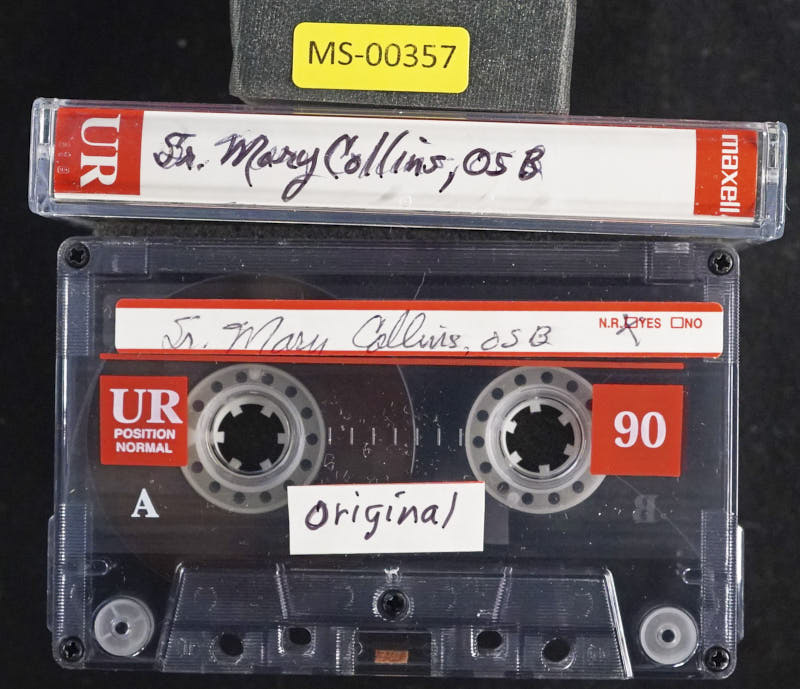
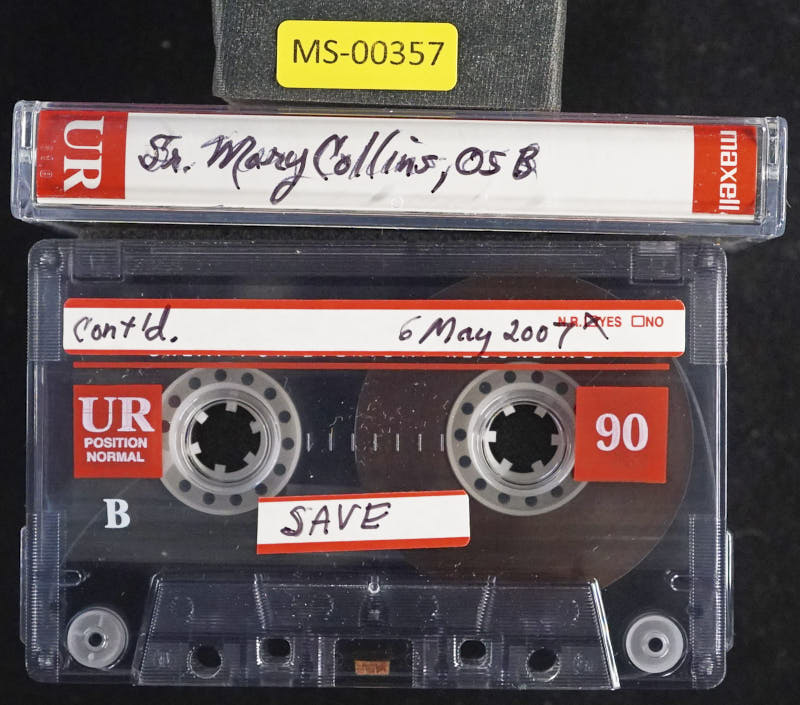
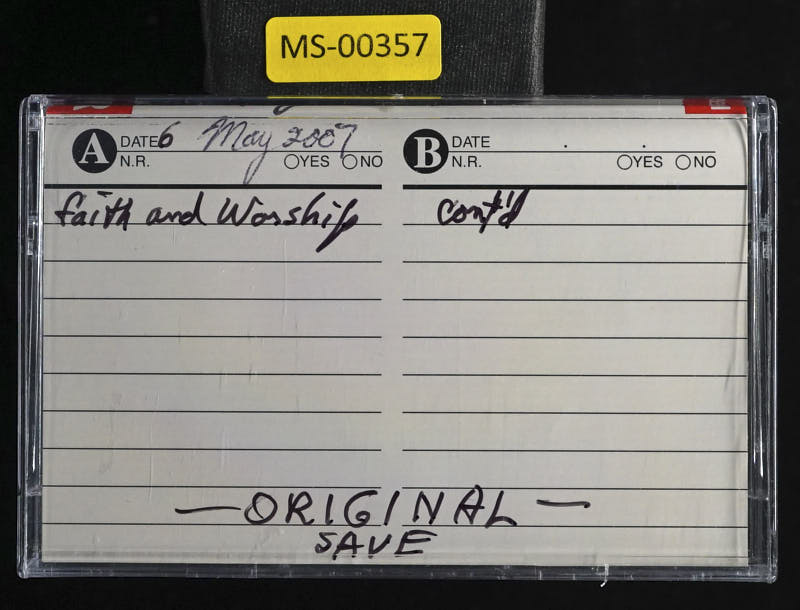
Side: A
Speaker: Sr. Mary Collins, OSB
Location: #N/A
Possible Title: Faith and Worship
Additional text: Original
Side: B
Speaker: Sr. Mary Collins, OSB
Location: #N/A
Possible Title: Contd
Additional text: SAVE
@AI-Vision_v003
The one correction in the introduction, I saw most of you doing the man. 1951 was the founding and the anniversary was 2001. I have been a little young to have been here in 51, although my interests theological were already emerging by then. I'd like to thank Dr. Martin, for the opportunity to return to my Savior. And I'm particularly grateful for the opportunity to speak on the occasion of an event which is named for Father Danus's. I knew Father Danus's name for many years from my earliest interest in liturgical studies, which took me back really to my college days. So it's a privilege to be associated with this particular event.
[01:02]
My title is Faith and Worship. I'd like to begin this presentation on a personal note, if you'll indulge me for a moment. 65 years ago on this date, May 6, I received my first communion. I was six. The white letter triptych certificate I received from Monsignor Richard Kelly that Sunday morning declared in embossed gold letters that May 6, 1942 was the happiest day of my life. The declaration puzzled me. I didn't really understand it because I hadn't had my life yet. But on that day, perhaps even earlier, I began a precocious yet lifelong quest to grow in faith and understanding and to worship in spirit and truth.
[02:11]
That letter at Memorial of my first communion sat on my dresser. Its message confronted me daily until I went away to college. The questions that it raised for me in its claim about happiness, probably the seeds of my Benedictine vocation, and my life's work on theological reflection on sacraments and liturgy. In short, I take faith and worship with the utmost seriousness all my life. In all my life, I have resonated most readily with those believers and worshipers whose life-giving faith finds its truest expression in the absurd and the ironic. Faith is not faith. if there's nothing incomprehensible, if there's nothing but what seems solid and rational. After the certain language of the catechism with its doctrines and creeds, there comes the full absurdity of believing.
[03:16]
After the assuring and reasonable words of the church's most revered pastors and theologians, there comes the religious imagination and the incoherence of the Christian mystics' writings. Catholic novelist, Finally O'Connor, wrote absurd stories, daring her readers to believe that God's redeeming grace flows across the world, extravagantly and indiscriminately. The Apostle Paul dared to speak absurdly about a God whose behavior was foolish, foolish enough to become like one of us. And Paul paid the price for his observed faith. Salvador and Archbishop Oscar Romero, too, played the fool, telling soldiers to lay down their guns to honor and obey with a gun. The Archbishop feared no better than Paul. So coming into our topic, faith and worship, I now propose that you cling to and must cling to seriously two bits of
[04:28]
Observe Catholic faith if you wish to put full faith in the message of Easter and to worship in the Catholic tradition. First, dare to believe that Jesus is raised from the dead and still lives among us here on planet Earth, here in New York State and out in Kansas, too. That defies reasonable scientific thinking. Second, believe that all who are baptized into Christ are together becoming the body of Christ until that body is grown to full stature. That too violates common sense. Yet these are the matters I want to speak about, strange though these claims might seem when we are wearing our practical 21st century Christian, Monica.
[05:32]
My point is not that our current generation... I'm getting a little bit of a hug. Are you getting a hug? Yeah, okay. Let's pray. Okay. I think I just need to be tight. Thank you. Okay. My point is not that our current generation can't state the doctrines of the church. That may be the case. But I think rather, I'd like to cite the poet T.S. Eliot, which says that we have learned the words, but we miss the meaning. I want to focus on baptism. Because baptism is, in my judgment, the most undervalue of the sacraments of the church in the 21st century.
[06:34]
Forty years ago, the bishop of the Second Vatican Council set out to revalue the sacrament, which is the start of Christian life. They did so in several ways. First, they organized the constitution of the church so that the doctrinal chapter on the church is the people of God, the community of the baptized, came before the chapter on the ordained. The editorial ordering affirmed the church's belief that what church members have in common, our baptism into Christ, is prior to the efficacy was just from one another. It is from the communities of the baptized that candidates for ordination are selected. And it is the communities of the baptized, local parishes, It will give potential priests their first Christian formation years before they crossed the threshold of the seminary.
[07:37]
The Constitution reinforces the point about the sensuality of baptism in chapter 6. Chapters 3, 4, and 5 address in turn the ecclesial roles and responsibilities that they ordained. They talk about the identity and mission of laity. and then the charisms of religious community. But chapter six comes back to that notion of what we have in common, the universal call to holiness. Again, underscoring the point that what we have in common is of greater significance than what distinguishes us in our ecclesial roles. The conciliar emphasis on baptism was reinforced by the conciliar decision to restore the adult catechumen. so that newcomers to the people of God might experience Christian formation within the community of believers, that they might learn to pray within the church and to live according to the pattern of Jesus and his faithful disciples living in their own towns and neighborhoods.
[08:46]
Now, the simple practical situation is that 40 years after the restoration of the adult catechumenic, the majority of Catholics in the United States are still baptized as it probably will be for the foreseeable future. But in some ways, that remains a mixed blessing since it reinforces our adult Catholic thinking that baptism is somehow a separate debate. Although the Council sought to revalue baptism and to revalue affirm the ecclesial identity of the laity, that reevaluation is currently somewhat stalled. We can moment the opportunity missed or perhaps see it as an opportunity squandered. We might even try to decide what's to blame or who's to blame for the situation. But I choose to reflect here on the possibility that we as baptized believers might yet come to a reevaluation of baptism.
[09:54]
in the name of Jesus, and to wonder at the transforming implications of being washed in the spirit in the water. To speak of baptism, we must first look at the faith in the church concerning the resurrection of Jesus. So that is the first of what I call incredible beliefs, an unbelievable belief in the bodily resurrection of Jesus from the dead. This is the bedrock of the church. It is a belief that has generated centuries of scorn and ridicule for those who insisted the truth. According to the Acts of the Apostles, when the Apostle Paul proclaimed the bodily resurrection of Jesus in Athens, he got a white brush off. Speaking of the Athenians, you remember, when they heard of the resurrection, What others said, we will hear you again about this.
[10:56]
In the 21st century North America, really believing in the resurrection of Jesus is just as likely to be stopped at or politely dismissed. In our culture of secular cynicism, the full cap of faith can be seen as ludicrous in the public forum. We can't internalize the message the touch belief is, at least. Embarrassing. But belief in the resurrection of Jesus is a matter of faith. It's not something that can be proved to those without faith. Yet the church teaches that belief in the resurrection of Jesus from the dead is reasonable. No matter how puzzling the language associated with resurrection is. Why can this be? Our minds resist. We say, how can something escape all effort to prove it? and yet to be reasonable to believe. There is a way forward, and that is to put our trust, and to trust ourselves, to the living traditions of faith and practice in the community of believers.
[12:05]
You may recall from your school days how the 17th potential mathematician and philosopher Blaise Pascal made his way to have faith, reasoning that he had everything to gain by trusting the God of Jesus Christ and nothing to lose, really, if he lost the wager. Catholic biblical theologian, Luke Timothy Johnson, suggests a conquerable wager is being made by each generation that learns Jesus by trusting itself to the tradition of living faith. It is only by standing fully within the tradition of active and believing community that the mystery of resurrection and be not trusted. How fortunate are those inquirers and those doubters who have the witness of the leading communities to support them. Another personal side. At age 14, my questioning self began to think that the whole of the Catholic faith just might be a hoax.
[13:16]
had seen a not unreasonable possibility, although I wasn't quite ready to decide against me. Still, on more than one dark morning, I stood at the city bus stop in Chicago on route to my Catholic girls' high school, wondering about the hoax factor. Either at school nor at home, did I ever voice these doubts, lest they be under... misunderstood and I'd be chastised, I kept my thoughts to myself. What finally resolved my adolescent uncertainty was more sociological than theological. With the intellectual acumen of 14 years, I decided it was an impossibility that millions and millions of saints and ordinary churchgoers over so many centuries could all have been doomed. So there had to be something to the story of Jesus and the church.
[14:21]
But what? That is much less clear. Since my family and many of our neighbors didn't seem to be bothered, I just had to trust myself to dwell within the tradition, even though I was also, with the wisdom of 14 years, ready to jet to my teachers. I suspected that they simply repeated what they had been told about any greater comprehension than I had about the mystery of resurrection and its unfolding in the church. Fortunately, there always has been a surer way than sociological analysis to learn about the mystery of Jesus and the church's faith in the resurrection and its rolling on us. Rather than counting the broad number of churchgoers, as I had done, half of faith begins in wonder about what God is doing in the world, even in the universe, if you will.
[15:25]
The earliest generations of believers who proclaimed the resurrection of Jesus paid attention to the power and presence of God in their lives. They were awed by their attraction to the bearers of good news. They wondered as they experienced unexpected personal transformation. What led them to faith, to hope, to gratitude, to worship in the name of Jesus? They recognized a power for transformation at work in and through them, a power not their own. Their post-resurrection experience of Jesus is the basis of the one Catholic faith that still lives and grows to worship How did they and how did we experience the resurrected Jesus? Let's turn to the world of the evangelists to re-network how this amazing faith in the resurrection took shape.
[16:32]
In the Gospel of Mark, the three women of the tomb are told by an unidentified young man. Do not be alarmed. You are looking for Jesus of Nazareth, who was crucified. He has been raised. He is not here. Look, there is the place where they lay him. But go tell his disciples in fear that he is going ahead of you to Galilee. You will see him there, just as he told you. Look for the risen Jesus back in Galilee. Why not? Galilee was home to many of the first disciples. the place where there were still sick to be healed, sinners forgiven, prisoners freed, the poor to be served. The Gospel of Mark locates the resurrected Christ's presence just where he had been as long as they had known him, in the middle of their ordinary human lives.
[17:33]
Where else will he be? Now, it is equally written that the risen and glorified Christ Jesus, the very one who had gone into Galilee, had returned to his idol. The tradition proclaims it clearly. We have Luke's account of the Acts of the Apostles of the Ascension of Jesus, a narrative testifying to Jesus' departure from the mundane existence he had shared with his disciples. The scene, Jesus ascending in clouds of glory, has been painted dramatically on great campuses now hanging in a world around art museums for our viewing. Yet to latch onto that image alone, as if Jesus' heavenly dwelling is the full extent of the story, is to miss the heart of a living faith in the church. Fortunately, we don't have to choose between which of these accounts tells us the truth, waiting for us in Galilee or sitting beside the throne of God.
[18:38]
The first believers accepted each affirmation as part of the one revelation that Jesus is alive, risen, glorified. Jesus was no longer with them if they had known him. He was truly present within the mystery of the Trinitarian community with the Father and the Holy Spirit at God's right hand, to use the scriptural metaphor for the royal throne. And yet the risen Christ was present. He appeared, they said. in his resurrection body in Galilee, in Jerusalem, in Damascus, Horde, and Rome. How could this biblical hearing be except that his Holy Spirit had been poured out on those communities of believers whom he had chosen to continue his mission? What the apostolic generation discovered about themselves must be the discovery of every generation. of worshiping believers. Luke Timothy Johnson states, in fact, in seven simple words, the church is the resurrected Lord's body.
[19:56]
Johnson continues, for reasons unknown to us, the risen Lord has chosen this inadequate, frail, and all too fallible body. as its most visible and sustained mode of presence in the world. For reasons unknown to us, there is a Lord who has chosen the inadequate frail and all too fallible body, as its most visible and sustained mode of presence in the world. We can all tell stories of Jesus' failures. I'm sorry. We can tell stories of the church's failures from now until now. go on tomorrow. We all know the dark side of the church. The church's public face is often bruised and white, unsanely to look at, and embarrassment at times to those of us who want to be admired. Yet the church is truly the resurrected body.
[20:57]
We can believe it. If Pascal thought his was a safe bet, God continues to play the great of us. Imagine God the gambler putting all his chips on communities of baptized believers, vetted that we can and will follow Christ, will participate in and complete his mission for the way of the world. Yet of God's extravagant love for the human race, the Holy Spirit of Jesus has been given to all who are baptized in his name and to his death. so that we might continue his mission in the world. Why, then, do we often find Luke's narrative of the ascension of the risen Christ on clouds of glory, preferable to Mark's words about finding Jesus in Galilee, when we think about where Jesus is right now? Why are so many of us a bit more comfortable with the idea of the bodily absence of the risen Christ Jesus?
[22:04]
at least until the second coming. Why do we affirm the real physical presence of Christ in the sacrament of the altar and hold back faith in the sacrament that is the church? Why is absence preferable to the revelation that Christ truly lives now in the church as it courses through human history? Both documents are observing a common sense world, but the revelation of God made in Jesus Christ calls us beyond common sense to awareness of history. What reasonable modern person can make sense of any of this? Consider the poem John Updike had several decades ago. We know John Updike primarily as a novelist, but at some point in his past, he was conscripted to write a poem for a local religious arts festival in New England.
[23:05]
The poem is a good try at making a reasonable sense of the resurrection. Unfortunately, the poem gets the resurrection wrong theologically, even though it is reported that Updike won $100 for a festive show for his poem. What the poet describes is a scientifically credible resuscitation of a corpse. But resuscitation is not the apostolic faith of the risen Christ, nor is it faithful to the 2,000-year-old witness of his resurrection in the church. Let me read from the poem, Seven Stanzas at Easter. I type in that. long ago, and found that website very easily. Somebody has posted it this past Easter, so if you're looking for a second hand to Easter, you can find the whole poem.
[24:09]
Update begins. Make no mistake. If heat arose at all, it was as his body. If the cell's dissolution did not reverse, the molecules remit. The amino acids rekindle. the church will fall. It was not as the flowers each soft spring we'd hunt. It was not as his spirit in the mouths and fuddle lines of the eleven costles. It was as his flesh, ours. The same hinged thumbs and toes, the same valve hurt, the pierced, died, withered, paused, and then regathered out of the doing might we spent again. close. That's not God's metaphor, analogy, sidestepping transcendence. Let us walk through the door.
[25:10]
The stone is rolled back, not paper mache, not a stone in the story. And if we will have an angel at the tomb, think of a real angel, roped in real land, spun on a definite moon. Let us not make Let us not seek to make it less monstrous for our own convenience, our own sensitive beauty. Lest, awakened in one unthinkable hour, we are embarrassed by the miracle and crushed by the monstrance. Unfortunately, while the poem engages our imagination, actually it's one of my favorite poems. I have to read it. It's goal is to make the bodily resurrection make sense. The poet's message is not the good news on which the shift is grounded.
[26:13]
We are not believers in Jesus' resuscitation. To paraphrase the poet himself, make no mistake if all that happened was that the cells of distribution reversed and molecules being in. and the amino acids of Kenya. If all that happened was the resuscitation of the corpse, then church is that hoax I'm learning about when I was a school girl at 15 or 14. Trying to get the church's faith in the bodily resurrection of Christ down to a size that fits our common theme has been an occupation of Christians where we fought with the game. The church at Corinth, in the decade of the 50s, had anticipated 21st century churchgoers' desire to make faith in the body of the resurrection more sensible. After Paul had profaned at the Corinthians that Christ had been raised from the dead and called Christ the first fruits of those who have died, he noted, so I'm not going to ask, how are the dead raised?
[27:24]
What kind of body do they have? What kind of body do they have? I have empathy for the Corinthians confused by Paul's teaching. I long found that the power of 1 Corinthians 15 was evasive, where he wrote of heavenly bodies and earthly bodies, knowing that the glory of the heavenly body is one thing and that of the earth weight is another. Corinthians and we might not have been so confused if they and we paid better attention to what Paul had said in chapter 12 of his letter to them. Like the Corinthians, like John have died, I had long wanted Paul to cut the chase. I wanted to know just exactly what the resurrected body of the Lord was by. Yet earlier in that same letter, Paul had been as concrete as he could be about the bodily presence of Christ. the risen Christ in the church in Corinth.
[28:28]
He told the Corinthians that no uncertain times that they were the body of Christ and individually members of it. In that context, Paul had also chided them for betraying their faith in Christ's resurrection. How had they betrayed faith? He pointed to their favor of celebrating the Lord's Supper in divisive ways. They were not in line. When you come together, wait for one another. If you're hungry, eat at home. so that when you come together, it will not be free of condemnation. Their failure to honor the body of Christ in the gathered assembly of the baptized was a failure to recognize the mystery of the church, was a failure to honor the one who has had a living body, Jesus Christ. You might think, well, that was back in Corinth. They didn't understand this is modern or post-modern America.
[29:28]
And we might wonder who can be expected to believe that he appears, that is the risen Christ is present whenever the church is visible and openly worshiping in the way of Jesus. Well, we can't and must believe this or the church will fall. Not because of scandals, but because of our lack of faith God's plan for the world's healing and our failure to plead our baptisms. Perhaps the greater scandal than the scandals we have been living to is the scandal by not really leading the message of our baptism. The other thought generation came to believe their own mystery slowly. Slowly they found evidence in their concrete experience that Jesus was alive among them. In a community called church, for example, Peter became a different person.
[30:31]
Courageous, more docile, more humble, more open to new possibility, more ready to suffer for the truth. The early disciples' experience of their transport wide needed interpretation. Just what was going on? Their answer was a response of faith to the ministry of resurrection. Either the living and life-giving Jesus was embodied in this community of disciples who were being filled with his spirit, or he is not risen at all. They came to recognize the incredible truth that they were his body, the only body he would have on earth until he comes again in glory. If the church came into existence as a post-resurrection people who are to be the body of Christ, it's time to speak directly about baptism and the continuing process of making Christians generation after generation.
[31:36]
An anecdote can illustrate the matter. Last weekend, five men and women became new oblates at my monastery. Short autobiographies with photos appeared on community board a week earlier. One candidate's autobiography began with a simple sign, I was born a Catholic. Those of you who know your Tertullian might be registering his objection even at this moment. Tertullian admired the church in the third century. Christians are made, not born. Someone might be born a Jew according to the provisions of the law. Someone might be born with Chippewa or Cherokee tribe blood. But becoming Christian is another matter. Being made Christian is a slow process. But one open to those born into any and every cultural and religious identity, provided only that they wish to love Jesus.
[32:45]
Who makes Christians? God does, and does so to the church in a way that is part of mystery. An admirer of Tertullian, the late priest-theologian, Rabbi Balthazar Fisher, who taught at the Church of the Institute at Trier in Germany, was famous for saying to his graduate students, sheep make sheep. Shepherds don't make sheep. But Pierre probably doesn't know that there has been a very prolific appearance of new sheep, and he didn't make them. Sheep make sheep. Shepherds don't make sheep. Fisher's point was that the shepherd's pastoral role is to guide and protect the flock, but increase comes to the flock. It is the people's task to keep alive in their communities the parent of the wife of Jesus.
[33:56]
Only the rich and varied living witness of baptized believers, the witness of the merciful, of the gentle, of the fiery prophets, only that witness has the power to draw the onceborn to be born again. The conversion stories of centuries repeat the point again and again. Believers who live from faith generate more believers. When asked to know the story of Piconius, the father of a synodical communal monastic life in Egypt, as a young man, Piconius was conscripted into the Roman army, a child soldier of sorts. The army was on a long forced march, and it had to provide for itself as it went, and so it raided and pillaged. Like Procomius reports, he was profoundly touched one day when villagers came out voluntarily to offer provisions to the marchers.
[35:01]
He asked someone, what made them do that? He was told, we are Christians, as though that were an obvious reason for feeding marching soldiers. Years later, Struck by the remembered witness of Michelle Neal, Napoleon was baptized into Christ and became a Christian, a monk, and founder of communities of monks. Christian initiation follows the pattern of the baptism of Jesus. Jesus' baptism was not by war only, not a simple river gap, The Agostara community testifies to us that Jesus was bathed in the spirit of God on that day and is being washed by the spirit and the water, set him free to begin his mission. Baptism, for us, is the public event that publicly introduces God's chosen into the Christian world.
[36:14]
Christians are made just one way, too. the spirit rewired, and the blood. The church initiates its Christian-making activity, remembering and enacting the mystery of what happened at the baptism of Jesus. As babies, we ourselves did not recognize the pattern. Yet at every baptism, those who were once without faith are publicly adopted as God's children in the pattern of Jesus, the firstborn and the only begotten Son. Whenever a pastor has poured water over an infant, whether many years ago or just last Sunday, the Holy Spirit has breathed new life upon the infant through the life-giving breath of the gathered church. It happens every time, even when no more than two or three are gathered in Jesus' name, and the water, too, is sparse. What the apostolic generation came to understand was how much had been revealed to them at the baptism of Jesus, and the simple New Testament accounts, the Gospel accounts, the baptism of Jesus.
[37:28]
It was the Holy Spirit given to them as advocates of all truth who showed them the mystery of what had happened and what was happening in their own lives. the church began to speak of the baptism of Jesus in terms of relationships publicly revealed. Identity deepened and sense of life's purpose clarified. First, relationships. In the very brief accounts of the baptism of Jesus in the New Testament, key relationships were uncovered. In the earliest theologies of the Eastern Church, the baptism of Jesus came to be understood as the occasion upon which, or the occasion when, the divine nature of the Holy Spirit was revealed. That mysterious spirit had been reported all through the Old Testament empowering biblical prophets and kings.
[38:40]
the Eastern Church saw in the narrative of Jesus' baptism a regulation of the divine nature of the Holy Spirit. The churches of the East also came to understand that with the disclosure of the divine nature of the Holy Spirit on Jordan's bank, the mystery of the Trinity, God as Trinitarian communion, was first fully unveiled. Jesus truly human and truly divine. lived within the mysterious communion of his Papa and the Holy Spirit. And these relationships grounded his identity. These same relationships ground support and sustain the lives of all the baptized. Concerning identity, it cannot be surprising that Jesus drew his identity from the relationships just meaning. After baptism, Jesus' sense of friendship led him again and again in mythology.
[39:43]
All the gospels bear witness to this. When the disciples went looking for him, he was often found praying to God, whom he called Father, with greater and greater ease. In the intimacy of that relationship, Jesus came to understand what it would mean to be God's glory. In the intimacy of that relationship, Jesus came to know what he was called to be and to do. In the intimacy of our own community with God, we too have hope to find our way. So we are brought to the question of the witness, not only of the water and the spirit, but also to the witness of the blood. The witness that completes the triad of the spirit, water, and blood, of which we read. Another anecdote.
[40:46]
A neighbor's grandchild was named Christian. He attended Catholic school. One of our sisters taught music to his class. As they were learning lyrics for a communion hymn, the seven-year-old Christian rose from his seat, and he came forward. And he wanted to whisper something. So Sister leaned down, and he whispered in her ear, don't say blood when I'm around. It scares me. Isn't that wonderful? Doesn't everyone named Christian find themselves scared by the prospect? He was certainly not the first or the last Christian to have fear of the blood.
[41:48]
Even Jesus at Gethsemane was anguished at the prospect of his blood death. Yet being made a Christian, taking up a life in the pattern of Jesus requires that we face the blood. The blood is essential to the mystery of the church of the body of the risen and glorified Christ. The pattern of life in Jesus involves and embrace, however reluctant, of pain and suffering, of diminishing and death as part of the package of being human and the beloved God. The doctrine of the church taught the Second Vatican Council expressed this conviction about the witness of the blood. Most forcefully, in the liturgical practice, provision made for the restoration of the Eucharistic cup to all the baptized. In 1969, a general instruction on the Roman Missal pastors were told, the sign of communion is more complete when given under both kinds.
[42:51]
In that form, the sign of the Eucharistic meal appears more clearly. The intention of Christ that the new and eternal covenant be ratified in his blood is better expressed in this way, as is the relation of the Eucharistic banquet to the heavenly banquet. Each subsequent edition of the General Instruction, edited several times, has affirmed the point of the sacramental significance of the Eucharistic Cup. One commentary on developments in the General Instruction from 1959 to 2002 calls it noteworthy that the latest addition authorizes the priest of something that had not been in the early editions to hold the host over the chalice. As he invited the assembly. Previously, only the host was held up for the invitation. The provision is now that both the host and the cup were held up for the invitation. The biblically literate or well-carchized can recognize that gesture of the raised chalice.
[43:59]
the question Jesus asked to his still romantic disciples, James and John. We read in the Gospel of Mark, they said to him, grant to us to sit, why don't you right hand and light your left in your glory? But Jesus said to them, you do not know what you are asking. Are you able to drink the cup that I drink or to be baptized with the baptism of I am to be baptized with? They replied, we are able. Then Jesus said to them, the cup that I drink, you will drink. And with the baptism, which I am baptized, you will be baptized. To take the cup of the new covenant, it should only be the suffering that life affords us as finite and more humans. In the Gospels, according to Matthew, we read, my father, if it is possible, let this cup pass away. That not what I want, but what we want.
[45:01]
We are called to be open to the suffering that is in our lives. We don't have to like it, but we are asked to be open. The churches of the East, as you know, regularly give the cup on the occasion of baptism, even baptism of infants, and to as well as adults in the regular celebration of the liturgy. In doing so, they need to honor the Lord's mandate, take and eat, Take a drink, for this is my body, broken for you, my blood shed for you, but God in heaven. The Catholic Church of the West invited adults to drink the cup for 1,200 years before the practice declined and was then prohibited, and that has only recently been restored. The liturgical pattern for the making of a Christian is people, people of God becoming the body of Christ through the Spirit the water, and water. These three are witnesses to the relationships that are core of our identity and our mission as church.
[46:06]
When the church makes Christians, the initiation process culminates not only in the First Eucharist, the First Union, but in a lifetime of Sunday and sometimes through the daily Eucharistic celebrations with the gathered community believers, listening, praying, and then being sent. In regular Eucharistic worship, the Church publicly proclaims and celebrates the divine and divine human communion revealed in baptism of Jesus. In Eucharistic worship, the Church publicly reclaims the deepest identity as the people of God become the body of Christ. The Church withdraws for a while from the public marketplace, going apart from the dead of the crowd to listen to the Holy Spirit and to pray in Jesus' name before it moves out to all the galleries everywhere to be good news for others and to proclaim good news to them.
[47:12]
Does this crank of faith seem too mystifying for 21st century Americans? Interestingly, the media are reporting this spring, and we'll see stories in various, it's almost as though of a contagion or a fever, but the media reported on a revival of belief on high school and college campuses in the spring of 2007. But as you read, you may find yourself wondering, well, what is it that is the belief that is being stirred on campuses? If those of us who grew up before the council and those of us who lived through the council, let's wait. squander the tradition of living faith, settle for less than the full faith of the church. If we find the tradition of amazing grace, it's too much to be ordered.
[48:12]
We may be unwillingly tying off the life breath of the young who are returning to faith or going into faith. Christians are made, not the ones. Catholic Christians breathe the breath of the Holy Spirit over one another, one generation, the next. So my hope is that we who are gathered in this monastery on May 6, 2007, dare to believe all these things. My hope is that we dare to live with the ministry that we ourselves are resurrected by Christ on earth because the glorified Christ gives us his spirit. My hope is that we dare regularly to go outside to pray as Jesus did together with his disciples. For it is only when we distance ourselves from the dental marketplace that we can hear what the Holy Spirit is saying to the church. My hope is that we dare to witness today and tomorrow to the truth Jesus is showing us about who we are and by whom we are called open and loved and by whom we are sent to heal, to comfort, to encourage, and to love others into new life.
[49:27]
Can you drink the cup that I drink? Don't say pour blood around me. It scares me. I was born in Tampa. Christians are made. You're not walking with questions. Does anyone have any questions? Also in order.
[50:31]
You mentioned artistic expression, how over the years we've seen the ridges of what, say, Renaissance people regarded as the central idea of the resurrection. I'm just wondering how that still affects our ideas and how that can prevent a deeper understanding of the meaning of the resurrection. Artistic expression probably has a much more profound impact on us than text we read. And I think in some way that it's precisely because if it's a strong image and a good image, it's going to register. And our imagination is a powerful, and they are also an important support for coming to faith. But just as all of us have in our minds and hearts of the image of the Last Supper as though the Da Vinci painting had been a big photo.
[51:43]
And this is who was at the Last Supper, and this is what it looked like. I think that there are other images like that that do that, and I think that the Resurrection and Ascension, they're powerful paintings and glorious paintings. But I think the point I was making, they only tell part of the story, and we don't really... see much art that is actually depicted, maybe because it's difficult to do, but depicted the reality of the power of the church as the body of Christ and the presence of Christ. And I think that because we haven't been fed by those kind of imaginary pictures, that it's easy, even though, if you look at the text and the doctrines of the church, the words say it. But I think that that is not our ordinary common sense understanding. So I think that observation is good.
[52:47]
Do you want to say anything more about it? No, I just can't. You said it. Would you see a place being made when sacraments being legal with the factors of not being referred in the first union being made? I don't think I'd go that direction. And the reason I wouldn't is because the church has baptized from the beginning. But I think what probably does need to be, and this is going to be much harder to carry on, is the notion that those who are having things baptized themselves really go through a process of reclaiming the meaning of the baptism of their children and then take seriously and need some help in, you know, taking seriously the responsibility of bringing that faith alive in their children. I remember when I was at the University, there was a sister from New Orleans who had finished teaching.
[53:49]
She'd been home at teaching for years and so on, and she decided she wanted to change at the end of her life, and so she decided to come and study canon law. And after she studied canon law, she came to the department, which I care, and she asked, could she teach a course on canon law to undergraduates? And I'm thinking, what is this going to be? But the head of the canon law department said, you know, really listen to it. So we let her put together a syllabus, and we offered it, and not surprisingly, there were students who had learned canon law. But what she did was absolutely amazing. For example, the canon law's parents were the first teachers of their children. And out of her homemade background, I'd heard the students talking to her. The students were really excited because she pointed out to them all the ways they could do that. You know, you take the baby, you put the baby in the crib, or you take the baby out of the crib, make sure there was a crucifix there, and from the time the baby was infant, you know, have the child touch the cross.
[54:53]
You know, just take and trace. She thought of all kinds of ways that they really could do that. And what was exciting is that the students were excited to discover how ordinary these things were. You know, the text that parents and the first teachers of their children sounds like drilling them on questions and answers. And she was so fresh about what's involved. So it isn't that the problem is that, you know, whether the infant is the right subject. It's whether the adult church believes enough in the mystery of baptism and the fact that we breathe the faith from one generation to the next. And because I think that we don't always have that sense that sheep make sheep, and it's the shepherds who make the sheep, that we're looking for the authorities to do something to fix this, when the increase comes from within the flock.
[55:53]
I'm very interested in what you said about the Eastern Church saying that baptism brought forth the Holy Spirit or made the Holy Spirit. I think that's something that we don't have. Can you and Laura comment? Well, all I can say is that maybe you just say a little bit more about what I said, but I think that what the Eastern Church developed about rich theology of the Holy Spirit that the Western Church did not develop. And so the Western Church has really only been... It's not the Western Church ever denied it. It's just that it wasn't ever amplified and developed. But the Eastern Church really saw in the narrative that while the Spirit of God is spoken of in the stories of the prophets and it's... mentioned the anointing of kings and so on.
[56:56]
That spirit's identity was never totally, you know, named in the Old Testament as God. But in the, they saw it in the narrative of the glory of Jesus, the revelation that the spirit coming from God and with Jesus speaking, the image of Jesus as the son of God. But in this, there was a revelation of the The identity of the Holy Spirit and the revelation of the Trinity in that particular, and that of Jesus' communion in the Trinity and our communion in Jesus in baptism, being drawn into the Trinity. So it's a very strong image of baptism and a very strong image of what is being revealed in the stories. I can't remember the ceremony of baptism, but do... Is it mentioned when in the formal baptismal thing of receiving the Holy Spirit?
[57:58]
There is that phrase at that time isn't there, but there are prayers that indicate the presence of the Holy Spirit. But one of the things that has also happened is that, again, the Eastern Church, when it does a sacrament of initiation, either in the Bible, infancy or adulthood, whenever they baptize. In a single act, there's the baptism, the Lenten, and the Eucharist all in one event. Whereas the Western Church, these things got separated after a while. And so we end up thinking that baptism is washing Eucharist comfort. And that somehow the Holy Spirit doesn't occur to confirmation. which, of course, is a confusion that becomes very difficult to work with because it does, again, displace the mystery of baptism and the power of baptism.
[59:05]
And from the moment of our baptism, the spirit is being poured out and breathed from within the church on the next generation. So the adult right of christianity Christian initiation makes that clearer but actually right now in church we have a kind of a divided mind in the sense that when we that the law is proper to that kind of adults at the white Christian initiation for example is easier that there is the full celebration of Baptist Confirmation Eucharist but if you do it with children you still do it to pieces and out of water baptism, Eucharist. Well, actually, baptism, penance, Eucharist, and confirmation. And so, again, I think that it's our practice that gives us, tends to downplay the power of the baptism we met.
[60:08]
Yes. Sister, one of the pastoral questions and problems today, of course, which people and priests are tasting, is whether to baptize the baby whose parents have not taken faith, who have been married, I think, like the church, just whatever reason. Some priests are willing to do it, and some priests refuse to baptize that baby. After what you said today, I was wondering if you wouldn't mind telling us how you weighed in on that question. I think... Actually, I'm not in the pastoral situation where I have to weigh in. But as an academic, I would say that probably the best pastoral situation is case by case. And the reason I say that is that it may be the case that whatever the parental situation is, is complicated by a whole variety of things. Perhaps the child's born to a second marriage and was a remarriage.
[61:14]
but the faith of the people isn't really an issue, but the relationship with church law and so on is a problem. But I think also you've got the issue of supportive family. You know, it can't be that a couple could come in and say they want the baby baptized. They act in a position where the laws of the church have, or their own choices have been, But they, in fact, have a family that is going to provide support for this child. So I think past the week that it's probably necessary to understand the situation of those who are bringing the child forward. Chris, do you want to say something about that? Well, I'm so glad someone raised that question, because there is a situation. Here's a baby. I'm not going to limbo now. I mean, he needs to be baptized, he just needs to be loved.
[62:19]
And the parents who bring this child to be baptized because someone else thinks it's a good idea. Now, if I've understood what you've been saying, that's a bad idea. It is a bad idea. That's all that's going on. But I think that a conversation... sometimes can lead to some kind of gamble. Whereas if you simply have a post in a bulletin, something that said, don't bother to come and ask for baptism, such and such and such, you never have the conversations that might lead to some discovery that people are more open than they thought they were. But I think you're right now that the limbo has been resolved, and God's love and mercy is affirmative. for any question. Do we just need to bring the numbers in? It's a good question. Yes. What's your thought process on those people who are on this planet who live a very Christ-like life, who've never been baptized or never will be baptized, who obviously are going to be saved?
[63:35]
How do you... How do you think of those? I think that it is the faith of the church, and I think it's my faith, that the Holy Spirit is free to bleed where the Holy Spirit will. And so, in a sense, it's not my concern that I figure out how they're all I think that the concern I really have is helping us as church to understand how we are connected and to believe that the Holy Spirit is working and we see this evident in people who lead wonderful holy lives and we see at the same time that even we who are baptized have not
[64:37]
grasp the message about baptism. And because of that, it can do things that are totally contrary to the spirit of Jesus. One of the stories that touched me just most profoundly years ago, I know if you remember the during the Rwanda crisis, that there was a lot of concern about complicity in the church and the death of hundreds of thousands of millions of people who were killed there. And there were two Dominican sisters that were arrested and tried or in jails in Belgium. And sometime later I ran into a Dominican sister who was from the Belgian community and she knew the sisters and knew the story and she said that her response was, you know, they were baptized. we were very proud as Belgians that we had baptized and converted all these people.
[65:41]
But we didn't evangelize them. And she said, this young superior in this community found herself leading, and I don't know whether she was hootsy or tootsy, I don't know what it was, but whatever she was, the community had members of both tribes in it. And when the trouble started, the community started pulling and binding. And she sided with her own people. and got pulled into it in communities, and then she assisted some people who were involved in the murdering, and so I think she provided kerosene or something like that to set a fire or something. But the notion, what that sister said was, we forgot to evangelize them, that they had not understood the message of the gospel and were still operating like tribal loyalties. And she felt that I mean, she just felt it was a terrible tragedy because somehow or other those who had formed them and brought them to profession and brought them to leadership in the church had never done the task of really proclaiming the message of the gospel.
[66:51]
So there could be terrible breakdowns and tragedies because the faith of the church isn't handed on fully from generation to generation. And on the other hand, you can have people who are outside the church, as you say, who seem to have a full understanding. So it's not an automatic kind of thing. There is really that having to live within the tradition. And that's why I think that for the vitality of the church in the next generation, particularly in this country, that it's got to be believing communities who somehow are there are able to give witness in ways they're credible. You have a right definition of church. Well, I start with the Catholic community, but I also, again, just formed by the doctrine of the legal church. And interestingly, the church's doctrine, if there is one baptism, if we no longer re-baptize, if someone has been baptized,
[68:00]
Baptism is baptism. Christians have been baptized. So in that sense, my sense of church is very broad. Anybody who has been baptized is church. And that, of course, is why it's also important to say that what we have in current baptism is more important than all the stuff that divides us, whether it's because of roles in the church or even that we are divided in a different Christian community. But before all the divisions and world distinctions and so on, there is one baptism. So I have brought understanding of church and baptism. But I also have a very clear sense of the importance of the Catholic community's understanding. And Dougalby at council said that there is a fullness in the Catholic tradition. If we avail ourselves of it, then I'm not sure that all of us who are availing ourselves of all that is in the tradition, but the tradition itself is full of nature.
[69:10]
You mentioned before about the right of Christian initiation of adults and the proper lineup of sacraments. As you know, back in the early 70s, I believe the right was reestablished. And my question has to do, I guess, more research. How is this new rite, which is celebrated at the East of Vigil, and considering that in most parishes, the East of Vigil is the least attended compared to, I want to see your experience outside of the New York area. Also, during the Lenten season is the welcoming, there's the bride of election, there's the scrutiny that's supposed to take place at the Sunday Eucharist. The ceremony was well attended, the plan was well attended. Is it changing in any way the mindset of people about the importance of baptism, the various rituals, whether it's the bride of election, whether it's the scrutinies, and certainly to celebrate
[70:27]
all those sacraments at the Easter vigil in a parish setting, is that refreshing people? Is it reminding them of their own baptism? It's about research has been done to let us know how well it's going. Let me say, first of all, one of the things that has been done is the Bishop Conferences keeping statistics, there were lots of stories that sprinkled up. the diocese had 40,000 people who were going to be receiving, and the diocese had 20,000. So the numbers are going, and I saw in the tablet that the Church of Great Britain was also, you know, the county, and the numbers were significant. But I think that the answer to your question is, does it really make a difference if it does only for those who participate in it? And so you've talked about the weak link of the non-participation.
[71:31]
And some of that kind of gives pastoral guidance information. One of my colleagues at University taught a course for undergraduate called Christian Feasts in the Oceans. She taught it in the spring because she wanted them to do something with the Easter season and the Easter vigil. And so spring was the time to teach the course. And they all had to, as part of their son, they had to go to East Division of Fairchild, but most of them were primarily an East Coast kid, but they came from New England down to Florida. And she said, she ever wrote up an article on what the students reported that was going on on the East Coast and over to them, Florida, to this pretty spot. I had one student telling me, for example, that she had got a son, and she had gone down to visit an aunt in Florida, And she admits her aunt that she had to go to the Easter vigil. So she and her aunt went to the Easter vigil. And she said that the whole Easter vigil was over again, 47 minutes.
[72:36]
Now, there's no, I think they got kind of stupid. So you've got to have some sense that this was not a whole experience. But I also have been at the vigils where the church was packed. But my sense at the beginning, it tends to be pastoral leadership, it tends to be But we've got situations, for example, in terms of pastoral leadership, where McPreece now is responsible for two or three care issues. And so the question of how is all of this happening? Because it takes a lot of pastoral care. But I don't know that the energy has actually been put into research. And it may be a little bit premature yet. But I know that they're looking at numbers. pretty high. And one of the things they're saying now is we really need to sort out those people who are baptized and be stupid. And those who are coming to the church. Because we tend to be putting them together and counting.
[73:38]
But people who have already been baptized are really not too baptized and be stupid. They're being received in the community. And the church's legislation on that says it shouldn't be done to be stupid. Except that there's an exception allowed. But the exception is not become rule. But the sense is, if they really are coming to Hope communion, that could be something of feast day. There's no reason to turn it into a, you know, classical event. But we tend to put it all together. And so that confuses things also. To your question. It was back on the one thing. It clarified to me something that I think you were saying about baptism. by itself doesn't make the Christian if the Christian makes the Christian. So that's, again, underneath, I think, why the church is hesitant to baptize anyone who isn't going to have the support, especially in effect who had no hope without the education of parents or close relatives of grandparents and women, that if they can't be made Christian after they've gone through the initiation moment,
[74:53]
then it isn't going to have any fruit unless divine intervention is miraculous and spectacular. It's hard to think of that the church would be so cruel. And I don't think any priest would let a situation like that go without trying to rectify it. But let me tell you another. I have a friend who investigates every day before he would ever knock back out of China. Let me tell you another story, though. It again shows the complexity of this thing. A Benedictine look from... Atchison Francis. He was a missionary in Brazil. He became bishop of what I call missionary diocese in Brazil. He was one of the dioceses up in the poor northeastern part of Brazil. Very poor. He had a diocese the size of the state of Texas. And he had 11 priests in the diocese. Seven of whom were traps. Who
[75:54]
did do some work, but they didn't, they weren't out. He petitioned Rome to be allowed to set up another alternate program for priestly formation, because he said that when the young people, anybody identified interested, there was no institution of higher education in his whole diocese. In order to go to the seminary, they had to have studied philosophy. But if he sent them out of the state to study, they almost never came back. They just moved on. So he wanted to know if there was somebody. And nobody wanted to answer that question, because it simply didn't fit into the, oh, why don't you pray, how we do priestly formation. So when he made this ad, I'm going to visit three different times. That would be over 15 years. The man is now dead. During, I mean, he regularly reported on how many people they had baptized in the diocese because deacons and other pastors were baptized.
[77:02]
He said, but we're baptized, I don't know, 20,000, 40,000 people a year. They will never have the opportunity in their lifetime to celebrate the Eucharist except very, very rarely. And we get very, very little opportunity for participation anytime the ecclesial community becomes lit. And his question was, should we stop that? And he reported that regularly his question was ignored. So, you know, once you start asking those questions, you begin to recognize that there's a whole other set of questions in the church that really have to be addressed. And if you don't want to get into addressing this, probably better not to notice the question was asked. I think we probably are on a very good point. Thank you.
[78:03]
@Transcribed_UNK
@Text_v005
@Score_88.46