You are currently logged-out. You can log-in or create an account to save favorites and more. more info
Faithfully Integrating Values in Education
AI Suggested Keywords:
Given to Benedictine Juniorates
The talk discusses the challenge of integrating religious and ethical values within educational and monastic settings, focusing particularly on Catholic and Benedictine institutions. It examines historical movements like the spread of monastic ideals from France to Belgium, and the role of influential figures such as Virgil Michael in shaping American liturgical practices. Additionally, the discussion touches on economic ethics, particularly around issues faced by part-time workers, and debates the Catholic character and academic freedom within educational institutions like St. John's University.
Referenced Works and Figures:
- Monsignor Baudouin: Discussed in relation to the monastic movement and its influences.
- Virgil Michel: Referred to as a key figure in importing and expanding liturgical reforms in the United States.
- Gaudium et Spes: Mentioned as a document offering insights into the social justice implications of the liturgy, unlike the Constitution on liturgy.
- Barbara Ehrenreich's "Nickel and Dimed": Highlighted for its critique of labor conditions.
- Thomas Merton: Cited for his views on monastic poverty, contrasting it with actual impoverishment.
- Benedictine Values: Hospitality, stewardship, and community labeled as values shared with secular humanists, questioning what distinctly Catholic values entail.
- The Rule of St. Benedict: Discussed throughout concerning governance and ethical guidance in academic institutions.
The talk emphasizes the historical, liturgical, and ethical intersections of Catholic thought with contemporary educational challenges.
AI Suggested Title: Faithfully Integrating Values in Education
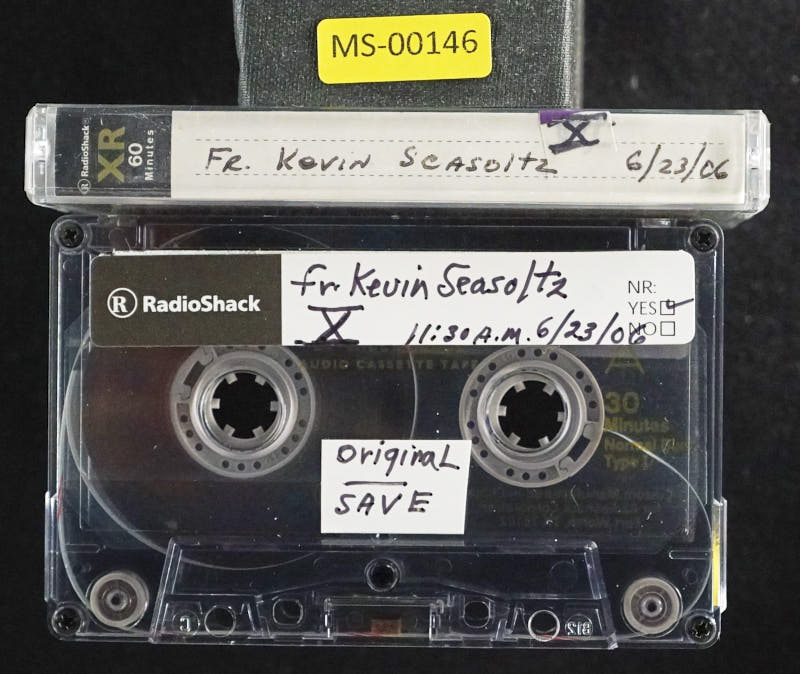

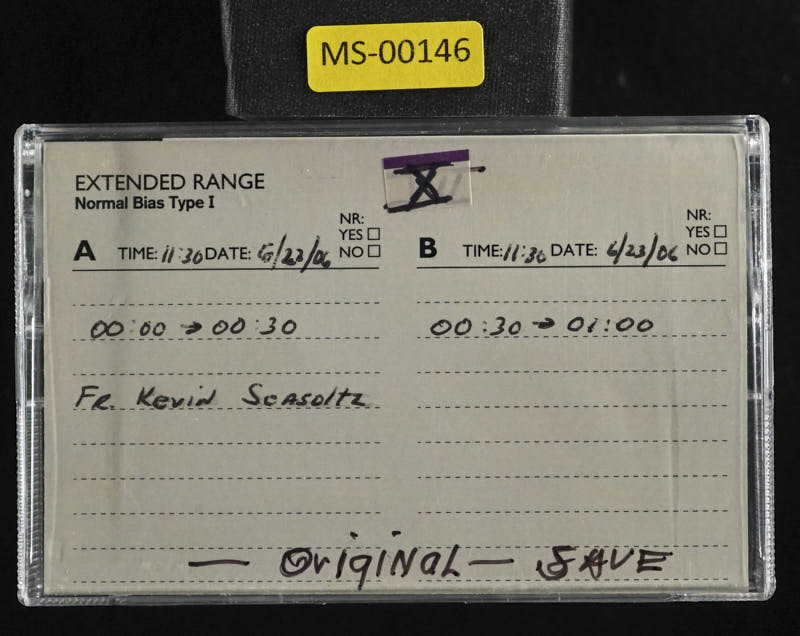
AI Vision - Possible Values from Photos:
Speaker: Fr. Kevin Seasoltz
Additional text: 11:30 A.M.
Side: A
Speaker: Fr. Kevin Seasoltz
Additional text: contd. - 2 min.
Side: B
@AI-Vision_v002
What you do with non-learning pathways to present himself, maybe in the bottom of St. John's, that we have. We have an ecumenical institute where we have ten apartments, you know, families come every year, every semester, for the whole year. We had an Anglican class of prayer on campus, you see, all sorts of groups there. And I'm afraid most people do not know how the canonical, as I say, to advance underput to unfold the sector. So that's the sort of thing I would set out for you. I just, in conjunction with the class that we just finished, I noticed on the board, when I came in the first day, that Father Cyprian had obviously talked about . You probably know more about this than I do now, but anybody, you know, with the monastic renewal in France, especially at the Solemn, well, it was very, very monastic.
[01:16]
It wasn't much oriented for the power issue of society, because France was a very popular company at that time. But when the Newfoundland did, in fact, move north, to Belgium. He had a whole background involved with young Catholic workers in Belgium. And he in turn then, as you probably know, was exiled. And he ended up at San Josello in Rome teaching. And that's where Virgil Michael came to know me. Michael would be considered founder of the American Church. And when he came back from studies San Anselmo, what he did was bring Lombard-Baudouin's vision back to this country, and in some sense, also enlarged it.
[02:20]
So he also was very convinced that literature should have something important to say to rural communities, because St. John's is a very rural community, which is something very important to say to politics and to the civil justice president. And so then was very much heir to Virgil Michael's tradition. And what is surprising, though, is that the social implications of the liturgy were never spelled out in the Constitution on the Liturgy. It's amazing. It's amazing. Nothing there. You have to go to . And so what has happened then, in the years immediately after the Executive Vanity Council, there was very little talk about the link between liturgy and social justice questions. But in recent years, especially among Methodists,
[03:23]
There's marvelous work being done, has been done, on the relationships between liturgy and ethics. Basically, what I was trying to talk about, it caught the last hour. And I think still much creative work continues to be done in that area. I am quite uncomfortable with much of the abundant literature on spirituality that we find in Barnes & Noble, for example, or in Lenny Patrick bookstores. It is intensely individualistic. Time and time again, you will hear people say, oh, I'm interested in spirituality, but I don't have anything to do with organized religion. I don't want to have anything to do with other people. The community. So it's a... It's a tough battle, if I... I must say, you know, when I read Robert Aaronike's book, Nipple and Die, I was absolutely horrified by her description of Walmart in Minneapolis.
[04:34]
Or the conditions in Minneapolis. You know, we pride ourselves in Minnesota, very prosperous and forward-looking state. Well, the program is going on. And then that force me to make a practical decision. I will not buy at Walmart. I think that's what we have to do. Make decisions about, I won't take your nuts. Somebody, a part of being an accomplice to what I think is evil. The way that poor people are treated. I know the rest of Santa's good thing is that many of them are part-time so they don't get any benefits. You know, that's the sort of thing we need to ask in our colleges and universities and the schools we run. Do we hire all these part-time people so they don't get any benefits?
[05:36]
Oh, that's going on for a year. That's been going on for a year. Of course it has. Of course it has. And I'm just two days ago. No, you can't. You can't. And as I mentioned, I mean, we take our own lifestyle for granted, don't we? It is like living in a welfare state. Anyway, do you remember the responses to what I was... Maybe you don't. I think it does give us a lot. My bachelor's degree is in business administration. At St. Martin's, it's a requirement to have a business set. I don't know if that's a requirement at state school or any other Catholic schools. I think the approach to our program was taught from businessmen. But from an ethical perspective,
[06:40]
And maybe it wasn't so one-sided because there's a lot of corruption in you in the organization. Yes, it was true. They make a lot of recaps, too. So you're just basically trying to say, you know, what's going to be at least of two equals? And what are you going to be more evil than the management? And it's trying to organize it so that, you know, more people have a fair shot. And what is possible? Yeah. What's possible, right? Yeah, he's the two. And it does raise the whole question of the great need for education. Please make people aware of what point. A lot of places think that just because it's legal, it's ethical, that it's okay. And so I would concentrate warning a politician to make the laws that commit, you know, a million of these things. Like if you have so many part-time people, you have to hire. They have to have so many full-time people, you know, where they can't, especially on large corporations.
[07:50]
But if the profit margins are above any certain amount, they have to increase salaries. And they would have to, on the books, show that they're not going to accept the profit. You know, there's lots of ways that they could improve it, but they have to legislate it. It's very interesting. I think the presidents of Catholic universities and Benedictine universities are meeting at St. Joe's next week because our president happens to be the chair of that group. I must confess, you know, I taught at Catholic for many, many years, which was very, very Catholic, I'll tell you, you know, because half the Board of Trustees were bishops and so forth. So, you know, we always insisted on four courses in media studies, four courses in philosophy, you know, try to push that down.
[08:53]
At the present time now, you've got a very, very hard time. But I've been fascinated, for example, I came to St. John's in 1988. And I remembered in an early discussion with community discussion, they were broken up into small groups. And I was very much perplexed, frankly, by what I would call the music Catholic character of the institution. And I remember a very distinguished professor from the language department telling me, well, We're not Catholic, we're multicultural, which really deeply, deeply disturbed me. And then, as you know, most of these institutes have rediscovered what it is. We want to be benedictive now in the same way as the Jesuit call it, just want to be Jesuit.
[09:54]
And all sorts of papers were circulated about that identity. And as I would read them, I would say, Hospitality, Benedictine value. Stewardship, Benedictine value. Community, Benedictine value, yes. But every secular humanist espoused those same values. Every secular humanist. What makes us distinctive is that we are Catholics. Now, if you have a predominantly non-Catholic faculty right now, often happens in our schools, they're apt to say, oh, we don't want to be Catholic because Catholic means the mandato. Everybody's supposed to have a mandato. Or it means no academic freedom.
[10:58]
What I find fascinating is that you analyze Donald Hicklin's rule very carefully. It's Jesus Christ who was sent. Jesus Christ. And so defeat Catholic means somehow that we are able then to articulate not these narrow gospel values of academic freedom, but what are the major gospel themes that Jesus proclaimed? I think some of them are violated in the last hour. And I do think that, you know, people are very unhappy about that. They probably should be teaching elsewhere. That's very threatening, of course, but they can't find jobs elsewhere at the present time. But I do think you would also find that more and more young students who come from Catholic parents, they're keenly interested in understanding and grasping what we would call Catholic value systems.
[12:02]
And I also think, you know, in running a Catholic Benedictic college, it's not simply the Department of Theology, or we did the studies, or whatever you want to call it, or campus ministry not to be Catholic, but what impact, for example, does Christianity have on what is taught in the English department, in the psychology department, in the business department, in the politics department? All those broader areas, you know? I mean, are they doggone things in our curriculum? We did it all by Maria. Where is it? In Michigan someplace. We're down in Florida, in Venice. You know, the college. Or Christmas film college in Virginia. To be at these things. Somebody asked me. Oh, you're talking about the knowledge of sex.
[13:04]
before of companies. There are companies that do do a good job. Well, yes. They are. And there's just not enough publicity. And if you enlarge them, see, I mean, I think what they're doing was a two-fold company. I think they do have some, you mean, they have a lot that are not big. You left toilet paper plant. It's a mile long, 125 acres on the one roof. And if you watch toilet paper, you know, round and round for 20 years, you'd probably over a millionaire. They paid up people quite a while. Yes. So they really don't. People don't feel a need to be here. No, no. And in the real reason, they did well, they did well, they did well. So it is a possibility, and it isn't done. But there's not enough publicity about it. And when you're talking about colleges, I mean, I think it needs to be ethic art within the Catholic colleges and schools with a vocational flavor pool, because that's not done anymore either. We asked a rather embarrassing question of our president recently.
[14:07]
How many Catholic Catholic do you think are on the faculty at St. John? And he estimated, counting the Benedictines, about 30%. Do you find that disturbing? Are the chairs of your department or not? I know what you're at it does. I know what he does. You have to have a long-standing tradition of that to introduce him now. Oh, what does he do? He's the one who hires everyone. How the department can you suggest as a hiring or two? It's amazing. It's amazing.
[15:12]
And this can happen very subtly, you know, the way you're talking. I remember a friend of mine, he taught psychology at the University of Minnesota, and he said to me once, I don't know why you have ever hired so-and-so at St. Jones. He said, out and out secular history in psychology. Well, that means you have no sympathy whatsoever toward religious symbols or ritual behavior or anything else. And then what is very interesting is that man precisely could best become the chair of the faculty, the whole faculty in the university, and also the chair of the psych department. I find that properly. Julie, I'm sorry I didn't get that to you. And it's a couple of things. One of the things that I find difficult in being a member of religious experience prior to entertainment, pay more attention to these kinds of issues and the implications of my purchasing products. But when you enter a community, you no longer purchase as an individual. You purchase as a community. So therefore, I don't have that part of choice.
[16:14]
Another thing I want to throw out is that one of the things that we have started to do at our community is that we've started to look at the implications of our culturalists. You know, what are the ecological, the economic, the social justice, and what we're choosing to pursue. So I'm grateful that there is that there is some movement to it here. And just another thing, just to throw up, I thought we started disturbing that I could go to Benedictine University and study military science. Mm-hmm. We also have a peace and justice major in the university. So this really just concerns those people. But then you ask, well, why are you in this program, Roxy? I could never afford to get an education if I want things.
[17:16]
There you are. It's a military itself isn't bad. In fact, I would say it's important to have military education on a Christian campus where you can educate the people that are future military leaders to act effort. That's a good response. Thomas Merton wants to have an article. We're listening now. Thomas Gartney once gave an article that maintained that moms do not live in poverty. And when I think of my own monastery, I know that we'd have three-star meals a day that were prepared for us by someone else, and they take care of all of our dishes for us. We want our laundry done, we drop it down a shoe that comes back to us in a couple days. If we need drugs, we put them in a receptacle, and when mom goes out and has our drugs for us in the afternoon, true poverty is a man who's not able to afford to go out and buy drugs for his daughter. He's not able to buy drugs. the groceries we have. And it was a really powerful article because it really ascertained that to live poverty really means to live without.
[18:23]
And in many cases, many months don't really do without. How about this, Robert? I always try to make a distinction between, for example, a Franciscan approach to poverty and the Lord Benedictine. We're much more into stewardship, for example. You know, I mean, I don't know how many acres you're We have 2,400 acres of absolutely spectacularly beautiful property. They have that, I mean, I looked at it a lot last year. And they're putting the Oak Savannah back. Oh, we're extremely good. I mean, that's great. Extremely. So it becomes a question, how are we responsible stewardship for this property? And do we, in fact, make it available for others. And not simply, it's simply a fact now, probably, I think at St. John's, for a student to come up, it's probably about $33,000 a year.
[19:26]
It's a lot of money. So can Native Americans, for example, benefit from that? No. But the point that I would make there, how do we make that gorgeous property? and all the facilities somehow available to people who live on the underside of our culture. Yes, by lots of scholarships, but by exercising the right kind of responsible stewardship. It's not easy. In terms of the buildings that we place, Dominic will be delighted to hear this. We have a design committee You know, I want to say, no door can be painted without their approval. And how they can be purchased without their approval, you see? Because it becomes quality, rather than the quantity of things, the cheapness of things.
[20:32]
Somebody's... Oh, I'm sorry, Edward. Edward. I don't know what I'm saying. Listen. I'll probably use the purpose of my system. Yeah. It's also our, it's also the poverty of our opinions. That's our superior decisions we're making. Living our things up. It's, it's, it's, we can see. It's a natural poverty. It's how we execute this thing as opposed to being on a, you know, a bad thing. That's right. It's just a, it's a good place. It's totally important. But I also think, then, the challenge is, for example, when we gather into chapter, is there somebody who is always goading us in the right direction and raising the right question? René McGraw is always doing that in our chapter.
[21:33]
He chairs the Peace Studies program. Always raising the question. For example, how you would do this? I'd happen to be on the Habits Council. And we're looking now for a new academic, or not an academic, but a vice president for finances. And so the job description came through. We still look at it at the council. And I simply raised the question. I said, you know, in Benedict's rule, the procurator is extraordinarily, as I mentioned in here, that he runs the monastery. Extremely important. And they're very clear qualities that are laid out for that person. I said, why cannot we preface this job description for this university position by a brief paragraph relating the vice president for finances to the procurator's role in the monastery? And I said, why also could you not insist on preferential hiring for a Catholic in this position?
[22:39]
Some people would say, oh, you can't ask that. You can't ask that. Especially if it's in your job description. And the response that I got, well, we've never done it. Well, maybe we ought to start. Maybe we ought to start. Yeah. Come on, Peter. Yeah, one of the things that when we were mentioning in your community, there was a discussion about Benedictine and Catholics. as far as colleges and universities that are calling themselves that. Shane Besson had a similar discussion with it going on, and it was brought up in a meeting at its conference, so there was some input a few times and a lot of listening. One of the things that I felt was missing in all those things that everybody arrived at is the matter of, you know, what is the great motto of Benedict, aura and labor? Okay, how about aura? is there any process where prayer is encouraged?
[23:49]
I.e., to have a schedule where monks and anybody else would like to come pray at prayer times of a monastic lifestyle. If you don't do that, you're kind of muting your benedictism if you can't even fit it in a schedule. Another thing would be, in the case of prayer, would be at perhaps, just one idea, but there's countless. The advocate could have a prayer that every class would pray a week, you know, for a week at a time, and there'd be a prayer for the week from the Archive, you know, the Chancellor. And it could be something about locations at one time, something else at another time, about peace and justice at another time, and so on. So anyway, there's all, but that's a You know, that's half of what we claim we are. And I'll be embarrassed by it. See you. Are you too wrapped up in the business of business?
[24:52]
Business of business. How? For getting a real identity? It's not easy. It's not easy. We have to appreciate the complexity of... of hiring, for example, somebody who was able to handle multi-million dollar budgets. Not easy. But there are ways, I think, you know, of becoming increasingly, you know, I talked about experience and understanding. You look at this world that I live in, it's extraordinarily complex. We have some understanding of complexity. Before I begin to make judgments, and there are, you know, as Julia points out, there are some very concrete decisions that I can make.
[25:57]
If I had to go out and buy clothes, where do I go to buy them? Well, when do I buy them? I've been in August and January whenever she's on sale. I'm in a lot of the books now. The liturgical press are being printed in China now. It's like a slave labor. It is. It is. It is. Anything else? Do you have any comments on the relationship between abbeys and our schools? Because there's definitely occurrence in places that use the schools as burdens, as much burdens, as destructions from the monastic life, and taking the true monastic spirits.
[27:10]
And if you're going out of school, you're right. You need tremendous involvement. Yes, that's right. And I think it's part of the history of most of the communities here. Most of us. Part of our history. And I don't think we're always three men to abdicate that history. We're struggling right now at St. John's on behalf of the whole past year. The university and the board of regents would like to be separately incorporation. We also have a coordinate relationship with the College of St. Benedict, you see, so that every department is coordinated across the board. I am adamantly opposed to separate incorporation, frankly. Frankly, I'm adamantly opposed. Because I really feel that if the university is separately incorporated, the chapter then loses all authority over the university, apart from electing a small number of monks to the Board of Trustees.
[28:25]
We then become the spokespersons for the university. And perhaps especially, the School of Theology is the only graduate program that we have at St. John's. And I think inevitably, I think it's always been the stepchild. It will be more the stepchild if the university gets separately. You know, and the Board of Regents folks will say to me, well, the number of Benedictines, you probably have 60-some Benedictines involved in the university right now. They would say, the number's decreasing. And I would say, I don't care about the numbers, but I want the people who are in major positions to be articulate about Catholic Benedictine boundaries. And not to be shy about it. And we should be learning from St. Ben's, you see, which did go the route of separating incorporation about, oh, I think in the 60s.
[29:31]
And I would ask them, How much involvement do the nuns have in the running of that college over there? Just about none. So I hope we don't simply end up collecting rent and selling Johnny Grant. Is it 2-0 on a board? On the board of trustees of Benedictine? Is it separately incorporated? Yes. And he's still on the grounds. See, even we as a council, the Adventist Council, we formulated all these reserve powers. But then when we got the report from the Board of Regents, all the reserve powers are in the hands of these monks who are on the board. So the chapter would never go wrong. It's Just St.
[30:33]
Leo's landed with the same problem. They really gave away the college when they got it started. And originally we had controlling interest, but then it happened where they added more members in and they slowly got edged out as far as controlling. We still have a couple seats, but we no longer have any say worthwhile in the college, and we don't what the new rent on the property is essentially given to the late board of trustees. And that's one thing you always have to look at if you're ever going to do the separation and make sure that you don't need the property and that you always will have control of it. See, one of the advantages and the advantage of being separately incorporated is you're not liable then to major suits. We're one corporation at St. John. The Abbey, the liturgical press, the preparatory school, and the university.
[31:42]
Our college was separately incorporated in the late 60s, and it was always positive because the monks could no longer maintain faculty, and we were we were viewed as holding the school back and expanding. Your high school is not separately incorporated. It is. You're much more involved. I get the impression that we have much more control over the high school. But that had always been presented to me as a positive thing, a separate incorporation. That was very fashionable in the 60s, as you say. And then I read A Sensitive Place, one of the essays in there, published by St. John's. And I predicted what it was talked about, the longest chapter being in the history, from 68 or 69. Oh, yes. Jeremy Murphy was his name. Yeah, and even a quote against that, found it very inspiring, very interesting.
[32:44]
So, nothing else. Well, I'm not going to start another paper. I'm going to let you go. So I'll see you tomorrow morning at 10.30.
[32:58]
@Transcribed_UNK
@Text_v005
@Score_87.97