You are currently logged-out. You can log-in or create an account to save favorites and more. more info
Eucharistic Encounters: Beyond Spatial Presence
AI Suggested Keywords:
Given to Benedictine Juniorates
The talk explores the multi-faceted symbolic understanding of the Eucharist within the Church, focusing on the themes of presence—physical, personal, human, and divine. The discussion addresses manifestations of Christ's presence in the Eucharist, the liturgical assembly, and beyond, emphasizing their complementary roles in conveying the omnipresence of the divine. The presentation also critiques the historical and modern practices of Eucharistic reservation and adoration, noting their impact on religious experience and theology, particularly as they reflect needs for visual and contemplative devotion.
Referenced Works:
- Vatican II's Constitution on the Sacred Liturgy: Highlights the presence of Christ in liturgical celebrations as specified in paragraph seven.
- Pope Paul VI's Encyclical "Mysterium Fidei": Explains the multiple presences of Christ in the liturgy, expanding on conciliar teaching, including sacraments and the Church's mission.
- Thomas Aquinas' Theological Discussions: Cited regarding the spiritual nature of Christ's risen body, distinct from the historical Jesus.
- Erik Erikson's Psychological Theories: Referenced to underline the need for visual symbols as focal points in personal identity and spiritual experience.
- Roman Congregation of Divine Worship Directive on Popular Devotions: Advocates for aligning devotions with liturgical celebrations, emphasizing their complementary nature.
Key Concepts and Points:
- Differentiation between physical, personal, human, and divine presence in theological discourse.
- Continuity and discontinuity between the historical Jesus and the risen Christ in terms of divine omnipresence.
- The relationship between Eucharistic elements as real symbols sustaining believers spiritually.
- The historical shifts in Eucharistic piety and theological emphasis, from a focus on the Eucharist as nourishment to visual devotion.
- The pressures for modern Eucharistic devotion to accommodate diverse needs in contemporary religious practice and experiential spirituality.
AI Suggested Title: Embracing Divine Presence in Eucharist
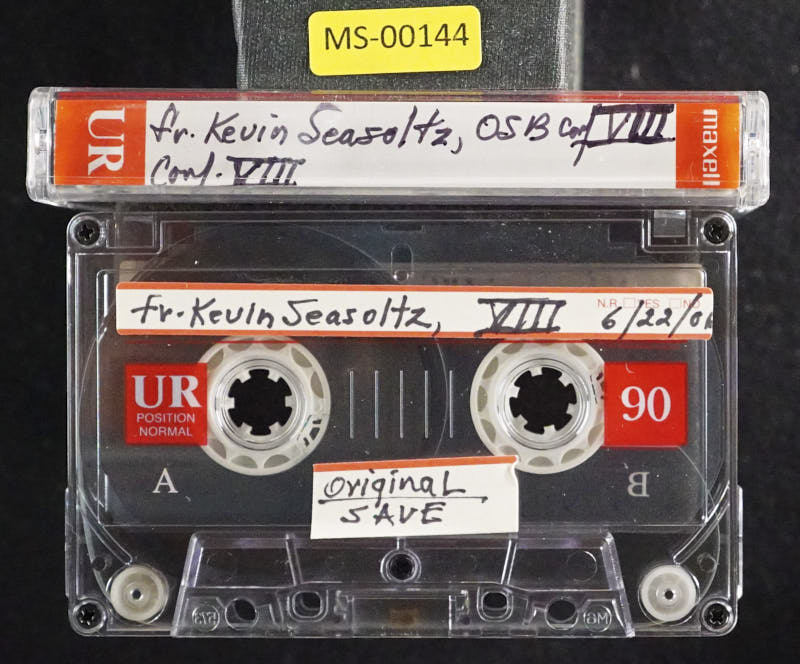
Speaker: Fr. Kevin Seasoltz
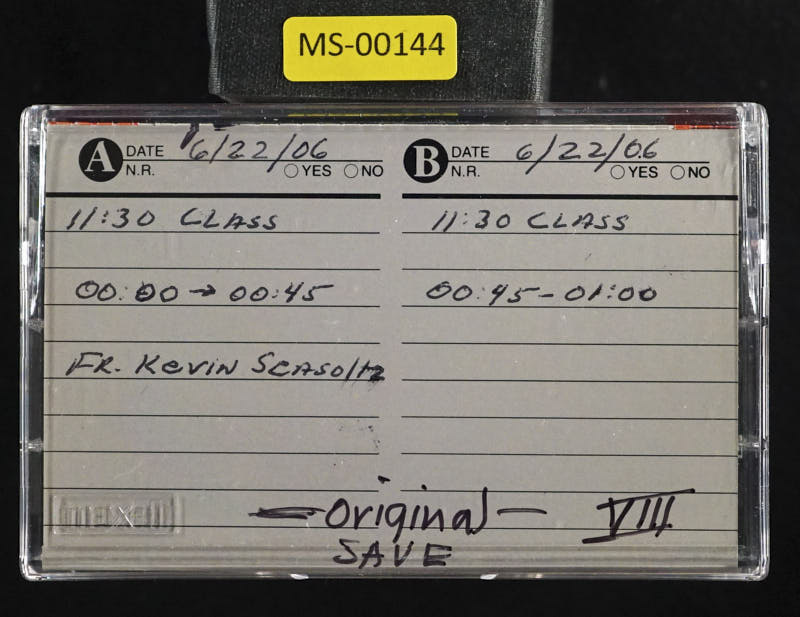
Possible Title: 11:30 Class
Additional text: Original Save VIII
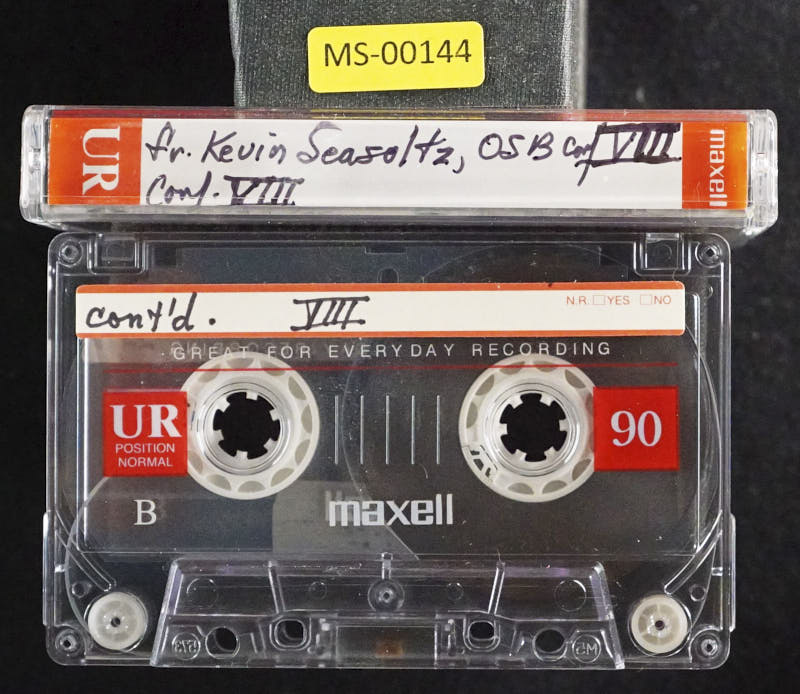
Speaker: Fr. Kevin Seasoltz
Possible Title: 11:30 Class continued
Additional text: Original Save VIII
@AI-Vision_v003
that the Church employs these days to help us come to some understanding of the Eucharist is the symbol of presence. And that term presence is essentially prominent in the writings of contemporary existential philosophers and phenomenologists. As the poetators in turn distinguish between spatial or physical presence, spatial or physical presence, personal presence, and human presence. Theologians, in turn, distinguish between divine presence, presence of the historical Jesus, the presence of the risen Lord Jesus, and the presence of the risen Lord Jesus in the church.
[01:26]
and in the Church's worship, including the Eucharist. I'd like to comment greatly on each part of these. Physical, spatial, material, or bodily presence, all the same thing, physical, spatial, material, or bodily presence, implies that something exists in space next to other material bodies. For example, the chairs in this room occupy a definite space and each chair is surrounded by other chairs. A physical, spatial, material, or bodily presence does not admit degree.
[02:40]
A thing is either present in space or it isn't. Some of us do get spaced out of time. Personal presence. To be a person is above all to have an intellect and a will. Believe in angels, they are persons. They have a body, but they have intellects and will. Consequently, personal presence implies that what knows and loves can relate to other persons and other things through knowledge and love.
[03:49]
Obviously, personal presence admits degrees of intensity. Some persons are morning persons. Some people are night persons, huh? How present are you in the morning or at night? Human presence brings together spatial presence and personal presence because we are body persons. Human presence brings together spatial presence and personal presence because we are body persons.
[04:52]
My body is either here or it's not here. But as a person, I might well be more or less present to other body persons and things which surround me. Divine Presence. Divine Presence is never confined to any particular time or place. The simple reason that God It's everywhere and always. Unfortunately, we're often like the folks in the Old Testament. Our tendency has been to tie God down to particular times and places.
[05:54]
So when we speak of God, We cannot speak in any way of a spatial presence. We cannot attribute a body to God that would limit God as our bodies limit us. Therefore, we cannot say that God has bodily contact with other bodies. God fills all space in all time, but not in a spatial or temporal way. In other words, I think we might do well then to see the world in God rather than God in the world. We live in God.
[06:54]
We are in God, and we have power to be in God. As I mentioned, we, in fact, are the bearers of God's life, but we're certainly not God. And I think we often make what I would call an unfortunate distinction between the natural and the supernatural, as the natural is down here, and the supernatural is up there. As in the world, the universe is a layer of cake. Personally, I prefer to think of it all as a wonderful fruit cake which is saturated through and through with good brandy. This makes sense to me. possesses, is around, and purveys us and our world through the power of the Holy Spirit.
[08:00]
Now, as we've seen this week, God offers us the divine presence always and as a free gift. God's always there. God is present in us in order to make us live, in order to fulfill us, in order to enable us to give our lives to each other in the power of the Spirit. But on God's part, this presence is absolutely unlimited. What I'm saying here is we cannot divide God up in the little parts or parts of it. But as the body persons that we are, we can refuse to be present to God. We can sin.
[09:06]
We can refuse the gift of God's life that comes to us moment by moment in the context of our world and the communities that we live in. Any questions about this so far? You can't be putting God in a box. All right. Yeah. Old comment. I'm sorry. It just occurred to me. I wrote this down. The incarnation would give people. When God became man and became man, that would be an exception. That's what I'm going to do now is to talk about the presence of the historical Jesus and then the presence of the Lord Jesus Christ. Okay, thank you. All right. Some comments then on the presence of Jesus Christ.
[10:18]
First of all, Something about the historical Jesus, the Jesus of Nazareth. In the beginning was the word of God, everywhere and always. But that word became plenty. That word was with God and was God from all eternity. The word existed before creation. But in the incarnation, the Word became one of us with a created body. So we had one person and two natures, one divine and one human. The Word of God took flesh in a humanity that was in no way
[11:23]
you'll be of sin. Hence, it was a humanity that was perfectly open to the light and presence of the Word of God. In other words, God's presence was very real in the historical Jesus, but not limited in any way. God was still everywhere and always, present in a very profound and special way in the historical body of Jesus. So through his body, his person, the divine word, it was revealed to all who saw him, heard him, touched him. And so in a real sense then, we can say, talk about the historical Jesus as having scapegoat or physical presence because he had a historical body situated in time and space.
[12:35]
The historical body of Jesus died but was raised from the dead and so we call the risen Jesus the Christ the Lord Jesus Christ there is continuity between the historical body of Jesus and his risen body but his risen body has become as Paul insists it has become spirit In other words, his risen body is no longer confined to a particular time or place that has become spirit. We can then, I think, as Thomas does, appoint us. We might well speak then of the risen Lord Jesus being present to a time or place
[13:49]
rather than in a time or place. The whole body person of the Lord Jesus has been glorified and not simply his bodiless soul. Therefore, the whole person of the Lord Jesus is present with us through the power of the Holy Spirit. Nothing of the Lord Jesus is far away from us as in a spatially imagined heaven up there. The disciples of Jesus encountered him in his historical body in Palestine. We encounter the Lord Jesus not
[14:51]
in a sense, immediately, but his presence is mediated to us through symbols which are we. We must be very careful then, I think, not to speak of the Lord Jesus as present to us physically or materially. You should probably know some Victorian hymns and prayers did in fact speak of the Lord Jesus as a prisoner in the tabernacle, as though the Lord was somehow confined in a small box. We cannot restrict or confine the Lord Jesus in any way. Any questions or comments about that?
[15:57]
We might not be able to restrict him, but he did feel restriction too. Yes, yes. We kept restrictive on our part. Right, I mean, he felt his body restricted him for his... Are you talking about the historical Jesus? or the risen Lord Jesus Christ. I'm just talking about the suffering between the historical body. Well, there's no doubt. There's no doubt, yes. That's the historical body. Big difference here between the risen Lord Jesus and the historical body. All right. Now, I think one of the most memorable and widely quoted passages of Vatican II's Constitution on the liturgy is found in paragraph 7.
[17:03]
And there, it's very important, it says, it doesn't say Jesus, it says Christ. That's the risen Lord Jesus. Christ is always present in this church, especially in her liturgical celebrations. It goes on and says he is present in the sacrifice of the Mass, not only in the person of his minister, but especially in the Eucharistic species. By his power, he is present in the sacraments, present in his word, present when the church prays and sings. By the way, reference to that conciliar teaching has been very carefully incorporated into the text of the general instruction of the Roman Missal journey. And that document, by the way, alludes further to the expanded formulation about Christ's multiple presences in the liturgy that are found in
[18:18]
Paul VI, 1965 Encyclical, Mysterium Fidei. what Paul did in that encyclical. He expanded, really, the conciliar teaching. He drew attention to the praying and preaching church, drew attention to the works of mercy and justice in the world, and very carefully drew attention to the whole range of pastoral ministry and sacramental activities. So very clearly then, discourse about the Lord's presence has been paramount in the church and discussions about the liturgy, especially the Eucharist, in the last 40 years.
[19:35]
So what I'm going to do now is to speak quite briefly about the various modes of the Lord's presence in the Eucharist. which are specified above all in the constitution of the liturgy. From the outset, I want to affirm that all the modes of the Lord's presence are real. They're all real. They simply differ in the way they express the Lord's omnipresence and must be seen then as Complimentary, not contradictory. Unfortunately, I think many Catholics probably still believe only in one real presence, the real presence under the symbols of red and white.
[20:40]
I've already talked these days about the Lord's real presence in the church, which is the body of Christ. And that means then that the liturgical assembly is really the primary celebrant of the Eucharist. And I think we need to affirm the privacy of people who are the members of the body of Christ. Because they're baptized into that body, And consequently, they share in the priestly, prophetic, and kingly roles of Christ himself as priest, prophet, and king. So as I mentioned, in the Eucharist, the Lord is present not only on the altar table, but also in all those who gather around the altar. The primary reason why the Lord Jesus makes himself present on the altar is so that he might be present in us.
[22:03]
And I think that's often where our faith lies. And I think today, you know, when human life is threatened on so many fronts, it's so important that we emphasize the dignity and the value of the human person, threatened by abortion, threatened by euthanasia, threatened by capital punishment, threatened by sexual exploitation. All right, within the Eucharistic Assembly, then, there are various ministries. And a very special ministry is, in fact, that of the ordained priest. What we need to emphasize is that his ordination is rooted in his baptism. But through his ordination, he is initiated
[23:08]
into the hierarchical structure of the church. Unfortunately, I think we tend to think of the hierarchy as a pyramid, with the ordained at the top and the non-ordained somewhere at the bottom. The term hierarchy, it comes in two Greek words, kiros and arche. And I think if one understands this, then one doesn't get spastic when we talk about the church as hierarchical. A divine institution, the church is hierarchical. And that means that there has to be holy order in the church. Holy order. All right, in other words, it is the function of the ordained to preside over the Eucharist, to see that the assembly is properly ordered, to proclaim the Eucharistic prayer and other prayer.
[24:38]
But he does all that in the name of the assembly. And he nourishes the assembly with the body and the blood of Christ. So it is the function of the ordaining to facilitate the expression and the constructive implementation of the diverse gifts and charisms that are to be found in the assembly of the faithful. You know, in his early letters, Paul reminds us that we are all members of the body of Christ. But in the letter to the Ephesians and the Colossians, the poem author affirms that Christ himself is the head of the body. Well, what does that mean? Well, just as in the human body, the head coordinates the activities of the whole body.
[25:44]
So in the body of Christ, the role of Christ is head. of the body is symbolized by the ordained minister who coordinates the various ministries in the Eucharistic Assembly. But we are all, by baptism, initiated in persona Christi, all of us. The ordained, then, as baptized, is related in a very special way in Persona Christi Capitis, very specially related to Christ as get in the book. Some of the commentators would point out he's in Persona Christi Servi, the person of Christ as a servant of the assembly.
[26:47]
So there is There is an essential difference between the ordained and the non-ordained. Is that clear? Now, among those ministries that the presider coordinates is the ministry of the Word. And we regularly speak the Scriptures as the Word of God. And since Christ is present in His Word, He's also present in the reader and the homilist, as well as in the Scriptures themselves. And so the mission of the church is to proclaim the Word of God
[27:49]
and transmitted faithfully to each generation. And so we Christians are called to listen to the word, the word of God, and respond to God who, in fact, is speaking to us. We care not only for fear of, major difference, by the way, between what I would call a Semitic anthropology and a Greek or Hellenic anthropology. For the Greek, you know, they often had more or less contempt for a matter. And the higher up you went to the body, the more noble you became, with the intellect being primary. But very different Semitic anthropology. It was not the head that was primary, but the heart. And so in their very primitive way, they imagined that there was a little canal that went from the ear down into the heart.
[28:55]
And so the person who was silent, the person who was attentive to light, much went in the ear and much went down into the heart. And so that was the person who became wise and big-hearted. He chatted all the time, never took time out to listen, He never allowed anything to go in the ear. Nothing went down into the heart. And so you were the one who ended up being hard hearted. This is very prominent, by the way, in the sapiential literature, including some of the songs, like 50. But who is it that opens my heart? It's God's word so plain to me that opens my hardened heart. You know, it's interesting in that regard, commentators, we don't pay much attention to this right now, but there was, when the new order of mass was being formulated, there was considerable tension over the placement of the penitential rite.
[30:06]
Now think of your experience of that penitential rite. You know, often I think we come together with a, on a high, singing an entrance in and then we got the in the name of the Father and then a greeting and so forth and then hold to mind your sins you're all rich what happens? does much happen? I don't think so Yes, Senator, this must happen. Well, the way I always see the penitential right was a way of opening, you know, seeing my prophecy and my need for what's to come. And who enables me to do that? Doctor. All right. But there's a penitential right that to me isn't a low point, it's actually a point
[31:10]
of opening up and preparing themselves for what? Well, what I want to emphasize, it's God's spirit that makes that all possible. And taking that into account, this other school at the council wanted to put the penitential rite somewhere else. Where did you put it? And some of the Protestant rites allow for this, by the way. I want to show you. It quite... well how much do you want what I've been saying it's God's word that opens my heart so they would have placed it after the proclamation of the word and the breaking of the word in the hall and the claim was they said Joseph you're not about to sleep on this until they got placed in the wrong clothes I have experienced that in some solutions of the Eucharist, and it does seem to work much more profoundly, at least for me, than anything.
[32:22]
We get the culture, it's a bit. All right. Listening to the word of God, then, really has profound implication. It implies understanding, the embrace of the message, participating in the saving deeds that are proclaimed in the scriptures, and above all, commitment to the person and power of Jesus Christ, the power of the Spirit. Is that the way I experience, for example, the reading in the Bible? And one can't help but think that if I never prepare, if I stumble through the text, I'm sheetingly assembled.
[33:30]
The Gospels tell us that Jesus healed and restored to life with a spoken word. Many of the people in this day perishing willingly because he spoke with power. No one seemed to speak as he spoke. And so the question then that I'm going to ask, if spoken words could heal and restore people to life in those days, why can't spoken words, which are the word of God, have less power today. Certainly our world is full of sick people, demoralized people, people who are really dead while they're still living. There is call in God's word, and I think what the word has done in the past, it can do in the present.
[34:32]
If the ministers of the word, first of all, hear the word in their own hearts, And that the words that they speak in turn to others are God's words. And you must know, one of the major complaints that we hear from lay people is the very poor quality of German captive arms. You know, you go away to Muhammad and you ask, what light did it shed? on my level. Life to mature, if any, on my level. You know, we simply don't have a tradition like the Protestant staff have, of the primacy. They really believe in the real presence of God's Word.
[35:34]
You know, after the Council of Trent they became people of the Word, Roman Catholics became people of the ritual. I do think that what the Word has done in the past can also do in the present. If the ministers of the Word Only hear that one himself. And then proclaim it effectively to others. The Constitution also speaks of the special presence, very special presence of the Lord Jesus under the forms of breaded wine. Now, what I think is also important here, he is equally present. under the sacramental forms of water in baptism, and oil in the sacraments of confirmation, holy orders, and anointing of the sick.
[36:52]
Do we believe that? A couple years ago, they re-carriages in the diocese of St. Cloud. There was a new church put up, and the bishop came to consecrate the church. And, of course, there's a very interesting article, by the way, in the July issue of worship on the whole history and meaning of the consecration of a church and altars, while in a young Holy Cross, he's finishing out the doctorate at Catholic U. Alcoraites Christus, the altar is private. And in the course of the concentration ritual, the ogre really treated almost like a body. And the bishop massages the ogre, you see, with prism.
[37:58]
And it was beautiful just watching him. I mean, the love and the care with which he did that. And then eventually it's clothed, you know, with the overclock. When he went over and sat down, you know, after he was done with all this, the MC came out with a roll of paper towel. And proceeded then to sop up the oil on the oil. I crawled under the pew at that stage. I mean, he obviously didn't believe in the real presence under the symbol of Christmas. I mean, the poor bishop's great care was just kind of canceled, just canceled by what the MC did.
[39:07]
Or water. You know, baptismal water and the baptismal fawn. I mean, is it a bath? I've never forgotten. I was sent out to a parish not too long ago. And unfortunately, a little baby was not to be baptized in the course of the Eucharist after the 11.30 mat. So I piously went back to the baptistry. And the family was all there. And I lifted up the lid. There was nothing in the trunk except a little bottle. We're so steep in what I would call sacramental minimalism. I'm not sure what that symbol said to the family. Now the point here is the special significance of the Eucharistic presence under the symbols of bread and wine.
[40:25]
And there is, from an anthropological point of view, something very distinctive about food and drink. Bread is to be eaten. And wine is to be drunk. Water runs off the body. Oil is absorbed into the body. Words are spoken, and they're no longer heard. If food and drink become one with the human person, they are in fact ingested. in the Eucharist we do not turn the Lord's body and blood into our body and blood through digestion we are rather transformed into the body and blood of God so as I mentioned yesterday the Eucharist is not simply a meal it's a sacramental ritual sacrificial meal
[41:39]
which memorializes the paschal mystery of Jesus Christ, the Son of God, whom the Father has given us, together with the gift of the Holy Spirit. It is, then, a very special symbol. God's love for us, at the same time as to be a special food and drink, nourishes us as we follow the Lord Jesus, leading into the kingdom of God. probably wondering what all this has to do with Eucharistic reservation and adoration of the Eucharist. Talk about that. Any questions before I move on? OK. From earliest times, the Eucharist has been reserved.
[42:46]
Above all, so that it might be taken, as bianicum, for those who are dying, be taken also to those who were not able to participate in the celebration of the Eucharist. And in the Middle Ages, the development of the theory of Eucharistic concomitants That theory developed that affirmed the presence of the body, blood, soul, and divinity of Christ in either the Eucharistic bread or the Eucharistic wine.
[43:47]
And so that provided then theological justification for a growing custom, namely the withdrawal of the cup from the layup. And I think that step, perhaps more than any other, contributed then to a Eucharistic piety centered almost exclusively on the hope. Eucharistic devotion and cult outside mass became, in fact, then, devotion to the Pope. The very feast of Corpus Christi that originated in the Middle Ages is the body of Christ. It's only with the liturgical reforms that now, once again, it's the body and blood of Jesus Christ.
[44:51]
that the cup has been restored to the lately. Fidelity to the words of Jesus, to eat and to drink. Now, four popular customs, expressive of the cult of the Eucharist outside the immediate context of Mass, developed then in the late Middle Ages. First of all, visits with the Blessed Sacrament, precessions with the Blessed Sacrament, exposition, and benediction. Now obviously, these customs reveal a popular change of perception. in the meaning and the purpose of the Eucharistic elements.
[46:00]
Their original significance as food and drink for the people of God, while not lost, was modified and reinterpreted. What you have then is the cultic and devotional attitude which in an earlier era was directed toward objects such as relics, altars, gospel books, was ritually transferred to the Eucharistic species and especially to the host. Now, they're developed in what I would describe as a new mode of Christ's presence under the form of a sacred mandapa.
[47:14]
What is a mandapa? Joseph. What is a mandala? It's a geometric figure, often a circle, sometimes a triangle. It's a geometric figure. And obviously you have a geometric figure then when the host is exposed in a monstrance. And this becomes possible because of a significant shift from leavened bread to unleavened bread. Significant shift they begin.
[48:16]
So that in the unleavened bread it is possible for the host to take on the shape of a mandala. The Eucharist took the form of a light circular waiver. It became then a geometric form of perfection, which is common in many world religions. We're in the New Age spirituality and so forth, but I think we know what I'm talking about. The point here is that by contemplating a mandala, people believed that they were contemplating and communing with the reality behind the four. It says significant references also to the Eastern Church's use of icons.
[49:18]
The Eastern Church, generally, it is the I-bond that replaces the Eucharistic stones. You said they were communicating with the what? Yes, you're talking about the mandolin. You said when they were... Oh, the reality behind the thought. Behind the thought. How did they get to the coast? and then were taken in by the eye in what came to be known as ocular communion. Ocular communion. Resulting in communion with the real presence of Jesus Christ just as realistically as if they were consuming the sacred hosts by eating.
[50:21]
So ocular communion came to replace the actual ingestion of the oath. And of course, at this time, there were many, many restrictions on the lay persons, including religious and nuns especially, major restrictions on the frequency with which they could communicate that liturgy. All right. Vision, a sea, became an increasingly common source of religious experience among Christians. Vision. And from earliest times, vision, and it's been a very common metaphor, or the Christian experience of a transcendent relationship with God.
[51:29]
Thomas Aquinas, for example, described the ultimate condition of humanity in the presence of God in heaven as visio beatifica, as beatific vision. between Roman Catholics and Protestants in the 16th century over the priority of visual or aural, A-U-R-A-L, aural symbols. Protestants favored aural symbols because of their conviction that faith comes above all through hearing Roman Catholics did not deny the importance of proclaiming the gospel and catechizing the faithful. However, the Council of Trent refused to vernacularize the liturgy, with the result that in the post-reprimation church, Roman Catholics tended to emphasize visual experience rather than oral experience in the celebration of the youth.
[52:48]
All you need to do here is look at the Maroque churches. For example, the church of the Jesu, the Jesuit church, you know. All you need to do is look at them. And what they developed into were elaborately ordained theaters, really. They've lavishly decorated walls and ceilings, the altars, Instead of being a table for a meal, the altars took on the appearance of pedestals or large, gold tabernacles. They became platforms for the placement of the monstrance during the exposition of the Eucharist and benediction. Now, the importance of seeing in the development of individuals into mature and responsible adults has been emphasized by a number of modern psychologists, for example, Erickson.
[54:16]
Erickson, for example, has stressed the need for the infant to discover a visual symbol of focused centrality in order to perceive a sense of personal identity and a secure focus in life. The infant normally finds this symbol of focused centrality in the round face of the mother and the eye-to-eye gaze of love and attraction between the mother and the infant. It's fascinating to have exposure to little children. For example, we'll meet somebody at the Epi Medical Institute, a Polish couple with dear little children.
[55:19]
And so her baby said, after she was taking my course on all this stuff, she said, Cynthia, let's draw a mother. This is what she went up with. And what is fascinating, for example, the experience a few years ago of babies in Romania who were left to fend for themselves without any simple photocentrality, they all became schizophrenic. Dr. Spock's famous studies in this regard.
[56:23]
Babies which were taken from their parents and then were fed. The bottle was put on a pole and simply stopped into them. They all became schizophrenic too. The importance of seeing a visual security in people's lives. It's not getting accurate. So Erickson has suggested that all religions seek a vision of sanctioned centrality, a center inhabited by a divine eye that is mediated through symbols of seeing. In other words, what he's saying is that all religions involve a search for a center of security and trust.
[57:26]
A discovery of such a center, he says, begins in earliest childhood and continues throughout life. Now what I'm fascinating is that perhaps the search for a vision of sanctions and reality, I think it might shed light on the desire of many people today, especially more recently, to pray before the tabernacle or to pray before the exposed hope. Perpetual adoration, and so forth, growing in leaps and bounds in a good country. Now, just to begin and just to a conclusion. One of the most obvious features of the Eucharistic liturgy since the Second Vatican Council is that the ritual actions and the elements of the bread and the wine, they are in fact displayed so that everyone can see them.
[58:36]
Very interesting. We talk about the presider now and the altar facing the people. Bread and wine are visible. throughout the literature on the table. And perhaps unconsciously, the matriarchical weak ones have cooperated with the primitive human instinct to see, to desire to see face to face, to gaze and to be gazed upon, participate in ritual of mutual seeing at recognition. So I think it may be argued that the recent liturgical reforms, which intensify the assembly's ability to participate visually in the ritual elements and actions, and the medieval fascination with the post as an object of contemplation, ocular communion,
[59:46]
with God in the Eucharistic way, are both rooted really in the same source, the search for a vision of sanctioned centrality. Now although the Vaticanian reforms of the Lutheran did not abandon certainly visual symbolism, they did in fact subtly shift and center. In the Reformed liturgy, visual attention centers not so much on objects, like parables, or statues, or the tabernacle, or brocaded vestments, or the post in the monsters, or in the tabernacle. Rather, the visual focus is on people, and their actions.
[60:47]
In other words, the visual fulcrum of sanction centrality has shifted away from inert objects toward visual actions themselves of taking, blessing, breaking, and sharing. And so unlike the rather static supplied by the host and the non-students, or in the tabernacle, the visual center of the Reformed Eucharist is in notion. It can't be easily fixed on a single element or ritual gesture. But I want to stress here that neither of these two expressions of visual symbolism need necessarily exclude the other.
[62:05]
The resurgence of Eucharistic devotions in recent years indicates, I think, that the Reformed Eucharist, especially as it's often celebrated, does not satisfy the devotion and need of many people, especially those who come from a frenetic world which is filled with busyness and noise. As they are in fact celebrated, many Eucharistic liturgies do not provide people with either time or space or silence and stillness. Consequently, many people yearning for the peace and joy that contemplation in the presence of the reserved sacrament can provide.
[63:06]
What I want to stress here is that people's needs in this regard person to person. Not everyone experiences these needs with equal intensity. Consequently, and this is the important conclusion, we should not use devotions of any kind as a gauge for evaluating anyone's value. Extremely important. Some marriages where perpetual adoration has been introduced, people are embarrassed. Why aren't you signed up? We have very different needs in this regard. Certainly, Benedict is silent on devotions.
[64:12]
And as you know, practices from one monastic community differ considerably. from monastery to monastery in this regard. What I think is most important is that such devotions always come out of the celebration of the Ugaristic liberty itself and flow back into the celebration. You know, the Roman Congregated Divine Worship and so forth issued this directive on popular devotions a couple years ago. And the opening chapters are extremely good in this regard. Devotion should be consonant to the liturgical celebrations themselves. It's the Eucharistic celebration which is most important. And I have unfortunately got the impression from some people, oh, it's Eucharistic devotion that's most important. Not the man.
[65:15]
So go liturgical action, and devotional practices are meant to empower us to undergo transformation through the power of the Holy Spirit. We might then become effective agents in the establishment of a reign of justice and peace in the world. And I think we need more and more to relate the Eucharist to the enormous problems social justice and peace that we have in our world. Very brief conclusion. The Eucharistic liturgy and Eucharistic devotions, then, they are complementary, not contradictory. And I think you do very well to remember that no symbols, no ritual practices,
[66:18]
even those that are an interval part of the literature itself, exhaust the infinite richness of God's presence in Jesus Christ through the power of the Holy Spirit. God's presence is inexhaustible and is irreducible to any single symbol, any single ritual. both of them laparism contends to our little systems have their day, but Jesus Christ is always more than dead.
[67:00]
@Transcribed_UNK
@Text_v005
@Score_92.46