You are currently logged-out. You can log-in or create an account to save favorites and more. more info
Enduring Suffering with Divine Wisdom
AI Suggested Keywords:
The talk explores the theme of suffering as discussed within wisdom literature, emphasizing its inevitability in human life and questioning its purpose and nature. It examines the implications of suffering in relation to divine justice, using texts such as the Book of Job, Ecclesiastes, and the Lament Psalms to illustrate different perspectives on enduring and understanding suffering's role. The discussion further highlights the concept of maintaining a relationship with God through suffering, whether by crying out to God in distress or finding solace in divine companionship and the promise of life after death as presented in the Wisdom of Solomon.
- Book of Job: Highlights the inadequacy of the theory of retribution and the importance of maintaining a truthful relationship with God during suffering.
- Ecclesiastes (Koheleth): Advises acceptance of life's realities, both joyous and sorrowful, promoting wisdom through the acknowledgment of death and daily life experiences.
- Lament Psalms: Emphasizes the tradition of crying out to God amidst suffering, underscoring the direct communication with the divine as seen in the Psalms, particularly Psalm 88.
- Wisdom of Solomon: Represents a development in the belief of life after death, reframing suffering and death from the perspective of an enduring relationship with God.
- Rule of Saint Benedict: Discusses humility and obedience in enduring suffering, suggesting that acceptance leads to spiritual growth and divine reward.
- Psalm 73: Discusses the dilemma of the prosperity of the wicked and the suffering of the innocent, concluding that trust in God provides solace and stability amidst life's inequities.
AI Suggested Title: Enduring Suffering with Divine Wisdom
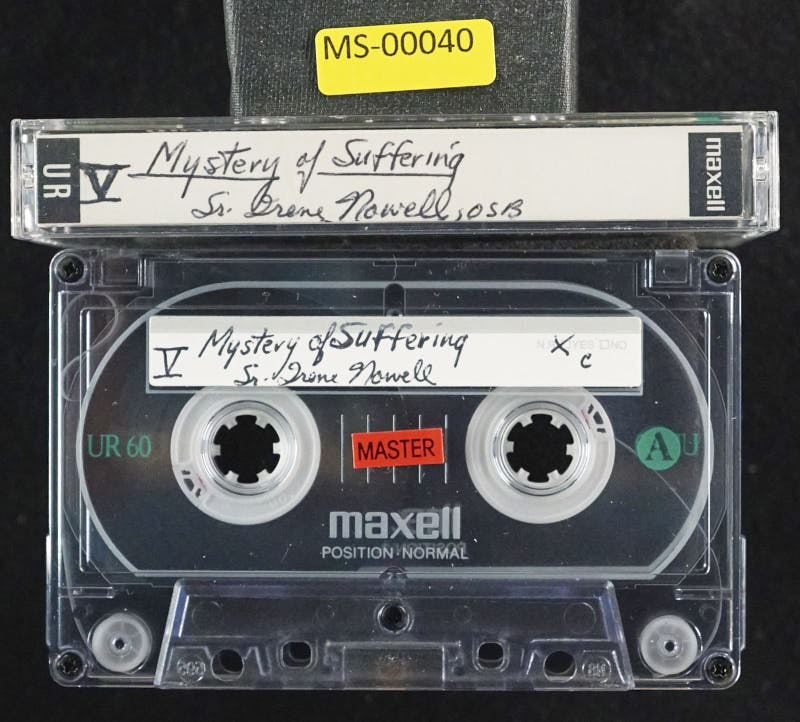


AI Vision - Possible Values from Photos:
Speaker: Sr. Irene Nowell, OSB
Possible Title: Mystery of Suffering
Additional text:
@AI-Vision_v002
works and was present when you made the world, who understands what is pleasing in your eyes and what is conformable with your commands. Send her forth from your holy heavens and from your glorious throne dispatch her, that she may be with us and work with us, that we may know what is your pleasure." The question of suffering is one of the major problems in the wisdom literature. It's one of the major problems in life, for that matter. To choose life, to live every day, to eat from the tree, to be human is to know good and bad. We said the other night Christ learned obedience from what he suffered.
[01:01]
Schopenhauer says the reason that the first thing a baby does is cry is that this life is a life of suffering. Now, I don't buy everything Schopenhauer says, and I think actually that's not why a baby cries. But anyway, it's true that it's impossible in human life to totally escape suffering. Now, the problem... part of the problem anyway of suffering in the wisdom literature is how does suffering fit in human life? Suffering is an absurdity and so how does it fit? Is it punishment from God or is it simply an inevitable part of being human? That's one of the major questions and We haven't solved the question yet. You know, why do good people suffer? Now, part of the problem also has to do with our own idea, our own human idea of what justice is.
[02:14]
That book we're reading at noon, or I think it was at noon, where we had all the things about the shoulds. Is that at noon or at night? Noon. We think we know how life should be. And the way we think life should be is that if you're good, you should be blessed, and if you're bad, you should suffer. And that is the theory of retribution that shows up in Deuteronomy, that the good are blessed and the wicked suffer. Now, the Old Testament knew It didn't work. They knew it didn't work, but the insight that sin is somehow connected to suffering is not a bad insight. You know, that insight goes all the way back to somehow what happened in the garden introduced suffering into human life. And the notion that sin causes suffering
[03:19]
really has a truth in it. The problem with that is that it isn't always the sinner who suffers. Now, we know in society that some of our social ills are really caused by systemic sin. Sin in our society can cause people to suffer. So there is a sense in which the connection between sin and suffering is real. But what happened to the theory of retribution in Scripture and what happens in our lives is that we would like it to be a one-to-one correspondence because it makes it easier for us to judge each other. You know, in the Old Testament, you have a certain sense in some books that the theory gets flipped over. And therefore, if you're suffering, you must be wicked. And if you're rich, you must be holy. The Lament Psalms show some of that, that the sufferer is accounted with the wicked.
[04:27]
And we certainly meet it in the book of Job. Job's friends keep saying to him, you know, just give it up. Repent of whatever your sin is and God will bless you. And Job keeps saying, I didn't do anything. So the wisdom writers are saying, you know, this theory doesn't work. This is kind of an aside, but I think sometimes in Christianity, we flipped it over again and said, if you're prosperous, you're probably wicked, and if you're suffering, you must be holy. You know, that doesn't work either. We want, in some ways, control. In a lot of ways, we want control. But in this issue, we want control. We want, for ourselves, all good and no bad, which is a denial, really, of reality.
[05:31]
Sometimes we simply have to face suffering. Sometimes we have to face grief. And in our clearer moments, we all know that. And so since there's no human life, without suffering, then what can we learn from suffering? First of all, suffering itself is never good. It always is absurd and meaningless. Suffering in itself is never good. It has to do with what we do with it. Now, we can deny it And some of us get really good at denial. We simply deny that the suffering exists. So what we're doing, in a sense, it's again some of what that book was saying, we're cutting off our own experience. Now, if the basis of wisdom is common human experience, to cut off part of our experience, to deny part of our experience, then really is a denial of wisdom.
[06:46]
We can fight it in the sense of doing everything in our power to avoid it, trying to be like God, to refuse to be human, to control, to do everything we can to avoid suffering. Now, I'm not saying we ought to look for it, but sometimes we can't fight it. But we can live through it. Now, you can take that phrase in a whole lot of ways. We can live through it. Always choosing life. Remember, if what we choose brings death, it is not wisdom. Now, again, you have to look at what is life. But always choosing life, even in the midst of it. And I know in my own community, and I'm sure you have experience of this too, of seeing people who don't stop living because they're going to die.
[07:52]
One of my very good friends, a sister who was my age, who taught with me in the college for 20 years, died this past summer of cancer. But she was a historian, and she was on sabbatical when she discovered that she had had a bout with cancer earlier, but when she discovered it had come back. She went ahead, did her sabbatical, went to England for a month, had a wonderful time, came home. She was working on a book back in the infirmary. She had all her stuff there. She made arrangements with another historian that all her notes were going to go to this other historian because she knew she wouldn't finish it. But she didn't stop living. She just kept doing what she could, whatever she could do. And in fact, most of us were, we were all, I think, edified. But a lot of us were kind of surprised because Georgia had never seemed to be, and she was just a plain ordinary person.
[08:58]
She never had seemed to be particularly edifying. Who knew she was going to be able to die so well? But she did. She died just like she lived. She just kept going until the end, for which reason it's hard to believe she's not still there. Now, there are a lot of biblical responses to this problem of suffering, and a lot of them are in the wisdom literature. Job is a classic example. Job's friends are trying to encourage him to take control, to forget the truth. Job will deny neither his own reality nor let go of God. He's hanging on to both. He's hanging on to his own truth, and he's not going to let go of God. He affirms God's freedom in the midst of this.
[10:04]
And in fact, he affirms God's freedom almost in his attack on God. He says, should God seize me forcibly, who can say him nay? Who can say to God, what are you doing? He is God and does not relent. And later he says, if it be a question of strength, God is mighty. And if of judgment, who will call God to account? Though I were right, My own mouth might condemn me. So he's saying, you know, whatever is happening to me, God is in control of this and I'm not. That's one of the things that suffering teaches us probably more than anything else is that we really are not in control. But Job never lets go of God in the midst of this. Actually, in the book of Job, He is the only person in the poetry who speaks to God.
[11:08]
Now, in the prologue, the Satan speaks to God. I don't think there's anybody else who speaks to God. But in the rest of the book, Job is the only one who speaks to God. The friends all talk about God, but they never talk to God. Job kind of gives up on talking to the friends and talks to God instead. So he never lets go of the relationship. Angry as he is at God, he never lets go. And it's the relationship that in the end gives the ground for that amazing statement when God says to the friends, you better ask Job to pray for you because he's the one who spoke rightly. And you did not. Now, the friends have been saying wonderful things about God. Job has been saying terrible things. And God says, Job is the one who spoke rightly. So one of the things that we learn about suffering from the book of Job is that keeping the relationship with God is one of the ways to deal with suffering.
[12:26]
And keeping the relationship in truth, Job reserves the right to complain to God. He reserves the right to cry out. There's a real biblical principle about crying out in the midst of suffering. In Exodus... The first two chapters of Exodus, the Israelites, you know, in Egypt are suffering terrible persecution and that attempt at genocide. God is not mentioned in those two chapters except in the couple of verses about the midwives. But for Israel, God is absent. God is never mentioned until the end of chapter 2. They cried out... And then God remembered the covenant and began to act. But it's only when they cry out. The same thing is true in the book of Judges. Now, that's a patterned kind of writing in the book of Judges.
[13:30]
But it's when they cry out that God responds. The real message in those texts, I think, is cry early and often. In the face of suffering... Cry out to God. Complain to God. I tell some of my students, yell at God. It's in the best biblical tradition. We've been too nice in our prayer. We think we have to be nice to God. But we haven't read the prayers of Moses and Abraham if we think we have to be nice to God. They certainly aren't. The Psalms... do a great job of teaching us how to cry out to God. You know that there are a lot more laments in the Psalter than there are hymns. We're encouraged apparently by the number or else it's just true of human nature that we cry out more than we give praise.
[14:33]
And the laments, there's something that in the form of the lament in contrast to the form of the hymn, the laments are addressed directly to God. When we're in trouble, when we're suffering, we cry out and it's directly to God. When we have something to complain about, God is where we go. The hymns, on the other hand, when we're going to praise, we know we can't do it by ourselves. And so the hymns are addressed directly to somebody else, usually all nations or all creation or all peoples or the various tribes or all the earth or whatever, to come help us give praise. Now, that's kind of the opposite of our human tendency. Usually, when we have something to complain about, at least... I don't know, this is true of me. If I have something to complain about, I'm going to tell you and you and you and you before I ever come back and tell you that I have something to complain about.
[15:41]
Or I may, if I have something to thank somebody for, take them off and say, you know, that was really wonderful. Whereas the Psalms teach us it's the other way. If you've got something to complain about, you go straight to the person you have the complaint with. But if you've got a praise thing, you have to call everybody together and tell them how wonderful it is. this person is but the Psalms do a lot of complaining to God and a lot of crying out in suffering now a classic example I think is is Psalm 88 and I have to tell you a story about Psalm 88 I had to do a paper for the Catholic Biblical Association and Somewhere along the line, I had heard that it was a good idea, if you were going to do research, to do something on a text that you couldn't handle, a text you couldn't deal with.
[16:44]
So I thought, well, I'm okay with all the Psalms except 88. 88 is the one that ends, my one companion is darkness. And I'm a pretty optimistic person. sometimes unrealistically so, and I just could not deal with Psalm 88. So I thought, okay, I'll do my paper on Psalm 88. So I memorized it. And I was walking back and forth to my office at the college in those days, which was about two miles, and so on my way over to the college, I would say Psalm 88 to myself, and on my way home, I would say Psalm 88 to myself. Well, in about a week, I was so depressed, I could hardly stand it, and I thought... I've got to do something about this. But I spent a whole summer working on this psalm and came to really love it. And part of what I love about it is its honesty. Now, Psalm 88 starts out and then comes back again and again with, O Lord my God, by day I cry out, at night I clamor in your presence.
[17:53]
And that comes back... more about crying out day and night and the psalmist starts out and says I'm as good as dead but then by the time you get to verse 7 it's not only I'm as good as dead but God it's your fault you have plunged me into the bottom of the pit upon me your wrath lies heavy you have taken my friends away you have made me an abomination And then you get a set of questions that the expected answer is no. Will you work wonders for the dead? Will the shades arise to give you thanks? Do they declare your kindness in the grave, your faithfulness among those who have perished? Are your wonders made known in the darkness or your justice in the land of oblivion? The question is, God, what good is it going to do you if I die? who's going to give you praise?
[18:55]
That's a typical biblical motivation. God, you're going to be better off if you take care of me. Now, it's pretty bold, but this cry says, God, it's your fault and it's not going to do you any good. And then most Psalms, you expect a kind of upturn saying, but thank you because you're going to take care of me and I know and I trust you and I have confidence. It's that tendency in the Psalms that Demetrius, dumb, talks about. That's the contrast between David and Saul. You know, that Saul always thinks something terrible is going to happen and it always does. And David, even in the midst of terrible trouble, thinks something good is going to happen. And so it does. But not in Psalm 88. Psalm 88 comes right back with the same cry that the first stanza had. Why do you reject me? It's your fault.
[19:55]
Your furies have swept over me. Your terrors have cut me off. You've taken away companion and neighbor. My only friend is darkness. And the psalm ends. It's God's move. And the psalmist and the person who prays this psalm is not letting God off the hook. It's a cry in the midst of suffering. It says, God, it's your fault, and I'm not moving until you do something. I don't know if you know the book or the movie, Sophie's Choice. I guess it's 20 years old now, but no, not quite, 15. Time speeds up, you know. But at the end of, at least in the book, at the end of the book, you know, it's the story of the Holocaust and this woman who has to make a choice between her children because when she gets to the concentration camp, they're going to kill one of them and they make her choose which one.
[21:00]
And it kind of is a study of how destructive the whole thing is. But at the end, when one of the men is going up for the funeral of his friends, he gets on the bus and there's a... a big black woman on the bus and he sits down next to her and she looks at him and she says, you're in some kind of trouble. And he says, yes. And she reads Psalm 88 to him. And then she says, that is some fine Psalm. It's some fine Psalm when somebody is really suffering. You know, it, it doesn't say, oh, it's all right, honey, you'll feel better in the morning. It says, no, this is terrible, and cry out to God. So that's one thing about suffering, and it's something we learn from Job who really won't let go, but mostly won't let go of God.
[22:02]
I think that, in a sense, there is... A little bit of that reality, I'm turning this a little bit, but I think there's some of that reality at the beginning of the chapter on humility in the recognition that God is God and we are not. That whole thing about fear of the Lord in that sense that says suffering teaches me that I'm not in control and so all I can do is just fling myself at God and be Now, another approach to suffering in the wisdom literature, also recognizing that we're not in control, is the approach of Koheleth, Ecclesiastes. A lot of people don't like this book, but...
[23:10]
I kind of like old Koheleth. I think he's kind of crusty, but I like him. And he certainly doesn't deny reality. And in chapter 7, he says, A good name is better than good ointment and the day of death than the day of birth. It is better to go to the house of mourning than to the house of feasting. For that is the end of everyone, and the living should take a tart. Sorrow is better than laughter, because when the face is sad, the heart grows wiser. The heart of the wise is in the house of mourning, but the heart of fools is in the house of mirth. It is better to hearken to the wise person's rebuke than to hearken to the song of fools. For as the crackling of thorns under a pot, so is fool's laughter, and this also is vanity. Now, this is certainly not somebody you're going to invite to a party. This is like, oh, dear.
[24:15]
But on the other hand, to go back to see what is it he's saying, it's better to go to the house of mourning than to the house of feasting, because that is the end of everyone, and the living should take it to heart. Benedict says, keep death daily before your eyes. It's part of the reality of human life. And so if going to the house of feasting is a way of avoiding the reality, a way of denying the reality that we all suffer and that we all die, then it's better to go to the house of mourning. He says further on in this chapter, do not say... How is it that former times were better than these? Now, how many of us have said that? Former, you know, the good old days. It was better then. For it is not in wisdom that you ask about this.
[25:19]
That again is a denial of the experience of the present moment. Even if there is pain in the present moment, if our memories are really pretty good, you know, the good old days had pain too. But at the end of this little section, he says, consider the work of God. Who can make straight what God has made crooked? On a good day, enjoy good things. And on an evil day, consider both the one and the other God has made so that we cannot find fault with God in anything. So on a good day, enjoy good things. And on a bad day, consider God sent this day too. It really is on a much more even tone, but it's the same thing Job said.
[26:20]
Who can ask God, what are you doing? And yet we have then the experience of the Psalms on the other side that says we can certainly cry out. We can't ask God, what are you doing? In the previous chapter, Koheleth also says, now these have to be balanced together. It's recognizing the good and the bad. We're back to that knowledge of good and bad. Here is what I recognize as good. It is well to eat and drink and enjoy all the fruits of your labor under the sun during the limited days of the life which God gives you. for this is your lot. So it's good to eat, drink and be merry and enjoy what you've got. Anyone to whom God gives riches and property and grants power to partake of them, to receive your lot and find joy in the fruits of your toil, has a gift from God.
[27:25]
So enjoy the gifts of God, for you will hardly dwell on the shortness of your life because God lets you busy yourself with the joy of your heart. So the same person in two successive chapters can say, you won't worry too much about the shortness of your life because of the joy that God gives you. And on the other hand, you should keep death daily before your eyes, and it's better to be in the house of mourning than in the house of feasting. Enjoy what you've got. Don't forget the reality of your life. He really is saying that we should accept our life every day, whatever it is, that we should choose life. Enjoy the good when we have it.
[28:31]
And recognize that sorrow can teach us wisdom. Suffering can teach us wisdom. It doesn't always, but it can. This also comes from reading education magazines 100 years ago. But one of the things I read then was that sorrow with his pick mines the heart. opening channels for joy to enter when He is gone. That there is a capability of suffering to open us to compassion, to love, to joy. But that only happens when we are willing to stay with the experience. Good and bad. I think that that has an echo.
[29:34]
It struck me tonight as interesting that I was correlating this whole thing about suffering with humility, but I think sometimes the thing that teaches us humility is suffering. When we feel good, we don't always remember that we aren't God. But in the chapter on humility, this question of accepting life every day, whatever life brings us every day, and being willing to live. The fourth step of humility is that in this obedience, under difficult, unfavorable, or even unjust conditions, the monk's heart quietly embraces suffering and endures it without weakening or seeking escape. For scripture has it, anyone who perseveres to the end will be saved. And again, be brave of heart and rely on the Lord. Another passage shows how the faithful must endure everything, even contradiction, for the Lord's sake, saying in the person of those who suffer, for your sake we are put to death continually.
[30:45]
We are regarded as sheep marked for slaughter. I've become so interested in the texts on sheep. They are so confident in their expectation of reward from God that they continue joyfully and say, In all this, we overcome because of the one who so greatly loved us. Now, Benedict teaches us something about this acceptance. We can live through this. We can live accepting our life and whatever it brings us because of the one who loves us. Now, that's true. Because we know the love of God, we've been reading Romans 8, we've moved to Romans 9, but Romans 8 says nothing can separate us. It's a whole different thing than to experience suffering with the support of people who love us.
[31:46]
And it's through the people who love us sometimes that we recognize the love of God. Now we've got two things. We've got Job giving us the model that we can cry out to God with all the honesty that we have. Kohelet teaches us to accept the gift of the present moment, whatever it is. Benedict says it's through those who love us, and especially through the love of God, that we can accept what life brings us. Now, there are two more things I'd like to... You notice none of these are solutions, and when we get to the end, there aren't going to be any. Which is exactly where I'm going, because I'm going to Psalm 73, which is one of the few psalms that everybody agrees is a wisdom psalm. Everybody agrees they're wisdom psalms. Nobody agrees which ones they are. But the message of Psalm 73 is back to the message of retribution, of
[32:54]
of suffering going with sin. And the basic theme of Psalm 73 is, we don't understand. It starts out, how good God is to the upright, the Lord to those who are clean of heart. But I almost lost my balance because I was envious of the arrogant when I saw them prosper though they were wicked. That's the problem of the suffering of the innocent and the prosperity of the wicked. And he goes on to say what my mother used to call the wicked being fat, dumb, and happy. You know, they prosper. They're doing fine. Meanwhile, this psalmist, who is a good person, seems to be suffering. And he says, you know, it's not working. But he goes to the sanctuary of God. And then he realizes somehow that God takes care of the justice of this.
[34:00]
And his solution for himself is, with you I shall always be. You have hold of my right hand. Whom else have I in heaven? And when I am with you, the earth delights me not. Though my flesh and my heart waste away, God is the rock of my heart. and my portion forever. And so in the end, now this only is possible with grace. But in the end, he is saying, I accept whatever you send, and you are enough. Psalm 63 says of God, your love is better than life. That's the only time in the Old Testament that anything is said to be better than life. And Psalm 73 is virtually saying that, though my flesh and my heart waste away, God is the rock of my heart and my portion forever.
[35:03]
The old Douay translation, which is... I won't talk about the old Douay translation, but there's some lines from it that are still in my own repertoire. And one of them is from Job. I think it's kind of a mistranslation, actually, but I like it. Even though he slay me, yet will I trust him. But that's only possible in the truth that goes with the rest of Job and with Kohalath that also allows for the crying out. What is vital is the relationship. the relationship in the end is, and in the beginning and in the middle, is the point. And when we get finally to the last book in the wisdom literature that was written, the book of wisdom itself, the wisdom of Solomon, that's the first book in the wisdom literature that has a belief in life after death.
[36:21]
And the belief in life after death really begins to develop as an answer to this suffering and death of the righteous. But what the book of wisdom says at the end of chapter 1 is not that we are undying, but that righteousness is undying. Now we're going to talk about this some more tomorrow, but... Righteousness in biblical terms is always dependent on relationship. And so what the book of wisdom is implying is that our relationship with God is undying. And if that is undying, then we can't die. So the book of wisdom makes this leap to say, ah, God formed us to be imperishable. the image of the divine nature God made us. Death comes because the wicked invited death, considered it a friend, and made a covenant with it.
[37:32]
So the difference is in the relationship. Do you make a covenant with God and therefore live? We're back to where we were the other day. Or do you make a covenant with death? Now, that changes the whole equation. If there's life after death, suffering is in a different category. It's still real, but it's changed. If there is no life after death, suffering is even more absurd than it is with life after death. But in chapter 3 then, with this new equation, with a belief in life after death, the wisdom author says, those who trust God will understand truth. and the faithful shall abide with God in love. The beginning of that chapter, we know it, we read it at funerals sometimes. The souls of the just are in the hand of God, and no torment shall touch them. They seemed in the view of the foolish, that's us, to be dead, and their passing away was thought an affliction, and their going forth from us utter destruction, but they are in peace.
[38:46]
Now, we all know what belief in life after death does to our understanding of suffering and death. And it's the Book of Wisdom in the Old Testament that's the first book that really gives us that reality. But what's happening still in the midst of this is the exhortation to choose life. Suffering is real. Suffering leads us to cry out to God in the absurdity. Suffering is part of what comes to us, and so suffering is one of the things that we accept as part of our life when we choose life. But what wisdom teaches us is that suffering is not the end. Not even death is the end. Now, the amazing mystery in all of this, which still doesn't solve the question of suffering, but the amazing mystery is that when in the fullness of time, God, the wisdom of God, chose to become incarnate, God did not eliminate human suffering, but rather chose to share it.
[40:20]
so that by his wounds we might be healed. Our suffering is not gone, but it has been given meaning because it has been shared. God, in wisdom, chose to share in common human experience. And part of common human experience is the experience of suffering and death. It's the sharing in that mystery that in the end redeems our suffering and brings us life. Christ learned obedience, so Christ learned wisdom from what he suffered. And he has shown us the way, and so now we follow him. And Benedict ends the prologue never swerving from his instructions then, but faithfully observing his teaching in the monastery until death, we shall through patience share in the sufferings of Christ that then we may deserve also to share in his kingdom.
[41:40]
None of that solves the problem of suffering. But I think it's the best we've got. So do you want to sit with that a minute and then if there's anything anybody wants to, any new lights anybody has? Hmm. Yeah. There's no proportion of the Holocaust. Oh, right. Whatever good could come. Yeah. And you see, and that, now that is what we're going to say, but you see a tidal wave of some kind of thousands of people are drowned. And why? And it doesn't seem to have a proportion to anything.
[42:48]
I mean, that's the You know, I had a lot of trouble with, you know, that they perceived that the Messiah had to suffer. And I couldn't figure it out, but I kept thinking, the ultimate question, why is there something? All they want to say was, that's what was written, you know, so if it was written, that's what we do. But the first question, why did they have to do it, you know? Why was it written? It meant we don't, you know, in little sections, well, of course, it gives us an orientation to God, which is good to teach us. Because Demetrius points out to When the Hebrews cried out, they didn't cry out to God. They cried out to God. And there's always that element in it. And of course, God could not explain it to us because we can't understand it. And it is always meaningless.
[43:51]
It's always absurd. Yeah. Yeah, it's the... And so I think that's why the lesson of the Psalms that simply crying out is at least... It orients us towards the mystery of God. That's right. Yeah. And choosing life. And choosing life. But it sure doesn't go away. It is encouraging when the... So do people bargain with God and tell them, you know, you're losing out. You might let me go or let me suffer. I know. I love it. I love it. Well, and the motivations that are in the prayer in the Old Testament, we really are way too nice when we pray, I think. Because you also get the motivations, like in Ezekiel, And Moses, too.
[44:51]
You know, God, this is going to ruin your reputation. You know, you're ruining your good name if I don't, because I'm attached to you, and people think that this is the way you take care of your servants, and so you'd better take care of me. It's like Teresa of Avila. I think it's Teresa of Avila who gets dumped out of her carriage. And God says, or Jesus says, this is the way I treat my friends. And she says, well, it's no wonder you have so few. I love that. And it has to do with that not letting go of the relationship. It's the only way we can bear it, I think, is in the relationship.
[46:05]
And I guess that's why it is such a wonder to me that in the relationship that what God chose to do was to come and share. Not to come and take away, but to come and share. Now I know there's a lot more about the incarnation, but that's one piece of it anyway. I always think that in terms of the same thing that Jesus died because we died. say, you know, he died instead of us. But I don't think that's it. I think he took on our nature and died in that nature through his love. And I mean, the love is the spiritual power that we don't really know how really Master is.
[47:08]
But that's where... me so explains it to me it's like yeah as much as it can be explained i know and somehow now this all systematic theologians are going to faint when i say this so but somehow his sharing in our death i mean image i have is that that then well and it is it's paul's image that then we're we go into death with him and and he pulls us through into life you know it's It's that he can't stay dead, and so we can't either, you know. Now, as I said, all systematic theologians just collapsed when I said that, but... You can waddle in self-pity when you suffer. Oh, sure. In a period of writing, it might tend to say, well, why does it happen? Why didn't it happen to me? Then you might also say, why shouldn't it happen to me? Yeah. Because Christ the Lord.
[48:10]
And so who am I that it wouldn't happen to me? It eliminates the idea of bringing up the God because he's already shared the suffering. But I mean, that's open to this. Yeah, I wouldn't want to let go of it. I'm not ready to let go of it. Yeah, I do. I do. Thank you. And Christ cried out. Well, okay. So that ended. Yeah. I can tell we could keep doing this.
[49:11]
I had an experience of my own. I don't know if I told a lot of people, but during World War II was on the first ship to be torpedoed off the coast of Spain, the invasion was like that. And the ship didn't sink immediately. It wasn't until some days later that it was actually dead. But it missed it really heavily and was well proportionate. And my dad, a surgeon, came up, and it was a Chevy fellow from Brooklyn. And he approached me. He said, why did it happen to me? Why did it happen to me us? And with this whole bunch of bravado, I don't think I genuinely felt uncomfortable to see it. Because I didn't know that we were done to survive. This thing was going to capsize. I said, well, why shouldn't it be? Why shouldn't it be us? Would you sacrifice the whole thing to live? If we were, the consequences of our being disabled is going to help carry it.
[50:18]
And so, very often when I get into a situation in line, years removed from that incident, and I think of, you know, I became a wild little bit and so, didn't you? Why shouldn't it be us? Why shouldn't it be me? Be dramatic, but correct. And just... It's true either way. But suffering can teach us something. It doesn't always. But it's possible that from the living through the experience we learn something, yeah. But it stays a mystery. It's true.
[51:26]
It's true. And that... You know, why shouldn't it happen to me? One of the places that theory of retribution shows up still is, you know, something happens to you, and what did I do to deserve this? Well, probably nothing. You know, good or bad. You know, you've got in The Sound of Music, Julie Andrews out dancing around that garden saying, somewhere in my youth or childhood, I must have done something good. Well, maybe not. You know? But it's that mystery of the freedom of God, too, that... that our lives really aren't that explainable. Well, speaking of mysteries, we are tomorrow going to look at, go back to the image of God. I don't know if you're beginning to figure out that I said everything I was going to say the first night, and I've been unpacking it ever since. So we're going back to that piece. Oh, wisdom proceeding from the mouth of the Most High,
[52:32]
announced by the prophets, come, teach us the way of salvation. Come, Lord, come to save us.
[52:39]
@Transcribed_UNK
@Text_v005
@Score_94.38