You are currently logged-out. You can log-in or create an account to save favorites and more. more info
Embracing Humility to Combat Sin
The talk examines the interplay between contemporary perceptions of sin, particularly capital sins, and traditional religious teachings, with an emphasis on the need for introspection during Lent. It references the "Vita Antonii" (Life of Antony) as a critical piece for understanding the historical and religious context of battling sin. The discussion pivots to modern psychological views on the development of autonomy and shame, influenced by Erikson, and explores the destructive power of shame compared to guilt, referencing early Christian figures like Augustine and Macarius. The narrative also explores anger as a capital sin, drawing on the rule of St. Benedict and the importance of humility and forgiveness within a communal and societal framework, advocating for the embracing of a collective will over individual self-will.
Referenced Works and Their Relevance:
-
"Vita Antonii" (Life of Antony): A seminal biography that illustrates early Christian monastic struggle against spiritual temptation, emphasizing the life of Saint Anthony in the Egyptian desert.
-
"Whatever Became of Sin?" by Karl Menninger: This work offers insight into modern reinterpretations of sin, listing societal issues like cruelty, racism, and sexism as contemporary capital sins.
-
St. Benedict's Rule: Several elements from the Rule, including humility and the handling of anger, are examined as guides for living a communal monastic life.
-
Erik Erikson's Stages of Psychological Development: Specifically, the talk references the second stage dealing with autonomy versus shame, providing a framework for understanding early childhood development influences on sin.
-
"Confessions" by Augustine: Used as an example of how an early Christian thinker grappled with feelings of shame, distinct from guilt.
-
Macarius' writings: Provides a historical perspective illustrating the deep-seated nature of shame beyond guilt, through childhood experiences.
-
St. Therese of Lisieux's Perspectives on Grace: Her views on recognizing divine presence and grace in one's life are used to discuss overcoming shame.
-
Biblical narratives on shame and blame (Genesis): Highlights the origins of shame and its societal impact through scriptural stories, and its implications in modern communities.
This talk encourages examination of the roots of personal sin, particularly anger and shame, advocating for the cultivation of humility and community-oriented living as espoused in traditional religious teachings.
AI Suggested Title: Embracing Humility to Combat Sin


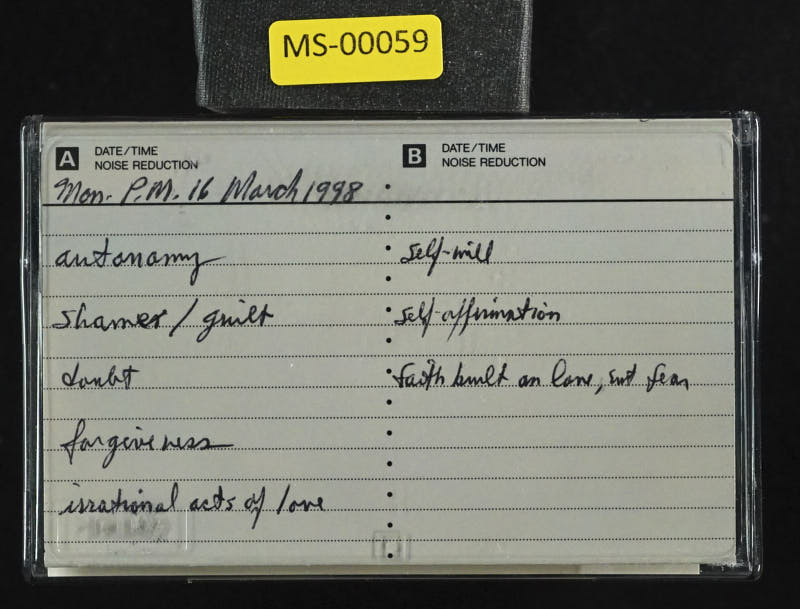
AI Vision - Possible Values from Photos:
Speaker: Abbot Justin D.
Location: St. Pauls Abbey
Additional text: #3
Additional text: #3contd
Additional text: Mon. P.M.\n autonomy\n shame/ guilt\n doubt\n forgiveness\n irrational acts of love\n self-will\n self-affirmation\n faith built on love, not fear\n
@AI-Vision_v002
Reading at Supper, that was in the current issue, I think, of the tablet, which shows the current interest in the capital sins. But society has a funny relationship. Our culture has a funny relationship with them. The tendency is to make light of them as something quaint. Whereas the literature, starting with the fathers of the church, and going through even to medieval times, even Chaucer, is to recognize them as something to wrestle with. And I think there is a value in looking at the capital sins, however we might list them. And perhaps at the end we'll have to come up with our own list. There's a value in looking at that, especially in Lent. St. Benedict uses military imagery in the prologue of his rule about doing battle with the devil.
[01:06]
And this was, of course, taken very seriously by Anthony, and it is portrayed in art and in literature as wrestling with the devils. I was in the monastery of Hanga, two years ago, spending a month and a half teaching English. And one of the things they were going to do was to read the Vita Antonii, The Life of Anthony, in English. So I'm listening, and it was good because the community is working with their English because it opens them up to a whole world of literature and a whole world of interaction with other monasteries. Well, you know, there's the curious passage in the life of Anthony where the devil appears as a little black boy. And I thought, my goodness, they're going to take offense at this. Well, they thought that was the funniest thing because they probably had some candidates in mind.
[02:10]
And it was really delightful to hear them struggle with the text because these classics are not translated... into Swahili, which is the language of East Africa, of 65 million people, the fifth language of the world. And hopefully, someday, one of the monks, maybe Odo, who studied, I believe Odo visited you some years ago when he was... with us maybe he will sit down and translate some of those classics because they have a value not only for monastic life but for the development of Christian spirituality for reflection on looking at the fathers and what they did and of course the Vita Antonii is a story of African experience in the Egyptian desert which is a very ancient connection that they have
[03:13]
I want to begin with a story. Oh, the thing I found amusing about the article was that it called them the seven dwarfs at the end, and I found that a bit curious because there's certainly something much more alive and active in these sins than we might imagine. And I think in making his list, he was looking at Carl Minninger, who wrote that book some years ago, that holds a great insight for our time, whatever became of sin. And he lists cruelty as one of the sins of our age, as well as racism and sexism. And he lists a whole modern look at that. And that might be worth... our while in the back of our mind to see what we would put on our list of what are capital sins, ultimately to come to the point where we need to wrestle with where the sin is in our life.
[04:17]
Here's a story, though, to start with. It's nothing like a story. Once upon a time, there were two groups of battleships on maneuvers. The weather was terrible. high winds and seas. The second night out was worse. The captain stood at the bridge all night, wary of just second-hand reports. He didn't want to chance the battleships of the other group colliding with them in the open seas. All night he checked the sky and what could be seen. Toward dawn, the officer yelled, Light on starboard sides, sir. The captain yelled back, Is she steady or moving? A pause to the reply, Sir, she's steady.
[05:20]
Send a message as soon as possible, he roared. Change course 20 degrees immediately. The message was relayed and sent. Then came back a reply on the radio. that was passed on to the captain, sir, they suggest you change course. The captain was furious. He turned and yelled, you tell them I am a captain and I'm ordering them to change course, 20 degrees hard now. Don't those fools know we are on a collision course? The message was sent. Then the reply came back, I'm an ensign, second class, and I suggest you change course now. The captain was near spitting, and the light was fast approaching. Damn it, you tell them I'm the captain of a battleship and they better obey my orders immediately.
[06:24]
The message was sent. Back came the reply, I'm a lighthouse. and the battleship turned I guess we have to know what we're up against what struck me about that story was how easily the captain gets caught up with his authority and anger comes spilling out that's the thing that I want to take a look at tonight, I want to look at the second age of development as understood by Erickson in the West, early childhood in which an infant comes to grapple with autonomy and that the conflict is between autonomy and ability to act on one's own or shame.
[07:28]
What I find very powerful about this, it is also regarded as a pre-conscious stage. That autonomy, an ability to do some things on one's own, not an identity, but an autonomy, an ability to act as an individual, or else shame, if the battle is lost. And that's... That's the thing that I perhaps will spend a little bit of time tonight on, too, is this issue of shame because it's a very, very powerful force that is older than our awareness that acts in all of us. The second task for a child is to learn that one is subject to the control of others. Now that's something that will accompany us through life, being subject to the control of others, or we'll run aground like the battleship.
[08:36]
And in that, to learn to control ourselves. Here is the discovery of a will, and it's obvious in small children that their will emerges, and they will know what they want, and they learn the word null. And early childhood, it's a battle of wills, parents will tell us, and we retain some of that notion as we continue on our journey. Genuine autonomy occurs when we become relaxed about the assertion of our will, when we do not allow our will to be subdued or broken, but at the same time we do not always insist on having our way. The failure to achieve real autonomy results in shame and doubt. Shame is an infantile emotion.
[09:42]
And unfortunately, it's not studied enough in our time because it's so easily absorbed by guilt, which is going to be the conflict of the next stage, guilt. Guilt is, of course, much easier to identify. When I do something wrong, when I break a rule, guilt is the feeling that emerges, and it is something that we go through... But shame is more subtle. Shame is more difficult, and it's especially hard for us to differentiate. Shame is telling me that I am no good. Shame is this early, very primitive feeling that I am worthless. that I can't do anything good. Whereas guilt is the breaking of a rule and we can easily identify guilt. And in fact, in our culture, guilt is much more of the thing that gets focused on rather than shame.
[10:43]
And yet shame is this force that is working like yeast in the dough or like a hidden cancer eating away oftentimes at our ability to grow and function. And shame is a killer. That's the problem with it. Shame is such a powerful force. Guilt is so much easier to recognize and deal with. When we stop doing the things that make us feel guilty, guilt will dissipate. Shame is far more subtle. Guilt is feeling bad. Shame is feeling bad. let me give an example of this from Macarius as a child Macarius together with other children herded the family cattle like children do all over the world when they're not in the developed world they take care of goats and cattle and on one occasion the children stole some figs in childhood
[11:58]
Macarius picked up one of the figs and ate it. And he writes, I weep when I think of it. We're not dealing with guilt here. It's a much more primitive notion and powerful one. His compunction or his gift of tears is connected with shame in this case. Augustine, in his confessions, tells us how he bitterly repented of a theft of pears when he was a child. Now, you know, you read these things and you say, well, come on, you know, like, grow up. But that's from the perspective of dealing with it as if it were guilt. It's not guilt. It's shame that he's writing about. a very powerful force.
[12:59]
Shame arises not from the question of judgment, what have you done, but it is what are you? And doubt is the brother of shame. Now, I'll tell a story that Damien told me. Father Damien from our monastery, most of you know him. He's in building the school in the Usambara Mountains. And he will go hunting. Once I brought him a shotgun, I had every customs agent in Dar es Salaam lined up around me, looking at the shotgun with longing eyes, saying, oh, why don't you bring me a shotgun like this? And it was in Browning, semi-automatic, pump-action, beautiful thing that his family had given him, and I brought it over to him. Well, he goes hunting. That's how they get meat for the school that he's running. So every couple of months, the sisters will put a lot of skulls around
[14:05]
as a reminder that it's time to go and fill up the freezers because they would like some meat. And he takes some Game Scouts with him and he goes into the Umkamazi Game Reserve which borders on Kenya and overflows into one of the big game reserves in Kenya and with three or four Game Scouts they will go hunting. Now, this is of course legal because he's got Game Scouts with him but he got in trouble because The World Wildlife Federation was on a campaign to catch people breaking the law, and once they captured the Game Scouts and Damien, and they took his guns, and they still have them. But anyway, he will go hunting. Sometimes they even, they don't know where they are, they cross the border, but he takes some Masai with him, which are the tall tribe in Kenya and in Tanzania who have not generally acclimated to Western ways, and they have an instinctual ability to know where the animals are.
[15:08]
They will say, well, they're over there, and they'll go for miles, and sure enough, the animals will be there. So they're out in the bush, and he kills an antelope. And sometimes he told me once of killing two or three with the same shot. They were lined up and it went right through one and through a few others. And the Messiah will come and they will help. But they have to carry out. They have to butcher them on the spot and take out the pieces that they want and preserve them and then drive out. And they leave the carcasses some distance away for the hyenas to come at night and to clean up. So he said this night he heard some strange sounds coming from where the carcasses were. And he decided that this calls for an investigation. So he goes over looking and finds that there's a man almost naked eating the carcass of the animal. And...
[16:09]
He didn't understand, the man didn't speak Swahili, he spoke a tribal language, but the Messiah were able to translate for him. And he was very curious about, what is the story of this man? We all have a story, and he was interested, why is this person out here? Well, it seems that the man came from a village in which he had done the unthinkable. He had insulted his mother. The fellow was an alcoholic. evidently, and was sitting in the local bar drinking, and his mother came in to get him out of there, and he threw his beer in her face, which was unthinkable in that village, in that culture. You couldn't do this. There are other things you could do, but you couldn't publicly disgrace your parent. So what happened to him, the man was shamed. He was put... on the edge of society and eventually driven out and it's curious that the power of shame turned him into
[17:22]
He was like the hyenas, first he lived at the edge of the town, eating in the dump where people would throw things, and then finally he was wandering off in lonely places, almost in a biblical image, like in the tombs, eating on carcasses of dead animals. Well, this is some of the power of shame, and I believe that it operates just as strongly in our lives. now this is true, coping with a disease like alcoholism, there is an issue of shame there. And ultimately, ultimately, the solution is on a theological level. When we look at the crucifixion, we can understand that there is our shame nailed to the cross. It's a very, very powerful understanding that this is the yoke that Christ takes up in all of our lives.
[18:27]
And we all have our bag of shame. Everybody carries the issues that they would not care to bring up. We all have them, and they go way back before our consciousness. Now, shame acting in us can be a great source of anger. That can be like the root of one of the capital sins. Anger is looked upon as the classic emotion because anger makes people move. Anger is the best example of an emotion which means to move and anger is the one that can best be looked at as an emotion. But anger fed and developed is also the source of such unhappiness and problems in life. Anger is a sin when it leads to the construction of barriers between ourselves and others.
[19:34]
Now, the traditional way to deal with anger, the traditional virtue that is offered is patience. Well, Since anger is so strong, we may need something stronger than patience. Patience based on scriptural encouragement, we are invited to forgive our brother 70 times 7. Anger. Anger one author regards as the dirty underwear of the emotional life. that everybody's got an issue with anger and aggression, and yet we are asked and we need to wrestle with how to deal with this. We have some reflections in St. Benedict's rule on this. He tells us not to yield to the passion of anger in chapter 4.
[20:40]
also in chapter 4, on the instruments of good works, not to give way to violent fits of temper, not to inflict injury, but to suffer injuries patiently. And then, following the gospel command, again in chapter 4, to love one's enemies, to pray for one's enemies for the love of Christ, and after a quarrel, to make... peace with one's adversary before sundown. Perhaps the hardest saying of the gospel is to forgive one's enemies. And this is really a goal of our monastic journey, to really take the gospel to heart, to live without that passion that would keep us especially from a brother. Great, great challenge.
[21:44]
Now, this not only has personal dimensions, it has communal dimensions, it has dimensions within the faith community, and it has national dimensions. Perhaps the looked-upon anger out of control in a corporate sense could be looked upon as war. And we're in a time now where people are looking at forgiveness as perhaps the only way to make sense out of life. Look at the recent situation in Yugoslavia. And it's emerging again. It keeps popping up. For the longest time, the brutality of the Soviet system or an army kept the peace. But what can happen among those different peoples living together? One writer said the only thing that holds any hope is an irrational outbreak of charity or love.
[22:49]
Irrational. That doesn't make sense. But what else? It happened in the Second World War that a division of German soldiers had been captured on the Russian front. And now these, the Russians, of course, were very brutal in that and moving toward the east. And a whole group of soldiers were captured. And they were paraded through one of the local villages. It was recorded somewhere in some town in Russia. And everyone was out to jeer at these conquered enemies. The officers came marching up the street, unrepentant, goose-stepping, arrogant, and the crowd jeered at them. And then came the regular soldiers, broken, ragged, wounded, shuffling along, and it was the mothers standing on the sideline, the old babushkas, who were looking at these beaten up,
[24:00]
conquered enemy and they were thinking of their own sons who had died and lost their lives at their hands and yet in seeing them it happened that one of the women reached into her handbag and took out a stale crust of bread and ran out and handed it to one of these broken starving German foot soldiers. And it happened in that village that the mothers began to do the same, to reach out to these boys who were killing their own sons. Irrational, but yet something that emerged out of the Russian soul, out of reading the Gospel. We know that violence will not work It is like yeast in our culture now.
[25:02]
That's why there is such a debate and a reflection over the bombing of Iraq and a hesitancy to do that. We know that violence will not work. And the corporate outbreak of anger, of course it's good to get people elected and to rally and wave the flag. but there's something in the consciousness of our culture deep down that we know that this will not work we know that ultimately what the gospel and we have been in the culture the gospel has been cooking for centuries and it's being read and we know that it's right we know that the direction to go is the gospel way What a challenge for us, though, to deal with our own anger. What an invitation we have in looking at the things that make us angry to examine the roots in our own life of where is this coming from and why is this arising in me.
[26:18]
In my own community, we spent some time in group discussion. The facilitator called it swords and shields. We always have people that have shields and swords that are ready to go to battle. But the invitation is to ask ourselves always, well, what's behind this? Where is the source of the conflict and the battle? And I think that... This capital sin is certainly worth our prayer and reflection. And the example we have been given, certainly by the Pope, in meeting with that man who shot him, is a remarkable visual image for our age, that we know that he was right. in forgiving, or in having a relationship with the man who shot him.
[27:22]
It's a very, very powerful thing. We need to find areas in our own life where our anger needs to be dealt with as, with courage. Let me talk a little bit about St. Benedict and his degrees of humility now. Let me take a look at the second... degree of humility in Saint Benedict. The second degree of humility is that a person love not his own will, nor take pleasure in satisfying his desires, getting one's way. but model his actions on the saying of the Lord, I have come not to do my own will, but the will of the one who sent me. It is also written, self-will has its punishment, but constraint wins a crowd.
[28:29]
I really think that there's a connection there with this battle of autonomy and shame and doubt. What is underlying Saint Benedict, I think, is a notion, and just the word that is really helpful here in understanding the second degree of humility is belonging. One's own will doesn't allow one to belong. The surrender of our will allows us to belong to the community's will, to the will of legitimate authority. When we conform to the will of legitimate authority, there is an opportunity for real growth there. Clinging to one's own will in opposition to the common will removes us from the life of community.
[29:33]
Thus one lives without a higher life. a personal life, without a social life. To live within a community that is dedicated to living a spiritual life and not be part of that inner life is destructive. It's spiritual suicide. So if we maintain our own will in the midst of the community, it is a spiritual suicide. Sometimes it may seem trivial to people from the outside and they might accuse us of subjecting adults to seeking permission for things that look like childlike things but the self-discipline that is encouraged here cultivates a notion of belonging and it really builds community submission to legitimate authority whether it's social or religious or spiritual has value insofar as such authority cultivates
[30:37]
higher values for which it stands. But submission, without this end in view, is subservience and ultimately it's harmful. The fruit of belonging is capacity. If we live in harmony, in community, we learn to facilitate the capacity to live a productive life. Now, what might be a practical discipline in which we can implement the second degree of humility? Here's a suggestion. Affirm yourself daily. Affirm yourself of your own value, realistically, on a daily basis. positively look at your contributions to your fellows each day.
[31:38]
In this way, you will learn how to share your inner values rather than focusing on behaviors that need be avoided. This focuses on the needs of others rather than on ourselves, ultimately. We are... more truly ourselves the more we belong to others a little saying that might be helpful for this is I am more truly myself the more I touch others at the core let's stop there and open up for questions or comments or any sharing that people might want to do The author of our article tonight had never read Brother David's essay on the Seven Dwarfs. Because the Seven Dwarfs are monks.
[32:41]
They look like that. Sneezy and sleek. And it's a wonderful story of how the community can help you. But you get to a certain point. The Divine Lover. I've used it with college groups and things. Other, actually, graduate type. Is this? It never dawned on anybody. Of course, Disney has ruined the whole thing. But in Disney, they even go out to work chanting. But anyway... You know, when you spoke about shame, the image that came to mind
[33:52]
to show itself on the mentality or the wound of everything that in Genesis, when God talks to Adam and Eve, it is shame. The first thing that he sees that and if he's going to get upset at anything is because he notices that they're feeling shame. Why? Why are you ashamed? And that shows, you know, from a psychological course, in their expression, the rudeness. Right, right. And what is so powerful about that story is it immediately leads to blame. She made me do it. And then God turns to Eve and she says, would you believe a talking snake? I mean, it is a whole blaming and passing offer, right? There's a wonderful insight into human behavior and that. We've had this Marist brother talking about this on the role of emotions in religious life in the past few years.
[35:05]
And it really is helpful to recognize how much is below our consciousness. We're totally out of touch with it. But nevertheless, these are the things, and that's why I think that notion of the capital sins and so forth, what are the roots of this, not just what happens, what is this deep? See, hopefully, ultimately, it leads us to grace that God can do more than we think or imagine in our own experience, in our own life. that somehow the healing of God and grace can touch us beyond even... But the awakening to how God's grace is acting in our lives is a beautiful challenge and experience for us. That's what Therese of Lisieux says, that heaven will be spent recalling...
[36:09]
how God was present even in spite of our how God is working in our lives even when we thought we were on our own does it prevent one from saying that one is sorry as well Again, going back to the biblical image, that was the only thing that they had to say. Or ownership, that Yahweh, I did it. Acceptance of the fact that... It's very interesting in that whole biblical image. It's much related to... When you see on television the kids being caught doing a horrendous crime, they've always got their jacket over their head The only one that didn't do that was the unabomber.
[37:13]
He was walking. I mean, obviously something's wrong here because shame wants us to hide. Shame, especially shame, and that's what they're doing in the biblical story is hiding and not owning up, not accepting themselves. And that's such a condition that self-acceptance for God's grace and for forgiveness from God and healing to occur in our lives that it requires an openness to, yes, I am a sinner and I stand at the foot of the cross. ... [...] Oh yeah, he was shamed.
[38:33]
The shame comes from there. Now, in a community like this, what would be the impact of marginalization of a member on his own behavior towards other members of the same community? Well, you find that culturally written in the rule of St. Benedict in the chapters on excommunication for faults. There's a whole approach in St. Benedict's rule. Now, how we deal with that in modern times, we find that most people excommunicate themselves from community life. At least that's been my experience in the monastery. People will... excommunicate themselves from the common table or from the common prayer for a variety of excuses or reasons and that's probably always a warning light for maybe not the individual who can't see it but for the community leadership however that is active whether it's the prior whether it's the
[39:55]
the seniors or the counselors somehow, that sometimes the person can't see it. And that's where the fun of confrontation gets to happen. But I mean, to call someone to test, especially true... hopefully in formation, that when one is being formed as a monk, there's the opportunity to examine this and look at this. You know what you just said about the Ruth Benedict, it is a very powerful thing because the Ruth Benedict also makes sure to instruct them that you have to make sure when you have to communicate someone that you have some people secretly going to be an individual to encourage him because of the powerfulness of the impact of it. So he realizes that.
[41:00]
Right. Right. Right. And anger. And it brings up all the anger of one's past life all of a sudden. And it's aimed at... You wonder, why is this person so angry? It's all coming, it becomes like a channel for all of the, for the reservoir of anger in their life to become... Oh, but I don't know what happened in the, I don't know what happened in the story, but it shows the power of these things to drive someone away. Yes? When I was doing my fourth step in maturity, and I was exploring issues of anger in my past life and in my present life, I made the connection with fear. Fear of failure, fear of inadequacy.
[42:02]
And then, when I tried to get back behind that, I got to shame. And the shame came from history. It came from being excluded by older people, grown-ups, people near me, when I didn't know how to behave as a child. So I learned, really learned shame through exclusion. And it really became, as you said, you know, then when situations become like that, Even if you just perceive them, the anger will come. As Father mentioned this morning, the notion of rejection in the readings today, that really causes...
[43:05]
In some way, internalizing the rejection is a survival, I mean, it's an attempt at survival, but it's worse because we internalize that not worthlessness that they seem to be saying. Right, and that's where I found that this notion on the second degree of humility in affirming one's self every day is a it's connected with the reading we had at Vespers about soberly and honestly looking at ourselves and not belittling ourselves or our contribution that's going to come up again when we look at envy because envy is a real crippling and devastating thing but the affirmation of our self as able to do good Benedict of course tells us in the instruments of good work to attribute to God the good we see in ourselves but yes God is working in me
[44:43]
To look at that in my own life and to accept that and to affirm that, it really, really is a helpful thing. I think that the affirmation that God himself affirms of the individual, moment by moment, the individual who are able to receive and to note that divine affirmation on the positive side. Because when we are looking at this negative aspect of us or the false self, I think it tends to deepen that false self because we have our own environment. So working on the positive affirmation rather than the
[45:43]
I think one of the hardest things to cut to grips with is in our formation when, you know, we've been told, I am a worm, no man, and you come around, you know, with a weak image. Sure. your religious life to convincing you and somehow the thrust is you know on the positive side but even the prayers of the church forgive us I'm saying you know that's in here on the on the degrees of humility that quotation and that that is a difficult thing to wrestle with uh uh Right. I think there were some pedagogical mistakes that were done.
[46:52]
Fear was one, to build a face on fear as the motivator doesn't really work. It really needs to be built on love. And that's what the... the story of the Passion, Death, and Resurrection, I think, can say to us. And we did that. We used fear in religious life. We used fear as a pedagogical thing in school. If you didn't know the multiplication tables, you're going to get punishment and fear. And it was used, you know, we can't just blame the good nuns for doing it. It was used by everybody. I mean, intimidation and fear was used as a motivating source. And I guess, here's what you get. But it's not being done today. And I'd be very curious to see what happens.
[47:53]
Of course, our young people have all got earrings and nose rings and God knows what else. But I wonder ultimately what will happen. where they're not using fear as a motivation. And I wonder what will happen. Still being used in the culinary world? Well, often in the business world, yeah. When you go to train, maybe not at CIA, but when you get out and you go to work at a four-star establishment, The sous chef and the chef, they don't tolerate any nonsense. If you want to make it in the world, you've got to do exactly what they say. Right, the business world. And they yell and they scream because there's a lot of pressure in that part. A lot of anger. And stress. And, yeah, yeah.
[48:56]
But it'll be curious to see, because the schools aren't using fear as a motivation for instruction now. It'll be interesting to see what happens with this. But I think in my days, we had hell. Not only fear, but hell. There's no hell anymore. Yeah, yeah. Free sex, free this, and that. Well, I think what we've done now is put the responsibility on the individual. But when I was growing up, it was that, you know, this fear. And I hated retreats when I was in high school. Many people avoid retreats when I was in high school because it was so negative that, I mean, it just gave me nothing to go by except You know, and then this idea that if you go through life, you happen to forget a sin or something, you commit to mortal sin.
[50:04]
That's up with that. But it still works. I was talking to someone recently who was a priest saying Mass, and these children, teenagers, were in the front row, you know, yapping all during, and he was ready to preach, and he said... This isn't going to work. So he put his hand over the microphone and he said, if you don't stop talking, I'm going to come down there and break your arm. All of a sudden, the kids had never heard anything. They were like this. The rest of the mess. I wonder if you couldn't, with the plot where you say, you should think of your contribution, along with that, in order to be the value of the other person, along with the person to value your own value, but to me, one of the things that I find very helpful is to,
[51:25]
see the value of the other person, and then you're able to make a connection, a belonging connection, if you belong to, with that other person. I'm finding, one of the things I do on the rest of the day is to go through the community and look at the value. Sometimes it changes, sometimes it doesn't, It gives me a word for the other person. And usually it gets... The thing that strikes me if I put this conference with the one you had this morning on how we so often revert back to the child. And it seems to me You end up not referring back to the child when you want to go out of yourself.
[52:28]
Well, I couldn't help this morning think about it. One of the stories that I tell people is when I want to go get food, you know, I've got to eat at some point, you know, and if I travel, well, I revert back to the child. I love croissants, only because of the child. I'll never forget snooching that croissant off the French train. in France for some strange reason. I always look at the Glossau in the store. I don't know what that's supposed to tell me, but... But anyway, it seems to me the progressive thing is to be aware of what you're doing, which is the first part this morning, when the child can't, the infant can't. We've done so many things out of the road that we end up going back to that, if you want, original moment.
[53:32]
But I just like the one. Tonight, you know, we don't like to belong, but yet it's belonging that will really bring to salvation. Because I guess there's a fear of going out of yourself. And when we make that march about your contribution, the other half of it is seeing the value of the other brother. So we're going to have a couple of nice doors. Isn't the names of the seven dwarfs have to deal with? What's the seven things that monks tend to do?
[54:35]
That's what I don't know. Well, they're not giving names in Remy's fairy tales. It's only Disney that gives them names. If it reads something, I can't put those names at all. No. Can we go? Put something here.
[54:57]
@Transcribed_UNK
@Text_v005
@Score_93.47