You are currently logged-out. You can log-in or create an account to save favorites and more. more info
Embodied Mysticism in Modern Monasticism
AI Suggested Keywords:
Conferences in Vina
The talk discusses the significance of integrating physical and spiritual practices into monastic life, drawing parallels with Jewish mysticism and the teachings of Martin Buber. This philosophy emphasizes making one's body and life the throne of greater spiritual ideals. It touches upon the contemplative tradition within monasticism, illustrating how the physical world and practices are intertwined with spiritual growth. The narrative includes personal anecdotes and historical context about monastic foundations in the United States during challenging times in Germany, focusing on the intersection of spirituality, community, and monastic education.
Referenced Works and Teachings:
- Jewish Mystical Teachings: The phrase "make your body the throne of life" is highlighted as an essential teaching drawn from Jewish mysticism, suggesting a comprehensive approach to the contemplative life.
- Martin Buber's Influence: His role in introducing Western audiences to Jewish mystical teachings is acknowledged, influencing the rhetoric around spiritual totality.
- St. Bernard's Warnings: Reference is made to St. Bernard's caution against intellectual pride, reflecting a balance between intellectual pursuit and spiritual humility.
- Lex Propria for Benedictine Confederation: Discusses the adaptations in monastic rules that allowed for the establishment of a Benedictine foundation in America, emphasizing flexibility and directives.
- Theological Integration: Touches on the ecumenical movement and how monastic life encourages unity across denominations, with particular reference to the harmonizing role of liturgy and worship.
Personal Historical Context:
- Details the historical context of the monastery’s foundation in the U.S., reflecting on the challenges of adapting European monastic structures within a new cultural and geographical context.
- Offers insights into the augmented educational and communal frameworks that adapt to both historical necessity and traditional spiritual pursuit.
AI Suggested Title: Embodied Mysticism in Modern Monasticism
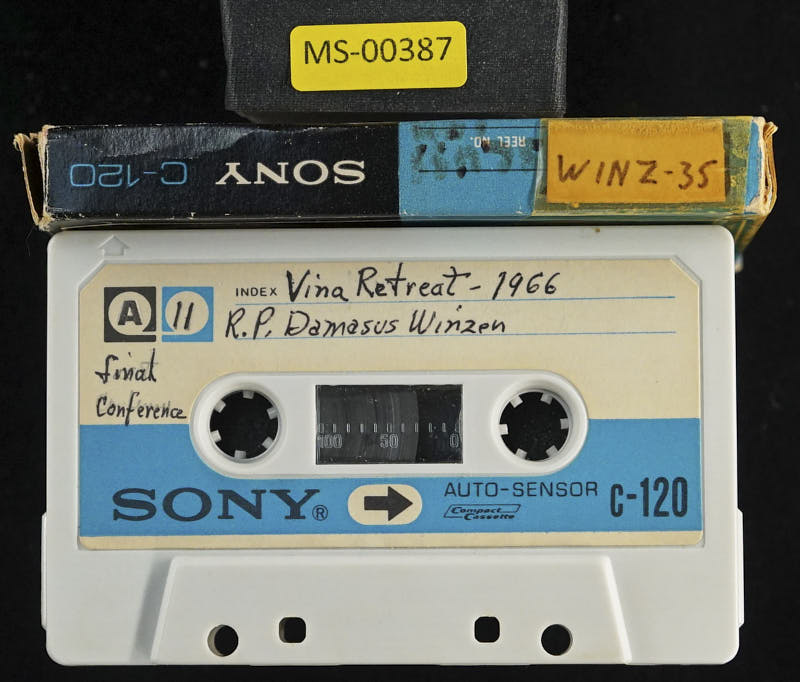
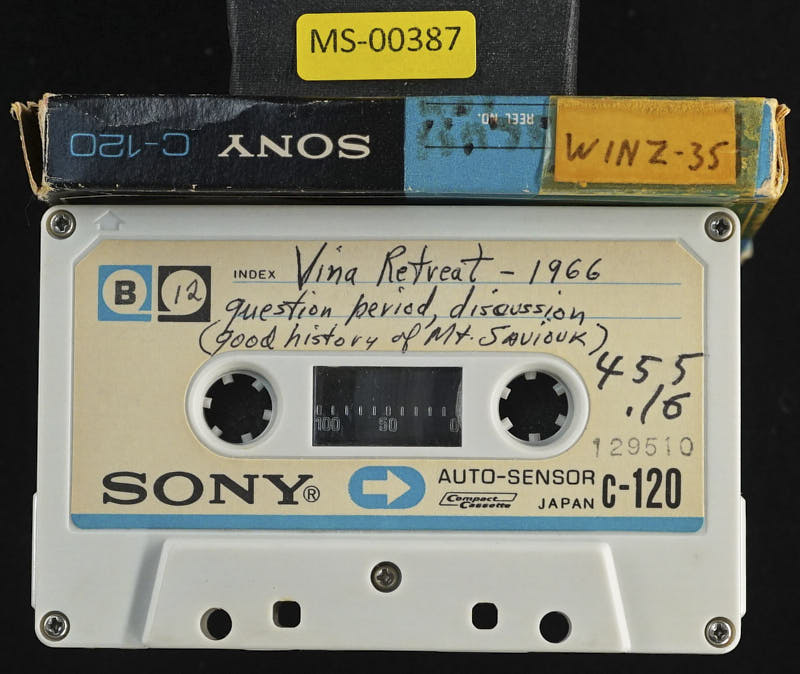
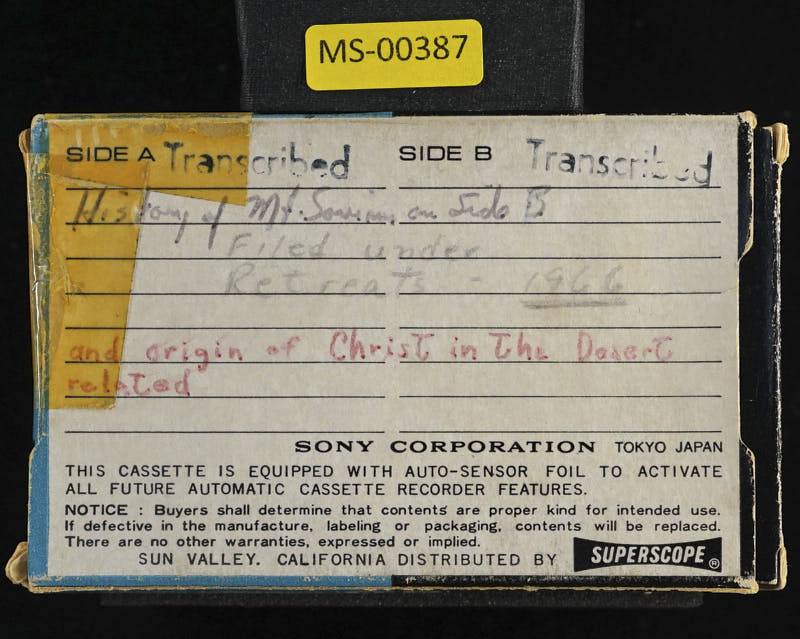
AI Vision - Possible Values from Photos:
Speaker: Fr. Damasus Winzen
Location: Vina, California
Possible Title: Vina Retreat - 1966
Additional text: final conference
Speaker: Fr. Damasus Winzen
Location: Vina, California
Possible Title: Vina Retreat - 1966
Additional text: question period discussion, good history of Mt. Saviour
Additional text: History of Mt. Saviour on Side B, Filed under Retreats 1966, and origin of Christ in the Desert related
@AI-Vision_v002
And I had a very beautiful experience, honestly. I was there this afternoon, and Father Hilarion took me around, and we paid visits, and we saw various things. He went first to Barnes, in a trade. The last of the bull. And that's what I experienced really then. And then later on we went to the agriculture. not apples at the moment, you know, and walnuts. And then we went to the, we saw the hermitage.
[01:05]
And then we went to the winery, but I was trying to play. Really, that gives a wonderful dinner cult in the cult of these days. You know, I have the great joy of meeting members of the community and all that, you know, I was just kind of trying and mulling these things over to, you know. for a world which would prove we would, you know, at the kind of winding up our retreat and gathering together what we have said, and also maybe just indicates still areas that we were not able to touch. But there's one word which we call belongs to the Cassidine, you know, that Martin Buber has made them known
[02:14]
in the in the West and there's this Jewish sect of a revival revival of one wouldn't say of Judaism but of the Jewish faith and and religion and a living thing and the thing of the heart. And it struck to me once I read a word in this connection, one of the And I think it's, for us as monks, it was a very beautiful thing and also to think about it and to see our own life in the light of this world. It says there that, let's say, conclusion of a longer treatise by one of the rabbi, you know, the originator of this movement, of the chathedine, movement, and he said, make your body the throne of life.
[03:21]
Make your life the throne of your mind. Make your mind the throne of your heart, and make your heart the throne of God's Lord. And I think that is a beautiful word. You realize, you know, it really takes in and summarize this approach that we have tried during these days, an approach to the contemplative life, which would be really comprehensive, which would avoid, you know, certain, let us say, exaggerations in the direction, you know, of one direction or the other, and therefore lead maybe to that end world, to certain things that just tend to get stuck, but that keep, you know, the totality of life.
[04:23]
And the monastic dedication is marked by this mark of totality. Monaco, in that way, means really the totality, the whole land for God, Monaco. And during the return, we have seen all this contemplative idea. We go, we start, as it were, from the heavenly pattern. And then we try to, looking at this heavenly pattern, then we try to get our life, or develop our life, I would say better, in and according to this pattern. And therefore, it's good, maybe, tonight, in the last conference, just to see it this way in which this rabbi sees it, make your body the throne of your life, or the throne of life, he says in fact. And that is also one of the, just one of the things that impressed me so much this afternoon, seeing the various members of the community
[05:31]
in working in this tremendous area which presents, you know, such a beautiful, now I see it now at the time and maybe it's nicer to see it in blossom, you know, but still what the basic impression is there, this beautiful promising spring air, you know, to see these roads, you know, and rolls and rolls and rolls, you know, trees and this whole order, you know, that is what one says, to cultivate, you know, what one seems there, of course, it's marvelous to see my namesake, you know, where the dinosaurs, you know, going up and down and swinging around, you know, and then trees fall down, you know, and so on, you know, kind of thing, such you know, that thing is done, you know, so it's all, it, so it's wonderful, I mean, to see, then it's, of course, that is, you know, our, we are as long as we are, we are living beings, we have to take care of the life, you know, and of course, doing it, one of the functions in which one makes really the body
[06:46]
The throne of life is the function, which is a basic function in this whole creation, that's that of the garden. It really is. And the garden, or the garden, in that way, was the first thing, indeed, that was, in that way, was enjoined upon Adam the man, you know, is the gardener. And that is, right away, we see that at the Jungian, say, the fulfillments there where the history of mankind meets, after the resurrection, meet the gardener. That is, of course, that has as Mary Magdalene does, you know, after the resurrection sees the Lord as the gardener. It's simply the first Adam and the second Adam. The old Adam is the new Adam. And it's the new Adam who takes up, as it were, and continues on a higher plane, the integrity, you want to say, of the first man.
[07:47]
So it is that because the gardener is a man who serves, he serves life. Just this kind of, this one thing about pruning, you know, is after all a parable that our Lord certainly takes all the time, takes up. And there are today, you know, there are these branches, and they fall down, and then they are there in rows, you know, and then they are being gathered together. And, of course, burning is the last word, you know. And that is a very wholesome perspective we should keep open to, you know. Tuning has to be done all our life, simply, simply. Yes, so... And therefore, that we have to do that, that is the function of the gardener, you know, also to help the grow, in that way, by illuminating as it really exists.
[08:50]
And in that way, you know, the fruit. So, that is, of course, our life is right away in it. And in doing it, and doing it as a monk, you see, one doesn't do it just only, you know, for the sake of culture. You do it also for the sake of sustenance, you know, too. But it becomes really and truly a document to do something. I mean, as a Christian and as a monk. And to think about it, what one is doing, that one is really in that way, too. on this level of the body and of life. What does one mean in the meaning of Hebrew? Life is nephesh. Nephesh is the same what we call, in Latin, we call it anima. Anima is the same as the, say, the light, you know, as it is pulsing in the organism in the body.
[09:58]
And therefore, also include the various passions of man, you know, all these things that belong to his bodily life. And therefore, make the body the throne of your life. But do it as the garden. Do it, therefore, cutting off what is superfluous, you know. And in that way, bringing and concentrating on bringing fruit. What is the bringing fruit? What is the meaning of repentance? What is the meaning of change of mind? What is the meaning of any correction in the whole monastic life? If it is not fruits, the fruit of the Holy Spirit, the fruit of charity, penance is the purerunner of charity. As one always says, what is Saint John the Baptist? The purerunner of the Lord, who then comes And he is the one who baptized us with the Holy Spirit.
[10:58]
And that is our life. So we could really see it there, you know, and see that also in our life, you know, seeing how we do it here around and how these things, one always says here, the Old Testament, you know, is so material. Yeah, but on the other hand, you know, on... One also must say that the material world simply is an integral part of our existence. And for that matter, our material world contributes to the resurrection. We shall rise in this flesh, you know, as we say. And therefore, this... body here, you know, with the things that he does, prepares, especially when a monk does these things, is really, in that way, a preparation for a new heaven and a new earth, and for a new man, and for the communion of Satan.
[12:00]
That is what we've got the whole meaning of this here. But therefore, one realizes you're in that way, you know, that the body of man is really there It becomes the throne of life. But, of course, that is a deliberate action. That is not something which is in any way unconscious or simply mechanical. Consciousness then simply supposes that one does these things, also the world works in the field and everything belongs to it, really with that inner realization. that it is a preparation for the resurrection of the flesh, that it is a preparation for the communion of saints. In other words, that the power of the resurrection is already there at work. That is the reason why, for example, St. Jerome says, now in Palestine, one can see there, of course, in Palestine so clearly, especially there, where existence is so difficult.
[13:03]
And depends all on the rain that comes from above. That's the difference here. It's the one thing that didn't quite fit into my picture when I was thinking about it. Because here it's all irrigation. But of course that is what it is in Egypt. And that means this in the context of the Old Testament. And you all know Deuteronomy and they had it. clearly written in theory that there are these pumps, you know, and so on, and there one works, and the land is flooded. You know, in the promised land, what does one do? One prays for rain that comes from above. In that way, I think Montevideo still has an edge, you know. Therefore, it's the point, as it were, of prayer. So here it comes all, you know, in that, in that, in that other way.
[14:08]
But I mean, later on, you know, another idea, you know, one author it wrestles, you know, with these timbers, you know, that one can really stay there too, you know, I mean, if one continues that again, you know, there is, and the antiquity, the father said, always said. If you look, you know, for kind of vestiges of the light of the Holy Trinity, then, for example, one of those is, there is the spring, you know, it talks to them for water, the spring. There's the channel that carries the water, and then it is poured over the pineal, that irrigation. And that's the Holy Spirit. So one has the Father, the Son, and the Holy Spirit. So if you look, you know, at these things, I don't know how they look, you know, but if you go around, you know, and you look at these lotus down there, these prune trees and everything, you know, irrigated, you know, by the... Efficiency.
[15:13]
then think, oh, it is a picture of the Holy Spirit, you know, and of course it is, you know, because the Spirit will flood the earth, you know, like the waters, you know, that already, you know, the, I think it is the prophet Olsteen who has said that, you know, years ago. So, I mean, it all... you know, in the end, you know. And it makes sense, you know. But that's the important thing, you know, that these things really big. If you have the life, you know, in my life, I make my life the throne of the mind. And that is, again, it's another step. And if you take that, I mean, as a community here, you have two things that you kind of contend with. you know, and that you struggle with. That one is the organization, you know, for the whole, all the things you went through, you know, from the house, you know, to the orchards, you know, from a few trees to more trees, you know, and maybe two-letter trees in the future, I don't know.
[16:20]
So, fewer trees. So, and, you see, there is that one area. And then there is another You see, and then, of course, then, with the life, you know, it becomes the throne of the mind. And that is, again, you know, of course, in our monastic life, you realize, you know, I mean, man does not look from bread alone. Certainly, the world does not. It is, therefore, absolutely intentional. And you realize, again, that there is one of the tremendous steps that we are taken Right in this, you know, in this, our time. Imagine, as long as monasticism, you know, let us say on this two, I couldn't say two-track thing, you know. There was one was the choir moans, and that means trees, and the other one was the lay brothers, and that means work. And as long as monasticism moved of these two things, kind of exclusively,
[17:26]
then what was the problem, oh, let us say, of the mind? Of course, if somebody had acquired novice after the novitiate, he was thrown into the philosophy. I mean, if I think back, you know, after the thing, you see, suddenly, after the year, Father Oliver, you know, came to me and he said, oh, Father Abbott wants to send you to Rome. But he didn't like the idea because he thought that nor German wouldn't do well in Rome, because he thought I would be scandalized without the canons, reciting their opera, and St. Peter's, you know, and so on. Let's pray over it. He said, let you serve my mass this morning, and then we pray together, and then you go to Brother Abbott, and then... So I went to Brother Abbott, and I came to the... his office, you know, and I thought, now he will ask me something.
[18:29]
Of course, I told Father Abbott that even after the Mass, I didn't have any life about going to Rome or not going to Rome. Then I thought, now, and then Father Abbott would probably ask me, what should I say? Do I want to go to Rome? Do I not want to go to Rome? No, I wasn't actually teed up about the conflict. And then I came, and then the Abidemi said, oh, yeah, no, Brother D'Amazouk, you were too long. Everything was already in his sight, you know. The Mass was too late, you know. The Council of the Most High was already, you know, finished. Sure. So I went to Rome and then, of course, then going to Rome, that means Joseph Gretchen, that means philosophy, and that means real, you know, I mean, cramming it in, you know, I had to tell the time first, you know, and all these things.
[19:34]
But I mean, the whole, it was to me, you know, I must confess, you know, we had this strict or mystic doctrine, I mean, it was up to, you know. doubt about it, you know. He really gave us straight, you know, I mean, the whole thing. We had to do it all in Latin. We had to know the entire book by half from the first page. He got two volumes, you know. If you want to make your doctor's degree, he would follow every line, you know. He said, very good if you have it all, you know. Now, I had the great advantage of simply having a terrific kind of photographic memory. Absolutely, after these years of exercising photographic memory, I could just turn the page, you know, and read it all. And he thought I understood it all. I didn't. So, in that way, you know, but I mean, it meant, you know, of course, that meant that the
[20:40]
The attention was simply concentrated now on philosophy and all the things connected with it. And of course, then also, thank God on Rome, you know, the whole thing there. But I mean, that was the privilege then, as I say, of the choir, the novice or the triennial prophets, you know. But on the other's hand, you know, therefore, our formation was essentially simply the formation of the priest. And the formation of world studies that simply that the congregation of religious and of the seminaries, we trusted of every priest. Because there was no... So in that way, we were simply turned, you know, into a direction which was not, in that way, anything strictly more nasty. Joseph Grett was a good monk, you know, sometimes he had doubts if he was. Especially when it came to dulcet, you know, sweets.
[21:42]
After eating or something like that, you know, it's duetto, he said, Paul. He gives me an extra sweet, you know. I won't want it. Because I told him, you see, Father Greg, you are getting old, you know, and it seems, you know, if you are, if you are, if you are one thing, one weak spot in your whole life, it's the point of modification. I think you're all right. Well, if you curse him, very weak. Mr. Rector's court. So, I mean, there came all these things. Told me that that was one direction. Our late brother, St. Maria Lanza, Wonderful men, you see, but there wasn't any kind of great effort to know, too, or any kind of spiritual formation. At the conference, maybe by the novice, by the brother master was drawn, and then they had a Sunday conference by Father Abbott.
[22:52]
The whole community was together in chapter, but in the Sunday conferences, I always admired, you know, Father Abbott, because he was always going, you know, in tremendous, you know, tremendous pains, you know, and we were always sitting, of course, hanging his mouth, you know, and lit, you know, and onward. I think, Father Pierre, Brother, you know, I mean, on a Sunday afternoon, Brother Abbott was sitting in front of the whole road, you know, of lay brothers, and they all passed to sleep. And he was talking about the monk and his relation to womanhood or something like that. For us, tremendously interesting. And therefore, there wasn't too much.
[23:58]
Now, you know, you see, this situation has completely changed. I mean, in this moment, this is the moment where finally, to my mind, monastic, you know, in that way, monastic thinking, as they completely were about children that we didn't have before. Before it was either schoolwork or the secular priesthood, essentially, or it didn't amount, you know, to much. And now, you know, what we have to do is, of course, entering into new age into a new horizon, one can say, into a new horizon of the love of the spiritual things, the things of the spirit. of the good things of the mind. Because so much in our, always think of that, you know, I had, last year, I had the great, really great, and great joy to give a retreat at Our Lady of the Genesee. And Jerome was there, and then later on we were talking about it, and Jerome dropped, you know, a kind of a key word into my mind.
[25:06]
Jerome said, never looked me, and therefore, when we were speaking about the possibilities of formation, and especially formation of all those who have their triennial vows, and the poor, you know, the solemn vows are being made. And he dropped this book's idea of natural contemplation, the field of natural contemplation into my mind. And I think that's a very, very fruitful idea. I was just thinking a little more, this afternoon when I, when I visited Brother Robert, you know, little, on the stage, a little, little, hmm, the little chalet, you know, there, the little Shangri-La, you know, and there, you know, to see that, you know, to see how, how the, the mind, you know, I mean, works, how things fall into a pattern, you know, how, Therefore, how we, let us say, also do the whole approach with this, let us say, the approach of the artist.
[26:15]
But what is the artist? The artist is, that is a contemplation, a burden, a degree of how much contemplation is in something somebody like Shakespeare, how much contemplation is in other things, you know, in the whole of poetry, of this whole There is a tremendous amount, and today we must, you see, I think that is one of our others' moments. If we want to live our life, live in that way, for its own sake, or let us say, for God's sake, if we want to have that our life there, has a deep meaning, even though it may not be dear to any kind of practical, production, I mean, in the sense of efficiency, but it is a liability and it still has a meaning. What is the meaning of our life?
[27:18]
To say it in one word, in that word, the glory of God. But this concept of glory, if you just take it, that isn't a practical concept, if you want. It's an aesthetical concept. And therefore, opens up and belongs into its whole field of natural condensation. And the great danger for us is that through the departmentalization of all, you know, human productivity, man loses the characteristic totality which, for example, the aesthetic approach opens up to him, and which is expressed in it, you know, this is simply... both kind of world, of the natural contemplation, there is mainly dominated by a basic attitude of admiration, the credibility capacity of admiring.
[28:19]
And that, to my mind, is a deeply and truly monastic inner attitude, because out of that comes the true reverence. And I sometimes, I tell you, I remember, I have Personally, I mean, I must say this, that I, the basic thing, you see, in this whole period of change, you know, we evidently enter everywhere into new, let's say, realm. The basic attitude for us as Catholics, as I think, is absolute confidence in the Holy Spirit. The Holy Spirit will lead us. But we must be interiorly open to the Holy Spirit. And that means that we have to be faithful to tradition. That means to do things that have been handed down to us. But that we have to do it in freedom of the Holy Spirit. Because the essence of tradition is, I think I said that in the beginning of the retreat, is what is being handed over in the...
[29:30]
Fulted tradition in our Lord on the cross, who dying, gives up, that means really not gives up, but surrender, hands over his spirit. So that his death on the cross really in a very deep sense is already in itself to think. And that, of course, is in our life too. That is the... But what is this Holy Spirit, you know, that Holy Spirit is this, for example, is the spirit of joy. In the spirit of joy, if you ask what joy is, now, a man who lived his whole life, you know, in the categories of practicality, he doesn't know what really what joy is. But our Lord says, and then that my joy may be full. and that your joy may be full, I mention, and that I mention all is prepared in our natural, let us say, structure of our mind in this specific capacity and openness and this capacity of admiration.
[30:49]
You know that very well that a man like Aristotle, he considers admiration, as the 12th waking up of the philosopher. That means of an approach to life and to things which is really and truly directed to the essential. And therefore, that is really what the mark is out there. So let us therefore, you know, see that and face this reality. And in our day, you know, the monasteries, if they see their past and their mission in the church, You see, the situation that I described is not limited to the monks. That is, the monastic problem is only a part of a much more general problem, the general problem of the capital laity and of a rapport of lay spirituality. If one says low spirituality, sometimes two, I must confess, you know, I get a little, you know, there we go.
[31:55]
Mr. Koeman and I don't want to go into any polemics, you know, but I hear, you know, lay spirituality, and then, what is the layman? And the layman is the one who has to do, you know, the things of this world, and the layman is calling, he is turned, you know, to a matter and material thing, and so on. You see, it's a very good point of view, you know. It, it, it, some reason, you know, somebody, you know, been laid in the seminary, which says that, you know, certainly he hasn't seen a Cistercian monastery, you know, and so on, because there he would know, you know, that there's absolutely a lay existing and a deep, spiritual lay existence, you know, is possible, but it consists in taking care of God, you know, and so on, and taking care of food, you know, and in Ontario, taking care of cows, and so on. So, I mean, in that way, we also turn, you know, towards this world. But if his lame spirituality, you know, is something that enables the layman, you know, let us say, to, I don't know what I mean, to do good things in the laboratory or so on, you know, to be a better chemist, you know.
[33:10]
Now, I mean, in this way, we were, to my mind, the monks, especially our form of money. and where we tend to, you see, more to have the lay element for that matter, let us say, the normal thing. For example, in numbers also, we dominant, you know. Then we should realize that there were tremendous possibilities. So here we could really develop in, we let us say, in the peak of the monster, in this special surrounding of the monster, We should really put work in the building up, you know, of a late spirituality, of a spirituality which then, you know, we could handle, for example, in our training. Yeah. As soon as it was not necessary anymore, you know, to cope, you know, with a tremendous amount of 400 or 500 pages, you know,
[34:16]
in the course of one semester or two semesters, as strong as we have the possibility to do things, not cramming them, but to do them in a leisurely way. And, for example, if I think you see on our course in San Anselmo, on Holy Scripture, Rostridia, Athanasius Muller, very nice man, you know, like a man, but I mean we had introduction, The most of the time, you know, for Holy Scripture was spent in introduction. Introduction to the Old Testament, introduction to the New Testament, and then it was now, who was really the author, you know, and so on, and all that kind of thing. And we had to, in the Old Testament, the only thing I remember, what we did, you know, we read in Hebrew the lessons from Isaiah that we have been seeing in the Christmas. I mean, let's read a read in the Christmas list. That was about anything. That's what all we did, you know.
[35:17]
I mean, we were working with the real test. And that was the doctor's degree of fame in Son and Thermo in 1925 or 1926. So, I mean, tell me, now, in the monastic community, where we don't have to face, you know, I mean, these... The, I mean, no cardinal will come to examine us, you know, I mean, at the end, you know, it was always a loan, you know, and Cardinal Sonto comes, you know, now, and he, all the things he expects, you know, and we don't have to expect that. We don't have, we don't work for an examination. I think that in itself is a tremendous advantage. Not to work for an examination, provided, you know, which one can really take as far as a loan course, I mean, If somebody enters the monastery, he has to have some, he does it out of a certain interest in spiritual treatment, you know, otherwise he doesn't do it.
[36:19]
And therefore, this kind of sapientia, that means, properly, this taste, the heavenly things, a taste for the heavenly things, if that, you know, could be in all quietness, but with great, you know, going into detail and enlarging all of things could be done in the world. Now, you see, that is the truth, one of the truths of this, of this unification of which we were speaking, that here, now a rule, lay spirituality comes up. But the lay spirituality, we thank God, finds it lower, of course, in prayer, in the glorification. So in that way, you see, we need from the mind, you know, and that is of course what I say here, what the next step is, and make your mind's control of the heart. There is another step. From the mind to the heart.
[37:21]
And it was essential again for monastic spirituality, for our monastic life. We are, in that matter, not rationalists. I mean, The Benedictines, the monks have, and the Cistercian leaders, the same thing, have never, you know, let us say, written the great Summa, theological, you know, how would you call it? Theological. We are not appealing, let us say, with any theological system. Never. We are, as monks, we were always... interested first of all in the word of god in holy scripture in history too that is true but that is of course because the monk in that way is contemplative simply allowed to see life grow and he goes into it and sees how these things have come about so i mean follows the process of becoming of growth
[38:23]
And that is, of course, that has always been a monastic concert. But so we things go beyond the mind. We are not in the monastery. We are not intellectualists. If we would be intellectualists, you know, then, you know, we would split up in school. Then we would very soon. We could have controversial, theological controversies of all kinds. We are... people of the heart. That means the mind becomes the throne of God. The heart is simply in a dimension. It's the dimension of, if you study holy culture, you will see it, you know, that first of all, the heart in holy culture, in the traditional holy culture, you all know that, is not simply, let us say, maybe the seat or the symbol for sentimentality, for For emotionalism, that's not true. The heart is, agitaciones called it, we speak of the thoughts of the heart, you know, the thoughts of the heart of God.
[39:35]
Therefore, the heart is also, let us say, the source of thinking, of thought, you know, it isn't of emotion, but it is with thought, you know, that kind of thought, which is, you know, called to the divine, to the counter-divine thinking, to the thinking of God, the divine providence. And what is it? If you, for example, if you follow through the lines of the mind and you approach to God, now what do you, what is the first step? You start and you establish an argument for the existence of God. I still... Remember, you know, we had first, we had five arguments for the existence of God, and then we had six arguments, because Father Joseph had found a sixth argument for the existence of God. And that is received, you know, on the accident, you know, I mean, on the... No, I don't want to go into that.
[40:41]
But, I mean, there it was, you know, for the existence of God. Now, as you know, that that God is. But naturally, the thing is for man is, who is God? Our relation is a personal relation. It's an I-Thou relation. Well, for philosophy, for that matter, it's optional to land up. I mean, as we can, as such, in an I-It relation. Without, you know, really entering in the I, thou relation. And that is there, for example, if you take it, you know, if you follow the lines of reasoning concerning God, then you arrive at God's omnipotence. Then you arrive at a complete, absolute unity. I don't deny any of these concepts. But with unity and the transcendence and then the cause and the effect
[41:43]
And then the analogy and the infinite, you know, distance between the Creator and the Uncoerpted, to come in the end, you know, God disappeared. He more and more moves away, you know, into a kind of the anonymity of perfection, of an absolute perfection, of the end absolutum, therefore of an it, you know, the absolute is it, so to speak. I mean, you may pretend on the word, you know. But later on, you see, there's a new thing, because the sun, you know, nobody had ever seen God. But the sun, who was in the Father's bosom, he has made it known to us. If you listen to it, there's a new thing to school beyond the intellect, the human intellect. Not that the things of human intellect are, I mean, all wrong with the real soul, But, I mean, there's a new dimension, and that is the dimension of the heart.
[42:48]
And this dimension of the heart, what belongs to it? God the Father, God the Son, God the Holy Spirit. As St. Paul says that so rightly and deep in the first chapter of the Epistle to the Romans, they said, yes, of course, speaking of the Gentiles, speaking of the pagan world, they have known God, you know, because... From the things that are seen, they make their conclusion concerning things that are not seen, concerning God. But he continues, you know, when it comes to prayer, you see. And prayer is, of course, what is it? It's the heart-to-heart contact between God and man. And then Paul says, although they knew God, Still, they did not know how to fight to him. And therefore, they changed, you know, his image into that of stones and of animals and of creeping things of all kinds.
[43:57]
You know, therefore, things that had nothing to do really with the Father of heaven and earth. So, therefore, you see, there comes a movie. That is the heart. In this whole thing concerning the heart, there's also something else, you know, I think that we have to take into consideration. Our mind has become control of the heart. The mind has it in it, and you know, of course, that I think it's in, you know, always warned, warned, warned about this thing that she ends your implant, you know. It almost blows you up. Otherwise, it's a to not can easily lead to pride. Yeah, that's absolutely true. The intellect, I'm just moving, you know, this kind of, you know, the secular city, you know, this kind of book there. Now, that is an absolute intellectualist, it seems to me, the man right. And he has all these qualities of the intellectual, you know.
[45:01]
First, look at the horizon. Really, he takes it at the horizon of the entire world. His own experience, he immediately projected, you know, to the entire, to all of mankind as it is today. All this time, where do they come from? Overestimation. So wrong, so for sure. Overestimating his own little mind, you know, that is working and plays around, you know, with reality in an absolutely brilliant way, you know. But always, as the suspicion can I be a man, are you really in touch with reality, you know? And otherwise, in other words, you know, the human mind as such, that's really, I mean, in foreign nature, is really constantly exposed to this danger of being what one may call super exposed, you know.
[46:01]
In German we say, I mean, too much, you know, appear, you know, and because too much appear, you know, things kind of fade away, you know, I mean, a couple of times, you know, and therefore, you know, we must, we must be careful, you know, of that, and that is especially, you know, of course, it really, one says always, and in some way, it might be right, you know, that That the woman is never logical, you know. Now, there might be something to it, you know. But the woman has a certain intuition. And the mother and the understanding of the mother, you know, is very different. The father goes, you know, and looks at his sons, you know, and qualifies them and judges them. How come they do they come up to my standards or not? Are they really in image of my glory or not?
[47:01]
Well, the mother is completely different, you know. The mother carries the child, you know. The mother takes the child as it is. Why? Because that is the way the heart does it, you know, with things. The heart mainly takes things as they are, but in a positive, open, you know, encouraging way. That means her whole office is nursing, you speak, nursing. And that is, you know, these things are so important, you know, to us too, that we see, you know, that it isn't the intellectual, it's in any way, that it, let us say, the ideal of the monk. Even the monk has to be deliberately on his guard, again, with danger. And therefore he rises, his mind rises into the totality of the heart. And what is the heart in that earth, that is really, really deep. The abode of the Holy Spirit.
[48:05]
And that is the way we as Christians simply have to describe it. The abode of the Holy Spirit. What is the Holy Spirit? You know, again, in the, let us say, in the totality of the divine positions, the Holy Spirit is the end. The Holy Spirit is also the turning point in us, you know. From what we receive, we give it back to God. So it is the Holy Spirit who, for example, is one can say imperial and carries the Christian code, Christian worship. The Holy Spirit is the hypothetical of Christian worship. So where we are then, you see, in a new world, and of course this world, you know, you see, the heart is the thing that leads, you know, into comprehensiveness. into the whole deal of understanding. The whole ecumenical movement, the whole relation among the various Christian churches was completely stopped, came to a dead end, you know, when absolute status quo gets stuck, you know.
[49:18]
Why? Because that whole thing was completely intellectualized. It was absolutely stuck in controversy. in the literature, theological, one can say, scientific, if you want, that kind, theologia vatsiona, you know, the theology in reason, the theology, how can you say, you know, I mean, music, that kind of thing simply isolates you, it puts you into the fugitive of some kind of scientific neutrality, you know, so, Then what you are interested in, you know, is then more or less the triumph of truth, you know. And period movement, what becomes to men, that is their, that's their business. Today it's completely different, you know. Today it's different. The ecumenical movement is what drives the ecumenical movement.
[50:19]
I think, and we should not ask, we should absolutely be clear about it. that just as the liturgical movement, which has done so much to the church, came out of the monastic spirit of Western monasticism, and that for the whole lot, because who was interested in worship is what were not the most. And of course in Absalom, so the same thing with the idea of the unity of the church. ecumenical moment, I mean, I know it because in 1932 or 1930 and so on and so on, who was the contact point, you know, between the, the first contact point between the church and other Christian confessions? They had a monastery. For what purpose? Because they had a monastery. Ah, for what purpose did one come together? What was the general atmosphere? It was that of the glorification of God. In Singapore, I still remember that very clearly because I was in it, you know, when we had meetings in Berlin and meetings in Sweden and meetings in England and in Geneva and so on.
[51:29]
So what really got us together and opened a new perspective was let us look at our different in the end of the, and as a practical, if you want, or better, spiritual aspect, you know, of... our common, what is our deepest common concern, it was the worship, the glorification of God. For Luther, too. I mean, the origin for that way of Protestantism was the concern for the glorification of God. Yeah, in the monastic milieu, you know, and on the mount, there is built, if could one, steeple concern of the glorification of God. So that our I still remember in 1932 when Karl Barth, he was professor in Bonn, and he gave to his students, he was Maria Lahr, he was often in Maria Lahr, and I was down there in Bonn, and we had discussion, and he had, you know, for the seminar for his theology students, what was the topic?
[52:41]
It was the theology of the orations of the Roman mystery. But that's an ecumenical topic, you know, too, absolutely. And in this sphere, in this atmosphere, you know, you can see that also in Newman, you know. You can see it later on in the, you know, Anglican movement. The basic thing was this concern for the ployification. Why do we have, you know, instinct of ecumenical movement? on the Protestant side, and what is it? The monastery of today. So that, you can see that, you know, how the monastic spirit, the monastic attitude reaches out beyond the intellectual controversy. That is why what got us stuck in the past was apologetic, and the accent on apologetics,
[53:46]
And the monasticism, for that matter, wasn't interested, for that matter, in apologetics. I didn't learn anything about apologetics in Mariella, but it was to be the monastery, it was to worship, and it was to take new liturgy, like Father Albert, you know, in Göttingen. So, I mean, therefore, we should recognize that, you know, and we should, you know, we should... accept that as one, you know, of the wonderful things, you know, for us today, out of the contemplative attitude of the monastic spirit, the ecumenical movement has practically been born. That's why we are concerned. So, therefore, that is also in the future, remains for us, remains a tremendous thing, and you will always see that, you know, in any context, will a Protestant.
[54:46]
The contact is not made by the rectories in the city. I mean, a pastor cannot invite, you know, his boy scouts, you know, I mean, to visit a rectory, you know, St. Patrick's in Elmira, you know, everything. Where does he find the church, you know? Now, I mean, you think, Mount Savick, Mount Savick, at the different stories. And they call investors, you know, from Buffalo and from all kinds of places, and we have sometimes more Protestants in our vectors than Catholics, you know, because the admiral, the church, the Catholic admiral didn't break up yet, you know, to the niches of the literature. So in that way, you know, therefore, There is this, but I invented, you know, we must be careful. We must clearly see that, you know. The ecumenical movement is today, thank God, on the level of the heart, not on the level of controversy.
[55:50]
Now, you understand very well when I say that on the level of the heart. I don't say, you see, that we have to play around with truth. That's something completely different. But St. Paul had given us the perfect formula when he said, you know, Do the truth in charity. And that is exactly the monastic letter. And that's what we mean, too, as Christians, as monks, when we say, let us make the mind the throne of the heart. And then let us make the heart the throne of God's glory. Because it is the Spirit of God who glorifies the Father. The Spirit, the Holy Spirit, for that matter, is in the order of divine power. of divine possessions. The Holy Spirit is the image of the Son, as the Son is the image of the Father. So when the Holy Spirit reaches us, what does He do? He prompted us the image of Christ. That's what He is, you know. Therefore, He leads us to Christ.
[56:51]
And Christ leads us to the Father. And that is the movement of the Holy Spirit. Gloria Patri, glory to the Father, through the Son, in the whole history. That is the whole, that is what we live for. That is really the very heart and center of our monastic existence. Therefore, so beautiful, it always stuck so much in my mind. You know, it's this little story on the back, but then also, in this little story, you know, of the Saint Jerome have it. In this letter, she wrote to Paula. Paula had difficulties with little Paulina, you know, and little Paulina was running around, you know, and singing, and they had the old Alexander in their house, and Alexander was the grandfather, and the grandfather was the high priest of Jupiter, the Pontifex Maximus, the Roman Pontifex Maximus. So he was the incarnation of pagan cult, you know, and he went to middle Paulina, and then she was singing songs.
[57:59]
you know, and Alexander got kind of grumpy about it all, you know, and so on, and then Paulina got a little scared, you know, about what would happen, and he wrote to Saint Jerome, and then Saint Jerome said, you know, now, teach little Paulina, you know, to sing a good, beautiful hallelujah, and then tell her that she should, you know, just kind of, you know, get on her grandfather's lap, you know, and then sing this Alleluia into his ear. He was a little deaf, you know. And sing it into his ear. And I'm sure that will melt his heart. That's a very good picture, you know. That's a very good picture. The Pontifect Maximus Alexander, he represents the world as world, and the world as world is always old, and in some way always grumpy, you know. And the little Paulina, that's us, you think. I mean, we can kind of get on the lap, you know, of the old grandfather.
[59:05]
And what will we do? You know, what is our mission? Just to sing the Alleluia into the hearts of the world, you see. That is the way in which we, as men, you know, and women, proclaim our mission in the way of redemption, because... The joy in the Lord, you know, is really the last crown of our life. So we end, then, the retreat with a little prayer, grant, O Lord, that the lips which hath sung thy praises within the sanctuary may glorify thee forever. That the ear which hath heard the worry of thy stoning may be closed to what was to chatter and dispute. that the eyes which have seen the great love may also behold thy blessed cross, that the tongues which stand the sun to may ever see the truth, whereas that the teeth which have walked in thy cross may walk in the region of life, and that the souls and bodies of all who have tasted of thy living body may be restored in newness of life to Christ.
[60:20]
If I had known, you know, the trouble. If you don't know the trouble I had seen, I wouldn't have predicted it. But I thought it might hurt, you know, to get the idea of, you know, of other buildings there. Perhaps you could start through that. I'll just give you a little history. like the serpents, you know, talking to the serpent. When we were founded in 1951, and after 1950, you know, the whole thing developed this way in 19... 1938 I came over to this country together with Abbott Leo who is now as an Abbey in a Priory in Weston in Vermont.
[61:31]
And we could see times were getting very dangerous and tense in Germany and our Abbott had kept in contact. He had for a long time he had had the idea of maybe making a foundation near the United States, because he had started a liturgical academy in Mariela, a liturgical and monastic academy, and that was around 1930, I would say, 29 or 30. And now the great majority of the students for this academy were Americans. And there were Gottfried Eakman, for example, and Michael Ducey, and many others, Father Boutard, who later spoke to the Catholic Digest.
[62:36]
For many people, most of them were American. And of course, then that brought his attention to the fact that there was a great openness and eagerness in the state, especially for the literature. So he was kind of toying with the idea of a foundation in the states in case that things would get bad, you know, in Germany. Ever since Hitler came into power, of course, the existence of the monasteries was more and more precarious. And then he sent in 1934, when it was absolutely clear that, you see, in 1933, Hitler tried to conceal his true intention, and he gave the solemn promise to build up the new Germany on the foundation of the two Christian churches, the Protestant Catholic Church.
[63:37]
That was in the Garnisonkirche in Potsdam, where... Frederick the Great was buried, but it turned out that Frederick the Great was not a good heavenly patron. And so in 1934, it became evidence that Hitler didn't want to have anything to do, especially with the Catholic Church. On the contrary, there comes the question of the Jews. And therefore, the abbot decided to send the prior, Albert Hannens stated, the one I mentioned to you before, to send him to the United States and to see about the possibilities of a foundation. And he was received very kindly by, who is now Montagnier Hillweger. And he was, at that time, he was chaplain of the Precious Blood, you know.
[64:45]
Brother Jordan, do you remember Montenegro? He was the real, real pontificate, you know, see, pontificate, you know. Great, great, great friend of ours. And so he went to Opelle, and then Montenegro helped him, and then they were looking around in Missouri. And then finally in Jefferson City, there was, at the outside there, the outskirts, there seemed to be a kind of a possibility maybe, was a former chicken farm, you know, and they used to can chicken. And so Father Albert sent a... a description of this property to the chaplain, Maria Lachen, we nearly fell off our friendship, thinking that the monks would count canning chicken. So it kind of came through, and I think it was good, you know.
[65:49]
But then, as I say, Father Albert came back, and he still was very enthusiastic about the general situation in the States, and he was very eager to have this idea of a foundation go through. But as I say, the members of the chapter were not too enthusiastic about it at all. In Europe, you know, the skyscrapers are from Europe, and you think United States, it's all practical and utilitarian, and there's nothing really idealistic about it. That was their, or the majority at least, their attitude. I belong to the minority right from the start, because I was in St. Althams, and I made my studies there, and there I learned to know the American students, and of course, especially also Gottfried Dietmann,
[66:53]
And we became great friends. And I always had instinctively, I had the feeling that the United States would be a tremendous opportunity for the church and for the development of the church. And so when it came to the point where our average heard that Hitler had decided on a war against Poland, That was in 1938 and around May and June. Then he called me in and he said, because I was, you know, in Germany, just to tell you, I was involved in the Catholic student movement. After returning from Rome, I was engaged in the work of Catholic students who came up to Mariela I tried to communicate to them, you see, the philosophy I had learned in Rome.
[67:54]
Didn't go over too well. And then, in the course of it, we got across into conflict with Hitler, because Hitler had then forbidden all activity among the students and any student associations that were not national socialists. But we had continued anyhow. And in 1937, in November, we had a meeting of all the leaders of our Catholic student movement in the Rhineland. And it was in Cologne. I went there. It was the first time that I, during the Nazi time, that I had something written in a manuscript and typed my talk. It was about Irving and about National Socialism and its inner relation to to communism, and we took the very movements of the time, so it was really very dangerous stuff.
[68:58]
And I had it in briefcase. I noticed that I'm in a severe yesterday. But that was a turning point in my history. And I didn't know it, you know. And so we had this meeting, and And we started out, you know, with singing, which we usually did. And then I said to the fellows around there, about 25 student leaders there from the minors, I said. And then I said, now let's sit around this table so that you can take notes. And what the idea was, we wanted to prepare the work during the winter in the various groups, let me. And at the moment, they were rising and gathering around the table, the door opened, and two Gestapo fellows came in, and they had these mitts, you know, how would you call it, I mean, around their neck, you know, and they were kind of swinging them around like this, and they said, now you probably know who we are.
[70:10]
And I said, yes, I... I have a fairly good idea. And then they said, you don't mind that we are just at your meeting and what you are saying going into say now. And I said, no, you know, you do welcome. And so they went down and then one was sitting next to me and the other fellow was sitting down at the table and we were sitting vis-a-vis. And I had this briefcase with this talk about Goering and National Association and the whole thing. I had it in my hand. Now, for the moment, I was thinking, oh, what shall I do? Shall I make it kind of quietly appear, you know, with a table or something? Or shall I simply keep it there and put it on the table? It was a kind of state of decision, you see, you know. So I simply said, oh, not great. You see, so I put it right there, on the table, between him and myself.
[71:16]
And then I started, he asked me, now, Preet, what was your idea, you know, to talk about it now? And I said, oh, I wanted to explain the Mass of the coming Sunday, which was Saturday. The Mass of the Sunday was the 18th Sunday after Pentecost. And then they said, He didn't know what mass was because these Gestapo fellows, those they used in the Rhinelands came from East Prussia usually, you know. And the people from the Rhineland were sent to Silesia. So that was one of the rules of the game. So he didn't know what mass was, you know, and so on. And then I started out, you know, about the mass, and then... He began to kind of fiddling around. He wasn't too interested in my topic. He took off the paper. We had various... We couldn't have any books anymore.
[72:17]
We had just mimeographed material. And these mimeographed things, you know, were kind of lying around. They were stones and things like that. Absolutely innocent, you know, in nature and all religious... So he started picking up one thing and looking at it and then putting it down, taking another thing and looking at it and putting it into his pocket. And I was thinking now, what are you going to do about this briefcase? And I talked and talked and talked. You know, I could do that already at that time. And then we had... I thought by myself, you know, let's see who has the longer breath.
[73:18]
And then, finally, it was too long, you know. And he said, now, excuse me, and so on, and so you interrupt. And I think I've heard enough, you know, and so I realized that simply I put on the mast and the aching sun. And suddenly I explained the mast, peat by peat, you know, and you can do that in a very extensive way. And then... So in the end, you know, he called an end to it, and then he took all our names, and then they disappeared. And then we sent two fellows from the group, you know, after them to see if they had left the house or not, make sure as soon as they had left the house, we opened the briefcase, you know, I took all these things out, tore it to pieces, and we flushed the whole business. But that was enough, you know, I mean, to give an indication of what was in store.
[74:19]
So then in the beginning of 1938, there was the first kind of the sign, you know, the approaching disaster in 1938, because there we were all, we had all to go, you know, we had to be, how do you call it, I mean, if you enter military service, you know, I mean, yeah. You are enlisted, you know, what your degree of how much you are serviceable in the nation, in the army and so on. So all that, we went through all these things, you know. And so then we were already practically enlisted, you know, too. So things became, you know, then... The abbot heard this thing that the war against Poland is planned for September. So the greatest leader of all times, you know, started on his way. And then the abbot said, this is now the time to leave.
[75:21]
And he didn't want, of course, Mariela, he wanted Mariela to continue, and he didn't want to give the impression that we, in any way, you see, we were leaving the country, so it was only myself, Mariela. And then, yeah, I think that I could pick, you know, somebody who would go with me. And I had this friend of mine, Father Leo from Galilee in Westphalia, And I went there, and then the abbot there gave the permission that the two of us would go. And we lived then in late August and came here in September. And then I still remember the time. It was a beautiful day, the 9th of September, marvelous holiday, and in the morning, and New York, and the skyscrapers, and the morning sun in them, you know, and all night, like new ones, you know, all over the place. It was really beautiful. And these two fellows were there next to us, you know, wanting to have an old boy home, home, essentially.
[76:25]
And we were a little sad, you know, but I mean, we weren't disappointed or anything like that in the country. We were very elated. And then we came to the pier, and then there was the Chancellor of the Newark Archdiocese there to greet us. He's now the Archbishop. And he said, yes, and the archbishop has made you teachers in the seminary of the Immaculate Conception. That's the first we heard about it. And we were supposed to start two weeks from our beginning, from our coming, landing in New York. So you can imagine, you know, the time we had. And Father Alba goes there, and we were a little community of... And later on, another one, Father Thomas Michaels, who is now in Salzburg, came also. So we were poor, in fact, so like a little community. And we had the most marvelous time. Then the first day in the United States, I should never forget it.
[77:25]
You know, we were then rushed out, or how would you say, hushed out, you know, of New York from the pier right over to Newark, and then on the skyway, they call it skyway, you know, Pulaski skyway. It's not exactly the sky, it's, you know, but it goes over all the roofs of New Jersey City, which is an advantage. I hope there's nobody here on God's country. Well, we kind of, you know, up to God's country, and we landed in Murbury Street in Newark. Now, Murbury Street is in a chair, something to see, if nothing to look at, you know. But there it was, and there was the Chancery. And of course, that was for our European eyes and context, you know, it was just absolutely terrific.
[78:26]
We had, there was a big gas station on one side, there was a brownstone church, of the late 19th century on the other side. And then there was the chancery, and the chancery was in Byzantine style, you know. It was a seven or eight story building in Byzantine style. So we were just mumbling. And so we saw the Archbishop and he was very kind. He had no clear idea where Maria Lachry was, but that didn't matter. He was really very kind to us and took us in as refugees, you know, from Hitler and so on. So we were really very much close to his heart. So there we were very much encouraged by that. And then we were brought out into the country, and Father Albert, knowing our European reactions, you know, had a range.
[79:27]
First the whole thing about Pulaski Skyway, and the little past little visit in Newark, and then out into the country to Morristown, you know, and the more elegant places around there. And there we were introduced to the First American Rectory, and there was a Monsignor. And the Monsignor was very famous, you know, for the gracious way in which he poured tea. And he was very appreciated, you know, by the kind of poor English-orientated upper 10,000 around there. And we had a famous housekeeper, and when we came there, the housekeeper wasn't there to make the tea because she was playing tennis. That was our introduction, you know, to the American church. And then we were carried the way up to Boonton, you know, in Boonton, and there we saw the first country club, you know, an American country club.
[80:37]
And with all these, you know, these tremendous, you know, store parts, you know, and all these things around. And we were quite taken by that and butlers all over the place, you know, and so on. And all kinds of shades, you know, of liquor from the heart to the top, you know, and so on. and all this kind of thing. And so that was the other aspect of the state. You know, Fr. Albert wanted to introduce it, you know, give a kind of summary of it. So we came from this highly civilized country club, then to our seminary. And our seminary was where the archdiocese had just bought it from a fellow, a New Yorker fellow. He had made, you know, loads of money, in fact, here in California. Then tried to come back and kind of crash society in New York in the East, but he didn't succeed quite, you know. But he built this tremendous mansion in Elizabethan style.
[81:38]
And we were introduced there. We lived up on a third story. We had that all upstairs. The first story down at an enormous ballroom. and a beautiful dining room, and it was all wood car, you know, all over the place, absolutely money, no object, you know. So we were shown, you know, this thing in this ballroom, and we came in there, and that served at the chapel. We looked around, we had never seen anything like it, you know, really, before there was a gallery around, there was a place for the organ, there was a place for the orchestra, it was absolutely terrific. And this gallery was supported by nymphs, you know. Now these nymphs, you know, of course, made the situation a little distracting to have it at the chapel, you know. Since they followed it at the chapel, you know, they had kind of, I would ask for it, purple tangents around the nymphs, you know.
[82:46]
It's good to have the... You cushion the impact. And then we had this wonderful gothic wooden altar, you know, in it, you know. It was absolutely marvelous. We had a wonderful time. And so then we were brought to our quarters and it was beautiful, just like Mariela. Very, very beautiful place, really. Very isolated. And the young faculty, they were all young, and they just had come back from Rome. Now one is Bishop R. of Trenton, the other one is Bishop Doherty in Newark, John Doherty, and many others. And we really, if I can still look back, you know, the states, these three years there in Dalek, they were the most wonderful. Of course, the students, of course, were all eager to kind of... polish the apple, you know, in every possible direction, and make it, you know, agreeable to us.
[83:52]
And we responded, you know, very, very eagerly. So it was a wonderful time really we had. The third in the faculty was excellent. This group of young people, you know, started in and wanted to build up something. And the, as I say, the stone material, really wonderful fellows. So, and we have still, you know, today, the greatest number of friends is still in Jersey, New Jersey. And that was the policy of the archbishop. And he thought, if we made a foundation in the States or in the East, that we should first learn, really, and get into the workings of the church in the United States. And I understand, I'm always grateful to him, was not Christian Walsh. He was otherwise, he was a real American, you know. I really, when I first heard the first homily of an American bishop, was when I heard, you know, was the new building, the new seminary building, was, yeah, I think it was dedication, yeah, the dedication or something, or foundation, I think the dedication.
[85:06]
And he was there. And he gave a sermon, you know, and he described, you know, all the advantages and glories of this new seminary building. See, and the high part was there was a toilet between every two rooms, you know. And he pointed, you know, he had a kind of a harsh voice, you know, saying, toilet. Toilet between every two rooms, you know. Out of bed, you know, two. And then he said, first class art picture, you know. In every room, first class picture. Two dollars a piece. Where I put them? He got it for nothing. He had to kind of portray it, you know. It was wonderful.
[86:08]
So we had a marvelous time there, really. But then, of course, after three years, we had a contract for three years, and after that, Our rector, you know, had become Bishop of Trenton. That was Bishop Griffin at the time. So after three years, we felt, you know, that we should make, stick to our purpose and try to get a foothold in the state. And we got a little place in New Jersey. We called it St. Paul's Byrie at the time. And there, that was just a religious house. It was nothing canonical. We were cut off. The war had begun. And so we started there at least the common life, you know, to some degree. We always went to, we had to go, I mean, to make ends meet, we had to go for weekends into parachutes. And I went to Blanket in New Jersey for years and years, every weekend. And so that was a very good experience, too.
[87:09]
And so... Then, you see, came the time when the war was over. That was in 1947. I got this thing with my back, and they suddenly stopped, you know, working, and I had to be kind of pushed into a hospital for this operation there, this business and so on. That caused the trouble right around Christmas this year again, but I'm glad that I was able to make it. and to be here with you. So then in 1947, I went over to Rome, and I saw the abbot. In the meantime, Abbot Ildepont had died, my abbot, in 1946. And in 1947, I met then the new abbot, Apostle Abbot Basil Evel in Rome. And it was very strange, you know, we were together at the hour. So all the abbots came together to elect the new abbot primates after the war. before the predecessor had died.
[88:13]
So we were so, you know, I was on the twinges there, you know, the small pie. And we had a tremendous dinner that the Bishop Abbott of Subiaco offered to the Congress of Abbott. And we went out there with flying banners to Jacob. And we had this real Italian dinner there, and this big prefectory, and at the end, you know, the people came with their backpipes, you know, and all these things, and it was tremendous. And then the small pie was collecting at the lower end of these tables, and there was one abbot who kind of accompanied us, you know, and we got to sit opposite to one another, And we got into talking, you know, and we came really, in a short time, the best of friends. And I had no idea that the next day he would be elected Abbott Prime. But that involved, you know, and it's the way it turned out.
[89:16]
So after he was elected, I said, no, Brother Abbott, you absolutely have to come to the United States because the Abbott Prime, you know, and the European Abbott should come and make contact. with the states, and so on. And then he said, we promised, yes, he would. So in 1948, he came over to the states, and he came to Regina Laudis, which is a foundation which was made by French nuns, and I was there the chaplain for the first three years to help them, and Abbott Barton had agreed that I could do that because we had to dispose of the property in New Jersey too, and we didn't want to to rush this thing, but take our time and do it under boat conditions, you know, because in these few years the property there had enormously had increased, you know, in value, you know how it is. If something becomes suburban, you know, possibilities, my, you know, people go haywire.
[90:21]
And then they didn't do in this day exactly, but I mean it was. So then the The other pirate came, and he came to Virginia Lourdes, and it was very impressed that he visited. I think he came to Spencer there, too, or at least to Getzellane to visit. And so that was this wave, you know, of contemplative occasions, you know, came to the monasteries, and I said, you see, now we have to have a benedictum. house, you know, that works, you know, on similar principles, you know, and get away from all these universities and colleges and schools and just, you know, lead the monastic life. And he was very convinced of them that it was necessary. And it's always good, you know, to get through to somebody if he's just new in office because he's full of initiative and he's open, you know, in every direction. So he was very, you know, very... But we had the big difficulty.
[91:24]
Who would make the foundation? Because the abbot of Mary Allah evidently couldn't do it. The chapter there would not be interested because they had lost, you know, many people in Russia. So on the other hand, there was no other possibility canonically. So the thing got stuck there for a moment. And then, but then in 1949, the lex propria was published. And this lex propria was the special code of law that Pius XII published for the Benedictine Confederation. And in this lex propria, there was the provision that the abbot primates could also make a foundation. He had people, you know, from other abbots, and these other abbots agreed. So that was our opening. I was there in 1949 again in Rome. And then in 1950, we went for the Jubilee.
[92:27]
And we had a group of Benedictine obloids. And this group, you know, went to Rome in 1950. And in the meantime, we had obtained from the Bishop of Rochester the permission to go into his diocese. So everything was kind of settled. So in a few days, you know, we had our decree of the foundation of Mount Silvia with the right of novitiate, and also with the provision that we would take the constitutions of Soleri, but with this marvelous distinction, which has kept us every student, you know, immensely, in the Roman, in Latin, non formalitaires se directive, that means, you know, Now, you have these constitutions, but non-formality. That means you don't have to stick, you know, to it, really, if you don't want. For directiva, that means take it at the general orientation.
[93:29]
You couldn't have anything better, you know, I mean... We have constitutions, make them directiva, you see, then... So, we took it, we locked it up, in great delight, you know, and we went home. And so then we started out first in San Bernardinac in Canada. That was our kind of part of benevolence, the prayer there. And they had helped us greatly. And then from there in 1951, when we came down to... to Montelvia, and we started there. We had, we had, we had work with property, three farms, more farms, on what the, what we've later found out, the admirers call it Poverty Hill. So there we were, we had these three little farms, you know, nothing in it, absolutely nothing. We didn't have a bed to sleep in, we didn't have a table. We piled the table in one of the barrels, but it was much too low, you know, and so on.
[94:35]
So we got some bricks that we found there, and we put the table on the bricks, and that was our altar. Then we didn't, it was terribly dirty, and we had this one little house there, of course, where we lived in first. And we had altars, all the dirt, you know, came right into the house. We had a piece of rather solid big paper that we spread out, you know, and that was our carpet, you know. We slept on the floor, just, you know. I mean, I've never have been practical in my whole life anymore. But it was, you know, really, we called it the Ditch Age. Well, all we had were ditches. And these ditches, you know, were all around. And one day we had a tremendous cloudburst and flood and the whole world. So the lower end of it was taken off. We were cut off from traffic completely there for three days.
[95:38]
But all that belongs to the beginnings of a foundation. And then we had young people who came, were interested in it, had been interested already before. We had a group of obliques who were interested, you know, in helping the place. So, in that way, we sent our novices first to Saint-Benimard de L'Arc, and later on, then the novice master of Saint-Benimard de L'Arc came to Mount Xavier, so we were able to start a noviceship at our place. But these first years were really, I think you have a brochure here, and on this brochure, you see several people there, and me also, and a cow, rather... kind of, you know, a poor-looking cow, what was the best, the better of the two we had, you know. There was this cow, there was this cow, and then suddenly, you know, we were building a small repository in one of us, addition to one of the palm houses, because we needed one room, and we could also have some gifts, you know.
[96:46]
And for a while, we were building this refectory. We had no money whatsoever. And the bullet began to come in, and we didn't have the money to pay the bullet. So the situation became a little, you know, thin. And the sheriff was around, you know. And so one day, Frank Shudu showed up from the Harald Tribune. together with a photographer, and they wanted to take pictures. In fact, they wanted to put an article into the Herald Tribune. It was in July, you know, when everything is in doldrums, you know, and one needs a little, you know, picture, some story of human interest, you know. So they were looking for human interest and they found it at Mount Xavier. But there was too difficult, there was nothing to take a picture of, you know. So Piner and his man, you know, got this idea that he wanted to go into what was our cow's stable at that time, and take a picture out through the entrance gate, you know, out into the oak.
[98:01]
It made quite an interesting picture, but then there's something had to be in there, you know, to kind of give the human interest to it, you know. So we were summoned, you know, Father Gregory and I, And one boy who helped us, you know, with the palm chores, and the brother, the son of the former owner who was always around and helped us. And then we had these two cows. One cow was alone, and that was the better cow. And the other cow we owned because it was a gift, you know. The one we owned couldn't possibly be photographed, you know. She was beyond that stage. And the other... The other one, you'll see about yours now, a little better. So we took this cow, and then we had the whole picture taken out of this palm door there, and the, don't you call it, the thing then, the title of it read, you know, half the monastery's cattle.
[99:07]
And that picture was published in the Herald Tribune. And it came in July, and everybody was delighted about it all. And the article, and the country who described life of Mount Xavier and other lovers, you know, would sit there on the steps, you know, to the farmhouse, and peed potatoes, you know, the whole thing. And people were absolutely delighted about the whole thing. And we got... letters over letters, and there was one dollar, there were two dollars, or five dollars, you know, here and there, ten dollars. And then we had it all together, we had enough money, really, to pay for our refectory, the new refectory, so the sheriff disappeared, you know. And we were in possession once again. And that was really, in some way, was the turning point in our whole history. Without that, we probably would have gone under, you know. But suddenly we had a good support on the part of the people who were interested to follow the point, you know, of the monastery, and were ready to kill.
[100:21]
So you see how things in God's providence, how they turn off. And from then on, we went on. So that was in 1951. And... Then I wanted to show you, you know, just give you an idea of the building. See, we came to the point that we had one, one principle was, I think it was more idealistic than practical, and that was the first thing. If we were able to build anything, we want to build this chapel. And in order to have the house of God, you know, as the center of the monastery. And there we had the idea to put the altar into the center and then have the monks as the inner circle around the altar, but then have the guests, you know, too, in such a position that they were able, you know, to kind of enter into this Eucharistic action and feel at home in the house of God.
[101:24]
So that was the general idea that we had. And with that we started, we came this octagon, and I love octagons because they, you know, that eight is the day, is the messianic number, you know, that is the, all the symbolism of the Old and the New Testament, you know. And eight, you know, that you have six of the bad number, you know, that is the number of working days. Three times six, you know, that is the Antichrist. you know, in the Apocalypse, you know. But then look, the seventh day, that is the day of rest. That is the day which comes to quote the sixth other day. So six plus one was seven, you see. That is in the Old Testament, is the number which includes God or this world under God. That's really the formula of the seven days, the seven day week.
[102:24]
You know, for the seventh day is the Sabbath, right? They are the work. Stop, you know, and what man cannot do, God is there to do for him. So that is the Jehoradia. Then comes, you know, the seventh, but that is the word of the God, this visible word under God. And then comes the eighth day, and the eighth day is then the one, the beginning of the new era, of the New Testament, that's the Messianic day. And eight is in the Old Testament really a messianic number, a messianic symbol. So we did that, you know, with this octagon, and it allowed us, you know, therefore to kind of see the messianic day in this little tabernacle, you know, tent really that we started there to build. And then we came another, the next step was then that we built a little plate, you know, for the monks, about 15 cells in it, and we counted that later on might be a retreat house once we move into the definitive monastery.
[103:30]
But then the plans for the monastery were this way, and then I'll just indicate to you, you see, the good square. You know, look at the quantity of it. And then, this big square is divided, you know, in this way, and in this way, And in this way, and then you have, you have all together, you have nine quits. This here is the whole, let's say, the whole tendon, you know, the central. And then you have here in the territory, in this here, it's there in the place for the chapel. And then here in Ontario, the visitors come from here, this here. This is the only, because on this side, you know, the whole thing, the deep slope, you know, goes down to the Mon Valley, and our company goes to Nevada.
[104:30]
And on this side, this is here, and on this side of the year, this is, you know, this kind of pattern, you know, but enough, you know, to make this whole character in its best, you know, kind of, you know, wanted to, in some way, we wanted to view and build the monastery as an expression of what we had in mind for the monastic community. And the one was, of course, that the altar was to stand on the roof. And then, as I said before, we moved around and repeated. So we came to the, basically, you know, we came to the idea of having a Greek cross. And we're having, we call it, you know, we all have the, uh, have the octopus. And, Richard, we, we, we, we call it, you know, it reveals a chapel.
[105:33]
Then, you know, well, in our day, one of the, uh, the difficult thing is to know what to do. with the room for some sacristy, whatever you need, you know, in order to hear this work room. If the sacristy becomes visible and somehow enters the body of the church, you just have to kind of pap it on, you know what I mean? You kind of glue it on somewhere. So therefore, we'd be happy, our idea was to have moved here. You see, first of all, Two stories, you know, have a quit and have an opportunity. And the two stories, the lower story, the quit, that is the place, you know, which in the whole economy of salvation, in churches, you know, in Europe, two are all over, signifies, you know, the birth of the Savior. That is because that is the womb of the earth. That is, therefore, the representation of our elite.
[106:36]
And then the upper church, that is then devoted, dedicated, you know, to the risen Savior. And that is therefore light, and that is the Spirit of the Resurrection. So that the Spirit of the Incarnation and the Spirit of the Resurrection are indicated in the two things. If you do that, if you take the form of the Greek court, then you have the advantage, you know, that if you are lower, if you count that three big, if you are put, you have Here is the sacristy very first, and we have here the word sacristy, the book rule. And you would have a few of this in our law. But we have an oriental chapel here, and we have this here, the entrance here for the blessed section. And it's a beautiful fire, and then the floor of it. But we have here in the temple, our waiting with the child. You know, that it then was $10,000. And then, in the old time, we still have to build it here, and we still have it.
[107:42]
He would then, on each side, we have, you know, for the private benefit. And up here, there's just the central altar, and nothing else. So, in that way, it kind of planned it out, which later on proved to be quite practical. and also compatible with the constitution of religion. Then we have the idea, you see, for the, to build the monastery in such a way that the circulation, you see, is possible, and that the enclosure, you see, is kind of grand. The chapel, you know, too, is a place where visitors and guests and ones meet around the one table. We are on this side, you know, this here, this, uh, where we go for the activity. That means here is the directory, and here is the chapter, and here is the common room, and here is the kitchen.
[108:47]
So that is in the upper story. Then there is another one in the lower story, and then has parlors, and then has all the workrooms. And throughout the year, it's the infernally, and here it's the federal office, and so on. And then, like that, are we, that the community contact with the outside world, you know, it's in the lower. So, you know, in the other one, you'll have the activities of the community, kitchen and so on. And you press away this, and if they are totally voting from this, and that is the, what we call a structural community building, and that is touch and flow. This is simply exclusively for the month, but that contains then the twenty-quarters of the month of the lower floor. They are in the earth, they are kind of paved, so to speak.
[109:50]
Then you have the other thing, and then it's the library, and the library at the same time, too, with the study facility. so that people don't have a book. They don't enjoy it. They don't have it so often the case. I remember in Mariana, he had Father Pius, and Father Pius always was a accumulating book. And then on Wednesday, at the end of the day, it refused to be a critical day, and everybody wasn't clear and friendly. I would hear something that had stored up all his ammunition, and all for the ass ring, the convict. And we were really taken, you know, I mean, to pass, you know, and you have to learn about the book, you know, and now the book should be brought back to the library. And then you could see, you know, piles of books go into the library, you know. Jumping them into the back of the library, you know.
[110:52]
And they had to do the rest. On Easter Sunday, he would go back the other way. Everything went the good all the way. Everything went the good all the way. We had already quite a lot of books. So we built, you know, simply as a thing here like this. And this here are then the stacks, you know, for the library. And the deck, you know, here and here are decks, you know, at the same time, and the library. And then here in the center of it all, you know, there is a So first, and that is then a little, of course, conclusion, you know, there's a little counter there, there's no water now because we have, you know, the drought.
[112:00]
Another word that doesn't fit, you know. But it is a decent idea, isn't it? And that is, you know, that, that's it. Then you can't find any other business, you see, will be just a kind of an elf thing here. And then we read a building, you see, which is for the public of the monastery, and especially for food, given the possibility of nature in the city of the town. And then on this slide here, that is the old building that we have built, you know, already before. That is for the tree. And by from here, this is the entrance, you know, where the people come into the chapel. Well, we have this thing, a trail. You have five, you know, buildings, the chapel in the center.
[113:02]
You have the gate. You have the train. You have the activities. And you have your place that can be there. And then you have these also. You know, they create a lot of proof. That is the entrance to the chapel for the register. Book here is a little garden for the most, you know, then we can operate vegetables or something, right? And then book here is the cemetery, right? That's called cemetery. And this here, then, is going to be jumped over there. Well, in that way, you have a kind of a Logical thing, you know, you have on this thing here, you have a meeting, you see, I'll get them up now. There are two of them, you know, for the month. And you have the two degrees that are, you know, for three, the visitors, the treatment, and then you have, well, mostly for three, always, because we have countries of war.
[114:14]
as they want to take power institution. One of the great things I mean for the secular clergy today is the feeling that they have been received, you know, their whole inner feeling. So that gives you the idea. The idea therefore is, you know, to receive, we were confronted with the, you know, with the kind of thing. Do you remember that the, of course, the traditional way of doing it was, you know, in the law, the church, the Basilica, that was the protection tool from the wings, you know, in the north. At the same time, it gives the possibility of defeat. It's then the resurrection. And that's where the choir, the way, and it's in Mariela, the same thing. Because if they open to the wet kitchen, for the sun, the wet here is like a portrait.
[115:15]
Because this here is where darkness comes from. That's where there really is, you know. And there you build your water there like a portrait. And now you know, it's very outspoken in that way. The wet, you know, after you, before you go into the church, you go to the patio. And that was the place where they had the environment. And there were all kinds of nymphs, you know, wallowing and all these things there in the process. On this side here, the east here is a dormitory, the school arrangement. On the south here, you have the refrigerator and the kitchen. And on the west here, you have the tools and the whole instrument, you know, from the So this is your man of labor. Here's your eating. Here's your sleeping. Here's your party. And this here, of course, that was in the Middle Ages, it's always kind of difficult to be telling who would be in the name of it.
[116:22]
And that is their tip, you see. But of course, the one thing is that you don't have a room, for example, for a library. Now, that was usually then, you know, Thank you, sir. There was the armory and there was this, uh, browning 60-folds. You can't believe I cover their clothes. But we have about, you know, let's say 20,000 books and more and more and more to do this. So in one way, this whole thing had to be brought over again, we brought, and then also to connect to pure work, the area of a certain open. I have taught him that. Now, please, do ask me questions. So, would you ask something? Yeah. Well, the new population.
[117:31]
Yeah, that is, that, that, that, We started that, you know, because building this thing here, you know, was, of course, in some way, you know, if you let it continue, I'm a little larger story, but this here is the prayer, you know, it's enough room for 40 people. You see, we have an each of these types and the ordinary. You see, they are here, you know, they are, ten beds here in the dormitory, there are ten beds here in the dormitory, that's usually used for the novices, that's usually used for the primary professor, and then we have ten fellows, you know, here on this side, and ten on this side, and that is four of the people, you know, the, the, some of the soldiers, but that's two, and it's here, the two of them, in the, if I'm not doing it. in the dormitory. It was a terrible time to determine do we want dormitories or do we want silence, you know.
[118:38]
It was a terrible time. And finally, it ended up as a compromise, you know. We said, now there are brown people who just need us there and say, we can help them. You know, if they are true, some people are tentative, they can't, you know, all the phones may be. When the moon comes, you know, and of course, you know that in our, the Benedictine thing, the tradition in there is simply that the, in fact, the entire consideration and all the terms, you know, to sell, under the really imprint of the Karl Rite of the what we call the Wots of Modernity. But that has become simply a kind of tradition, and therefore it's difficult to establish any kind of gloratory, and then, of course, it's not Christian, you know, again, how part of these things really today stir, you know, the need of the soul, and so on, and so on.
[119:51]
So I didn't want to be too, kind of, apodictic about it, you know, and then take the entire Benedictine course and thinking, oh, you are trapped, you know, something like that. And therefore we have made it, and they're insignificant, you know, in poor people, and poor people, and they are true, they still have certain boundaries, I mean, people, you see, for any kind of problem, anything like that, you know, and so. So, we think the alliance is a compromise, but you see, there are 40, that's what 40 is quite a member, and we were living in the improvised house, we lived here, very nice, very simple, we had a lovely, it was a factory where, you know, it was all very good and very beautiful, practically 13 years, In these quarters, there's still another little farmhouse right here, liquid.
[120:54]
And then this year, of course, that was too much for us to undertake. I mean, we couldn't do it ourselves. We had to do this year ourselves. But this year, it was too much. We couldn't do it. And therefore, we had to have contact. As soon as you have contact with me, then you are grateful. I mean, you know how it is. And so you get to drink now with a fork, you know, out into a certain form that you really don't particularly care for. And, of course, that is here. Each length, you know, we have 120 feet, you know. And there was one method I thought was in each length, you know, we probably have 120 feet here. if you arrive at private visiting, before you know it. And so then, we got in here, you know, then, you know, we got oil, you know, we have lost our identity, we ended up, you know, kind of, you know, and all that.
[122:03]
So there was a difficult time. And really, also, you know, I noted that in our community, There are some people, you know, that really for their spiritual development really need, you know, community and they need a certain, let us say, larger community. You see, as, for example, as you have it here, I think we all agree, you know, that we don't want to become an institution. And if you get, you know, beyond the 50s, then, you know, things become difficult. And so we didn't want to go into that, certainly. But on the other hand, you know, have a possibility where we, you know, where we really could have, you know, for those who maybe would, you know, a little larger, you know, and so that was the hour. But then there were also those, you know, who, you know, had this tendency
[123:08]
of more, let us say, greater simplicity. Now, if you believe in the E, if you believe in the thing like this, you know, then you have to take care of your, for example, heating. What did you put for me? We have the whole heating exhibit, you know, here under the tier to the top, showing the upper glory, and in the lower tier, there's a whole heating plant, you know, here. And that takes care of the whole person. you know, but of course, you know, you have to have the courage, you know, against the elements, you know, which are very, the winds here are very bad, you know, and the leader, and all the planet. So you arrive, as I said, without knowing it, you know, quite a bit. And there are others, you know, who really want, you know, a more how would you call it, you know, simple, you know, life. And I said, stop, I think our life is not very elaborate, to tell you the truth.
[124:11]
But anyhow, I feel very strongly that the, especially the South, which, you know, of this country...
[124:19]
@Transcribed_UNK
@Text_v005
@Score_87.13