You are currently logged-out. You can log-in or create an account to save favorites and more. more info
Deep Faith, Profound Understanding
AI Suggested Keywords:
The talk explores the concept of "Fides Querens Intellectum" (faith seeking understanding) in the context of deepening the personal understanding of faith, highlighting the teachings of Fr. Damasus and the role of critical questioning to avoid superficial knowledge and embrace a living, evolving faith. Engaging with foundational Christian scripture such as the Acts of the Apostles, the discourse emphasizes St. Paul's teachings on divine immanence and warns against inner idolatry by advocating for an alive and evolving understanding of God. The dialogue bridges intellectual, spiritual, and existential queries, linking them to the broader context of Trinitarian theology and personal spirituality.
Referenced Works:
-
St. Anselm of Canterbury: Introduces "Fides Querens Intellectum," underscoring the necessity of seeking deeper understanding in faith.
-
Prophet Hosea 2:14: Used to articulate the theme of being led into the desert as a metaphor for spiritual openness.
-
Acts of the Apostles 17:28: Cited for St. Paul's statement "in God we live and move and have our being," grounding the talk’s exploration of divine omnipresence.
-
"I and Thou" by Martin Buber: Highlights the notion of personal relationship with God through the concept of the 'eternal Thou.'
-
Writings of C.S. Lewis: Referenced to describe the endless mental engagement with the mystery of God, likened to an abyss.
-
Psalm 63:1: Invoked to express a personal relationship with God, emphasizing devotional intimacy.
-
Teachings of Gregory of Nyssa: Introduced the concept of the "round dance of the Trinity," linking theological tradition to contemporary understanding.
Mentioned Figures or Concepts:
-
Father Daniel S. Vincent: Highlighted as central to the formative spiritual influence of the talks, framing the discourse around his emphasis on deep spiritual inquiry.
-
Trinitarian Theology: Discussed in terms of relational dynamics within God, drawing on the notion of the dance led by Christ.
-
Fr. Damasus’ Advocacy on Idolatry: Emphasizes the danger of static religious imagery, advancing the importance of evolving theological concepts.
AI Suggested Title: Evolving Faith Through Critical Inquiry





image_texts:
Side: 1
Speaker: Br. David
Possible Title: Retreat
Additional text: The way of teaching of Fr. Damasus\nQuestion the terms that monasticism employs\nGo into the desert, open your heart\nStart w. the Basics \u2014 God immediately \u2014\nIf it doesnt unfold, it cant alive\nMystery cannot change interaction, in mystery\nIf you know what it is, it is not God, it is not mystery\nMystery is an actuality which we cannot grasp
Side: 2
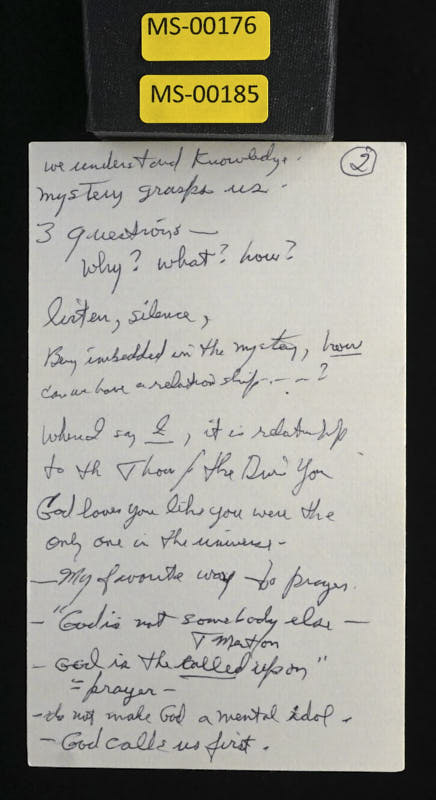
Additional text: We understand know, mystery grasps us\n3 Questions \u2014 Why? What? How?\nListen, silence\nBeing embedded in the mystery, how can we be related to ity \u2014?\nWhrned sg ? , it is relatdsp to TH / Thou / the Divi You\nGod louw you like you were the only one in the uniwee\nMy favorite way to prays\n- God is not somebody else\n\u2013 Fr Mator\n\u2013 God is the callsed fifteen\n- p thing\u2014\ndo not make God a mental idol\n\u2013 God callse us first
Side: 3
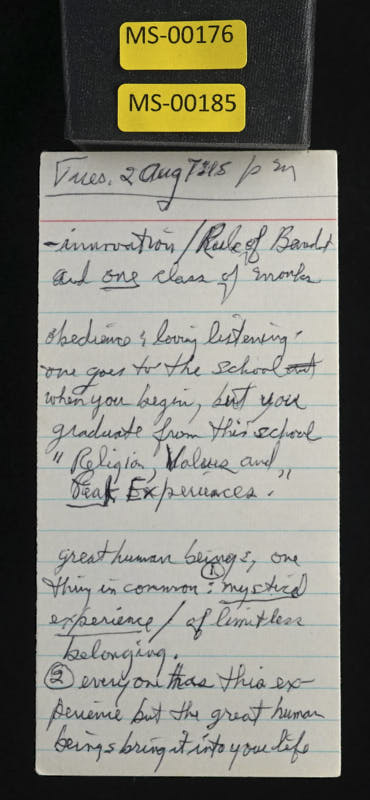
Additional text: Innovation / Rule of Benedict\nAnd one class of monks\nObedience & loving listening,\nOne goes to the school not when you begin, but you graduate from this school\nReligion, Values and Great Experiences\nGreat human beings one thing in common mystical experience of limitless belonging\nserve on this by experience\nBut the great human beings bring it into your life
Side: 4
Additional text: B-class\nFr. James Co - 19 June\nBr. David - 12 July\nBr. Stephen - 30 July\nNanette Keleka\nLarry Dundlee - 1980
Side: 5
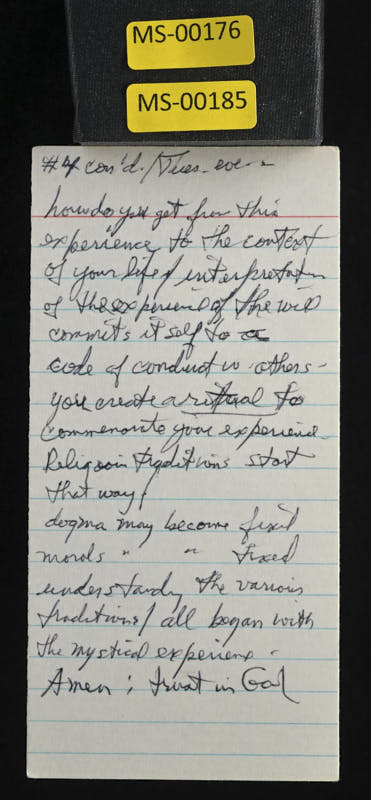
Additional text: #4 contd Tues. eve \u2013\nHow do you get from this experience to the context of your life?\nInterpretation of the sanctifying of the word commits it to a code of conduct in others\nYou create a ritual to communicate your experience\nReligion traditions start that way!\nDogma may become fixed marks fixed ended \u2013\nStudy the various traditions all began with the mystical experiences\nAmen : Trust in God
Side: 6
Additional text: - Silence \u2013 Buddhism\n- Understandy - Hindu\n- Ward - Christmas/Indian moslem\n- Monastic life; limitless belonging\n- Interreligious dialogue
Side: 7
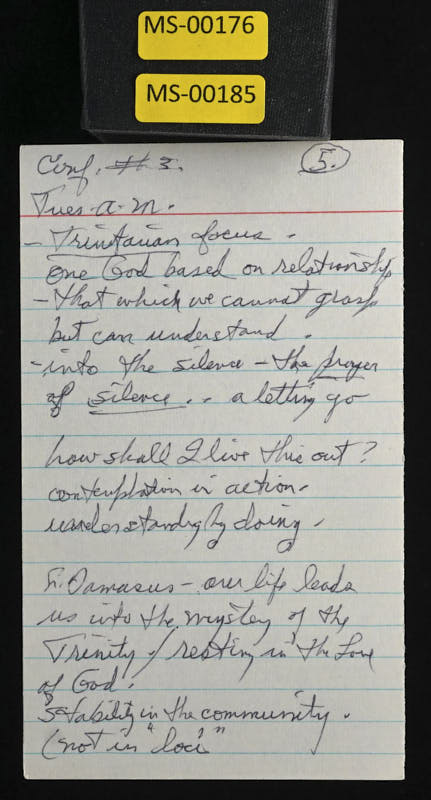
Additional text: Tues A.M.\nTrinitarian focus\nOne God based on relationship\nThat which we cannot grasp but can understand\nInto the silence the prayer of silence... a letting go\nHow shall I live this out? contemplation in action\nUnderstandingly doing\nFr. Damasus, our life leads us into the mystery of the Trinity resting in the Love of God\nStability in the community\nnot in lock
Side: 8
Additional text: The school of the HeartLT\nCabod / doxa / glory\nShines forth\n- Fully alive\n- Special vow of Fr Damasus for RDR Pave\n- contemplative \u2014 not at as costing apostolate \u2014\n- but as extraordinary \u2014 acc. to Rule \u2014\n- Traramion \u2014 natural\n- not clerical \u2014 calling from a bishop-\n- a monks call is from within\n- truly seeking God
Side: 9
Additional text: Deep calling unto deep\nWhether it - a tree is a word in itself as o lie\nAliveness in all our senses\nListening to the silence\nGod gave us the senses \u2013 they proclaim that God loves us\nThe well known ongaro says I bring to every human being message tooling that expresses Gods love\nI will be present in the way that I choose to be present\nLifet the stone and Ill be there\nNot over standing \u2018contus\u2019\nNot over standing \u2013 but understanding\nCappadocian Fathers dance
Side: 10
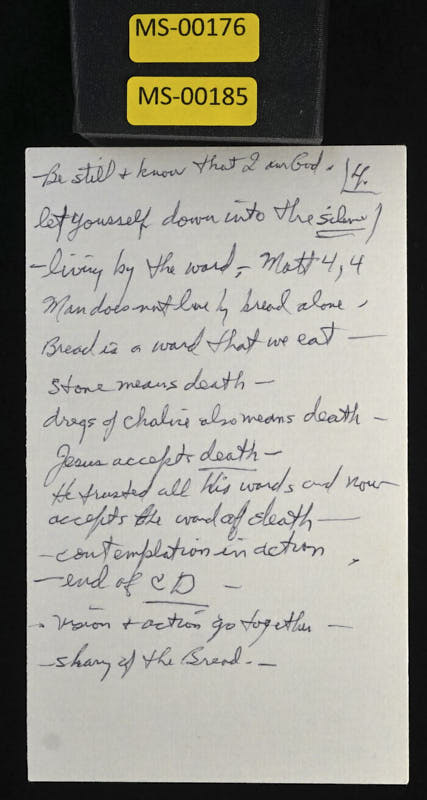
Additional text: Be still and know that I em God. /4\nLet yourself down into the Silin\nLiving by the word, Matt 4,4\nMan does not live by bread alone\nBread is a word that we eat\nStone means death-\n- drips of chalice also means death -\n- Jesus accept death-he treated all his words and now accepts the world of death\n- contemplation in action\n- end of CD -\n- vision + action go together -\n- sharing of the Bread -
@AI-Vision_v003
In the world of God's most beautiful. O love of God's most holy. Peace for style cards and rings of light. And kingdom of God's Lord. restless till they burn on fire with thee with whom we burn. Come give us light that is done. How good and wise thy light to us. How kind thy
[01:02]
May the others be in thy heart, O Lord, and till the night in vain. By thee our nature's wounds on earth, thy living water's good. come and give us life and wisdom now dost renew the face of earth with love beyond or telling and give us joy to rest of those in whom thou takest dwelling.
[02:13]
Transform us by thy living name. Come, strengthen us to praise thy name. Come, give us life Good morning. First of all, my thanks to Father John and to all of you for inviting me to facilitate this annual retreat. It's a great privilege and a great responsibility I see. And we'll have to do it together.
[03:14]
I will depend on your good questions and your good cooperation throughout and especially your prayers. I'm very happy about the renewal of Father Damas' spirit here at Mount Xavier. Unfortunately, I've been away very much, but when I come back, I get, of course, a different feeling for the spirit in the community than when you are always here. And this time, it is different. much warmer and lighter. So that's a great joy for me to see, and I'm sure it's a great joy for all of you. And I was told that you have also a special interest this time in any input that I can give about Father Dan, Mrs. Vincent, since this is a renewal in this spirit, and I will
[04:31]
And in planning these talks, I focused on words by him that I remember or especially passages that he would sing out and that were very important to him. And I will build it around those. If at any point you can't hear me well, just raise your hand. I have great compassion for anybody who can't hear well, because I myself am half deaf. So at any time that I don't talk loudly enough, please ask. And this interaction between us, I would also hope that in the course of the week, I can have a talk with every one of you. At any time that you want, that's convenient for you, just let me know. and we can arrange that.
[05:33]
I definitely make enough time for that all along. Very important for us when we were in formation were the conferences that Father Danvers gave. frequent and they were really the heart of our formation, the heart of the input that he gave. And he would put a great emphasis on what he called the Doctrina Abbatis, the teaching of the abbot. He inherited that from Maria Lach, from his own abbot, who put great emphasis and wrote a commentary on the holy bull, on Ildefons Herrwegen, and long before I came to Monsei where I studied that commentary and the young people in Austria would be very interested in that.
[07:01]
And there, the position of the Abbot is very much stressed, but not as a kind of power figure, but as father, you see, Abba, father, and the teaching of the father. And therefore, it was also an interactive teaching we could ask questions. He was happy about good questions. And so I hope that this week we can continue this format of answer questions. Anytime you can interrupt me with questions, if something isn't clear, or write them out and give them to me and I will pick them up later on. And one of Fr. Damas's emphasis, not so much explicitly but implicitly, was to really go deep, to go really deep into all these, in anything that he spoke, not stay on the surface.
[08:19]
I remember him saying many times, No, that's not deep enough. Go deeper, go deeper, go beyond the surface, go deep. And that he put into a term that he often, a phrase that he often quoted by St. Anselm of Canterbury, fides querens intellectum, faith searching for understanding. And that was really the basis for the teaching of the abbot. Rooted in faith, rooted in our faith, but seeking understanding. And understanding, in this sense, meant put it in your own words. Don't just mouth what you have heard. Digest it deeply enough.
[09:21]
so that you can say it in your own words, and not exactly the way you have heard it, because then you have really understood it. We'll have to say more about this later. But this rooted in faith and seeking a deeper understanding, that was very important to him, and therefore Question the words you use. Question what words you use. Don't think anybody understands that. You say faith. Of course you know what you mean by faith. Question it. Question it long enough until you can say this in your own word. What does it mean to you? Prayer. Monastic life. Community. Any term. Any of the important terms. And that's what I will try... with you together this week, take some key terms and go really deep and try to understand them.
[10:27]
Of course, the way I understand them, the way I will present it, comes from the teaching of Father Damasus, because that was the way I myself was formed, but it isn't limited to what Father Damasus, I heard him say, but the whole point was... Adjust it always new to your understanding. Don't just sit with some fixed doctrine. Doctrina about this is not something that you can put in the book and there you have it, but it is something that is alive through exchange, through interaction. And finally, a word that was very frequently quoted by Father Damasus and that seems to me to express what his conferences did for us is this passage from the prophet Hosea, 2.14, I will lead her into the desert and I will speak to her heart, he says, of
[11:44]
the people of Israel. I will lead her into the desert and I will speak to her heart. And when it worked best, our listening to the conferences that Father Damascus gave, we were always led into the desert. That means we have nothing to hold on to. We are really exposed, you see. And then open your heart Listen with your heart. But allowing yourself to be led into the desert is a very important thing. And the desert is not where you are at home. It's not, oh, I know everything, and now I hear a little more. Yeah, I'll be fitted here. I know exactly where the furniture is. This goes in this drawer, and this goes on that table. No, you're in the desert. You are comfortable. This is new. This is completely new, as if you had heard it for the first time.
[12:46]
That was really important. Go into the desert. Have the courage to go into the desert. Praise us as if it were for the first time. And open your heart, the innermost heart. And if we have that attitude, then it really doesn't matter too much what anybody says, it will be always the Holy Spirit that speaks to us through anything, through the advertisement on the cereal box that we read. All of a sudden that will speak to us. If we are really in the desert and if we open our heart. And so this morning I would like to take Another word that was very important to him, and that's from the Acts of the Apostles, because we have to start with the basics.
[13:59]
The most basic word would be God. Let's start with God. Let's not assume when we say God, we know what we mean. So this morning I would like to speak about God and the word from the Acts of the Apostles is from the 17th chapter, verse 28, where St. Paul preaches on the Areopagus in Athens and so he's not talking to Christians. He's talking to people with whom he has nothing in common. He is a Jew. There are Gentiles just basic human, just a human speaking to humans. He had to face that situation. And so he wants to say something about God as a human being to human beings, not as a Christian teacher to Christians, but a human being to human beings. What can we say about God?
[15:00]
And there he says, in God we live and move and have our being. In God we live. and move and have our being. And that would be the starting point for anything we say about God. God to live and move and have our being. And Father Damasus had another word that he was always cautious against, and that was idolatry. he often spoke about idolatry. And he said the inner idolatry was much more dangerous than the outer idolatry. When you see an idol, the statue of an idol, you are not going to pray to that very long. You know it's cloth and it's an idol.
[16:01]
But he said the inner pictures that he made, as long as we don't question them as long as we don't as long as they are not alive and alive means changing if it doesn't change it's not alive it must constantly change it must constantly grow it must constantly unfold and anything also the notion of God that doesn't unfold is an idol it must unfold and therefore in God we live In God we live. In God we live. Our very life, our very life is our relationship to God. Our relationship to life is our relationship to God. And life is something that we have.
[17:04]
And that is constantly given to us and received with gratitude. If we just live and never think about being grateful for being alive, then we aren't really alive. We are just vegetating. We're just living alone. But if we realize that life is a gift every moment, And there you can go into it in great detail, you could, if you had the time, to see how life is every moment new. It's every moment given to us. And you don't have to go to the subatomic particles that are at every moment, so to say, exploding out of nothing. And Father Damasus was very frequently relating to contemporary science, to contemporary all different sciences and art.
[18:15]
His spirituality was very open to not just theologically and theologians talking to theologians, but he was a theologian who was talking to artists. He was very active in the Catholic Art Association. He was talking to scientists. He was talking to politicians. All the time we had politicians here. In the very early days, so in the mid-50s, anybody who came, say, from Europe to the United States would sooner or later end up here in Montsevier and talk with Brother Damerson. It was kind of a hub of intellectual life. That's not absolutely necessary for a monastery, but it was at that time helpful and good for us, and it meant particularly this interaction. So if you speak about life and you interact with science, you find, for instance, that every second, so now, now, now, as many red blood
[19:28]
corporations, they are pretty big, you can see them on the microphone. As many of those as they are inhabitants of New York City, many millions, die, now dead, now dead, in your body, they block out corporations. And then as many are born, as many are created, then you think, well, you live alone. every moment you are new. And that newness of life, that is a profound mystery completely. And so if St. Paul says, in God we live, it means this constant change, this constant newness, that every moment we live and move and have our being. To be alive to this life, to be alive, to our aliveness, be aware of it, that is spirituality.
[20:36]
Spiritus, Latin means life breath, so spirituality is aliveness, coming alive on all levels. And Father Damasus was always emphasizing that this means all levels of life. It means our bodily life, no less. Sometimes we think spirituality begins somewhere above the eyebrows or is closed up in the heart. No, our whole life. And life means not just my little life. But my interaction with all others, my interaction with the food that I eat, therefore with the animals that died, with the plants that died so I may live, this complete network of interactions with all human beings, with all animals, with all plants, that belongs to our life. And that belongs to our life in God because life itself is that
[21:41]
place, if you want, or that place is not a good word, is that event in my life. Each one of us knows what you mean by my life, better my aliveness, moment by moment, is that event by which I am in contact with God. Every moment in my life is that contact with God. because it is an interaction with mystery. And it is helpful to think of, drop this word God for a while, and replace it by mystery. Because otherwise, it's fine, of course, we use it all day long, and we can use it sometimes. an outlawed word, but for the time being, let's just bracket it.
[22:44]
Let's put it away because otherwise there is the danger that we think we know what we mean and we don't. If we know what we mean, it isn't God. God is mystery, and this is another one of those words that we're again and again mentioned by Father Damus' mystery on many levels and in many contexts. But mystery was a mysterium, we used to say mysterium. Mystery is not some vague notion. It's a very, very clearly, you can even define it, what you mean by mystery. And it is that Don't say reality because reality has to do with race, with thing, so it's not a thing.
[23:47]
It's an actuality. It acts on us. Mystery is an actuality that we cannot grasp. We cannot get it into our grasp. We cannot intellectually grasp in concepts or words or even in our notion. We cannot grasp it, but we can understand it. Those are the two terms that are important to remember when we speak about God or mystery. We cannot grasp it, but we can understand it. If we couldn't understand it, there wouldn't be any point in talking about it. We cannot grasp it, but we can understand it. And how do we understand it? By it grasping us. There's a very great difference. Bernard de Clairvaux says, what we can grasp gives us knowledge.
[24:51]
What grasps us gives us wisdom. And we are not after knowledge, we are after wisdom. And a good image for that is music. It's a good example. We all have certain pieces of music of which we will say, I understand that. I understand that. I understand this music. I don't understand some other music. I understand this music. What does it mean? It does something to me. It moves me. It grabs me. It sweeps me off my feet. If it does that, then you understand this music. And so with mystery, we can't grab it, but it does something to us. If you can grab it, grasp it, we know it. We can't know mystery, we can't know God in that sense of concept, but we can understand God by interacting just like you interact when you listen to music.
[26:02]
And there are three questions that lead us into this mystery. And I would encourage you in the course of the day to think about these three questions. They are the big existential questions. And one is, why? The three questions are why, what, and how? The first is, why? Why? Why leads us into mystery? Why leads us so deeply into that there is no bottom to it. You may find a little answer to why, whatever you are, start asking, but then you can ask, and why that, and why that, and why that, and finally come, why is there anything other than nothing? So why leads you into that bottomless abyss of which C.S.
[27:04]
Lewis says, A creature can throw down their thoughts forever and ever into that abyss. Never will they hear an echo coming back. And that he says about God and about the Father, God the Father. It's that abyss of silence into which we throw our minds by asking why, why, why. And ultimately, there is no answer, but let yourself fall into the hands of the living God. That why leads us into that silence of the Father. The other question is what? You can take anything, a piece of paper, your hand, a light bulb, anything, a table, and ask what? What is it ultimately? And you may say what it's made of, but ultimately, what is it? What is it? And you come again,
[28:05]
into this mystery into something that you cannot grasp but you can understand it how do you understand what is the answer to this what you understand it as a word a word see the why leads you into the silence nothing you can say the what leads you to the word everything there is that means everything every plant every animal, every human being that you encounter is word. It's lastly a word that comes out of this mystery and speaks to you and you can interact with it. So silence, word. And in order to find meaning, You need to have silence, because otherwise you have no word. A true word comes out of the silence. If it doesn't come out of the silence, it's a chit-chat.
[29:08]
But a true word comes out of the silence, and you can understand it. Understand it. And understanding means that you listen, and that was another aspect that Father Damerson kept emphasizing. that listening to the Word, that listening was very important. Well, over and over, the very Word of the Holy Lord is listen, listen. Listen so deeply to whatever it is, this situation, this person that you encounter, this thing that you handle. You will handle it very differently. Every spoon you will handle differently. You should listen with your heart, and then you will understand. And understanding is a process. It's a process by which you so deeply listen to the Word that it takes hold of you and leads you into the silence from which it comes.
[30:09]
That's important. Understanding is a process. You listen with all your heart and it takes you and leads you into the silence from which it comes. And that understanding, in this sense, is the Holy Spirit. The silence into which the why leads us is the silence of the Father. The word is the Logos, is the Christ. And the why leads us into the understanding through doing. And that is in the Holy Spirit. The Holy Spirit leads you to listen so deeply that it will take you and make you do something. The Word will make you do something. So why, what, how are the three great questions that lead us. Why into the silence of the Father? What into the Word, the Logos of the Son?
[31:14]
And how through understanding to the Holy Spirit? Even though we are completely embedded in this mystery, in God we live and move and have our being, you might wonder, how then can we have a personal relationship to God? This is one of the key questions when people realize that God isn't somebody over there, but you live and move and have your being in God. How can you have... a relation to this God? That is a very difficult and deep question, but in that sense, Father Damasus was always referring to Martin Buber. Martin Buber was a very important figure for him, and particularly his book, I and Thou.
[32:20]
And in this book, I and Thou, Martin Buber, unfolds a thought that was also one of the key thoughts for Father Damasus that when I for the first time say I and mean it, I am already in relationship to an eternal thou. I doesn't make any sense if it isn't related to a thou. And that Tao is the divine Tao that precedes my being able to say I. And so even though I am in the God, move and live and have my being, I can at the same time, I am at the same time related to God. This Tao, because I say I, one of the
[33:25]
American poet E.E. Cummings has a beautiful line. He says, I am through you, so I. I am through you, not so beautiful or so whatever else, but so I. My very I is constituted by my relationship to you. And that you is ultimately not a human you, but this the divine you, because we live our life as a story. Every one of us lives not episodes, but a story. We have a story. And we want to tell that story to somebody. If it's a story, it's to be told. And then we try to tell the story to someone we really love, a very good friend. And there's always something left over. You can never completely get it across.
[34:26]
And that is one way of appreciating that really we tell this story to an eternal soul. We tell our life story to God. Henry Nowen, I know him from his books, he taught at Yale for a long time and his students liked him a lot and They were coming in and out of his apartment and just going to the refrigerator and taking a beer out of it. And he was just completely there for his students. And when he came back from a trip, he always wanted to show them slides. At that time, they were taking photographs and making these slides, and we made a little slide show. And he had too many slides, and his students would look for about 20 or 30, and then they would fall asleep. And he said... I know what it will be like when I get to heaven. God will say, Henry, here you are, show me your slides.
[35:28]
We all have this slide show, you know, a slide show and we want to somehow get it across. And we never find anybody who has the patience to look at all these slides but God. So we are related, even though we are within God, We are related to God. And that is, of course, the mystery of the Blessed Trinity. We have always learned about that, that this one God within this one God is relationship. And we are in it. It's not out there floating around. That's why in Sunday school they used to tell us, well, you'll never understand it anyway. It's this mystery out there. It's the hard piece of our Christian faith. In God we live and move and have our being. That is, we are part of what the Greek Fathers, particularly Gregory of Missa, called the round dance of the Trinity, the circle dance of the Trinity.
[36:34]
That was also one of the images that were very dear to Father Damasus Christ as the koryphos, the leader of the great dance, you see. I am the lord of the dance in this song, you see. But that was before, I think that was long before that dance was ever too popular. He would say Christ is the leader of the dance, comes forth from the Father and leads all of us, we belong to him, leads all of us in the Holy Spirit back to the Father. And that's why he said the ancient doxology was not glory be to the Father and to the Son and to the Holy Spirit. He said that was later, that was kind of having everything nicely. They are equal, so you have to say and, and, and. He said the original doxology was glory be to the Father through the Son in the Holy Spirit.
[37:39]
through, through, in, repeating these words. And that is also what you later on see, this is also meant to be a preparation for the Feast of the Transfiguration, what is celebrated in the Transfiguration. It's really the life of the Blessed Trinity that's celebrated there. So let's once more say The key sentences that we had, in God we live and move and have our being. One, another one is from the Psalms, Psalm 63.1, O God, you are my God. Father Dempsey used to say, well, we pray this, O God, you are my God, as if, well, what's next? The first person who prayed, O God, you are my God.
[38:42]
We should just be so overwhelmed by this word that we can't go on. I'm personally related. He used to say, God loves you so much as if you were the only one in the universe. Personal relation. Oh God, you are my God. And then I will lead you into the desert and speak to your heart. that openness. So to remember these three words, God will live and move and have our being, O God, you are my God, and I will lead you into the desert and speak to your heart, that would kind of, to ponder these words would kind of be the homework for today. And I would like you to write out one question. It really would be important that you one answer to a question.
[39:43]
Write it out, because if you just think, well, I know it, maybe you don't know it clearly enough, so it's very short. The sentence starts, my favorite way to pray, that relationship to God, my favorite way to pray is, and then finish the sentence. If you write that out today, then in the evening you bring it. We don't have to share it with others. We are free to share it with others. But for you it's important to have that with you. And then this evening we will talk about prayer in this context of living and moving in God and how Father Damascus understood prayer and why it was so important.
[40:30]
@Transcribed_UNK
@Text_v005
@Score_95.1