You are currently logged-out. You can log-in or create an account to save favorites and more. more info
Consecration Over Proclamation: Redefining Priesthood
The talk explores the essence and identity of priesthood, focusing on the distinct consecratory power of ordained priests as central to their role, amidst modern theological debates and interpretations from Vatican II and theologians like Ratzinger. The discussion critiques the emphasis on Word and proclamation in priestly duties, advocating for recognition of sacramental and consecratory functions as distinguishing factors in the priesthood. The speaker raises concerns about interpretations of the New Testament and emphasizes the church's role in safeguarding doctrinal teachings, underlining the importance of understanding priesthood as both an ontological and functional reality.
Referenced Works and Concepts:
- Summa Theologica by Thomas Aquinas: Emphasized the primary priestly function of celebrating the mystery of the Eucharist, laying a historical theological foundation on which subsequent Church decrees, including those from the Council of Trent, are built.
-
The Second Vatican Council Documents: Highlighted the ongoing discussions on priestly functions, particularly emphasizing the deepening understanding of salvation under St. Thomas's guidance, sparking current debates on the balance between Word proclamation and sacramental roles.
-
Institutions Generalis Missae (General Instruction of the Roman Missal): Provides context for the distinction and function of priests in the Eucharistic celebration.
-
Ideas and writings of Karl Rahner and Joseph Ratzinger: Discuss modern interpretations of priesthood focusing on proclamation as a primary role, contrasted by the speaker with traditional emphasis on sacramental acts.
-
The Decrees of the Council of Trent: Reaffirmed the power to consecrate and offer sacrifice as defining aspects of priesthood, echoing the arguments for the unique role and dignity associated with the sacrament of ordination.
-
Writings by Otto Casel and Gerardus van der Leeuw: Explore the mythic and mystical dimensions of liturgical acts, comparing them to dramatic representation, thus illuminating the intrinsic symbolic nature of priestly acts.
-
Theological concepts of acting "in persona Christi": Derived from Aquinas and entrenched in Church doctrine, signifying a priest's unique role in sacraments through which Christ acts.
AI Suggested Title: "Consecration Over Proclamation: Redefining Priesthood"
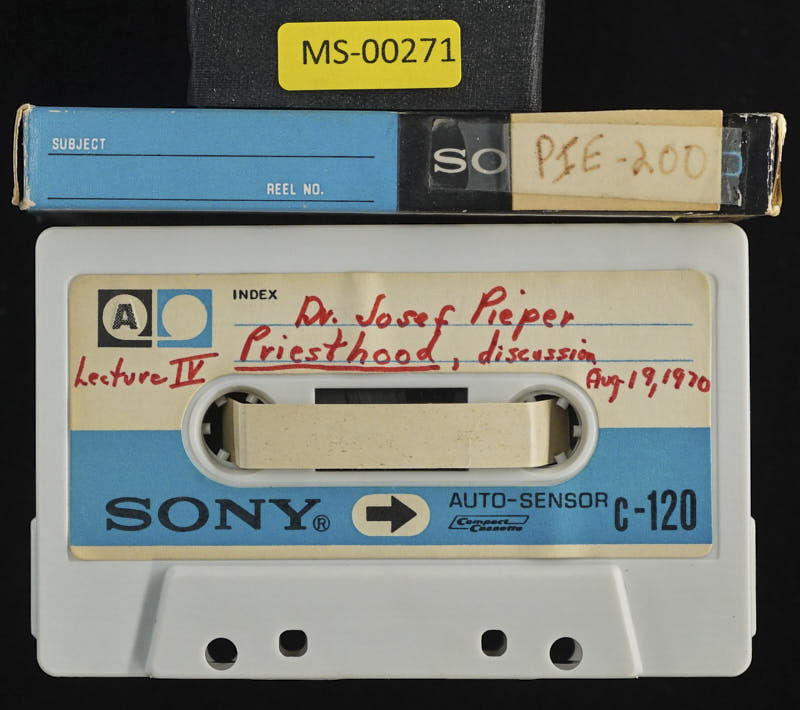

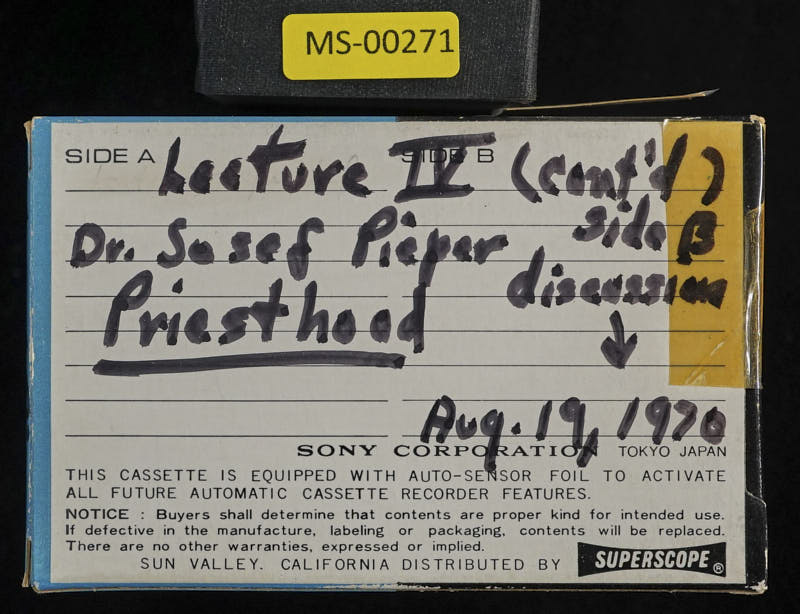
AI Vision - Possible Values from Photos:
Speaker: Dr. Josef Pieper
Possible Title: Priesthood, discussion
Additional text: Lecture IV, cont\u2019d:side B
@AI-Vision_v002
I hope that nobody will expect from me a theological treatise on priesthood. What I feel I am able to do is something like a contribution to a discussion, which is, as everybody knows, going on for some years. So I should like to formulate a rather surprised remark. Surprised remarks may be challenging remarks of a layman on the subject of priesthood.
[01:06]
I am a layman in the double sense of the word. I'm not a priest and not a theologian. The second fact is clearly a handicap insofar as I am not able nor authorized to speak on this subject on the basis of my own competent interpretation of our sacred tradition within it of the New Testament in particular. On the other side, one should not understate too much either. I'm not quite unfamiliar with the great tradition of theology regarding priesthood. And I may be allowed to say, for instance, that I had a rather long meditating intercourse with that doctrine, that clear, and I feel very deep, doctrine on priesthood, which is formulated by St.
[02:11]
Thomas. Now you certainly know of that painful fact that it has meanwhile become somewhat embarrassing to use even the name of this last great teacher of this still undivided Western Christendom. But it should not be suppressed, however, that the Second Vatican Council demands the future priest to go deeper into the mysteries of salvation under his guidance, Sancto Toma Magistro. And it has been said, rightly, that never before an ecumenical council has named and distinguished an individual theologian in such a way. Now, to be a layman in the first sense of the word, which means not to be an ordained priest, maybe I should rather say to be a non-ordained priest,
[03:22]
This seems to be much less a handicap. It may be of some advantage to complete a bit the discussion which is going on about the priestly self-understanding and to correct it a bit by what a simple Christian layman considers to be a priest and what he finds are his desirable qualities and necessary qualities. I said it will be a surprised remark. The surprise which I should like to express is concerned only with one thing, with one point of that discussion among priestly theologians. And the point is that there is usually not even mentioned that quality which has been unanimously considered hitherto the distinguishing mark of a priest, that which makes him a priest.
[04:38]
I said hitherto, that is perhaps not a very precise term. In any case, it has to be understood in such a way that it explicitly includes the decrees of Vaticanum Secundum. So what, then, is the priestly in the priest? What does distinguish him from the non-priest, from the non-ordained priest? Now, it has, of course, not much meaning to give here a private, individual answer and be this answer as original and as modern as it can possibly be. Instead, I should like to quote three hitherto informations, three hitherto answers, all of them of representative character. First information, priests are being ordained for this, that they perform the sacrament of the body of Christ.
[05:51]
The priest has two main acts. The first and primary act is related to the celebration of the mystery of the Eucharist, and the second and secondary act, which is based on the first one, but nota bene also belongs to the main and specific task of a priest. That second priestly act is to lead the people to and to prepare them for the meaningful and convenient participation in the celebration of this mystery. Second answer, that in and with the office of priesthood... the apostles and their successors have received the power to consecrate, to offer, and to spend the body and blood of Christ and to forgive or not to forgive the sins, this in the Holy Scripture is clearly said and has always been taught in the tradition of the Catholic Church.
[07:08]
And third answer... The Lord has established certain ministers among the faithful so that they, provided with the sacred power of their order to offer sacrifice and to remit sins, should perform their priestly office publicly for men in the name of Christ. Priests fulfill their chief duty in the mystery of Eucharistic sacrifice. they exercise the sacred function of Christ most of all, maxime, in the Eucharistic liturgy or synaxis, in eucharistico cultu, acting in the person of Christ and proclaiming his mystery, they re-present, re-hyphen, present, and apply,
[08:10]
in the sacrifice of the Mass, the one sacrifice of the New Testament, namely the sacrifice of Christ, until the coming of the Lord. Now, these three informations or answers, fully identical in their core, cover the span of seven centuries up to our own present time. The third answer is, namely is contained in the decrees of Vaticanum Secundum. The first one has Thomas Aquinas for its author, and the text quoted in the second place is a formulation of the Council of Trent. Of course, none of these answers claims to describe the totality of all concrete possibilities of priestly activity within history. and certainly the emphasis on the different aspects of the life of a priest may change according to time and place.
[09:25]
But what is under discussion here is the differentia specifica, the difference, the distinguishing quality. If we are to define what a medical doctor is, an officially authorized surgeon, surgeon, let's say, or a lawyer or a judge, then, of course, it can be said that a doctor or lawyer, a judge, at the same time and always is also a citizen, he is also a husband, he is also a father, and so on. And it can be possibly said also that a specific individual, a mother or a nurse, might likewise have some experience and capacity of healing as a doctor, too.
[10:26]
But the difference, the differentia specifica of an authorized doctor would still be that he alone, for instance, is allowed... to make a surgical operation or to declare a person to be dead. So, in the same way, it can be rightly said, and it must be said, of course, that the priest is also a responsible citizen and that he should be maybe a well-trained speaker or maybe even a journalist. or that he should be acquainted with social problems and be an active social worker, and so on. But all those three answers emphasize the differentia specifica, that quality which makes a priest a priest. And if in a theological exposition and representation
[11:36]
of the priestly service or the priestly self-understanding, you can find hardly a single word which could remind you of those three answers I quoted. If there is, of course I am referring here to those discussions I know of, Germany, Europe, but I think it is not very different here. if there is an almost complete silence with regard to the consecratory power and to the offering of the sacrifice and to the connection between what the priest is doing on the one side and the Lord's sacramental presence in the sacred bread on the other side, then... neither friendship nor personal veneration can prevent me from looking at the basic conception with an extreme degree of distrust.
[12:42]
And I think it is simply wrong to say, for instance, what in our discussions many times has been said. that according to the Vaticanum Secundum, the Word would be the all-embracing and fundamental thing, the Word, unless you would understand by the Word the divine Logos who became man in Christ and whose body and blood we venerate and receive in the Eucharist. And it is, I think, not true either. that the entire priestly service essentially should be kerygma, proclamation. Also the celebration of the Eucharist, au fond, at bottom, proclamation of the mystery of Easter, or cultic proclamation of the death of Christ.
[13:52]
These are formulations of Ratzinger and Karana. and consequently the priest, primarily a preacher, the announcer and proclaimer of the word. In the Institutio Generalis, or the new Ordo Missae, you will find that the priests are called neither preachers, nor managers, nor chairmen. of the congregation, nor even presbyters, of course, in that liturgical context. But they are called sacerdotes et ministri sacri. Now, nobody will deny that there happens also proclamation, also carigma, in the performance of the Eucharist and in the sacrament of the Confession.
[14:54]
And it might well be that I, as a receiver of those sacraments, get an insight which possibly changes all my life when I hear the words of the absolution or the word of the body of Christ broken for me. Nobody will deny that. But I would say, I would ask the question, pose the question, is not the real abolition of my guilt, my sin, and the real reception of the sacramental bread something which is different on principle from all that? If, let's say, in the service of the Word, in the first part of the Mass, the report from the Gospel of St. Matthew, on the Last Supper, is being read, then, without any doubt, there is happening keringma, proclamation.
[16:08]
But this reading can be done by every Christian. For this there is not needed an ordained priest, not even a lector. But if, on the contrary, The same report is being spoken within the prex eucharistica, within the canon of the Mass. Then, besides the Kerygma and apart from the proclamation, something quite different happens. It happens what the word of the proclamation is speaking of. but that this event really takes place and can take place, for that the consecratory power is needed, which the priest receives in the sacrament of the ordination and through which alone he is an ordained priest.
[17:15]
My very good friend Joseph Ratzinger, whom you certainly know by name at least, once published the somewhat fatal sentence. We had some debate on it, and he even allowed me to publish my different and opposed opinion. He once published the somewhat fatal sentence that a priest should not be, I'm quoting him, a cultic craftsman, but a ponderer of the word. Now, as I said, the author said at the same time in the same article that this is a drastically over-pointed formulation. But it is exactly this headline character which makes it a dangerous thing. I experienced that myself many times.
[18:20]
in some dozen discussions with students of theology and with young priests. This formulation seduces people all too easily to enter into a wrong alternative. Of course, the priest must not be a cultic craftsman, whatever that may mean. But he has to be, and he is, one priest, who is in a unique way called upon and authorized and empowered through the sacrament of ordination for the cultic performance of the divine mystery. And of course the priest ought to be also a ponderer of the word. Nobody has ever denied that. When Thomas Aquinas, for instance, in the 13th century is fighting for the mendicants' permission to preach in the churches, in the parish churches, one of his main arguments is that the normal, at that time, the normal parish priest doesn't know anything about Holy Scripture and that the preacher should
[19:47]
know the Holy Scripture. Without this acquaintance with the Bible, the priest would not be able to fulfill his secondary but not less important task to lead the people to the meaningful participation in the celebration of the divine mysteries. To be a ponderer of the word, perhaps even a preacher and a proclaimer and an announcer of the word, is in a certain sense the task of every Christian. For this, that's true, possibly, in special cases, an explicit mission, commission, the Missio Canonica by the Church is needed, but by no means is needed. the sacrament of ordination.
[20:48]
On the other hand, nobody will maintain that the priest would receive in his ordination the charism of pondering the word or of its right proclamation or even the ability of a correct interpretation of the Holy Scripture. It takes time, it takes time exercise and there is practical experience needed for the realization and the fulfillment of the two offices and tasks of the priest, to be a good pastor and shepherd and to be a good preacher. But there is needed neither time nor exercise nor experience for his becoming able to fulfill the specifically it is exactly this ability which in its fullness is received by the priest and by him alone in the sacrament of ordination, in its fullness.
[21:57]
He receives above all the consecratory power to celebrate the Eucharist in persona Christi and for the whole Church. Exclusively this is also the basis and the reason for and of the true dignity of the ordained priest, by virtue of which, according to Vaticanum Secundum, he is distinct. Essentially, I'm quoting, you know that, essentially and not only gradually, from the common priesthood of all faithful. And for me, again I have to remind you of that surprise. For me it is not only a surprising but a deeply terrifying experience to hear priestly theologians speaking ironically of their dignity, as if it would have anything to do with something on which one could pride oneself.
[23:12]
On the other On the contrary, I would say, the objectivity of this dignity makes the non-priestly faithful independent of the incidental and casual qualities of the priest. Popular sermons... During the first mass of a new ordained priest, they may certainly sometimes get into all too drastic and sentimental comparisons, even with angels or something like that. But personally, I do not feel the slightest difficulty to call a young chaplain whose father I could be reverend and even father, pair of what by no means would come to my mind when I meet the most ingenious ponderer of the world, or the most dedicated social worker, or the most learned professor of theology.
[24:21]
By the way, the Christian could be raised whether the special priestly form of life, in the first place the celibacy, could be made plausible in the most convincing, if not in the only way, by going back to that consecratory dignity on which everything else is based. I said it could be made plausible. I should say plausible at least as something internally belonging and... Nobody says that there is a necessary connection. At this point, I should like to make some remarks in order to clarify, first, the term in persona Christi, and second, the objectivity, the objective efficiency and effectivity of what the priest is doing in persona Christi, in the person of Christ.
[25:31]
So first, this expression, in persona Christi, is to be found in St. Thomas Aquinas, and I think from there it came into the decrees of the Council of Trent, and also from there again in the decrees of Vaticanum Secundum. So to act in the person of somebody else is a representation which is... We have spoken here often enough now of the preambula. This is also a pre-theological representation. It belongs to the preambula. If you don't understand what it means to act in the person, in persona of somebody else, you cannot really understand what it means to act in persona Christi. And there are probably two sources from two realms from which this representation is taken.
[26:40]
From the juridical sphere to act in the person of someone else, juridically, or maybe even more, from the theater. The actor acts in the person of Hamlet, let's say. That is to say, there is a specific kind of identification. The actor, for instance, does not quote Shakespeare. When he says to be or not to be, this is the question. He does not quote a poet. It might perhaps be helpful to consider for one moment some different possible ways. to say the words, this is my body. There could be, let us say, a non-Christian educated Hindu who reads or who cites that passage of St.
[27:45]
Matthew to his friends or to his students. This is what the Christians believe that this man, Jesus, said. during what they call the Last Supper. This would be a mere quotation out of a certain book or a certain author. Then a Christian could read the same passage to his family in a Sunday's Scripture reading, let's say. Then... It is obviously more than a mere quotation. It is a kind of realization in this specific sense, which this word, realization, has only, as it seems to me, in the English language. And then, as I already said, the same report could be read in the mass.
[28:53]
by a layman within the service of the Word in the first part of the Mass. And again, it would have become much more than a quotation. It would have become proclamation, keringma, in the stricter sense of the term. And finally, it can be said as, in fact, it is being said in the canon of the Mass by the priest. Where, now I could not say where the priest is identifying himself with Christ, as the actor identifies himself with Hamlet. No, where Christ himself is speaking and acting in and identifying himself with the priest. And this mystical but, of course, real objective identity becomes also somewhat visible.
[30:04]
That is the sense of any sacrament, of every. It has to be made somewhat visible in the way the priest is speaking and behaving. He visibly takes the bread. in his hands and so on. And Odo Kassel once said, he was quoting then this Dutch theologian or historian, Gerardus van de Leeuw, not his Phenomenal Way of the Origin, a book on primitive religion, where this... Vandeleu says, if you would like to see or to attend, to observe a real myth, a real mythical happening, of course myth and mythical is here taken in the positive, the most thinkable, positive way.
[31:07]
He said, if you would like to attend such a mythical event, then you cannot... only have to go to the Catholic Mass. There is this mythical identification with the Divine Person. By the way, I would like to put this into brackets, so to speak, because it is only a side remark and it is not of real I mean not of essential, it doesn't belong to the essentials, but this speaking and this acting objectively in persona Christi is, I said, it has to be made visible in some way, but it is also made visible, in fact, in the liturgical vestments, for instance.
[32:08]
And again, I would say, in analogy to the theater. I don't speak here of entertainment theatre, that's clear. Tragedy. Or when I think of the Japanese No Place, for instance. And this, for my feeling, is also the reason why the priest, I think, should not go outside the church in his liturgical vestments in order to talk to people. who meanwhile light their cigarette, maybe offer the priest another one. There are some other reasons for that, I would say. It has also to do with the meaning of the sacred action we spoke already of last night and the night before. It belongs to the nature of a sacred action to have a definite beginning and to have a definite end.
[33:10]
Again in analogy to the theater. Hamlet on the stage neither says goodnight to the spectators nor does he talk to them while in his costume. But I said this is in brackets. Here is also just another remark belonging still into the brackets. It is, I feel, also the reason why the individual name of the celebrant is not in the least of interest. I spoke of the Indians, and I'm just coming from New Mexico and attended some dancing celebration, sacred dances with the pueblos. Santo Domingo, for instance, and I had a conversation with a man who is really an expert on all these sacred customs of the Indians, a certain Mr. Ortega, he wrote also on that subject.
[34:31]
And I asked him, would an Indian, I think I talked, I mean, private conversation I already, told that to somebody here. I asked him whether a Pueblo Indian, while wearing his ceremonial dance vestment, would possibly talk to people on commonplace subjects, or whether he would leave his ritual place. The answer of this Mr. Oteja was very definite, no, never. The dressing itself, which takes place in the kiva is a ritual event, and so the disrobing too. And Mr. Ortega said, I have many friends among the Indians, but if I would meet them in such a ritual dance, they would ignore me. But this would not mean that they deny my friendship, that they deny the brotherhood also.
[35:35]
It only means they are now acting on a different level. Now, brackets closed. I should like to try to make clear the meaning of that mystical identity between Christ and the priest acting in persona Christi still in another way. In our discussion there in Santa Fe on pastoral liturgy, we have there the French, the president of the National Liturgical Center of France, the Père G. And he pointed out that the priest alone is able to say oui in order to represent the congregation. He alone can say oui. in the name of the congregation, we. One could say that he is speaking then in persona congregaciones.
[36:42]
Certainly true. But sometimes the priest says also, ego, I, and not we. And this ego, again, can have a different meaning. And I think it is important to see and to realize the differences. St. Thomas, for instance, is stressing that point when he distinguishes between ego te baptizo and ego te absorbo. In the second case, he is acting strictly in persona Christi. The ego is Christ himself, although, of course, in the first case, too, as in all sacraments, The real agent is cast, but there is a difference. And a last remark on the objectivity and the objective effectivity of the priests acting in persona Christi.
[37:48]
We speak of the Eucharist prayer, but there again has to be made, I would say, a distinction, or even more than one. I pray that my child may become healthy again, my sick child. Or the priest prays, I eat your body and drink your blood, let it not bring me condemnation but health in mind and body. This is one kind of prayer, petition prayer. But it is quite a different thing. when he prays, Father, may the Holy Spirit sanctify these offerings, let them become the body and blood of Jesus Christ our Lord. That's a quite different kind of prayer.
[38:49]
It's not a petition. The petition prayer is an expression of hope. Petitio est interpretativa spei, says St. Thomas. But in the first, in the prayer, let this become the body and blood of Jesus Christ, our Lord. In that case, the priest does not express his hope or our hope. This prayer expresses expresses gratefully, of course, what we are sure will really happen. It is an expression of the acknowledgement of what objectively will take place. So far about these two points, what does inter sona Christi mean and how about the objectivity and the objective effectivity of
[40:03]
this acting in persona Christi. Now, concluding, everybody knows that all this has become somewhat questionable today, and that it has been made questionable. and that by an appeal to her, as they say, new understanding of the New Testament, which our generation has brought about. From the point of view of this pretended new understanding, all I have said seems to be a kind of relapse into the Old Testament, or even into paganism. And at this point, I have to confess that my handicap of being a non-theologian comes in again. I am not really on my own capable of a counter-argumentation on the basis of my own interpretation of the New Testament.
[41:13]
Although I am convinced that the early fathers of the church and the great teachers of medieval Christendom have likewise thought and argued and that they were much closer to the Holy Scripture than most people today are willing to concede. And the more I become aware of the enormously contradictory variety of exegetical information, also of the apparently evident ones, the more urgently I feel faced with the question, who is the definitively legitimatized explainer and interpreter of the New Testament and the Scripture in general? And in spite of all my grateful respect for the historical critical labor, whose fruits are absolutely, of course, indispensable also to the Church,
[42:24]
Nevertheless, I am infinitely happy that I have to expect the true explanation of the New Testament, inspired and guaranteed by its author himself, not from the side of the exegetical science nor from theology in general, but just from the Church herself, not only to be sure from her explicit edicts on Scripture and decrees, but at the same time from all, and perhaps even more, from all what she, the Church, especially as the ecclesia orans, is saying by her cultic sacramental life itself. Thank you. Thank you very much. I think if there are any questions... I'm expecting that you are willing to kill me, some of you.
[43:36]
Would it help if we stood up just a moment? Yeah, maybe. And in the view of modern conditions and the necessity of examining other aspects of priestly ministry, they focus on these and discuss and elaborate and explore. But with this understood as in the background, do you think that the silence is a kind of conspiracy to eliminate from the notion of priesthood what is, as you would have put it, is essential to it? That's, of course, difficult to answer. I would say I wouldn't judge what they have in mind and what they really think, but what they say. And if they claim to describe what priesthood means, and they don't speak of that, and they even say, as Ratzinger did, I think he changed his mind a bit, meanwhile.
[44:54]
But as he did... that the main thing is the word, according to Vatican Council II, and the priest is primarily a proclaimer only of the word, then I would say he suppresses something. Of course, he wouldn't deny that there is a consecratory power, but he doesn't speak of it. And then it becomes, of course, very close to The Protestant view of the minister. But in regard to this proclaiming of the word, in some things I've read, and I must confess I haven't read widely in this area, but in some of the things I've read, it has been pointed out that this office of proclaiming the word is also realized in his proclaiming the Eucharistic words, the consecratory words. part of the proclamation, obviously not in the same way in which it is in the proclamation of the Word in the foremast, but this also, and because it is in the essential part of the Mass, is also proclamation of the Word.
[46:12]
When the priest says, this is my love, he is proclaiming the... No, I do not deny that. I mean, I made it explicitly clear that There is proclamation also, but, I mean, the main thing is that it is really happening what the proclamation is about. And, I mean, if you wouldn't see that distinction, then I would say the main point is failed. You fail the main point, then. If you speak only of proclamation and do not... realize at the same time that what your proclamation is about is at the same time really happening as an objective happening, an objective reality. But if this isn't denied by such theologians, do you think that one could assume that they are denying it? No, I wouldn't say that they explicitly deny, but they don't explicitly speak of it either.
[47:16]
And that is misleading at least. And I had some very sharp debates with them, and so I saw that they have some, there are some obstacles which prevent them from accepting that. And they speak of magic, of a magical idea of priesthood and so on. Not Ratzinger. Of course, Rana, but Rana never says, speaks as far as I know, he says, it's a cultic proclamation. I asked him, what does it mean, cultic proclamation? There is proclamation within the cultic performance of the Eucharist. That's all true. But I would like that he would stress also this point that there happens something, something real, objectively.
[48:18]
and that it happens exactly that what the proclamation is speaking about, and that there is a difference between that proclamation and that happening. There are two things. You cannot separate them. They are together, but they are to be distinguished, and they are two different things, I would say. And what makes the priest... I should say that is this power that this really happens then by his proclamation, not by my, as a blamer, not by my proclamation. Even if I would that, I mean, this objectivity also in the absolution, for instance, I remember, and that was for me really a clarification of the objectivity of what happens in the sacraments. A friend of mine who was in Siberia in the prison, in a big prisoners camp. And he said, one day there came to me a minister, a Protestant minister. There were many others, or some, several others also, Protestant ministers.
[49:24]
He came to me and said, I would like to have, to say confession to you. He said, I answered, why don't you go to your Protestant confrères? He said, because I do not wish to get an advice nor a consolation, what I wish to get is the absolution. So I think here, the man, he knew what is going on in the absolution. Something, not only proclamation and not only a kind of prayer, I hope God will you forgive you, but the real forgiveness, the real abolition. Abolishment of sins. That was what he was looking for. And I wouldn't deny that when I hear the words ego te absolvo, that could change my life, that this is possible, that a man can say that.
[50:26]
I would say that is the fruit of proclamation, can be. But the real forgiveness is something different. I mean, the main obstacles, the main objections also, they seem to come out of the interpretation of the New Testament. They say there is no talk about priesthood, there is no talk about sacerdotes, the New Testament even avoids all these names, Kohen and... and the pagan expressions for priesthood, especially them, but also the Jewish. But I feel there could be in that... I mean, there could be an interpretation of this fact. Could be that the situation of the first generation is always different.
[51:28]
When I was in India, I found a... It is a situation of the mission. of the converts, of the first generation. I found there a Belgian priest who had on his chalice and even on his liturgical vestment the holy syllable of the Indians, om. And it was in Calcutta where they speak Bengali and this om with which all religious sessions in India begin, even non-religious lectures. This Aum is written in Bengali in three letters, A-O-M. And he says, for me, that is first the symbol of Trinity, Holy Trinity, and at the same time the symbol of my deep connection with the sacred tradition of Hinduism.
[52:29]
But I spoke with other people also, and he himself said, if you... become a convert from Hinduism to the Catholic Church, you cannot in the first generation, you have to get away from it. You have to leave out this, you cannot speak out anymore for a longer time this holy syllable. This is impossible. You have to get away first and you have to avoid any mistaking of what you are doing now with what you were doing before. And I think this could be true also for the first generation in the New Testament. It was dangerous to speak of something or of somebody or of some institution which at the same time was still valid in the Jewish religion or in the pagan religion. So I think that it has to be at least considered, I would say, that this possibility exists.
[53:30]
And then, after then, when the danger was over, this Belgian priest who was for 25 or 30 years now in India, for him it was not danger at all to see the connections between the sacred tradition of Hinduism and of all religion and of his Catholic faith. But as I said, the Hindu who becomes first a Catholic, he cannot... insist on that connection. He has to go away first. And so I would say this may explain this avoidance of all terms which could be, which could lead to a misunderstanding of the new, of the absolutely new kind of priesthood in the In Christianity, priesthood distinguished from what was in the temple, the Jewish religion, and from pagan, in the pagan religion.
[54:39]
And we spoke already of that last night, of that other objection, that the Eucharist is derived from the meal in the family, the home, and not from the temple service. But I think, again, at least the Church is clearly using, in the explanation of the Eucharist, all terms which were used in the temple sacrifices also. And the sacrifice of Christ is, at the same time, I would say... has the character of a meal and at the same time the character of the sacrifice which was prefigured in all the sacrifices in the temple. So there are some biblical objections and I think they are not valid, these ones. Maybe there are other ones. But this wouldn't convince me.
[55:47]
Yeah. Dr. I'm not completely satisfied. I would like to hold on to what you said, which I always didn't hold on to until those documents came out that the big thing about the priesthood is power to consecrate and give sins. But I'm sorry I don't have the documents here. It seems to me the way that Vatican II speaks that the emphasis on the preaching We would always say before that that it was the consecratory power. But it seems to be on the preaching. So many these modern theologians, they're not denying the consecratory, but they say, what is the most important function of the priest? And from the way the Vatican says it, it seems to be the preaching delivered. That's the impression I am, anyway. Yeah, there are two... There are two expressions in the, as far as I can see, in the decrees of Vatican Council.
[56:53]
The primary act or the first act of the priest is, that sometimes is said, the proclamation and preaching, but it depends upon what first means. And of course, first comes the proclamation, the leading to. That is temporarily first, I would say. And second, I should say that this certainly has been a bit neglected in our pre-concilia church life, so that the emphasis is understandable on preaching. But if you ask for the differentia specifica, I think, then things become different. But this leading to the meaningful celebration of the faithful, the meaningful participation of the faithful in the celebration of the mystery of the Eucharist, this leading includes many, many things.
[57:58]
It may even include revolution in South America to take part in the revolutionary movements. But we had in Santa Fe also the Archbishop of Panama Thomas Clavel, with his San Miguelito liturgy, maybe you know about it, and there was something in his talking which showed that he, in his experience with people, in these very new and daring experiences, that he changed somewhat his mind. For instance, this is a different thing now, but it has to do with what we were talking about yesterday, last night. He, for instance, said, first I was convinced we don't need churches at all anymore. We just have some rooms and finished. And all the palaces, and he gave his own bishop palace to a university and so on.
[59:01]
And then he said, I changed my mind. I saw we need real churches and people, not only the normal churches, Simple people, but the educated people and the Christian, we need churches. So he also said that... He was speaking of Camilo Torres and so on. And he didn't agree with his attitude. He said, that is not a priestly task. We have to lead the people there and we have to make the layman, the Christian layman, able... to work in the social sphere, but that is not a priestly task to be just a leader in revolutionary movement. So although he was very much involved in all these social problems of South America, he said, this is not our priestly and even not the task of the church.
[60:04]
He said, the church hasn't to change the social. We have to teach the people that they do, and then they can participate much more and much more meaningful in what the church herself is doing in fulfilling her own task. So, again, I would say this leading to includes so many things you cannot even enumerate them. It may include, as I said, journalism, and to get all tricks and all media of communication, and to make... to be a social worker, at least. But if you divide that... I met in St. Louis some years ago a social worker, a priest, Father Kohler, maybe you know his name. He is...
[61:06]
working among the Negroes, and he gives his life for getting houses and so on, and repair houses with federal help, by the way, for the Negroes. And he took me around, and my son was with me, he took me around through all the family houses of his parish to some of them. And he said, I don't care for baptism, mass saying and all that. Here, this is my work. I said, why? Why do you separate that? They know that you are not a businessman. They know that you are not a manager. They know that you are a father. So I would say this is wrong. I wouldn't, of course, judge this individual man. I wouldn't dare to judge him. But I mean, in general, in principle, on principle, that's wrong. to separate that simply. That's not my task. I am a social worker.
[62:07]
If you are a priest, you are something more, I would say. You can be also a social worker, but in order to lead the people there where they belong. So this doesn't exclude, I mean, a multitude of functions. And they can be, in our modern society, they may be psychologically even not only emphasized, but maybe overemphasized for a while, if it does not mean that the main thing is just neglected and denied. I mean, is that a kind of answer to you? I can't find anything that you said that I disagree with at all. I mean, it all seems perfectly agreeable with the pain. It's just that the emphasis that you put on certain things makes me uneasy.
[63:12]
And specifically, the emphasis on the consecratory power of the priest. And this is the specific thing that makes him a priest. which is, you know, is foreign. But the business with the proclamation of the word and the early Christian communities, if I'm not mistaken, chose the member of the community among them to be the priest that they thought was the most holy. And it seems to me that the most holy member of the community is the one who best proclaims the word of God. And And so what I guess I'm saying is that I don't see how there's really too much of a difference between the consecratory power and the proclamation of the word because they're both such complementary concepts and they're both necessary for each other. In other words, if I don't... If a person within the Christian community doesn't... Well...
[64:26]
Let me just look at that. That's all. No, I believe that I understand you. And I would say, first of all, there is no consecratory power which would not be connected with the duty of proclaiming the word. So it belongs to the very nature and very essence of a priest to proclaim the word. But it is not the differentia specifica, I would say. And second, I should say, you said maybe that the proclaimer of the word who is not a priest may be holier, more holy than the priest. That certainly can be. But if I would be in the situation to confess my sins and get rid of some, sins, I wouldn't go to that holy man, I would just go to that priest who is maybe a very common and not at all exceptionally holy man, just in order to get what he as a priest has, he alone.
[65:39]
Maybe my question is, and I'm really ignorant on this point, is how the consecratory power is conferred by the church. And this is This is a, I mean, through the ordination, the sacrament of holy words, but this is a problem that I see. How did it come about that one individual got that consecratory power, whereas it seems that in the New Testament no special individual was... Yes, that's... I don't know. I cannot decide that question. But anyway, there has been, from the beginning, a consecration. When St. Paul says, this has to be distinguished from the normal bread, then now, when the bread came out of the bakery, it wasn't that. So there was a consecration act in between, and there is no mention about...
[66:43]
the man or the community who did it. But in the history of the church, certainly very early already, there was designated, ordained one man who did it. And I would say it is just... We are so much talking about history and historical understanding. Now, this is simply unhistorical, to jump back to... or to try to jump back to the first original community. And we don't simply know, I think, we don't know in what way this change has taken place, that one day a specific individual was given that task and that power of consecratory So, this is a question I'm not competent to answer, but I mean, I would say nobody is, as far as I can see, able to answer that question, how it came from the community to a specific thing.
[68:00]
But it is certainly the history of the Church herself, and I would say, as I said, past night already, that the self-performance of the Church and the self-realization of the Church in history is not only based on a biblical argumentation and an interpretation of the Bible and Holy Scripture, but it is itself an interpretation of what the revelation is about and what the revelation of Christ is saying. And that it is not possible to derive everything from Holy Scripture. And that is said in the Vatican Council too, that the Church knows something which is not included explicitly in the Holy Scripture. From where? If I wouldn't believe that the Church and the office of St. Peter is in charge of preserving the revelation of Christ, if I wouldn't believe that, I would leave the Church. I wouldn't be a Catholic.
[69:03]
Yeah. I see a basic problem that I'm having, I think, in what you're saying, Doctor. And perhaps it goes to a particular interpretation of the Greek Christ and maybe an effort by myself to understand exactly what is being said there. I go back, though, to the very much the Semitic concept, which I think that I find you are in place with Specifically, you use a great deal of ontology in your speaking, state of being, the very concept that bread is one time bread, another time Christ. All this certainly is something that the Church has been spending a great deal of time denunciating and certainly not without truth. However, I think that we do this denigration of the very Semitic and therefore the very Christ-like concept that we cannot speak in terms of what things are, but only in terms of what things do.
[70:09]
The God of Israel was not a God who was something. He was a God who did things, who manifested himself. And I think this is a basic problem I have with your role of a priest. And it's certainly the same problem I have with your role, your vision of being sacred and to fame, because I think This is the way you have taken away the action of the priest. For example, they have taught a great deal of the preaching quality of the priest. Of what? The? The preaching. Yeah. And we're speaking, I think, I said it's mainly in a liturgical role, mainly about pronouncing the words for a message. But it occurs to me that that is not the only type of preaching, that the greatest type of preaching, perhaps the greatest testimony to the preaching of Christ transcended nearly the words of Christ. and lead it to the actions there are. So I see, too, that this aspect of preaching in the priest occurs mainly in his actions, and that this perfunctory aspect of proclaiming the word in sermon or scripture is merely an aspect thereof, and his consecratory power, didn't call it that, is merely perhaps the apex of the natural continuum
[71:26]
of the priest as preacher. There was whole like both an action outside the church and inside the church. So I see you doing in order to establish a sort of ontology of the priesthood. You have imposed almost a schizophrenia upon the concept of the priest within the sacred and the man who does priest-like preaching outside the sacred. And I just find the whole concept there, the whole theme that you want to develop and being somebody inappropriate. I would have had to say that developing a submitted concept of action rather than being. Yes, may I first try to repeat what you are saying in order to find out whether I really did understand what you said. As far as I understand you, you say that when I may overpoint it perhaps a bit, my view is too static.
[72:27]
You said ontologic, ontological. And what is more important is the dynamic aspect, the action aspect, life aspect of priesthood, even in his consecratory power. And isn't that, I would try to interpret you further on, Isn't that the main thing in priesthood, his action, his doing, his life? And isn't this consecratory power and the consecratory act just only one stage in that dynamical life of the priest? Is that what you were saying? Now, first I would answer that maybe this impression is... understandable, but I'm not really speaking ontologically.
[73:28]
I didn't say this is bred up to now and then it becomes Christ. So that this ontological, let's say, change of the state is the main, the important thing. But when Christ himself says, this is my body, that is also an is. There is a, it is a a statement about what is now. And all the attempts to get it, to get a kind of handle, conceptual handle, that is something quite different. I, for instance, wouldn't insist on the concept of transubstantiation. I only say this is also a handle, an attempt, To get a handle, the question is whether you can get a better handle. I doubt it whether you can get a better handle in order to get what happens, but of course you never will get what really happens.
[74:35]
But there is not only a question of acting, there is a question of being, and this is my body. Second, I certainly do not restrict the preacher's or the priest's activity on the realm of words. He has to be a model of a Christian. He has to conduct a real Christian life and even an exemplary Christian life. And that is certainly part of his priestly activity as a preacher also. He shows, he has to show. You can show by words, you can show by doings, you can show by sacrifice, by personal dedication, and that's all preaching, I would say. So I don't exclude that at all. And if you are a social worker and get into the social movement as a leader, maybe that is certainly dynamic, and that is action, and that belongs, maybe...
[75:45]
if it is connected and if it is related in the good sense to that main point, to lead people not only to social justice, but to lead them to what is meant in this agape meal and this celebration of the Eucharist. If that is done... or this has been done, then I would say this is belonging to the activity of the priest. I have no difficulty with that. Is there still a point which you would... The concept of community ordination of the priest. We apply that to the Eucharist, I think, and it ends back fairly well there. Now, can you apply that further to the concept of a man, not a priest, and a man with ordination? How does the... Yeah. Well, that's not my business. I would say you have to ask the Church.
[76:47]
They always say, at least, until the latest decrees of the Church, that there is an essential distinction between the ordained priest and the common priesthood of all faithful, in which this difference really consists wherein it... That's a different question, and I wouldn't dare to answer that question. And the Church doesn't. She only says there is an essential difference. And that is not only a thing of dynamics, but it is a matter of being. In this, I would insist that this, at least, is the teaching of our Church. The explanation... That's a matter of theology, interpretation of what the Church teaches and interpretation of what is said in the Revelation. So I would here capitulate, and I couldn't answer that question.
[77:52]
But I would insist that there is a difference in being, and not only a difference in action. Bringing in something that you said about the sacred... You brought it into the idea of the priest when you said that if you saw a young man young enough to be your son, you'd have no hesitation to call him father because of his being a priest. So it brings in this element of reverence and respect for his being a priest. What I want to know, what would your opinion be? How far should this respect and reverence for his priesthood go? I would not disagree at all that insofar as he can consecrate, insofar as he can forgive sins and his specific priestly duties, I have no question about the respect and reverence due him because of that.
[79:06]
But what about outside of that? The thing I have specifically in mind are the various religious orders. For example, my own, the Jesuits. We have brothers and priests. And at the moment, we're having problems with Rome, so that might already terminate the answer, as to the position of brothers with respect to priests. At the moment, they cannot hold positions of authority over clerics. Now, I would wonder, you know, how you would view this with respect to the idea of the sacredness or the respect you were priest because it is consecration. You certainly don't expect that I should solve that problem of yours. But, I mean, I would say first, this respect is based
[80:08]
on the priestly quality. And I can at the same time find that he has absolutely stupid political opinions, for instance, that doesn't exclude each other, or that he has absolutely stupid scientific opinions or convictions, that he is wrong in some way in discussing some... even problems of theology. So my respect, I think you overemphasized again a bit what we were talking about last night, that sacredness means always power and respect. I mean power on one side and respect and even fear and subjection on the other side. I would... You know, I'm a Westphalian, and when I go to bed, then the ideas come to me what I should have said last night.
[81:16]
A long, long reaction time. So I would say to you, Father, that's the discussion of last night. Certainly the main thing in the sacred... sphere is adoration. And adoration certainly means not power but subjection and that there is a difference and a distance and a subjection. And that adoration is not at all opposite to love and agape. On the contrary. But this is not your point now. So when I respect the priestly power It means it is restricted to the priestly power. And maybe the same man is acting as a social worker, which I respect, but maybe I say what we are doing is absolutely wrong. Now, your question, it seems to me, was whether, let's say, in a community, a non-priest could be the superior
[82:28]
in a community in which there are also living priests. I would... There is Ehrlich of Rival, whom you maybe know, Benedictine probably, Ehrlich. You have a father Ehrlich there. Now, he wrote a book on friendship, and there he says, if you are distributing functions then friendship is not the main point, is not the aspect, but the ability to conduct or to fulfill that function. And so he refers to Christ and said he didn't make St. John, his friend, the head of the church, of the community, but St. Peter. And so maybe that he would say also, if there is a man in the community who has exceptional abilities, capabilities of leading a community, organizing a community, maybe I wouldn't see any obstacle to make him the leader, although he is not a priest.
[83:59]
This is not a specifically priestly function to be the leader of a community. So, but this, I'm afraid I'm offending some people here, but I mean, this could be said, probably, in abstract, in the abstract. But I wouldn't like to go into the concrete situation and the concrete decisions. But this, I mean, as a principle, could be valid. So my respect for the priestly function does not include the respect of his non-existent organizational faculties or abilities, if they don't exist. Is that what you were asking for? after what do you think of the idea of the tendency today priest becoming more specialized there seems to be more written on this and more of an interest in everybody becoming a specialist and uh... the so-called hyphenated fruit uh... you think this is a good trend or are we getting away from the real work of what a priest is supposed to do according to a theory
[85:34]
I do not really know the concrete situation which you may have in mind now, but I would say if this leading the people to, as I said, it includes innumerous possible action and activities. And insofar, the priest in his main task can always have this hyphen to some activity on which he has to be specializing. That is a normal thing today. You cannot just be a dilettant, or how do you call that, dilettantizing in some fields of social work, for instance. You have to be specialized, a specialist. So if that hyphen is between priest with his main task, celebrating the Eucharist, and if that on the other side of the hyphen means leading the people to the meaningful celebration or participation in the celebration of the eucharist, then it is all right, I would say.
[86:48]
But if it means that the main emphasis is on the specialist side, as this example I gave you from St. Louis, the social worker who says, I'm a specialist in social work and don't care for the for the task of the parish priest. No baptism. I'm not interested in that, and so he said, because all these people were not baptized. Then I would say it is problematic, not even problematic only, but it is thrown, I would say. But the specializing in, let's say, in the field of television activity or radio activity, I mean, radio talks and journalism maybe even, or social work, I would say there is no objection against it. But the condition, I think, would be that this hyphen really connects the social work or the specialist work with the main task, which is not a special one.
[88:00]
in this sense, not a specialist one, I know that there are many priests who say that is not a full-time job. Maybe there is, of course, this being a cultic craftsman, as my friend Tratzinger said, that is not a full-time job, but to lead people there, that is a full-time job, and that has to be maybe the job of a specialist. So I don't see any real difficulty to... to concede that there must be this kind of hyphen priest. I wouldn't like to call that this way, but that's... The real thing with Lippamita is the possibilities in the future, say in the 1970s or 1980s, that there might be different dimensions or levels of priesthood. And this is sort of the caricature, someone that might act in the celebration of the mass and at the same time be a bartender.
[89:01]
This is not out of the question. Apparently the council at the end took the bit freeze from being bartended. But that's a caricature. But I really want to ask that question because would you see the possibility of different exercises of functions that there might be a priest ordained to do this? And there might be a priest ordained fully and totally in his life to theologize and preach the word. It seems to me in the past that there's, well, right now, the priesthood is suffering from a massive identity crisis. There are a number of reasons in history for this, the identification of the priesthood. In the early church, when they're speaking of the priest, they're really speaking of the bishop. St. Gibral had this problem with the bishop. St. Ambrose's book on the priesthood is really on the episcopacy. The identity crisis, I know this is a case in point, one of the earliest documents of the church distinguishes between a deacon and a priest and a bishop.
[90:12]
And the only two ranks that were supposed to participate in the offerings were the bishop and the deacon. I don't know where the priest got his paid from. But there was this crisis of identity in the early church, whether he belonged to the episcopacy or was sort of a layman that was ordained to function and help the bishop. And the problem with the monkish element coming in is sort of really confusing his identity. But I think today there's a real crisis about his identity, but the church is quite clear about his teaching of preaching the gospel, administering the sacraments, and being a servant and reader of the community, says this in the decree on priesthood training. But what I'd like to ask in view of that sort, for almost 2,000 years of this identity crisis, what do you might foresee that there would be different levels or dimensions, mainly in terms of function, for the
[91:13]
Well, I wouldn't like to make any prophecy here. And I wouldn't like to, I'm not able to judge this historical question about deacon and bishop in the early century. But when you ask this first question, that he could have, the priest could have, let's say, a side business, a side function, like a bartender. Then you said yourself that this probably wouldn't be the ideal case. I would again say, let's say, referring to the worker priests in France, what they originally had in mind, afterwards there came out something different, I mean politically something different, but what they originally had in mind was nothing but to get the worker back
[92:19]
to the Church in order to make them able to participate in the life of the Church, whose Kulmen et Fons is the celebration of the Eucharist. So they had, certainly they looked like workers, but they were at the same time real priests, and I would say this kind of connection is certainly legitimate, and it may be that it will become more and more necessary in the church. I don't know. But the condition is again that it has to be related to the main office of the priest. Then there is no problem. But probably you said it served the bartender. What can he do in order to lead the people too? So if it is only an economical question, maybe sometimes there will be an economical question just of survival. just of have a living. But this is then a case of an exceptional case.
[93:25]
It's not the normal case. It's not the question of what the priest should do. Maybe he has no choice. He has to do what justice offered to him and opened to him to keep one activity just to have a living. That's different. But if you ask what should be done, then I would say the secondary task has to be connected with the primary task. But what will happen, I don't dare to say what will happen. Don't know. Just one point further. It probably seems to be in this, in fact. this dialect or this tension between what we seem to be imposing, or maybe it is true, maybe it is the reality, the priesthood as a way of life, and the priesthood as the exercise of function.
[94:27]
You know, for example, I could possibly see a priest celebrating the Eucharist and preaching on Sunday, and then the rest of the week is life being dedicated to something else, and sort of function for it. At the same time, I can see a role for a priest who is entirely given over to, preaching the gospel at all times, reflecting and theologizing, meeting people that way. And that's why I see people. I'm not prophesying either. Yeah, I mean this... Yeah, hasn't that been always the case in the Church? There were Jesuits who were more active, there were Benedictines who were more contemplative, and there were Benedictines who who were contemplative and at the same time having a farm. And there were Benedictines who were teaching. But I think there is now going on some change.
[95:30]
I had a very, for me, for my personal feeling, a rather happy... experience in Santa Fe with our group there in the center of pastoral liturgy. There came a young Dominican from California, and he was ordained, I think, for two years now. And he said, he told me in conversation, private conversation, we have three Dominican provinces in America, one here in the East, in New York, and then one in the Middle West, River Forest and one in California. The Eastern and Midwest ones are very big, 500, 600 men, and we are in California, we are rather small, 200 or so, 150, 200. Now they have two novices and we have 25. I said, why? And his explanation was, for he said, the reason is that we decided to conduct
[96:37]
visibly refused to get off our habit. I'm going, he said, with my white Dominican habit in San Francisco over the street. And the older ones, he said, the older priests in that convent in Auckland or in San Francisco, they made the suggestion, Sharon, whether we should perhaps also leave and give up the monastery and live in something apart. And the younger one said, no, we stay in the monastery and we conduct our monastic life as before. And he said, this is, in my opinion, the reason why we have 25 novices and they have only two. I don't know whether it is true, but there is a change going on, I think, in the opposite direction. And they don't care. They are not interested in being non-priests during the week.
[97:40]
They show and they will be, they are willing to be priests all the time. Every second, one said, every second of my life I am a priest. He was talking about a visitor from Holland who didn't go to church at all and saying mass at all. But he said, I am a priest only in my own community. And when I'm not there, I'm just not a priest. So this was opposed very vehemently by these young people there. And I felt it was a... I was rather happy about the experience, and that there is going on some change. And not Sunday, priest, and in the... Why, in the week there is also a celebration. of the Eucharist and all that, and the leading of the people must be done in the week as well as on Sunday. So maybe I am conservative there, very much so, but when I, of course some people call me conservative, but I always ask them, the conservation of what is in Christian?
[98:46]
I certainly would like to conserve and preserve the very important things in the church. in spite of all changes which are going on and which are certainly necessary. But the main thing, if that is not preserved, then we just lose what the Church is about, I would say, and the Church life. Do you have any opinions that you'd like to express about the celibacy of the Persians? No, I wouldn't like to touch that delicate problem. The only thing I said, and I would insist on that, that there is a meaningful connection, at least, between being a priest and a celibacy. And that this connection doesn't come to light. I mean that the reason for this connection does not come to light clearly enough if I stress and emphasize
[99:55]
the side activities of the priest, but only if I emphasize the main activity, which is in the sacred sphere, in the sphere of the celebration.
[100:09]
@Transcribed_UNK
@Text_v005
@Score_95.49