You are currently logged-out. You can log-in or create an account to save favorites and more. more info
Benedict's Rule: Origins Affirmed
AI Suggested Keywords:
Colloquium
This talk examines the debate over the authenticity and origin of the Rule of Benedict, challenging the hypothesis that it is an evolution of the earlier Rule of the Master. The discussion reviews Ansgar Mundo's analysis outlined in Studia Unsalmiana, volume 42, 1957, which addresses linguistic, manuscript, and literary evidence supporting the Rule of Benedict as a 6th-century document from Italy, attributed to Benedict of Nursia. Mundo refutes earlier theories, specifically those posited by Dom Froger, establishing the Rule of Benedict’s precedence based on internal Latin studies and source analysis.
Referenced Works:
- "Studia Unsalmiana, Volume 42, 1957" by Ansgar Mundo
-
Discusses the authenticity of the Rule of Benedict within the context of its origins and the Rule of the Master.
-
"Dialogues, Book 2" by Gregory the Great
-
Provides testimony indicating the historical attribution of the Rule of Benedict to Benedict of Nursia.
-
"Sangal Manuscript 914"
-
Analyzed for its 6th-century Italian Latin, reinforcing the Rule of Benedict’s geographic and temporal origins.
-
"The Rule for Monks" by Caesarius of Arles
-
Paralleled with the Rule of Benedict and relevant for dating the latter between 525 and 550.
-
"The Life of Pachomius" by Denis the Little
-
Its translation date aligns with the Rule of Benedict’s composition period.
-
"Liber Pontificalis"
-
Compared linguistically with the Rule of Benedict to support its Italian origin.
-
"Regula Admonicos" by Ferriolus
-
Another 6th-century work paralleled to the Rule of Benedict.
-
Works of Cassiodorus and Gregory the Great
- Examined for parallels with the Rule of Benedict, reinforcing the timeline and influence.
Speakers or Theories Referenced:
- Dom Froger
-
Posited a theory of the precedence of the Rule of the Master over the Rule of Benedict, which is refuted in this talk.
-
Christine Mormont
- Conducted philological studies affirming the Rule of Benedict as a 6th-century Italian text.
The exploration of these texts and their connections to the Rule of Benedict form a substantial basis for Mundo's assertion of its authenticity and historical positioning.
AI Suggested Title: Benedict's Rule: Origins Affirmed
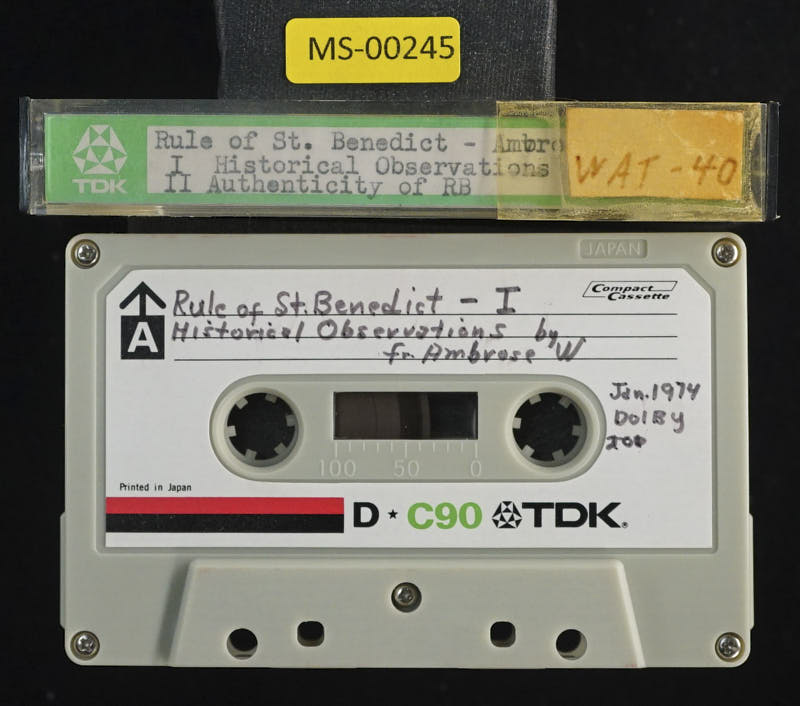

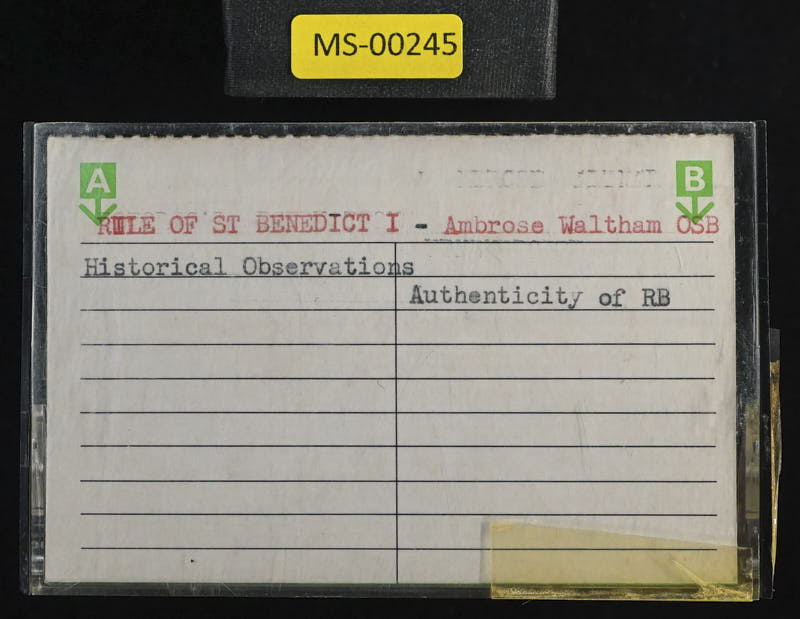
AI Vision - Possible Values from Photos:
Side: A
Speaker: Ambrose Waltham OSB
Possible Title: Rule of St. Benedict I
Additional Text: Historical Observations by Fr. Ambrose W.
Side: B
Speaker: Ambrose Waltham OSB
Possible Title: Rule of St. Benedict II
Additional Text: Authenticity of RB
@AI-Vision_v002
We're going to do probably two things. The first, the authenticity of the rule of Benedict, and then I'm sure there'll be time left and we can go into an introduction to the rule of the master, just a general picture of the rule of the master. This question of the authenticity of the rule of Benedict, as I mentioned to you yesterday, is the question of who wrote the rule, when it was written, and in what locality it was written. What I'm going to present this afternoon is a summary of an article in Studia Hanselmyana, volume 42, 1957, by Ansgar Mundo, who's a monk of Montserrat, and has done quite a bit of study in monastic sources and in the ruler Benedict. This particular article is written in the context of the Rule of the Master and the Rule of Benedict controversy, which we're going to take a look at a little later.
[01:08]
But this is the context in which this article is written, so in some ways it's going to be a preview of that controversy which we will examine later. Mundo states the problem concerning the priority between the Rule of Benedict and the rule of the master. Which one is prior, the rule of Benedict or the rule of the master? And then he goes on to review a theory of a monk from Solheim by the name of Dom Froge. After he reviews this theory, he examines the language of the rule of Benedict, the literary sources, the manuscript tradition, and finally the testimony of Gregory the Great in Dialogue's book two. So that's the general outline of his article. First of all, with regard to the problem of the rule of the master and the rule of Benedict, as solved by Dom Frosier, the monk from Solet, who Mundo is going to be sort of counteracting.
[02:10]
Dom Frosier says that the rule of the master is definitely prior to the rule of Benedict, but he says further that both rules, the master and Benedict, are but two forms of the same rule. And he says, the rule of the master was written in the 6th century by a man named Benedict, mentioned by Gregory in the dialogues, the rule of the master. And he says, what we know as the rule of Benedict is a later refinement with certain additions. The arguments that Frosier presents are as follows. First of all, and this is accepted by most scholars, is that the rule of the master comes from the 6th century southern Italy. Secondly, the rule of Benedict is first referred to historically in the letter of Venerondus. Around 625, Venerondus was a French bishop, and this is the first historical mention that we have specifically of the rule of Benedict.
[03:19]
Thirdly, he says that both the rule of Benedict and the rule of the master are anonymous works. And it is only with the Merovingian manuscripts at the time of Chardonnay that you find the rule of Benedict that we know of as the rule of Benedict attributed to the Benedict of Nursia. So not until the seventh century or so. Then he also says, fourthly, that the dialogues, book two of Gregory the Great, which is the so-called story of Benedict, of Nursia, that these dialogues correspond not to the rule of Benedict, but to the rule of the master. He claims then that what we have today as the rule of Benedict went through three stages of composition. The first stage was that the rule of the master was written by a 6th century Italian abbot named Benedict, in the dialogues of Gregory the Great. Secondly, this rule of the master was abbreviated by an anonymous author.
[04:28]
And finally, thirdly, the present rule of Benedict was finalized by a French author in the seventh century, possibly being Ben Arandus, who first mentions the rule of Benedict. This is a very interesting hypothesis. Remember that Don Faugé is a Frenchman. And now he's claiming that the rule of Benedict is really a French origin and not Italian origin. Now Mundo's investigation has as its goal to show the authenticity of the rule of Benedict as a sixth century Italian document attributed to the Benedict mentioned by Gregory in the dialogues. And in order to do this, he's going to answer the following questions. First of all, At what time and in what place does internal criticism of the rule of Benedict situate that rule? So internally he's looking at the rule, the Latin, the sources, etc., to see what we can gain from internal criticism of the rule of Benedict.
[05:34]
Secondly, he's going to see about the manuscript tradition, to whom is the rule of Benedict attributed in the manuscript tradition, actually. because this is a very difficult situation. And then thirdly, to which rule, rule of Benedict or rule of master, does Gregory allude to in the dialogue? So that's going to be his approach now. First of all, with regard to the internal criticism of the rule of Benedict that we know, Mundo looks, first of all, at the language, the Latin of the rule of Benedict. Remember, yesterday we talked about the manuscripts being in three different categories by the Latin, which is used. Now, he's looking at the Latin of the authentic text, the San Gal 914, and that whole family, which he considers the authentic text. Philological studies, to date, have shown that the Latin of the rule of Benedict
[06:38]
and the rule of the master situate both of these rules in 6th century Italy. And the Latin in both of the rules is that of a southern Italian dialect, probably a dialect spoken around Rome and south of Rome. So both the rule of Benedict and the rule of the master come from 6th century Italy, somewhere around Rome. A very famous scholar in philological studies in Christian Latin is the woman Christine Wormann, who's done quite a bit of study in this area. And she studied the Sangal Manuscript 914, which, remember, is an old-school text, a degenerate Latin text. And she's concluded that this Sangal Manuscript represents a 6th-century Italian document. Now, remember, we saw that 914 was from Switzerland, copied from Aile Chapelle.
[07:39]
But actually, the Latin in it, Christine Mormon has discovered, represents or expresses a 6th century Italian Latin. So this, again, shows the authenticity of that particular manuscript. The rule of Benedict, therefore, according to Christine Mormon, cannot be reasonably placed in 7th century Gaul, as Frosier would like to say, because it's not the kind of language which was used in 7th century Gaul. It's 6th century Italian Latin. Now this conclusion results from phonetic comparisons, the use of the words that are used, orthography or spelling, and syntax. For instance, a number of interesting syntactical formulas that are used in the rule of Benedict are the use of the accusative absolute. I don't know if you know anything about Latin, but you have what we call an ablative absolute, but an accusative absolute is a particular late usage.
[08:47]
Another interesting use would be the inherent genitive, where the genitive is a synonym for the noun which it modifies. This abounds in the rule of Benedict. And so through this study of language, Christian Mormon has shown that this Sangal manuscript is a sixth-century Italian document. And then she also compares the Latin of the rule of Benedict with the Latin of the Liber Pontificalis, which was the book of the popes in Rome, their sort of ritual book. And This Liber Pontificalis, of course, was written in Rome. The Latin of the Rule of Benedict is almost the same kind of Latin as in the Liber Pontificalis, which indicates that the Rule of Benedict, by its Latin that it uses, originated in the same milieu as the Liber Pontificalis, namely somewhere in the environs of Rome.
[09:49]
With regard to internal criticism, Mundo also takes a look at the literary sources of the rule of Benedict. Now, in the past few years, a lot of work has been done in this area of literary sources. One of the first people to do some studies in this was Abbot Cuthbert Butler, and in his edition of the rule, in the back of the rule, you find a list of the so-called sources of the rule of Benedict. Hanslick has this kind of a listing to an index, and De Brogue's New Commentary also has this index of sources in which it shows the passages in the Rule of Benedict which are related to some earlier source. Mundo shows that the following 6th century works contain parallels to the Rule of Benedict. So within the 6th century there are other monastic works which have parallels. There's the Rule for Monks by Cesarius of Oros, which was written sometime between 503 and 542.
[10:54]
There's a Latin version of the life of Pocomius by Dennis the Little, which was translated from the Greek by Dennis the Little in 527. Then there's the Latin version of the Lives of the Fathers, which Latin version was translated by the deacon Pelagius. And this especially is what Mundo is going to dwell upon later on to show that his real proof comes from this particular source. Another parallel text in the 6th century is the Codex of Justinian, the canonical prescriptions of the emperor, around 530. Then we have the works of Cassiodorus. who was a contemporary of Benedict and founded a monastery at Vivarium in southern Italy, and he wrote somewhere between 538 and 560. Another work is the Regula Admonikos by Feriolus, written between 558 and 581, and then finding the works of Gregory the Great, and especially his letters between 590 and 604.
[12:08]
Notice all of these works are in the 6th century. and they all have parallels with the rule of Benedict. Now, it's very difficult at times to decide, when you have this parallelism, which work depends upon the other. If we would postulate that the rule of Benedict was written somewhere between 525 and 550, then we can say that any literary parallel that dates before 525 can be considered a source for the Rule of Benedict. Anything which dates after 550 and has parallels in it with the Rule of Benedict borrows from the Rule of Benedict. Now we're postulating that the Rule of Benedict dates somewhere between 525 and 550. Between 500 and... 25 and 550, however, the dependency is going to depend upon the exact date of the rule of Benedict.
[13:14]
And that's one of the things that Mundo is going to try to show, to more or less hone in on the dates for the rule of Benedict. Notice in this group of texts that we've looked at, we would say that certainly the works of Gregory the Great, which have parallels with the rule of Benedict, depend upon the rule of Benedict. and not vice versa. Mundo considers the following, however, as sources for the rule of Benedict. Cesarius Avaro's rule for monks, Dennis the Little's Latin version of the life of Peconius, and especially the deacon Pelagius' Latin version of the life of the fathers or the sayings of the fathers. Now it is this last source that is especially helpful in gating the completion and composition of the rule of Benedict. We talk about the Apothegmata ton patron.
[14:17]
Now, we're going to take a look at these later on this year. But the Apothegmata means sayings of the fathers, and these are collections from the fathers in the Egyptian desert made in the 4th and 5th century, many originally in Coptic or in Greek. Now, there was a particular Greek edition of this that was translated into Latin. And this Latin version of this Greek Sayings of the Fathers was translated over a period of time. The first part of this Latin version, which we will call Books 1 to 18, there are 22 books in all, but Books 1 to 18 were translated by Pelagius, who later became Pope, while he was still a deacon. And so it would have been translated somewhere between 526 and 535. And then after that, Pelagius becomes Pope, and so he no longer continues a translation.
[15:22]
Now, the rule of Benedict seems to be aware only of the first 15 books of this translation. There is no trace in the rule of Benedict of books 16 to 18. Why? Because the rule of Benedict, when it was written, had as a source only the first part of the translation. Pelagius hadn't finished the translation yet. So Benedict could only have used from book 1 to 15. The other books weren't translated yet. It's also interesting to note that the rule of the master does not use this source, since this source was not yet available or in existence when the rule of the master was written. Do you understand so far what I'm saying? See, we're trying to come in on the date of the rule of Benedict. And so it would seem that since Benedict uses this Latin translation of the Apothecimata,
[16:30]
translated by Pelagius, that it would have had to have been written somewhere before 535, at least with regard to this particular source. It's a little bit more complicated than I presented it because this progressive translation of the... sayings of the fathers. Later on, the translation was picked up by John, who later became Pope. And we can tell where Pelagius stopped at one point, continued on, and then where John took over. And we notice that Benedict only uses the first 15 books, because that's all that was done by the time he wrote somewhere probably around 535. The later books were probably translated somewhere after 550, so out of the place or out of time for Benedict.
[17:30]
Now, it's very difficult to date the rule of Benedict precisely, since the nature of the rule of Benedict indicates that the rule was composed over a period of years. For instance, there are individual blocks in the rule of Benedict. We'll take a look more closely at this when we look in the structure of the rule. For instance, you may be aware of the liturgical block from chapter 8 to chapter 20. That's a unit. Remember yesterday I mentioned to you that that unit has a type of Latin which is sort of unique. It has vulgarisms. They abound in this section. The Latin in that section is different than the Latin, for instance, in the first part of the rule. Also, there are two penitential codes in the rule of Benedict. So there's a repetition of the penitential code. The abbot is treated two times in the rule, in chapter 2 and in chapter 64, almost as if Benedict wanted to add something later on. Various officials are treated twice.
[18:33]
For instance, the deans are treated once. and the provost or prior is treated later on in the rule. There also seems to be obvious changes due to experience of the author, and there seem to be glosses added for explanation. I would recommend on this particular point sometime that you can read the thesis on silence, which goes into this variation in the rule just on the matter of silence and seemingly inconsistency, really, in the rule. However, it is safe to conclude, says Mundo, that the rule of Benedict, the obscuuta text, which is the original text of Benedict, and the obscuuta text, which is the corrected text, already existed in both forms at the end of the 6th century. But, probably the better date for the rule of Benedict, as he sees from the comparison of the sources, would be between 520 and 550.
[19:40]
Now, as we go through this year, we will get... Well, I won't do it so much because we're not going into the rule of Benedict. At least I'm not going into it with you. We'll see, as we study the sources, that we can date the rule of Benedict a little bit more closely. For instance... Cesarius of Arles finished his works about 534. Benedict seems to have known both of the rules of Cesarius of Arles. So the rule would have to be after 534. Also with Dennis the Little, that translation of the life of Pocomius, made into Latin in 527, Benedict definitely knows that translation. So it's after 527. But see, you're in an area here of about years that you can say the rule of Benedict in this period of time was being written and completed, definitely completed, no later than 550. With regard to the manuscript tradition, Mundo examines this and shows that very early the manuscripts begin attributing the rule of Benedict to Benedict of Italy or Benedict of Nursia.
[20:58]
Now, it isn't surprising that the very earliest manuscripts shouldn't have the name of the author. This was not the custom in the early ages to put down the author of a monastic rule. And it's only later that the manuscripts that people would begin adding the name of who wrote the rule. But the rule of the master has no one that it attributes this rule to. It's anonymous all the way through. But already early in the 7th century, the rule of Benedict is being attributed to Benedict of Nurcia. In general, Mundo maintains that the manuscript tradition is pretty solid in attributing what we call the rule of Benedict to Benedict of Nurcia and not the rule of the master. I find his argument with regard to the dialogues of Gregory the Great extremely interesting Frosier maintains that the event at Vicavaro and the style of life at Subiaco all point to the rule of the master as the rule to which Gregory refers.
[22:07]
Now, I don't know if you've ever read the dialogues, but you recall the story of Vicavaro where Benedict became the abbot of this group of monks, and they were sort of intractable, and so he left them. Now, at Vicavaro, one of the things that... we notice that Benedict does is he blesses this cup of wine before he drinks it at the meal. In the rule of the master, there are all sorts of ritual blessings during the meal. And so Frauget says that this ritual blessing that Benedict performed over the cup of wine refers back to the rule of the master, which demands all of these ritual blessings. Well, we don't have anything like that in the rule of Benedict. No specific blessings for a drink that is brought to the refectory. And then he also talks about the style of life at Subiaco. Benedict had 12 little monasteries founded around little communities, sort of all living together in a larger community. And this is very similar to the rule of the master, insofar as the master legislates for a community of 24 monks.
[23:12]
26, actually, counting the abbot and the cellar. But he has small communities, whereas Benedict has no indication of how big the community should be. that is in the rule of Benedict. But Mundo proceeds to show that the dialogues are in better agreement with the rule of Benedict than the rule of the master. The way he does this is he points out the text in the rule of Benedict on chapter 51, how when a monk is outside of the monastery, whether he should eat anything. The chapter is called Brethren Going Not Very Far Away. It says, A brother who is sent on an errand and expects to return to the monastery the same day must not presume to eat while he is out. However, insistently he is pressed by anyone unless he has been told to do so by the abbot.
[24:13]
If he acts otherwise, let it be excommunicated. It's extremely simple. When a monk is outside of the monastery, and expects to return the same day, he may not eat outside the monastery. Now, in the rule of the master, there's a corresponding section, chapters 59, 60, 61, and 62. The master treats it at quite a length, and the important chapter is chapter 61. There's a long and elaborate casuistry for eating outside of the monastery. In chapter 61, with regard to a brother on a journey, the master has the following rules. First of all, it depends on who it is that asks you to eat. If it's a spiritual brother, a monk that is, and it's Wednesday, Friday, and Saturday, then you must deny the first petition, and he must ask you a second time, if it's a monk.
[25:19]
It's Wednesday, Friday, and Saturday. On the other day, the first petition, you can answer. Notice how casuistic he's becoming. Then he says, if it's a secular or a layman, then you must refuse all the time, no matter how many times this person asks you. See, the monk only has to ask you twice if it's Wednesday, Friday, or Saturday. If it's a layman, no matter how many times he acts, you have to say, I cannot eat outside of the monastery, until the person who is asking you gets so exasperated that he begins to swear. And then, because he's beginning to use, I suppose, in decent language, then you give in and consent to him and eat outside of the monastery so that you can keep him from swearing. Notice the casualty of the rule of the master compared to the rule of Benedict. Benedict's extremely simple. You just don't eat. Don't care whether it's Wednesday, Friday, Saturday. Doesn't make a difference whether it's a monk or whether it's a layman.
[26:21]
Now we see this reflected in the dialogues of Gregory the Great. There's a story in the dialogues of Gregory the Great about some monks who went outside on mission and they ate outside of the monastery. And when they came back to the monastery, Benedict corrected them very severely. If this was reflecting the rule of the master, there would maybe have been some excuse for the monks. They could have said, well, it's Tuesday, and so we could eat. Or they could have said, well, it's Wednesday, but it was a monk, and he asked us twice. Or it was a secular, and he asked us five times, and then he began to swear. So they could have made an excuse for themselves. But in the dialogue, no excuses made, because in the dialogues, it represents this... Absolute forbiddance of eating outside of the non-stead. And so from that point of view, Mundo says that the dialogues really reflect the rule of Benedict and not the rule of the master.
[27:30]
Now, Mundo's conclusions are as follows. The language and the sources of the rule of Benedict indicate that the rule of Benedict appeared in central Italy about the middle of the 6th century in a milieu very similar to the Roman period. So that sort of puts us at ease. It's a 6th century Italian document somewhere in the environs of Rome. So very well could be Monte Cassino, which is in the environs of Rome. The rule of Benedict cannot be situated in Merovingian Gaul of the 7th century. since the Latin and even the manuscript tradition is contrary to this. St. Gregory, in his dialogues, explicitly attributes a rule to Benedict of Monte Cassino, and there is no reason why we shouldn't suspect that this rule which he's talking about isn't the rule of Benedict that we know today.
[28:36]
And unless there are some substantial contrary arguments, there is no reason why we can't accept the traditional theory. Are there any questions about this or observation? Does that put you a little bit more at ease about the full authenticity of the rule? Does it take to turn the authenticity of St. Benedict II from what you said? The historical figure, I think so, but the dialogues are not a good history of Benedict. Actually, I think we can assume that there was a historical person, one particular person, who is responsible for the addition of the rule that we have. It's very similar to the whole problem of Moses and the Old Testament. Is he the author of the first five books? And certainly he is the author of much of the first five books. And one man who is sort of a spiritual genius and a religious genius sort of molds the thoughts together and presents them.
[29:44]
And I feel that the rule of Benedict indicates that one man put it all together and formulated. It's not just something which evolved anonymously over a number of years. There was a guiding spirit behind it. And I think the spirit of that man comes, we understand that man better, not by studying the dialogues, but by studying the rule of Benedict. That's where his psychology and his spirituality comes out. And we'll see as we start with rule of Benedict, that this was a very fine spirituality and a very coherent approach to monasticism and spirituality.
[30:28]
@Transcribed_UNK
@Text_v005
@Score_96.19