You are currently logged-out. You can log-in or create an account to save favorites and more. more info
Basil's Communal Monastic Legacy
AI Suggested Keywords:
Colloquium
The talk centers on the study of Basil of Caesarea, specifically his life, works, and spiritual doctrine, emphasizing his contributions to monasticism. Basil is portrayed as a pivotal figure in shaping a communal ascetic lifestyle influenced by various regions, though distinct from solitary and excessively austere practices. The discussion highlights his ascetical writings, such as the Moralia and the Morals, and his development of monastic rules, which emphasize community life, spiritual guidance, and practical virtues. The speaker explores potential parallels between Basil’s teachings and the Rule of Benedict, particularly regarding concepts of community, work, and humility.
Referenced Works:
-
Diccionary de Spiritualité: Extracts from this resource provide insights into Basil's spiritual doctrine and life circumstances.
-
Letters of Basil: Letter 223 and others, detailing the initiation of his ascetic community and experiences on the Iris River, are found in Fathers of the Church, Incorporated.
-
Moralia (Morals): A foundational work containing questions and structured scriptural responses, forming the basis for Basil’s ascetic rules.
-
The Longer and Shorter Rules: These Greek texts represent Basil's structured ascetic guidelines; Rufinus’ Latin translation amalgamates unknown earlier Greek versions.
-
Hexameron: Basil’s meditation and commentary on the creation and the wonders of the universe.
-
The Renunciation of the World and The Admonition to a Spiritual Son: These works, attributed to Basil, possibly influence other monastic texts like the Rule of Benedict, providing foundational ascetical guidance.
-
Jean Ribemont's Studies: His research clarifies the origins and evolutions of Basil’s rules, challenging assumptions about their harmony with Pacomian traditions.
Other Influences:
-
John Cassian and Palladius: Both figures are mentioned in connection to influences and comparisons with Basil's approach to monasticism.
-
Rule of Benedict: Analyses suggest potential correlations with Basil's principles, especially concerning the monastic hierarchy and community life.
AI Suggested Title: Basil's Communal Monastic Legacy
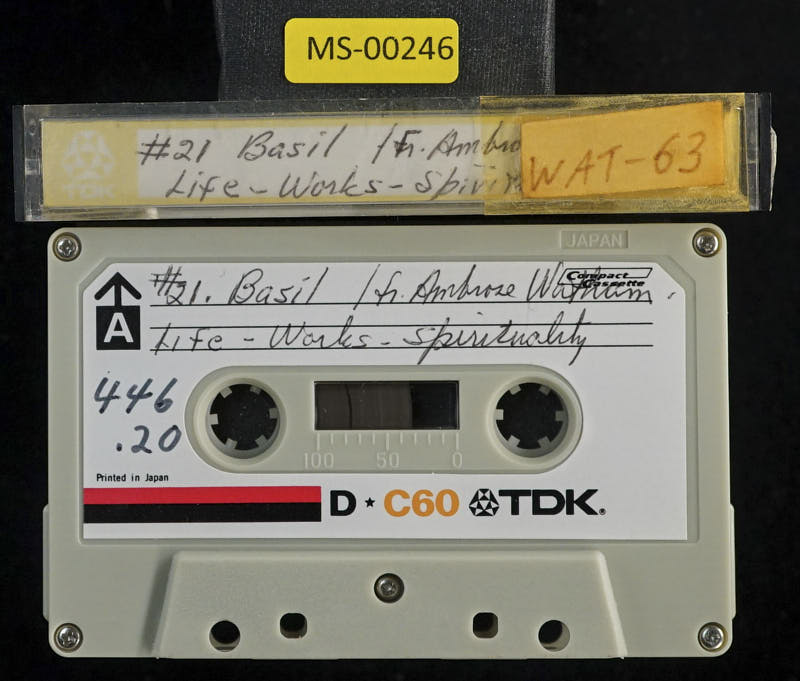

AI Vision - Possible Values from Photos:
Speaker: Basil / Fr. Ambrose Wathen
Possible Title: Life - Works - Spirituality
Additional text: 446.20, #21 WAT-63
@AI-Vision_v002
Although we haven't really finished John Cashin, because one never really finishes studying any of these, because I'm not prepared to do anything more on him right now, we're going to go into Basil of Caesarea. And what I'd like to do is just share with you the article that's found in the Dixionnaire de Spiritualité. I've really just begun my own deeper reading into Basil, and so this is... What I'm doing now is just a repetition of somebody else's work. And maybe as we go through, I'll make comments that I see that are questionable from other things that I've done. We'll take a look, first of all, at his life and works, and then more specifically his spiritual doctrine. Basil was born around 329 or 330 in Caesarea and Cappadocia. You know where Cappadocia is up there in Turkey. Notice about 329 or 330, well, he's born before Anthony dies.
[01:08]
Anthony dies in 356. But he's in that same sort of century where Anthony's death is. And his family is famous for its asceticism and virtue. His elder sister, Macrina, made a vow of virginity after the death of her fiancé. And his mother, Amelia, following the example and advice of Macrina, the daughter, withdrew to Annecy on the Pontus River to practice asceticism after the death of Basil the Elder. So you've got his mother and his sister living sort of an ascetical life. And then in 351, when they went, the younger brother Peter also went with them. And later on, Peter becomes a bishop himself. Basil has... brothers who are bishops besides himself. Gregory of Nyssa is also his brother. And that's the same year that Basil departed for school in Athens. Basil had gone to school in Jezarea and then he'd gone to Constantinople and then eventually he went to Athens.
[02:12]
And in Athens is where he met, well, at least he was closely related with Gregory Nazianzus who became his lifelong friend. Now some people say he met Gregory Nazianzus already in Constantinople. But in Athens, they probably talked about spiritual things and developed a very deep friendship. In 352, another brother, Nacratius, with his servant withdrew to the solitude of the Pontus to live an austere life. So you see, the whole family sort of has this thrust towards solitary life or an ascetic life. Basil returned from Athens in his school to Cappadocia. And when he did, he entered into contact with a man, a bishop, named Eustatius of Sebaste. Now this Eustatius later on becomes suspect for some of his ascetic doctrine. But probably much of Basil's asceticism is the doctrine of Eustatius or even a reaction against Eustatius, who was sort of a very rigid ascetic.
[03:19]
This man, Eustatius, certainly influenced Basil. And Basil, with his counsel, began a long pilgrimage to study asceticism in Egypt, Syria, and Mesopotamia. So he took one of these trips. Now we've seen this with other people. For instance, John Cashin took a long trip to visit Egypt. Palladius moved around to visit the different monks. And here you find Basil doing the same thing. And so he wants to visit the famous solitaries and the famous monasteries in Egypt. Egypt, Syria, and Mesopotamia. It seems to have been a very fruitful trip, and Basil became aware of the various forms of ascetic life, so the pluralism. He also notes in his comments on his trip that there were excesses in some monks, and that's one of the things Basil seems to avoid. It's exaggerated, for instance, of Syrian monasticism. He also sees the need for prudence and wisdom and the dangers of complete solitude, And Basil's going to be against, really, hermits, or against complete solitude.
[04:29]
He's much more in favor of a community way of life. He saw the need for a rule which was at once flexible and precise. And so returning from this pilgrimage, he was well prepared to set up his life of asceticism. Now, one of the interesting points about Basil, as a number of other people in this particular time, he had been baptized on his return from Athens before he set out on this trip. and I don't remember how old he was at that time, but he wasn't baptized as a child, and he was baptized after his education. Augustine is the same way. You recall Augustine is baptized when 28 or 29, and it seemed to have been a custom at this time to put off baptism until you were sure that you were going to live a good Christian life. But Basil is baptized, and then he goes on this pilgrimage trip, visiting the ascetics, and he comes home, and he sets up his own ascetic way of life. So in 358, he went to the banks of the Iris River in Pontus and established himself there in a community life with some friends.
[05:35]
And there's a letter that we have, letter 223, written much later in 375, which reports the beginnings of this religious life and his first experiences. Some other letters are contemporary with this experiment. Letters 2, 14, and 22. We have the volume of his letters in, not ancient Christian writers, but the other one, the Fathers of the Church Incorporated. You find the letters in there. And they're numbered according to these numbers. I think it's letter two, which is one of the very famous ones about the solitude on the banks of the iris. They're filled with enthusiasm of his experiences. And it's also possibly these letters are his first attempt to codify a rule. And Basil shows himself as he progresses to be a born organizer and legislator. He's really a great administrator because he becomes a bishop later on.
[06:37]
In 364, Basil begins what we call the redaction of his rules. And throughout his life, he seems to be correcting these rules. And that's why we have... well, at least three versions of the rules that he has. He's always correcting them by his experience. In 365, he began to be occupied with the affairs of the church, and then in 370, he became bishop of Caesarea, following Eusebius of Caesarea, who had ordained him priest. He always kept his nostalgia for solitude, and as a bishop, he practiced a rigorous asceticism He founded at Caesarea a large hospital under the supervision of monks. And this is one of the things about the monks of Basel. They run schools and hospitals very similar to the Syrian monks. In 372, he had to pronounce Eustatius of Sebast, his old mentor, a heretic because Eustatius did admit the divinity of the Holy Spirit.
[07:45]
And then Basel broke communion with Eustatius And this caused him some serious problems. He died in 379 at the age of 50. So that briefly is his life. He's written quite a bit, but what we're interested in for monastic doctrine is what we call his ascetical writings. And generally there's 11 or 12 works that are included in his ascetical writings. The ones I'd like to mention now, without going into all the problem of authenticity, are the rules themselves. We have a work called the Moralia, or the morals. This seems to have been, in many ways, an early edition of what later came to do the rules. And it's a series of questions and answers on ascetic doctrine. And the question is posed, and then the answer is given from scripture citations. Then in the Greek text, you have two rules, one called the longer rule and the shorter rule.
[08:48]
The longer rule is called longer because the question is posed and then the answer is given in its rather prolonged answer. It's probably earlier than the shorter rules. I think the longer rules have 55 questions and answers. The shorter rules have 213 or something like that. I'm sorry I don't have the details right now. But it's much shorter answers to all of the questions. But one of them, they seem to be redactions of the same thing. Now there's a rule also in Latin that is not found in the Greek text. Maybe I've mentioned that rule to you before. But Rufinus translated or paraphrased the Greek rules of Basel into Latin. People usually thought that refiners had taken both of this longer rule and the shorter rule and combined them and came up with 203 questions paraphrasing two redactions of the rule.
[09:53]
But Jean Griebermont has shown that that's not the case, that what the Latin rule is, is a Latin translation of a Greek redaction which has been lost. Redaction of the longer rule? Well, the chronology goes, the moralia would be first, then the Latin rule, which the Greek text has lost, then the shorter rules, and then the longer rules. I'm not sure if it's shorter or longer. I may have said it wrong. But anyhow, the Latin text is earlier than the other two versions. And probably the reason it was lost in Greek is because Basil himself wanted to discard it. because he had changed it. He had redacted his rules. And so it wasn't kept in the Greek manuscripts. But Ribemont has shown that there's a Syriac translation and a Latin translation, and they're not translations of each other. They both seem to indicate a Greek original. And that's the one that Benedict would have known, because I don't think Benedict knew Greek.
[11:01]
And when he talks about the rule of our Holy Father Basil, he's probably talking about this translation of Rufinus, of the Greek text, which is now lost, but we have the Latin text. And there's some difference and development. I'm reading an article now on what co-responsibility in Brazilian monasticism, and it's very interesting, and if I have a chance, I hope to go through with it in the future, that this first redaction, the Latin, which is lost, there's no strong image of a superior there as it comes out in the later rules. So as things develop, the superior takes on more functions that originally Basil saw sort of a communal responsibility, but with a superior. But it isn't such an absolute superior as you would find later on. He's also written some things like The Renunciation of the World, which some people say may not be actually his.
[12:07]
There's also a text called the Admonition to a Spiritual Son, which may be also from Basil, at least it's attributed to Basil. And that has been shown to be one of the sources for the prologue of the rule of Benedict. Now, whether it's actually Basil, some people think that it's actually Basil, some people deny that it is. We're still talking about Refinus' work? No. No, I'm talking about two other works. The Renunciation of the World, which is another ascetic work, and then the admonition to the spiritual son. That's a different work. I missed the link between what Refinis had translated out of the Greek. Yeah, no, I don't know whether Refinis translated the admonitio or not, but it was an early Latin translation. And whether it was actually Basel or not is a question too. But it is a source for the prologue. So it was in existence and it could go back to Basel. But the main ascetical works that would refer to monasticism or the moralia, and then the Latin rule and the two Greek rules.
[13:11]
Now, the Greek rules, at least the longer rule, has been translated in Basil's ascetic works in Fathers of the Church, Incorporated, and also the Moros, but not the charter rules, and I don't know of any translation of the Latin rule of Rufinus. It's a pity, because that's the text which we really like to take a look at. But this problem of the rules of Basel is very questionable, and there's been a lot of dispute on it. But it's Gribelmont, who's done the most studies, and he's written a lot of articles on Brazilian monasticism. One of the problems here with that, though, is that Basel never uses the technical term monk or monastery. He's talking about a fraternity of Christian ascetics, and he doesn't use the technical monochos, the Greek term. Whether then you could say he's really monastic or not, if it's a question of terminology, he's not. But certainly what he's presenting is a monastic way of life.
[14:14]
A number of his homilies are very important also. I think some of these have been translated as sermons. And then his letters. There are 366 letters published so far of Basil. Let's take a look at his spiritual doctrines. the general principles of a spiritual doctrine. The goal of human existence is God, nothing else. Because God is the first and most perfect of all good. Basil repeats this in a number of his homilies. And God must be sought in all things and before all things. The whole thing of the rule of David to seek God. Basil has this trust too. And so evil is what is in opposition to God. That is sin. We're often inclined towards sin and we have to try to combat against it. And so one of the things that comes up in Basil's spirituality is this combat against the devil and against sin.
[15:22]
Basil says that to make progress in the spiritual life, one has first of all to begin with a knowledge of oneself. And he quotes Deuteronomy, be attentive to yourself. This is very similar to the whole Greek philosophical idea, know yourself. Basil knows Greek philosophy, and so it may be a combination of Greek ideas and also scriptural ideas. And one must be resolute in a fight against one's passions. And so life is a battle, a combat. And only he who runs the race will win the prize. Glory will result after the hardship. of the combat and then you will gain the crown. Now that I think in some ways is very similar to what we've seen in Anthony and in the Desert Proverbs. Life as a combat. But there you have the idea that the combat is against the devil primarily. It may be here that Basil with the same idea of combat also is
[16:26]
linked up with Greek philosophy again, gaining the prize and the struggle and asceticism. So sort of a combination of Greek philosophy and scriptural ideas. Basil's homilies are full of wisdom and he describes the phases of the spiritual combat. But his exhortations are very practical. For instance, one of his practical exhortations in a homily is dedicated to be careful not to get drunk, so don't be inebriated. And this may have been one of the sermons that he gave at Caesarea at the beginning of Lent when he was bishop, warning the people to avoid inebriation. Another one of his homilies has for its object envy, and he says that this is a sadness provoked by the good fortune of one's neighbor. Another homily is against anger. Impurity is not an exclusive theme of any one discourse, but he has a description of the dangers of it to the soul throughout his homilies.
[17:31]
So he treats of the various virtues and the vices. Now, nothing systematically like John Cashin would have done in the eight capital vices that he treats. But against the vices, then Basil presents the virtues. He's especially enamored with humility. which he presents as the greatest means of salvation for man. This is very similar to the rule of Benedict, where humility seems to be the peak virtue. Humility is the remedy for one's evil, and it's also the return to the primitive state. Now, in Greek spirituality, especially like in Gregory and Nyssa and Gregory Natsianzen and also in Basil, the goal of asceticism seems to be to relive the life of paradise, to return to the primitive state. Now, in some ways we've seen that in Anthony too, because even in the desert, in his deep asceticism and solitude, he became a perfect full man with all of the beauty of the original man, you might say.
[18:39]
But this return to paradise is a strong theme in spirituality. Basil dedicates an entire homily to the virtue of humility. Strange that humility would bring us back to paradise. But then if you think, see, what has brought us out of paradise is pride. So humility will take us back. Basil constantly seems to be combining pagan philosophy with the doctrines of the teachings of Christ. He's really a Hellenist in that sense. You only come to the perfection, which is the goal of life, through effort. And one must make unceasing advances in the ways of virtue. And it compares perfection to a ladder, which one ascends by degrees. Now, it would be very interesting to compare that text with chapter 7 of the Rule of Benedict and see if it's just an image which is used or whether it's really dependent upon the text.
[19:45]
Basil also seems to employ a three-fold division of the spiritual life. The beginners in the spiritual life, those who are in progress or process, and the perfect one in the spiritual life. This sort of fits into that classical division of purgative, illuminative, and unitive ways. But Basil talks about beginning, progress, and perfection. At the beginning, man is a slave to fear. Then he becomes sort of a mercenary and he practices virtue out of hope for a reward. And finally he comes to love. Remember at the end of chapter seven of the rule of Benedict where he says fear, which we began to practice virtue out of fear, will slowly give way to love. And he also has, Benedict has this idea of mercenary reward too. He's for the reward of virtue, but then also for the love of Christ. So in some ways you see the same sort of progress in Benedict as you see in Basil.
[20:53]
Basil demands of those who want to seek perfection that they live monastic life, what we would call monastic life. That is the perfect life. And so he merely tolerates marriage. He doesn't really praise it. For instance, there's a certain tendency in which marriage is sort of looked down upon. But this is sort of common among the early fathers. Because marriage is going to have a lot of difficulties, especially with regard to chastity. Whereas the ascetic life, the chaste life, you're going to be freed from this. And you can, as Basil says, enter the company of the holy army of Christ's disciples, the society of the monks. Basil certainly doesn't require that all Christians leave the world to embrace the life of monastic asceticism, although he considers it the perfect life. Now, remember what we said about Syrian Christianity originally.
[21:56]
In order to be a Christian, you had to give up marriage. And this is not as extreme as that. But you find these early fathers, like even John Chrysostom, the perfect Christian life is the monastic way of life. And it's almost developing this whole problem of the dual standards. that there's a perfect way of life that monks live, and then other Christians live sort of an imperfect way of life. And there's something of that in Basil, too. I don't see too much of that in Benedict myself, but you wouldn't expect that developed in a rule. But compared to the solitaries of Egypt, Basil's spiritual doctrine is moderate and prudent. He portrays the monk as a virtuous man, but one who doesn't necessarily work any prodigies. In fact, Basil's sort of suspicious of prodigies. Recall the Lousy Act history where people are doing quite spectacular things, curing people, prophesying.
[22:57]
We don't find this in Basil. Basil is content that the monk make progress each day by the disciplined way of life, by his ordinary routine, and thus that he acquire perfection served from the common life. So nothing really extraordinary in the life for Basil. With regard to his monastic life, Basil was influenced by Egypt. There's no doubt about that. Now there's a real question about how much he's dependent upon Piconius. Some people maintain that he, when he was in Egypt, he went to the Piconian monasteries and got acquainted with it and then came back to Cappadocia and set up his own community life in sort of contrast to what he saw in Pocomian monasticism and also taking certain things of Pocomian monasticism. This is really questioned now, it's disputed, how much influence Pocomian monasticism has had on Basil.
[23:59]
For instance, if you just consider that Basil may not have gone to Pocomian monasticism, but only heard it from northern Egypt, like Caching did, then his influence wouldn't be direct. On the other hand, the rule of Pocomius, you recall, was translated into Latin by Rufinus in 404, so it was probably available in Greek earlier, but it may not have been written before 376, which, if I'm not mistaken, is the date of the death of Orsiasius, so it wouldn't even have been in existence for Basil to have known. He died in 379. So the whole relationship between Basil and Pocomius is very questionable and fuzzy and confusing. But some people go so far as to say that he is definitely dependent upon him. Well, couldn't he be dependent on his ideas? The days you give would say they meet each other in person. Well, even whether he went to Tebead itself, Joel.
[25:03]
See, that's the question. whether he went down there. It's the same problem that comes up with John Cashin. See, John Cashin quotes what goes on down in Pocomian monasticism. But as I mentioned to you, that Cashin may not be a good witness to what actually took place in the Tebead. And the same way with Lousiac history. Remember when he saw Palladius going down into Egypt? It's questionable whether he ever got lower than Mycopolis, whether he ever got down to the Tebead or not. What you get the impression of is that most people, when they talk about Egyptian monasticism at this time, are mostly familiar with that around Alexandria and Antonian monasticism, the Scepe, the Mitre, and the desert of the cells. And Pachromia seems to have been so far down that people have heard about him, but whether there was any direct conduct is really questionable. Certainly, Basil...
[26:04]
is not for the solitary life. And in that he's in agreement with Pachomia monasticism. He retires from the world. He quits the peopled villages and separates himself from relatives and friends. But he's not in favor of the Aramidic light. And one of the things that he says, whose feet will the hermit wash? And since washing one's feet is One of the gospel commands, well, the hermit doesn't have anybody's feet to wash, but the one in the community has his brother's feet to wash. Basil also says that in community, if you live in community, you fulfill all the gospel precepts, because while you're doing one, your brother's doing another, and you all share in it. But the hermit can only do one at a time, so he can't possibly fulfill all the gospel precepts. Basil insists over and over again on the advantage of community life.
[27:05]
Now in the community, a superior holds the authority. And he exercises it immediately over all the members of the community. One of the pictures you certainly get is that Basil's community is small compared to the Bacomian community. Remember the huge organization in Bacomian monasticism because of thousands of monks. And the superior wouldn't have had... been able to have immediate contact with everyone. Well, you get the idea in the Brazilian community that the superior has contact with each monk. When he's gone from the community, the superior, then a person named the second takes his place. Basil's community sort of resembles a family. The older monks watch over the younger ones and It's very important to have what we would call a spiritual director. And this holds a primary place in Basil's spirituality.
[28:08]
Very similar to what you would find in the desert of an elder and a younger. But within the community, you need an elder who is your director. Because Basil says, no one knows what is good for himself. And so younger monks must confide in an elder monk. And he calls this elder monk a presbyteros. What? we call a priest. Now, it's really disputed whether this presbyteros is a priest or not, and just what function they have in the community, or whether it's just a Greek word for elder. And in Greek, the word for elder is presbyteros. So it doesn't necessarily mean somebody who is priestly. The first virtue practiced by the monks must be, of course, humility. Superiors themselves have to be humble, and they are servants of of the community. Also, the inferiors in the community must be humble. They must obey without discussion and they can make observations to the superior if the superior has given them a command which is impossible.
[29:17]
Now, that's an important note because we notice in the rule of Benedict, that chapter on if you've given an impossible command, which you don't find in the rule of the master, which is Benedict's source. So it may be that this is something that he gleaned from Basil. And the obedience of the monks has no limits other than the law of God itself. With regard to the other virtues, there's no need to insist on them. But, for instance, the virtues of poverty, mortification, renunciation, all of these virtues, anyone who wants to live an ascetic life must practice. And Basil says that work safeguards virtues. An essential characteristic of Brazilian asceticism is work then. This is a necessary part of the spirituality. Basil hates nothing as much as laziness. And he says that the work monks are assigned their work and they're assigned this work in relationship to their strengths and their aptitude.
[30:26]
So the superior takes into account what the person can do. And whatever is spoken of to be done has to be done with zeal. Now, besides manual labor, there's also intellectual labor, or what we would call study of sacred scripture. And Basil recommends this over and over again, very similar to Pachomian in that system, with this great emphasis on the study and meditation of scripture. A great number of the rules contain explanations of difficult passage of Scripture. In fact, the rules are nothing more than a collage of Scripture texts. Prayer is also a great duty of the monk. One is to pray constantly. But monastic prayer or community prayer is regulated as all the other aspects of life are regulated. And so Basil is already a witness to the cycle of canonical hours.
[31:27]
which were already fixed at his time. I don't know if you've taken that with Father Patrick or not. And there's some problem there, too, how many hours there were because of different texts. But there is a matins or vigils in which the first movements of the heart should be offered to God. There's terse, sext, and known, prayer at the end of the day, and prayer at the beginning of night, and then prayer in the middle of the night. All the monks attend these hours in the same place. And if they're on a journey, they're to interrupt their work or their journey to pray at the designated hours. It seems to be a constant theme in the early thinking. If you're outside of the monastery, you still say the hours at the regular time. What this consists of, this celebration of these hours, is recitation of prayers and chanting of psalms. And Basil wants to have a variety here in this recitation and the use of psalms in order to avoid distraction and to renew enthusiasm.
[32:32]
Prayer has as its goal union with God. And one of the ways that the monk or any man is led to union with God is by reflecting on the marvels of creation. And so Basil has a work called the Hexamaran. Now, that's a classical name in this period for treating of the six days of creation. And you'll find a number of the followers with their Hexamaran. In the Latin, sometimes they call it De Creazione, the creation of the world. But Basil has this, which is a description of the universe. But more than that, it's a meditation on the wonders of creation. Basil knows that God is ineffable, that he can't be spoken, that he escapes all of our understanding. Nevertheless, we can know him and serve him and thus give him glory.
[33:37]
But this knowledge of God is more than intellectual knowledge. It's an experiential knowledge, a knowledge which one receives because one loves. Basil doesn't speak very often of contemplation. It's not because he's not drawn to a life of intimate union with God, but he has a lot of activity in his monastic life, which has to keep him, the monk keeps busy, and so he doesn't oppose action and contemplation. He just doesn't use the term contemplation to speak of that. The monk is constantly to be praying, to be in union with God. But Basil doesn't see work as a contrast or an opposition to this union with God so he doesn't oppose action and prayer because the soul penetrated by faith always finds its union with God and it seeks nothing else but union with God who is the beginning and the end for the soul Basil really is nothing extraordinary in his spirituality he's very practical
[34:55]
He's very moderate. He's a very fervent man himself. And he wants to give himself completely. Now, because of his education and his abilities, he was called to govern other people. But he always kept this desire for what we would call a monastic life. And he's really a man of prudence, of balance, and of harmony. And analysis of his rules shows this beautiful moderation that he has. Do you have any comments or questions? Anything that you would like to talk about with regard to Basil or anything else we've discussed? Have you gone into Basil with Father Dominic with regard to? We cover it every now and then. I mean, something that David White mentioned, you know, that there's a similarity. We usually deal, but it's always in the long run rule.
[35:56]
I wish somebody would translate the Latin rule so it would be available to us. One of the things I'm convinced of, and that's why I want to do more work on Basil, is that he's the only one Benedict calls by name, our Holy Father Basil. Now, what does this mean? Is this just because everybody considered Basil the father of monasticism in the East, and therefore Benedict is just using the name because it's a name which is attributed to Basil? Or does it give an indication that Benedict really considers him and his spirituality the foundation for his own spirituality? And it would be, I think it's very important to study more, study Basil more. And maybe with that, we can begin to interpret the rule of Benedict better. Because it's going to put us in a different perspective than if you study the Egyptian fathers. And right away with the idea of community and solitude.
[36:58]
The idea of work. Many different things come up. The concept of obedience I think is very important here. And maybe some of the difficulty with the place of the abbot and what is authority in the rule of Benedict could be seen in a different light by studying the superior and authority in the rule of Basil. That's why I think Basil is so important. But I'm still... beginning that area myself. But I see it as a rich area for investigation. I hope for the Summer Institute on Obedience and Authority to go through the rule of Basel and find out more about authority and obedience there, try to help see what that will throw light on the rule of benefit or not.
[37:46]
@Transcribed_UNK
@Text_v005
@Score_95.38