You are currently logged-out. You can log-in or create an account to save favorites and more. more info
Balancing Tradition and Liturgical Innovation
The discussion primarily focuses on the blending of flexibility and structure in liturgy, exploring the Benedictine tradition's emphasis on adaptability while respecting monastic frameworks. A detailed examination of archival materials related to Father Damasus Winzen underscores a historical commitment to liturgical renewal, touching upon themes of community, autonomy, and the broader ecclesiastic context set by the Second Vatican Council.
- Rule of Benedict: Reinforces the balance between liturgical flexibility and respect for tradition, critical for maintaining harmony in worship practices.
- The Pastoral Constitution on the Church in the Modern World (Gaudium et Spes): Highlights the universal vocation and dignity of humanity, aligning with liturgical adaptation and renewal objectives.
- Mediator Dei: Addresses concerns about liturgical changes and is contextualized by Winzen’s resistance to overly rigid applications.
- The Task by Denise Levertov: Utilized to illustrate the overlap between Benedictine themes and poetic imagery in understanding divine work outside traditional liturgical spaces.
- Assisting at Mass Liturgically: This essay, referenced in the talk, warns against a pedantic application of liturgical reform, advocating for a spirit of openness and autonomy in worship practices.
Overall, the talk critically examines the tension between innovation and tradition in liturgical practices, drawing from historical texts and contemporary theological dialogues.
AI Suggested Title: Balancing Tradition and Liturgical Innovation
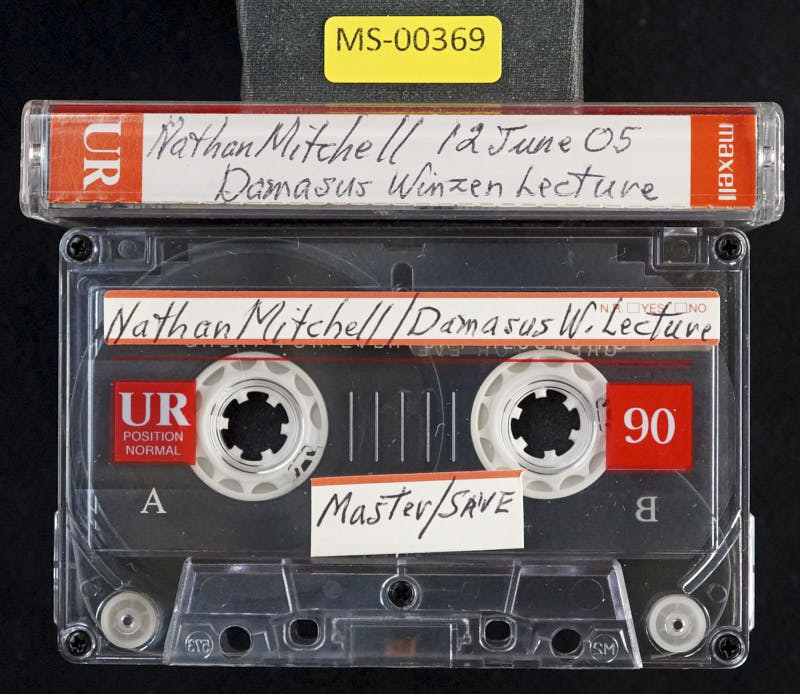


AI Vision - Possible Values from Photos:
Speaker: Nathan Mitchell
Location: Mt. Saviour
Possible Title: Damasus Winzen lecture
Additional text: Master/Save
@AI-Vision_v002
Well, I want to repeat the same thing that Father Martin just did. I'm going to actually be seated, although it occurs to me that maybe it would be better. Can you hear me more easily if I'm standing? I might just decide to stand and hold my lecture notes, if you don't mind that, because I would... like for everybody to be able to hear without having to strain or without having to... On the other hand, of course, sleep is also welcome. I always tell people whenever I talk, you know, the nice thing about me is that I'm not Abbott farming, you know, like you don't have to get a prescription or anything like that. And so if you need a little extra rest, well, feel free, please. I hope, however, that you'll be engaged in the... afternoons discussion as I was in preparing it. The first thing I want to do is thank Father Martin and also the whole community for inviting me to Mount Savior. This is a legendary place for me.
[01:05]
I've heard of it since I was a young man. Now I am not so young. I never had an opportunity to come here. I never had an opportunity to meet Father Martin or the monastic community at Mount Savior. But I have done both now, and I want to thank them for their graciousness and their hospitality and their welcome. It's been really a wonderful weekend for me and a weekend of renewal. I hope it will be for you too. I can maybe explain that Benedictinism is buried very deeply in my blood and breath and bones. As a young man, I was educated in philosophy and theology and classics at St. Minewood Archabee by the monks there. And I even spent the years from 1964 to 1984 as a member of the community at St. Michael. So today is a kind of homecoming for me. It's a return to my roots. It's a pilgrimage to my past. And not only to my past, because I hope that what I learned at the Benedictine continues to shape my present and will also continue to shape my future.
[02:12]
for many more years to come, naturally. That's my hope, and I hope it is yours, too. Like Benedict in his rule and like Chaucer in the Canterbury Tales, I think it's best to begin with a prologue. When I began to do research for this lecture, it occurred to me that the archives at Notre Dame's Hespert Library might be a good place to begin. That's where I work, so the library is just a stonework from my office, and I decided to begin my search there, and I had a hunch that Father Daneson's scholarship in the field of scripture and liturgy might have drawn him to the graduate program in liturgical studies that Holy Cross Father Michael Maffetz created shortly after the end of the Second World War at the University of Notre Dame. So I put on my Hercule Poirot disguise, And I started snooping around the Mathis collection of documents in the Notre Dame archives, and I was not disappointed. In fact, I found a great deal more there than I expected to, or that I was parting for.
[03:16]
The archives contained a substantial number of files, chock full of correspondence, exchanged between Fr. Dennis and Fr. Mathis over a roughly 15-year period from about 1946 to 1960, when Fr. Mathis died. Also in the archives are printed materials, such as a copy of the first Mount Savior letter from February of 1952, and type scripts of lectures with corrections in his own hand that Father Damasus gave on the Bible and liturgy during July of 1947, the year that Notre Dame's program in liturgical studies began. So I found a great deal of material in the archives. And while I never had the privilege of actually meeting Father Dennis' face to face, I felt like I got to know him through his work and through his letters. I've had the privilege now of holding in my hands a whole treasure trove of his handwritten letters, note cards, annotated manuscripts.
[04:22]
even a small illustration that he did, a linoleum block print probably, for a Christmas card that was sent out by the community in the early time of its history. And as I sifted through that material, portions of which I will describe in greater detail later in the lecture, I felt an instant connection with those Benedictine pioneers who courageously pursued the renewal of Roman Catholic worship in Europe and in the United States long before the Second Vatican Council. and long before it became fashionable to speak, as Polydamasys does in his 1957 Christmas letter, about the way great art, such as Giotto's painting of the Nativity, illumines our experience as Christians better than any sermon or syllabus does. It was not fashionable to say things like that in 1957, but Polydamasys was saying them. So as I sat sifting, Papers in that stuffy windowless archives reading room, images began to crowd my mind and my heart.
[05:29]
I recall the arresting color photo of Father Danesis that Father Carl Martin had been kind enough to send to me last year. It shows Mount Savior's founder, some of you may be familiar with this, but it shows him smiling. seated on a smooth gray stone in a garden that could have surrounded an ancient temple in Kyoto. From a single pipe, a stream of water feeds a zen-like spring, and Father Damasus's smile shows the warmth and serenity of a Buddha. Still another image stolen to my consciousness, the image of a young Damasus Vincent on a November evening in 1920, when Prior Albert Hammenshtede of the Abbey of Maria Locke gave a lecture on the Advent Liturgy to students at Gertigen, where Damasus was in school. To the end of his days, as Natalago Rourke tells us, Father Damasus declared that his true life began that evening when he heard Prior Albert speak about the liturgy.
[06:41]
Two decades later, these two great monks were publishing thoughtful essays on liturgical life and renewal in journals like the Yard Book for the Divi Vissenshop, which I'm sure you all get, probably, and Arrabi Pratres, which is now known as worship. In fact, in an essay entitled Assisting at Mass Liturgically, and published in erotic structures in July of 1947, the same month that Father Danmistus began to lecture in the summer program at Notre Dame, Father Albert warned against becoming too pedantic, thank you, about becoming too pedantic about applying the principles of reform. He writes, it was a sign of Roman virtue to know how to misere tempora temporibus, to mix times with other times. or perhaps better to read the Sign of the Times. It was a sign of Roman virtue, he wrote, and speaking as a Benedictine, he added, I might say that freedom of spirit has also been a characteristic feature of the Benedictine tradition throughout the ages.
[07:51]
Such freedom of spirit prevents discouragement and will more readily gain hearts for the liturgical cause than with the fire or with the burning zeal of an extreme reformer. Flexibility, freedom of spirit. Surely those virtues shape the rule of Benedict's justly famous advice in chapter 18. All of you probably know this. After outlining the entire pattern of daily prayer over a week, Benedict says, above all else, we urge that if anyone finds this distribution of the Psalms unsatisfactory, He should arrange what he judges better. When it comes to liturgy, Benedict says, the first step is flexibility. But then he adds, provided that the full complement of 150 psalms is carefully maintained every week and that the series begins anew each Sunday at vigils. So if step one is flexibility, step two consists of respect
[08:58]
or framework for the monastic tradition. Benedict intuitively understood the critical relationship between flexibility and framework, and thus he knew that liturgical autonomy does not have to mean anarchy. He realized that at the end of the day, all liturgies, even those that aspire to dranger and universalism, are local. It's like all politics. It's local, too. They involve specific communities celebrating specific events at specific times and places. As we discovered this past April, even the funeral of a pope is a local liturgy. The obsequies celebrated in Rome for the Bishop of Rome. So a Benedictine approach to prayer realizes that in human communities, liturgies are inevitably brokered between those principles of framework and flexibility.
[10:00]
And the respect for local autonomy in decision-making is the best way, not the worst way, to avoid anarchy. Father Albert Hommenstede, the man whose words helped change the course of Gerd Otto Winsen's life on that November evening in 1920 at Gertigen, Father Albert understood those principles perfectly. We must be allowed, he wrote, this is in 1947, almost two decades before the Second Vatican Council. We must be allowed to act liturgically in a manner that readily corresponds to our age, our character, our reputation, our state of grace, and our present conditions. Pleasure in the beauty of worship does not, he added, mean superficiality. Nor is the wish to do justice to one's individuality the same thing as individualism. The principle is always, he wrote, unus sic alias verus sic.
[11:08]
Live and let live. Flexibility doesn't threaten great work, nor does autonomy betoken anarchy. Worship symbols are thick. They are dense, multiple, multidimensional. They can never be reduced to one single meaning. In fact, pointing to John Patmos' vision of the heavenly liturgy in the book of Revelation, which we hear a great deal about during the Paschal season, Brother Albert urges us to remember that liturgy does not merely comfort or console or confirm. It also, to use his words, stirs us up. And it even distresses. It disturbs. It shows Christ on the cross as the center of history. Liturgy is never all light and poetry and joy. It also embraces cries of limitation and distress. It protests injustice and oppression. It rages against the dying of the light.
[12:12]
It pleads passionately for the Lord to come, to come and rescue, to come and free from pain, to come and release us from bondage. to wipe every tear away. Wise words indeed, welcome words, especially in this increasingly intolerant age of culture and liturgy wars. Flexibility, freedom of spirit, autonomy, making room for all that is human in our worship, for all the concerns, as Father Albert put it, Our good farmers and craftsmen and shopkeepers and artisans and railway employees, you might say airline employees today, and paper boys and shoeshine boys, making room for the vast liturgy of the world, smelling of death and sacrifice that ordinary Christians are already celebrating before they ever hit the doors of our churches.
[13:13]
Making room. for people, making room for what the Chilean poet Pablo Neruda once called the confused impurity of the human condition. Our footprints, our fingerprints, our wrinkles and vigils and dreams, our denials and doubts, affirmations and taxes, the holy canons of madrigal, the mandates of touch, smell, taste, sight, theory, the passion for justice. The transports of love. Making room. Making room for all these experiences. Making room for all these human, earthly facts and feelings. That, Albert Hemenstedt suggested already in 1947, is the unfinished and perhaps unfinishable work of liturgical renewal in our time. Making room for people. For their bodies. with their flesh and fluids, for their hearts and with their hopes and mysteries, for their faces, with their fears and failures.
[14:24]
People, after all, are the point. People are the point of God's work for the world in the pastoral mystery, and hence they are the point of God's work for us in the liturgy. In Benedict's rule, therefore, opus dei, he is not the work of experts. or professionals, or, thank God, university professors. It is humble work. It is domestic work. It is work that can be done wherever you are, in the oratory, in the field, in the garden, in the infirmary, on a journey, even alone. As biochemist René Dubois once tripped, Benedictines were the first saints and scholars in the history of the Western world to get real dirt under their fingernails. We cannot forget that when, near the end of his life, Benedict had his great vision of the whole world in a ray of light, he did not himself cease to be in the world.
[15:31]
Benedict is graced with his vision, writes Gianni Blacosque, not in some seventh heaven, but somewhere in Italy. Not in some seventh heaven, somewhere in Italy. Benedict's vision left his feet firmly planted in the soil precisely because Benedict's God is a weaver. One we meet working at the loom of the world. The late poet Denise Levertoff makes this case in her astonishing poem entitled The Task. Permit me to quote just a bit of that poem for you. God's in the wilderness next door, that huge tundra room. No walls and a sky roof. Busy, busy at the loom. Among the berry bushes, rain or shine, they'll plow.
[16:33]
clacking in worry, irregular but continuous. God is absorbed in work, and hears the spacious hum of bees, not the din, and hears far off our screams. Perhaps he listens with prayers in that wild solitude and hurries on with the weaving until it's done, the great garment woven. Our voices, clear amid the familiar, blocked-out clamor of the past, can't stop their terrible beseeching. God imagines it, sitting through and thorough at the lights, to music in the astounded quietness, the loom aisle the loomer addressed. Gods in the wilderness, busy at the loom, That is why the Christians are the world's servants and not its masters.
[17:34]
And it's why the Second Vatican Council's preferred images for church were those of mystery and pilgrim people of God. And many of us in this room, or at least I certainly know I am, are open up to remember that when the Second Vatican Council ended in 1965, his final gesture was not to issue a set of directives but to send messages of peace and goodwill to all of humankind. It sent messages to seekers after truth, to explorers of the human and the universe of history, to pilgrims on their way to the light, to the tired and disappointed, to artists, painters, sculptors, architects, musicians, men and women working in film and theater. To women themselves, half of the immense human family, girls, wives, mothers, widows, single women, living alone.
[18:35]
To the poor, the sick, and the suffering, with their pleading eyes, burning with fever and followed with fatigue, questioning eyes. To workers, and the questions they pose about economic and social conditions, about warranties, about migration and displacement. They sent a message to those young people, those men and women who will receive the torch from the hands of their elders, heirs of a world convulsed by hope and despair, living through the period of the most gigantic transformation ever realized in human history. Fifteen hundred years before Vatican II used light as an image for the church, Benedict, as I said a moment ago, had already seen the world in a ray of light. His vision was a kind of shorthand. It tells us what he hoped for humanity, what he loved.
[19:39]
It tells us that he recognized but one vocation for the whole human family. And that too was a theme at the Second Vatican Council. In its final document, Gaudi in its steps, the pastoral transposition of the church in the modern world, the council recalled that when Christ assumed human nature, he did not acknowledge it, but raised it up to divine dignity. In Christ, our humanity belongs forever to the definition of godliness, of divinity. For by taking flesh, God's word united itself in some fashion to every human being. working with human hands, thinking with the human mind, acting on human choices, loving the human heart, as Gaudi Mitzvah's paragraph 22 tells us. So Christians are indeed of themselves linked to the paschal mystery and pattern of the dying Christ, precisely through our baptismal initiation, and we've hastened forward to the resurrection
[20:47]
But in a breathtakingly bold passage, the council insisted that is not only true for Christians. It is true for all persons of goodwill in whose hearts grace works in an unseen way. For the council insisted that because Christ died for all men and women and since the ultimate human vocation is in fact one and divine, we ought to believe that the Holy Spirit in a way known to God alone offers every person the possibility of being a partner in the Paschal mystery. Such, the Council told us, is the mystery of humankind itself, and it is a great one. No wonder the British novelist D.H. Lawrence could write in a letter to an Anglican priest to try to get him to convert to the Church of England. We're truly converted only when we begin to hear the vast, low murmur of humanity.
[21:48]
Only when we recognize God at work in the wilderness next door, God busy at the loom. For Benedict, liturgy was not a monument to Christian success or savvy or grandeur or good taste. It was humble testimony to all humanity's earthbound powerlessness. We do the liturgy because we need to. That is why the liturgical code in the rule of Benedict, chapters 8 to 20, directs that the hours of the office should begin not with the famous prayer, I thank you, God, that I am not like the rest of these, but rather with the prayer, deus and auditorium, mayum and tende. God, come to our assistance. We need help. Flexibility. freedom of spirit, an acknowledgement that autonomy does not betook an anarchy, a conviction that liturgy is something human between us and God, a firm belief in the God who is at work in the wilderness, at the living, that at God's table, the least and the littlest, the weakest and the most vulnerable, the haves and the have-nots, all belong there, precisely because God is there.
[23:10]
creating before our eyes the great garment woolwood. A new human race, washed in the blood of the lamb, and fed with his own body and blood. These were not only conciliar themes in the last century, they're Benedictine themes, and as I'm gonna show over the next few minutes, they were very much themes in the life and work of Father Damasus Gwenzel. As you know, Damasus was deeply in touch with his own humanity. with his vulnerability. We catch sighted this in a letter of his written from the monastery of Regina Laudis on December 8, 1947 to Father Mathis at Notre Dame, in which Damasus mentions both his delight in the liturgy and also his concerns about the future. I'm going to quote him this letter. It's in the archives at Notre Dame when I was able to make a copy of it. Now I start all over again. He wrote. First, to tell you how delighted I was to hear your voice over the phone, which breathed all your goodness and kindness right into my heart, thank you especially for your blessing, which I need so much.
[24:22]
Although I must say that the stage here at Virginia Laodice is like a monastic spring, with the daily sung mass, the conical, if it means canonical, hours, et cetera. The nuns are very zealous in that respect and full of enthusiasm. As the letter unfolds, it becomes clear that Damasus was replying to an earlier letter that Michael Mathis himself had written on November 14th of that year. And Mathis wrote to Damasus to tell him that he had heard from Father Basilius, who was the avid of Maria Locke. That would have been the monastery that Damasus belonged to. And Mathis had written to Basilius asking for permission to bring both Father Damasus and also Father Thomas Michaels to the Notre Dame faculty to teach on a more or less permanent basis and to have them as kind of the core faculty for an increasingly successful program to graduate those surgical studies. And that Vasilius had replied to Brother Mathis somewhat evasively saying, I quote, they have it here, you can easily understand that in our present conditions it is impossible for me to anticipate it anyway
[25:34]
the eventual possibilities in the years to come, which is like saying, you know, like, huh? What does that mean? So having quoted the Ambit's words, Father McManus asked him, he says, I appreciate your telling me what the Ambit means. Or rather, do you recognize anything favorable in his reply for our procuring yourself, Father Thomas, and perhaps some other persons from Berea Lot for our liturgy program at Notre Dame in the immediate or distant future? Davies' reply, especially his assessment of post-war situation in Germany, is very revealing. And this is what he writes. He says, since I have seen Germany, I understand much better that they are really unable to make any decisions about the future. The abbot cannot possibly commit himself to anything regarding the future. With the food situation as it is, with starvation threatening, They told me that they had potatoes only up until Christmas without knowing what may come after that.
[26:35]
One must add, however, that our dear friend, Father Albert, has also influenced the general attitude. He means, Albert Havensteins, a great scholar who had written the article I referred to earlier, that Father Albert has influenced the attitude of Maria Locke very much against any act of cooperation with the things of this country. The thesis which he depends is that there is in this country now an angel and that there is a mind read and that they are completely capable and better equipped to work for the liturgy than anybody who's written a lot would be. I've heard again that saying the letter which I received yesterday. Thus, in my judgment, is not to waste any time with the letters, but to go to them in person and convince them on the spot. The abbot gave us permission for me to stay here for one or two more years. He added moreover that he gave the permission only for me to act as chaplain to the nuns and for no other purpose. These words caused much admiration with the bishop here and gave me a black mark, I pray.
[27:37]
I tell you this only for your own private information. Now, of course, I've divulged it to you from the archives that you may see how things stand. There are so many conflicting emotions in that paragraph. You can hear the ache in his voice or his comrades at Maria Locke in their food situation. You can also hear the sadness in his reference to Father Albert, his great hero, his great mentor, his great teacher, who seems to be uninterested in doing anything with respect to the American liturgical movement. You can hear his respect, Rabbi Basilius, a respected however, that did not immunize him against scheming. Ditch yourself over there, he tells Father Mathis, and convince him on the spot. He didn't waste time with the letters. You could also hear his generosity and candor. He recommends that Father Mathis recruit several other European scholars over the Middle East program, people like Pius Karsh, E. Kodar, and Romano Gordini, who eventually did come over and teach him in that program.
[28:40]
So, in spite of his disappointment about the Abbott's attitude, Damasus could write Balinacus, a very warm note from Regina Laudis, only a few months later, saying, this is on March 8th, 1948, I am flooded with war and still buried in snow. So, I mean, he was never downcast, it seems, for long, nor did he allow the Abbott's opposition to divert him from his own interest in liturgy and its renewal. This is clear from a question that Father Macedus asked him in April of 1948. He had written to Father Damasus and said, is there anything to the rumor I hear that Pius XII's encyclical letter on the liturgy, Mediator Dei, was actually directed against the monks of Boerum and Maria Locke? And it was precisely at this time, of course, that Father Damasus' great conqueror, Don Pumio Casal, had died, in fact, rather unexpectedly in the spring, I think, in the vigil of 1948.
[29:45]
And many believe that Mediato Deke, in fact, was directed against Kassel's Theology of the Mysteries, the so-called Mysterio and Teolotide, and that that was what was being criticized by the document. But in any case, none of these things deflected Brother Gammus from his goal of interest in the a liturgical movement, both in Europe and the United States. None of it deflected him from continuing to write, but for Iraqi projects and former technical journals like the Yahr book, Framing the Dismichok. In fact, he was so dedicated to that work that he actually gave an entire set of the Yahr book, as I said, this is not exactly something you probably have in your household, The Arbor for Literary Business Shop, which when I was a doctoral student in the early 1970s, I myself made use of. Those were a gift of Damasus to the library, Kennedy. So if his letters and lectures are any indication, Father Damasus must have embodied in himself both the humanitas and the gravitas that Benedict's rule recommends.
[30:50]
And in his young monastic life, those qualities were surely enhanced. and enriched by his contact with the likes of Melio Cazzo and Albertus Hamishkida. It's also clear, and from the material that I discovered in the Notre Dame Archive, that Damasus was a fiercely independent creative thinker in his own right, and that he was never content merely to repeat or parrot what his teachers had told him. There's no greater evidence of this, I think, than in this wonderful little pamphlet, some of you may know this work, entitled The Great Sabbath Rest. It's a stunning meditation on the meaning of Holy Saturday that was published just a year before he suffered a serious heart attack in, I think, May of 1958. And it puts one in mind of appearing an ancient patristic homily. Permit me to share just a bit of it with you, though some of you may already be familiar with its contents.
[31:52]
Genesis wrote, The silence of Holy Saturday is not only the empty silence of not talking or stopping all the noise. It is an invitation of our Lord's silence, of the silence of selfless love, which instead of accusing and defending, covers all sin. and carries them into the depths of rebukeness. Therefore, the silence of Holy Saturday should be an inner silence of the heart. And then Demesis goes on to affirm in language that sounds quite contemporary, even though it was written half a century ago. He writes, Holy Saturday is the day of the women. It is of deepest significance that Holy Saturday is, in a very special way, the day of women. They are the heroes of Holy Saturday.
[32:55]
The men around Jesus had lost heart when they saw their master stripped of his external power, helpless victim in the hands of a hangman. They fled. Man is easily carried away by abstract ideas. While women are deeply rooted in the concrete and flesh and blood, on Holy Saturday the men saw their ideals shattered. The women did not hear up. Their compassionate hearts were with the Lord in the tombs. Jewish tradition had always given a special role to the mother of the house in the preparation and celebration of the Sabbath. It was she who kindled and blessed the lamb on the eve of the Sabbath. The burial service with which the Eastern Church celebrates Holy Saturday culminates in the dialogue between mother and son and announces quotes that dialogue.
[34:00]
It's a famous hymn that goes to mother's eating first. Oh, my clear springtime, my sweet child, where has your humbleness disappeared? Behold, your mother and the disciple whom you love, grant me a song, oh sweet one. You know, the son replies, mourn not my mother, because I suffer to deliver Adam and Eve. The silence of Holy Saturday, Genesis concludes, ends therefore not with lamentation, not with sorrow, but with freedom and forgiveness and release. I quote him. Freedom among the dead should be the watchword of all those who gather in spirit around the tomb of the Lord of Holy Saturday. Let us prepare our hearts for the celebration of the Paschal Night by entering into the same motherly peace that reigns
[35:03]
in the tomb of Jesus. The spirit of contention cannot raise its claims, for divine love has come to utter poverty and make us rich. Free among the dead, we forgive those who trespass against us. Free among the dead, we go to all those who are in need on the wings of prayer. This is the day of intercession. The mother may pray for her prodigal son. The heart of the Christian may go out to those who suffer for Christ's sake as well as those who have lost all faith. It's an amazing statement written 15 years ago. That meditation on the great Sabbath rest invites us, I think, then to return on to that theme of freedom which I suggested earlier is so central to Benedict's vision of the liturgy and of life.
[36:11]
Worship is not a fetish in the rule of Benedict. And Benedictines were never meant to be an elitist class of liturgical experts or professionals. Elegius Deppers pointed out many years ago, in fact nearly 50 years ago, in a classic essay, that monks were never at the beginning primarily or even particularly liturgical. Prayer is daily in the rule of Benedict for the very same reasons that food and drink and work and sleep and rest are daily. They're simply part of the ordinary life of Christians. Benedictine freedom is a freedom of naturalness, a flexible formality, of autonomy without anarchy, and of community without compulsion or coercion. It's the freedom of one who is, as Gregory the Great describes him, sapienter in doctos, wisely untaught.
[37:14]
It's the freedom of one whom she enter nations, expertly unlearned. Benedictine freedom is the freedom of learned ignorance. It's the freedom of the haiku written by the great Japanese poet and traveler Basho. It's the utter naturalness of letting and letting be. It's the direct awareness that has no need of decipherment or commentary. How admirable it is, writes Basho, who does not think life is ephemeral when he sees a flash of lightning. How admirable, too, is what American poet Wallace Stevens writes in this poem, The Snowman. Stevens said, one must have the mind of winter to behold the juniper shagged in ice, the spruces wrought in the distant glitter of the January sun, and not to think of any misery.
[38:23]
in the sound of the wind. About this mind of winter, about this kind of freedom, about this way of reading the world without imposing definitions or significances, Roland Barthes, a contemporary French philosopher who died some years ago now, writes that the work of reading is precisely to suspend language, not to provoke it. And in a similar vein, a contemporary French theologian, Father Louis-Marie Chauvet, writes that Christian sacraments and worship, when you get down to the bottom of it, are simply God's word at the mercy of the body. God's word at the mercy of the body. That, I would argue, is precisely the spirit of freedom that characterizes Benedictine liturgy and the Benedictine approach to liturgy. It's a reading of the world that lets and lets be.
[39:25]
Benedict understood that no one leaves the world for good. You leave the world only to reconnect. Benedictines understand that in their bones. They've long known how to be the numinous and the natural and the holy and the human and the divine and the daily. They have an instinctive feel for what the Irish poet Shumshini calls the kingdom of gravel. Here is a little beginning of a poem by Hini. Hoard and praise the verity of gravel. Gems for the undiluted. Milt of earth, its plain chanting song against the shovel. Sound tests and sandblasts. Words like honest worth. Beautiful in or out of the river, the kingdom of gravel was inside you too, deep down, far back, clear water running over pebbles of caramel, hailstone, natural blue.
[40:40]
Beautiful in or out of the river, the kingdom of gravel is within you. Benedictines have long loved that kingdom. They have long loved the human and the humble and the homely. They are, as I mentioned earlier, the first scholars to get dirt under their fingernails. The Rule of Benedict understands that it was never humanity's task to justify the ways of God to men. After all, God is not subjected to ethnic cleansing. People are. God isn't threatened with extinction. Our planet is. God isn't searching for meaning and definition. We are. God doesn't have an ego. You and I do. God presumably doesn't need spin doctors, nor did Jesus. The rule encourages us to let God be God and to let us be us. Horde and praise the verity, the truth of gravity.
[41:45]
as he advises. Gems of the undiluted. Milt of earth. Milt is senile secretion. It's procreative fluid. A homely word, an earthly word. A word just right for people whose Lord was, and still it is, a radiant scandal. And a failure. And an embarrassment. Jesus milked his family tree fairly ballooned with gold diggers, cynics, sinners, the sexually irregular. Read the genealogy in Matthew's Gospel if you don't believe me. Among the first followers that he had were thugs, jerks, shysters, a sort of peddlers of flimsy. All have sinned and fallen short of the glory of God and Satan. said St. Paul in a candid assessment of the human condition found in Romans 3.23, and I suspect he meant it.
[42:48]
Benedictines believe that it isn't God who needs defenders, but humankind. Because what is ultimately at stake in a world of missing presences isn't God's being, but our own. Our own blood and breath and bone and body. I'm sure that's why the rule clings to the scandalous belief that human beings and their lives, that human work and its tools, are to be cherished as though they were the sacred vessels of the altar. Oxy-Gossocratical tyrants, it says, in the rule of Benedict, chapter 27, verses 2 and 3. We meet in that rule a world And a word found nowhere else also in Christian literature. We meet in that rule the word sintekta, a term probably derived from the Greek sintektes companion.
[43:54]
The abbot, R.B. 27, tells us is to use every skill of a wise physician and send in sintekte, wise counselors, mature persons. who under the cloak of secrecy can support the wavering member. Like an abbot looking after his monks, God companions our fragile troubled species. It's we who need the support and the comfort and the company. As Wallace Stevens said, it's the human that is the alien, the human that has no cousin in the moon. Benedictines are people then that acknowledge God's passionate attachment to the human world and its history and to acknowledge that every time our planet tries to be heaven, it becomes a living hell.
[44:56]
The rule solution to this dilemma is proposed in chapter 7 of the rule, the steps of humility, arguably the world's very first 12-step program. It is. Its strategies are salvific but stringent. They include unconditional surrender, the depletion of ego, the admission of powerlessness, and a love so perfect it finally casts out fear. It is a daunting program. A Benedictine who has climbed the 12 steps of humility knows that each of us must seek salvation in fear and trembling, in anguish and doubt, knowing only what Jesus promises at the end of Matthew's Gospel. I was hungry and you gave me food. I was thirsty and you gave me drink.
[46:00]
I was a stranger and you gave me welcome. I was naked and you gave me clothing, ill and in prison, And you cared for me. What you did for one of these least ones, you do for me. Who is this hungry, thirsty, naked, imprisoned stranger? We don't know. We don't know. And that is precisely the point. The only solution is an unconditional saying yes to the least, to the littlest. to the vulnerable, to the marginalized, to the unlikely, to the sore, the sick, the scabby, the smelly, in short, to the world in all of its terrifying complexity and sorrow. Maybe the late poet Octavio Paz put it best in a brief poem of his that paraphrases Psalm 8, and I'll conclude with that.
[47:04]
I am the man Little do I last, and the night is enormous. But I look up, and I'm ours right. Unknowing, I understand, I too am written. And at this very moment, someone spells me out. Thank you. Thank you. Thank you. Are there any questions that people would like to bring up? Not to me, but to someone who just spoke recently.
[48:08]
Is there any possibility of getting a transcript with the extra or a tape? Oh, sure. Yeah, I think the tape is there, but I can also give the text to Father Martin. I know it's especially on a hot, human afternoon. It's very hard to try to focus on something, especially with a lot of illusions and stuff. So yes, I'd be happy. Thank you. Can you talk a little about your students and their involvement in literature? Yes. As many of you know, I teach at Notre Dame, and I teach only masters and doctoral students. I teach any undergraduate, so I don't know too much about the undergraduate students. But I do know the graduate students very well, the ones at least in the liturgy program. I am very encouraged. by what I see of students who come to us today.
[49:11]
I mean, I know that in some ways, events of the last, I don't know how many years, have led some people to feel kind of like, well, you know, the post-conciliary renewal was very promising and it was kind of underway and it's kind of lost steam and it's kind of lost its way and all that kind of thing. I really don't feel that way. I mean, when I look to the future, I'm very, very optimistic And I'm optimistic mainly because I'm not really the future. You know, people of my generation came to this work. We came with a lot of baggage. And, you know, we are persons of our time and place also. You know, we were the generation of young people who came of age in the early 1960s. I mean, I graduated from high school in 1961. I graduated from college in the middle of the 1960s. You know, it was a time of great social experiment of people. And to my way of thinking, a very interesting and wonderful time to be alive, the war protests.
[50:13]
And it was a huge kind of experimental moment in the light, at least of the... people in the United States and in many other parts of the world as well. But all of that also colored my vision of tattoos in a very particular way. The people that I teach today, of course, are much younger. Many of them have no memory whatsoever of the Council. No living memory. I mean, they're just simply too young. So when I look at these people, many of these people are talented, energetic Catholic and non-Catholic lay women and men. They have enormous ability. I think they will make wonderful contributions to the ongoing light of the liturgy, not only in the Catholic community, but also ecumenically. I'm very, very encouraged with what I see.
[51:14]
I mean, they're extremely talented. They are people, I mean, I've said this about Damascus Winston, you know, he was obviously a person influenced by his mentors, but he also had a very stubborn, consistent mind of his own, an independent mind of his own. It was not a doubt to simply care of what he grew up with his teachers. And these young people that I teach are not that, you know, they're not going to care what I say either, thank God. And they shouldn't. I mean, they should develop their own points of view. I mean, you know, the people in my generation are, you know, we're kind of coming to the end of whatever contribution, if indeed there was one, that we made into this work. That's great. I mean, that's our time of life. That's what we've done. Those are the things that we've tried to do, some successfully, some unsuccessfully. We've had great successes, I think, and also great failures. You know, this is, you know, it's our time to kind of hand this torch on. to a new generation of thinkers and scholars. And I feel very encouraged. They're really talented. I would be happy.
[52:14]
If any of them stood here and talked to you, I think you would react much the same way that I do. I'm visiting 30 years as a priest. I grew up in that time of finding out how things are going. And then we get hit with G.I.R.M. and then Cardinal Lorenzi. Where are we going? It seemed that there was a liturgical movement, and it seemed that it was responsive, and people were, that all of a sudden, I'm interpreting, I may be misinterpreting, but not so much germ, but Cardinal Lorenzi's instruction is like a brick wall. You know, it's interesting. I was in Rome at the very time last year when Sacrament of Redemption was coming out. And in fact, I bought the copy that I have of it at the book store in the colony of St. Peter. Anyway, you know, I had also, just before I bought this document,
[53:23]
I had been through the Vatican Museum, and I had gone through an area where there are these wonderful collections of tapestries that the Vatican owns. They're priceless works of art. You know, there were many Last Supper scenes, and as I was looking at them, there were all these Last Supper scenes with pieces of the disciples, with flagons all over the altar. Do these people who got these documents in Rome ever look at their art? Did they ever... I mean, it was a little jarring because I thought to myself, anybody who wrote this document can't have looked at the whole history of the way in which this event was imagined. artistically by the great people who, as I say, you know, it's like Davis was in his comments about Giotto. I mean, I, you know, probably you get as much education about what the twisted mystery is, especially the mystery of incarnation, if you've got to clean it with Giotto's work, because Giotto was, in fact, one of the first painters in the West to finally start giving human bodies a wife.
[54:26]
That was the amazing thing about his work. You know, the kind of almost cubist identity of the style of opinion that had preceded Giotto was transformed. It was transformed by his use of color, among other things, and light and dynamism. It was an incredible moment. Getting back to your point, though, I mean, when I think of the... When I think of the faith of the legal means, again, maybe I'm just being naive or in full-scale denial, but I don't really think the movement is jeopardized by somewhat more repressive or restrictive legislation. I mean, you know, the fact of the matter is, very shortly after the council, and this was really requesting bishops worldwide, and Paul VI said that, And he said that out loud. I mean, the whole vernacularization, for example, of the liturgy, which was not intended to happen nearly as rapidly as it did, it happened because of requests from bishops all over the world.
[55:38]
I mean, I don't think that toothpaste is going to go back into the tooth. And I say that not because I have any animus against white. I want white. I read white every day. I was in classics majors in undergraduate. I mean, I love that kind of thing. Yet that's not my... I don't have a quarrel with that. I don't have a quarrel even with the youths. I mean, there are communities. I was at Saint-Ménois-sur-Loire for Nass one day a few years ago, and it was a wonderful liturgy, mostly in French, but all the singing was done in line because that's their repertoire. That's the repertoire that they know. And the people who were present for the liturgy, the weekday liturgy, they were all singing too, so it wasn't a big deal. Again, I think Albert Hamish said, don't be a liturgical terrorist, is in effect what he was saying. Don't insist on such a rigid
[56:42]
one size fits all solution to all liturgical issues that you fail to allow for that wonderful benedict and flexibility and that's what the rule does i mean the rule is not saying and you pay no attention to the monastic tradition saying pay attention to the monastic tradition yes but if this arrangement doesn't suit you do something else I mean, now, that's not really exactly what we're hearing from the congregation for... You know, there again, I mean, I would say, I would make a couple of remarks. One is, we Americans that are in the United States have never learned how to read or hear Roman documents. We don't understand them. I mean... And it's really true that when you issue a document, you know, well, it's time for us to say something nice about the literature.
[57:46]
It's time for us to say something nice about Latin. So we issue a document, you know, if anyone should dare use Latin at all times. They're not under the illusion that anybody except the Americans will pay attention to that. I mean, they're not, everyone's got to run out and read this. So part of it is that we have, and in that I guess I would probably fault our leadership to some degree in the Church of the United States. I mean, people, our leaders often seem to feel so constrained to prove their loyalty that they forget that their real purpose is to serve the people. I mean, you know, People think that a pectoral cross is given to the bishop because it's jewelry. But in fact, it's not jewelry, it's a noose. And it's supposed to be a noose. I mean, this is a person who's, by Episcopal ordination, you're basically saying, lead me to the gallows, as the Lord was led to the gallows.
[58:55]
I mean, that's the role of the bishop. That's why in the Didascalia, an ancient Christian document from Syria in the early part of the third century, the bishop, at the end of the bishop, is always Moses. Remember, as long as Moses' hands are uplifted in prayer, you know, and you try that for a while, try that for 24-7, and see how exhausting that becomes. As long, that's the bishop's role. And also, by the way, If any poor person, and I'm saying to this, if any poor person comes in to the assembly late, if it's a rich person who comes in, the bishop doesn't give his place, but if it's a poor person who comes in, the bishop leaves his seat and gives it to the poor person. That's the right, to my way of thinking, the right way to understand the relationship between those who lead and those who are led. Could put a footnote on that. What do you see as Benedict XVI liturgy?
[60:00]
He said a couple of interesting liturgies in public, and he said interesting things. Can you pull from anything? Well, I have my crystal balls unfortunately broken. And besides even when it was not, it wasn't working very well. So I can't say, I mean, I would want to try to say what's in his mind. I mean, I'm not kidding, but I say I really like his choice of name. I really do. I mean, and I like it for a lot of reasons. Also because the last person who had that name, Giacomo de la Chiesa, was a person who was a peacemaker of the church, actually. That was his great contribution. I mean, it was acted in the postmodernist atmosphere, de la Chiesa, who... It was Della Chiesa. He was very, talk about unblocked by candidate. I mean, for one thing, he had a birth defect. And so one side of his body was higher than the other side. I mean, so it always looked like that you were looking at a painting by Picasso when you looked at it.
[61:04]
But he is said to have said in the Sistine Chapel of the day that he was elected. when someone came up to him who was not friendly to him, he said to the cardinal, the stone which the builders rejected has become the cornerstone. Of course, the cardinal said, it has been done by the Lord, and it was a marvel on our side. So, I mean, it sounds dangerous to quote scripture. But I think, I mean, it's really interesting. I said this to the community last night. You know, one thing that Two months have gone by, and we haven't had, of course, there hasn't been a deluge of pronouncements and decrees. That's good, I think. I think it would be wonderful if there was a kind of self-imposed moratorium on decree-making for a while.
[62:06]
And also, remember that His job as prefect of the Congregation for the Doctrine of the Faith was to be an enforcer. I mean, his job was to be Arnold Schwarzenegger in the term. I mean, that's not his job now. He was elected as a pastor. You know, maybe he's saying to himself, at last, my entire priestly life, you know, at the age of 78, I've finally got to get to be a pastor. Imagine that. That would be wonderful. We could use a little comfort. We could use a little pastoral care. I mean, we often forget that. And here again, the rule of Benedict, and I realize my prejudices and all that, but the rule of Benedict is so good on this. It understands that liturgy is an act of pastoral care. Celebrating no liturgy. It's the primary form of astral care that we experience on a regular basis in the church.
[63:08]
And, you know, maybe you're ready for a little bit for that and tell. And you're right. The liturgy, in fact, somebody in the community mentioned to me last night, the liturgy, he celebrated Corpus Christi, I think, which was at St. John Lennon. Perfect. That's his cathedral. You know, that's another church. St. Peter's is a shrine church. It's a basilical church. It's not the mother church of the city of Rome or the dances of Rome. That's good. He restored the old form of Italian, which is a very interesting gesture to the East because that's really the patriarchal form. He's not a fool. He's a very, very smart guy. I mean, he knows what he's doing. He knows what all these gestures will be perceived as. I think that's a, you know, I think there are some positive signs there.
[64:10]
As I say, you know, the other thing is I think we just need to be a little more savvy as Americans about how we interpret Roman documents. Yes? Many of us, Mr. I've met you through your book, New Presence, and also some of your writings in worship. They have to go over these three or more times. But I was wondering, a comment on the encyclical by the past vote on the Eucharist. Remind me of it, I said, I don't mind what I said. I couldn't see the connection. I didn't know what he was talking about. It was in my eyes, it's in my liturgy as a local. They started to do the adoration of the blessed sacrament. That was their definition of it. for many Eucharists, and so was the bishops and some of the others, and they didn't mention too much about liturgy at all. I was wondering if you would comment on the encyclical, presence, and, you know.
[65:11]
I can, yeah, I can make some comments. I, you know, I think the reason why the encyclical was written probably does have something to do with a perception in Rome and where this perception comes from is hard to say, but I think there is such a perception, and it's been fed to them probably by persons who are perhaps discriminated in this country and elsewhere in the West. But there is a perception that somehow people are massively, Roman Catholics are massively defecting from our tradition of belief in the real presence of the Lord's body and blood in the Eucharist. And you know, For the life of me, I can't understand where this perception comes from. I don't know of anybody. I mean, I don't know of anybody who denies the real presence of Christ's body and blood, or denies it even in the tridentian formula. You know, whole and entire, soul and divinity, body and blood, I mean, in both species.
[66:17]
I hope not. Nobody's denying that. I mean, I don't know any liberal theologians who are denying that. I don't know any conservative theologians who are denying that. I don't know any liberal theologians who are denying that. Maybe there are some, but they're not known to me. I mean, I don't run across them another day, and that's true. And I don't... You know, it's true that if you just did a kind of poll, which would be ridiculous because you can't really cast that kind of question accurately on a polling mechanism. I mean, it's just a fallacy even in terms of sociological research. But it's probably true that if you ask somebody to explain exactly what they understand or mean by that, they would stumble around. But we've always stumbled around. I mean, at the end of the day, the mystery of the Eucharist fractures language. Language is defeated in the presence of that mystery, and indeed in the presence of all the mysteries of our faith. The mystery of the Trinity, the mystery of the Incarnation, all of the core beliefs we have as Roman Catholics of language suffers defeat.
[67:31]
Because, on the one hand, we experience the mystery of God as A nameless and incomprehensible mystery, yet we also experience this mystery of God as incomprehensibly near to us. As more intimate, as Augustine said, more intimate to me than I am to myself. So this nameless, incomprehensible, irreducible, radiant mystery, which is God, is also at the same time incomprehensibly nearer. You know, so even though God remains at the end of the day not only nameless but unnameable, we are convinced, and this is because of Matthew's Gospel that I quoted at the end of the lecture, that this same unnameable God is infallibly seen in the poor, in the sick, in the hungry, in the naked, in the prison, and heard from
[68:35]
in their cries, infallibly. I mean, one place for sure you can be certain you have heard God's word is in the cry of the poor. And the reason for that is because nobody gets into heaven without a letter of recognition of the poor. It just won't happen. So, I mean, I say all this because I think that there is somewhat of a mystery. And I think that kind of drove the urgency of getting this uncyclical written, that somehow people are denying this mystery. I don't think that we are. Secondly, now, there has been, in the last, I would say, 20 to 25 years, a kind of resurgence of interest and also devotional and adorational practice vis-à-vis the Euclid, the mystery of the Euclid. You know, that was envisioned even in the post-conciliar documents. We have the document on the Holy Eucharist and communion outside of the liturgy and the Holy Eucharist and the worship of the Eucharist outside of man's.
[69:46]
We have documentation for that. That's always, at least it's been part of the Western tradition from, I would say, at least... the beginning of the second millennium, not so much evidence in the first millennium, but in the second millennium. It is not, it's not part of the Eastern tradition. You know, so there, you know, I mean, so if you look at the broad catholica, you know, the broad church, you know, there is both that devotion in the West and there are churches, and those of the East, where that devotion is not common. I think what the council helped people do is to understand that the purpose of the devotion is always to rise from the liturgy and to lead back to the liturgy. You know, and as long as that happens, you know, again, I don't think anybody has a problem with that. I mean, I don't see people, you know, standing with lips outside, you know, the chapel of the devotion, saying, don't go in there, don't go in there. I mean, nobody's doing that.
[70:47]
I mean, you know, who would do this? Who would do such a thing? Of course, you know, devotion and devotion are part of our tradition. Of course we recognize that. Of course we recognize that the primary purpose for reservation remains giving the communion to those who cannot be present in the liturgy on Sunday or for the sick and the dying. I mean, those remain, and that's in our documentation. So, again, I mean, I was a little puzzled, too, not so much at the document itself, although some things about it puzzled me. I mean, it seems to be a much more devotional document than an actual document about the theology of the Eucharist, as I would ordinarily think about it or talk about it. But then I'm not the Pope's. So, you know, I may be missing things, but I would say that it's not...
[71:48]
When you look at other encyclicals, especially from Pope John Paul II, things like the documents on the Holy Spirit, those documents, I think, are extraordinarily important because they really advance. The theology, number one, of the interreligious dialogue, which is what Missio Bredoporos does, and they advance the theology of the Holy Spirit, which I think is what happens in Domino met Viva di Kantem. I mean, those are actually very important contributions, I think, to the ongoing evolution of theology in the Roman Church. You know, but it's like everybody. I mean, you know, some days you have a good day and you write well, and some days you have a bad day. You know, that may even happen to folks who, you know, do not work with their humanity as a result of their election.
[72:53]
So anyway, so part of it, I think, is that it's just not the strongest document from that quote. And as I say, for myself, I think it may be based on a somewhat mis-understanding of what attitudes are like in this country. I think maybe in that context, the new pope maybe wanted to clarify the situation on his sermon of Popeus Christi. He said that the two The two points never to prevent Christ's to be experienced and to be adored. That was his point. That's the big difference. What I think that says in effect is that you can't really understand one except in terms of the other.
[73:58]
You know, at the end of the day, the Eucharist is not several mysteries. It's one mystery. But it's a mystery which, because of its multidimensionality, and this is true of all sacramental symbols, because of that, it cannot be assigned a single meaning. Let me say, well, the Eucharist means this and only this. Your own mysticism is going to be heterodox, because, of course, somebody else is going to come along and say, oh, that's... That's not what it means. It also means this. I mean, I'm a great believer in the phrase, it also means da, da, da, da. Because I think the richness of the Catholic tradition is precisely its wide embrace, its inclusivity. That's what makes Catholicism have its best moments in history. very supple, very flexible, very strong, and very tensile.
[75:00]
In its best expressions, it's that way. It gains your lip when it becomes brittle and narrow, and when it focuses so exclusively on one thought that it forgets all the rest. And again, I think that's, the rule of Benedict doesn't make that mistake. You know, here's this document written by an anonymous, or, well, we know his name, I guess somebody else told us what it was, his name was Gregory, you know, written by an obscure monastic in, you know, early 6th century Italy. You know, and it's, you know, and it talks about, you know, when you give that document to students, they're always mystified, because they expect to write a great, you know, all these great, you know, chapters on mystical prayer, you know, that 18th, You know, very mysterious. You know, the bulk of the rules of things like, what do you wear when you go to sleep at night?
[76:03]
If you get your knife on, you should be careful. Keep a light in the dormitory. After long, make sure there's enough time for people to go out ad necessitatis noturi. You know, we all know what that means. We've all been in church and we wish they would break so that we could go out to ad necessitatis noturi. I mean, it's so practical. I mean, it's full of stuff. What kind of food are you going to have? How the day is organized? I mean, it's full of The verity of gravel, the kingdom of gravel, as famous Heaney says. It's not full of mystical speculation. The mysticism is all internal. It's like Mozart's music. You know, the marvelous thing about Mozart's music is there's no Mozart in it. After all, it survived. Mozart got, you know, when he was my age, he'd been dead for 30 odd years.
[77:07]
I think. The music survived his temporality. All great music does. And the wonderful thing about it, you know, is that all the complexity is internal. You know, there's a lot of, sometimes there is a lot of bravado on the surface. For example, in the Queen of the Nights, sorry, in the magic flute, you know, the famous thing where she's, blah, blah, blah. But the real emotional complexity is inside. Not really on the surface. On the surface, it's just simply a typical classical form. I mean, he was writing in the classical period. I mean, how else do you think it's going to sound? It's going to sound like, you know, a classical composer. Just as... Just as Bach is going to sound like a German baroque composer.
[78:11]
But of course, again, the complexity is internal. It's inside of that. And that's what, you know, is that explosion that happens to you when you're listening and the music grabs you unaware and takes you away, which is exactly the idea. Sorry, yes. I was heartened to hear your reminders about the flexibility of Benedictine's rule. Could we then expect leadership in flexible interpretations of these documents, the latest documents coming out of the world, or the principle practice from, for example, federations like the American best nature. Should we expect them to be overly zealous about, you know, knocking packets off the altar and moving and reading a piece, things like that.
[79:13]
I think that Benedictines are, you know, I mean, in some ways, Benedictines are like, they're like way people in the church. I mean, I know this in my own life, having been on both sides of the clerical fence, Once you become a layperson, you're left alone. Because you don't count in that system. It's great. I mean, it is. I mean, because it gives you lots of freedom. You know, it really does. And in some ways, I think it was Leo XIII who said, in a bit of tea, that the Benedictine It's an order without any... And, of course, he was griping because they didn't have a superior general.
[80:16]
Well, of course, we still don't have a superior general, but we don't. And we have an advert primalist, you know, and... I always think there was a advert primal... It has absolutely no power. It's not... I mean, the President Abraham is a great guy. He's actually educated. He's a classically trained blockist, I believe. And he also plays in a rock band. And he's called as I am a ruler. It's amazing. I mean, he's a more percent affiliate. Anyway, I think that Rome is just kind of, you know, well, they're the Benedict. They just kind of dove their own way, you know. And I think that's good. I mean, I... Maybe I'm wrong about this. I mean, maybe you have a lot more infringement from local Episcopal authority or from higher-ups than I think. But I think in communities of Benedictine women and in communities of Benedictine men, there's a very healthy sense of...
[81:22]
You know, of listening, you know, documents come out, we listen, we read them, we take a look at those, and we make decisions about them. But the decisions are mainly local and, as I said, autonomous. And, you know, there's nothing, and I'm, he asked this one, I mean, what was anarchic about that? I mean, I found this true of all of these, that I've been privileged to be a powerful, I've been a non-savior, I mean, It's prayerful, it's simple, it's beautiful, people are participating. What's not to like? What's to object to? This is kind of the point, isn't it? People come and they have an experience of prayer and a wonderful rhythm of both speech and silence. a sense of encountering the mystery of God in the home windows of human acts. Because, you know, really, in a sense, that's all the liturgy is. The liturgy is a placing of what we cherish most deeply into the hands of human practices.
[82:28]
It's what it is. And where does it make it up? I mean, in spite of those doctrines of the early church that, you know, imagined Jesus in a post-resurrectional moment, getting very liturgical, you know, and giving directions about how the liturgy is to be celebrated. I mean, but we know this isn't really true. I mean, it didn't have an interest in that, apparently. I mean, his interest was in giving to himself. Otherly. So, I mean, that's the core of the heart of the Eucharist. I mean, it's the gift itself. I mean, because that's really what The mystery of the Trinity is the mystery of personhood that exists only by giving itself away. I mean, it's a perfect example of communion without hierarchy. There is no hierarchy in the Trinity.
[83:31]
There can't be. Otherwise, one of the persons would be superior to the others. That can't be true. Communion without hierarchy. Personhood constituted by giving itself away, by surrendering itself, by pouring itself out. The mystery of the trend is kenosis. That's why you have the great hymn in Philippians chapter 2, you know, that even though he was one with God, he did not imagine divinity as something to be clung to, but emptied himself, you know, taking the form, in more faith, to do in the form of a servant. So, I mean, those are the things that we celebrate. Those are the things that give us light. You know, I think Benedictines are pretty good about being discreet, but also being sensible. You know, so I don't see that there's going to be a huge move. I mean, I didn't, you know, I think that we used to play. What did we have? We used to cut the cancer.
[84:35]
It was very good. That's one challenge to start. No, exactly. And also, remember, the bread is broken. I mean, it's not at all accurate to just hold off an integral. The breaking of the bread is important, and you're right, because that is what tells us that this is one who gives himself to us as our community directly precisely by giving himself away. So the lamb's body is broken. broken. That's why the four of her, you know, he took, he blessed, he broken. By the way, the same set of verbs that are used to describe the action of the woman who anoints his spina in the house of Simon. She took the jar covalently. She blessed it by breaking it open and pouring it on the spina and ate it. They were celebrating every girl.
[85:40]
Okay, well, I think it's pretty warm. Yes, sure. You lost your crystal ball, but if we could engage in a little wishful, you could a little wishful imagining. And we were to come back in 50 more years, 50 more years from now. How would you see the liturgy of ordinary people, not the lines there, but changing? How would you see it? Would it be more sensitive and intentional community, more attentive to the context in which it existed, more like participation, or what? Well, I don't think for sure. I can express to you my hopes. in the future. Maybe that would be the best way for me to respond. I hope that the religion would not simply happen in cyber space.
[86:45]
I mean, that is only in cyber space. I would hope that there is a real gathering of people, you know, because on the one hand, the internet and modern technology, and I don't want to bash technology. I mean, look at what the rule says. I mean, What are tools? They're extensions of the human body and the sensorium. And Benedict says, you treat technology, you treat tools, as though they were the sacred vessel. So there's no anti-technological, there's no Luddite motif in the rule of Benedict, as far as I can see. So I'm not against cyberspace. I mean, I have been initiated somewhat into the mysteries of Googling by my students, of course, because I didn't even know what it was about until I thought they had to tell me that I needed to go to make searches I needed. So now I do. But I would hope that we don't have virtual communities because I think face-to-face encounters are important in the Christian tradition.
[87:49]
I mean, the liturgy happens face to face. And the best example, and that was true even by the way a lot of people missed this, in the pre-conciliar liturgy. At least the act of communion was face to face. Even if the rest of the liturgy was celebrated so that you had the priest back in you, When communion was given, he didn't give it to you this way. He gave it to you face to face. Somewhere along the line, there has to be a real, live human encounter in the literature. Remember, we're taking what we cherish most and placing it in the care of human practices, human ritual practices. So that would be my first note, that it won't simply be said. Secondly, about intentional communion. I mean, most of the, I mean, not the parish that I go to. It's not technically the one that I geographically live in. I live in Little Flower Parish, but the parish that I go to is St.
[88:53]
Joe's, which is actually I used to live within the territorial boundaries of St. Joe's. But virtually all the parishes in South Bend, and I would say there are between 20 and 25 of them, they're all pretty much intentional. communities at this point. I don't think there's any big fuss made. Pastors, of course, want people to register for the parishes and stuff, but they're not really based on geographical location too much. So, I think that in some ways, George is probably going to be, and this is a little speculative, In the future, there might be an enhancement or an increase of the kind of local diversity that you see in liturgical practices. That's true in South Bend. The parishes on the west side, for example, where the old Polish and Hungarian ethnic communities established themselves at the beginning of the 20th century,
[89:57]
Those parishes have a different way of celebrating the Eucharist, because the people who vote those parishes are still very much, many of them, the children and grandchildren and the great-great-grandchildren, the people who vote in the parishes. On the other hand, the fastest growing community in South Bend is the Latino community, and many of the parishes, like St. Hedwig's, or Lady of Hungry, and so on, are The majority of the parishioners are Spanish-speaking. So, in spite of the fact that they were established by Polish immigrants, they aren't Polish any longer. So, I mean, and there was a different style of celebration. St. Augustine, which is a primarily African American, that, I mean, the style of celebration, there's a good bit of very melting. But, see, I would argue that that should not deflect or yes. I mean, You know, you go to those parishes, it's still the Roman right. I mean, come on, people say, we can't have this diversity because it will endanger the Roman right.
[91:04]
Of course, he was saying this, too, in the middle of the 19th century. I was thinking to myself, right. I mean, he's saying that. But, you know, did he change the Benedictine office to the Roman office? I should say not. I mean, so, you know... and why? I mean, I don't think that anybody is going to be confused about whether this is the Roman Rite. It doesn't look like the Byzantine Rite. It doesn't look like the Malabar Rite. It doesn't look like the Syrian Orthodox Rite. It doesn't look like the Greek Orthodox community, which actually the church that I live in the very nearest to is a Greek Orthodox Church. There's a Serbian Orthodox Church in the South. It doesn't look like that literally. I mean, it's still, you know, so, I mean... I think the diversity that we see and that we have experienced as a council is liable to grow rather than decline over time. But I don't think that that will in any way threaten, I don't think it needs to threaten either the unity of the Roman life or the unity of Roman Catholic Christians.
[92:12]
I guess I could just simply say that I You know, when it comes to things like, you know, music, repertoire, art and environment, all those kinds of issues, I mean, I don't go to the parish that I am a regular part of because of those things. Actually, I hate the music for the most part. At my parish, and the art environment is okay, but I mean, But I don't go for those reasons. But I don't go. I mean, you know, when I'm at Mass, I'm not there as a leader. I'm not there as a leader. I'm simply there to celebrate with the community, you know. I mean, and I try to remind myself as I walk into the church, we have all sinned and all short of the glory of God. You know, that would be a wonderful motto for the halls of Congress. If there were some, if there were some
[93:15]
The lip of a recognition that all are sinners and all are short of the glory of God. Wouldn't that be refreshing? I mean, where somebody says at last, you know, I didn't really hear God talking to me last night. You know, God is, you would think that God has a whole cosmos to run. Surely, I mean, God is busy enough. There are other things to do, but what do I know? Very normal, as it turns out. Yes. I've heard that, regarding this diversity, that in the Middle Ages, there was a good deal of diversity from place to place. And then it was only in the later centuries that there were pressures towards uniformity. That's right. And, you know, what's ironic is that even though the rhetoric In the period, this comes out in this book, in fact, what we're reading by the German Macaulay on the Reformation's A New Study.
[94:19]
One of the points that he makes is that actually late medieval Catholicism was very strong and very healthy and it was very diverse. And it was. It became the rhetorical commonplace in the Reformation and the Counter-Reformation for political reasons that had nothing to do with late medieval Catholicism as such, to say that in fact it was corrupt and miserable and that it was out of touch with people's lives and stuff like that, because really for the most part it probably wasn't. I mean, you know, the one thing that people rioted over when the Book of Common Prayer was imposed in 1549,
[95:01]
@Transcribed_UNK
@Text_v005
@Score_90.92