You are currently logged-out. You can log-in or create an account to save favorites and more. more info
Awakening Ahimsa Beyond Duality
AI Suggested Keywords:
Role of the Guru in Ahimsa Training
The talk explores the intricate relationship between ahimsa (non-violence) and the role of the Guru. Ahimsa is presented not merely as a lack of violence but as a profound state of inner non-violence, which cannot be mandated or imposed by a Guru, emphasizing personal realization instead. The Guru's role is likened to light, which facilitates self-realization and understanding without coercion. The discussion critiques different interpretations of ahimsa, including its use as a political tool or moral precept, and underscores that true ahimsa transcends dichotomies of Himsa (violence) and non-violence. It underscores self-awareness and personal vigilance as prerequisites for achieving ahimsa.
- Kathopanishad: Referenced for the command "Uttishtata, Jagrata" which means "Arise, awake" underscoring vigilance and self-awareness in understanding ahimsa.
- Bhagavad Gita: Discussed in the context of setting an example and the role of a Guru, highlighting the verse where Krishna explains the importance of performing duty irrespective of outcomes.
- Patanjali's Yoga Sutras: Mentioned to stress the idea of transcending dualistic conflicts (e.g., Himsa vs. Ahimsa) to realize a state of pure being, beyond thesis and antithesis.
AI Suggested Title: Awakening Ahimsa Beyond Duality

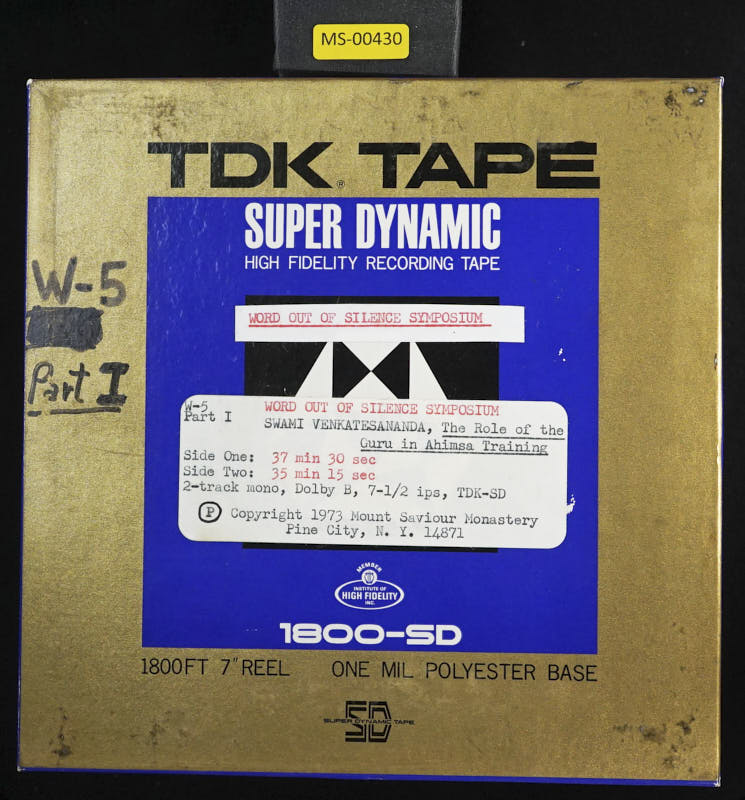
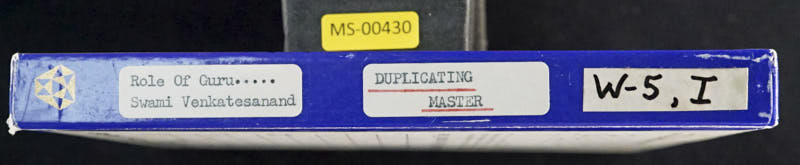
AI Vision - Possible Values from Photos:
Speaker: Swami Venkatesananda
Location: Mount Saviour Monastery
Possible Title: Word Out of Silence Symposium, The Role of the Guru in Athmic Training
Additional text: Part I\nSide One: 37 min 30 sec\nSide Two: 35 min 15 sec\n2-track mono, Dolby B, 7-1/2 ips, TDK-SD\nCopyright 1973 Mount Saviour Monastery\nPine City, N.Y. 14871
@AI-Vision_v002
Aum. [...] Om Bhur Bhavaswa Tatsa Vidurvarenyam Bhargo Devasya Dhimahi Dhyo Yona Prachodaya Ate Lord, lead us from the unreal to the real, from darkness to light, from death to immortality.
[01:27]
Om Shanti Shanti Shanti This problem of Himsa and Ahimsa is exercising the hearts of sane and holy people all over the world.
[02:32]
Especially since we have come a long way from our primitive ancestors who had the courage to face the person whom they hated. Hate him! We have come a long way from those primitive times. We have no courage even to fight. And one person does not kill one person anymore. One person is capable of wiping out whole cities. Probably this is what moved the enormity of the problem.
[03:38]
It was that moved the organizers of this to suggest a discussion of this topic. Also, I think we are desperate. Is that the right word, sir? Desperate. We have shouted from rooftops love one another love one another we have proclaimed God is love we have done all sorts of things nothing has worked what has gone wrong
[04:43]
Before we can enter into the discussion itself, it is good to understand what understanding means. Understanding is not Tolerance. It's a dreadful word. Not that intolerance is better. You know this wonderful thing of tolerance. Well, silly man, I tolerate you. In that there is violence. In that superiority, inferiority, complex, there is violence.
[05:54]
If you watch the hands, not me, I'm not so fond of being watched. This is, the right hand tolerates the left one, stands up there and looks down upon this one. When we mature a little more, maturity Demands that we come down, yes. That's why all the gods, avataras come down. When God matures, he comes down. When you come down to the same level, there is love. Put your arm around your brother and say, love, I love you. There is no longer tolerance but love. Even that is not quite... For understanding. You know, English is not my mother tongue. I learnt it at school.
[06:56]
Understanding. Two words. How come you use it one word? Understanding. Stand under. So when I stand under you, then I understand you. Not till then. Not in tolerance. Not even in love. But in understanding. Standing under when I appreciate you. When I look up to you. Also possibly when it comes to dialogues there is another way in which the spirit of understanding can be understood. The brain or the mind which is up there can never understand unless you can stand on your head. The brain can never understand.
[08:07]
What stands under the brain? The heart. When the brain is silent, And when the heart is open, the heart understands. So, in this encounter here, let us understand one another. And in order to bring about that understanding, it is essential that the mind must be confined to the limbo. the heart made wide open if we look at this problem with this heart with this understanding we may be able to glimpse the truth that has slipped through our fingers all through the ages
[09:25]
back to square one how does one define all this what is ahimsa and what is this thing called the guru and what is this training ahimsa cannot be defined I can hear someone say why didn't you say it before you wouldn't have come here Ahimsa cannot be defined and therefore it is defined negatively. Ahimsa. Non-violence. Ahimsa means non-violence. Ah, I know. Don't you? Yeah, the gospel of non-violence, you know this.
[10:34]
political ideology it is a moral principle society for the prevention of cruelty to animals society for preservation of wildlife sorry I must ask your forgiveness as I sat down here I thought I would be able to repress this humor because this is not a topic which can be dealt humorously with but even if this irrepressible thing comes up I hope it wouldn't befuddle the seriousness of the problem Of course, religious people all over the world understand this great doctrine of Ahimsa.
[11:50]
Do we? Let's take them one by one. Politicians have used this hope you heard that politicians have used this ahimsa one independence there or dependence there I don't know what they do as a political Weapon. Did you hear that? Political weapon. Ahimsa. Ahimsa as a political weapon is paraphrased into non-violent
[13:11]
Resistance. I still haven't arrived at that point where I don't resist you. I have to resist you. Because you are the oppressor, you are the aggressor, you are etc. But I shouldn't hit you. could just as well have hit me. Why not? Why do I resist you? What is the outcome of this non-violent resistance? I become free. I... as a nation, my country, my nation, becomes independent of you, your nation, your country.
[14:30]
I am not suggesting there is anything terrible about this. Where does that lead to patriotism? Don't we all admire this? Patriotism. He is a patriot. Who uses that? Who uses this word, patriot? You know who? A cannibal. The modern, highly sophisticated version of the ancient cannibal patriotism is nothing but a euphemism for cannibals you know what a cannibal used to do don't you he killed other human beings so that he may live with your permission may I repeat that
[15:40]
He killed other or he had other human beings killed so that he and his family may live. And don't we do that now? Don't we do that now? In the name of patriotism. My friends, our country is in danger. Our nation is in danger. Our culture is in danger. Come on. Means you go and fight. Get killed. So that we may be safe. Isn't that cannibalism? What else is cannibalism? That we don't eat the flesh of the people killed creates two problems. Ecological problem of disposal. And food problem.
[16:44]
Waste of flesh. But the basic fact that we are killing one another or we are not even killing one another. We have others killed in order that I may live. In the name of patriotism is nothing but covert cannibalism. And yet, this can also be done in the name of Ahimsa. Moralists, these great people, whose hearts are full of the milk of animal kindness, Who are horrified.
[17:47]
When a cat or a dog is run over. Because these animals have been classified as pets. But whose tables and stomachs receive other animals. Oh they are food. They are food. few days ago there was a beautiful large picture in a newspaper in a British newspaper the keeper of a zoo had killed a donkey and fed it to the leopards hue and cry what a horrible thing to do
[18:53]
Why is it so horrible? Because the leopards have to eat some flesh. They feed the leopards with flesh in any case. But you know the argument? Hundreds of the children who go to the zoo loved this donkey. So I still have no objection to killing provided you kill something which I don't like. This is my pet. Don't touch it. If you even touch it, I will shoot you. I thought that business people did not believe in Ahimsa. Because
[19:58]
Business is business. It doesn't matter how it, how the money comes. And in these days of, what do they call them here, those cards? Credit cards. In these days of credit cards and checkbooks, there is no tainted money. No one touches money. I was bemused by another large picture in the newspaper with a heartrending caption. Victims of Docker's strike.
[20:59]
Who are the victims of Docker's strike? a few thousands of chicken a few thousands of the news item says a few thousands of day old chicken might have to be gassed what a horrible thing read on that's not the end of the story Because of the Docker strike, these chicken could not be transported, etc. and have to be gassed, whereas otherwise they would have lived for a month more before reaching the market.
[22:07]
I'm not very clever, but I couldn't understand this at all. When it comes to religious teaching too, religious doctrine, we have done more or less the same thing. We have first declared Ahimsa, Paramodharma. Ahimsa is the supreme virtue. Or thou shalt not kill. But then looked around, So, the problems we had created for ourselves and then held a discussion, a council, modified this, interpreted this, reinterpreted this.
[23:25]
To suit changing times, all sorts of remarkable arguments we have. an American vegan pure vegetarian once travelled to a Buddhist country and he was justifiably horrified to see monks eating meat and he said how can you do this And the monk said, what? Do what? Eat meat? Buddha said, Ahimsa, Paramodharma. Ahimsa is the supreme dharma. How can you eat meat? And they said, come on. Don't be rude.
[24:31]
I am a beggar. I go from door to door begging for my food. I hold up my begging bowl in front of this gentleman's house. And he throws some food into my bowl. I eat it. Biggers can't be choosers. This wonderful, he must have been very naive, the American vegan, he took the answer and came back and reported it. As I was reading this, I felt, how silly. if I'm a beggar I come to your house beggars can't be choosers you had just cleaned your pantry and you found a couple of dead rats and I held up my begging bowl you dropped those dead rats there alright beggars can't be choosers beggars can't be choosers
[25:38]
if one thing is clear in all this that we have refused deliberately wantonly and willfully refused to see the problem where it is violence is not outside Here in me. Psychologists discovered this and they hallowed it. Aggression that is essential to human life. That's most beautiful. So we have accepted violence. law of life or as the law of death I don't know and all these other people the moralists and the religionists and and the politicians and businessmen so on and so forth all of them have realigned their own doctrines and ideologies
[27:19]
To reconcile themselves with this acceptance of violence. Ideologies do not create conflict. Ideologies do not give birth to violence. It is violence that gives birth to ideologies. Different ideologies. Conflicting ideologies. Or conflict of ideologies. The opposite of all these are I'll come back to this again. That which is not all these is ahimsa. Ahimsa is the total absence of violence where alone it is within us.
[28:35]
Where alone it is within us. there is one more glorified violence the psychologist calls this the martyr complex again something which has been glorified endlessly all over the world in India we have several stories of how great saints cut off the flesh from their thighs and from their arms and from their wherever it's parable you know and fed their own flesh to wolves and vultures isn't that marvelous what a wonderful man what a violent man why does he have to cut his own
[29:49]
Butchering himself, his own body. So, without glorifying or condemning any of these things, can we look at this violence, understand it as it is, where it is? Possibly in that understanding there is no violence. We'll come back to that. This is Ahimsa. What is this thing called the Guru? That is the definition that we have. The syllable gu stands for darkness, gloom, the gloom of ignorance.
[30:57]
And the syllable ru stands for its remover. The remover of the gloom or the darkness of ignorance is the guru. I wonder if you have ever endeavoured to remove darkness. Looks black, doesn't it? Darkness looks black. And if the tile is black, you use soap and towel. If the carpet is black, you use vacuum cleaner. Have you ever tried to remove the darkness of ignorance with soap and towel or vacuum cleaner? Nothing but light will remove darkness. And therefore the Guru is the light. The manifestation of the divine light.
[32:01]
Divine means light and therefore there is no need to say divine light redundant. The manifestation of the divine is the Guru. this divine manifestation has become dreadful perversion in our hands again there are some who think that the guru is soap and towel I do I commit all the sins under the heaven and go and say oh guru please bless me what kind of bless me You know, bless me in French means to bless blesser in French means to hurt, to be injured.
[33:07]
Swamiji is here and maybe some of you who have been to India would appreciate this. black marketeers, scoundrels, murderers, they would go to the Swami. Usually they pick a flower in from his own garden. And go into his presence, fall at his feet, Maharaj, please. Please forgive my sins. What do you think? Soben towel? Vacuum cleaner? Electric shaver? It's a guru. He's my guru. So, I touch his feet.
[34:20]
I take the dust of his feet and put it on my... I am pure. You are pure. This is one version of the Guru. Did I say version? I should have said perversion. Sorry. And there is the other, the schoolmaster. The guru is the schoolmaster. He must tell you how to sit, how to stand, how to do. And if you do it nicely, he'll give you a chocolate. And if you don't do it as he asks you to do, you slap. Usually if you sort of, you know, propitiate him by washing his clothes or getting his coffee, everything is alright. I mean, he's a schoolmaster. What is the Guru? The Guru is the light.
[35:21]
The Guru is the light. The discussion that has been going on here concerning the words master, teacher, etc. It's also intriguing. English is not my mother tongue. I hope you realize that. Master. Unfortunately, the name Swami, the title or whatever it is, the word Swami also means master. Since this became a Swami, I am a master. They don't seem to be any servants. It's upset.
[36:31]
Then I look at it. This hand helps me write. Type. Brush my teeth. One servant. Good boy. The eyes enable me to see the senses. Sometimes even they don't obey me. And so possibly the word master only means one who is trying or endeavouring, to master himself. One possible meaning, another possible meaning, I must be, extremely grateful to be Vilayat Khan, for, enabling us to discover this, this morning.
[37:41]
There is a master Vilayat Khan, Not he. He is Peer Vilayat Khan. There is a master Vilayat Khan. Didn't you see him this morning? The little baby. The son of Mr. Vilayat Khan is Master Vilayat Khan. So master may also mean a child. Master need not mean a child. The boss. Master may mean a child. As a child, yes, of course. I was looking at this baby. Marvelous. I hope if the baby had been here, no talk was necessary. The purest exemplar of himself. He doesn't like someone.
[38:48]
He doesn't dislike someone. Yeah? There is a third which I learned from this baby. He doesn't dislike me. He doesn't like somebody. But that does not persuade the baby to To do violence to itself. The time comes. I want the mother. I want the mother. Whether you still consider me. Innocent or ahimsa or non-ahimsa. I want my mother. I don't know. I don't know if this could be. Expressed. The baby in its. purest innocence does no harm, no harm, no harm to anyone in this world, not even to itself.
[40:04]
We tend to go to one extreme or the other. Either I kill all of you or I kill myself in order that you may live. None of these. Master could be... That pure baby. That pure child. The other things also are dreadful. Teacher. If one is not a bit extra careful, by a slip of tongue it becomes what it truly is. Cheater. Cheater. Unfortunately, the teacher, far from cheating others, he is cheating himself. That he is teaching others. That is the greatest bluff I have heard.
[41:04]
That somebody is my teacher. Can you teach me? You can probably cheat me. But probably you are cheating yourself by thinking that you are my teacher. Another word which also... We use very often leader. Leader. I think our friend ought to, would appreciate this better. You know, in photographic films and tapes, magnetic tapes, there's a leader. Yes, sir? You have a leader there. Does everybody understand this? In any tape recorder, magnetic tape, there is always a leader. Not only empty, it is the most useless part of... A leader?
[42:15]
What do you think we are? Cattle? That you take me by the nose. And lead me around. No, no, no. The Guru is none of these. Not a master. Not a teacher. Not a leader. The Guru is the light. It's a divine manifestation. he do what is his role in the light of our life what is the guru's role in our life what is the role of light in our life does the light compel you to look at me or somebody else
[43:25]
Does the light persuade you to look at me or to look at somebody else? Nothing at all. Can the guru, in relation, in the context of our discussion, can the guru therefore train, train me Nahimsa? How does he do that? How does he do that? Can someone compel me to be non-violent? In that compulsion is violence. In that compulsion is violence. Can one who is violent train me to be non-violent? Can he teach me? How? Can you tell me you are a violent man?
[44:31]
Give up your violence. Are you looking within yourself? If someone came and told you you are a violent man stop being a bully. Can you see what happens within you? You feel like wringing the other man's neck. the other person is in some way or other superior to you and you cannot revolt rebel or if it does not suit your purpose to rebel what do you do? You... All right.
[45:36]
I'll obey you. Why do you obey the other person? Because it suits you. And therefore, you are not seeing what he is seeing. Even if he practices ahimsa, and even if he is so loving, kind, etc., etc., and he wants you to be kind, you are kind, not because you see that it is good to be kind or loving, etc., etc., non-violent, etc., but because you see some other advantage in this. Oh, that's right. It is the same thing with nationalism. When a whole lot of politicians. Follow the non-violent leader. They are not being led by him.
[46:41]
They are being led by their own nose. Which smells their own profit there. That is violence. Therefore if. The Guru even persuades me. Leave alone compel me. He is already doing violence to the core of my being. The divine and inalienable right of every living being is to see the truth for oneself.
[47:44]
If I wouldn't like the bridal veil of my wife to be lifted by someone else, I am only being polite. If the bridegroom has to do it for himself, Discover his wife. For himself. In the same way. This truth of violence. In the human heart. Has to be discovered. Each one for himself. It cannot be done by anybody else. It cannot be handed down. The doctrine of Ahimsa cannot be handed down. Non-violence. Cannot be handed down. Cannot be. transferred, cannot be imposed upon by anyone else. I have to see it.
[48:46]
I have to see it. Then, shall we dismiss this thing called guru? I have to see that violence is totally destructive. Destructive to my life. And so, can I dismiss the Guru totally? No. No. I have to wake up to this truth that violence is destructive. And then I realize that I have to be constantly and vigilantly watching myself in order that Not a trace of violence manifests in my heart. But then, do I know what to do?
[49:50]
Do I know where to go from there? Do I know what it is to be totally non-violent in its positive aspect as love? In one of the Upanishads, the Kathopanishads, we are told Uttishtata Jagrata. These two cannot be done by anyone else. Uttishtata, wake up. Jagrata, keep awake. It's easier to wake up, you know, if you have alarm clocks. But unless you are sitting on a pin cushion, it is not easy to keep awake. Wake up and keep awake. Right? I am awake. To this problem of violence. In the human personality. And I am vigilant. Who is vigilant?
[50:55]
I is vigilant. I is awake. I is awake. I is vigilant. And the I sees. The problem of violence. I see is the problem of violence. And therefore, in a moment of non-vigilance, which the I will, the ego will still interpret as vigilant, it will invent its own euphemism for violence. Pretending No, it's bad to... I don't eat fish. But seafood I have no objection to. That's all. Only change the word. Who does this?
[51:56]
It is the I that does it. Therefore, in spite of the fact that I am awake and I am alert, I am still not able to... They are totally clear of the trap of violence. And therefore, the Upanishad commands, Arise, awake and then go to these holy ones, Nibodatha. Get enlightened. The Guru is the light. And this guru can be a human being or a non-human being, an experience in life. But the light that shines outside cannot illuminate your bedroom.
[53:02]
The light, so long as it is outside, cannot illuminate, illumine your heart. where there is this darkness. If you can kindle your own little candle from that big one called the Guru and install it in your own heart, then that light is the remover of the darkness of ignorance. The Divine grants this Guru I repeat again, it may be a person, it may be a non-person, it may be an event, it may be anything, a newspaper. But if from that blazing fire of God, if I can kindle my own little candle, I need it. I need the big one.
[54:04]
I need the big candle, big flame in order to kindle my own little thing. That big candle is of no use to me whatsoever. But not altogether. It helps me kindle my own little candle. That is the only role that the Guru can play in our life. No more. He cannot set an example. There is a beautiful verse in the Bhagavad Gita. where Krishna says, tells Arjuna, you know, Arjuna, I am doing all this, not because I want anything, but to set an example. That's lovely, beautiful. Yeah. But then, there's a mischievous statement in the next verse. I am setting an example, but
[55:14]
if I do not do my duty here, watch carefully, if I do not do my job, then others will follow my example. Did you get the message? Nobody follows anyone's good example. you are my guru if you set an example whatever it is for me what are you going to do if I don't look at you there are two problems here problem number one unless it is your nature to be no your own being is a himsa if you are going to set an example and therefore you are
[56:18]
trying to violating yourself, doing violence to yourself, in order to set an example to me, you have already done violence to yourself. And then, if I do not see your example, you are going to catch hold of my ears and say, look, look what I am doing. That's another violence. And then if I see that you are terribly anxious that I should watch your example and follow your example, I say, oh, this fellow is having an ego trip. Why is he so dreadfully anxious that I should watch him? None of these things will work. The Guru. If the Guru is Ahimsa.
[57:20]
Ahimsa is not a thing which is done. Ahimsa is not a matter of doing. Doing Ahimsa. All doing is Ahimsa. All doing is violence. If the Guru's whole inner being is Ahimsa. And if I as a disciple awake, alert and eager to be enlightened. if I go to the Guru, then the Guru has a vital role to play, as light has a vital role to play in our life. This light can illumine the dark corners of my own inner being in which violence may Lie hidden or masquerade as Ahimsa.
[58:23]
Even then, the Guru will not turn my eyes towards Ahimsa or Himsa. The Guru can only be the light. The light. For this Himsa or Ahimsa is an extremely powerful Difficult thing. It is not. Himsa is not the antithesis of a himsa. A himsa is not the antithesis of himsa. If you watch yourself as you are listening. If you watch your own heart as you are listening. If you watch your own heart as you are reading a newspaper. Or your scripture or whatever it is. There is not very much of a difference. You will realize this. When you read about a conflict, watch.
[59:31]
Please, watch. Watch your mind when you read. And the news of a conflict. Whether it is the present day conflict in the newspaper or the past conflict in a scripture. Watch. Watch yourself. Watch your own heart. There is A to this. Ne to this. Yes to this. No to this. I agree. I don't agree. This agreement and disagreement. This is the thesis and the antithesis. And The two living together is violence. And therefore the guru is not interested in trying to persuade you this is himsa and this is ahimsa.
[60:39]
Oh no, no, no. It's gone. It's gone. Watch yourself. This has to be inwardly watched, inwardly observed and inwardly realized. We have tons of stories, legends, scriptures. I'm sure you have already read the story of Rama. How Rama was a very righteous person and how he went and destroyed all the demons. Sure. That's what God should do. I approve of it. And there's another person. There is a cult in South India. Which says, the villain is the hero. Oh no, we don't approve of this, we approve of that. There is violence.
[61:40]
Approval and disapproval. Persuasion and being persuaded. All this is the hotbed of violence. As you are looking at me, I am looking at you. I am talking to you. Sound, word, word, sound. I tell you, you listen to me. The speaker and the listener. Is there a polarization here? Or is there only the act of speaking without the polarity of I speak to you? Because in light there is no polarity.
[62:48]
The light shines. Without intending to do. The sun shines without intending to do so. The light is. The light is. The light is. That which is in between these two words. Forgive the words. In between these two poles which is not polarized. Ahimsa is therefore not the antithesis of himsa but that which is without being polarized. The middle, the truth to which Patanjali referred most beautifully in his yoga sutras drishta drishimatra which can be applied to all situations.
[63:56]
It is untrue to say, I am looking at you. Sight is. And as this thing called seeing takes place, someone jumps up and says, I see. And once the eye has come, the object, you, has also to be projected. when this projection, when this creation of the ego and the projection of the object do not take place, then there is pure being. Being not as opposed to non-being, but pure being, drashta, drishimatra. Only when we learn to rise above these dialectics of thesis and antithesis, violence and non-violence, rise above.
[65:05]
And that the Guru, the light of God, the divine might illumine within ourselves if we are awake, if we are alert and if we humbly reach out to this Divine Light, the Guru. Shri Rama Je Rama Je Je Rama Om Shri Rama Je Rama Je Je Rama Om Shri Rama Je Rama Je Je Rama Om Shri Rama Je Rama Je Je Rama
[66:24]
Shri Rama Je Rama Je Je Rama Om Shri Rama Je Je Rama Om Shri Rama Je Rama Je Je Om Triyambakam Yajamih Sugandhim Pushtivarthanam Urvarukami Vabandhanan Vrityor Mukshiyam Amritat Om Triyambakam Yajamih Sugandhim Pushtivarthanam Urvarukami Vabandhanan Vrityor Mukshiyam Amritat Om Triyambakam Yajamih Sugandhim Pushtivarthanam Urvārukami vabandhanān ratyor mukṣiya māmṛtāt sarveshām swasti bhavatu sarveshām shantir bhavatu sarveshām pūrṇam bhavatu sarveshām mangalam bhavatu sarveshām mangalam bhavatu sarveshām bhavantu sukhinah sarveshantu nirāmaya [...]
[67:41]
Om Shanti Shanti Shanti Shanti Shanti Shanti Shanti Shanti [...] Sh .
[68:45]
. [...]
[69:46]
. Thank you. Thank you. I love you.
[70:50]
I love you. Thank [...] you.
[72:02]
Mario [...] All right.
[73:02]
@Transcribed_UNK
@Text_v005
@Score_69.14