You are currently logged-out. You can log-in or create an account to save favorites and more. more info
Reclaiming Opus Dei's Liturgical Essence
AI Suggested Keywords:
Agape
The talk addresses the translation and interpretation of a Benedictine liturgical text, highlighting discrepancies and omissions in its English version compared to the original Latin. Emphasis is placed on the theological and liturgical principles outlined in the Latin directory, particularly the importance of the Opus Dei in monastic tradition and its expression through dignified ceremonial practices. The speaker also references the broader intention for liturgical reform post-Vatican II, seeking to preserve tradition while adapting to modern contexts.
- "Directory for the Celebration of Opus Dei" (Latin: Directorium): This serves as the central text under discussion, noted for differences between its Latin and English versions and emphasized for its detailed liturgical guidelines.
- Thesaurus Liturgiae Orarum Monasticae: Described as a liturgical resource that includes the directory along with calendar and office structures, relevant to the organization of monastic hours.
- General Instruction of the Liturgy of the Hours (Institutio Generalis): Cited as a critical post-Vatican II document that frames the recent liturgical reforms and their intentions for spiritual renewal.
- Odo Casel: Recognized for his influence in liturgical theology, emphasizing the commemorative nature of the liturgy as a realization of Christ's mystery.
- Salvatore Marsili: Credited with being a significant contributor to the directory, embodying the integration of Benedictine liturgical tradition with modern reforms.
- Vatican II Liturgical Constitution (Sacrosanctum Concilium): Mentioned as the foundational document for liturgical reform, advocating for the centrality of Opus Dei in monastic and ecclesiastical life.
AI Suggested Title: Reclaiming Opus Dei's Liturgical Essence

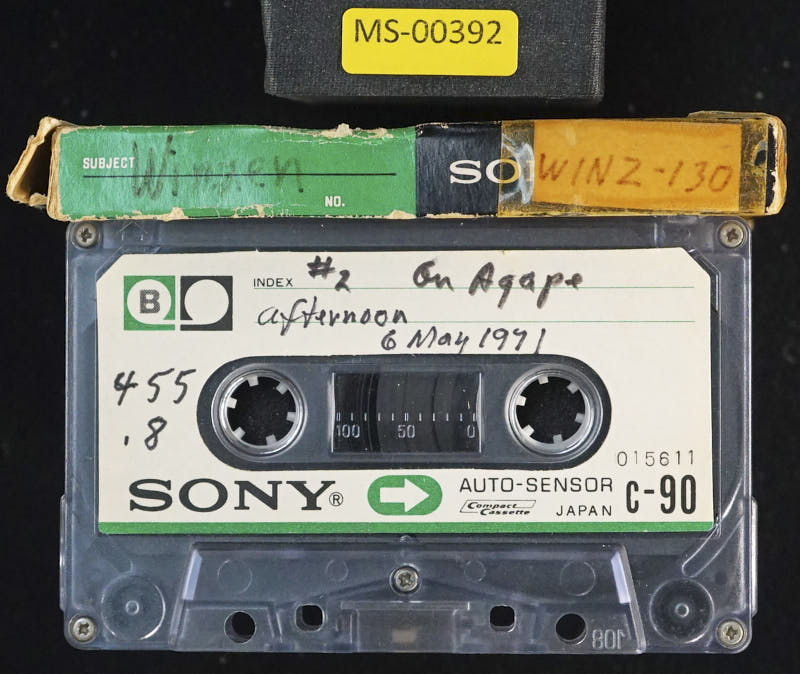
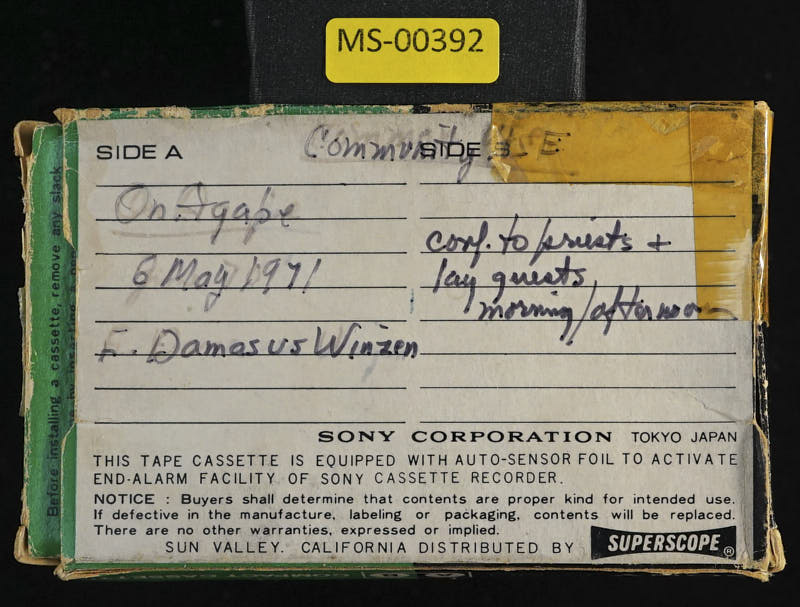
AI Vision - Possible Values from Photos:
Speaker: Fr. Damasus Winzen
Possible Title: On Agape. Conference to priests & lay guests, morning/afternoon
Additional text: morning, copy #1
Speaker: Fr. Damasus Winzen
Possible Title: On Agape. Conference to priests & lay guests, morning/afternoon
Additional text: afternoon
Speaker: Fr. Damasus Winzen
Possible Title: On Agape. Conference to priests & lay guests, morning/afternoon
Additional text: B
@AI-Vision_v002
Two talks from same date.
Superfluous, I don't know, but I try to give an introduction and then we discuss it with you. And I think every one of you has the English translation of it. And according to our scientific method in St. Anselmo in Rome, my first intention is to ask myself and also to invite you to ask yourself how far this English translation is corresponding to the real document. which we have here in Latin. Here is the original source to which the sacred congregation of worship has given its approval. And then I would say the directory, the English text, is a good and free, but very free, translation of the Latin directorium, the opera dei per solvendo. The directorium, a directory... for the good realization of the Opus Dei, of the worship, following exactly the single numbers.
[01:07]
But in a very strange way, two numbers have not been presented. Number six, Musica Modulatio, the musical modulation, and number 27, I can't do this in celebration. Therefore, it seems that the people who translated this were not interested. I don't know why. In every song. It's not true, because sometimes they are speaking about melodies. But nevertheless, this is the first draft. And later on, as they added, some musical ideas, all have taken it away. I don't know. And also... Therefore, to 28 Latin numbers, there are corresponding only 26 English numbers. And also in number 25 of your English text, in a very strange way, there is not given the last part of the Latin text concerning vigils, as the most important hour of the worship.
[02:24]
Because of its eschatological meaning, it seems that modern Benedictine monks, and I have this experience in St. Anselmo in Rome, and also in my own monastery in Maria Lach, don't like to rise, to awake too early. Four o'clock in the morning is quite impossible for the majority of the monks of today. In St. Anselmo, we are, how do we say, rise or awake. We are awake only at six o'clock. And in Maria Laque, we are rising only half past five, very late. I don't know the reason. And then sometimes, for example, in number 26, it's added some short word about a place where the symbol workers are staying during the office. At the center.
[03:25]
the president, the canto, or in front, the reader, and so on. And also about external expressions of words. It must be the office, the worship must not be too uniform in the acclamations, in the proclamations. Therefore, they are realizing also the necessity to change. And also, I am sorry that... titles of the single numbers are not given. For example, in number one, you have eminentia operis dei in benedictina tradizione. It's very helpful to know it, that in number one, you are speaking about the eminent position of the worship in the tradition of the benedictian monastic life. It's not very important, but it would be helpful to give them. And there are also some other changes.
[04:35]
For example, if you take number six, number seven in the Latin text, and the title is Sinia Externa, External Science. It's a marvelous text. The community will participate in the Opus Dei with the entirety of its interior and exterior being, because the action and attitude and the voice itself must be signs that the community experiences the presence of the mystery of Christ, which it shares, and is moved by the action of the Spirit. External expression... of the presence of the mystery of Christ, and all that is done by the action of the Spirit. It's an excellent theology. It's quite corresponding to the theology, to the Latin text. And also the second elements are well translated.
[05:39]
The exterior elements, which make up a celebration, make this a liturgical action only if there are the means of contact efficacious signs with the theological reality to which they refer. Thus, gathering together at the place of prayer is not merely obedience to a task commanded, but must express the will to act as the living church, one of the most essential ideas of this directorium. We are doing not something only juridically because we are depotated, to do our duty, but we are expressing ourselves in external signs as the church of Christ, the local church. The texts are proclaimed and in turn heard precisely with the desire to help the world penetrate the heart. The song or the proclamation of signs is a way of implanting in us through
[06:45]
the inspired voice of Christ, the pleading and the praise of all men. And acclamation must be the echo of a conscious interior enthusiasm. A silent pause is the will to dig into the spirit in order to make a spring of prayer rise up in response to the world. To be all this, the celebration first, must not fix the attention on itself, But on the reality of the mystery, if it is fixed attention on itself, it would be an obscure sign. Secondly, must not be incomprehensible. It would then be an empty sign. Thirdly, must not be carried out in a mechanical way. It would then be an absurd sign, because it would be contrary to its end of communicating spirit and life. And so far, it is quite responding to the Latin text. But no... The sign value of the celebration demands that the opposite day, even with respect to the laws which govern it, must never be performed on a purely legalistic plane to obtain validity.
[07:58]
Nor should its form be called, detached, governed only by protocol, and falsely hieratic, thus dehumanizing the action and the celebration in general, but in Latin there is said more. And in a very strange way, it is fine, and insinuations and counsels are taken away. Let me say it first in Latin, and then I try to translate it. Res illa quam celebratio significade et producere debet non solis verborem textibus, The reality which our celebration wishes to signify and to produce is touched not only by the text of the words, not only in the observation of norms, but also in the external form of the celebration.
[09:10]
The English text does not speak about this external form, and it continues. Therefore, the external form is described by this word, magna dingitate, with a great dingity. I am very sorry that you did not speak about it. We must not do it, how do you say in English? Slap. Slap. Slap. Very often people today celebrate liturgy, especially in the parish churches. Excuse me, some priests, some younger, some older priests, without any dignity. Our intention is to go away from this old baroque pompa, with a big mitra, with a great crusher, and with many people on the altar. with very great Baroque investments and so on.
[10:14]
You could possibly speak about this very long ago. No, we don't wish to do it anymore so. But nevertheless, also in the greater simplicity we are seeking today, we must preserve a great dignity. And you are doing it here. But it would be necessary to insist in it against some tendency in younger people of today, in Europe and also in the United States of America. Magna digitale, in great dignity, in the way to execute it. In absentia precipitationis, precipitation, is it English? Precipitation, to go on too quickly. That must be absent. Not too quickly, with a great calm. We can wait, we have time. We waste time for God. Not quickly to finish. in the presence of quiet and silence in certain times.
[11:23]
At least in greater solemnities, in this solemnity which is given by the song. All this part is not here in the English text. I don't know the reason, but I believe that the translators who have been very able, very capable, who understand the text, did not think it is not so necessary to insist, to shorten it a little bit. But they have taken away very important things. And we must also be very attentive to that, that we may not be too rationalist.
[12:28]
What's that? Just rational, intellectual, yes. Not too much. Because today we are, after the Vatican Council, we have an invasion of wars. And we are speaking too much, forgetting the solemnity, the dignity, the silence, and to be open to the Holy Spirit. Therefore, not too much reasonable. Too much. We must be reasonable. We must be intellectual, but not too much. So that we are reduced to verbositas. What's the verb? To... Loquacity, yes, and all these things. The words, without any doubt, are signs of the greatest importance in liturgy. Nevertheless, if we are remaining only in words, then we would be the properati, we would be in poverty, yes.
[13:31]
Therefore, we must... have not only words, but also a song, a certain solemnity, not pomposa, but a certain solemnity, and we must have silence sometimes, to be open only to the Holy Spirit who is speaking in silence. We don't need words then. Therefore, we would be very poor, we become very poor, if we would have only words without signs, uts und musica, luxe, corporales habitus ornamenta. And these signs are music, light, and the way in which we are staying, kneeling, sitting, and so on, the corporales habitus and ornamenta, some ornaments, and so on. And then the rest is very good. The tone of the voice, the attitude, and the way of pronouncing a formula and of proclaiming a reading must be supported by a true interior... How do you pronounce it?
[14:33]
Worms. Which, while it shows everyone that we are present to ourselves, this is added. It's not found in the Latin text, but it's very excellently said. Therefore, the people who translated it were understanding the meaning. And here they have given a very good commentary. We must be present to ourselves, not mechanically. We must know what we are doing. Therefore, An interior warmth, which while it shows everyone that we are present to ourselves, succeeds also in communicating to others, to the people which are, who is present, sharing in our celebration, to others, the living presence of Christ, as something perceived by us in the world and in our response. Then, both in Latin and in English, the citation of Luke 24, Did not our hearts burn within us as he talked to us?
[15:34]
Stay with us, Lord. So we must celebrate. Therefore, I have given this example to show you, you have in this English translation a good presentation of the Latin text, but sometimes something is lacking, sometimes we say more. And now, this directory in Latin is, therefore, in its original text, the first part of this book. First part only, very short part of this Thesaurus, Liturgia Orarum Monastice, translated in English, of Monastic Liturgy of the Orls. And this directory is composed first of the directorium, the directory, then some prenotanda, some introduction words, and the thesaurus itself.
[16:44]
A, the calendar, the structure of the office, and schemes to dispose sun in different ways. According to the rule of St. Benedict, according... according to the method of the Abbey of Cheyenne in Germany, according to the method of Christogonos Waddle in Gesemani Abbey. Three, four examples. Only as examples. You can dispose the Psalms as you like to dispose. But nevertheless, here are given some examples for the people who need it. And then, after that, you have... Disposition of the entire psalms from 1 to 150 pip antiphons. And you have then also all the antiphons which are necessary during the year for Benedictus and Magnificat. For the saints. And you have the command of the saints.
[17:47]
You have the office of the dead. And finally you have some appendages and some final conclusions for the Abbes who wish to retain the prima, the first hour, and for others who wish to... who don't wish to see the prime, but who must then put the psalms first given to the prima, to the prima, to our hours. And then also the hymns, which are proper to the Benedictine Confederation, and some... prayers and introductions for our father and some other things of minor importance. Now, the intention of this directory of the thesaurus would be, of this entire work, his
[18:55]
to create again a rigid uniformity. This is excluded. The abbots did not visit. The men, the people who have composed this did not visit. And also the congregation of worship is agreeing with that. Nobody is obligated to have the unique form of the Benedictine bravery as it was performed. But the intention was only to present the framework for a convenient restoration on the vivification of our Opus Dei in the light and in the spirit of the Vatican Council, of the liturgical constitution, Saccolactum Concilium, and of the realization of these spiritual principles in the Roman liturgy of ours, liturgia horarum. But here again, the intention is in no way to give us this liturgia horarum.
[19:56]
Only we must restore our own office, our own worship in the light of this principle given in the Vatican Council and then present it concretely in this liturgy of the hours for the Roman light. And In the spirit of this restoration, the spirit of the Vatican Council, the spirit of this realization of the Liturgy of the Hours is given in a marvelous institutio generalis in liturgiam horarum. General institution, general introduction to the Liturgy of the Hours. And this work of the greatest importance, and it would be convenient for everyone to read it too, sometimes, which is also translated in every language now, was made by the consultors of the worship congregation. And the consultors of this first congregation, of the Concilium ad Exequindum Constitutionum de Sacra Liturgia, of this council created to install, to reform the liturgy, to execute the ideas and the desires of the liturgical constitution of the Vatican Council,
[21:13]
have been the most excellent liturgies from all over the world. Some cardinals, some bishops, very excellent bishops. The American was especially a good bishop who died already, I don't remember, or Atlanta. Yes, he was an excellent man, but other people too. And then, because the bishops were alone, with the help of the spirits, Holy Spirit could not do the work. Some learned liturgists from all over the world who must do the work. And sometimes when we were speaking too much, the bishop says, you must not speak. We wish to stay alone. You are excluded. Then we went away for two, three days. And then the bishop said, please come back again and help us. But you can speak only if we are asking you. For one day, we did so. After two days, again, we could speak.
[22:16]
Therefore, we have worked together in peace after this only one difficulty we had. And the most learned literatures from all over the world, therefore, MacManus, Gottfried Dieckmann, to say only two names from the States, and then all from France, from Germany, and so on. And many Benedictines, Therefore, we can say that the spirit of this institutio generalis, of this general institution, is made already in a benedictus spirit. Sometimes we were fighting when we were discussing the problems of the new liturgy and composing this institution about some principles. For example, somebody said, some secular priest, it is awful to say every day the benedictus. It's too heavy. After all, the psalms still in the benedictus. And we were fighting to retain the Benedictus for every day in the Magnificat, and we obtained the victory.
[23:20]
And also in other things, sometimes I am very sad when I see that no, Benedictine monasteries don't say every day the Benedictus. It's against the spirit of the Reformation. Repeat psalms, not every day you psalms, but every day all. Some psalms must be repeated. Let's say, go on in our heart. Benedictus, Magnificat, and so on. And other psalms too. Repetition sometimes is a good instrument to gain it. But nevertheless, we have tried to go via media, a good middle way. And therefore, we can say that already the Institutio Generalis, a marvelous work of theology and also practical information, is filled with the spirit of the benedictine tradition. And now again, after that we have made this Institutio Generalis for the liturgy of the laus, we must see our own worship and the restoration of our own worship in the light of this Institutio Generalis.
[24:32]
in the light of the principles of the Vatican Council and so the Abbot's Congress has elected a commission of four Abbot's to compose the Thesaurus and also some introduction to it in which we are thinking about the main lines of our worship in the light of the Vatican Council and of the Reformation after it. And the man who then really did it was Abbot Salvatore Marsili. It is true, the directory is not given in his authority. The four Abbot's were speaking and the Abbot's Congress were agreeing. And finally, the sacred congregation in the authority of the Pope has given his agreement to it.
[25:36]
Nevertheless, it is very interesting, as in every ecclesiastical document, to know also the way in which it was made. And therefore, we can say the document was written by Abba Salvatore Massili and then perhaps corrected a little bit and finally taken by the commission of the four Abba's and the sacred congregation. Who is Salvatore Massili? He is a monk of a very small monastery in the north of Italy. And this monastery has been one of the first Benedictine abbess in Italy to promote the liturgical movement since 1914, editing the magazine Revista Liturgica. And the abbot who was beginning it Abad Caronti, very famous in Italy, and his successor, Abad Boniface, tried in 25 to get in contact with Maria Lark, with my own abein.
[26:41]
And therefore, he sent a monk to Maria Lark, and together with this monk who stayed there for the summer of 25, Father Damasus Vincent, a monk of Trio, this monk and I, we... made a great travel to Germany, Switzerland to visit his monastery. And here I have seen for the first time marvelous Benedictine hospitality. And between the boys, which then in the last day were greeting us, was one who some years later came to St. Danzelmo and he said, Father, do you remember one of these boys in 25? And it was Sabatole Massili. And therefore, he liked very much our Abbey. And he came to the famous Benedictine Academy founded by Abad Ilde von Herzberg in 1931 and passed the entire year in our monastery. And he fell in love for us, for our liturgy and for our theology, and especially for Odo Kassel.
[27:48]
And when he came back, after his very well-made studies in Rome, St. Anselmo, He was writing about theology of Kassel, the presence of the mystery of Christ. And he did not please to the abbat president of his congregation, Abbat Caronti, who condemned him to silence. And the greatness of the Abbatore Massili is that in this difficulty, in which many people very often leave the monastery, he remained faithful. He remained in silence. He was sent to the south of Italy, condemned to silence. to be there far from every active life. And he obeyed. Until in, after the troubles of the war, where he also was field chaplain, et cetera, et cetera, et cetera. A little bit difficult, also politically. Until he, in 57, 58, was called to St. Anselmo. And here, as professor of liturgy, he could also speak about this theology
[28:54]
He has known in Maria Lark, the castle, and so on. Therefore, he became one of the most excellent theologians, speaking about liturgy as a realization of the mystery of Christ. He was also always in this theological religion, until now, when he became Abbot, and so on. And in 1608, He had very, at then, when he was professor and president of the Institute, a very open mouth. And he was speaking also openly, very openly, so that he did not please to some people in this sacred Roman congregation. And these people said to the Abbot primates, good, cardinal good, put him down. The Abbot primates did not do it, defending him, also in big difficulties. He succeeded.
[29:55]
And in a certain day, 68, I don't remember, nine, one of these men in the sacred home congregation said to the rector, Augustinus Meyer, the actual archbishop and secretary of the congregation for religious people, said to him, say to Salvatore Martini that he may be silent. And Augustinus Meyer came to me and said to me, said you to Sabatole Massili that he is more prudent, that he is not speaking so openly. I said it to Sabatole Massili, and he said to me, no, I have, I have, how do you say, I have 50 years, I am a monk. They can depose me, I shall obey, but I shall not close my mouth. So far, he allowed me to speak, I speak. What I think was very faithful. And when he had written a certain article in the Hospital Romano at that time, some people were not very edified by it.
[31:04]
And then in the audience with the Pope, the Pope said to him, ah, you are the man who may explode this bomb. But the Pope was very kind to him. Therefore, you can say a man who is faithful and intelligent and speaking, he can do it. And finally, he will not have difficulties. But nevertheless, speaking openly, and if the superior is persevering in his opinion, he was obeying. Therefore, I tell it to show you the man who was composing this directory. He is a man who can be said spiritually a disciple of other castle. Designee to the entire theology of Maria Lark, and then president of the Pontifical Liturgical Institute until he was elected abbot in 1972. I mean, professor, still today of this, our Pontifical Liturgical Institute in Rome, still today the first editor of the Revista Liturgica, and also the first editor of the manuale, how do we say, manuale, yeah.
[32:17]
of liturgy which we are aditing with the title, very signifying title, Anamnesis. Memorial. Memorial as the main idea for the entire liturgy. Liturgy is memorial, but memorial in the strong sense of castle, memorial which is realizing which we are remembering, that we stay in the presence of this topic which we are remembering, Anamnesis. Do that in memory of me. And he was invited in these days, last days, last week, to speak in Maria Lark about the theology of Odo Castle in the last years, under the concept of memorial, anamnesis, memorial. Excellent man. And therefore, he was composing this directory. And we can say that therefore he is speaking precisely in his view, underlining in the principles of the Vatican Council this idea of liturgy, is this solemn action in which the entire work of salvation is realized, as the liturgical constitution says it in number two.
[33:44]
The liturgy, especially the Eucharist, is realizing the work of salvation. It is one of the main ideas of Odo Castle, according to this wonderful oration on the Oblates, formerly on the ninth Sunday of Pentecost, All the times that we are celebrating this commemorative sacrament, The work of salvation is exercised in the most eminent way in the Eucharist. But in every liturgical action, the work of redemption, the mystery of Christ, the pastal mystery, death and resurrection is represented, is given to us, that we can touch this, that we can stay in it, go in it, and die with Christ and be resuscitated with him. This idea is for him the main idea, and therefore he is speaking about it, not always, and also the abbot later on has mitigated a little bit this language, a little bit too cassidy.
[34:49]
The theology of the castle is presented in a very peaceful way, finally, not too much, not too strong, nevertheless it is there, therefore we could find in this directory a wonderful presentation of these main ideas of the castle, of Maria Lark, which they also as the fundament of your own monastery here, taken by the Vatican Council, taken now by the liturgical reform, that we can worship according to our Benedictine tradition, but in the light of these wonderful principles seen by the entire liturgical movement in the last 50 years and now approved by the Council. And... And this, Father Mastilli, the Abbas then, and the Abbas Congress, present as this directory, not to repeat the marvelous theology, as you can read in the preface here, not to repeat the marvelous theology of the Institutio Generalis in the Liturgy of the House,
[36:07]
But to speak about the directive norms of the monastic tradition in the light of the principle of the new renovation exposed in this institution generalis, as you can see in the second and in the third section of the first page, preface, Its scope is not to represent nor even to summarize what is already to be found in the Institutio Generalis, which deals admirably with both the theological spiritual aspects and the actual order of celebration, rather taking as our starting point the preeminent importance that the Opus Dei has always had in the tradition of monastic prayer. It is our intention to examine it in the light of the principles of renewal and reform which are let down by the general institution. In these principles we find all the treasures of the theology of spirituality which, with regard to the celebration of the divine office, have always been safeguarded by the monastic tradition.
[37:19]
However, as we hear them once again proclaimed with authority, we are given the I cannot read the next word. The incentive to make sure that the Opus Dei retains its central position in the lives of our communisms as the luminous central whereby the church comes to be more and more manifest each day in her liturgy. Therefore, we, and that is the intention of Abba Massili and this entire directory, we wish to retain our old tradition, but to see it, to see it, No, again, in the light of this marvelous theology of the council and the liturgical reform authority, which is approving our entire tradition and is repeating it again with great authority against the temptations to which we are all exposed to saying, oh, today we must work.
[38:22]
We must be apostles. We must go out. To pray is not so necessary. No, no, no. To pray is the first way to do it, because praying really, in the wonderful theological deepness of our Benazitian monastic worship, to pray so is to be apostles, is to be a witness, and to find a source for all our activity. directly wish to insist on one side in our tradition and on the other side to say this tradition in the new light of the Vatican Council in a new light which is nothing else than very authoritative
[39:23]
exposition of the old and very good principles of authentic worship. And so far, we could now begin to read the work itself, but now I must ask Perhaps I was speaking already too much and it would be better to finish today and perhaps to go on the territory itself another day and to invite you to discuss, to speak about these things. And I must ask you if you could understand me. My English is not too bad and so on. It's interesting of this book. Finalpia, okay.
[40:25]
It's near to, between the French frontier and Genova. And the Riviera. Finalpia. A very, very small monastery. And also he does not have many novices. I'm very sorry. But his revista, his magazine, Trevista Liturgica, is still one of the most excellent liturgical reviews we have. the question liturgic, the Louvain in Belgium, the Vista Liturgica perhaps is one of the best, but in Italian only. And Massili was so courageous to write also openly in his revista an article when Bongini was deposed. You remember three years ago, the secretary, who was the most excellent worker in the Jewish reform for sacrifice.
[41:27]
Of course, many people also, the Coria Romana, have been against this reform. And he was the Sindenbok, the Mauligus saying, he was the animal to be sacrificed. And he was sent away, and he became the Neuntius Apostolicus in the end of the world, in Teheran, where Father Asgaf has seen him last year. And when he was deposed, he has written an excellent article where the literary is going. And in the end of this article, he has given the invitation of my letter. I have written to him what has happened, the catastrophe in Rome. And he then said, some friend of Germany has written me a letter, catastrophe. In a certain way it is the same.
[42:59]
We are Christian people and all we must pray, must worship, must adore. But we have, as a monastic, according to our monastic tradition, we have the possibility to pray in a better way, coming from the silence and the recollection of our monastic existence. We have the possibility to realize some forms which cannot be realized by the secular clergy or by the secular pages. So for example, visitors. Night visitors. You can do it. People outside cannot do it. We have more time for it. According to our Banastha tradition in worship, which must be a central point for everyone, for us must really be the central point of our entire day.
[44:03]
It must be the source of our spirituality, our authentic spirituality, and the means for the disposition of our entire lives. as it is said in number one of this directory, a source of authentic spirituality, that we can stay really in Christo-Jesus, to live in Christo-Jesus, to live in Christ, strengthened by the Word of God, hearing it, confessing it, praying it, praising the Lord. It's the intention of every Christian. But for us, in a more excellent way. In a certain way, as every monastic life is nothing else than Christian life, but in greater decision, greater excellency.
[45:08]
So all pray with the same message for everyone, but made better, with all the means we have to sing, to listen to it, to hear in silence. to give answer to this. Meanwhile, the poor clergy outside sometimes is praying very quickly and they must go to work. They have no time. They cannot listen. They have no time that the Word of God is going into the heart. We are in this wonderful situation that we have time for it. And if we don't do it, And they are worse than the Christians in the world who, not offending their difficulties, sometimes are playing, sometimes are doing it better than being in the monasteries. Also, I would answer with your question. I would say, the directorium itself was speaking about the visuals as the most eminent monastic hour of the day.
[46:39]
And here, also, not only the directorium was speaking about it, also the council itself has said, it is true, there are two cardinal hours for the principal hours, laws and despots, but then it is the third hour, the hour of reading. Therefore, we have not only two principal hours, but after this Lord and Westeros, we have still a very important hour, which for the Christians in the world is, how do you say, is taken away from any respect to time. You can say in the hour of reading, the Hora lecciones, today, in every moment, you are not obliged to say it in the morning, You can say at noon, when is it most comfortable for you? But monks are invited to say during the night, so far as possible, in the sense of we. We, when we were preparing a new liturgy of ours, obeying to the word of the council, we must try to give
[47:57]
To every hour is veritas pure. It must be said in the right time. Lords, really, for sun rising in the morning. Twelve at nine, more or less at noon, in the beginning of the morning. Six at noon, more or less. No, in the afternoon, in the first afternoon. That was in some setting tonight. And complete before we go to bed at two o'clock in the morning. when we are going to bed. It must be the last prayer. But one hour is without any respect to time. If it is comfortable for you, if you have time. And in some excellent book in Germany, written in the 60s, in the 50s, before the Council, it was said, for the modern man in the world, the most convenient time to relax after the daily walk, is at four o'clock in the afternoon, and you come from your institute, from your bureau, and you are washing a little bit, you are refreshing, you are eating at four or five o'clock, and then you have time to go to listen to the radio, to read the newspapers.
[49:14]
And here, the Christian would have the time to pray. And here would be the most convenient time for the whole Galaxianis. But for monks, it would not be so. For monks, it would be necessary to insist in this meaning of vigil. where we, during the night, are ready to wait for the coming of our Savior, in the second, in the fifth, in the sixth hour of the night, ready when he is coming. And in a certain way, it would be an awful thing if one would forget this necessity, at least in the first morning, so far as you are doing it, before God starts. may be a little bit tiresome, and nevertheless, monks are invited to do it. Therefore, here, we must follow the, we could say, the principles of the Vatican Council, and in the same times, and the directory is written in this way, in the same times, retaining our tradition,
[50:24]
which is insisting in the eschatological aspect and essence of the visual character of the Horalexionis. And we must do it, and we are invited to do it, when more or less the Liturgia Hororum, the Roman Opis, was finished. Let me say, 68, 69, 70. Pongini has told to me, at that time I was still the predecessor of Henry Ashford as Secretary of the Liturgical Commission of the Order. He said to me, no, you must make your office. You are not invited to take the Roman office. You must take your own, you must reform, you must adapt your own bravery to the principles exposed here in the Liturgy of the House, according to the Romanite, inconvenience for clergy, for Christians in the world. But no, you must adapt the same according to your tradition. And so you must do a little bit more and you must do it so that this, your office, according to your tradition, retaining the most principal elements of your tradition is really the source of an authentic spirituality.
[51:39]
And also a very important meaning to give them the characteristical disposition of your entire day. You are walking not according to your civil work, but you are walking after loss, after heimes, before six, after noon. Therefore, your entire day is characterized, is determined by the prayer. Also, you are walking very much. Oh, no, no, no, no, no, no, it's more, it's more, more.
[52:45]
Yeah, no. Yes, you are right, you are right. There are still the cardinal points of the day. You are beginning the workday with the Lord, and you are finishing the workday with Vespos, more or less, and then during night you have time to stay in peace for, to hear the readings. And not only, and we were very much insisting in it, not only to hear the readings, but also to pray. When we were composing the new liturgy, somebody has said, it's only hora lectionis, it's only hour of readings, without any psalms. Then we said, no, no, there must be also some prayer, at least two or three psalms, and you have more, according to our monastic tradition. You have not only two or three psalms, as in the Roman office, you have more. Nevertheless, it's very important to have readings of the scripture, last scripture, and rather, as you are doing it very well. Therefore, we are invited to inform our bravery, and we are invited, and the entire tendency of today is to do it in a certain, we must speak about this reading later on, directory, we must do it in a certain spontaneity, so that every local church is able to create its own liturgy, as you are doing it.
[54:23]
Therefore, we shall no more have a breviarium monasticum for the entire Benedictine confederation as they had it. It was very comfortable. And I liked it too, but the intention is not to give again a breviarium. And all the people who were expecting that we would produce a breviarium are disappointed, because here is not a breviarium, here is only the treasure in which you find all the elements which you must use to compose your own office. They are invited to do it. That is very difficult. That is difficult because many monasteries are not able to do it, and other monasteries have not the money to do it, have not the time to do it. Nevertheless, for example, if a single monastery is not able to do it, then the congregation must do it. If the sisters are not able to do it, they can ask the help of the monks. Therefore, some offices are made for a greater group.
[55:27]
some congregations have their own office. But the greater Abbas wish to have their own office, and therefore here have the possibility to have spontaneity according to the modern tendency. But this spontaneity must not forget, is very important, and the entire directory is made in this way to show us the principles which must lead us. We cannot make our office let me say, introducing only the Rosary. Other means. Excellent ways to do it, but not the monastic tradition. We must follow the old tradition which is praying not 150 Abimaviyas, Hail Maris, according to the Rosary, the Great Rosary, 150, but 150 Thans. Here is our word, our prayer, 150 Thans. Also so far as possible, according to our tradition, in a shorter time, possibly in one week.
[56:34]
But it's too difficult because we are insisting very much today more in quality than in quantity. And to consume our office, to consume it with silence, to consume it with dignity, in peace, we need perhaps a greater time. And therefore, it's quite possible to say the 150 psalms, eight days, but in fifteen days, or in four weeks. In my monastery in Maria Lark, according to the ideas of Father Raphael, we are seeing many psalms only every four weeks. You can repeat every psalm in every day, on every week. And the congregation in Rome is agreeing with that, but so that we are more or less more or less seeing in a fortnight 150 psalms. Not all the psalms, but at least more or less 150 psalms.
[57:35]
Therefore, a minimum, also in numbers, is required. Also, for the distribution, it's liberty. Spontaneity, in the same time, obedience... faithfulness to our old tradition, and also in the distribution of the hours during the day. According to our tradition, it is not possible, as somebody has written it in Germany, an excellent book is true, as the daily prayer of Christian men of today is not pray in morning and afternoon, but once the day only. because in the morning you have no time. You are waking, are waking, and you must very quickly go to your office, to your work. Tonight you have no time because you must go to theater, to conferences, and to all this work.
[58:37]
But in the afternoon at five o'clock you have, before the evening is beginning, all this activity of a modern life, you have to have an hour to pray. For monks it's not right so. We must retain the cardinal hours, night and also at noon and during night. Therefore, twice a day, three times a day and during night. It's not seven times. But we are not insisting in the letter. It's not necessary to pray seven times during the day and once during night as the rule is saying it. But the principle, the spiritual principle of the rule must be retained. We must pray so that the prayer is going through the entire day. morning, noon, afternoon, night, morning, so.
[59:45]
. You know what I mean? . Yes, there is still remaining. But also here is a certain liberty. I think this is your idea of all the 150 sons in a certain interval of time, not leaving away one, three, four sons. 150. Therefore, we are fighting about it in our concilium, and then we are preparing the new liturgy. Somebody said it's impossible to say every psalm because there are psalms which in their mentality are no more corresponding to our actual situation. How do you call them proof psalm? Cursed psalm, yes. We, the benedictives, or many of us, not all, were fighting, defending them.
[60:46]
And you remember perhaps that not of Fugleston as psalm, written in an excellent small booklet, an article also in the Review of the Jesuits in Germany, where he was strongly defending the cross in Psalms, according to the rule of St. Benedict, who says, let us destroy his little children on the wall. We must destroy the little children, the little thaws. of temptation in the rock which is Christ. And so we must give this spiritual interpretation. We are defending it. But we could not prevail. And finally, also with the authority of the Pope himself. In the Roman office, the Corsic Psalms and also some verses have been taken away because the Pope said, and he is right, he is saying so, we must take away
[61:49]
any argument for people who say, we don't pray this Platerium, this liturgy, because it is against the spirit of the New Testament. And when I, in the Concilium, was defending it, some French priest asked me, do you still say your psalms in Latin? Yes, and you could not speak here, because if you say it in German, and the people is hearing it, how you are fighting against your enemies, how you are washing your feet in the blood of your enemies, how can they be Christian people? And there is some truth in it. It is difficult to pray without any explication. Therefore, that may be taken away. Any argument against the prayer, the Pope wished that it is only a new seminarian prayer. where the Psalms are given only if they are really corresponding to the spirit of the due testament, testament of love.
[62:57]
But he said expressly in the holy scripture, they are remaining. But we, we wish in our monastic office, according to our education, our possibilities, our explanations, according to the rules of the building, we wish to retain the code of Psalms. And we are free to do it. And if you don't like it, you are free to take them away. There was a young non-Christian that even sat at our city. And he threw it for a month sitting there and said, Christian, Christian, Christian. And we went to the parents' time. You are right. Yes, yes, yes. These people here, we know in the modern language our crossing words are terrified. You are right. They say they would need immediately explanation. We don't speak against our political enemies. We could not speak against Khrushchev, against Russia, against somebody in the state, against the other democratic party and so on.
[64:04]
Only against the devil. In the kingdom of God, we must say that. Therefore, we must explain the sound in a spiritual way. We need this spiritualization. If we don't do it, oh no, no. Nobody can tell it against my enemy who yesterday has made me troubles. Against my bonfire. We could continue another day to read them. You can tell me one.
[64:48]
@Transcribed_UNK
@Text_v005
@Score_93.79