You are currently logged-out. You can log-in or create an account to save favorites and more. more info
Desert Wisdom: Echoes of Monastic Sayings
AI Suggested Keywords:
Colloquium
The talk begins with an introduction to the "Upothegmata," or "sayings of the Fathers," from the collection "Vitae Patrum." It explores the origins and significance of these sayings, particularly their role in monastic life in the Egyptian deserts during the 4th and 5th centuries. A detailed analysis of the literary forms, evolution of collections in various languages, and the spiritual and doctrinal themes found in these sayings follows, highlighting their focus on spiritual discipline, moderation, and contemplation. The talk concludes with a discussion of the complexities involved in drawing a coherent monastic theology from these diverse and terse sayings, as compared to other monastic literature.
Referenced Works and Texts:
-
Vitae Patrum: A collection of monastic documents, crucial for understanding early Christian monastic practices. It includes the sayings of the Fathers and various translations by figures like Rufinus, Pelagius the Deacon, John the Subdeacon, and Pascasius the Deacon.
-
The Life of Antony by Athanasius: Offers a biographical and literary view of desert monasticism. Contrasted with the "Apothegmata," which are characterized by brevity and a lack of contextual literary devices.
-
Benedict's Rule: References the "Verba Seniorum" in Book 5 of the "Vitae Patrum," underscoring the importance of these sayings in the development of Western monastic rules.
-
"Western Asceticism" by Owen Chadwick: Contains translations of the sayings of the Fathers from "Vitae Patrum," Book 5, emphasizing thematic organization.
-
"Paradise of the Fathers" by Ernest Wallace Budge: A Syriac translation that includes these sayings, offering a unique perspective on Christian Asceticism.
-
"The Wisdom of the Desert" by Thomas Merton: Features selections of these sayings but lacks clarity on the specific versions or collections used.
-
"Iberian Fathers, Volume 1" in the Fathers of the Church series: Contains translations of sayings by Pascasius of Dumium, providing varied insights into monastic teachings.
-
French "Dictionary of Spirituality" article by Cavallera: Examines literary issues concerning "Apothegmata," highlighting their impact on the comprehensive understanding of monastic literature.
-
"Theology of Monastic Life" by Jean-Claude Guy: Analyzes how monastic theology is reflected in the apothegmata and other forms of monastic writings.
These texts, among others, showcase the diverse methods of transmission and collection of the sayings, illustrating their historical and spiritual significance, and providing critical insights into early monastic life.
AI Suggested Title: Desert Wisdom: Echoes of Monastic Sayings
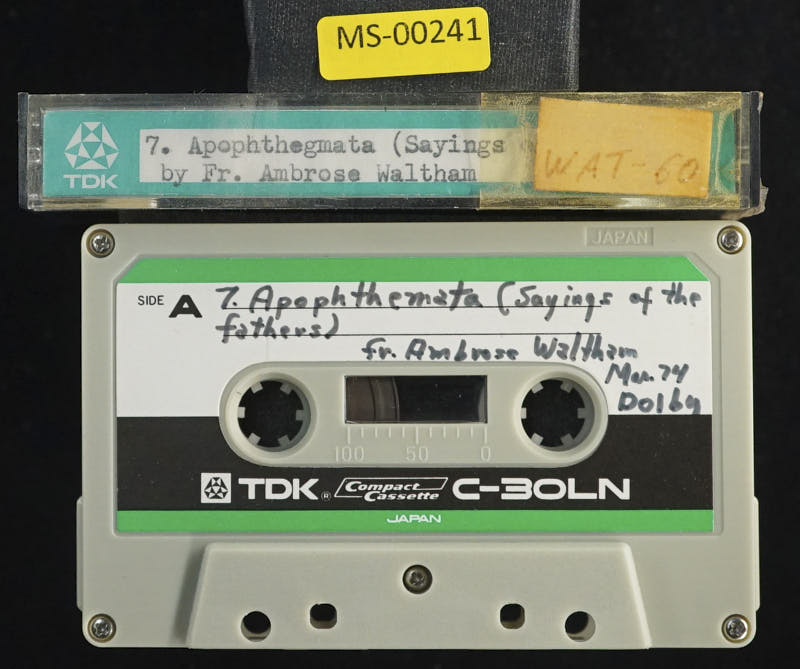

AI Vision - Possible Values from Photos:
Speaker: Fr. Ambrose Wathen
Possible Title: Apophthegmata Sayings of the Fathers
Additional text: Nov. 74, Dolby
@AI-Vision_v002
We're starting this afternoon the Apothegmata, which is one of the categories of the Vitae Patrum. Apothegmata is about A-P-O-P-H-T-H-E-G-M-A-T-A, Apothegmata. According to the small entry in the New Catholic Encyclopedia, it says this word comes from which means in Greek, I speak my mind plainly or I make a statement. Now in a primitive state, these apothegmata were a terse reply or a statement made by an elderly monk to a young candidate whom he was instructing in the ways and principles of monastic life. So it's just a word of an elder to a young candidate in the desert. In the Latin, these are known as the verba seniorum, which we translate as words of the elders.
[01:04]
Or another way would be the sayings of the fathers. And this is more or less the typical way of saying it, the sayings of the fathers. You recall that this verba seniorum, or apothegmata, is part of the collection of the vitae patrum. Remember we took the vitae patrum of its ten books in Roseweed's collection of monastic documents. And that in that collection, Book 3, 5, 6, and 7 were Verba Seniorum. Book 3 was Verba Seniorum compiled by Rufinus. Book 5 was Verba Seniorum translated from the Greek into Latin by Pelagius the Deacon. Book 6 were translated by John the Subdeacon from Greek into Latin. And then Book 7 was a translation by Pascatius the Deacon. Because these verba signiora marina vitae patrum, frequently they're simply referred to as vitae patrum, and that's part of that confusion that I've mentioned to you before. Remember in the rule of Benedict in chapter 18 at the end, those monks show themselves too lazy in the service to which they are vowed, who chant less than the psalter with the customary canticles in the course of a week.
[02:19]
Whereas we read in our Holy Fathers that our Holy Fathers strenuously fulfilled that task in a single day. And he's referring this Holy Fathers back to the Vitae Patrum, and specifically to a Verba Seniorum, which is in Book 5 of the Vitae Patrum, those sayings of the Fathers translated from Greek into Latin by Collegius the Deacon. Now, to take a look at your map of Egypt, we'll try to locate where these things originated. These sayings of the fathers almost all originate in the area known as Wadi Natran, the Chelia, and the Scythus. That's the area up around the delta, this desert area, which was greatly influenced by Antony, and which is the home of Eremedic and semi-Eremedic monasticism. And that's the locale from which these Gerba Seniorum or Apothecnota originated. I'd like to take a look at the contents and the literary problem of the so-called Apothegmata.
[03:28]
Now, here I'm using an article by Cavalera in the Dictionary of Spirituality, French Dictionary, under the title of Apothegmata. When we talk about the content, one means by the name Apothegmata, the collection of sayings and anecdotes concerning the Eremitic life in the Egyptian desert of the Ski, Nitria, and Chelya. So this refers to a collection of these little sayings from this Egyptian desert. Now the principal representatives of this form of life in the fourth and fifth century are giving their testimony to sort of one after another about the meaning of monastic life. So when you read these, you're going to come across names like Anthony, whom we've seen before in his life, Arsenius, Agathon, Bethlehem, Theodore, John, Isidore, Macarius of Alexandria, and another Macarius of Rome, and even other Macarii, Moses, Poiman, Pamela, and Orr, and many others.
[04:34]
Altogether, there are about 130 different names in this collection. not counting the ones that are done anonymously. Usually this father gives a very simple exposition and a direct statement. But these little terse statements give a very fine view of the desert. Now, one of the things about these little apothegmata is they don't have a literary device... as the life of Anthony has. Remember, we saw the life of Anthony gives a view of the desert monasticism, but it's in a literary device of a biography and his life and as he develops in his life. These are just simply little statements sort of out of all context. And yet we're going to see that they do have a literary form of their own, which is very important. Very often they are very picturesque and paradoxical. and even sort of puzzling. These words and deeds of the fathers of the desert are recounted in the form of a word or a logion to their disciples.
[05:40]
And this word which they give contains the experience of the elder's path to God. And he's trying to transfer, transmit this experience through the use of this word. Thus, these words contain very deep spiritual doctrine. concerning the struggle with vices, all the way to the realization of contemplation. Now, from your own experience of having read some of these, you probably recognize that the stories are at times bizarre. But underneath, there is usually a very elevated spirituality based radically on the gospel. And this spirituality consists of a renunciation of the world, the fight against oneself, love of Christ and of God. And all of this is penetrated by humility, charity, concern for one's neighbor, discretion, common sense, and moderation. Don't try to take every word down that I'm saying.
[06:44]
I'm just going to go mad after a while. I was just grinning at the idea of moderation. Some things I've read already are... Yeah, but they're very interested in moderation, and this ties in with discretion. Now, for us, it doesn't seem like it's too moderate at times, but they emphasize moderation. Fidelity to observance is recommended, but at the same time, there's always consideration for weakness. And also, one should mutually edify one's brother by fidelity in observance. Recollection is recommended, vigilance, prayer... meditation and reading of scripture. And temptations and struggles with demons, of course, have their place, as we should not be surprised after what we saw in Anthony. So that's sort of the content. We'll go more deeply into the literary form later on. Now, there's a literary problem with regard to these apothegmata, or the collections, because these collections began appearing rather early.
[07:45]
Now, of course, originally these sayings were oral. Eventually somebody started writing them down so they wouldn't forget them. But the collection was developed in various languages so that we have diverse collections and traditions. Greek, Latin, Syriac, Armenian, Coptic, Ethiopian. Now in all of these collections in various languages there are three basic forms that we can see. The first type of collection is what they call an alphabetical recension. This means that the sayings which are presented are presented under the name of the elder, and the elder's names are then in alphabetical order. So it would go all the way from Anthony, A, all the way to Or. Now Or, the reason he's the last one in the alphabet, because his name is an omega and a row. So Or, it's a Greek omega, which is the last letter in the alphabet. In the English, we would spell it H-O-R. But it's actually, he comes at the end of the
[08:47]
of the line. So they're in alphabetical order, but within the letter itself, they don't, they're not really that precise about alphabetical order. So if, for instance, if Anthony comes before Ammon, they're not too concerned with that. Now there's added to this collection, usually anonymous sayings, according to topic or even haphazardly. Very often, these sayings have the introductory formulae, that is the the anonymous ones, that an ancient said. And then it's this form which is given the title to the entire collection. Sayings of the Fathers are an ancient saying. The saying of an ancient. So, fair vaseniorum. So that's the first type of collection. And when they collect them, they collect them according to the man who said it. And they put them then in alphabetical order. The second type of collection is more or less a systematic recension. Here they made a collection of text on a particular topic.
[09:49]
And that's what you're going to find in Owen Chadwick's translation of the Sayings of the Fathers, which is Book 5 of the Vitae Patrum. There it is according to a topic. So, for instance, on chastity, or on humility, or on silence, various topics which are listed. And then you find all of these various sayings that might be Anthony has one and Pambo has one and various people have them. This is the type then that is found in the Latin edition of the Greek that can be found in books five and six of the Vitae Patrum in Roseweed's collection. A third type is a mixed recension. So it's a third category. Sometimes here the collections are according to alphabetical order, sometimes according to logical order, and sometimes without any order at all. And this we find in book three of the Vitae Patrum, which is the collection by Rufinus.
[10:49]
Of these three collections, or types of collection, the alphabetical order is probably the oldest, but this is rather disputed. And it's hard to date any of the different collections. But many of them, and most of them, were probably in existence by 450. So this is the... little bit after John Cashin. You'll see John Cashin wrote between 420 and 430. Or at least they were in existence within the second half of the fifth century. So certainly a century before, in the century before Benedict. And the ruler Benedict cites a saying from this Latin version. As we noted at the beginning, that story about the monks who came to visit another monk, and then they set this altar all night, which he refers to in chapter 18. And then again he says in two places in the room, chapter 42 and in 73, the lives of the fathers.
[11:51]
These are good edification for the monk. Smaller collections were also probably in existence in the second half of the fourth century, so already in 300 sometimes. There were probably little collections already coming into existence. Now, some maintain that the original statements and the original written collection were in Coptic, but the majority think they were probably in Greek. Probably the statements were made in Coptic because this is a Coptic culture, but then they were written when they were actually written in Greek. We don't know for sure about this. But this Greek collection, which is very early, is the source for almost all of the other versions that we find. However, Cavalera maintains that a lot of study still has to be done in this particular field. Well, there are various collections, then, that we have translated into English, and I'd like to point these out to you so that you're aware of what's available.
[12:52]
The little book I gave you by Thomas Merton, The Wisdom of the Desert. Now, as I mentioned to you before, I don't know what version or what collection he's drawing these from. He may be drawing them from all over the place, but he doesn't say from what I could find in there where exactly he gets these. Then there's Owen Chadwick's translation of Rose Reed's book five of the Vitae Patrum in his book Western Asceticism called The Sayings of the Fathers. This is the Latin translation from the Greek by Pelagius the Deacon, and that's the collection that Benedict would have known. So that's a very helpful collection for us. Then you have Ernest Wallace Budge, who wrote or who translated the Syrian version of The Paradise of the Fathers by Ano Isho. And in The Paradise of the Fathers, which is really two volumes, the first part is the lousy act history, the rule of Pocomius, and some other monastic statements.
[13:55]
And then the second volume of The Paradise of the Fathers... are these apothegmata. Now, this one collection of the Paradise of the Fathers in two volumes has been republished in two separate volumes, and volume called The Wit and Wisdom of the Christian Fathers of Egypt is the same as volume two of the Paradise of the Fathers. So that's a little confusing at times. Now, another collection that we have in English, which has come out in the last couple of years, is the translation of this collection of Pascacius of Dumium. Now that's book seven of the Vitae Patra, which is in Roseweed's collection. And that's been translated into English in the Fathers of the Church in the Iberian Fathers, volume one. Martin of Braga, Pascacius of Dumium, and Leandra of Seville. It's volume 62, so we have that in the library. Now, Pascasius of Dumium translated from the Greek into Latin this collection of sayings.
[14:56]
But already, notice, this is a different collection than the one Benedict, or the one Pelagius translated and Benedict used. And that's book seven. And the questions and answers of the Greek fathers, just as an example, the first question is conquering gluttony and gluttonous desires. and second, against avarice and concerning perfect renunciation. Notice it's in the topical approach. Then later, a little later, his sort of pupil, Martin of Braga, also translated some sayings of the fathers. And apparently what this is, is just a paraphrase of the sayings that Pascatius is translating. So it doesn't have any exact... these sayings of the fathers. So that can be a little confusing. I'm a little confused on it myself. But Martin made his own translation and not all of the things that are found in, well, everything that's found in Martin is not found in other places.
[15:57]
So it's hard to say where they're getting these various things from. So we see that even in English, there's a variety of versions from the Syrian, from the Latin, from the Greek. And now that leads us into the question a little bit more closely of the problem of the Latin tradition of the Apothegmata, because this is the tradition that Benedict would have known. And just very briefly, I want to point out a few things that back in 1922, a benediction by the name of Wilmart wrote with regard to this collection of the Latin Apothegmata. He says that in one of the Greek... traditions had 22 books in it. Now that's the tradition or the collection that it was translated by Pelagius and John the Subdeacon, as I think I mentioned to you earlier. Pelagius translated of those 22 books, the first 18 books, and that's book five of the fathers, of the lives of the fathers, and that's what Benedict would have known.
[17:06]
The rest of the collection of that 22 book Greek collection wasn't translated by Pelagius, but by John the Subdeacon, and that becomes book six of the Vitae Patrum. But you see, it's really all one collection in Greek. Wilmard has also shown that there's an ancient tradition in the West of various collections, dating from the ninth century, we have manuscripts already of these sayings of the fathers in Latin. And all throughout, until the time of Roseweed, these various manuscripts which he studied, which Roseweed studied, and then presented his sort of critical edition in the 17th century. So that's where that comes from. Now why this is important, Wilmark's study is important, because he had discovered a few Latin apothegmata which aren't found in Roseweeds. And they're very terse little things, and they give us a very good idea of really sort of the primitive
[18:09]
And I'd like to read just a couple of them to you to see how terse they are and to give you this feeling for these sayings of the fathers in the desert. Someone asked an old man how a monk ought to live. And he responded, insofar as it is possible alone with the alone. I'm sure you've heard that before. Solus ad solum, or alone towards the alone. And this has become a theme in monastic tradition. Alone with the alone. And this is one of these early statements of the fathers. Again, someone asked an old man, why he was always afraid or living in fear as he walked in his hermitage.
[19:10]
And he responded, because I'm still alive. So as long as he was living, he still lived in the fear of the Lord. Someone asked an old man what he must do to be saved. And when he was asking this, the old man was sitting there... matting his palms together, weaving his palms together, and not lifting his eyes from his work. And then the old man said, when he was asked this question, what must I do to be saved? He says, what you see. So in other words, if you want to be saved, you do the same thing I'm doing. Sit there, weave your mats, and don't lift your eyes from the earth. One asked an old man why he was never... weak of heart, the word pusillanimous, or timid, or scared. And he responded, because I always have death daily before my eyes.
[20:13]
So he wasn't afraid because he was constantly remembering what was going to happen to him. And another one, this is a good example of the contradiction that comes up in these apothegmata. Another one asked, why he was always timid? Why he was always pusillanimous. And he responded, because I don't see the end. So he can't, you know, it's just going on and on and on. He can't see any end of this thing. And that's why he's always scared. Now this may also refer to that he doesn't know what's going to happen to him in the end. So the same type of fear. One asked an old man, what is the work of a monk? And he responded, discretion. Discretion. And discretion is extremely important throughout all of this monastic literature. An old man was asked, why am I tempted to fornication? And he replied, because of too much food and sleep.
[21:15]
That's so typical of their mentality. Too much eating and too much sleeping, you're bound to experience temptations of the flesh. which reminds me of a story that was told in Rome when they talked about these priests who wanted to get married, and they approached certain of the Roman cardinals and asked them how to solve this problem, and they said, put them on a diet of spaghetti and beans. They asked an old man what a monk ought to do, and he responded, every good work... and to abstain from evil. Notice how simple and how terse these little things are. The old men used to say, the mirror of a monk is his prayer. So this is where you really see what's going on in monastic life. They also used to say, there is nothing worse than judging another person.
[22:19]
They added, The crown of the monk is his humility. Here again we see this emphasis on humility, which certainly in the rule of Benedict is still in the tradition. An old man said, in all things be violent to yourself, and that is the path to God. An old man said, if a monk only prays when he stands to pray, then he never prays. Explain that to me. Mike, what do you think that means? If a monk only prays when he stands to pray, he never prays. Joel, do you have any ideas? Well, the only thing that comes to mind or I figure out is that unless a monk prays continually, it's more formal.
[23:24]
prayer is incomplete, huh? Right. I think that this is, because he's using a very technical term, or adorandum stant. And we saw that standing is the form, the posture of formal prayer when you pray. Now, he says if you only pray when you're standing to pray in formal prayer, or specifically what we would call prayer, then you never pray. Now, he's not saying you're not supposed to have this specific type of prayer. And that goes into what I suppose you've been Father Patrick has been treating with you, incessant prayer and prayer at fixed times. And here's a very beautiful little statement, which I think captures their mentality. If you only pray at the time of fixed prayer, or the time when you're supposed to pray, you don't really pray. Because the basic law of prayer is to pray all the time. I really like this little thing. Simonicus, Tunk, Tam, Tunk, Kum, Adorandum, Stat, Orat, Hick, Nun, Quam, Orat. He never brings. Again, this emphasis on discretion.
[24:28]
An old man said, of all the virtues, discretion is the greatest. Here's one I think that sort of fits to our day, and we'll see that many of them sort of fit to our day. An old man said, this generation doesn't look for today, but for tomorrow. Nonqueret hodier said crostinum. So they're not worried about taking care of today, they're always worried about the future. And their idea is that you take care of today and tomorrow take care of itself. But notice, this generation, this generation in the fourth century, that's their problem. They can't settle down and live today, they've got to live tomorrow. An old man said, sit in your cell... and accumulate good things. Now, I don't think he means property there, but virtues. And this whole idea of sitting in your cell is a theme throughout this literature. An old man said, Woe to the men when their name is better than their works are.
[25:36]
So they have a better reputation than what they actually performed. An old man said, this is what the Lord requires from men, mind, word, and work. So I guess the way I translate it is, your internally disposition is good, what you speak is in accord with what you are, and your work is good. So God looks at the internal and the external. He also said, these are the things which a man needs. to fear the judgment of God, to hate sin, to love virtue, and always to pray to the Lord. And then it ends up, this little collection of 35 sayings, ends up with, to whom the honor, glory, and power forever and ever. Amen. Sounds like the doxology at the end of the Lord's Prayer. But those give us some idea of the pithiness of these statements.
[26:38]
Any questions up to here? Let's reflect a little bit on what we would call the problem of drawing a theology of monastic life from these apothegmata. Now this is based on an article by Jean-Claude Guy in a volume called Theology of Monastic Life in French, which is a very fine volume and treats of the monastic theology of most of the old documents and sources. He points out again that the apothegmata are in two principal forms in their collection, at least in the Greek collections. The alphabetical form according to the name of the speaker, and then the systematic form according to the content of what is said. Now, these apothegmata are a different literary form than some of the other things we've looked at. For instance, the life of Anthony. Now, the life of Anthony...
[27:40]
could be considered a big, expanded apothecmata, a statement by Athanasius about monastic life. But it's a different literary form. And it's quite different than we're going to see, for instance, in the Lausiac history, which is an account of travels, or the Historia Monocorum, which is another account of travels. And within that account of travels, for instance, the Lausiac history, you're going to find a lot of little apothecmata in there. But the form of the whole thing is quite different. And then, of course, these lives, the biographies, are quite different than treatises on monastic life, as, for instance, John Cashin's writings. Now, although there are great differences between the Apothegmata and these other types of ancient monastic literature, there's also a lot in common. In order to understand the general problem of the theology of monastic life, as presented in the first centuries, it is necessary to notice the similarities and the differences of these various literary forms. Because it's very important to understand the literary form in order to interpret the document.
[28:46]
That's the point he's making. So we can't go to the Apothekmata in the same way that we would go to the life of Anthony and find the same sort of coherence of a monastic doctrine. This demands then an understanding of the literary genre of the Apothekmata. Now, in organized monastic life, as we'll see later in the Cenobium of Pachomius, the formation of the candidate was determined by an abbot or a superior of the house and by submission to a rule. So when you get to Cenobitic organized life, then when you're talking about formation, you have a superior and a rule and a common good. And the rule was considered an interpretation and an adaptation of scripture for the life of the monks. Spiritual exhortations usually stimulated the fervor of the community and taught one how to overcome the temptations of the devil. So you still have spiritual exhortations in a community life.
[29:48]
But it's not going to be the same as these spiritual exhortations. So community life is going to be a different type of thing than you have in this eremitic life. And this is important to remember that the apothetnatot rise up from the Aramitic.
[30:01]
@Transcribed_UNK
@Text_v005
@Score_96.32