You are currently logged-out. You can log-in or create an account to save favorites and more. more info
Embracing Silence in Sacred Rituals
AI Suggested Keywords:
Talk at Mt. Saviour
The talk explores liturgical reforms and traditions within the Catholic Mass, particularly regarding the silence and gestures, such as the sign of the cross and the use of priestly vestments. The discussion questions when to incorporate prayers, the significance of silence, and the practicality of different liturgical traditions such as concelebration and homilies. The speaker expresses preference for certain traditional practices while also recognizing the latitude given for local adaptations.
Referenced Works and Discussions:
-
Discussion on the Sign of the Cross: The speaker debates its use at the beginning of Mass, noting historical traditions and decisions by the bishops and the Pope.
-
Liturgical Books and Practices:
-
Roman Missal: Continuously referenced in relation to prescribed rituals, introduction of homilies, and the order of Mass. The speaker questions and debates its interpretation.
-
Historical Context and Reformations:
-
The impact of post-Tridentine reforms and newer liturgical movements, dating from the Second Vatican Council, are discussed extensively.
-
Karl Barth and Roman Missal Theology Seminar (1931): A meeting recalling Barth's critiques on how the Gospel was announced, highlighting the importance of a living and dynamic proclamation.
-
Concelebration Discussions:
-
Focus on priestly vestments and the role of clerical garments in liturgical settings. The evolution from simply wearing civil vestments to using specific liturgical garments is a key historical note.
-
Theological Considerations of Priestly Functions: The dialogue includes reflections on the theological implications of these ceremonial acts and how they resonate with the broader monastic and ecclesiastical standards.
This strategic overview highlights the critical examination of liturgical practice and the evolving interpretation of rituals in contemporary and historical contexts within the monastic community.
AI Suggested Title: Embracing Silence in Sacred Rituals
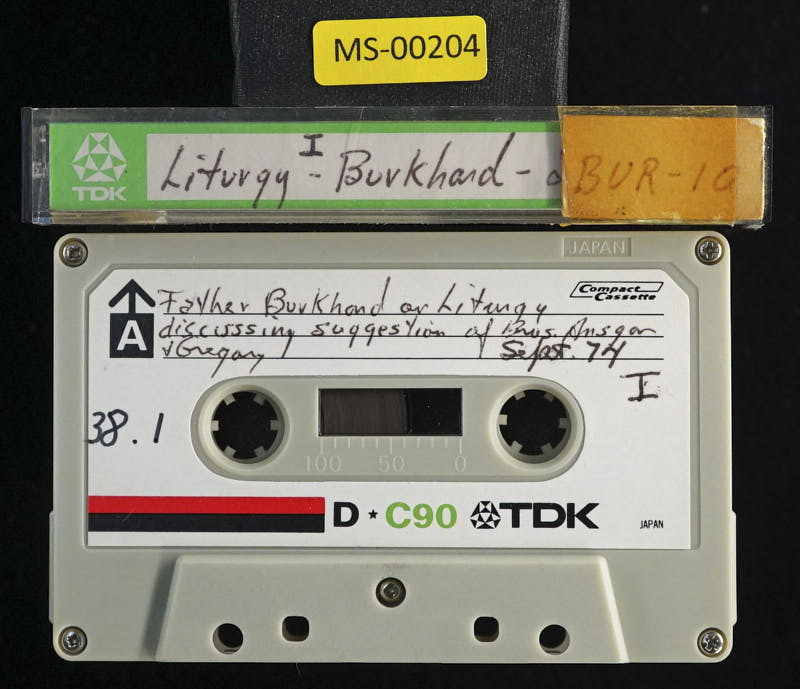

AI Vision - Possible Values from Photos:
Speaker: Father Burkhard
Possible Title: Liturgy discussions
Additional text: discussing suggestions of this season
@AI-Vision_v002
We come back to some of the old forms. Not entirely, the new way. It has been very helpful to do so, but... Yeah, you can begin. Therefore, I have here the notes about mass, office, and minor hours. Perhaps you can go so, not in the chronological order. We begin with the mass. Here are notes of Father Ansgar, and here is Father Eri. Suggestions for celebration of Mass on Memorias and Firias. Firias. Opening chant. And then the first point, sign of the cross by all in silence. Reading, introduction, opening prayer. Collect. And here, Father Ansgar makes his... I make just a few additions off the top of my head, as they say.
[01:01]
First, omit sign of cross, which we don't do here anyway. What do you think? I was very much surprised that you don't use the sign of the cross. I can tell about it. When we were preparing the new Mass, we were... strongly against this in name of the Father and the Son of the Holy Ghost, because never the Roman Church, no Church, was beginning their mess with this Catholic greeting, post-Tridentine greetings in the nomine Patris and Filii Spiritus Sancti, as ever the Catholic Permanent is doing. But the liturgy, never. The liturgy, the Roman liturgy, officially did not know this nomine Patris and Filii Spiritus Sancti. Only the private prayer of the priest in the medieval Roman mass had it.
[02:02]
The priest privately said this prayer on the steps of the altar. Therefore, we are fighting against it. But the Roman mass always, at least in the last century, knew officially in the beginning of the mass of the priest. No. The priest was signing themselves. And the liturgy very often used the sign of the cross in silence. And it would be very nice to take it in the beginning. You are right. Again, in convention, we did not use it. Only the priest when he privately sent the intro. Therefore, you could omit it. So was our opinion. And the bishops were divided. Some of the bishops came from this modern tradition where there is no Catholic prayer after the Council of Trent, the atmosphere of the Jesuits, where you did not begin with the Nomenepartos et Filii.
[03:12]
We in the monastery never, for meals, we never used the Nomenepartos et Filii. We never, never, never had it in the monasteries. You remember. And the bishops and the pope themselves knew it, especially the pope when he was a young monsignor in the beginning of the liturgical movement. He always began every mess. Therefore, they wished to have it again. This is a sign of our Catholicity. We are fighting against it. It's not true. It's not a sign of Catholicity. OK, so what a situation in the beginning. But then we must... follow, and the last decision, the Pope or the bishops, I don't know where, finally the decision was, we are beginning the Mass with the . My question is now, can we renounce to that totally? In Elmira, I think, in every parish church, they are beginning so, and you don't do so.
[04:13]
It is right. in the beginning of the Tuxio, you speak something about the, I have another quotation, I know. Oh yes, you are right, you are right. But you are right, this is really true, but after the beginning sign, here, these certain bishops and the pope were imposing themselves to the last decision. We must begin, per se, we can discuss it, in the name of the Father and Son of the Holy Spirit, and then you are free. You can continue to do what you like to do. But per se, the idea was to begin with this common sign, I don't like it very much, it's not bad, but it's too subject, it's too modern.
[05:18]
And for the moment, in a certain way, sometimes at least, but nevertheless, we don't do it. You can do it too. But the sign of the cross. I don't understand, by the way, where you stand. Please. I don't understand your opinion, whether or not. Therefore, my opinion, per se, is against. But after that, the universal charge solemnly introduced it as, let me see, as a scheme, general scheme for the entire celebration in which you then can change some elements. But this scheme must be preserved for the moment. I would believe it would be nicer to follow this indication of the charge. And I was a little bit happy to see it here. And this is not so far like I got it. I would not have spoken about it if I would not have found it.
[06:22]
It's very nice. Why not? And he says sign of the cross by all in silence. It's very nice to do so. The Lord be with you. You can change. It's not necessary. But sometimes, why not? It's not prescribed. Not important. I think it's very important to be silent. Otherwise, we have so many interruptions. Yes. Yeah, you are right. Okay. No, no, no, no. After glory is not the Lord be with you. It was in the beginning of the prayer.
[07:51]
No, pardon? But nevertheless, Father, he invited, let us pray. That intention. And then you did not wait. You must give a little time of silence. Yes, that's true. You were continuing too quickly. That's true. But he was invited. Let us pray that our God, the Father, and then peace or silence, and then you are collected, yes. But that is already the prayer after the beginning. For the first introduction, here, We thought in this introduction, you can speak about the Mass, you can speak about the readings, you can speak about the mystery of the day, and also about the sins.
[08:54]
But you must change. You cannot say every day, as in Rome we are doing sometimes, before we are celebrating the sacred mysteries, let us think to our sins. Period. You must change it. You have any liberty to do it. And the minister is insisting in this liberty. It is not the idea of the Roman minister to say every day, before we are celebrating the sacred mysteries, that is, think to our sins as the priests are doing it outside. But doesn't the penitential right itself lead you to that? To think about your sins? Yes. Then what should you say? No, you must say, you must say, but you can say, my dear brother. No, for example, you can say, today we are celebrating, we are here together to celebrate the feast of St. Gregory the Great. Some words, and now let us prepare ourselves. Let us implore the mercy of God.
[09:59]
Let us realize that we are sinners. In some way, by the short, you must not do it because people know it. But he says, sign of the cross by all in silence, greeting. You know, some form, the grace of our Lord, the fellowship of the Holy Spirit, and the love of Christ be with you all. You are quite free. There's nothing. Introduction, yes, some words. Sometimes also this formula. You are tired, you have no time, you wish to change, therefore you say only let us prepare ourselves. But then, you did not do it, and you don't speak about it. Per se, it is provided after this silence in which we are thinking to our sins and imploding the Lord, after having said a curio, or a Lord have mercy, per se.
[11:04]
You did it. But in a certain way, you are right to curie. in a certain way, is the same. Therefore, also here, you can change. But sometimes I would say it. Not always. The curie, in a certain way, can be regarded as a penitential right. Also, originally, it was not. Then the opening prayer. Here, where Ansgar says, introduction and greeting seems the same to me. If there is no feast to explain, nor a penitential light. Why an introduction? I don't know. Therefore, he seems to suppose sometimes there is no penitential light. There is no feast to explain. After the greeting, immediately the display. No, that would not be the intention of the new missile.
[12:09]
All these things are innocent, because so long as you don't sit down for a cup of coffee, and for, as Don Bott said, for a Disney Eucharistic, for a Eucharistic breakfast, you can do these little things. But you cannot change the essence after, right? Therefore, here, there is a great elasticity, but nevertheless, the sign of the cross in silence greeting some kind in which you are mixing introduction and penitential rite must be even before you say let us pray and then you could give the intention and then silence and then the collective But on the other hand, it's not necessary always to give the intention because you know it. Only the parish churches are not able to do it.
[13:13]
They must receive this invitation. Let us pray that the Lord or God help us and so on. There are, I don't use the rule, but there are, let us pray. In the Missile itself, it says four, something for the love of God. In the New Missile, it said so? Well, at least in the one that we're using at the paperback. In the Roman Missile, there is nothing, or remus, silence. But to use, to realize, to make it fruitful, this silence, a short indication, is not bad. It's very good. And it is provided, but it's not necessary. Good one thing. Also here, sometimes I would do it, also to change. Not always the same, according to the situation. Then Ansgar is continuing, opening chant not needed, especially as it means rushing out the same few old antiphons every day.
[14:19]
I am not of this opinion. If you use the antiphon or singing according to the missile, you have every day another antiphon. For example, in Rome, we are doing so, and it is provided in the rubrics. You can choose, if you take the missile, for every day the antiphon of one of the 33 Sundays during the year. Therefore, you have the most wonderful variety in Latin. If you are singing in English, the situation is a little bit more difficult. But so far as I know, you have so many canticles in English. Or not? Not so many. They're not good. Nevertheless, you have at least, let me see, seven good. or 14, or 20 good canticles.
[15:27]
You can change very often. You must not say every day the same. Therefore, a joyful canticle in the beginning is always good, and you could use this Latin antiphon, or this English antiphon from the Roman Missal, for the introduction. If this, for example, we received your mercy in the temple of God today, or or all these wonderful intros to give this idea as a motif for this celebration I would not agree with him then he makes other indications the priest should not kiss the altar but go to their seats why He's not here. But we are doing the same in my monastery.
[16:30]
We never kiss the altar. The first kiss to the altar is given as he is insisting for the offertory. But I am not agreeing with that. Per se, the Roman Missal is providing that we are in the beginning of our celebration around the altar, our kissing the altar. And if it is possible... And here it is very easy to do it. I don't see any reason to do that. It's not bad. It's not too solemn. You can do it very easily. You come in. What do you think? Why would he be interested? Why? Why would he be interested? I don't know. I don't know. Only for the... I think for the main... Main settlement, yes. Somebody says it. Where is it? We're kissing it again.
[17:32]
I have more. No, no, no, no. More kissing again. I'm used to it, but I shouldn't. Just two kisses. Formally, we did so many kisses, but the intention was to drop them. Therefore, one in the beginning is enough, and perhaps one in the end. One beginning, he has to greet the author, and then taking, going away. Then, there is still, we can go on here with him, with Father Gregory. Readings and responsorial songs, et cetera. Short homily, ad libitum of the first celebrant, but... That was unnecessary, but it should be encouraged. And he commented, no daily homily. It is too much and often used as outlet for something or other.
[18:33]
There is a name. Can I read it? Number four. Who was he? What is a priest who wanted to join the community? Emmanuel? Yeah. Oh, yeah, I remember him. Yes, yes. Yeah. By this reason, we dropped every interruption and every homily in Maria Lark. Because we are fearing these people who are speaking indiscreetly. Too long. Nevertheless, I think this feeling in my monastery is exaggerated. I would be, again, of the opinion of here, if the priest is speaking, able to speak very shortly, you could encourage him without making it obligatory. Shortly, sometimes only a minute, two, three minutes, but during the week, not more.
[19:39]
I'm not against that. But nevertheless, in a monastery, sometimes it is heavy. It's what? Heavy, heavy. If you disabuse this homily to moralize, to insist against little things in the community, and it's awful. It's impossible. To insist on the reality of the celebration, we are doing it today. I think it's helpful. Helpful, it's helpful, yeah. If the community is discreet enough, is able to do it, why not do it? The intention of the reform was to introduce homily in every Eucharistic celebration. And so was also the question in the beginning of the liturgical movement.
[20:43]
We never had a dialogue mess with our family. What we did in the small chapel of our crypt in Maria Lange and so on, you are a small community in a very intimate group, why not a short word? And I did the same in my life. the parish church during the war, in every occasion in the last weeks when we were in danger, we could not, we could use only in the crepusculum, what's that? In the morning and the evening for mass, when the British Air Force and the American Air Force were changing. Yeah, in the right, you could celebrate mass only this time when the Air Forces were changing. During the day, during the night, it was too dangerous. Very quick. But in the celebration of half an hour, one minute of harmony, it was marvelous. The way you can die, never there is. I shall never forget that. Also the people.
[21:45]
And so also here, shout harmony. Most of the gratitude is our glory, our help, and so on. If people feel their love, Here, you must have the liberty of God, and I think American people has this liberty. You are doing what you like to do, also, if you are quite alone. In our community, you would not be able, but you can do that. I don't wish to speak today, then I don't speak. I wish to speak when I speak. At least I have the impression that you are doing so. Therefore, use your American liberty. You are right.
[22:47]
You are repeating. For example, when I in this situation, certain situation, had only one minute to my disposition, I repeated one word of The Gospel with great insistence. I can tell the truth. In certain days, Hitler forbid to celebrate the feast day. He could not do it. Corpus Domini during the week. We must work. Therefore, it was not allowed to celebrate High Mass at 10 o'clock. We must say High Mass at night at 8 o'clock. The Pope was allowing that. It was too late. We had no time to make a great sermon. But it was a solemn mass, purpose, dominion, ascension, immaculate, conception, and so on. We were singing, the entire people were singing, 200, 300 people in the church, children, adults and all, men and women. And then I take the gospel, I read it first in Latin, then in German, or to gain time only in German, and at the end, my dear brothers and sisters, one word, you take it with us.
[23:58]
There was a perfect silence. And the people realized this word of the gospel, no, repeated in a free way, in a free kind, strongly. It was enough. You were happy. And so here, too, a different situation. You cannot insist on a normal day too solemnly. But nevertheless, take this. From all these words, beati, I must say, I have already forgotten the attitudinous of St. Luke. If you say beati properis in spirit or beati properis, I don't know. Properis only, yes. Blessed poor. And from all this form, beatitudinous, you are repeating one. It's repeating, but it's repeating Karl Barth when he was in Maria L'Arc in 31. But the Darmazos invited him, and we both, Darmazos and I, we were together with Karl Barth and his students.
[25:04]
They made a seminary about the Roman Missal, the theology of the Roman Missal. They came to Maria Lark to see it, really. Then we were sitting down in the afternoon in the garden, discussing it. And Karl Barth said, you don't announce the gospel. We said, what? We don't announce it? Suddenly, did you not see how we are incensing it and the tangles and the singing? Yes, you did, you did. But you did not announce it in a living way. There was no homily. It's right. I shall never forget that. You must not only read and solemnly announce it, but you must also announce it in this newer way. Nearly every day, repeating some words in the situation of this day. Therefore, it is not easy. And it may also, for a monastic community where the greater number are not priests, a little bit difficult that every day only the four priests are speaking.
[26:13]
The other must hear what he is saying in a certain way, the ministry of the priest. Oh, yes. Okay, therefore, if it is so, then I would say again, these brothers are invited by the superior, by the priest to do it, okay, and then there is no, therefore, this point can be excluded, yes. A year ago, actually, we had two priests here. We're not members of the community. But you could not hinder it. You must do it. It is typically for a priest. You must always speak too long.
[27:15]
No, no, no, no, no. It was always on a social level. Oh, yes. It's not right. It's not right. Therefore, the priest who is speaking here must in a certain way speak within the mentality of this community, not social work only, but the reality of Christ and his mystery and social obligation is only the consequence. And you must keep critique of it. Nevertheless, I know from my own community, we are preaching only in Sundays, and some of the younger said terrible things. We are sitting there. But then afterwards, the abbot or the prior, they say, you cannot speak so. I hope at least that this is.
[28:17]
or also correction of materno. How could you say so this morning? Then again, well, Ansgar is speaking very well. Silence is better than homily. There could be silence and response after first reading, and silence and prayers of the faithful after the second. It's a good suggestion, but I think silence, if you have time, after a reading is good. Silence after the homily is also good, as we are doing it in Rome. Occasion, not always, yes. In Rome, the cardinal, Vicar, or Vicar, suggested it for the entire diocese. We did it in St. Anselmo. It's marvelous. After the homily, sometimes 12 minutes. Nevertheless, at least two, three minutes of silence. And everyone is enjoying it, the five faithfuls in the church and the community, so far, as I saw. And I think he took it from Rome.
[29:21]
Oh, you did it already here. And then he says again, priests should stay at the lecterns during Mass. It is too much with them crowding around the altar. Our own priests should always concelebrate in stalls over the habit. Therefore, at the lecterns during Mass, it would be quite possible. We, perhaps you know it, in Maria Lark, we never, three years ago, go to the altar. We are remaining in our White Alps in the choir. And if you know the situation there, the choir is very distant from the altar. Normally we went after the offering around the altar. It's too slow. It's a big process around the altar. We remain in our styles and only for communion we go to the altar. Ah, yes, because it was formally prescribed. You know the history.
[30:24]
We were beginning in Maria Lark after a short period of this too clericalistic, too solemn kind to use every vestment, all the vestments with the Jezebel, we were beginning to celebrate in cowl with stole. It was marvelous. And after so many in our community were protesting against this clericalization, which was introduced by the concelebration. Also, the faithfuls were not satisfied with the celebration. It's not necessary. And they were again excluded from this solemn celebration. The provost remained in the choir. The entire priestly community was around the altar in Chazabal. Changed it. In calls. And finally, in calls in the choir. It was marvelous. The bishops came and saw it, admiring it. Some apostolic nuncius came from South America. admiring it. Our own nuncios, I don't believe that he came. He was not satisfied. He's a very, very close man. And therefore, we all were happy.
[31:30]
And then this good apostolic nuncio of South America wrote to Rome, to the congregation, please give also to me this permission to have given to the monk of Maria Lark. And then the cardinal came to our primate, what's the I doing in Maria Lark? The primate told it to me, Cardinal Prefect. And I wrote it to Maria Lark. Then after a month, somebody, another cardinal, speak to the procurator general of our congregation, Father Engelwert of St. Tertilian. I'm doing terrible things in cold ongoing. He came to me, and I wrote it to Maria Lark. After half a year, Our Father Albert received a formal letter from Archbishop Antonelli, the Franciscan, who was secretary of the congregation. We received from a very good source that you are doing so. With which right you are doing so?
[32:30]
Can you tell it? We answered, and I came to him. I knew him very well. Excellency, you must allow it. We need it for the unity of our community. And I brought him photographs and so on. He was very kind. We shall think about it. For an entire year, they were discussing. And in 67, they published the second instruction. In this formally, they established you must use For the con-celebration, all the vestments. Only in certain occasions it is allowed to use alp and stowl. Therefore, the situation is so. Formality is so to help us. Alp and stowl is allowed. And they did not condemn the other form.
[33:33]
But positively, you must use the vestments. There is... Therefore, to do it so would be formally disobedience against Roman decision. And if, really, if you don't celebrate an Eucharistic breakfast, then perhaps you can do it. And many are doing trio, still. But they are not so exposed. And you are not... No, you are also exposed. It's not good. It's not... And also, we did it with coal. You immediately go farther, and you are doing it without coal. And Anthony said to me, we must forbid it, because if we allow it to the Benedictines, we must allow it to the Franciscans, who are building the vestment of the Mendicans, how do you say? It's not a clerical vestment, to the Dominicans. And finally, to the Canons, with their terrible...
[34:35]
instruments they have in the European choirs. It's impossible. And also Kaul. We, Maria Lague, made these ideas as priestly response by certain communication of privilege with Monte Cassino. And other people said, you always have said Kaul is specifically a monastic habit of the Holy Spirit, and you give it now to the brothers. How can you tell this? And Abbot Marsili, who is really a very progressive man, said, you made it in a false way. You are right with your difficulties. All the concelebration is too clericalistic. But you must fight against this kind of clericalistic concelebration. But if you are concelebrating, you must use priestly vestments. Therefore, you are preparing the horse from the back and settled on the header. I think it is impossible to, there are exceptions, yes, for the canto and so on, but for one or another, and also me, Maria Lach, we have a burial, and all the entire communities running against cowl, because we think it's impossible to go out, or in Alps, if it's raining, and so on.
[35:57]
Therefore, there are exceptions, but normally you must take at least Alps and Stoke. The difficulty is not the investment. The difficulty is the existence of priests. You don't need priests for the celebration. Why five? The difficulty of our monastic communities. But the church does not wish that we are receiving holy communion in the lake. You need for a priestly celebration a priestly investment, and according to our actual tradition, you need not only stole, but something more art. Or, as in the Timony, a special art, a celebration art, more or less a call. But not the call of the monks, the call of the priests. Things are perhaps going on, but for the moment, it would not be good. What do you think? LAUGHTER
[37:00]
In the Middle Age, they did not use concelebration. They did not have concelebration. Concelebration dropped out perhaps with the growing of the number of the priests. or they received only Holy Communion. It's difficult to say. If they're concelebrated in the Middle Age, so far as we know, they used priestly vestments. It's quite evident. But in the beginning, when St. Ignace of Antiochia in the second century is insisting, bishop and priest and deacon. And then in the of the third century, they are speaking about the order in the church, bishop,
[38:00]
Priests, deacons, men, women. For this Eucharist celebration, in every case, priests were distinguished from the faith process, but they didn't use vestments. We don't know it. When, for the first time, they were using liturgical vestments, not used in the streets. Fortunately, not perhaps. It's a slow evolution when you were using for Eucharistic celebration a priest, solemn vestments, civil vestments. Toga, I don't know. And this time, meanwhile, the mode, what do we say, the mode was changing in the streets. This solemn, civil vestments of the fifth century were retained for the liturgical celebration. And this was with time institutionalized so that we, after a thousand years, have the custom to use Specific vestments for the Eucharist celebration. You can fight against it.
[39:01]
Yes, I am agreeing. Our Lord did not do so. The Apostles did not do so. St. Ignatius did not do so. But you cannot introduce it immediately without going against the universal custom. In Rome, they have no power for the moment because you do what you like to do. No bishop has the power to change. But it's not right. And fifth time, I think this power comes back. For the moment in Rome, they are in silence. They don't insist, because it's not possible. Nevertheless, Bognini told me, after the year after all these things were in 67, finished, he said to me, how could you do in Maria Lark? Such a good monastery, such a famous monastery. You made so many difficulties. I can tell you, If you do it again, your father will . He springs up from his throne.
[40:06]
He will be deposed. Yeah. It was a very humorous expression. But nevertheless, at least in 67, he said, if you do it again, your father will be deposed. Today, they have no more to do it. Nevertheless, nevertheless, that's still power. No. But that's not a question of power. It's a question of, can you do it really? Normally not. Normally not. The movement, at least, is what it feels like in ourselves. It's not the informality in the sense of casualness, But it really is in the sense of not having symbols which are not signifying. But here, is it not signifying if you are acting as priest, why do you not mere vestments?
[41:08]
And you are using at least a stole. But again, perhaps your answer is very good. Are you doing so officially with the bishops in the United States? If all the bishops are doing so, if the bishops are agreeing, I would not have any difficulty that you here in the States are doing so in Europe, it's not yet possible. They don't appreciate our situation. I mean, the same as with Locke. If you take a monk out of the choir, you know, you're really tearing apart. You can remain in your choir. It's not necessary to go on the altar. No, I'm agreeing, quite. There is no prescription to do it. But staying in the choir, priests have their specific signs. In every case, you are using the stole. In a certain moment, there is a certain danger. I remember when we were discussing in 66 these questions, our brother sometimes, after 67,
[42:16]
were insisting no distinction between priests and brothers in the Eucharistic celebration. We must in the choir stay according to our profession. The tendency is to abolish the priesthood of the ministry. There is one, and there is some right in it, there is only one priest, our Lord, and we are all participating as ministers in different steps. But there is no priestly people of the world if there is no also this ministry of the ordained priest. And it is very high, very great. I think to get ahead, I think you can move ahead of one of those, that tendency. Strangely enough, not by holding back specific investments, but by moving forward in the thing of the priest and taking his role without special science.
[43:28]
Theologically, it would be quite possible, but we cannot go, so I think, at least that is my personal opinion, we cannot go against universal custom. And in the moment, It is also dangerous because we need signs to express realities which are really existing. Our priestly function in the celebration is a reality. We are participating in this presence of the sacrifice of Christ in a special way, also as presbyterium, as the entire group of priests, helping the people of God that it can celebrate also in a priestly way, this Mass. But without this presbyterium, we cannot do it. Therefore, this reality must be expressed in a sign without a sign that is not corresponding to our human nature, that is not corresponding to our tradition. Therefore, we need an expression. And you all are agreeing at least to stall. There is a sign. The question is only if the sign is enough.
[44:29]
You can say so, it is enough. But for the moment, it is not enough because the choice does not allow it. You can wish that the choice allows it. And in so many cases, We could use sometimes only your monastic habit and stole. Here again, we could say to the Roman congregation when we were discussing this question, we never are using our monastic habit only. We are using only always our cowl. Therefore, a real... Liturgical? Clerical vestment? And we said, yes, but it's not true. The call is not clerical, not hierarchical.
[45:30]
There's no way. In a certain way, you are right. That is your call. And then Mourini and all the people said, oh, yes, we are agreeing. You don't use civil vestments because many priests are celebrating in civil. Oh, yes. the whole solemn procession coming up every day, it matters. Here, again, you don't need the procession. Also, here, somebody is discussing it. I think Father Gregory. Not to. Because the priest would probably stand out just to measure more. interspersed, and they were all dressed in one. I mean, if that's the point, it would seem to be the best thing you would leave there naturally before the hour.
[46:31]
I did not understand what you said. Therefore, you would like not to have possession and the priest staying in the choir? Yeah. I would say the best thing to do would be to have some of the investments and the rest of the priests with the community. Well, if you're going to be with the community dressed in towels, I think it's going to be a big difference. Well, for the Eucharist celebration, you must make a distinction. That is at least, we can say, from the second century on, quite evident. Also, I must say, I cannot imagine that St. Paul's... There were some suggestions there that the father addressed himself to. One was that the celebrants just stay in the wire of souls.
[47:35]
The father said that that was not to be desired. Not to be desired? Not to be desired. Who desired? In that the celebrants just Ah, no, no, no. For me, it's impossible. I thought you would have spoken about to remain in their places, not go around the altar. That is quite possible. I don't say it must be, but that is quite allowed. Why not? There is no prescription about the distance from the altar. You are free to do it as you like to do it. But for this overpoint, there is a clear... Again, here from Bongini and so on, there's no difficulty. You must use Alps and at least Alps and Storr. It just seemed to me that that question stemmed from the fact that there was some kind of uncomfortable feeling with the celibates all gathering around the altar and going together like that.
[48:48]
blocks out everything from the community. And I was just, Father Gerhardt, as you just said now, felt that there was no need for that. And that the celebrants could remain in their places for the entire Eucharistic prayer. So I would say so, there is no necessity to go around the altar. You are free. You must choose. I, for my person, I would say both are quite possible also to go around the altar. I have no difficulty to admit that. But you could change. Someday, go around the altar. And during the week, not... because you desired a greater simplicity and a greater variety. Therefore, it would be possible. From the standpoint of the rubrics or Roman authority, there is no difficulty to do it, but you must choose.
[49:55]
I think you should distinguish also where we're doing this and providing these actions for ourselves. As for instance, We haven't done it for a long time, but when we have the eugurists in the crypt chapel, there are a different kind of setting. And I think we could do something like this more readily there. Not that there's any necessity either way, but I think it's when we do the eugurists downstairs, it is more informal there. And though usually the priests gather together at the canon, so they perhaps wouldn't have to in that case. When you say Mass in the crypt, you don't go around the altar? No. The entire community is there. But the priests are in a special place, in the first place. But nevertheless, if you celebrate Mass in the upper church and remain in your places, I would not call that informal.
[51:03]
It is quite formal to stay there. For the we, in Maria L'Arc, we do it always so, also in the highest feast. We remain in the choir, we don't change. But I would not say that that is absolutely the highest ideal. You can insist for priests during the canon, it's more convenient for them to stay on the altar. But you are not obliged to do it. Only if the community really wishes a greater simplicity during the week, if you wish it. Also here, I would say it is not necessary to have the simplicity because it is already simple, very simple, but nicely simple. But if you wish a greater simplicity and variety, you could do so. Just a question on that then, Father, was that if it were decided celebrants would stay in their places.
[52:08]
How would you suggest or there seems to be something you said about receiving Holy Communion. How would you suggest that the celebrants receive Holy Communion if they're staying in their places? I would say not in the place. Not let go go around the pattern with the host through these places. But then you could come to the altar. For example, so as you are doing it for the moment, there is no necessity to do that around the altar, that you stay all together. Look there, the Lamb of God. But you could go after that the priest has said it. I'm not worthy. You go to the altar, from both the sides, take the hosts, drink the chalice, as we are doing in Marianac II.
[53:11]
But I would not like to... I would not like, but it would be possible to do it as we are doing it in Sant'Anselmo in Rome. Here, before, after breaking, the oldest, The primate and the prier go around from priest to priest and give the bread. So I go back, and then the priest says, it's Anglos Day, and look, the Lamb of God. There are so many possibilities, but I would insist, if you remain in your places, find one of the simpler ways, not as you are doing it today, all solemnly around the altar. It's just You can come to the altar or you bring the bread down. Somebody? I would prefer the first way. You come to the altar. You take it yourself. Here, in a certain way, the dignity of the priestly concelebrance is manifested.
[54:14]
You go to the altar, you have the right to take it yourself. The bread and the chalice, one after another. And then the priest goes to the faithful and gives them, in the name of the Lord, the bread and the blood. And also, I would suggest, in this case, not to extend the hands during the condition of necessity. You can do it. We are doing it in Rome. So we also are remaining, you remember, we are remaining in our places in the circle very far from. No, we go near to the order. But nevertheless, in Rome, the circle is very large. Also, in a certain distance, we are making so in luck we don't do it. You mean if we can? Cannot, yes. No time. No, no, no, not during the... No, we don't do it. In life, we are too far. Here, you are not so far. You could do it. It's quite according to your free will. Also, according to the rubrics, because there is that if it seems convenient, you are extending the hands.
[55:20]
Why, Father... In the beginning you said also I will not extend the hands. It is not necessary. Would you elaborate a little bit on that? You would suggest that we did not. It was all for you. No. My opinion? Yes, your own opinion. My feeling is in a certain way I like this extension. I don't understand the reasons not to do it in the first beginning were given by old people who were not accustomed to it. Somebody said it is ridiculous. It is remembering Hitler. And for my feeling, because we are concentrating... To express it in a symbolic way is very convenient. The only reason, because I am hesitating to recommend it, is if you are too distant, it seems to be strange.
[56:29]
And in Maria Lark we say, we are insisting this other point, this terrible big group of consultants is not necessary. One is enough. Therefore, let us restrict, let us limit all our expressions, so far as possible, that only one is acting, and all the other people is actively participating, but in a very discreet way. You can't say so. There are different points of view. It is difficult to say for me, my feeling is so, you must do it. No. No. Also, I am quite agreeing, I am insisting, according to the rubrics, that you don't pronounce too loud the words, but you must speak for the moment. The theology in which you say it is enough to stay there as priest, and you are offering the Mass, you are applying it, you are concelebrating, according to Carano and to also the younger Christians,
[57:38]
in the actual Eucharistic theology. This is not allowed for the moment because the Pope explicitly said, if you wish to say Mass, you must express, you must say these words. But no, the Rubik says so that the words of the first servants are heard. Yes, we are doing it here. Sometimes the good Father Placid is speaking too aloud. According to the old So they don't participate in the intro. And then, later on, they seem to withdraw from the singing by the fact that they're a part... Oh, you must not withdraw.
[58:46]
Yeah. I think here, when a priest is celebrating, he feels that that's his function and not for singing or celebrating. That is false. It's false. It's false. But you are right. Also in Rome, there is a certain group of priests who, not upstanding the insistence of the prior, Of the cantors, every conservant must take his Gradovala. They never are doing it. With this feeling, we are only... Please, it's not true. And in Maria Laga, every conservant has his book. We are singing. And we did not go to the altar precisely by this reason, because it's difficult to change the melody of Sanctus. If we go to the altar, we cannot take our books. It's very difficult to do it, therefore we are remaining in our place to sing. There is a reason to do it always, also on Sundays. But here, I would say, at least during the week, to avoid this great solemnity of the introit,
[59:51]
The entire community, black and white, comes to the choir, stay together. And are waiting for only one priest and acolyte, without cross. It would be very nice during the week. It's not necessary. Also, as you are doing it today, it is very well made. Only you are right, you are too few. It's very strange. Four men or eight men stay in the court, or ten or whatever. then are in the choir, and five or six come from the copter. And we were talking with Father Gregory three days ago, and he made a very good proposition. You remember, we have said our first intention was to begin with the word of God. and not to wait so long in the name of the Father, introduction, potential light, career, glory, and finally we come to, we did not do so because our tradition introduced this first part, which has a special right on it alone.
[61:13]
And nevertheless, to avoid this strange impression, he said, come, the priests, or the procession, and remain in the entrance on another side. And staying in this place, you make the first part. The Lord is with you. Introduction. And then I don't remember, during the glory or after the glory, you go to the places. And here you are beginning, after having made this first part in the entrance, you are beginning the literature of the word itself. And you have really two different parts. It's a good idea. More or less, as they are doing it, but too powerfully, in St. Meinrad, where they come in, the entire community stay around the altar, which is in the middle of the long nave, for the first part, then they go upstairs to the choir, to Elysia of the World, and they go downstairs for the Jugaristic prayer, and to Thanksgiving events, they come back.
[62:26]
It's dangerous. You cannot, you have no, it's not, you don't do it. But nevertheless, a little bit change would be very nice. But it would be a great thing for the moment, for the simplicity. Perhaps it would be better not to do so, but to drop out the procession of the entrance and all. Just if you can picture in your mind the way Ah. You are right. You don't do it?
[63:27]
No? You are right. For example, in Maria Lark, there is no difference after the... After the last consulment, immediately the oldest lay monk. There is no reason. We must insist in the fact that in the Eucharistic celebration, the priests must stay on their own place. But immediately other people is following without any separation. I don't remember. If you are doing so that there is a space, no, no, take it away. Yeah, I think it's because people want, you know, just... What people? Independent. Who? The monks' people? Yeah, you have one there, one on this bench, you see... Oh, no, no, here you must stay against individualism. One there, two there, one there, three here. So, yes? You don't join? No. You must join. For the office. For the office. Yes, for the best, too. That's what I would like, because I feel the singing is weak because of that.
[64:30]
You know, people are all there. No, I... I did not remember that. Therefore, I would insist, you come together. If you can do it during the office, you can do it also. You must be united. It was our feeling, Maria Lach, also. The brothers, the lay monks, wish to be united with the priests. and we were ready to do it. Nevertheless, we were against this first proposition of some brothers to mixed, as we did it yesterday. That is not right. It may be strange, proudness of priests, clericalism, clerofascism, and so on, but it's not, no, no, no. We are acting as priests, or called to serve to the people of God.
[65:31]
that it may be organized people. The unity of the body of Christ, there are different charismans, different gifts, and it is all a gift to serve, to minister. Therefore, in the first place, but then no separation altogether. Yeah, I think as a separation, it's just independence. Yeah, I don't think we do it deliberately. No, I know. When the priest leads, Like, say, Brother James leaves his place. There's a hole. There's a vacuum. When does he leave? When does he leave? If he celebrates, you see. Oh, he celebrates with a stall only. Yeah, no, I mean, well, don't take him and take somebody else. When the priest leaves the choir, say, finally... After loads. Yeah, they leave the choir. And you remain in your places. You don't change. But you go out for air. But then you may go back... No, no, no. Here you must take a new place, as evidently.
[66:32]
I can understand, yes. OK. For example, the situation is different on Sundays, where you are coming, not after an office, but you come for the Mass. And you must do the same also during the week. Stay together, yes. But perhaps then it may be that there is a big distance to the faith, to the faithfuls. But the faithfuls come in second place. The community must stay first together. I think it would just look better. It would look better. Look better also. And if the faithfuls, your guests, are disappointed, invite them to... To come near, not in the choir, I would not do so, but at least very near, if they are on chairs. Sometimes we have, for instance, on Sunday, so many people that we have to have people.
[67:35]
Okay, yes, you're right. Oh, fine, good so. Also, we in Larkt, we have no more any difficulty to admit at least guests who are very... very often in the monastery, in the choir. It's quite possible. There's no reason to make a too big separation. On this, I must bear themselves in a very convenient way, but you don't feel so as we are feeling. You are scandalized if somebody is sitting when all are staying. But you're not. Like, for simplicity, you know, myself, I like the idea of just having Let's say that the priest coming just from the upper sacristy with the acolyte. Also, yes, you are right. Without acolyte. Yeah, with the acolyte. Okay, yes, you are right. Perhaps you are right. Yes, yes, yes. I forgot it. Therefore, not coming from the crypto, from your upper sacristy. Yes. And the priest, the priest could, could they be without the stall for the beginning of the Mass?
[68:39]
Without the stall? Could they be just with you all? Why? At the beginning of the Mass? Why? And then? And then police? You know what, here... No, it's not allowed. Here, I must insist, you cannot do that. Not outstanding. Oh, no, no, no, why, why, why? And we were explicitly against any investing during the office. You remember this very famous moment when, in the beginning of the Vatican Council, this famous father, Massivi, for speaking to the journalists. And he said, we change now some rights. And we wish to avoid forever, in the pontifical masses, the night from the nightclubs. What is it?
[69:41]
Striptease. Striptease, yes, theatrical striptease. And then these journalists, these awful, hypocritical people, were protesting against the thought. How can you speak so? In the liturgy, there is no striptease, because striptease is another thing, you know. And he was then, he's quite right. He was quite right, but these people make such a terrible noise that he had a big difficulty with the Pope. Pope finally was, and somebody, not the Pope, somebody wished that he must be removed from his office, and only the abbot good, sometimes very good, said, no, he remains. Because he understood. And I remember in Maria Lark, there was this scenery. Father Abbott was, how do you say it? after the Mass, and our wood garden, wife, with his little son was there, and for five years, mother, mother, they take all, they make it nude, they take all away.
[70:52]
Oh, awful, awful, and I remember in Rome still, we never did it in Maria Lark, during the Thales, Somebody came to put his shoes on his foot. Oh, therefore, that is finished. And therefore, you're going to do that. I didn't want to ask that. No, no, no, no. You must begin with the Jezebel. No, I mean, not that, no, the chasm, no. I mean, for the concelebrant, you know, that normally they wear the... Ah, so, excuse me. Yes, you are right. We, Maria Lark, we come with a stall on our arms and we put the stalls over the arms at the opportunity. Yes, excuse me. And then all was, as I said, was... Yeah, that's... This would be... Because it seems, I don't know if it's our mentality, when you see a priest with a stall up,
[71:56]
there's something special, you know. Ah, yes, there is some special. But nevertheless, you are right here. Or something like that. I must say again, in the rubrics, if you are insisting in the letter of the rubrics, it's not right. Because they said formally, you must use for the con-celebration, the entire con-celebration, at least Alpes and Stoll. Therefore, this little paper of Bongini is not right. Yeah. He forgot it. In number 161, explicitly he said you can do that in the newer institution of the Missal. Sometimes the good Homer is sleeping. The good Homer, this famous word. For a good reason, as when there are more concelebrants than vestments, but there are other reasons too, there's only an example, The consultants may omit the chasuble, but ruin the stall of the Alps, explicitly.
[73:02]
Therefore, he did not speak about it. Insisting the chasuble. But nevertheless, here are some exceptions. When we are doing it, it's not a reason to follow. But I believe you can do that. To insist here is the first we are all hearing only. Only one is praying, the first servant. And then, with the beginning of the Eucharistic prayer, all the priestly group is beginning to act as priests. Therefore, you need the stone. It's very good. You can do so. Also on Sundays. Therefore, if you wish to retain this... the solemnity of the protestion. You can't come, all the priests, but we don't do so in Maria L'Arc. In Maria L'Arc, in every day, also in the highest feast, the entire community, white and black, enters, the priest with the stone on the arm and the books, so?
[74:10]
Are you going in? Yes. And then in the moment when the acolytes, two acolytes, and the priest and his assistant celebrant enter the church, we are beginning to enter it. And in big feasts, when Father Albert comes, he comes from the beginning of the church in the solemn procession with cross and so on. We use the cross only on pontifical feasts. That you are using the cross is an innovation. It's not custom to do it. Formally, it was not custom to do it in every high mass. But here you are. There is no prescription. You can do what you like to do. In this point. And you did it, I think so, because it's very nice to begin with the cross. I remember that Father Damasus in Maria Lark, he could not sing, therefore he never could be deacon and so on in the Pontifical Mass.
[75:14]
But he liked it very much to be subdeacon and to bear the cross. also as father, always. He and the old father Ignace, who could not hear, they were subtegans only for the cross. In Tunicella, and then they left, they went back to the sacristy and put away the Tunicella and came in black again to the choir. But to build a cross to conduct, to guide the people of God, there were exodus of the world throughout. I think, therefore, he was introducing it here, too, to have it always. I think that would be one way of, you know, making some of the feast days more solemn than said burial days, if we had used the cross. Only in feast day, not every Sunday.
[76:15]
You could say so, yes. For example, you could say so, you are, but you must know it, you are introducing this very simple form from the upper sacristy during the week. On the Sunday, the priests come from the crypt without cross, and on high days and high feasts, you come, of course, you have a separate gradation. Yeah, even just on a practical level, this would be... Because the celibate, if we have many celibate, they have to come from downstairs. Oh, yes. For this reason, yes. We can put one set of... Also here, I must say, to use the chasuble on Sundays is very reasonable. We don't do it in Maria Life, but you must not follow everything we are doing. In Rome, we are doing as you are doing it. For many years, we used every day the chasuble. It was too much. One year or two years ago, we put them away.
[77:18]
and all were satisfied and happy, only herbs and stone, and only in some days there. Also, with 40, 50, we've treasured. I think that the idea of, if you don't have to wear your soul, until the, until the, what I said, that the idea of, of, of just coming in, say, with the Alba, taking your place with your soul and taking your place to choir is not... No, why? It's not too bad. It's not too bad. Not too bad? No, not too bad. Okay. In a certain way, the Alp is only the fundamental... and so he said also explicitly, you must need it for everything.
[78:20]
Per se, also the acolyte, as you are doing it, Birste Alp. Everyone who is working on the altar, Birste Alp, therefore you come with Birste, stay in the choir. And then, if the real priestly function is beginning, if you are in prayer, before the prayer of the oblation, of blood, of all the gifts, you take the stone. And you take it away, we are taking it away after the last blessing. You can take it in Rome. We take it also after the last blessing. And then we go again out. And also here you could, you know, the priest leaves the altar on the end at first and all are following as you are going away over every day. Practically, I would say, For the four, five, six, you cut your Alps during the week in the upper section, and you let them there. Only in some days, you bring them back downstairs.
[79:23]
In the North May, we do it. If everybody was in there, it would help from the entrance. Yes, then you have always a great community to sing this entrance song. For us, it's impossible. We don't have the text. And also, to go, at least for me, old men go up the steps. It's still difficult. And how would the priest then leave, say, on a long day? I would say he gives the blessing, he kisses the altar, makes his bowel, and then he goes away to the sacristy.
[80:27]
He would go to the upper side. Where he come from. I would say, because you are there then, Absalom is only as monks, go away as you are going away always. Informally, yes. Can I just sit a few moments? Oh yes, it would be possible too. Oh yes, oh yes. We've been discussing here some of the The operatory continues to be a problem. I think at one time it was an important thing that the people put their hosts in the place. But I would think, especially here ordinarily, let's say in the week, perhaps they act like it's up to do that from the credence table on Sunday.
[81:36]
There is a certain value in putting his hosts on the pattern, as we are doing it in Maria L'Arc. It's very strange. We don't like to break the bread. We say that it's better, it's more practical to have already the host ready because we say today it's a little bit strange to break. Nevertheless, the new right is insisting in this breaking the bread in its symbolism. Therefore, as you are doing it, you have a big host and you are really breaking it. Therefore, it's functional. It's not a lie. you can do it very easily.
[82:36]
It does not ask for time. Therefore, the symbolism is to breathe the bread, the unity of the body of Christ that you are sharing in it. You don't need to put your house on the pattern. We are doing it in Maria Laga and in a certain way it is nice because before the Mass doing it, you can say explicitly, no, I am ready to go in, to enter. Yes, it's good, but you cannot have all the things. You must have chose between breeding, then you don't do that, and also for the faithful, it's not necessary, because the idea is, so far, as I have seen this this morning, the bread is enough normally for the entire community, monks and guests. We did not use the smaller hosts. Sometimes, yes, but there are also then, the guests are receiving the real bread. And you must sometimes be satisfied with the host you did not give. Is it true?
[83:38]
Yes? Yes. Nevertheless, you must know how many are coming. Here is the difficulty. Do you know it? No, it varies quite a bit. But I think there is some question. Who could do that? That's perhaps the acolyte. To count, yes. In this small chapel, there's no difficulty. Yes. There's a question of time, you know it. I think you've heard it. Yeah, I know. Please. Yeah. Somebody else continue. By the time we're set at the altar for laws, we know. Well, it's not. I mean, Saturday. People come up from town or some other time. Myself, I have no problem with this. You know, the people putting their clothes. One ritual I would suggest is that I would put back the assistant celebrant to help. One thing I would tend to do is that the acolyte, when it's ready for the operatory, the acolyte takes the book and the celebrant goes to the credence and brings the things from the credence to the altar and the acolyte brings the book and after he takes the book, he goes and gets the tray.
[84:55]
The host from the guests. Yeah, the tray and the wine is there. You can do so, yes. And he's right at the altar, and there's no transfer of trays. On the other side, it is also possible, as we did it this morning, when the ceremony is waiting, to arrange all the things and also take this tablet. The tray. The tray, yes. But... But also, for simplicity, it would be quite possible to put all on the credencia, how do you say? Credence. Credence, the credence. All, all, nothing in the guest room. And the acolyte is counting. Three, four, five, six, seven, eight, nine. And he prepares the book. He takes these things. Simply, simply, simply, very simple. For the faithful, they don't insist. But in a Sunday I would do it.
[85:58]
Also because it's more difficult. And for the faithful on a Sunday, once a week, to make this explicit act, I am offering this bread and in the bread myself, it's very good. And we, of course, we in my monastery, we are doing it for the community, for everyone. And if we forget it, sometimes the last house must be and we must accuse ourselves therefore in the chapter of phones I forgot to put my house but the guests never because we have too many but here they had a special tradition of this clockwise and counterclockwise. Yeah, you bring the tray counterclockwise. Yes, yes, yes. You are right. There is a deal, very deal, I think, to Father Heifel. We are doing the same in Maria L'Arc. We, Maria L'Arc, the abbots and the elders of the monks, lay monks, come after the beginning of the offertory to a place in the choir where...
[87:11]
Ah, put all the hosts we have given before the Mass in the cloister and the wine and say, bring these things so. Going back to that. And the communion becomes so. To close this clock. Around the tabernacle of the highest, the heavenly Jerusalem and so on. and around the circle and all these mystical considerations are there involved. But I would say again, you can do that. It's very nice. But if you wish simplicity, you must renounce some things. Simplicity and variety. And you can retain this wonderful procession around so and so on Sundays, feast days, solemnities. He always is concelebrating, yes.
[88:14]
And if he... Yes, the Abbot. But it's not necessary. In some monasteries, for example, in Eibingen, this big, great convent of sisters, of hundred sisters, always the Abbot brings it. In Herstelle, never the Abbot, but the master... of masters, mistress of ceremonies brings it. How do we say it? Not too much insist in the solemnity. Only in high fees, the abbess, if the assistants come to bring it solemnly. It is an offering. It has a certain value, but we must not emphasize it too much, because the real offering, the real sacrifice, is not in the offertorium, It is only a presentation, a preparation, but in the Eucharistic prayer, in the sacrifice of our Lord. Here, in the modern theology, a differency.
[89:17]
Father Jungmann and somebody else is very much insisting in these elements of the offertorium, which is quite Latin, medieval, and also, oh, oh, very early, after St. Irenaeus, Irenaeus. But apostolic times did not, St. Joseph did not know it. Only you present your gifts. Those that were medieval customs, you know, to bring the fruits at the same time, the whole altar would be just... No, but very early, in the 4th, 5th century, you know, yes. But in the medieval, they did it sometimes in this wonderful way. They brought their house, and the priest said, Juscipia Domino Sacrificium II. And the faithful asked perhaps, I bring it for my father. And from this short dialogue between the offering people and the pleas were evolved our prayers.
[90:17]
And our actual prayers, blessed be the Lord. There was an infinite variety of these small prayers in the Middle Age. Only Pius V established the order we had until now. And because it was too much, we changed again, trying to find these modern prayers, blessed be the Lord who gave us this wine and so on. would be for the simplicity of the entrance and offertory. To change, to have variety, also with Father Gregory we have spoken about it, a little silence after the readings. For example, you could do so to change, to have simplicity.
[91:21]
The first celebrant says some words of introduction, perhaps also a little bit longer, for two, three minutes, and does not speak after the Gospel. Also possible. But then with silence after reading and after gospel would be possible. Instead of responsorial silence? No, no, no, no. After the silence, the responsorial silence. Yes, yes. That is also prescribed. Reading, silence. Yeah, reading, silence, and responsorial. To finish the silence. I would prefer this order. I'd not... reading, responsorial, and silence as you are doing it in the office. I find that I have no meditation myself after that. I meditate on the responsory. Yes, you are right. You forgot already. Yeah, I look at it. Better is to make the silence immediately after the reading and then the responsorial as a collect of your ideas.
[92:24]
You can do it, but is it really so? Yes, in the Quatempo it was so. Today, we were, or Saturday, we are saying the, it's true, the reading, the graduale, and then the oration which were concerning these things. But in a certain way, also the oration is preceding the reading. Therefore, you could justify also this order you have in the visual. You would say all as we said in the philosophy of Father Joseph Gret in Latin, all these signs are freely selected. You can do it so, you can do it in another way. There is no obligation. Do it free. But nevertheless, in a certain way, it is more easy to have the silence immediately after the reading to retain the voice And then, especially if you are saying this morning with hallelujah, already in the transition to the gospel, there's more or less a preparation already to the gospel.
[93:43]
But I never would omit the prayer for the faithfuls in the community mass, as we did it yesterday. Perhaps I forgot it. I thought it was optional. Yes, you are right. Nevertheless, the intention is to insist on it. Optional in the sense, if you are...
[94:24]
@Transcribed_UNK
@Text_v005
@Score_89.64