You are currently logged-out. You can log-in or create an account to save favorites and more. more info
Hymns: Tradition Meets Spiritual Innovation
Talk at Mt. Saviour
The talk focuses on the structure of the Divine Office, specifically emphasizing the importance of hymns and their Christological and poetic elements to enhance spiritual experience during worship. The discussion includes flexibility in hymn selection and a general structure imposed by religious authority. Key points involve incorporating the dynamic aspects of hymns, maintaining a balance between tradition and innovation, and adapting the Liturgy of the Hours to meet both historical practice and contemporary needs.
Referenced Works:
- "The Spirit of the Liturgy" by Romano Guardini: Highlighted as a pivotal text influencing the speaker's spiritual understanding, illustrated by a personal anecdote about the book's impact on a student's religious experience.
- Analecta Hymnica Medii Aevi by Guido Maria Dreves et al.: Cited as a comprehensive series for Latin hymns, significant for its extensive repository of hymnal tradition.
- The Didache and the Epistle to Diognetus: Mentioned in the context of patristic readings, these early Christian texts provide a foundation for aligning monastic readings with church traditions.
- Writings of St. Ambrose and Philo of Alexandria: Specifically referred to in the discussion on the thematic elements of hymns, showcasing a linkage to historical theological perspectives.
- "The Imitation of Christ" by Thomas à Kempis: Discussed as a possibly outdated text for modern reading within monastic settings, reflecting changing preferences for scriptural readings.
Notable Persons:
- Fr. Damasus: Referenced for critical views on doxology, reflecting scholarly insight into the evolution of hymnal practices.
- Cardinal Schuster: Praised for appreciating mystical atmosphere elements, potentially influencing monastic tradition aesthetics.
- Fr. Gregory and Fr. Raphael: Contributors to discussions on lectionary readings and adjustments to the Divine Office, displaying varying approaches to maintaining liturgical continuity within the monastic context.
AI Suggested Title: Hymns: Tradition Meets Spiritual Innovation
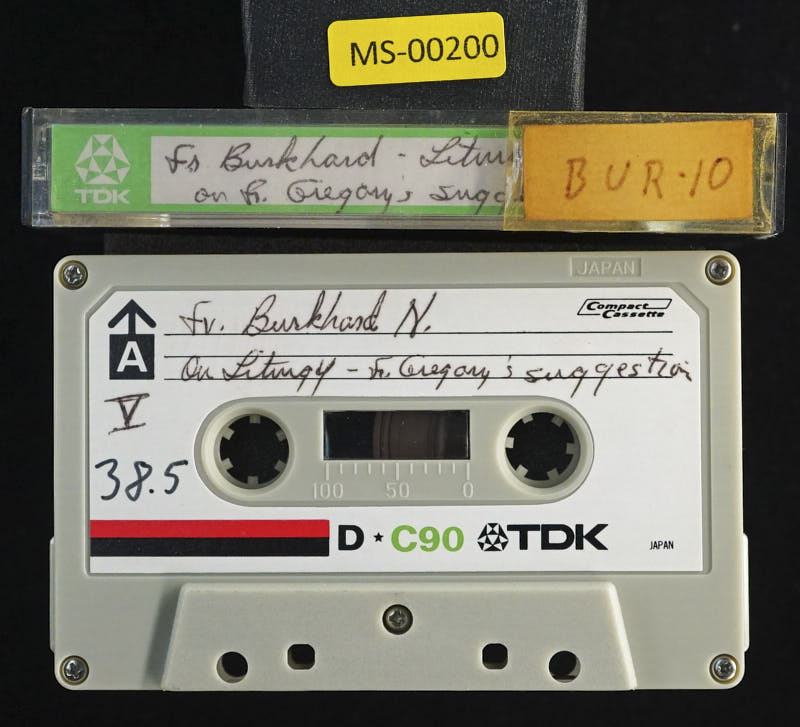
AI Vision - Possible Values from Photos:
Speaker: Fr. Burkhard N.
Possible Title: On Liturgy - R. Gregorys Suggestion
Additional Text: 38.5
@AI-Vision_v002
Here are some suggestions made, as he says, some other, no. The following points are not in the order of what I think is their importance, but simply the order in which they occur to me, some ideas. He gives the order of the office. What can we see first? Perhaps with this, as it comes to his mind. And therefore, here is beginning. We have spoken already about this problem yesterday, or I don't know, I remember when. Would it not be good to introduce the custom of people standing or kneeling for a few moments at their place in choir before sitting down? but it's necessary to speak about it again.
[01:02]
We have already discussed yesterday. Okay. Then hints, this is very important, at the beginning of all offices, including complain, complain, how do you say? Compline, complain. This has been done in the due liturgy of the hours. It gives the theme of the feast or season or hour or provides a Christological character to all that follows. And you have it. already more or less with exception of vigils. Therefore, I would say you are free. You can arrange things as is it convenient to your community. And I hope and I think and I am sure that this liberty will not be taken away. But the central authority, the Abbas Congress, or the congregation, or somebody else, will insist in a certain structure. And this structure means the hymn.
[02:06]
Therefore, you could not, with time, for the moment, oh, it's okay. You are free. You can do what you like to do. But with time, you must more or less follow this structure. And I think it is very convenient to do so. Your invitatorium is marvelous. And nevertheless, after the invitatorium, you need... some fire still in the hymn this wouldn't be what do you think the apostle says you must be filled with the holy spirit cantantes, im psalmis, hymnis, and cantici spiritualibus. Therefore, the idea of the fifth chapter to the Ephesians is that the people of God come together in the Holy Spirit singing in psalms, hymns, and spiritual canticles. You do it in psalms, in invitatorium, singing it, awaking, and you do it sometimes in greater visions also in canticles of the prophets.
[03:13]
And you do it in this special kind of hymn, which is poesy, and not only psalm, but a poesy of European, also American, feeling, with rhyme sometimes, with a melody, very short, giving the special intention of this hour, after night, before day, or at sixth, no, first was lost, and so on, and also... Some Christological impostation is a Christian possibility. Sometimes it's also Christian, but it's very Old Testamentarian. If you don't say in every hour a hymn, some Christological, some Christocentric element is not there. Here are the reasons why we were defending the hymns against these bishops and Periti who said... We are praying it always alone.
[04:14]
It is meaningless to say a hymn if you don't sing it. Okay, you cannot sing it alone, but you can sing it. Therefore, you have no reason to take it away. Do it with this dynamic element, which is a Christological element, with this poetic element, with this pneumatic element, which is in the hymn in a special way. And again, your intention is not necessary, has been explained in our commission. And after years and years and years, finally, a decision was taken by our council, with majority. The Pope gave his last approbation. Therefore, rightly, you cannot know go again back to these problems we have touched so long, so long, so long, so long.
[05:15]
We must find in a certain way a certain compromise, a compromise which is very reasonable. Therefore, retaining this general structure, and within this structure you are free. Here would be the ideal, and also Prada Samuels in the years before he died, very often was insisting in this point. general structure for all, but liberty to fill it concretely. And you are free also in choosing the hymn. You can take these Latin hymns. It's difficult today. You can translate it. It's more difficult still. You can take new from the Gethsemane hymnal, which is very big. You can choose the most important, the most convenient. You are not obliged to take them all. Some have been very, very good, all Anglican, old Anglican hymns, terrible hymns of the last century, translation from the German, very many translated from the German, from good old Lutheran German tradition, with good old and terrible new melodies.
[06:28]
I think that's the one thing that no matter how little sensitivity you have to even to life or anything else, it really comes across that the hymns are inadequate. Therefore, you must seek to create new, but for the moment, I would say, if you don't take them, this time you lose the possibility to use it anymore. Therefore, take at least the best you have. I would say, if you don't find good modern or old hymns in English, take... Some of the good old Latin. You know so much Latin that you can do that with translations. For example, I am very sorry when you take this marvelous hymn of the Lords. Three strophes, and they're the most excellent... How do you say strophes? So if it's not there, laeti bibamus sobriam ebrietatem spiritus, joyfully we are drinking the sober dankness of the spirit.
[07:39]
Sobria ebrietas, one of the most excellent motifs of Saint Ambrose, of Philo of Alexandria, and also immediately intelligible for everyone today, sober dankness of charismatic renewal. We don't speak about that. Here you have chosen too few. I can understand that he was shortening, and more or less is okay, but especially in this case here, you did not take... The richest point of this old wonderful hymn is original, authentic hymn of St. Ambrose. Sometimes I have taken the book of Guadini, The Spirit of the Liturgy, the hand exemplar used by Gerd Winsen when he was still a student, I think, in 20.
[08:55]
And when, at the end of this book, he wrote, and finally, two years later, I could see it. After having read this book, I was enjoying in greatest joy, etc., etc. And then he was giving the citation of this verse. Therefore, I would pray for the reintroduction of the hymn, not only because that is my personal opinion, but I know in these discussions between Bungini, the congregation of worship, of religious, Aspich of Mayo, and the primate, and the same with the Cistercians, it seems to be clear, liberty is remaining for the disposition of psalms. for the lecture, for so many points, for the selection of hymns, but the general scheme will insist.
[10:02]
With time, every monastery which made his own office is invited to present his office to his fraterna correction of the central authority. Therefore, not today, but tomorrow, after some years, in the next 10 years, you must present his office to Rome, and you will finally not get the permission to use it, from this fraternal correction, from this brotherly correction, if you don't follow the general structure, and it is quite convenient to follow this general structure, it's not so bad. We were fighting for these elements, not so only because it was tradition, but because we are convinced. It is wonderful. I wonder why... Because here, when we decided about the office, it was psalms, hymn, and prayer. And that was the office of Mount Savior.
[11:02]
Yes, okay. But for vigil is true, the new hymn. Yes, against your own rule. But you are, I heard already, I can understand, you took away some years, last year, I don't know when, the hymn, because you said the invitatorium is the hymn. But that is not true. Your invitatorium is very nice. And also I found the same in the other monastery. In the exception of Mount Angel, in every monastery, they are singing the invitatorium today. It's excellent. We are doing the same in my monastery with a very simple melody. Nevertheless, that is nice, but not nice enough. You need still this hymn. We dropped the hymn for Sunday, because we had It's the end. Yeah, I know, but that was, you see. Yeah, you have a hymn, yeah, you are right, yeah. But the edited house is true, true, true, true. It's only an acclamation, you are right, it is a hymn, but it's only an acclamation, a larger arm.
[12:07]
I can understand your intention, but no, as in all other monasteries, in Concepcion, in Mount Angels, they were moving from a first place draft to a definitive draft. With time, you are realizing where are the better, the best elements. And therefore, I would say, after these experiments you made, rightly, according to all the permissions given, it's all in order. No, today, I would say, again, a short hymn, some, the best you can find. In the new liturgia horarum, for four weeks, every day, different hymns. At least, I don't remember, not for every fortnight. I don't remember, but nevertheless, there are many, many new hymns. In the new liturgia horarum, in the Latin text. The old and new of the tradition. The new from the old. There are in the Middle Age, you know, there are 50 volumes.
[13:09]
Analecta hymnica of Bloomedreves in Latin. There is an infinite number of hymns in the Latin tradition. Not all from the same world. Some are awful. Nevertheless, many are good. No, you never determined in English. I can't remember right now. You are invited, and that is a very big problem. All are agreeing, also in the testimony. I was agreeing with the master of these things, was from the same opinion. The hymns are the most feeble point.
[14:10]
We must wait until they are made by a new man according to our mentality of today. perhaps from the Pentecostals, I don't know, from somebody, from somebody. It's very strange in the Charismatical Groups, they are using so many hymns, but generally from a very, very, very level. Not very good, but nevertheless, they are due, because they know it is necessary to speak in hymns. Cantantes in Codipus Vestres Domino, singing in your hearts to the Lord. And because it's so difficult to sing the Vigilas, every monastery, also in Chester Madity, they did not sing the Vigilas psalms. It's too much. Reciting, or speaking, or reading, or pronouncing, or proclaiming, and alone, together, and so on. But the hymn gives this life. And also, not only on the Sundays, when you are really singing, it's a deum now.
[15:13]
It's a very good thing. Perhaps you could say the tedium is instead of the hymns. But then again, I would say, because so many arguments are speaking for the hymns, and also this intention of Rome, I would say, take the hymn because the rule speaks about him. Retain tedium because the rule speaks about tedium. And it's one of the most excellent formulations of Christian tradition. And tedice too, after the gospel. It's not too much. On Sunday vision. Oh, okay. The last decision, you must take it. It's not I. Where to put it? Most everybody has this at the beginning. Please. And perhaps I told it already. In the beginning. For the visuals. For the other hours. we liked to retain the position of the rule, of the entire tradition, Lords and Vespers.
[16:20]
Nevertheless, in all the minor hours, we had always the hymn and the beginning, complete after the psalms. Now, finally, Bongini and his group said, you cannot reclaim, reclaim? a claim, or you cannot put yourself, no, found yourself, no, you cannot base yourself on the rule, because you are changing the rule in so many points, for psalms, for meal, for sleep, for hours, if the position of Hing's, it's a special case, is more reasonable in the beginning, I think this argumentation is very good. The feeble point is, is the position of the hymn in the beginning really good? And you can say only for modern men, for modern congregations, gathering of people, it is so.
[17:24]
If we are singing, we are singing in the beginning. There is no ecclesiastical assembly today which is not beginning with a hymn. Therefore do it here too. The pastoral reason is here very strong. You could say, for us, that is not so important. Therefore, we, in our liturgical commission, we made our general schemes so, saying, in the beginning or in the end, as you like. But it seems that he, the congregation of worship, will change that, to have a certain uniformity at this point. They said so already to the Cistercians, not yet to us. Can we continue? Yeah, here myself I was suggesting the hymns at the beginning because we have no entitlements. And it's only after the reading...
[18:31]
It's only after the reading, not even with the reading sometimes, that you know where you are. It's very good. Nevertheless, I would say this argument is feeble because it would be convenient to have antiphons. But if you don't have antiphons, the Himmels is more necessary still to know the character of this hour. speaking. A very important fundamental element to know we are now at the end of the night and during the night in silence and peace we are praying and worshipping and so on. You're like the Apostles. Like right now we have new hymns for the Apostles. Also, yes. We never know. It's only in the end of it. Maybe we might know that. Here is one of the... I admire your office. But I must say... Your office is for me, who is here for three, four, five, six weeks. Marvelous.
[19:32]
But for one who must for years and years say this office is too poor. You don't know what you are doing. Apostles, Our Lady, weekday, Sunday, all the same. As somebody, the master of choir in Mount Angel said to me, they had a first office, and we realized that We don't have the liturgical year. Always, only Psalms. Psalms, Psalms, Psalms, Psalms. It is a very old system. The monks did so. Only the Psalterium, nothing else. But fifth time, they were in the fourth century, when the liturgical year was growing, they were introducing it. convenient to insist in this horie. Today we are celebrating this mystery and we stay in the presence of it. And if you don't have a hymn, if you don't have an antiphon, you have still the riches of the psalms, but the riches are more excellent and greater and more speaking, more living, vitally speaking, if you have the antiphons.
[20:44]
Changing. Do you think that the hymn also should be really, you know, if we celebrate, if we're during Advent or... Yes, yes. It should be, it should... Yes, therefore, during Advent, you don't have a hymn in the visuals? You don't have? No, no, no, I'm sorry about it. Advent. We do have that time and passion. We have both Advent and hymns special for those times. Also for visuals? Yes. No, not really. Yeah, you have speech. Of course, you have it for the other hours. But the visuals always, it may be a lot to say so, it is awful that during Advent and Easter time, you don't have a hymn where you are pronouncing with the joy of a poetical form the glory of the risen Lord, of his epiphany, and he's waiting for him, for his parousal, and so on. Some hymns, you see, were suggested, like, after Easter. But in the text, you know, they were dealing with the whole history of salvation.
[21:47]
And for me, it was not a hymn appropriate for the time. Because I like to hear only that this is the risen Lord. Because we... And take a hymn, and it is true, the hymn for visuals in the Easter time was not very... He was a little bit telling the entire history of salvation, which is not absolutely false, because Easter is a synthesis of the entire history of salvation. Nevertheless, by this reason, the new hymn for vigils in Easter time is no more than the old. It's a little bit changed to insist more in this specific value of the resurrection itself. And if you are not satisfied, you take another. You are free, you can choose what you like to choose, but you must have this poetical, joyfully pneumatic expression of this specific element which you are celebrating in visions every hours. Sometimes joining it with the element of the hour, of the time, of the concrete time of the day.
[22:56]
And then the next... Then he makes some remark about the doxology of the hymns, according to Father Damasus, where later additions, so it's not so important. I think you can go over. Compline. Start like all the horse with the verse, O God, come to my assistance, etc. Oh, you are doing it. You do it. You do it. Ah, then the hymn is noted above. There's the new system, yes. In the liturgy of the hours, there is a little silence for your... Conscience. I myself also think, let's say, that it is better for us to keep it as it is. I mean, the custom is to read something before... also I would like very much this reading and we introduced it in nearly every monastery in Europe in the last 10-15 years or we retained it from the old traditions but
[24:31]
experience shows it is very difficult to find a text which is convenient to this hour. The collations of Cassian and the history of the old fathers sometimes for modern men are too it is a lot to say too ridiculous too strange filled with wisdom but very strange like this history which was given on the of his poem yesterday about the monks who are allowed to speak only once a year for two years. A wonderful story, but if you hear it, it's a little bit strange. And then if you take Karl Rana, sometimes not agreeing with him. If you take the imitation of Christ, we don't like it very much today. Therefore, Father Raphael found only one possible solution, read Holy Scripture.
[25:35]
And then, after two, five years, we were not satisfied, we took it away, we have nothing anymore. I don't know if it is easy, if it is convenient to take a reading. Nevertheless, why not? But the sayings of the fathers, all are very strange, some, or they are marvelous if you hear them for the first time. And here you must repeat them. And then, after five years, as we say in Rome, it's too much. Then you wish to change. Nevertheless, I am not against this reading. Only I wish to say the experience of most of our monasteries shows that it's difficult to find a reading which is very appropriate.
[26:43]
I remember from my visits in Italian monasteries in the last 50 years, when the Italian monks are gathering together in the darkness of a totally dark chapel, and in every monastery reading some verses 5 or 10 from the Imitatio Christi. was not so bad there are chapters you can read them so by verse for verse other chapters but some you can choose them very good Augustine must be easy it was a marvelous mystical atmosphere Cardinal Schuster liked it so much words, little words, small words, also the saying of the Father sometimes. Therefore, it would be possible. And nevertheless, then perhaps after this reading, and also after a short silence, also for examination of your conscience, and at the end of the day, is not prescribed in the New Liturgy of the Hours, but is suggested perhaps begin with the hymn.
[28:02]
as is now foreseen. Then the psalm, a short chapter, and the Canticum Simeonis. Also here, I don't understand. Place complete reading after the psalms as at other little hours. What do you think? Therefore, he proposes to take this reading of the saying of the fathers. Not in the beginning, but after the sons, and then you don't take twice a reading. Also, when we have it in the dark, then that behind the reading, you have to
[29:03]
I think the reading was put before Compline simply to replace the long extra liturgical reading which we used to have. It is true. This was only replacing the old, long reading, but not reading the chapter in the complete itself. It was an element of the hour. And how do you say in English? I don't remember. Please? Yeah, you're right. You are with us, and your holy name is invoked above us.
[30:05]
Have mercy with us. Please. Here again, I would say, if you retain this reading for your company on Sunday night only, or during winter, It would also be convenient to retain, after this reading, according to monastic custom, a hymn, psalms, and then a short chapter. As is today in the Roman office, changing every day. Not always the same. But very, very, very convenient for this all. The same mentality to auto-innovus as dominus. Reading at the beginning, I feel that it's no longer needed. That was a thing for latecomers or those who were busy. There was a long reading.
[31:06]
Yes, that's true. And now everybody comes only when the bell rings. You and I. That is the intention of St. Benedict. Everyone comes. Today is ridiculous. We don't use this form. Nevertheless, here again, with time, the intention of this reading was changing. It is a moment where you, after the trouble of the day, are sitting there and hearing in peace some words. I remember when we, in Maria Lark, 20 years ago, or 15 years ago, introduced again this reading. We were gathering together in the chapter, sitting there, hearing this reading, all the Holy Scripture, all the saying of the fathers. In a certain way, it was an ideal. But we did not have the patience. It was too much to change the place from the chapter to the church, losing time.
[32:11]
And to hear this reading, stupid. We don't hear it acoustically, also because we become older and [...] don't hear it. And then saying of the fathers, and so on. Holy Scripture, we heard too much. All these arguments are not convincing, but these are the arguments of modern man who is too complicated. Because sometimes, you see, we have a conference or a meeting here, and then we go back there. Before a conference? It's evident if you have a conference here, you don't have the reading. Here, again, you have the elasticity to change. But if you don't have the conference and you don't have it, for example... Also, in our constitution, it was foreseen that the superior is speaking every day to the community. When I came 50 years ago, he did not do so.
[33:14]
Only twice a day. But the Ramos, as I remember, liked to speak every day for a very long time to the community. And very quickly, also he was speaking too much. The community was reacting against that. Also, he was speaking very excellently and so on. You cannot speak every day, but you can read every day a good reading. A certain way is better to do so. And I heard also that the old Beuronese abbots sometimes did it. It is not necessarily superior speaking every day, but to read is quite possible. The word of Christ may dwell between you in a very... Rich way. Verbum Christi habited in vobis abundante. Abundantly. It's never too much. But when the pervert is not there, what do you do?
[34:19]
I would say you must... Stoke the fire. Stoke the fire, yes. Stoke. Stoke, yes. We say the sea in German. I agree with all those principles, but in fact, you see... Do it not too long. No. Here I would say you can exaggerate. For example, when Father Raphael introduced the custom to read the entire Holy Scripture in one year, perhaps 20 years ago, then we were sometimes obliged to hear the Holy Scripture during the entire dinner. Then the community was, I think, reasonably reacting against that. The principle was good, but the realization was not good. Therefore, we changed to two years, and then things became very convenient. But nevertheless, here, dinner, supper, a short part of the Holy Scripture.
[35:19]
Then again, Lord's Vespers. Then again, in vigils. A little bit before the... But different kinds of reading. Before the community, it's not too much. Not too long, but at least, let me say, five minutes. Yes. But you must not do it. Only I wish to present it to you according to this scheme. And the favor, yes. Sometimes the favor is Must be kindled again. In fact, I would also like to see some kind of penitential rite, at least on failures and memorials before complete.
[36:20]
A few moments of silence, then some form of confession and absolution as we had it always until the last reformed. You don't have here nothing. You're related totally to the private initiative. No, you are very happy. We're saying, man, you're all right. It's very bad. It's very bad, but I feel the formalism, and I think people are so unhappy with the formalism of, we're special about the paternal forgiveness thing. Therefore, you could say, because you have it every day in the mass, you don't do it in the form of absolution. It's not necessary. It's not prescribed anymore. You are totally free. You can use official forms, but you are right if this, every day you say, nobody was thinking about this.
[37:23]
Also, you could say, you must think about it. But nevertheless, but as little silence... as we did after the reading, it's not so bad. In a silence in which you are meditating the reading, and then also your sins, your little negligences of the day. We have now in Maria Lark the custom. It's not so bad. We have Thespos, this order is not very good, at 7.30. And then free time until 8.30. But it is foreseen that at 8.15, slowly the community comes, one after another, sitting there for 10 minutes in silence. Not many come, because very quickly people prefer to remain the entire half hour free after festivals in the room where they are concentrating better than to stay there for 10 minutes, then go for 10 minutes in the church.
[38:32]
Both is too short. Nevertheless, to stay there for 10, 15 minutes is excellent, especially because we have the very bad customs, excuse me, to go after Phespos, 7.30, not to our room to meditate and to read Holy Scripture, but to go to television to see at 8 o'clock the news of the day until 8.15. And then some people, this is evident, are remaining to see these marvelous things after the news. And then it's quite better to go to the church and sit there in silence. But nevertheless, with the beginning of the Compline, all is finished. We formerly had this very bad custom to have the Compline at 7.30. quickly, [...] to go to 8 in the television.
[39:35]
And then, after complete, at 8 o'clock, the news never finishing until 10 o'clock. Now we changed it. We were realizing you must finish with prayer and not with television. That's the most important element of the day. Therefore, we changed. No, for you, these things are not existing. You are a holy man. Nevertheless, a silence, a silence. And instead of reading also, please. Please. For my feeling, it's not very nice. We had the same certain day. We had not a company at 7.30. We had fespers. instead of complaining, to go to television. And then, instead of complaining, to fulfill at least formalistically our duty, after the oration was during the week, the oration of the complaint with the benediction.
[40:48]
No, no, we changed that. Therefore, also, I would say it is very nice. In a certain way, your Vespas is complete. And nevertheless, if you allow me to say my opinion, it would be... Because Vespas is an official night of this, and the end of the workday. It's not really the prayer to go to bed. And therefore, I would say, if you take your supper... If you change the time of supper, you are finishing your work, so far as I remember, at 5.45. You are finishing your work perhaps 50 minutes earlier, or it's not necessary, you finish, and 10 minutes later, you go to Vespa. After Vespa, perhaps at 7.30, you say, you have your dinner, and you have still an entire hour Until complete, at 8 o'clock to complete.
[41:52]
We have a practical problem here. See, two people are milking. Two people are milking. So two people are away from the fire. But that's not the problem. It's been worse by the fact that the cooks are also in the community. And they say, and I believe it, that... While there is a meal in the oven around the stove, your mind is so concerned about something burning or boiling over. Yes, yes, yes. So if we were then to leave out the two milkers and the two... Four is for you, coming is too many. We see this ourselves, we would much rather have... But during winter you have company. How do you do this? We have vespers before dinner, we have vespers at five. That is for the summer too early. Oh, here you are right. If you have it during winter and during summer or not, you can say you have five hours and then you have... Also, from this standpoint of the authority, you are justified and you are justified especially in meditating all these reasons, yes.
[43:06]
Therefore, I would not... nothing. Per se, if you could do, if you could have a complete, it would be nicer as you are doing it during winter. But for people, it's too many. Sometimes it's the half of the community. And then he goes on Could we not, and should we not, use the new official translation at Mass? Of course, but you don't yet have the book. But if the book comes, you must perhaps choose it, I think. But he speaks now about the new translation. I think the translation of the Gloria and the adaptation made by the official committee is especially fine.
[44:10]
He says the translation of the Gloria, he says so. I cannot judge because I have not seen it and I cannot judge about the English. This and the changes in the Holy Holy and the Lamb of God are very easily made We had one for the Gloria and for each of the other channels at Christ in the Desert. So I could easily get a copy of each. Of course, this is an introduction into the conscious area and he does not wish to insist. Okay. Another point, there was the recited creed at Sunday mass. We wanted to drop the creed altogether at one point, so I remember it. And then we repainted it. Why do you recite it?
[45:11]
Oh yes, you are right. I would not have any difficulty here for a recited credo in English because how can you sing it in English? In Rome the situation is quite different because the entire people would be able to sing it in Latin. also more or less understanding it. And there is the funniest principle, no, the confession of faith cannot be sung. It's ridiculous. If you have a melody, you don't have it, therefore you say it powerfully, you are right. It's not difficult to do that. Also, I would prefer to sing it in Latin. The Pope himself is insisting, from time to time, also you have a vernacular language, it would be nice to sing it in Latin. that you don't lose the custom to do it, because you know it still. It's not very difficult. You know he made, he published a little booklet of 20 pages, 30 pages, with the most fundamental canticles in Latin, also a credo, especially for the Holy Year, that people in international meetings are able to sing together.
[46:33]
you don't need it in the States. I just want to say that I heard this from a fairly good source. One of the reasons, like the song, someone said that it was the English translation that was given by whatever commission it was, it was fairly nice English, but it was not a good translation at all from the official text. But they changed now. No. They changed to a translation. They are saying so. The translations are made not according to the letter, but according to the translation. So that is also good English. Therefore, you are allowed to use a certain liberty. But more, this is a principle. Just another example of that would be, and also with you, as a translation of that conspiracy to all. That's not translation.
[47:37]
And... But sometimes you are right. Therefore, you can justify the translation of and also with you. But nevertheless, here you are losing the specific reaches of this word. You must sometimes try to combine both the principles. A free translation so far as possible, but so far as necessary. This is the principle we used in our school 60 years ago. Translate so... as possible and so free as necessary, or vice versa, according to the situation. I don't know how I look at you. I would agree with Father Gregor. And it would be good if we had, let's say, a translation of the glory, which was in the modern translation also. It made also the creed, actually. And little by little it loses the whole nation. And especially for the people, because they are using it in their Paris churches, and if you introduce it, you always see a different text, it's not good.
[48:44]
For a certain unity in your country, you must use the translation, Jews know in the United States. As we are using in Germany, the new German adaptation, also we don't agree with their translation, for example, Jews know. To say in German, We give you thanks for your great glory. We thank you for your glory. It's not right to thank. Thanksgiving is more than thank. I don't know if it is the same in English. Danksagen is the real expression for Eucharistain. Therefore, praise God, bless God. And thank, danken, mercy to you. because you have been so nice to me in this individualistic meaning. We thank for the meal we have had now. But Eucharistia, the Thanksgiving is, we bless you for your entire work of salvation.
[49:45]
It's quite more. Nevertheless, against this, our feeling, we used the German translation to be united with the entire people. Sometimes you must renounce for some marvelous thing. Therefore, I am agreeing that you are using here if the states wish it, the bishops are wishing it, the new translation wishes it, and also with you. It's not possible that you are here using alone and with your spirit when the entire Catholic Church says, and with you. Otherwise, there's a great confusion. You see, the big problem is this, when they put melodies to those texts, In some ways, I'm glad that we didn't, you know, rock to try to find all the, you know, and learn things and think, you know, too many things because, you know, now they come up with a translation which is, you know, the Our Father is completely different than what it used to be. Completely different, the Our Father? I mean, now it's a little, now we have, what, two years now, really one.
[50:48]
But the new translation, hasn't you, Father Nostal? Yeah, Father Nostal. But the creed now I hear, the glory I hear is different. There was one that came out that was kind of an ecumenical thing. But I think you must use the paternoster, which is in the new missile. We Germans are Germans. Therefore, the bishop said, the bishop and the Protestant bishop said, we have no ecumenical text of the Gloria, of the Crete, and our father, but we have no ecumenical text. And the next day, the German peoples in the entire Catholic and Protestant church are using it. It's very nice. We changed, for example, the expression in the Hail Mary also, just for the Catholics only, blessed are you between the women. In German, the Bistke benedite unto den Weibern. Wife, an old German expression.
[51:50]
Today, impossible. You cannot say to a woman, wife. That is very, very, very, very sexual. And therefore, Frau, you must say, yeah, it's this kind of lady, Frau. You don't have this word in English. But we changed. And where you come now, for me, is very difficult to change. We are used to another form. But people do that. And now, it's already after two years. What do you think? Go on. Why do we omit this is the word of God after the first and second readings and this is the gospel of the Lord after the gospel? Well, I can tell you very simply about the last one is because we have some affirmation and if you say that, people just reflexively...
[52:52]
Speak out. And here I would say you are right. We, Maria Lark, but also I don't agree completely with these things. We detest this form because it was not in our tradition. Our answer to the first reading is the God of Allah. Our answer to the second reading is the Alleluia. Our answer to your gospel reading is this solemn acclamation. You have the possibility to be free. Also, I must say, it is in Rome, for example, where they are using this, also in Germany. Parola di Dio. Parola, yeah. Word of God. And the entire community, the entire St. Peter, 10,000 people are answering Parola di Dio. Grazie.
[53:53]
Parola di Dio. Grazie a Dio. I forgot it already. Thanks to God, yes. And after gospel, Parola del Signore. And immediately another answer. It's very well made. And after two years, this very convincing way the people are answering. But here you are doing another way. Therefore, I think you could continue. It's my personal opinion. But here are mixed office and math. Therefore, the next point is a cursus of selected readings for laws and vespers would seem preferable to the ad libitum choice of the hebdomadary. So often we have inappropriate readings and repetitions of readings recently used.
[55:01]
I am also of this opinion. And here again, the new, is one of the masterpieces of the new liturgia horarum of the Roman office. They have, not only for four weeks, but changing nearly every four weeks, a system of many readings. could say, during the year, at least for eight weeks, changing. And then you are repeating the same. For every hour, a different reading. Excellently chosen from the Holy Scripture. Not too short and not too long. And it would be very easy to take this book, translate it in English. The hebdomada could do it and then used it. I was looking this week in the Liturgy of the Hours, what readings they were giving the visuals, doing Prophet Jeremiah.
[56:11]
That is in the visuals, yes. Now, it would be impossible to read that if you didn't have the book. for tomorrow's meeting. It's just like chapter 15, 1A, 7B, 8A, 9 to 14B, and you know, this is the problem with my last episode. Please, I can make a remark here. If you speak about visuals, this morning is an exception. We, preparing it, have the opinion, so far as possible, no sentonization, therefore not this system. But in certain cases, to give a short, not too long, but nevertheless very rich reading, because you cannot read the entire prophet, they did it. So here you must wait for the two years cycle, where you have more time.
[57:15]
And chosen is for people which is more mature, where you could really apply our principle. No stentonization, therefore not take a verse here and a verse there. You are right, it's not agreeable. But this morning, so far, if I have seen in your election, you had only two points, and Father Prasid forgot... the seven one. It was very easy to find it. No, you had to look at it the headline because the seven was almost the same size as, well, it wasn't the minor numbers of the first numbers, the chapter numbers. You could not find it, so yes. It was slightly black because I looked for it on myself and I didn't have to find it. I thought it dropped out because it would feel... But for the visuals, here we are not touching the problem of the visuals. The visuals is a thing for itself, and you can use your own system, not left to the choice of the heptomata, but made by the community, by the responsible father.
[58:21]
Here we are speaking about laws and vespers, where you have a novel reading. And here I would say, follow for this house the wonderful position never made in this way you are rightly criticising but a short compact text for you I can remember saying about the little hours, but the ideal is to have maybe one sentence which one can remember rather than what you think of as a reading. But I think it's not right what you say. The readings, also in Easter time, so far as I remember now, in the little hours are not too long.
[59:23]
But they are not only one sentence. Sometimes there are three sentences. You can select one sentence from it. Also here you are free. Oh, yes. But nevertheless, follow more or less. And I would say, take the suggestions of this book and you are free still again. I thought it was rather short. Yeah, they are too short. I was starting earlier with what they suggest more. Also here again, we thought for laws and festivals, we have the difficulty and it cannot be too long. if you desire to use it together with the people. And that is the high idea of this Liturgy of the Hours. Use the new office also for the people in the parish church. And therefore, for other groups who are saying this Hours, we provide it, you can take another reading. There is no difficulty. You are not obliged to take this too short reading according to your judgment.
[60:28]
You can take the entire chapter. And it's quite foreseen so. And you can do the same. But on the other side, I would say, don't forget these wonderful suggestions given in the Liturgy of the Rauer. They were made, especially by the work of Professor Lengeling, one of our best consultants of this university in Münster. Excellent priest, and Lengeling. It's very in Europe, very new in the entire Europe. One of our best, clearest, and excellent, and pious consultors. Also, he hears until he hears. Because he says, and so, so, he says, I cannot teach to my students. They don't accept me if I don't come this way. We are all laughing about it. is there a principle to use, I guess you can find it as you know, for the reading of vespers and voids?
[61:41]
Yes, yes, yes. Therefore, in the, so, there's never gospel. According to the entire tradition, The Gospel is only for the Mass, and in our Benedictine tradition, for the Vicious. Every hour, over hour, not the Gospel. And then still again... But the Roman office never had it. And also the Benedictine office never had it. Do you remember? Never the gospel. Always apostle or prophet. But we left the principle totally, used formally in our old office, Benedictine and Roman, to repeat the epistle of the mass.
[62:50]
This was too poor. We are changing now. More or less, there is no other principle. You are free. You take the best way. I think for New and Old Testament there is no distinction so far as I remember. But at least we said explicitly we are retaining the principle until not used. The gospel is not used in, therefore, the first gospel is the canticle. Magnificat e Mededictus, that is gospel. Here is the gospel, but not before. There was an Old Testament, Old Testament. Yeah, in the Ephesians, if you, but it does not touch you, if you sing instead of the last psalm, a New Testamentarian canticles, you cannot go back to the Old Testament in the reading.
[63:52]
You must then take also a text of the New Testament. In the Roman office, they introduced in the festival at the last, instead, in the place of the last psalm, a canticle of the New Testament. If you use a canticle of the New Testament in the festivals, you cannot use, take an Old Testament Italian text for reading. There must be a certain progression. In the Lords, you are using always Old Testament canticles. Therefore, there is no difficulty to go on also with the Old Testament. Per se, it is not so necessary. But nevertheless, you could say, during the last 1,500 years, some things were going on freely, forming a law. And it's not so bad to follow. law created by the spirits of the church, of the faithful, of the priests, by the monks during the centuries.
[65:02]
You must not do it, but it's also very convenient to see how it's reasonable to do so. If you have all... You can... Yeah, you remain free. Do they replace the... No, no, no, the last sound. Last sound. And here we were, many of us were, especially I, I have nothing to say, were against it. And the practice shows it is very difficult because where are the New Testamentarian canticles to be sung in the first post? They take to the Philippians 2. It's not a canticle. And they take two, three, four canticles brought together from different places sometimes of the Revelation. That is all.
[66:02]
And Mr. Schwachsach, who are insisting very much stronger still in this system, they are choosing in principio ad ad verbum, the Prologos of St. John's, not a canticle, and so on. Or the canticle of love, 1 Corinthians 13. So you can take the entire Holy Scripture. And Mr. Schwartz is exaggerating to not to repeat, they don't say Magnificat the Benedictus every day. We were fighting for that also. I remember some of the most prominent consultors said, oh, the Benedictus and the end of the Lord is so terrible. He was from a modern congregation who never say office only in Christmas at night. And then the entire Christmas visuals, the Lord, oh, still the Benedictus.
[67:04]
And then we answered, I said it from my practice and all were agreeing, the monks. When we were for four hours during Christmas in the old system, in the church, visuals, Midnight Mass, lost. And then finally we arrived to Benedictus, all tired. All tiredness were finished. We were awaking again. So that the people could say sometimes, and you can tell that, it's not my merit. They stay four hours in the choir and they are not tired at the end. But it was too much. And beyond the end of the day, we were finished.
[68:06]
We introduced the custom of going to the lectern for Vespa reading, not for love, because we were going to have a long. Yes, quite possible. But now, you see, if you follow this lectionary, No, I would say, no, no, no. You can retain this following his counsel, take the suggestion given by the New Liturgia Orarum, you are not obliged to do it, but you can do it, and take the entire text, a chapter, a longer, you can insist in this custom, if you like it, we wish to have in Thespos a longer reading. It is foreseen in the Liturgia Orarum, and if the reading is not adapted, able, made for that you take another but I would say the riches given by the new liturgia horarum are so great that it would be convenient at least to see what they are saying you can use it make this experiment use the new liturgia horarum in Latin with the indication of the text
[69:19]
and take then the text himself of the English Bible, take the new English translation of it, and so on. I think most of the hours, especially for the minor hours, you will be satisfied, and for lots too. And for Vespers, you take another text, or the same text, but in the entire chapter, or the greater part of it. Here he says, of course, the whole problem of the lectionary, including scripture readings in the refitory, is one of the biggest problems, and to arrange a course of selected readings for laws and festivals, and the refitory would be a considerable task. Perhaps this is an area which Father Burkhardt can be of special help. I don't know. I'm not. Father Raphael could be. But here I think the way in which Father Burkhardt Raphael combined the courses of the choir with this refectory is an iron jugum.
[70:32]
You never can change. Sometimes you wish to be short in the refectory, but you must read it, otherwise you don't have the continuation. And the old system of St. Anselmo, where we, without any attention to the ecclesiastical year, and formerly was also in my monastery, so, we are beginning in a certain day with the Genesis, and after two, three years, we are finishing with the Revelation. It's also good. You read a chapter, and if you have no time, you read only two verses. You are free. But for the choir, you need a very well... Here I would say you are right. You cannot read Isaiah in the choir in summer.
[71:33]
You must read him in Advent, more or less, but on the other end. read Isaiah every time, therefore, in Reflective, there is no reason not to read him. I would say it is an exaggeration to say Isaiah can be read only in Advent, but you must read him in Advent. I wish to say you can do it as Father Raphael is doing it, but the difficulty is, and we are suffering sometimes by it. For example, he must arrange things so that things are going on. In two years, you must finish. Therefore, in the feast of St. Matthew, you must read Tobias. No. You must read how the scripture takes convenient to the apostle. They are not free enough. Because then the system is ruined.
[72:36]
It's destroyed. One of the reasons because this wonderful breviary of the Cardinal Quintiones in the beginning of the 16th century did not succeed, he was invited to make this breviary, and later on, Pius V and the Council of Trent forbid it, was he did not know the liturgical year. In the first edition, his breviary had the common sounds of the air for Christmas. In the second, he changed that. But nevertheless, the entire Holy Scripture in every year, therefore, in most of the feasts, you had the common readings. It's too much. It's convenient. Therefore, he is right. It is a difficult problem to choose. And perhaps the solution would be if you don't wish to make your own cursors. If you have nobody, you could do it, but you have somebody who could do it.
[73:40]
You or Father James. If you don't wish it to yourself, use the two-year cycle suggested by Rome. And so far, Father Gregory says it is already in the English translation of the liturgy of the hours, but we cannot find this book. You have found it? Okay. Is it there? Is there a two-year cycle? The official Roman two-year cycle? Yes, I think so. Why not? The cycle while in rituals is different than the cycle in the liturgy. Yes, the liturgy of the hours has only one year cycle. Yes, but even so, like this week, in the English translation, there's no Ezekiel.
[74:52]
One is New Testament, I think Timothy or something, and the other one is the Book of Esther. Where? In the two-year cycle? Two readings? In one year? Yeah, it's okay. No, no, no, no. You are right. That is so. In the two-year cycle, you have in certain days the New Testament and in another year you have... But they in no way correspond. No, they don't correspond to the Latin office. That is evident because it's a two-year cycle. The two-year cycle is totally different from the one-year cycle. It could be official one, but nevertheless, you see here the New Testament, and our Benedictine tradition for the racial is very much existing, and also you, I think. You cannot read the New Testament in one year, in another year, the Old Testament.
[75:54]
You need the New Testament every day, according to the rule of St. Benedict. at least for the Sunday vigils, in the third nocturne, always St. Paul. Always St. Paul. Entire here, no homilies. Homily is a later principle. St. Benedict says in the rule, Old Testament, or some letters too, in the first nocturne, then Father, then St. Paul. And we wish, at least in Maria Latte, we wish to reintroduce this system for the Sundays. Perhaps during the week you can change a little bit. But if you are reading St. Paul in the Sundays, you don't read him in the week, and therefore you need for the week only the first... No, you must read in the visuals only at...
[76:55]
Revelation and the Catholic letters. And you are doing it in the Easter time. Because in the Easter time, you don't read the Old Testament. There are certain rules. In Easter time, only New Testament, in the first nocturne. In the other year, in the first nocturne, Old Testament. In the second or in the third nocturne, always St. Paul. And then, after the reading, a patristic reading. And here again, the new Roman liturgy has the patristic reading, and you know, marvelous readings, a wonderful lecture. And I would suggest with time that you use these lectures, but you must have translations. That's a difficulty. And you know, there is, I said it already, there is a letter to a diognate.
[77:58]
Justin, Melito of Sartes, and all the apostolic fathers, St. Ignatius, nothing formerly we had in our old Roman liturgy. We had it with all the great Greek, Syriac, and Latin fathers, also monastic fathers, and Henry Ashford, in his new... patristic lectionary wishes to get also more monastic readings than the Middle Age, so far as possible, modern authors. And the intention of Rome is also to give the possibility to create a lectionary where you find modern authors which are not sent. For example, Colonel Heumann, Colonel Berul, the great mystics of the grand siècle in France. And you can also add Abad Marmion and Father Damasus and so on, and all these people.
[79:03]
I must say again, the reading on this last Sunday on Esther, on the pathways, I never have heard such a marvelous explication of Esther in this commentary. But not living authors. It was our principle. Also, perhaps this principle is not so great because it is foreseen, at least for as monks, that sometimes instead to read a patristic reading, the upper primate gives a homily. The superior is speaking. If a superior is speaking, and if the pope is read sometimes, also in the official Roman liturgy, perhaps it's not so bad to take also a living order, but the difficulty is Sometimes you take the living author as Evelyn, or Monseigneur Charles Davies, and later on he left the church. For the prophet. Please. You read a lot from the prophet.
[80:08]
Who? Who? The prophet? Who prophet? The prophet. Oh, it's a Catholic wedding, and the kids all take us back. Then he says here, if you allow to go on, it seems to me a tremendous pity to have dropped the te deum completely, but you did not. You have it again. Okay. No visuals. It seems to me that four readings... are too many on Sundays and solemnities. Why? I would like to see the Gospel omitted, since we will be hearing it at the Eucharist. And I think it gains in solemnity by that one proclamation.
[81:11]
So, Father Gregory, we were discussing it last night, but I don't agree in all way. No, no, no. Nevertheless, In my monastery, as in Gethsemane, we are using, you did it too sometimes, the gospel of the resurrection. And I must say, it is not too tiresome to hear it because you are changing it every 10 weeks. It's very powerful. But as we are doing in St. Anselmo, to hear it twice is not too much. Or you are changing, you take, in year C, Luke, in the morning, you take Matthew. Therefore, there are so many possibilities, but in no way I would omit the gospel. Here is one of the points we must retain also because it's our Benedictine tradition. If we wish to remain Benedictine, we could accept the Roman breviary and change a little bit the disposition of science because there are too few, four weeks.
[82:14]
But for the rest, this breviary is very well made, I think. But we must retain at least gospel, the literature laws, and amen, gospel, amen, the literature laws, and the canticles. All the other things are not benedictum, but common with the Roman office. After having destroyed the complain by the introduction of the nunc timetis dominus. But we did not destroy it. Here all today are agreeing that the nunc timetis in the complain is a good thing, then benedict not have become take it also. But the real Benedictine specific point is gospel and so on, and canticles, or canticles and gospel. Here I would not agree with him. For visuals and Sundays and solemnities I would suggest the classical arrangement of an Old Testament reading in the first nocturne.
[83:17]
Okay, that's good. And according to the laws of the liturgical evolution, in Easter time, not Old Testament, but Acts and Revelation, and Catholic letters. Then, a patristic reading at the end of the Second Nocturne, okay. A reading from the Apostle, it is from the Epistles, and he says, or Book of Revelation at the end of the Third Nocturne, but it's not classic, Revelation and the Third Nocturne, but you could do it. because perhaps St. Paul is not enough for the entire year, I don't know. The second nocturne reading could be, as it is now the case, from modern church fathers, as well as from the ancient fathers and could relate to the gospel of the day, even though the gospel would not be proclaimed at vigils. This is one suggestion which would simplify the work of the compiling of the weekly order.
[84:21]
Therefore, you have very few, but here again, there's one point it is allowed to criticize, that you, on the feast of the exaltation, did not have festum, with three nocturnes, with canticle and gospel, did not please to me. And would not please to Rome. Because you have, when do you have a feast? Exaltation? And Matthew? In September? No, according to the calendar. You don't have it. Feast is just a name. No, no, no, no, no. According to the calendar, it's festum. You have memoria always made in the same way, ad libitum or obligatoria. There is no difference between the kind, the form to celebrate. But you must not celebrate the memoria ad libitum. Then you have feast and solemnities, both in the same way celebrated, with exception that the feast don't have first Vespa.
[85:41]
But there is no difference in the kind of celebration. Therefore you have, according to our Benedictine system, three nocturnes with canticles and the gospel. And a few feasts could be celebrated. And here again you are free in the disposition. You can take six psalms only, first nocturne three, second three, and you can take one canticle. You are not obliged to take three. Therefore, it must not be too long. My impression was, and to take this example of exaltation, did you have a special invitatorium? At least that. But you did not have it in the Memoria Obligatoria of St. Chrysostom. No, it's not necessary. You must not do it. But in the Memoria Obligatoria of St. John Chrysostom, you did not have nothing in the office. Here, for a Memoria, You are quite free.
[86:43]
You can take, as you did it, the entire de feria, ferial office, with exception of patristic reading and oration, and sometimes also antiphons to Benedictus and Magnificat. You can take from the common or from the weekday. You are quite free, also for the obligatoria. But it is foreseen that you take, instead of the normal patristic reading, a reading concerning the saint. And this year for Jean, there was some marvelous reading where he is speaking homily to the people before he was expelled. And he says, I don't fear it. If Christ is with me, what can the exile do for me? Therefore, I am ready to go. Really, I did not know this homily. Excellent, excellent. Therefore, but you have the reading of the Holy Scripture of the week, and then the patristic reading of the cent, and you are invited to see the oration of the cent, at least in Lord's and Vespers.
[87:54]
We changed in Rome already. We had in Rome the same system as you. We did not think to... memoria, only in the mass. But no, we changed. We have the possibility to take the hymn of the cent. You can't take the hymn of the cent, but you must not, and so on. Therefore, the old commemoration after the Benedictus is no more existing. I'm going to talk to you down the No, it's time to finish. It's already 11 o'clock. No, no, half past 10. But if you think it's too much, you finish. Please. I think it's too much also for you. Let me see.
[89:00]
To finish this shorter... Oh, yes, it's still... No, it's too much. There are suggestions only to... Father Martin was inviting me to give also a conference to the entire community, and here I would think to speak about our fundamental intentions in the Concilium ad Exequindum Constitutionem, What was our meaning? What did we wish to obtain? And therefore, what are the main principles of our reform? And then if you would like, I could join also. You invited me to do so as a kind of criticism, critique about my impressions of your wonderful office, yes.
[90:03]
But nevertheless, yeah, I am very enjoying it. But there are some points where I don't agree. But you must not follow me. You can hear that? And then do what you like to do.
[90:25]
@Transcribed_UNK
@Text_v005
@Score_89.75