You are currently logged-out. You can log-in or create an account to save favorites and more. more info
Harmonizing Tradition in Monastic Prayer
Talk at Mt. Saviour
The talk focuses on the liturgical practice of responsories in monastic prayer, emphasizing its spiritual significance and the need for thoughtful integration with readings and silent meditation. It discusses the adaptations in the "Liturgia Horarum" to ensure responsories correspond meaningfully to the readings. Furthermore, the talk examines practicalities and historical perspectives of integrating minor and major hours into monastic life, particularly regarding the distribution and timing of psalms.
-
"Liturgia Horarum": The modern Roman liturgical book, which has been updated to ensure that responsories align with the readings, forming a coherent spiritual experience. The adaptation was notably influenced by liturgical scholars, including a Benedictine monk named Pelagius Vicentine.
-
Rule of St. Benedict: This foundational monastic document is referenced as a guiding structure for the arrangement of the Divine Office, emphasizing balanced prayer and work.
-
General Instruction of the Liturgy of the Hours: This document provides guidelines for organizing and adapting the hours in contemporary monastic settings, allowing flexibility in practice while maintaining traditional elements.
-
Saint Benedict's Rule: Cited along with references to integrating meditation and repetition into prayer, reflecting on how repetition serves as a meditation tool, akin to practices like the Jesus Prayer.
-
Roman Breviary: Discussed regarding the adaptation of traditional psalm arrangements in modern liturgical practice, aiming to retain spiritual depth while considering practical community needs.
The talk extensively discusses the balance between maintaining traditional practices and accommodating contemporary liturgical needs.
AI Suggested Title: Harmonizing Tradition in Monastic Prayer
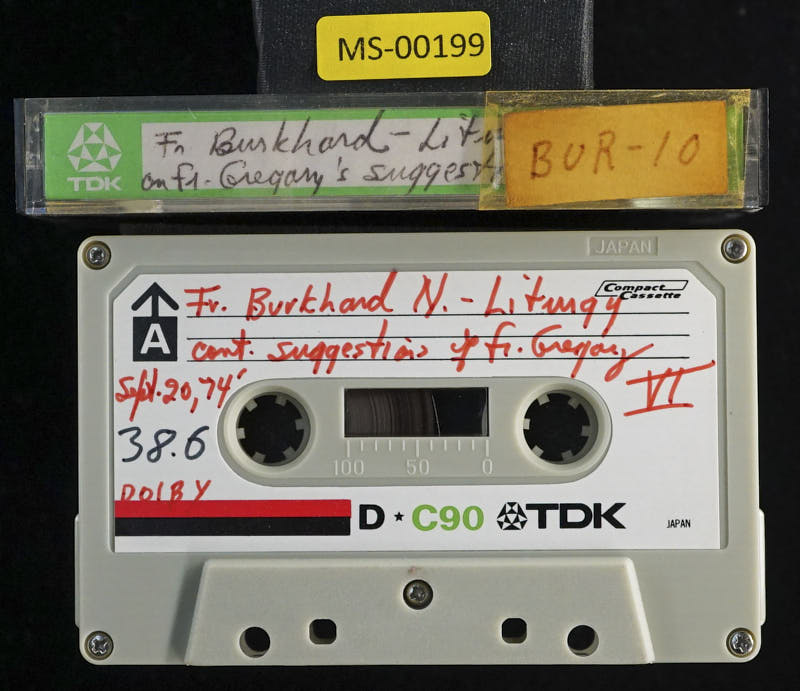
AI Vision - Possible Values from Photos:
Speaker: Fr. Burkhard, Fr. Gregory
Possible Title: Liturgical Suggestions
Additional text: continued, VI, 38.6, DOLBY
@AI-Vision_v002
You know it. I don't know where they published it. Well, maybe if you have anything to do, I don't know. Yeah. I've read it already. I haven't read it. Because in Germany, we need a German text, or in Italy, an Italian text, nobody can read it. So, therefore, Father Gregory, number nine. Respond to this after readings and visuals. and perhaps short responsories after reading the Laws and Vespers. Therefore, the principle of responsories. And here again, we were fighting to retain them, because this Australian archbishop and somebody else insisted this has no meaning, only for choir office, because the greater, far-out great majority... of priests, I cannot say it together. I say, wish to put it away. And we said, no. Also, if you say it alone, in modern situation, it has a very great significance to meditate about the readings as you are doing it.
[01:13]
But I have the impression that perhaps according to the principles of the Roman office, also we, the monks, could insist more in the responsories. Therefore, after every reading, and after laws and vespers, do you have it? No. But you have the hymn still. The hymn would be a kind of responsories. In the new liturgia horarum, they made this awful work that every responsorium is really corresponding to the content of the reading. It's no more as formally that you have A responsory which has nothing to do with the reading, but goes on in his own way, telling the history of the kings. Meanwhile, we are reading a prophet or a father. Now, you don't have a responsory which would not correspond to the text. And therefore, they arranged them.
[02:15]
They changed them. They made them so that all these mistakes which somebody, where possible, avoided. An excellent work made by one Benedict monk of Tralia, Father, I forgot the name, okay. Bellasius Vicentine, good man. So for my feeling, I would suggest to attain your responsibilities and to You have also responders who are corresponding to the reading, more or less, at least in this week. At least in visuals. Yeah. The question was that you have them after every reading. After every reading, you have a feeling of the. Therefore, if you are introducing in Sunday visuals,
[03:16]
fathers, also after the fathers reading the responsorium. And perhaps combining it with silence. What did we say yesterday? First, the silence, and then perhaps concluding it with the responsorium. You don't do the other way. You have immediately the responsorium, then the silence. Both is possible. What do you think? I think so. We didn't have any responsibility for years. But you introduced it again. One man was really pushing for it, I think. I don't wish to know the name, but nevertheless I have the feeling... I have the feeling with time you are realizing that also your office was very nice made.
[04:29]
Nevertheless, a little bit impoverished, it is good to go on to take again these elements for which we were fighting to retain them. And we succeeded. And I'm very sorry that now Benedicts would not do what we were fighting for. But we have to fight for something that means something to people, I think. And I think, therefore, I would say, responsorium, well elected, as you did it now in this week, say something to people, to the people. Because I feel that we have so many words in the office that you come back and bring again those words, which is saying. No, no, no. You are right. You have some words in the office. But you need words. No, I mean, we're too many. We need words, I'm sure. You reduce the office so powerfully. Instead of 200 psalms every week, you have perhaps, let me see, 100 psalms every week.
[05:36]
And you reduce so many elements, but the elements which are manifest as valid, as good, as spiritually fruitful during thousands and more years, you cannot reduce them. And here again I would say we have discussed all these problems. Don't do too much. We need silence to meditate and so on. We discussed and after all that we were convincing that we must retain which are well made in our crowning and fulfilling and making perfect our silence, our meditative prayer. And I think now... In Rome, the central authority, this fraterna correction, is insisting in this structure.
[06:41]
You can chose. You can take it. You can make them yourself. But you can no more go back after all these questions and say, we don't take that. If you say many words, I would say, you have too many terms. You have too many readings. And again, I would say, Verbum Christi hapetit in vupes abundanto. The word of Christ must dwell in your mid, in a very rich way. And so, with all these words, that is ruminating after. You do it freely, in silence, and then a collecta. It's all together. A conclusion, a last word, very short. And you must remember, you had 12 responsorias in every vigil. And the responsoria brevia in Lord St. Vespos. And the Romans had them still in the minor hours. And you took away all of that thing, and they're introducing one, two, every day. That's not too much. One thing I feel myself, I want a responsibility after Lord and Vespos.
[07:47]
But these responsibilities are very short, where people can come in. You don't have them. You don't have them. No. Now, I mean, you know, in the old time, the responsibilities were really for the liturgical year, not for the reading. The responsibilities were not for the reading. Yes, in the visions. Oh, yeah, in the visions, yeah. But the other hour... No, you are right, yes. Myself, I would like to see that, but you see ambitious. It doesn't mean anything to me because we have many lines and you have the same thing that was just said and the tone is awful, first of all. I must say, here you can judge. You are right. I cannot judge because but if the tone is awful, then take another. I would say... Therefore, we could make abstraction from the tone, chose a better melody.
[08:49]
For example, as we had it formerly, at least in my monastery, we had a simple way for Christmas. Very nice, very calling, very good melody. We used it also in Rome, in San Cancelmo, very splendid form. You can take a novope form, you can take what you like to do. But after the reading, real instruction, after your silent prayer, to take a little song, or a good recitation, where you are repeating things, because one of the most fundamental principles of meditatio, of meditation, as our Father Prior, Emmanuel von de Verdus, for many years already is insisting, is to repeat, to repeat the same word, Domine Adacemando Mephistina. Domine Adacemando Mephistina. Domine Adacemando Mephistina. Like the Jesus Prayer. and all these things. And according to a modern novel written in Germany, as modern propaganda is doing, reclame is doing it, in the great cities, the most excellent tea-past-holygocet cream is this year.
[09:55]
And every minute it comes back, until you, after a night of having seen and heard this reclame about tea-paste cream, you are convinced it's the only one you can use. And here it's the same. You hear the word of God always again, always again. You heard it in this reading of Esther. You are meditating about it. And then again, I am confessed. Take it with me. So I am fighting. You are free. I am fighting for the spirit, the problematic content of this element. And with time, Remaining all your liberty, this fraterna correctia of a central authority will insist in a certain structure where the responsoria after readings will be seen. Is anything published so far in the Latin for these responses?
[11:03]
Oh, yes. In the Instituto Generalis in Liturgia Morarum, you find a marvelous explication of all these ideas. In regards to nowadays. Please. Nowadays. No, not yet. We were, this was one of our fundamental problems. What must we do? What can we do? Can we, must we take responsoria only where are existing classic melodies? Or, because the number of classic melodies for responsoria is too short and sometimes too difficult, must we make new responsoria and let the difficulty to compose melodies to the next centuries, and we chose the last possibility. We make good responsoria, and you, the masters of melody of sang, must find the corresponding not bad, but good melodies. You are right. It's a very simple... With time, therefore, yeah, with time, with time, with time, and it may be really also, it is a good idea to sing the responsoria as you are doing it, this dark melody.
[12:08]
The answer of the choir is a little bit strange. But here, the musical man must try to find a way. In a certain way, also it is right, as we are saying sometimes in Rome, if you cannot sing a hymn, in a certain way it would be better to let him away. Also, I don't agree, because you can proclaim also a poesy of Goethe without singing it. It's a powerful recitation, a good recitation, yes. So perhaps we have exposed the problem. You can meditate about it. Therefore, we must have patience.
[13:19]
But sometimes I know in Germany there are excellent choir directors, lay people, who are very unhappy because they have In unhappy, they are feeling that no, with the active participation of the faithful, they have nothing anymore to do. Everyone has much to do. They are invited to invent melodies. Every year, every day again, because of all these new creations, something perhaps can remain. What gives the inspiration? A period of creativity. Okay. And then the next is somehow arranged to have the psalms assigned to the psalms, which is not publicly celebrated, assigned to some other office.
[14:23]
And I think that is quite necessary. You don't say the psalms publicly, you don't say it anymore, therefore you must put the psalms of psalms as, for example, psalm 118, the first psalm four or eight bars. Do you say that? The thing was, when we made the office the last time, there was a question of what we do with church. And the pharmacist had the idea, you have the office, but for some reason you wouldn't say it. Other people felt it would be best to say you aren't going to have the office. We just forget the church. Oh, and there's no difficulty. But anyway, finding an option for having an office of church, but never seeing it. And in practice, and it isn't. Exactly, right? Well, we're supposed to say that. We're talking about having lawless maps, and we're thinking about those terms.
[15:26]
And we didn't know how often we were going to do that. But in the days that we had lawless maps, that would have church. But, you know. We did in the entire world the same when we suppressed the prime. For half a year, for a year in the communities, the sound of the prime were not said. But then we realized we must say, with time, the sound of the tears and the other primate could make this arrangement provisoriously to say, Psalms of the prime, during the minor hours, during the week, and so on. Therefore, you must not do it immediately, but with time, you must find a way. And here, Father Gregory speaks immediately about another possibility. If the mass on memorias and philias is simplified, how about having community
[16:28]
with the exception of the first celebrant, con-celebrant, acolyte, and Sarkrishnam celebration, celebrates Therese before the Mass. And he is more or less suggesting a combination of Therese and Mass. Immediately before you are beginning the Mass as preparation, the people staying in the choir, and now, according to the suggestion of yesterday or two days ago, Also, the people, the concelebrants, who are still already in the choir, could say, could begin with the psalms of the Thales, and then, without any chapter, oration immediately go on with the oration of the Mass. Regarding, that is the principle given in the Instructure Generalis to the Divine Office, in the Roman liturgy today. You can arrange things so that you are beginning with the hymn of the Terths and the Psalms, or with the Intuit of the Mass and the Psalms. In every case, you must save the Psalms, but you are free to arrange it.
[17:30]
And after this beginning, you can choose hymn or Intuit. You can change also from day to day. And after the three Psalms, you go on with the Mass, without penitential act, immediately with oration. Can you do the same thing? Yes, yes. Yes, quite probably. I don't like it because the Lord is too important. You are destroying laws and destroying mass. But with the tells, it's quite possible. And it would be also so possible that the celebrant is coming only at the end of the psalm, saying, Dominus Fobiscus, the Lord be with you. Let us pray for all your wish to do that. Therefore, the entire problem to bring the psalms in another place, would be eliminated. And you can take it away. And in the Sunday, you say terse really in the morning, at 8 or 9 o'clock, and you are beginning the penitential ride once a week with the faithful.
[18:41]
In the Sunday, you could say the terse in the morning at 8 o'clock or 9 o'clock, and... and go away, and begin the mess of the penitential right once through a week, then. This is real power, also for the faithfulness. In a certain way, you are right. Also, he speaks about this problem. It sounds like more like a way to... Yes, but here there is a real problem. To get the psalms in, the idea is, the grammatic idea, it's not formalism. You must say the entire Absalterium, which is the Book of Christ, in which, according to St. Augustine, you hear the voice of Christ singing, lamenting, praising, and therefore the entire Absalterium, you must say then. And because you wish to praise God with the psalms through this hour, 7.30, formally, it's quite possible to do it.
[19:46]
Yeah, but it's not because we want to have truth, it's because we want to have truth. It's because we want to get the psalms in. Yes. No, I only say psalms. But have you another possibility to say truth? Please. Please. You are right, you have different possibilities. Therefore, I don't insist in this. If you prefer that, you can do it so too. We had a good principle before, you know, that when there was a mass at a certain hour, the hour was eliminated. Yes, but I don't think that this principle is good. But we've never followed this principle, really. We have the two in Maria Lark. We have the same... That's the whole thing, because mass is almost always fixed. I enjoyed that, but you never... We have to... We said five years ago, instead to say taas, we say mass.
[20:49]
When we moved to mass on the evening, we forgot the taas. For example, you could do so. And here is a big problem. He says he speaks also about lords. And lords after mass to Thanksgiving. I don't, it's not right. And also he takes it away. But lords must, also he himself is realizing lords must be set at sunrise. But did you, according to your timetable, do you say, Lord, that sunrise? Only, no, when I came in the September. It was marvelous. You said the Lord precisely in the time when the sun was rising. But during the entire summer, the sun was already very high on heaven when you said at seven o'clock the Lord, because... During summer? Nevertheless, you see, at least know...
[21:56]
And also, perhaps in September, in August, I don't know when, with the, how do you call that time? Daylight saving time, you make compromises. Therefore, I would say, sometimes, say, not quite on the time of sunrise, or at 9 o'clock, you can change a little bit. But nevertheless, if you find the possibility to say third, if you are agreeing with it, as we said yesterday, third after chapter, then you are free. You can say the laws separately, then the mass is perhaps more or better. To contaminate, to join hours and mass is always only the last salvation. So far as possible, I would prefer not to do it. But nevertheless, I would say, if you cannot say then, by certain reasons, after the chapter, then to save the psalms, to find a compromise, therefore, after lost and theirs together, the psalms, it would not be impossible.
[23:17]
too much frame. And what comes up then, what surfaces the 3D preview, is we're simply doing this in a routine way to get it done. And that becomes the reason, and that begins to take over and contaminate your prayer. That we're just simply going through the reason. That's the corruption. Not the fact that there's terse. But the corruption is that you let yourself get into that frame of mind where you say, I'm just doing this. Well, I was one who would have gone ahead with six months, but I have to admit that you tend to bask down ashes and duck. You just slide under it, and you're not really into it. Could it be a lack of education and an appreciation of the Psalms and prayer life? That could be the core of it, isn't it? Well, you've got a wide variety of different things and so on and so on, but I, as I say myself, I could go through the Psalms, but I just realized that you probably aren't reading this editable. reframed. It's too much.
[24:26]
You are right. A 7 o'clock loss, 7.30, and mass is a little bit much. Also, you are right. This is the sake of education and so on. Therefore, I would not say you say it only to have said it. You are liking the psalms. You are expressing yourself in the psalms. Nevertheless, you must also attend to this necessity to divide psalms in a convenient way, really, through the day. Otherwise, the danger becomes a mechanism. If somebody believes in the principle of sanctifying the hours, this means that at a certain period during the day, you stop and... That's the principle I did not know. I think we would all agree to the principle of sanctifying the hour. But the question is, what is our normal breakdown of the day? The Romans have to read for our periods of watch, but certainly ours isn't these days.
[25:32]
Hours is much more morning, noon and evening. I think everybody would agree with the principle, to sanctify the hour. But then this puts in an artificial... sanctifying. At 10 o'clock, they have a break. In town, at 10 o'clock, they have a break. At 3 o'clock, they have a break. And they end working at 5. But they stop for 15 minutes. And I think, for me, in the spiritual life, that's how I see it. I don't see in the number of Psalm or over 150 that this is mighty powerful. But I just, you know, just this downbeat that in a certain way you are right the sanctification of hours is a very fundamental principle and in all our deliberations Bonini said it still in this meeting in February the first principle is to stay at hours at the right time and he then said to Archbishop Meyer who is insisting in the traditional number of hours please your excellency
[26:42]
it is your competence in the congregation of religious, because this congregation is insisting in these minor hours, how can you do it in the real time? That the community is not forced to say the three hours, and we did it formally, three hours at the same time, never it will be allowed. You must separate the hours, but how can you do it? Here is the problem. Therefore, in a certain way, also Maya is right, the congregation of religious is right, to say the entire Psalter It's a spiritual principle, and we must retain it. But we must combine it with this due insistence of the Council after all this corruption of the last century. The hours must be set on the right time. And today, this principle is the first principle. But you must combine it with this or whatever. You must say also the Psalms. A certain compromise is possible, but not the corruption we had in the Orobritism of the last century. And perhaps, therefore, to say this test after the chapter is the better solution. then you are free, laws, short interval, sometimes too short, and the mass.
[27:51]
We've tried several ways of having the mass and laws combination. Most people felt the best way if you put them together was laws after mass. Nobody was happy with anything. Sorry, but that was the kind of best. You had sometimes laws after mass. For us, now, here, it worked out in a more favorable way than others. I mean, as I say, nobody was happy to think about it. The situation that we have now, that most people felt they wanted to have the law, it's fully independent. Here, now I haven't supported it, but it seemed it's not too bad. Here again, nobody's exactly happy with it. I think if we had, well anyway, so that's what we've done. We've tried to, most people here in this monastery prefer the whole office. But here you are again with time. And there's nothing which, it's very irritating to do things on a totally artificial basis.
[28:55]
We're simply running the prayer. We have all, the whole rest of your life to live here. You know, you said there's a beautiful part of your life. if people are having to work and can't come and all of a sudden... But that's exaggerating. People just don't want to stop. Just why? That's the question of my mind. Why don't people come to sex? No need for many people not to come. I don't understand. Yeah, they're into it. It seems to be someplace else. That's the answer I find. Would it be proper, say, if we couldn't work out another hour in our Ferrari to take the psalms that would be said at terse, like, say, the psalms from 118, and instead of saying at none, the same psalms, or in sets, the same psalms
[30:01]
Yes, you are right. If you must, for example, if you cannot say these psalms before the Mass or not after the chapter, the most easy solution would be to say these psalms in the minor hours, yes, because you are repeating in four days the same psalms. You must not do that. No difficulty, no difficulty. Therefore, you have three possibilities. You can say the terms in the best time after the chapter. You can say the minor, not so good solution before the mass combining with the mass. And the last, and also a good solution, would be to arrange, as Father Gregory also is supposing, the psalms during the minor hours without any difficulty. Therefore, not saying the third, because it's too difficult, and you could say, instead of third, you say the mass, and then sixth and non. We had another arrangement where we never repeated the same psalms and the little albums.
[31:08]
Oh, yes. It's quite possible. Here you must choose what is the best. And I think the best is to choose between two possibilities after the chapter or in the minor hours, 6th and 9th. I never liked that because it covered the little hours. Is it? No, no, no. You have Wednesday, Thursday, and Friday, and Saturday, the same psalms. You say the same only once, and you take the psalms, say, for the first part of the 18th and 19th, 20th, on the November days. It's very short. Okay, but you practiced. I didn't like it. No. Only three? In our singing of them, their form and their format. It was different.
[32:09]
Yes. Where did it go? If this reason is valid, then you, I would again suggest to take the time after chapter. This moment. If you had church with mass, do you always take the hymn for church? No, you must not. You can't take away the hymn. Instead, the hymn begins with the canticle. So the Roman breviary is providing. Combination of minor hours with the mass, sixth or known, when you say mass, or hymn and psalms, or... or canticle and psalms, and then oration and the reading of the Mass, nothing else. And the combination of laws was seen so, canticle or hymn of the hour, the psalms going on with the Mass, and the benedictus after communion.
[33:12]
At least for us here, that's always been a mess. Whenever we try to put laws intersperged in this various way of practice, broken up within the mass. You are right. Here, that is the provision of the Roman breviary. For me, that is not good, because it's destroying everything. I think Weston can do it. They've done it well there. They're like their law of mass combination. But they're a small community. There are never any guests the priests can celebrate. In fact, all these factors make a difference really. You are right. Therefore, you must exclude this possibility. But in the Roman breviary, to introduce the lay people too into the... They wish, but practically. Practically is not so often. For example, there are monasteries like Etal with their big gymnasium, college. The professors, the fathers must be free at seven o'clock. Therefore, say... must combine the morning hour, one morning hour, to have the entire community there to be finished at 7.
[34:26]
Because they must prepare, they must take the breakfast, and they must prepare themselves to begin at 8 o'clock. And the community wishes to pray together, wishes to sing together, wishes to celebrate Eucharist together, but in the same time they must walk in the school. And therefore, see, I must combine Poor people. But you don't need that. You are free. Therefore, don't take this. Therefore, you are free to arrange things according to the ideal. Therefore, laws alone, mess alone, and therefore, in a certain way, also not combine tells with the mess, but try to find another way. Therefore, not following your boundary. The timetable is always the most difficult thing in the monastery. You have just the songs.
[35:36]
You said if the argument with the mask, you need the songs kind of more technical. Yeah. Oh, yes. Therefore, if you wish to do it in the Mass, then also you are a little bit very early. You are all staying in the choir, perhaps also the celebrants, I don't know. And then you are beginning with the canticle. And when the priest comes, and you are continuing with these small three psalms, and you are going on before Eshi. the readings of them. This is the first time in the year that we had it at 7.30. Yeah, I remember. You had it later. But for working, it's better you are.
[36:37]
If you say mess at 8.30, 8.30, then you're finishing after 9.00. You are beginning your work more or less before 10 o'clock, two hours. There would be a possibility to eat at 1 o'clock. Because the afternoon is very, very, very long. Not so. Is it necessary to work all morning during the summertime? It's not visited. The community wishes to have longer time in the summer to work. Not all, yeah. But also, for example, for students, Sometimes you need three hours to come in.
[37:44]
You need an hour to go on. Then you must immediately, when you have begun, you must finish. It's difficult. That's also some of the things that have been mentioned. Yeah, this is difficult to know, because I say different people work different. You are right. Some people want a lot of time to work. And if they've only got 20 minutes, they can't do anything. You know, the time I get, my mode is changed or stuff like that, you know, it's all put out. And so then you're wasting units of time all over the place because everything's so short, you can't do anything. So again, I would say your actual timetable for some of me seems to me to be very good. But nevertheless, you must find a place to... See, these psalms, you cannot forget for an entire half and year the six very important psalms.
[38:46]
It's not spiritual, I would say. And you have so many good possibilities to introduce it in a very convenient way, not formalistically, after scepter, or in the minor hours, sixth and third, or The last possibility, not so good, I think, together with the mass. But you must find one possibility, and there is nothing perfect in this world. But you like the satirium, you like the house. Everyone must make a sacrifice. There's also an idea of a community. We were fighting in Maria L'Arc for half a year last year to restitute a mess in the morning because to us, too many things. But we were voting, and the small majority was for the evening.
[39:48]
No, we must. Yes, okay. We are doing it. It's not so bad. We have only five. Morning hour, daytime hour, vespers. And I say five because morning hour practically is a combination of visuals and laws, but I'd say for practically only four. Theoretically, we couldn't say to Rome we have five. And here again, the council is insisting in five hours for the entire world. How can the monks do? Not so much. Two cardinal hours, laws and vespers. No very important hour, visuals for us, or hora lectionis of reading. A minor hour, complete. Minimum. And nevertheless, the congregation of religious, therefore, also a certain tendency is to, that monks at least would, must, could retain these minor hours, which are known already by Tertullian.
[40:57]
Second century. Very, very few, very few. Yeah, he asked in Italy, Monte Cassino. evidently. And there are still monasteries in France and in Germany, I don't know, but in Italy and France who are saying the entire office with the exception of Prime, which perhaps only said in Monte Cassino. Cava, two years ago. We remember they had vigils, lords, All together? That is a thing which must be avoided. It is forbidden. They cannot retain it. Impossible. You are right. And Bongini will never allow that. If you say the entire office, according to St. Benedict, in this form, no. But it's not necessary.
[41:57]
We, Maria Lahr, in 50 until 60, set the entire office according to the rule every hour separately. That is so strange. We came to a time where we set the entire office in time. Because the people today say it's too much to say 200 songs in a week. In a certain way it is right. You cannot digest it. Here is the difficulty for modern people. I did not feel so. I said it already to somebody. My health is very good. I am not tired after the Sunday vigil. But many of us said, Father Urban Boom, the abbot, after the Sunday vigil, I am finished. And I can understand that. Twelve psalms and three canticles and the readings and the laws. Therefore, from four to... One hour and a half.
[42:58]
And nothing before, only Benedictus' song. All the other things, very quickly, not quickly. No, it's not good. It's better today that you have time. Also, we have time now to read, to meditate. You have this marvelous time after five o'clock until seven. It's a miracle. where nobody can hinder you in silence, perfect silence. But you cannot omit the silence. You can omit the silence. Yes, it's true. There is another thing. And I don't just say that. I was listening to everyone. There's nothing forbids someone here from saying terms.
[44:00]
Nobody is forbidden to say terms. No, no, no. Nobody is forbidden to say conflict. No, no, no. Privately, yes, yes. So, yes. Therefore, in a certain way, if the community says... We don't say terse, we don't say complain, but we are suggesting to say the psalms. We would like that we are saying it privately. That would be a solution, but not a perfect solution. The perfect solution would be that we are saying it, as St. Benedict says it, in little groups. You've heard this a thousand times, too. St. Benedict's ruler was the only man. Yeah, I know, there is the fundamental problem of the mass. But nevertheless, to say mass and to say in two weeks the entire Apsalter is not too much.
[45:04]
Not too much, not too much. Yeah, again, I would say we are exaggerating. We don't wish to pray in a certain way. It's very strange. And You said it's too much. Last year in St. Anselmo, two years ago, this Belgian exegete, Dupont, gave a marvelous conference about Matthew 6. If you are praying, don't multiplicate the words, insisting it is not right to take this text against our office. quite different genera literaria. You have the psalms, which are as the rosary, as the Jesus prayer, a repetition of words to move in the word of Christ in his spirit. And you have petitions, sometimes, where you must say, Father, have mercy on me. You don't need to repeat it.
[46:06]
Give the help to my mother or to my brother and to my nephew and niece and so on. You know... And he is speaking about this repetition of magic words. He is speaking about this ostentation in which you wish to be seen, but he is not speaking in no way against communitarian prayer, against a long communitarian prayer. And the entire tradition of Christian people did never correspond to this false interpretation of Matthew 6. But saying, the monks in the desert set the entire psalm in every day Maybe an exhilaration, but nevertheless, they were praying the entire day and entire night. And today still in Jesus' prayer, which is for all us an ideal, the monks of the Mount Athos, they are praying the entire day during the work. St. Benedict separated a little bit, work and prayer. He introduced our modern feeling in a certain way, but a certain mass. What do you say?
[47:08]
Massa. Massa. Mass of prayer is necessary. Salterium. Also for a festum, the only exception is they don't have a first festival. But the structure of solemnitas and feasts in the office is quite the same. Therefore, according to our Benedictine tradition, three readings and three nocturnes, the Deum, Gospel. And the solemnities and fees are so few in the new era that it's not difficult to do that. But all the tertia classes are now memoria. And for memoria, it is quite a failure of this. We were reading at oration, nothing else. But testum, apostle, and some piece of Our Lady has nativitas and presentation and so on. Lawrence, perhaps?
[48:10]
Not very many. Few. Apostles, especially. Therefore, I would suggest with time also we are to get it so. But no, perhaps. I don't know. If you wish to continue. Finish. Okay, fine, yeah. Therefore, He says, on feasts I would certainly limit the number of psalms to two nocturnes, or two of three psalms each, but specially selected. Again, I would not agree. Not two nocturnes, but three. But nevertheless, you are able, there is a liberty to limit the number of psalms, but the number must not be from the week, but must be selected for feasts, especially from the common or from proper feasts. And he says then, at present, these important offices have very little character of the feast, which surely should be apparent.
[49:18]
And he is quite right. That is the norm of the new office. Solemnitas and feast. And the feast days, or feast days, in technical meaning, festum, like an Apostle of Matthew or Exaltation of the Cross, not the weekly psalms, but special psalms with special invitatorium, hymn, and special readings too. Against our father Raphael, who in this feast today, to have his wonderful disposition of the entire two-year cycle, is reading some book of the Kings in the feast of an Apostle. And our Father Abbas says, what is this Book of Kings today where somebody was killed is saying? Or some adulterium is... Okay, we must read that according to St. Benedict, but not in the Feast of the Apostles. So on. Therefore, here there must be some arrangements.
[50:21]
For the canticles of laws... No, then surely it would be desirable on feasts as well on Sundays and solemnities to select special psalms for laws and festivals instead of using federal psalms as I believe is done at present. Okay. For the canticle at laws on feasts, I suggest using the text we used to have on amber Saturdays instead of the long candle of the three youths. You are free. You can't change. Also, the Roman office is changing. Sometimes, canticum trium puerorum, sometimes the other. But I would insist more in the cantica of vigils, which are specifically benedictives. The Roman office does not know it. And the Roman office, in the appendix, for all the people who wish to have a longer vigil, but it's not following the hood of St.
[51:24]
Benedict, they introduced our canticles. In the Roman office, it is possible to prolong, how do you say, the whole election is to a real visual with tria cantica and gospel, as we are doing it, ente deum and gospel. Therefore, they are following us, we must, at least retain it for our vision. And not every day, but on Sundays, on solemnities, as Pentecost, and on feast days, as Nativity, as Our Lady and Apostles. Okay. Would it not be better to bow throughout the text, praise the Father and the Son and Holy Spirit, both now and forever, Amen, rather than bowing up at the end of the first half of this text? Therefore, for the entire formula, not only for the three persons, but also both now and forever.
[52:27]
You can do that. Because you are doing it for the overending in the imbitatorium, for an H unending. This end, both now and forever, is so short. It's very strange. In Gisemini, they are changing at least with three or four possibilities to say it is doxology. You have only two. Praise the Father and the H and Ending. Very minor point in any case. No, the very minor point is another. How about Oh Lord, open my lips once only at opening of visuals. Then he continues, I am not against all repetitions.
[53:30]
They can be extremely helpful, but I am not sure that this one is so. A very minor point. But here I would ask, because it's such a minor point, why not do what St. Benedict was suggesting? But sometimes you must change to change. Well, I think that's one of the things that everybody is so weary of, that anybody even makes a good suggestion. Now they get it. We're playing, I can see also, in a certain sense, your commission plays the same problem. But we here are playing with the fact that we don't really have a good knowledge of liturgy, historically or theologically. So all of us feel at a certain point, if something gets to, what would you insist on? You get to say, well, it's just kind of my opinion, the way I build up, or I won't insist. But also, you don't pay too much attention to anybody else, because you feel that's just what he wants, you know, and it's not .
[54:33]
But of course, there is both this thing of what is a . And the other thing is that we eventually so cut up any changes, and we heard all the theological principles, There are some repetitions which are only medieval, only Frankish German, because they wish to have this powerful growing. For example, this melody three times higher. That is medieval, Frankish German. Not a repetition, but a repetition. You can take it away. But repetition in se is an excellent element, fundamental element of meditation. St. Benedict is not Frankish German. He's Old Roman. And therefore, to take away any repetition with the citation of Matthew 6 is not right.
[55:36]
Therefore, I would say, let us retain it. Fifteenth, Luchinarium before Vespos on all Saturdays, but not offered it, would be appropriate. Luchinarium. Luchinarium. And this suggestion is not meant to exclude the use of incense as done at present on Sundays and solemnities. However, it seems to me a light is called for a Saturday Vespos. And here again, I would say formally, in every monastery, we had lights at Vespos. It was a last relic of Lucianarium. Therefore, to introduce this at least for Saturday would be marvelous, and also Sunday, Lucianarium. And so far as I understood him, also speaking with him, Lucianarium took one candle solemnly there. I said then also two candles, why not? But not on the altar, no, on the sides.
[56:41]
One candle before the altar and two candles not on the altar. It remains not touched, but on both sides. They are doing it now. Or in St. Meinrad, where, say, in a powerful way, make the intro it for festivals. I had the impression the entire community is running. LAUGHTER After the Easter candle. Lucinarium. In a certain way, very well. But perhaps we must not do so. What do you think about the incense at Vespers? It pleases very much to me. Also, I must say, that is not old Roman. It's a Frankish German, middle-aged. But here again, not everything from the Middle East is false. And you admit in your right in a very simple and discredited way incense which we are using powerfully by a priest with cup who is incensing the altar during the Mass.
[57:56]
And formally the entire choir was incensed. You remember that, the old times. We, in our old-fashioned monasteries, we are incensing the entire altar during the Magnificat. In the priest, in ferraments, is incensing it. And formerly, not only the altar, but also the celebrants and the abbots and the entire community, only the priests, nobody else. We were incensed. The deacon came, you must bow. Then invite him the next. And so the entire choir. And the novices, only one. And the brawler only. I want to change nothing else. No cult of persons. Please. Yeah.
[59:00]
It doesn't seem to me that I never saw this before writing here. We changed it perhaps before the concert already, but near to 55 or 60 in the simplification. You mean Vespers now. I'm talking about Vespers. Vespers, Vespers, yes, yes. I never saw. I always thought that the incensing was only made sense. Now, when you incense the altar, we don't incense the altar. No, you are right. You don't do it anymore because it's unnecessary. But per se, the origin of the incense in the first person is a symbolization of the words, of the sounds, and instead to incense the altar, which is in no way necessary. Why? Why must we incense the altar during the Vespos? You're made very conveniently in a new symbolism, until now not used in the Roman church, but very well introduced in Montevideo, why not?
[60:12]
This wonderful idea that during the Vespos, Like incense, my oration is nice, good, you are free to do that. If you are able to understand the symbolism, you could say it is in no way corresponding to the gospel. Incense was a perfume given to the pontiff that he, during his difficult task, must not suffer so much by this terrible smell of the Roman people. That was the meaning of the incense when it was introduced, perhaps from, I don't know, from Byzantine custom from the court in the 7th, 8th century. And later on, from this practical reason, a good parfum in this assembly, or the colonial, some kind of that, you had this idea to...
[61:17]
Yeah, the symbolics and then also the idea to incense the persons as an act of honor. The prince, the emperor, the king, the president must be incensed. Yeah, we don't do a mess, I would say it awkwardly, but just to incense the stone and then know that reverence, I think, people should know of their... No, here was the idea the altar is Christ, therefore also here is a certain spiritual idea then, but nevertheless, there is enough to do it in the mess. where the altar is really used, but for the spiritual office of vespers, you don't need the altar. So for here, I would, more or less, the altar outside. If you have a luchinary, would you put the lights at the lectern? Also, yes, you can put it in a very, for example, together with the picture of the icon you sometimes are putting there. If we're going to use the Bible, if we're going to go read a little Bible or something like that, you know. But then you are introducing the Jewish symbolism, the Bible, and you can do that, yes.
[62:19]
Yeah, I mean, you know, we're going to bring the book, you know, and reuse. But the idea of Father Gregory is to introduce it for Lucianarium, and here's the meaning of we. At the end of the day, I'm introducing light, symbol of Christ, according to the Greek kind of light. as the Ambrosian liturgy has it still today. It is a good thing to give a servant solemnity to the saturday response. I would agree with him. But I would not add too many other symbolism. One candle or two candles before the altar, next to the altar, and then not omit the incense. It's very nice. You do it only on Sunday. Therefore, you have Saturday the Lucinarium. One of these monasteries, all conceptual, I don't know where, all Gethsemane has a real Lucinarium with text.
[63:26]
I forgot where. As in Milan, today still. Dominus Illuminatium e Salusmea, somewhat. Because Christ in the Desert, they had the and it was done during the hymn. Because the hymn is a little bit light hymn, yes. It's all an auction. The hymn of Saturday is a very nice hymn where the element of light is in. And still, the last here, the hymnal compiled at Gethsemane is quite fine, but consists of several volumes, that's true. I understand that at Genesee Abbey, they are having one volume hymnal compiled at Gethsemane from the multi-volume hymn.
[64:30]
used there, I shall ask Father Baldwin of Jetimani to send me a copy. We might be able to enlarge our repertoire of hymns and improve it. Again, this is the cantor's idea, and so a sensitive matter. Okay, but I also would suggest take from this very excellent collection, the best. Not Genesee, not Jetimani, but from this collection made already, by men with taste, this Anglican, German, and all the American hymns, the best, and also the translation from the Latin. But at least to have hymns, good hymns. What is that collection called? The hymnal. Oh, the one at Gethsemane. That has a collection of all. Yes, yes. from the oldest church tradition, but everything.
[65:32]
Many Germans, and I think the English know, and many Episcopalians and so on. Lutherans, Catholic, some very sentimental, too sentimental, and in the same as they liked, and to sing at least in the last strophe, a second or third voice. Also sometimes very nice. And so we finish this work of Father, the suggestion of Father Gregory. Yes. And then more or less we could finish. And if you like, next week I could reassume these ideas as Father Martin was in inviting me to explain again, altogether, the main principles of this Concilium Ad Sequentum Constitutionum of the New Roman Liturgy and of our necessity to compose, we are called to compose our office in a certain common structure and every community in its own way.
[66:57]
@Transcribed_UNK
@Text_v005
@Score_87.9