You are currently logged-out. You can log-in or create an account to save favorites and more. more info
Mysticism and Monastic Harmony Unveiled
AI Suggested Keywords:
This talk explores the application of Trinitarian spirituality by examining the monastic life, particularly focusing on prayer, stability, obedience, and community life, as articulated by Father Damascus and Gregory. It highlights Abraham Maslow's concept of "peak experiences" and its correspondence with mystic experiences as key to individual greatness, influencing religious traditions and inter-religious dialogues. Additionally, the speaker reflects on practical experiences with Zen Buddhism, stressing its similarities with monastic practices and explaining the Camaldolese model of monastic life as a balance between community, mission, and hermitage.
-
Abraham Maslow's "Religion, Values, and Peak Experiences" (1964): This work is pivotal in linking peak experiences with mystic experiences, highlighting their role in forming truly great individuals and impacting the core of religious traditions.
-
Thomas Merton: The mention illustrates the intersection of theoretical knowledge and practical engagement in comparative religious studies, particularly between Christian monasticism and Buddhism.
-
Benedictine and Camaldolese Monastic Traditions: The distinctions emphasize variations in monastic life, with the Camaldolese pattern offering a flexible model combining community, hermitage, and mission, relevant to contemporary monasticism.
-
Trinitarian Spirituality: Integrated within monastic life and Christian spirituality, recognizing the involvement of prayer, contemplation, and engagement in divine mystery.
The talk offers a rich examination of mysticism, individual spiritual development, and the dynamic interplay across religious traditions, providing insights for scholars of monastic studies and interreligious engagements.
AI Suggested Title: Mysticism and Monastic Harmony Unveiled
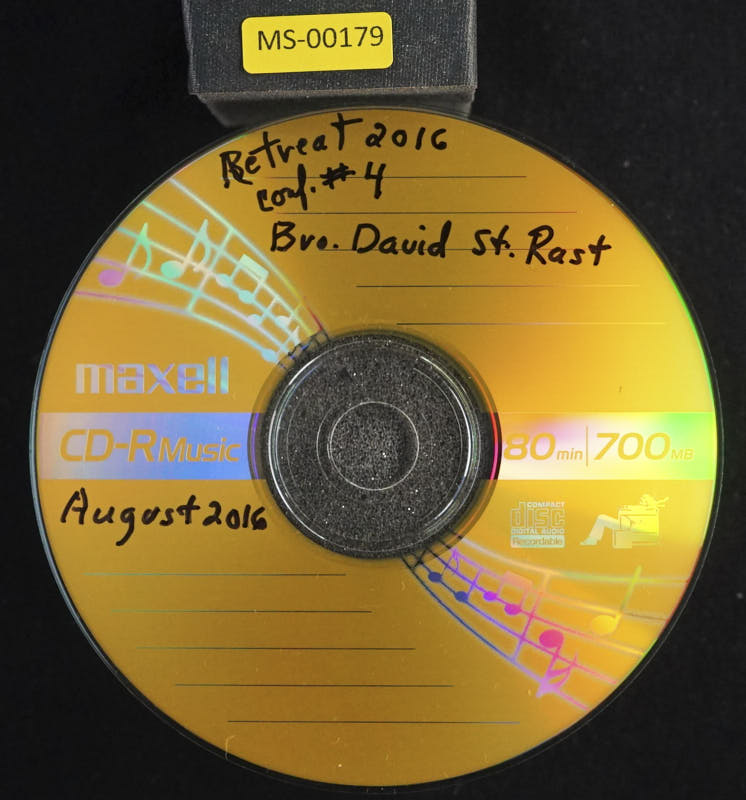
AI Vision - Possible Values from Photos:
Speaker: Bro. David St. Rast
Possible Title: Retreat 2016
Additional text: cd. #4
@AI-Vision_v002
the living. Let's start again in the living of the Father, in the soul, and the Holy Spirit. This Trinitarian structure is sort of the structure for all our considerations so far because One way of looking at it is that for the spirituality of Father Dan, follow the Trinitarian structure for our considerations here because from one point of view, the spirituality of Father Damathus was quite clearly a Trinitarian spirituality.
[01:11]
And so we have gone through a whole series of applications of that Trinitarian approach. First, the basic human encounter with mystery, with blood, divine mystery to being led into this mystery every human being being led into this mystery to the questions that we have considered why and what and how deepest question that lead into mystery then we have considered Christian spirituality as where We speak, of course, of Father, Son, and Holy Spirit, and we have considered the three worlds of prayer, prayer of silence, by which we let ourselves down into that silence of the Father, living by the Word of God, by which we listen and respond to the Logos, and the
[02:31]
contemplation through action which is understanding through doing in the Holy Spirit there too we find this trinitarian structure we found it this morning even in monastic life where stability is clearly related to stillness and silence and to that aspect of the great mystery, while obedience is, of course, a loving listening and responding to the word in all its different forms. And the third was the Congressatio Morum as life in the Holy Spirit, as really... contemplation in the full sense that includes action and understanding through action.
[03:36]
Now I wanted to add two little things that I forgot to mention this morning. One was that among the great innovations that Father Placid. The innovations that we brought was that all in the monastery were of one category. Because at that time, that was frowned upon. You had choir monks and you had lay monks. That went way back to the Middle Ages where whole monasteries, all the fire monks were aristocrats and the other ones were Serbs so it's amazing how these things seep into monastic life and then become at one time that was actually a very positive thing because that the monks were aristocrats that was not in question but that others could join them was in question and so the
[04:56]
They gave an opportunity to everyone to join on Bede as a lay brother. But in the beginning, that was positive. It was a widening of an elastic concept at that time. But later on, it became really a stumbling block for young people to join. And when I first came here, I had only two questions. I was here less than... 24 hours. And right away I was put to work with Father Placid, planting squash, and that gave me the opportunity to ask a few questions. And I had only two questions. The first one was, do you really want to follow the holy rule? Just plain follow the holy rule. That was extremely important to me. He said, yes, that's what you want to do. And the second question was, Do you have lay brothers or is everybody on the same level?
[05:57]
Everybody's on the same level. That was enough for me. I had no further question. The next morning I had already arranged the ride to reach back. But that was a great innovation. And the other aspect I wanted to add to the question of obedience is that One thing that Father Damasus stressed was that the concept of obedience belongs into the context of a school for the Lord's service. The monastery is a school for the Lord's service. And obedience is the behavior of the students in that school. obedience is not what a dog learns in obedience school doing what you are told but obedience is this loving listening and we learn this loving listening systematically in the monastery and that was also the most important aspect of formation at that time that you learn that but then
[07:21]
Father Dan was to stress the aspect in a school. You are not kept going to school year after year after year. You graduate. He said you graduate. And so one graduates also from obedience school. The goal is that now during formation you do what you are told. And very punctual. He said, Don't cross the T when the bell rings and you have just started the T. Don't dot the I when the bell rings. Very precise. But that is only a means to an end. And the end is to know what it is time for. That is the great goal. Obedience is a loving listening by which moment by moment tune in. What does God want from me now? And so, in that sense, you graduate from being told, just like you graduate from formation, from the formation process.
[08:27]
So, even the monastic life we saw under this Trinitarian scene in this Trinitarian aspect, of course you could slice it any other way, this is just the way we are approaching it right now, but I hope it is a helpful ring. And now I would like to take this evening a further step, again following this pattern, and speak about mysticism. Mysticism is a very important aspect in the context of monastic life and was particularly ripe at the time when Mount Xavier was sort of in its hay days in the early 60s, late 50s, early 60s. And there I want to mention one important name, Abraham Maslow.
[09:36]
Abraham Maslow was a great psychiatrist in the mid-twentieth century. He was eight years younger than Fr. Damathus, but died in the same year as Fr. Damathus. He died in 1970, and in 1964, he published a very important book of which I hope we have in the library. I haven't had a chance to check with Brother Bruno, but if not, we definitely ought to have it, and it is available, and it's called Religion, Values, and Peak Experiences. Religion, Values, and Peak Experiences. Very thin book. but definitely worth reading. And the story, how Maslow came to write this book, he was not in any way a religious, he did not consider himself a religious because he was a deeply spiritual person, but he did not consider himself religious.
[10:56]
actually considered himself agnostic. He was just an agnostic Jewish background, a psychiatrist. But he had some teachers who impressed him greatly. One of them was Margaret Mead. He mentions Margaret Mead, the anthropologist. So as a graduate student, came across these very impressive human beings. And so he asked himself, why are they so great human beings? What makes a human being great? He was a psychologist, so he asked psychologically questions, what makes a human being great? A great, what everybody would say, that's a great human being, a real man she would use. admits that even though he had a doctorate in psychology, he had never come across that question.
[11:58]
He had always studied what makes people psychologically sick, but then a woman asked a question what makes them healthy. So he set himself single-handedly to study this question and studied, interviewed people who would qualify by most people's judgment as great human beings, studied diaries and autobiographies and biographies of great human beings in the past and came to an insight, a discovery that completely threw him over. He said the one thing that all of them have in common is a mystic experience. And he was totally unprepared to think of that or even reluctant to admit it, but it wouldn't help. Again and again, they wrote or admitted or said that they had a mystic experience.
[13:08]
And by mystic experience, we mean in this context simply It's just about an experience, so it isn't an experience, so it isn't something that you simply read about or write about or think about. It's an experience. That was one important aspect. And what kind of an experience? The experience of limitless belonging. Limitless belonging. You set no limits. to the mutual belonging. You belong to everything and everything belongs to you. This all-oneness is sometimes called oceanic feeling, but it is much more than a feeling. It's an experience that includes the intellect and the will and the whole person. And then he started writing about it and speaking about it, but It didn't sit well at all in the psychological community because we missed the experience that was a no-no for these agnostic psychologists at the time.
[14:18]
So he changed the term and he called it peak experience, which is a good term. He invented it and it's a good term because it's a kind of peak experience. of your consciousness, a peak of your awareness, a peak even of your aliveness. And when you stand on a peak, you have also come close to having this feeling of being high up, having a vibration and being elevated and supported. Peak experience is not a bad term, but all of his life long he insisted that there was no difference that he could point to any difference that he ever found between the peak experience that he wrote about and the classically mystic experience of people like St. Teresa of Avila or John of the Cross or any of the famous great mystics. And then he continued his studies
[15:25]
in many countries in the world, actually, with a whole team of co-workers, and came to a second very important aspect. The first one is that the mystic experience is characteristic for great human beings, for a really accomplished human being. The second insight was that to the extent to which one can generalize in psychology, that's how he put it, everybody had these experiences. So everybody had these experiences. And the difference between everybody and the great human beings was that the great human beings made something out of this experience. They let the insight of belonging to everybody flow into their daily life. They lived out of it. It became the driving force of their life, not just something that happened once and you shake yourself off and what's next.
[16:29]
And he actually came across many people who came to him after the lectures and said, this is the first time that I... dare to tell anybody that they had such an experience because they always thought that was a momentary insanity. And he pinpointed whole professional groups that had great difficulty admitting these experiences, for instance, accountants. Why? Because they have to keep everything under control, and in that moment, in the peak experience, you are not under control, but it's an encounter with mystery, and so it controls you, it grabs you, it does something to you. And people who professionally have to keep everything under control should be very insecure about that.
[17:36]
The important thing is that Maslow said, to the extent to which one can generalize, everybody has this experience, which means all of us are mystics, potentially great mystics. The mystic is not a special kind of human being, but every being is a special kind of mystic and can live this mystic life if we acknowledge this mystic experience, find it, remember it, and gratefully integrate it into our everyday life. That is the point. So it's a gift and a task to have this experience. Our task is to become the mystic we are. And this, in the book, religion values and peak experiences, Maslow spoke about religion, you see, and about the mystic experience as being the core of every religion.
[18:56]
One religion says, yes, this sense of communion with God, if they use the term God, or the sense of oneness with all, that is at the very heart of what we are all about. And one has to ask now the question, how does one get, I'm not sure to what extent Maslow follows this particular pattern that I'm now going to show you, but it's pretty basic. The question is, How does one get from that mystic experience, which is the core of religiosity, of basic human religiosity, to the various religions? How does one get to these religions? One can actually know this from experience if one has one of those peak experiences.
[20:03]
Don't look for Mount Everest. That is always the danger somebody says, oh, I've never had one of those big bang experiences. Doesn't matter to be Mount Everest. Any peak is a peak. Even an anthill is a little peak. Whatever is given to you, but that experience, sometimes when we listen to music, sometimes when we pray, sometimes when nothing happens at all, people describe waiting at a red light until light changes, and all of a sudden they feel one with all. Thomas Merton describes one of his peak experiences. He said, just sort of halfway stepping down from the sidewalk to cross the street, I suddenly felt one with all the people that were there. This kind of thing, that wasn't a Mount Everest, but it was certainly a mystic experience. So, when we have this experience three things happen inevitably and the first is that right after the experience in the experience there's nothing but the experience there's no reflection that's one of the aspects that makes this peak experience so great that most of the time when we feel we feel that we feel and then we feel that we feel that we feel we are all rolled up in ourselves
[21:33]
In that moment, we just feel, that's all. Just present. But a moment later, the intellect swoops down on this, as it always does, and says, what was that? And then we interpret it. And everybody interprets it in the context of their life. So a Christian might say, God spoke to me or God touched my heart or something like that. You might even say, I encountered Jesus or something like that in Christian terms. Obviously, a Muslim is not going to talk in Christian terms. You use Muslim terms. A Hindu will use Hindu terms and an agnostic will use some other terms that he has to make up or borrow some terms from someone else. Well, there always happens this interpretation.
[22:35]
And that is already the first element of every religion, namely doctrine, a teaching. And the teaching is about, the core of every religion's teaching is about encounter with God, encounter with mystery. So that's the first element. The second element of every religion is moral. So every religion has a moral code. And that comes about because your will, intellect, asks and interprets. The will follows the intellect, sees, wow, this was great. I want that. So to be one with all, the will says, that felt real good. I want that. So the will commits itself, and that commitment is morality.
[23:36]
What felt so good was the sense of belonging. And morality, everywhere in the world, although the codes of morality are very, very different, so different that people have said what is right for one is wrong for the other, that's not correct. They all have one thing in common. They all say basically, every moral code in the world says, this is how one behaves towards those with whom one belongs together. That's what they all say. And the difference is that some draw this circle of those to whom they belong very narrowly and everybody else is outside and you can behave to them any way you want, but to those who belong together, that is their morality. One believes in a special way, and that's a moral code, and in that sense, it has often been said, even thieves among themselves have a very strict moral code, but it's a thief code.
[24:46]
It's not a generally accepted one. This is the second element that spontaneously springs from the peak experience, namely morals. And the third one is now that not only intellect and will, but the emotions come in, and the emotions say, that has to be celebrated. And this celebration is ritual. So don't... morals and rituals are the three elements that you find in every religion that constitute what you call a religion and the emotions celebrate they celebrate for instance in this sense that you have had this peak experience on this mountain let's say we have made a hike and we had it on the mountain saw this beautiful sunset
[25:47]
you will go back again and again to this mountain, and not that you have this experience another time, you can't bring it back, but you go and you celebrate it, you're grateful for it, and that is pilgrimage, you see, or you will continue your pilgrimage with a ritual, or you will say, oh, it was on this day, and every year you will remember, oh, that was when I had this wonderful experience, And that is already a liturgic calendar, so to say. And then, this is now taken over by community, because it was an experience about belonging, so it belongs to community. It will be taken over by community, and in that sense, One can say that all the great religious traditions in the world originated with the mystic experience of the founder.
[26:50]
Some of them we can no longer pinpoint, but we can Buddha, in the autumn of Buddha we can pinpoint. Mohammed we can pinpoint. So the founder and the founder's mystic experience and then the community around it. And in this sense, if you step out from the Christian, from inside the Christian tradition and look at it from the outside, you can see the mystic experience... the baptism of Jesus would qualify as such and that was also the beginning of his teaching and then he goes out in the desert and then starts teaching so every tradition starts that way and then it goes on and two things happen first a development in time time passes and then the community gets bigger and gets institutionalized.
[27:52]
Sooner or later it gets institutionalized. And then the danger is almost inevitably this doctrine freezes and becomes dogmatism. Nothing wrong with the dogma, but dogmatism, just frozen teaching. Or the ethics, the morals freezes and becomes moralism. This is all. This is how it is and don't ask. It's no longer alive. It's no longer moving. And ritual freezes. That's how it's been done ever and ever. And don't you touch it. That's ritualism. And that's the danger in every tradition, in every religious tradition. And it can be overcome because this comes from institutionalization. is freezing, and the thawing of this ice block there comes from the personal section.
[29:01]
There is no other way in which we can. So out comes this living water rushing forth in the beginning of a tradition, and in this cold climate of our world, it freezes. And so instead of having this living fountain, you have a block of ice. And there's no other way in which you can melt it except personally with the warmth of your own heart. And wherever that happens, the living water starts flowing again. And that is what all the saints have been doing, and that is the core of every religious renewal. And now we come to what has been called interreligious dialogue or understanding between religions.
[30:04]
And that is based on the fact that the mystic experience is at the core of each of these traditions. And each of the traditions will say, yes, it's not that you tell them that, they will say, yes, this is the core of our tradition. Christians say it, Buddhists say it, Hindus say it. But in this mystic experience, in this peak experience, the emphasis can again fall on one of those three aspects of the mystery that we have spoken about. And if it falls on silence, let's start with this. With us, that is, with Christians, Jews, and Muslims, typically it falls on Word, living by the Word. That is why I like to call these three traditions the Amen Traditions.
[31:05]
It's interesting that all three of them have one word in common that is so important and central to them, that's Amen. And that was another one of Father Damasus' sayings that was very frequently repeated that amen was so important and he stressed when in the liturgy after the canon when we say amen say that loudly say it with conviction not just another amen that is the one great amen after the in the Eucharist so say that with conviction and He said, Amen is the human response to God's amunah, which is God's faithfulness. So, it's the one word that summarizes our faith, our trust in God. Amen.
[32:06]
And God is first faithful to us, and then we are faithful to God. And then we have Trusting God, that's really what faith is. We express that by saying Amen in one word. So I call these traditions the Amen traditions, and they listen to God's word. It's also sometimes called the religion of the book, so book, word, very important, and respond to that. And actually, since we are standing in one of those traditions, in the Christian one, it is very difficult for us to even conceive that in another tradition silence may be equally important as word is for us. But it is a fact. In Buddhism, silence is central, absolutely central. Every Buddhist teacher will tell you that.
[33:08]
For instance, The great sermon of the Buddha that corresponds to the Sermon on the Mount, which is three chapters in the Dark Book of Matthew, Buddha says not a single word. How can you give a sermon without giving a word? It's called the flower sermon. And he takes a flower and holds it up. And how can you tell that you have understood the sermon? You say something, you haven't understood it. So one in the audience smiles. A Buddha smiles back at him, and the Buddhists say, at that moment, the tradition of the Buddha was handed on to his successor. That one became his successor. And ever since, What's essential in Buddhism is handed on in silence. It's the silence. Just like we are the custodians of the word, we are the custodians of silence.
[34:12]
And when I talked with my Buddhist teachers, I mentioned later that I was sent to study Zen, I would sometimes because they give talks and they talk also. And so I would try and really understand what he had said, and then I would come back and say, now, did I understand it correctly? And then I would say exactly what I had heard, and the teacher would just laugh and would say, precisely, but what a pity that you have to put it into words. And then what we were saying, dialoguing, so he was getting carried away and all of a sudden he was talking a lot. In the middle of a sentence he would stop and he would say, I'm talking again, I'm becoming a Christian. He understood that that was our territory, the speaking.
[35:14]
And then there is another tradition, namely the Hindu tradition, in which understanding is equally in the center. Just as word is for us and silence is for Buddhism, Hinduism, understanding. And Swami Venkateshananda, you remember he was here, our word, our silence, in contrast, together with Swami Tatchitananda. And Swami Venkateshananda put it very clearly, he said, Yoga, and yoga is the spirituality of Hinduism, it's not just yoga postures, we think mostly of yoga postures when we say yoga, but there are many, many kinds of yoga, raja yoga, bhakti yoga, hatha yoga, all sorts of spiritual brains or practices or worlds, I think you can say, and all of them
[36:18]
are understanding. Yoga is understanding. And he even said the word yoga comes from yoke, from the same root as the word yoga, like a yoke of action that ties two action together. And yoga ties together word and silence. And we said that understanding comes when you so deeply listen to the word that comes out of silence, that it takes hold of you and leads you into the silence. And that is the process of understanding. And that is the core of Hinduism, core of the spirituality of Hinduism, core of yoga. So, because this mystic experience is so central, and because monks are living out of this experience.
[37:26]
That is one way of speaking about monastic life. It is the expression of limitless belonging. That's why we call it brothers. We belong to everybody. Everybody calls us brother. Anybody can call us brother. We belong to everybody. And this because monks live in this area, monks are particularly cut out for individual style law. And I remember Thich Nhat Hanh, the great Vietnamese Buddhist monk, told me that when he was still in Vietnam, That was during the war and before the war, very, very difficult times. And he said, we Buddhist monks felt much closer to the Catholic monks than we felt even to Buddhists that were not monks.
[38:32]
And the Catholic monks felt close to the Buddhist monks, maybe closer than they felt to Catholics who were not monks. As monks, they had so much in common. And therefore, the Here in the West, at any rate, the interdimensional dialogue was spearheaded and largely carried by monks. That was two years after Father Damason died when it was a very, very important event here. this word out of Simon's conference. John David Robinson, one of our long-time armblades, and sister Elizabeth Espersen that was also here with the sisters in the House of Prayer down there, and they organized it, and it was the first such big event.
[39:35]
It was unprecedented. but first of all in the monastery and there was absolutely everybody. Hindus, several Hindus, several Buddhists, several Sufis, Jewish rabbis, Christians of course of different denominations and it was a really great event and the beautiful thing was that At the beginning, it was very difficult. Imagine preparing and housing so many people. Then there was a flood that same summer. So it looked almost as if we had to call this off. And it would have been very easy to excuse ourselves and just call this off. And the community was not convinced from the beginning. The community found it very difficult. But from the moment that the guests arrived, the community was totally hospitable and totally taking them in, and that made all the difference.
[40:44]
So it was not just something that happened here, but something that could not have happened anywhere else except in this monastic environment, through this monastic enthusiasm. And the crowning event, there were many incredible events, like the Eucharist that Ramunda Panica organized in the chapel with all the elements. Water, of course, water sprinkled over everything, holy water, fire, incense everywhere. air opened all the doors on all four sides and everybody went out and breathed deeply and came back and then earth and they carried two big baskets of earth and stones and put them under the cross in front of the altar and then everybody came up and put their hands on earth and who comes up together at the same time
[41:51]
the Jewish rabbi and the Maaslan. But for me, the climax was at the factory, I think it was, and Rabbi Karlbach got up and he said, I want to tell you a story because he said, this happened. And he said, now. He said there was a great rabbi and he had all his students around him and they were so happy.
[42:55]
They were so really stout. that the rabbi say to one of the students, quickly go to the window and look if the Messiah hasn't come. And the student goes and opens the window and comes back and says, no, outside, everything is going on as before. People are buying and selling and cheating one another. And another student says, but rabbi, if the Messiah had really come, Would you have to look out on me? Wouldn't you know it in here?" And the rabbi said, but in here the Messiah has come. And for the rabbi to tell this, that was a very great event. So I think it was also in this context of, I think so, it was definitely in the context of monastic life that Father Damasus sent me down to study Zen because, as I had mentioned earlier, he was so often invited to give talks that he sent sometimes
[44:34]
some of the older monks to give talks, and I was sometimes sent. And what everybody wanted to know was about monastic life. We would talk about anything else, and the students would always ask, what's a life like in a monastery? That was in the air at that time. And there were all these other monks suddenly. One had never before seen Buddhist monks running around in their robes, and Hindu swamis running around in their robes, and so forth. So I felt, since I was always asked about monastic life and was lecturing about monastic life, I felt the responsibility to inform myself, are they really monks, in what sense are they monks, and so forth. So I read up on it, and one of the books I read was the training of a Zen Buddhist monk, and I was absolutely blown away because their training was very much like our training. yet there was no historic contact at all. They were as far west as you can go, and they were as far west as you can go, and historically there couldn't be any contact.
[45:44]
Although Jean Leclerc, the great historian of monasticism, I asked him once whether he thinks that The earliest Christian monasticism was possibly catalyzed or triggered by some Indian monks that came to the Near East. And he said there was a very lively exchange between Rome and the Far East, even China. Pottery was exported imported to Rome and things like that. There was a lively exchange. So it is almost impossible that sometimes one monk in all these centuries wouldn't have come across. And that would be sufficient. One monk would be sufficient to start a chain reaction with someone that feels a monastic vocation and is a Christian.
[46:50]
He said, it is very likely But he said, as a historian, I cannot say more than we do not know. We simply do not know. We have no evidence. We have no documents that would point in that direction. We don't know. But it is a possibility. So there is a possibility of some connection. But I was surprised. I was just amazed. And when I told this to friends, especially Anne Winter, she was baptized here. When she started to come here and wanted to be baptized, her husband, that would have meant a divorce because he was agnostic and totally against it. And as far as he would go, he said, if there is such a thing as a soul, then you have it, and. That was the most religious statement that we've ever made.
[47:54]
And she wanted to be baptized, and Father Dambison says, okay, I know what we'll do. You come every year, and we do one of the little steps of baptism. You put your sword on the legs, and reciting the creed, and so on. So seven years she came, every year, and every year he did a little something to her. And during those seven years, her husband got to know Father Damascens, and he became very good friends, and he was happy and came to her baptism. She was baptized in the crypt. So that was a success. And Ann Winter was the one who told me we should meet a wise Buddhist monk. has just come to New York, and you can meet him, and she made the connection. And so I met Tyson. He was then a young monk, not a teacher really, but just a young monk who taught because he brought other teachers. He brought Nastani Roshi and Nakagawa Roshi.
[48:59]
He brought them to New York, but they came only for a short time. And then they went and he was kind of always there, so in that sense he was the teacher. And when we met, immediately, I mean, we did not make small talk for one minute. We started really talking about important things. I remember, I think our first topic was death. And we talked for hours and hours on the first day that we met. And then he said, well, you should come down, study with us. And I had not the slightest intention of coming down. I thought it was a good idea. But I reported to Father Damascus, and Father Damascus said, yeah, that's a very good idea. And I was glad that he didn't say anything more because I didn't want to go. But it was a good idea. Somebody should go. And this happened many times. We would write, and I would tell them, and I would say it's a good idea.
[50:03]
And then we even, I was invited to a teach-in in protest to the Vietnam War, and I thought that would be a good team if a Buddhist and a Catholic come together. So I thought we might come along, and people said, oh, no. they will deport you, don't go, but he stuck out his neck and we went, so we went together to the University of Michigan, and we even wrote a manifesto and published in the local newspaper, and we made a little stir, and we lived together, we had to share a room together, and we were like two goldfish that had been in the same boat for many years, you know, everything was perfectly natural, perfectly normal. We just understood one another deeply. Then he wrote again, come down, and the same thing happened. I said to Fr. Davenson, maybe we should invite him up here. And so he came and visited us here, and he gave several talks to the community, and the community asked him theological questions, and he gave all these Zen answers.
[51:17]
And I just didn't say anything. I thought that was the end of this project. And then he left. And the community said, well, what he said was, that was so important, but the way he walked and just his presence, his presence was truly monastic and somebody should go down. It happened that somebody was I, after all. And then I was there for half a year, and then for another half a year, and then for two more years, so I was down for a long time. But at that time, it was not yet acceptable, really, for a Catholic monk to be there. So I applied to the Homeland Foundation for a little grant to pay for my home and board down there. thought, oh, that sounds very fishy. And so they wrote the congregation of the faith in Rome.
[52:24]
And they got back a document, which we still have, that said, yes, it's okay for Brother David by name to study Zen Buddhism and report to us I never did any reporting. They were asking me for it, but it was sanctioned then, and it was okay. And Thomas Merton was very interested in the project. Father Damos took me to Kentucky to meet with Thomas Merton, and he had met very important teachers. He had met D.T. Suzuki, and then he had met Thich Nhat Hanh, but he had not practiced Buddhism like I had. So he had more of the theoretical knowledge, which I didn't have, and I had more of the practical experience, and so that was a very interesting exchange. What, of course, it led then to my being among the, behind the one Irish king, and so...
[53:35]
Nobody knew anything about Buddhism and wanted to know about Christianity and Buddhism. And that's how I got on this whole rollercoaster of lecturing. That was then the House of Prayer Movement, 200,000 sisters were at the time still in religious orders. They all discovered their contemplative life. Up to them, they had more professional life. They were teachers. nurses and social workers, but then they wanted to have their spiritual life. So I was in New York. We had founded this Center for Spiritual Studies with a Buddhist, Edo Roshi, and Swami Satyadananda, and a rabbi, Rabbi Gelberman. So we had a team, and we went from house of prayer to house of prayer, and it became a very important input for this renewal of religious life. And that's how my own stability was stretched to the limit and still is to this day.
[54:44]
But I am profoundly grateful to the community to have made this contribution to interreligious dialogue. It was an important contribution. And I do my best, and that's still going on. So that was more the kind of personal reflection on it by autobiography. But from the monastic point of view, to conclude, there is still something very important that has happened here to me, namely that I've fallen into this Camaldonese pattern. And the Camaldonese pattern, as you know, has three focal points for monastic life. The regular Benedictines have one, that is the community, and then sometimes they allow hermits because it's in the rules, so they allow hermits.
[55:48]
But St. Benedict was going out and teaching, we see that from the Vita, and he was also allowing hermitage. So the commandlies, a thousand years now, had this pattern that there is community, and on the one hand is what they call mission, so that you go out and you serve in some capacity in the world, and on the other hand is the hermitage. They are equally valid. And a monk can, theoretically at least, go back and forth between these two poles. And Thomas Merton thought that this was an extremely important model for the future, because formerly people who lived their whole life as monks lived maybe 15 or 20 years in the monastery, and then they died because people died so much sooner.
[56:53]
The average age in the 19th century, you see that on the cemetery down there, in big flats, all these tombstones from the mid-19th century, average age was about 35 years. So the monks were not monks very long. And now they have maybe 60 years, 50 years, 60 years to be monk. So Many people find it difficult to have the same, they want to have the permanent commitment, but they find it difficult to have the same form in which to live up.
[57:27]
@Transcribed_UNK
@Text_v005
@Score_94.02