You are currently logged-out. You can log-in or create an account to save favorites and more. more info
Eucharist: Catalyst for Christian Justice
Given to Benedictine Juniorates
The talk addresses the ethical and social dimensions of Christian life, emphasizing the importance of the Eucharist in embodying Christ's life and mission. The narrative intertwines historical and modern examples, including the story of World War II-era Christians protecting Jewish fugitives and modern societal issues such as workers' rights and economic injustice. It challenges Christians, particularly those in monastic life, to embody their baptismal promises through social justice and active engagement with the world's suffering, using the Eucharist as a foundation for this transformative journey. Key discussions also include themes of suffering, transformation, and the convergence of spiritual and social duties.
Referenced Works and Texts:
-
"Lest Innocent Blood Be Shed" by Philip Haley
Describes true stories of religious people risking their lives to protect Jews during World War II, illustrating active Christian compassion rooted in communal worship. -
"Nickel and Dimed: On (Not) Getting By in America" by Barbara Ehrenreich
Explores the struggles of low-wage workers in America, shedding light on economic inequalities that the talk connects to modern Christian’s social responsibilities. -
Euphemisms regarding the concept of the Eucharist as a collective social and spiritual celebration.
Reinforces the discourse on the transformative power of the Eucharist in fostering community and addressing global injustices. -
Mention of papal encyclicals relating to labor rights, such as those by Leo XIII, Pius XI, John XXIII, John Paul II
Highlights the alignment of labor rights with Catholic social teachings, emphasizing the historical context of worker’s rights within Christianity. -
"The Gospel According to Saint Matthew"
Provides scriptural basis for discussions on neighborly love and self-gift, centering on the ethical conduct exemplified by Jesus Christ. -
Reference to the works of Stanley Spencer
Discusses Spencer’s paintings that depict biblical scenes in contemporary settings, highlighting the relevance of Christ's presence in modern-day scenarios. -
Mention of the International Labour Organization and Human Rights Watch reports
Illustrates current global labor issues, linking them to the Christian call to advocate for justice and ethical practices.
These elements provide a framework for understanding the Eucharist's role in personal and societal transformation, advocating an active Christian witness in addressing contemporary ethical and social challenges.
AI Suggested Title: Eucharist: Catalyst for Christian Justice
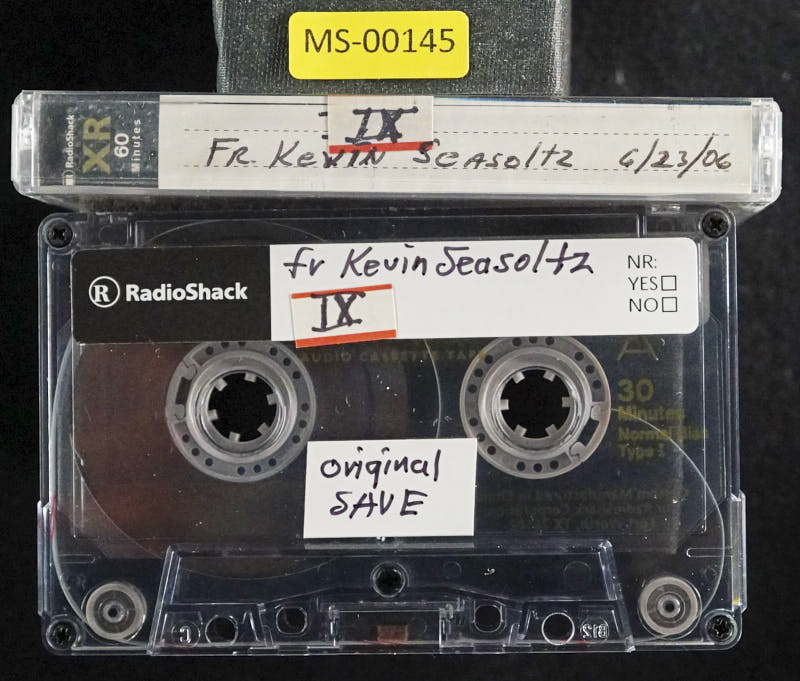
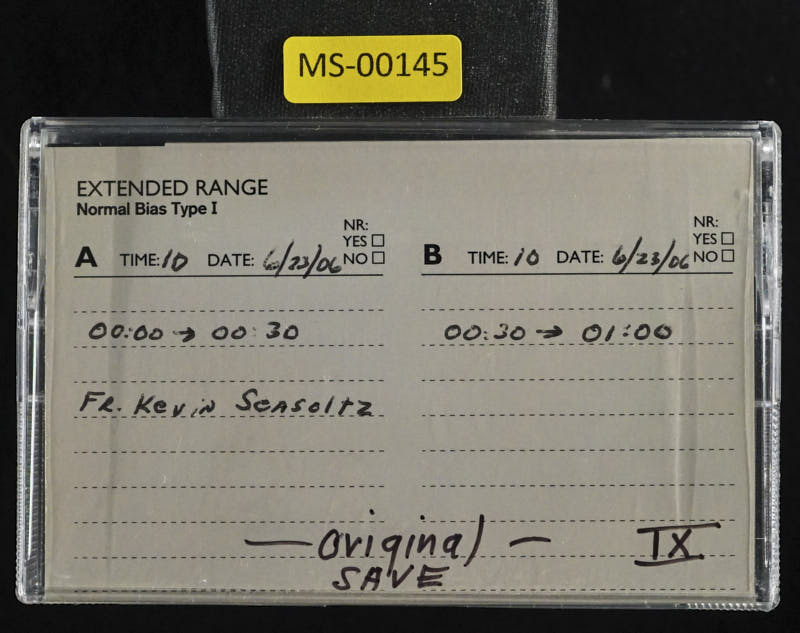
AI Vision - Possible Values from Photos:
Speaker: Fr. Kevin Seasoltz
Additional text: Original Save
@AI-Vision_v002
We may be your faithful witnesses to all those who are indeed of your gospel. We ask this to Christ the Lord and in the power of the Holy Spirit. Amen. I think they'll pop the gallop and ditch or something. It's not easy to listen to. I want to talk this morning, Rich Bauer, about uterus and social consciousness. In a book, that was published in 1979.
[01:02]
Philip Haley tells a true story of deeply religious people who were profoundly torn by the Word of God. People who opened their lives Sunday after Sunday to the wisdom and strength of God's Word. Then, as prophetic people, living in obedience to God's word, shared their lives and their possessions with others, above all of those in dire need. The story is Paul lets innocent blood be shared. And it opens with a knock on the door of a Protestant parcenage in France. during the Second World War, one night during a raging snowstorm.
[02:05]
It was later recalled by the Jewish fugitive scooch shuddering on the doorstep. Magnet, the pastor's wife, opened the door, looked at the stranger asking for entry, and she cried, come in, come in. as she drew the Jewish woman into the warmth of her kitchen. The pastor's wife was aware, as everyone else, in the village of Les Chambons, of the penalty of bartering Jews. Death, both for the Jews and for those who bartered them. And yet, the refugee lived across her threshold that reiterated her night. It was only the first of hundreds who were given shelter, who were fed, and escorted to freedom from the farmhouses, the schools, and the bollies, or glacial bollies.
[03:16]
And years afterwards, when asked what had made them risk their lives for these unknown Jews, People of Les Chambons found the question quite disconcerting. One after another, they hesitated. But after a few moments of silence, they replied, we've had no choice. They would have died without us. As they had all shared in the Table Fellowship, a worship year after year. So they also shared Magnet-Track May's immediate characteristic response. Amen. Amen. In the Jews, on their threshold, they implicitly would have recognized the life of Christ was at the center of their common worship. The life that they shared week after week through the word of God in Jesus Christ
[04:21]
and the embrace of the Holy Spirit. Truly, I tell you, just as you did it to one of the least of those who are members of my family, you did it to me. Now that story raises hard questions for all Christians who, by baptism, are committed to laying down their lives for others, just as Jesus laid down his life for us. And it raises critical questions for us as nuns, because we are presumably formed by the word of God and sacraments of the Lord Jesus Christ, week after week, day after day, year after year, through Christian initiation We are, in fact, publicly committed to bear prophetic witness, not only to the meaning, but also to the ethical implications, Christ's death and resurrection, the outpouring of the Spirit on all of creation, on all of us.
[05:39]
Question then, what difference is the celebration of Christ's Paschal mystery, make in the way we Christians live and relate to God, to the world, and to each other. The Christian Eucharist is primarily the celebration of the work of God in Jesus Christ's acting through the power of the Spirit. It is that Trinitarian work which is given expression in Christian assemblies of believers who should be facing contemporary ethical and political issues. Therefore, turn to God in Jesus Christ through the power of the Spirit, bearing chestnut
[06:46]
and powerfully operative in human hearts and in human communities. We Christians turn to God in order to procreate to receive the gift of salvation to express and deepen our faith and our communion not only with God but also with each other. And as a result We have a distinctive identity. She is expressed, hopefully strengthened, through our regular celebration of the year. This sense of identity empowers us then to relate, to live for others, to relate to the world just as God lives and relates to all of creation in Jesus Christ with the power of the Spirit.
[07:53]
Our Christian Eucharist then should always have a Trinitarian shape. In other words, it expresses the inner light of God, revealed in Jesus Christ as three persons in one God, as both personal and and common. God's own consciousness, revealed in Jesus Christ, is both personal and essential. The Eucharist also expresses the self-gift of the incarnate Son of God, offered to the Father, the power of the Holy Spirit, but it's a self-gift offered also to us as God's people. His whole life was one spent for God and others, one which ended, as we know, with his death on the cross.
[09:03]
As I mentioned the other day, he was put to live by political and religious leaders who were in fact threatened by his commitment to God and God's people. Especially his commitment to the poor, the marginalized, and the sinners, at least that. Jesus himself passed from death to life. He rejected false idols, power and pleasures. by committing himself to the Father as the ultimate source of meaning and value in his life. In other words, all life lore, he entered very deeply into the healing and corrective dimensions of life. And he brought light when it was dark, brought light when it was death.
[10:09]
And just as he himself died to the temptation, to isolation, to self-preoccupation, to self-sufficiency, so he invited and empowered us to take up our cross daily by responsibly embracing the gift of the Holy Spirit, Spirit of the All-Living God, comes to us momentarily by moment, in the context of other living people. As I mentioned this morning, Jesus himself had to pass from this baptismal experience of unconditional acceptance by God, you are my beloved son and you I take delight. He had to pass from that to the desert experience, loneliness and pride.
[11:15]
He had to come to grips with the mystery of evil. He had to tap his own hidden inner resources, confront the mystery of life rather than in life, confirm above all the ultimacy of evil. The way of suffering, the way of the cross, It's the way of liberation, to freedom, to eternal life. So it has to be in the lives of all of us profess to be disciples of the Lord Jesus Christ. As we all know, there is an enormous amount of suffering in the world today. Much of it comes from injustice.
[12:18]
And the experience, I think, offers us the opportunity to search out and to find the unsuspected resources that are very deep within the heart of each one of us. As Léa Moix wrote, There are places in the human heart which do not yet exist. Suffering enters into them so they might not exist. There are places in the human heart which do not yet exist. Suffering enters into them so they might not exist. Suffering is often the key to the discovery of what we are, what we have in us to become.
[13:21]
Only we summon forth that power and strength. Senator Zegrees' little prince once observed, what makes the desert beautiful is that somewhere Far below its surface holds a spring of fresh water. And our challenge is to discover that light giving us spring. In one of his plays, Eugene O'Neill wrote, that man is born broken. He lives by lending. The grace of God is to do. In our better moments, we know that the brokenness and the burdens of life are not pointless. It's sometimes very difficult to go on convincing ourselves at that point.
[14:25]
For example, the person we love beat the guy suddenly, subject to a violent accident, and a little child develops cancer. A very important relationship is frustrated. Again, let me see people hungry and poorly housed and inequity clothed. Depression often sets in, sometimes even despair, sometimes feel marooned in pain. Yet, in courts of time, it often happens that many mysterious events seem to work together for good. Because life is always something we live forward, but understand won't be backwards. Eventually we come to grasp the positive meaning and value of what at one time appeared to be simple matters.
[15:35]
Well, Christian initiation the celebration in which the Christian community affirms life on its deepest levels. It's really meant to move us into the life and mission of Christ himself. Christian initiation is most fundamentally a call to life, to love, to communion of life with God and God's kingdom. The marvel is that before we're asked to love others, we're first of all, loved by God, who operates through the community, meant to symbolize for us what's love for all people in Christ and through the Spirit. In other words, our baptismal experience is meant to be like Christ's baptismal experience. The contemporary quality of Christ's baptismal experience was captured very imaginatively by the British painter Stanley Spencer in his scenes from the Gospels, which he set in his native village of Cucum in England.
[17:00]
And in his painting, which he calls Baptism by John, Jesus is immersed in the River Thames at Cucum, with contemporary people in bathing suits, swimming all around it. Spencer would probably have agreed that a price was not contemporary. It doesn't live with us in our time. The power of the Spirit is really not the price. of the Lord Jesus invites us who are sometimes perhaps often weary and burdened to come to him. He doesn't promise that he's going to take our burdens away. He does guarantee us strength, courage and peace.
[18:04]
You know the New Testament says regularly protest against a spirituality, that suffering and hunger. Protests against the false delusion, God is to be found apart in Jesus Christ crucified. If we want to be reformed in God's image, share in the risen life of Christ, because first of all, be found in the image of Jesus on the cross. However, I would stress that the acceptance of suffering must not be equated with passivity, with indifference, with abstract endurance. Those responses, in fact, simply pardon the human part.
[19:08]
They dehumanize the human person. As a result, then the real self never surfaces. The track is always set for us. It's exemplified in an amusing but very disturbing Charles Adams cartoon in the New Yorker a few years ago. Two women. are looking at an enormous blob sitting in an armchair. And the only signs of light are its beady eyes. One woman turns to the other and she says, we're still waiting for Stan Lee to gel. We're still waiting for Stan Lee to gel. Sadly, sometimes we're tempted to yield up all responsibility. We just drift. We refuse the ongoing gift of God's Spirit.
[20:14]
We simply become blogs, destined never to jail. In fact, we're called to confront suffering and struggle through it, so we might become more capable of love. more capable even of suffering. And in bearing our cross, our isolation, our self-protection, they're often broken open. So that a result then, in our hearts, our broken hearts, there is in fact more room for others. Above all, more room for God. In the prophecy of Isaiah, who claims that the way of the just will be smooth, which food and choice wines are all along the way.
[21:17]
I think most of us know those who have tried to walk the way of justice and peace, whose stations are warm, whose bodies are very high. Powerful image of Dorothy Day, which you may have seen in the National Catholic Reporter a number of years ago, but it comes to mind. She's sitting on a stool in a Shabbat boycott line, her face turned with a part California sun, her wriggled hands took the grass to her knee. You know, persons who are especially sensitive to the ways of God, to the dreams for the world that were entertained by the prophets above all by Jesus, those people often experience a pain that is not shared by others.
[22:24]
A pain of weariness and sadness that frequently shows in their faces. That was expressed well, I think, by the American poet Paul LeCunel that each year I lived, I watched the fissure between what was and what I wished for widened, but it was nothing left but the gulf of it. This is most men have not seen the world divide, or if they did, it did not open wide, or wide they plung to the safer side. but I have felt the sundering. So we ask them, is the way of justice and love always true? Certainly, the image of the radiant God as a banquet is often tried and tested, purified even.
[23:31]
When we see hatred and injustice, living side by side with those who celebrate the Eucharist every Sunday, perhaps every day, claiming to be disciples of Jesus Christ. Receptive people tend to grow disillusioned by institutional violence, by benign and liberate. At that moment, then, that one must be just with one's own consciousness, one's own conscience. I think it's then that one learns the meaning of honesty and truth. One learns how to respond to the mystery of God's Spirit in the human heart, calling us all into a deeper entry into the pastoral mystery of Jesus Christ, in order that somehow
[24:33]
In our own distinctive vocations and ways, we might come to share the transformation of our world. But often the meaning of the Eucharistic banquet is simply transposed to a deeper level where hope for the future becomes the great source of nourishment, and perhaps the only source of nourishment. that we can offer to others. Our Christian initiation, our monastic initiation, as we've heard in the reading in the refectory, has launched us on a journey. Past the last, all I do. In other words, we spend our lives becoming the Christians that we're called to be. And although we have died together with the Lord Jesus and have risen with him to a new life in baptism, we're still en route, en route to where the Lord Jesus sits in glory.
[25:50]
The path that all of us have to follow always takes us through the world. And so, as we live in the world, we do not know precisely where fidelity to Jesus Christ is going to lead. We do know that along the way we will be supported by the Eucharist, but the specific contours of our journey simply remain unknown to us. journeyed by faith, not by full knowledge. Consequently, major decisions have to be made along the way. I think our Christian lives are often stymied by our failure to recognize that we are called to venture into an unknown future
[27:02]
Unfortunately, the strong faith of Abraham has so often been replaced by a calculating shrewdness which refers a very clear blueprint to an uncharted course. Such an attitude excludes really any positive decision making. God's invitation to us in Christ is not something that we initiate But can the risks involved in Christian living be eliminated by our human calculation? In the Eucharistic ground over which we must journey, as I said yesterday, is set out for us symbolically. The group for the journey is shared. The ground, however, is often very unfamiliar. terrain is often very rugged and steep.
[28:12]
Symbols are always ambiguous. They do yield their meaning only to those who are willing to engage in the complicated tasks of interpretation. Perhaps Reason God is sometimes hard to find these days that we do not look low enough. I think that's so well illustrated in Jesus' parable of the Good Samaritan. The priest and the Levite in the parable thought that they would find God in salvation in the clarity of the law, which forbade them to have any contact with the dead or anyone who's soon about to be dead.
[29:15]
They knew well that if they had touched a dead body, they themselves would become impure, and so they would have been prevented then from carrying out their very religious duties. Samaritan, then despised by the Jews, He looked down in the ditch. He was overcome by compassion for the man that he saw there. So he was the one who set about fulfilling the duties of mercy and hospitality. The other two simply echo. In our complex world, there is the temptation to act like the priest and the priest. There is the strong temptation to look for precise laws, for very clear rubrics, for unambiguous doctrinal statements as the way to find God and salvation.
[30:25]
Life today is much more mysterious, much more complex. There are no easy answers. As I mentioned the other day, Freud was fond of telling his patients the measure of a person's maturity is his or her ability to live with ambiguity. I think the point of Jesus' parable is clear. Don't look up to the precise law Find a way to God and salvation. Look rather down to find the neighbor. Neighborliness is all, and all are our neighbors. If we are to learn the secret of eternal life, loving God with all our heart and strength and mind,
[31:33]
teaching of Jesus I think is quite simple. Lock the other person. Charles Peakey bodies have always been in danger of introversion. Trying to encapsulate the spirit. Sometimes even of masquerading as God in the midst of the world. It's a danger in Manastas. It becomes so inward-looking, so self-preoccupied. Perhaps one is even more evil if we could become very vulnerable. We really did, in a welfare state, we have excellent food. Though we have to complain about it.
[32:35]
wonderful housing, all sorts of educational opportunities, superb health care and hospital care. All these things are so easy to take for granted by a comfortable one. I think in this regard, one might think of Federico Collini, still eight and a half. in which Guido is anguished by the emptiness of his life. Desperation emits, arranges to meet the Cardinal at the baths. And it's a marvelous scene, ensconced in steam, wearing his buckled shoes like his scarlet Zucheta. The Cardinal has a smug and very facile answer to Guido's plight as he responds to the solemn oracles. Extra Ecclesion, Nula songs.
[33:41]
Outside the church, there's no salvation. Cardinals like Joshua in the Bible would complain because there were other people prophesying in the camp. Moses asks the very hard question. Are you jealous? Are you jealous? Would that all people of the Lord were prophets. Would that the Lord might bestow His Spirit on all. For whatever the evidence, the future simply belongs to those who embrace it. Belongs to those who seek the truth. Remain confident of it. the power of the powerless, the gentle, the repentant, the poor. Confident in the power of simplicity which scorns rich idols.
[34:49]
Confident in the power of those who are in fact voices of the voiceless today. Confident in the power of those who stand by the intrinsic value of the truth and goodness implanted in their lives and their communities That was the very message of the Old Testament prophets, certainly was the message of Jesus. Ezekiel, such a prophet, he wasn't a political or a military man. He spoke God's holy word, justice and righteousness. His concern was about a nation's sin And each person's involvement in that sin, dissuading a bigot from their guilt, was his chance. Well, nowadays, we call such people whistleblowers.
[35:55]
It is a sad, often unpredictable fact of life. Those who stand up for righteousness these days opt get knocked down. Whistleblowers are a prime example. A policeman reports that other policemen are abusing suspects. He's shot dead, punished with very clever, but often violent values. A woman reports accounting abuses in a large corporation. comments on her coverage. You know, we just downsize. You know, paraphrase. You see, criticism and cover-up go together. Part of the cover-up is to eliminate the criticism.
[37:04]
No constriction can be put on the Lord's assertion of love often tough law, is always meant to be the response to human life and its predicaments. Such law always demands initiative when a fellow human being is victimized by evil. Of course, reconciliation becomes possible when people possess the skills to accomplish it. custody of the conduct of others never goes away from us. In the workplace, in neighborhood situations, community and family life, in schools that we run, responsibility for the conduct of others is almost always in escape.
[38:05]
As we know, many of us tend to escape but the responsibility, either by temperament or by constitution. Nevertheless, the responsibility does not go away. You play it safe. Why get involved? There's always, too, the matter of courage. Confronting another person's behavior is never easy. Never easy. And so in fact, often the one you want to encounter, for example, in our communities, it's skip. We conclude that, well, he's hopeless. The situation, he's incorrigible. And what's worse, he's sipping your rock. And so immediately, what do we do? We go to the uprights. I go to the prior.
[39:05]
I go to the apple. in the book having the offender somehow chastised strangely often we seek punishment first because reconciliation demands on our part mental and emotional qualities that we say oh we don't have those qualities it's impossible you know Each year, in September, the Americans celebrate Labor Day. And it marks a movement that really has been extraordinarily influential on the lives of all of us. And its concerns gets you in accord with the papal and cyclical, Leo XIII, Pius XI, John XXIII, John Paul II.
[40:11]
As a matter of fact, I think there would be no United States as we know this country without the gains of organized labor. They are gains which were wrested from the rich and the powerful and resisted at every step along the way. studied American history who may have heard of those signs that appeared in sweatshops and factories regularly in the early years of the 20th century. If you don't come in Sunday, don't come in on Monday. You're extendable, all of you. We can find people in greater need of a job than you. They're the ones who will be working here next week. That's precisely the way it was in Manhattan in 1901. Exactly.
[41:14]
That's the way it is in this country, even now. You have undoubtedly read in the Catholic papers or the secular papers very subtle threats to those who seek to organize workers in this country, even in Catholic diocesan schools hospitals across the county. You may also have read the deeply disturbing book by Bardwell Ehrenreich called Nickel and Die. Nickel and Die. was on the New York Times bestseller list for many weeks. It's a classic about undercover reporting.
[42:16]
The simple fact is that millions of Americans worked full-time, year-round, for poverty rate. And so Ehrenreich decided to join them, inspired in part by the hollow surrounding our welfare reform, it's promised that any job equals a better life. But how could anyone survive, let alone prosper, on six to seven dollars a dollar? But to find out, Aaron Wright moved from Florida to Maine to Minnesota taking the cheapest lodgings available, and accepting work as a waitress, a hotel maid, a house cleaner, a nursing aide, and Walmart salesperson in Minneapolis.
[43:18]
She soon discovered that even the lowliest occupations require exhausting mental and physical efforts. She also discovered that one job is not enough. You need at least two. You're not going to live on the streets. Nickel and dine reveals low-wage in America in all its tenacity, its anxiety, and its pain. This is a land where people are forced to live in cardboard boxes, in underpasses. a land where some people only can eat fast food, a land where they must resort to desperate measures just to survive. McGarran White has brought the news of America's poor to our attention then with deep and moral courage.
[44:29]
She's a premier reporter of the underside of capitalism, the rich get mature, and the poor get poorer and poorer and poorer. I think it is significant. Because of her efforts, you probably know, Walmart's policies have been challenged in court across the country. There's no doubt that abusive labor practices continue to plague workers both here and around the world. I think that's a circumstance that should give pause to all of us. We're very fortunate enough to live comfortably in our community. For many in this country, it might come as a surprise, but even here,
[45:32]
worker exploitation is pervasive. As Aaron Wright pointed out, Walmart, the country's largest retailer, offers an excellent case in point. Among other issues, the company has been cited for child labor law violations in two dozen stores, naturally. After a federal investigation of such issues in Connecticut, Arkansas, and New Hampshire, that giant corporation was buying $135,000, the sum that child advocacy groups derided simply as pauper. Likewise, the use of child labor in poorer countries is also widespread. But it's far more blatant, despite the prohibition in the United Nations Convention on the Rights of the Child, a work considered dangerous or detrimental to children's education and development.
[46:48]
Human Rights Watch, for example, has documented harmful practices in El Salvador. One of the reports found that children as young as eight planting and cutting in sugar cane fields, which is back-breaking work in which accidents are very common. Young girls working as domestic servants around the globe make up another frequently exploited group. The International Labor Organization has estimated that more children work as domestic in any other type of child play. And because it is a hidden employment, working as they do in private families, often unseen by the outside world, physical and sexual harassment and abuse are really quite common.
[47:56]
And of course, there are long hours of work to keep the possibility of education. Where Daleks, worldwide, resistance to unionization by big corporations militates against fairly good practices. This all raises the question, what do those who teach management in our colleges and universities. What do they communicate about all this to students? St. John's were overrun with management makers. Students are honest, but they'll tell you, I want to make money. Again, Walmart is a good example.
[49:00]
For example, when 10 butchers at a store in Jacksonville, Florida, voted to join a union, Walmart simply eliminated their jobs by shipping in precutments. A far more reaching step was taken up in Canada. When workers at a store in Quebec moved toward unionization, the whole store was closed down. exploited labor practices have become increasingly common here among the estimated 10 million undocumented workers, not only in the United States. And because of their irregular immigration status, they can so easily then fall prey to unscrupulous employers. The 1986 federal law mandated that employers verify the legal status of their workers, especially in some physically demanding jobs that many Americans won't take, like construction, agriculture, meat processing.
[50:24]
Employers then become desperate for help. And so they wait. at the immigration issues. These poor people applied for jobs. Of course, should the workers then complain about their working conditions or their low wages, the threat of being reported to the immigration authorities is immediately called into play. One notorious example concerning the group of eight Mexican workers at a Holiday Inn in Minneapolis. Then the poor workers, mostly housekeepers, voted to join a union. The inn's manager simply fired them, and then immediately reported them to the immigration service. It is very significant if you look at the labels on the clothes that we wear, much of the clothing
[51:28]
It's now made in a very royal country where wages are prophetic and low. Likewise, many of the books that we read out are printed in China. Because wages are low and the costs for printing are much lower than printing costs in this country. And you're probably asking, Look at those examples that I set out here and many things to do with the Eucharist. So they have everything to do with the Eucharist. The Eucharist has everything to do with that. Our appreciation of the Eucharist must be rooted in our embrace. God's great love for us manifested above all the gifts of the sun, the outpouring of the spirit of all the creation.
[52:38]
In other words, the Eucharist provides a context in which we celebrate, can discover or rediscover who we are in the world and what the nature of the world we live in is really like. There's no view that is set out for us in the celebration of the Eucharist, certainly at odds with the highly privatized view of religion and salvation, but so often espoused by contemporaries. And I think that individualistic view of religion often gets reinforced contemporary literature on spirituality where the language is very narrow.
[53:39]
It's autistic. It's tribal. Hence, it's far removed from the broad social language of both the Bible and the Christian Eucharist. Talking a language which simply advocates individual growth, individual fulfillment, shies away then from the gospel themes of transformation to suffering and death to oneself that others might live. But obviously there's no coercion in the Eucharist. It's only a loving call. It's an invitation to act and to relate to one another and to God, according to the prescribed patterns in the ritual.
[54:41]
We know so much of modern life spent in competition with others because we so strongly know that they live by success and consumers. You know, in the Eucharist, there's no need to justify our existence. There's simply a need to be there, to acknowledge our need for a Savior, for a loving God, when we find in Jesus Christ the power of the Spirit. There's simply the need to embrace the gift that's offered to us, to respond with thanksgiving and praise. And if we allow God to be God in our hearts and our communities, that God, in fact, is created compassionate, loving, just. We ourselves and our communities then will in fact become loving, compassionate, just.
[55:46]
In a world terrible. Ugris unfortunately is contaminated. if it doesn't serve as a paradigm for honest, just, loving relationships outside of the celebration. Turgical celebrations which do not correspond to the worldview of Christ readily, I think, becoming corrupting agents in the lives of our persons and our children. Certainly in the Eucharist, do not celebrate the failure of the dead Messiah. We rather celebrate the fact that the one who identifies with us and all of our failures, because he loves you so much, is precisely the one who God has raised from the dead.
[56:50]
So in Gerard Manley Hopkins' really lovely words, every time we celebrate the Eucharist, We want that risen Christ to Easter in us. Easter in us. Be a day spring to the dimness of us. Be a crimson precedent beyond. That's precisely why we celebrate the year. Come back at 11.30, you know, you can just spend a little time, maybe, in a restaurant.
[57:44]
@Transcribed_UNK
@Text_v005
@Score_89.2