You are currently logged-out. You can log-in or create an account to save favorites and more. more info
Embracing Unity in Sacred Traditions
AI Suggested Keywords:
This talk delves into the integration and appreciation of Eastern Church liturgies within monastic practice and the broader Catholic Church. It emphasizes the need for monastics to rediscover and incorporate rich spiritual traditions from the Eastern liturgies to better reflect the universality of the Church and deepen the understanding of monastic life. The discussion highlights the role of ancient and evolving interpretations of the biblical narrative of creation, the unity of nature and the divine, and the return to a sacred recognition of nature, body, and spirit within the framework of monastic endeavors. A fundamental facet includes the return to original sources and the importance of harmony between nature, body, and soul, characterized through scriptural and theological exploration, reflecting on the holistic unity and relation to God.
Referenced Works:
- The Rule of St. Benedict: Cited as a fundamental guide for monastic life, emphasizing the return to early sources of monastic tradition.
- The Conferences by John Cassian: Mentioned as a source St. Benedict referred to, linking to monastic ideals.
- Works of Isaac of Nineveh (Isaac of Syria): Highlighted for their insights into spiritual life within the Assyrian church tradition.
- Sacramentum Futuri: Shadows to Reality by Jean Daniélou: This work is discussed for its explanations of how the Church Fathers understood the links between the Old and New Testaments and the mystery of the scriptures.
- The Bible and the Liturgy by Jean Daniélou: Illustrates the Fathers' understanding of the mysteries in biblical narratives.
- Work by Origen: Acknowledged for pioneering interpretations of the scriptures' mystical elements and unveiling its deep theological meanings.
- Concepts from Pierre Teilhard de Chardin: Discussed in relation to an evolutionary perspective on creation and theology, aligned with St. Paul's doctrines.
Biblical References:
- Genesis: Key to understanding the "New Creation" concept, emphasizing the roots in the Old Testament creation narrative.
- St. John’s Gospel: Linked to the creation mystery through its opening words regarding the Word.
- Letters of St. Paul: Cited for teaching creation through Christ, providing a Christological view of creation.
AI Suggested Title: "Embracing Unity in Sacred Traditions"
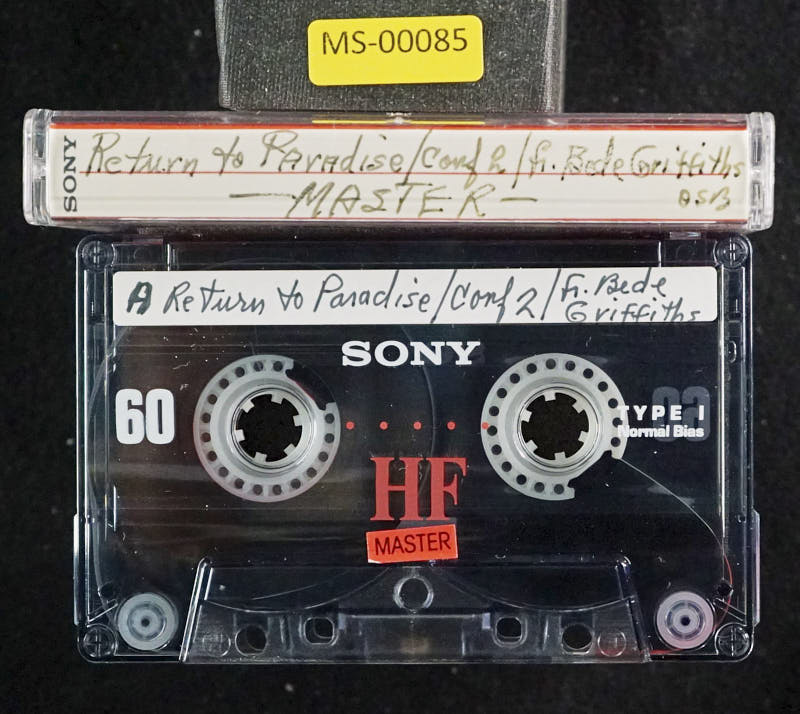
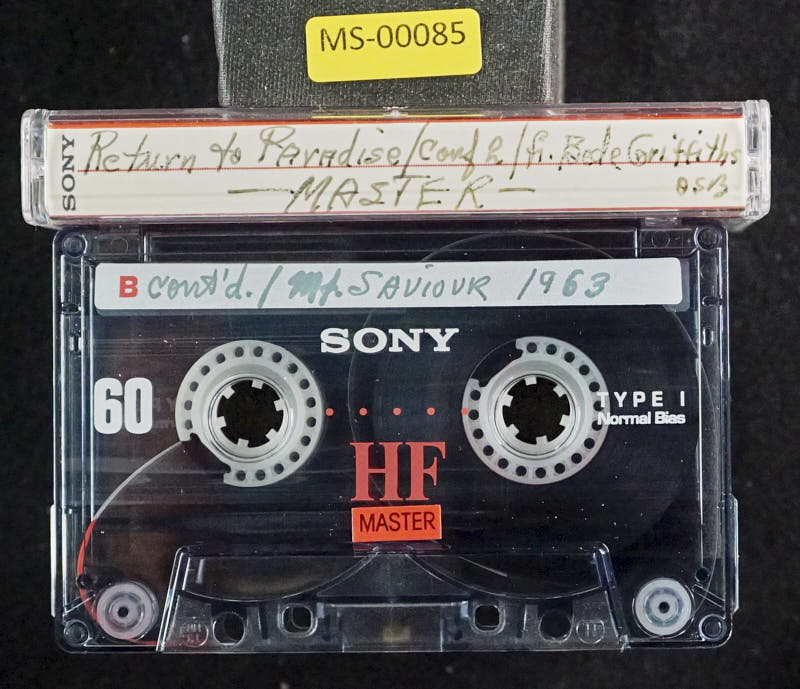

AI Vision - Possible Values from Photos:
Speaker: Fr. Bede Griffiths
Location: Mt. Saviour Monastery
Possible Title: Return to Paradise
Additional text: Conf #2
@AI-Vision_v002
the child of your father and your brother. The field of the liturgy that we celebrate in the morning is the spiritual path of our retreat. A drawing walk tells us I do always when I celebrate it that it is a real experience of prayer. To me, this feeling of liturgy is a perfect act of divine worship more, perhaps, than I've ever experienced before. And I would like to mention the importance which I and Father Francis with me attached to the oriental rites. It has been a new experience for us. When I first went to India, I had no intention of making any change.
[01:01]
I thought we would simply follow the Benedictine rule and have the Latin liturgy. In fact, we began in that way. But gradually we were led through various experiences, in particular the discovery of this rite, to make this change. And it has really been a wonderful experience for us. And I know that you are also interested in this As a matter of the Eastern liturgies, I was saying yesterday that the Church has to be universal today. It has to be in practice what it is always in its essence, universal and Catholic, embracing all cultures and open to different forms of worship and, I would say, also to different forms of theology. And consequently, I fear that it is necessary for us, particularly as monks perhaps, we are particularly concerned with the worship of God, to be aware of this diversity of rights in the Church, and to some extent at least, as I know you are doing in your own practice, to make use of these other forms of worship so that we...
[02:21]
learn something of this universality of the church's prayer. And this discovery from, say, the Eastern churches is not only discovery of prayer, it's discovery of a whole tradition of Catholic life. It is quite extraordinary, actually, to follow this Syrian literature to discover how different it is, though essentially the same as the Latin rite. For instance, we celebrate saints. We can have, in fact, a saint for every day, but we scarcely ever celebrate a Latin saint. St. Peter and St. Paul, the apostles, perhaps one or two masters, but the city of the church has a complete calendar of our own saints, some of the Greeks, certainly, but very few of the Latin saints. And I think it's well for us to remember this wonderful diversity in the church, that there are these different worlds, the whole wonderful world of the Latin liturgy, the equally wonderful world of the Byzantine and the Slavonic liturgy, and then this quite separate and distinct world, which very few people know very much.
[03:36]
of the Syrian church and her liturgy, with martyrs, particularly the Persian martyrs, tremendous persecution under Saphore in the 4th century, and particularly of all, really, her hermits and monks, this wonderful tradition of domestic life, which we know so little, but which I and Father Francis are beginning to discover. But all this, I think, is important for us as monks, that we should be aware of these riches these days of the church and the domestic life. And so, as I say, when we follow this liturgy, we become aware of another world of Catholic life, and I think it takes us to this Eastern world, which Benedict himself was associated for the domestic life that he perceived it. You know in the rule how he refers us, most of all the Bible, that then to the Catholic Fathers, and he mentions the lives of the fathers, casual conferences, and our early fathers, that all.
[04:53]
So the sub-Energic himself refers us to these sources, and I think as monks today we have always to be going back behind the rule to these sources. monastic life, a tradition. And again, we found wonderful riches in the monastic tradition of the Syrian church, particularly some of you may know him, Sir Isaac of Syria, Sir Isaac of Nineveh, he's very extractor against the part in the Philokalia, really one of the great masters, I would say one of the two or three great masters of spiritual life in the history of the church. And so one becomes aware of this tradition of monasticism, and I feel that in our lives we must get back to the sources. As you know, the Church is engaged on this return to the sources, and we as monks have to find what I call the monastic tradition and the monastic order.
[06:00]
Before we're Benedictines or Cistercians, or belong to any particular order, we all belong to the monastic order, and we're inheritors from this monastic tradition, which goes back beyond St. Benedict to St. Anthony. And then, of course, even beyond St. Anthony, it takes us back to the world of the Bible. We can never forget that our monastic tradition though it has accentuated certain features. It's simply rooted in the biblical tradition. You know, the fathers always considered Elias and John the Baptist sort of types of love. Well, I may disagree with some of the viewers they held about the actual life of Elias and John the Baptist, but I think, John, it is of very significance for us. These biblical figures, the old and the introduction to the New Testament, does stand for us for a deep principle of monasticism.
[07:05]
If you like simply this life of the desert, the life of the desert, on the Baptist turning up to the desert, it's a witness to monastic tradition, how it goes right back beyond the fathers to the New Testament and to the Old Testament. And so, as we follow this tradition back, we're inevitably brought back to the Bible. And I'm sure you and we do find that one's thoughts and one's meditation, as soon as one begins to try to fathom the monastic life, takes one back to the Scripture and to a deeper and deeper meditation on the Scripture. Actually, I find it rather amusing in our monastery, Father Francis gives us uh, conferences to the novices, and he seems quite incapable of getting beyond the chrono, the rule. The chrono sucks him off, and then he gets back to the physical sources that go, and we go on and on, getting deeper and deeper into the sources, and we don't get on to his further racism about the rule.
[08:19]
But I think that is fascinating. really valuable. It's something which we have to be doing. Now, in this retreat, we are taking as our subject, as I said, a new creation, which is, of course, a biblical deception, and we have to go back and the sources of this idea of a new creation inevitably in the Old Testament. As soon as we begin to study the New Testament, we're taken back to the old. The new is rooted in the old. As you know, you can't take any single phrase from the New Testament partly of its great theme, the kingdom of heaven, the Messiah. All the fundamental themes simply take us back to the Old Testament. And so with this idea of the new creation, we naturally go back to the first creation, and we're led to open the Book of Genesis. Well, I won't take you into any detail into the Book of Genesis, at least not this morning, but we can meditate on this mystery of creation, and we can, I think,
[09:33]
try to fix in our minds what our approach to the Bible should be. As you know, the Fathers had this wonderfully deep sense of the mystery of the Scriptures, and that is, I think, what we have to recover. In our modern study of the Scriptures, as you know, great advances are being made, and they are really necessary for us. We have to know the general principles of biblical criticism and the idea of the organic development of the Old Testament from early sources of extreme importance. But behind that, surely, we have all to be trying to discover this mystery of the scriptures, which, as I say, the fathers are concerned with, and which really goes back to origin. It's in him we find the first Well, it certainly goes back behind our kids. It goes back to the apostles, really. But he was the first to bring out in a systematic way this unparalleled mystery of the Scriptures.
[10:40]
And we actually have to follow in his footsteps. And so when we come to the story of creation, we must approach it as a mystery. I would even be prepared to say we have to read these first two chapters of Genesis As a myth, in the most profound sense of the world, a myth, a myth, is really a divine word. It is a manifestation of the hidden work of God. Even in the primitive tribe, you know, the myth is essentially a sacred story. It is a story of the divine beginning. as Thessy Eliade is always quoting in Illo Tempore. The list tells us what happened in the beginning when God first acted. And so it is in the Bible. We approach this story of creation to find in it a muthos, a word, a manifestation of the divine mystery.
[11:41]
And we must eliminate from our minds purely rational scientific view. perfectly all right to have a rational scientific view of the beginnings of the material world, as far as they can be known, and of the production of the book of Genesis, for that it's fatal to stop there. And I think that is really the trouble, a scientific rational view. tends to absorb the attention that people think when you've discovered that you've found the whole meaning, what you've only got a very, very elementary and basic meaning. So we have to go behind that and try to see this hidden mystery which God is revealing to us in the story of Genesis. And so we consider in the beginning God created the heaven and the earth. And You know the fathers take this trait in the beginning in a very deep sense.
[12:43]
They relate it very rightly, and surely without any question, this is what St. John had in mind to the first words of St. John's Gospel. Genesis says, in the beginning God created heaven and earth. St. John says, in the beginning was the Word. And it seems to me we can't understand the mystery of creation precisely as mystery unless we understand how the creation took place in Christ. You know, St. Paul says, in him and through him and for him all things were created. So that when we ask ourselves what is this mystery of creation, we have to say it is the mystery of creation in Christ. And that surely is her key for the understanding of the scriptures, the key which origin of the father's hand. They, no doubt, they were often fantastic in the interpretation of the Bible, and that is what has led to a great deal of a modern reaction against it.
[13:49]
But as you know, a deeper study soon enables us to discover that behind many allegories and fantasies, there is this profound theological understanding I've been mentioning in particular Father Danielou's work, I'm sure, but if you know it, both the sacramentum futuri, a statement to English, the from shadows to reality, and also this very great work, the Bible and the liturgy, both of which show us how the fathers understood the mystery of the Bible. So it's this learning to see the Old Testament in the light of Christ. That is our real task as monks, I would say. Because surely we have a particular function in this. The modern teacher who's expounding the Bible, he must obviously use modern scientific methods. But from monks, he must make use of them.
[14:50]
His real lexio divina, a real... reading, surely, is in the Scripture, and in the Scripture understood in the light of Christ, using modern criticism, which has to give us, but basing ourselves on these deep principles, which Dr. Augustine, St. Gregory of Nyssa, Origen, Clement of Alexandria, were using, and which go back, in fact, to Father Daniel, quite clearly, to the Apostles and to our Lord himself. It's how our Lord and the Apostle themselves understood the Old Testament. That is what we have to discover. And so when we approach Genesis, we must see this mystery in the light of Christ. Now, we won't try to go in detail into this mystery of creation, but perhaps it's worth mentioning how In the early interpretation of the first book of Genesis, the fathers, you know, had two different interpretations.
[15:57]
The fathers of Antioch were rather of the literal school, and St. John Chrysostom, a great leader, and they tended to interpret it literally. There were seven days in which the world came into being. and that they took these as seven days of the week. And John Chrysostom was a pastor, a very practical man, not a great, certainly, reposition, or even perhaps theologian in a deep sense. And he was quite content in expounding the Genesis to his flock to speak of these seven days of creation. Ambrose in the West followed the same practice. Both of them were pastors. But those are the fathers who were theologians, were not content with this. And the school of Alexandria, which was always deeply theological, very soon had a different interpretation. It took the words, I think, from the book of Thesiasticus, God created all things semel, at once.
[17:03]
And they conceived the whole creation taking place in a single act of God, surely a very profound conception. And then they saw these seven days of creation simply as the stages in which this original act of God was manifested in time. And Gregory of Nyssa wrote a wonderful exposition of this in which he rarely anticipates, I think, the whole theory of evolution, that God originally created the seeds or potentialities of all things. And for the casting, you know, followed him later. He spoke of the ratione seminale, for seminal reasons that everything was created originally in its seeds, in its potentialities, and so created that in the course of time, these seeds were great to develop, and the whole order of nature as we know it would come into being. So there is an example, to my mind, of how the fathers, without the awareness of the scientific order of the nature as we know it, yet we're able to draw out the fundamental principle that all nature comes off from God originally, and that it comes out by this creative act of God in Christ, as we may say in the word, and then how it is manifested in time for a gradual course of evolution.
[18:26]
And now what is particularly significant is that the fathers saw how all this work creation converged, first of all, on men. You know, Teilhard de Chardin has developed this in what I think we all agree is the most wonderful way. some of the manner in which he formulated his theory, but I think everybody's agreed that he has really expounded, in terms of modern science, what is the basic insight, one could say, of Christian understanding of nature, really simply a development of the doctrine of support, seeing how the whole creation, from its very first stage, is ordained first of all towards man, and then finally towards Christ. We can't conceive creation properly unless we understand that from the very first movement of whatever it may be of letter, in whatever form it may have taken, God was preparing the way for man and for the resumption, the taking up of all things,
[19:39]
into Christ. So that creation from the beginning looks towards Christ as its turn. Now that surely gives us the fundamental Christological view of creation. And I find that very important for us to see that nothing should be allowed to escape from Christ. He is the head of the whole creation, and nothing can be seen in its true life without reference to paper. And so we can see in detail, if we choose to follow Kaya Deschardins, how the material in organic world was gradually building up to what he calls the biosphere, the sphere of life, and how this infinite complexity of the organic world was gradually building up through the different organic forms until a... mode of being was prepared in which man with his capacity of reason, conscious life that the noosphere, as Sharda calls it, could be manifested.
[20:46]
So we see creation converging on man, and then we go on with Sharda to a true Christian view of man and creation to see how man is through his history through the development of his consciousness is converging on the perfect man who is united with god in christ the whole creation is moving towards its fulfillment in christ from the beginning that all human history i think this is very important when we consider the different religions of mankind, the whole course of human history, so much of which, I mean at least 90% of which, is outside the actual sphere of divine revelation in the Old and the New Testament. We take the call of Abraham about 2000 BC, we've got to account for so many hundred thousands of years before Abraham.
[21:49]
But yet we know from this vision of the call fundamentally of the relation of all things to Christ that from the very beginning then was being led by God towards his fulfillment in Christ. There was no sphere of human life or human religion which has not been a vital and definite relation to Christ and therefore to the church. So we see how this The world is converging on Christ. And that, as I say, is the fundamental view of the fathers, their soul, creation, reaching up towards man and true man to God in Christ, who assumes human nature and takes up into himself the flow of this course of evolution. Well, now that shows us the fundamental plan of creation. And now we try to see what is the place of man within this scheme.
[22:51]
And again, we won't go into detail, but you know when you begin to study the story of paradise, you are in what Origen called a forest of symbols. You know, all the scripture, the forest of symbols. We were never tired, as you know, of finding symbolic meanings. rather fanciful, but sound very profound. And when we approach the story of paradise, there is no add-on, really, the depth of these symbols. Because remember that all these ancient stories, all these ancient lips, are based on symbols which, as it has been amply shown, are derived from the deepest levels of human consciousness, or rather, from the deepest levels of the unconscious. that there are in our nature these archetypes, these figures, ingrained in a being through which we're able to interpret the universe. And so man, from the beginning of history, has drawn on these symbols, these archetypes, in order to understand the universe.
[23:59]
And God, in his revelation, makes use of these symbols. The whole idea of paradise, the garden, the idea of a tree, the idea of a circle, all symbols of unfathomable depth by which this mystery of man's creation and after his creation or his fall are revealed to us. Well, as I say, we can't attempt to handle the depth of that mystery, but let's take this from it, that we can see how from the beginning man was created to be a part of nature, and to be in perfect harmony with the order of nature. It was God's intention that matter should rise up through these various spheres of being, of life, organic animal life, to man. And that in man, there should be a profound harmony between all the orders of nature.
[25:01]
And when we're looking for purpose of our life. When we're trying to see what human life should be, we must see what was God's purpose in the beginning. That is why, as I said, the fathers looked on a monastic life as a return to paradise, a return to the original border which God created and for which we were created. And only when we see death in as clear a light as we can in the light of Revelation can we see what's the purpose of our life. So first of all, I think we must see how then is related to this whole order of nature, that in our unconscious, we have this deep, unfathomable relation to the whole order of nature from its beginning. We can say that in our blood and in our bones, we are related to all those movements by which this world has been gradually formed over thousands of millions of years.
[26:03]
I mean, the actual formation of our bones in our body follows the same laws as the formation of the hills and the rocks and the whole structure of nature. And so also the whole formation of our blood follows the whole movement which separates in the trees, by which living organisms are produced throughout nature. Deep in our unconscious we are linked to all these portions of nature. You know the simile, which I think is as adequate as one can find, that our conscious mind is like an iceberg. We have this little tip of consciousness appearing above the waters, but under the waters we go down right into the depth to the very source of nature. So we should see human life emerging from this unconscious depth of nature. through thousands of millions of years gradually building up until the moment rises when life could come above the waters as it were above the unconscious into consciousness and could open into the life of God.
[27:15]
And there is the point where a man appears rising above the waters into consciousness into the light of God. So our place in nature is to be a medium between this unconscious world of nature and the divine life above us. And that is how man was created, to share in the truth. And you can see the difficulty of his position. You see, he's involved in this whole course of nature, in its unfathomable complexity. And in our bodies, when we try to think of what unfathomable complexity, There is. I mean, supposedly we would try for one moment to organize our body by our conscious mind. We should simply relax immediately. I think it's wonderful to think of these wonderful processes going on in us all the time when we digest our food, when we breathe, when we simply make a gesture with our hand.
[28:16]
We're calling on... all these wonderful forces of the unconscious which we can't control in the smallest degree, yet which are working in us and by which God himself actually is working in us continuously through this power of the unconscious. So we are in this difficult position where deeply involved in nature And we must never forget that. I mean, any attempt of angelism, separate the soul from the body, imagine that we were simply created to enjoy the light of God alone. That is illusion. It might have been very nice if we were, but we weren't. And we are involved in this rather terrible, but also beautiful world of nature. We must realize that. And I think as we go on, we shall see more and more how we have to realize more and more deeply this involvement in nature and how it affects every level of our life.
[29:19]
But with this involvement of nature, then originally it had also this opening on God. He was opened to the divine light and continuously aware of the presence of God. But speaking of that yesterday, and I think we should recall it, that primitive man, in every phase in which we can study him, seems to have this awareness of the presence of God. Perhaps I may recall a little incident around experience when I first went to India, because this sense of the presence of God is extraordinarily common among Hindus, almost universal. Quite nearer to our monastery, we had a small bungalow where we started the monasteries. There was a little temple to the monkey god, Hanuman. You needn't be surprised by the monkey god because it really signifies that the Hindu, like ancient man in general, was aware of this presence of God in every form of lecture.
[30:24]
That is why the Hindu is prepared to worship anything, or I think not accurately, to say he's prepared to worship God in anything. I don't think it is true that the Hindu is an idolater. I'm very doubtful whether the majority of ancient primitive people were idolaters. I think they worship the divine mystery in its manifestation in the different forms of nature. And so the Maliki is sacred to the Hindu in many respects as a manifestation of God on a certain plane. Well, I was doing a visit to this temple, and as I was coming away, I met an old Brahmin, a well-educated man. He'd been to a Catholic school, actually, and that was quite general. You'll find that most of the educations in those picked as Brahmin for being a Christian or Catholic school. And so he began to talk to me, thinking that I was wondering about this monkey god. And he began to explain that God is present in everything and he can be present in a monkey as much as anything else.
[31:28]
But above all, he said, God is present in the human soul. And then he began to quote some stanzas from the Bhagavad Gita in Sanskrit. They quote them, you know, they all, not all, but very many. educated Hindus know the Bhagavad Gita by heart, and also many of you Venetians as well. And they quote them in a beautiful sort of rhythmical chant. It's very appealing when you hear it. And so he began to quote this, showing how God is present in the human soul. And that man's happiness consists in realizing this presence of God. Well, now, that's very typical of the Hindu, and I think it is very typical of ancient man, and I think it is a sign of man's original creation, that he was creative in this state of awareness, a far deeper awareness, of course, than he's ever had since, of this presence of God filling the whole world in nature and filling his own soul.
[32:30]
And that is the real source of religion, is the awareness of the divine presence. And that is surely what we have to seek to recover. And I think we, particularly as monks, we are deeply rooted in nature. The other orders of the Church are concerned with... preaching the gospel, particularly in the modern world. I always think, you know, they're very significant that when St. Francis and St. Dominic came, it was when the towns were beginning to develop in the Middle Ages. From the 6th to the 10th century, which Newman calls the Benedictine centuries, the church was settled in the countryside and the monastery was the typical form of the church. rooted in the countryside. Then, in the 11th century, in the woods, the towns began to develop, and the need was built to preach the gospel to the four of the people in the towns, and so the prayers grew up.
[33:32]
And then, as civilization extended, so the different modern orders came into being. And that is their function. But our function as monks is still to remain rooted in the soil. A monastery is a place of stability. We stand firm in this enclosure where we'd be placed and separated from the town. We can never really avoid that. You have a very good example in your monastery here. I always feel happy when I come to a monastery. You get out to the town and you probably lose your way going up separate roads until you find this remote place where the monks have separated themselves from the world. I think that's very important for us in order that we may belong to this world of nature. And surely our manual work also places us in this world of nature. Very few orders today have any concept of manual work in their role, but for us
[34:39]
Surely it is fundamental. We have this relationship to a world of nature. We normally live or are there, be working for our livelihood. So we are rooted in nature. And therefore we have this particular obligation to discover this right relation to nature. Surely one of the tragedies or principle tragedy of the modern world is this loss of the sense of the holiness of nature. The world has become desecrated. Everything is now profane. We use nature for our benefit, and of course it's very wonderful what we do with it, but we use the sense of nature coming forth from the hands of God, how nature is still rooted in God. I mean that at every moment, as we know, it is only because God upholds each thing that that thing exists.
[35:45]
It's only because God is in it and moving it that it has life and growth in itself. And the modern world has lost that sense, and I think that is one of the things that we as monks have to recover. this sense of the holiness of nature, of God's presence in every natural thing. And that by no means excludes God's presence in the work of science and engineering. I mean, I think we have the task, really, to consecrate tractors and all the rest of it to the service of God. That is part of our monastic vocation, really. So there, I think, is a We have this awareness of our relation to nature, of God's presence in nature, and how in all our work we are working with God. We are bringing to completion, if you like, a work of creation. God has placed these powers in nature, and he gave the past the capacity to bring their potentiality into act, to impose certain forms on nature.
[36:49]
So that is one of our tasks, and one of our tasks which is bringing us back into this original harmony. Now the second thing is that just as there was in harmony with nature, so also the soul was in harmony with the body. And I think that again was very important for our whole spiritual life. As I said, not to think of the soul alone in its relation to God. And this has been one of the, I mean, tragedies of development of the modern world, and particularly, I would say, of the church in the modern world, that gradually the soul became separated from the body. And we talk hypothetically about the salvation of souls. And it has a terrible effect on the mission, because you go out to save God. Yes, they've got bodies, both bodies are related to a completely different world, an economic world and a social world and a cultural world, and so you're sepiening at the soul, and you quite miss the reality in which that soul is actually involved.
[38:03]
So it's done incalculable damage, this separation of the soul from the body, and therefore the loss of the reality of the human person. that men must be grounded by soul and body as one person. And that in our spiritual life, we have to be continually aiming at this reintegration of soul and body in their original harmony. That is part of this meaning, isn't it, of this return to paradise. It isn't an artificial paradise at all. It's this original state in which man was created and for which... that there should be this harmony of body and soul. And that, of course, is immensely involved. We may perhaps have time to go into it a little, but it does mean in all our spiritual life that all we are having to contend with these forces of nature and with all these forces in our own bodies, which, as a result of sin, have become
[39:06]
lost their original order and have become dangerous, but which nevertheless are essentially holy. And there again is this awareness of the holiness of the body, surely, that we have to recover. And I would say especially the holiness of sex, because there again is the tragedy of what modern life is, that sex has been separated on this... whole to which it belongs, and of course when you separate it, it becomes desecrated. It's no longer got its relation to God, therefore it has no longer its proper relation to human nature and human life. And we as monks have a particular function, I think, to recover the sense of a holiness of sex, of its place in the life of mankind. We will be able to consider that more in detail, perhaps when we come to the consider the vow of chastity. But surely right from the beginning we can see how this awareness that sex is holy, it is holy in marriage, and it is holy in virginity.
[40:13]
And we as monks have with our vow of virginity this call to consecrate this power of our body, this wonderful power of nature deep in the unconscious growing up from the very roots of nature which rises up in us and has to be dedicated to God if it's to find its proper fulfillment so the holiness of the body the holiness of sex the holiness of the whole of this organic life which we possess there again we are returning to the original creation God's original purpose And now finally, the root of all this awareness that holiness in nature, holiness in the body, holiness in our human being, depends upon this deep awareness of the holiness of God. And that will come to consider more this afternoon when we also consider the mystery of sin.
[41:19]
Because sin and holiness are not very closely related. But we can surely see how this whole order of the cosmos, right from the beginning, depended upon its orientation towards God. As long as nature was moving towards God, as long as man was moving towards God in all the complex movements of life, he was moving towards the end of his creation. And then that he separated himself from that, then the whole order of nature was upset. But therefore, we'd have to keep always before our minds this holiness of God, what I was speaking of yesterday, this sense of a center in which all these forces of nature, of the body and of the soul, are gathered together into their unity and into their harmony. That is the function of a monastery. To bring that nature to its original harmony, if I am there to work, by our regular disciplined life, by our communion with one another in charity, to bring back nature, to bring back the human soul and the human body into this order where they are totally surrendered to God, where they find their center in God.
[42:40]
And there, from that center, all our lives should radiate. Well, we weren't... go on to consider that more in detail now, but let us conclude with that thought that in the midst of all this complexity of our life, we have to keep constantly before our minds, for single reason of purpose, this holiness of God. God, you know, holiness means separated. A thing is holy when it is separated from the profane, from this world, from the use in the service of God. And a man is holy when he's separated from the world for the service of God. And that is why a monk is essentially a holy man. I think we should keep that. In the modern times, we think of holiness almost entirely in terms of sanctity, of moral holiness. And of course, monks are not necessarily holy in that sense. But we are holy in the sense that we've separated ourselves from the world for the service of God.
[43:46]
That is a charism. And perhaps we can say more of that, but it's one of the features of the Eastern Rite which has struck us so very much that in the Eastern Rites a man does not so much consecrate himself to God by vow as he receives a gift from God, a charism that had it, is a gift from God by which he is made holy. And I think that is a very important aspect of our life. so we are holy because we are separated from the world and in the monastery we can find this order of holiness where nature once again is restored to its proper relation to God where soul and body are restored to that original harmony and where our lives can be continuously related to God because ultimately surely that is the point in the modern world nothing is related to God you go on making all these inventions, wonderful inventions, improving good life in every level, but we've lost the sense of relation to God, and that is what is causing this immense distress, this genuine emptiness in life, which you find everywhere in America, in Europe, and wherever modern civilization extends.
[45:03]
With all the abundance of goods in the material world, you've got this continuing emptiness within. And that is what has to be filled, and can only be filled, when we have this sense of the holiness of God, of the presence of God in everything, and therefore in the relationship of every single thing, every single person, every human being, to God, and when we have that sense of relationship in our lives, there, from the beginning, our return to God, our return to paradise. Well, just in conclusion, read your passage from our liturgy. While you were saying your prime and curse, I was reading my own curse, which I have in English, and it's a very beautiful example of this kind of mystical interpretation of the scripture, and actually on this theme of paradise. And this is what it says.
[46:26]
who will raise me up to that state from which i have fallen have my soul image of the king you who have lost your beauty behold in the hands of your lord your beauty is kept for you the moment that you come he will give it to you as he promised he has kept it carefully and preserved it for you that it may be restored to you the angels will praise him who has woven for us garments of glory and note the reference to paradise, the garden will rejoice with its trees at the return of the heirs. O you who made us theirs when we had sinned, in your mercy lead us. Restore us to our inheritance. We will be praying.
[47:09]
@Transcribed_UNK
@Text_v005
@Score_92.02