You are currently logged-out. You can log-in or create an account to save favorites and more. more info
Journey of Remembrance and Reflection
AI Suggested Keywords:
The talk reflects on themes of remembrance and reflection as key elements in spiritual growth, emphasizing the importance of recalling one's experiences, the teachings of the Desert Fathers, and embracing a continuous journey towards understanding God. The speaker discusses personal anecdotes to illustrate the challenges of monastic life, highlighting prayer, balance, and accepting one's limitations and temptations as part of spiritual growth. Emphasis is placed on remembering God in everyday life and recognizing divine guidance in overcoming adversity. The notion of continuous self-examination and repentance is stressed as part of the path to spiritual maturity and union with God.
-
Psalms of Lamentation: Discussed as a means of expressing human struggles, ending in reaffirmation of God's sovereignty.
-
The Sayings of the Desert Fathers: Referenced as guiding principles for monastic life, highlighting the importance of balance (ora et labora), personal accountability, and the enduring nature of temptation.
-
Alphabetical Sayings of the Fathers by Benedicta Ward: Described as a collection akin to a medicine cabinet, providing spiritual remedies.
-
The Journey of a Soul by John XXIII: Mentioned for its depiction of lifelong spiritual struggles and personal growth.
-
Writings of Clement of Rome and John Chrysostom: Explored for their insights on repentance and the transformative power of acknowledging one's sins.
-
Way of the Pilgrim: Cited for its teachings on humility and self-awareness in the spiritual journey.
-
How to Win Friends and Influence People by Dale Carnegie: Used allegorically to underline the power of acknowledgment and encouragement.
-
Rule of St. Benedict, Chapter 72: Highlighted as an essential guide for communal life, focusing on bearing one another's burdens.
-
St. Gregory's Writings: Emphasized for urging meditation on the scriptures to understand God's heart and achieve spiritual depth.
The talk also touches on the lasting impact of Vatican II, the evolving nature of vocation in the Church, and the importance of embracing divine providence amidst worldly and personal challenges.
AI Suggested Title: Journey of Remembrance and Reflection
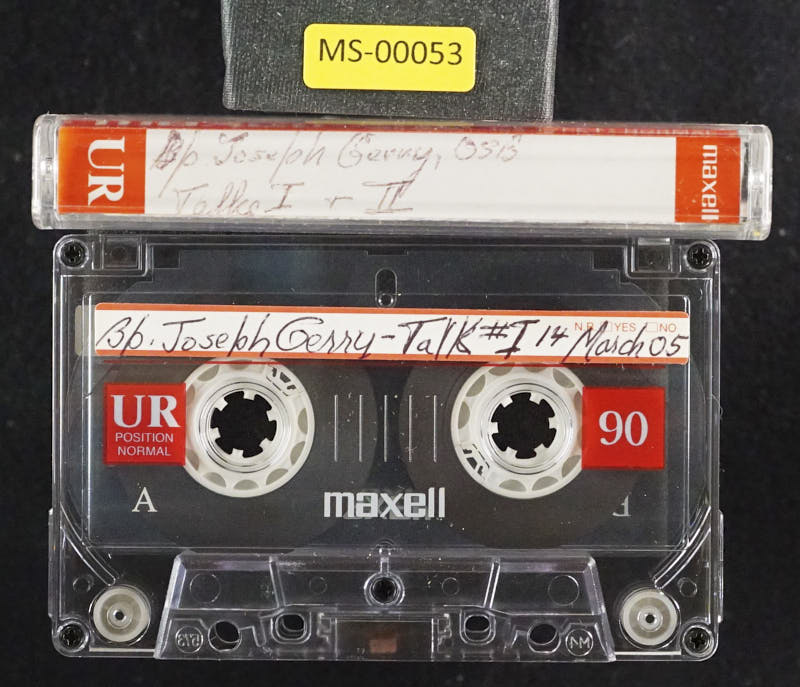
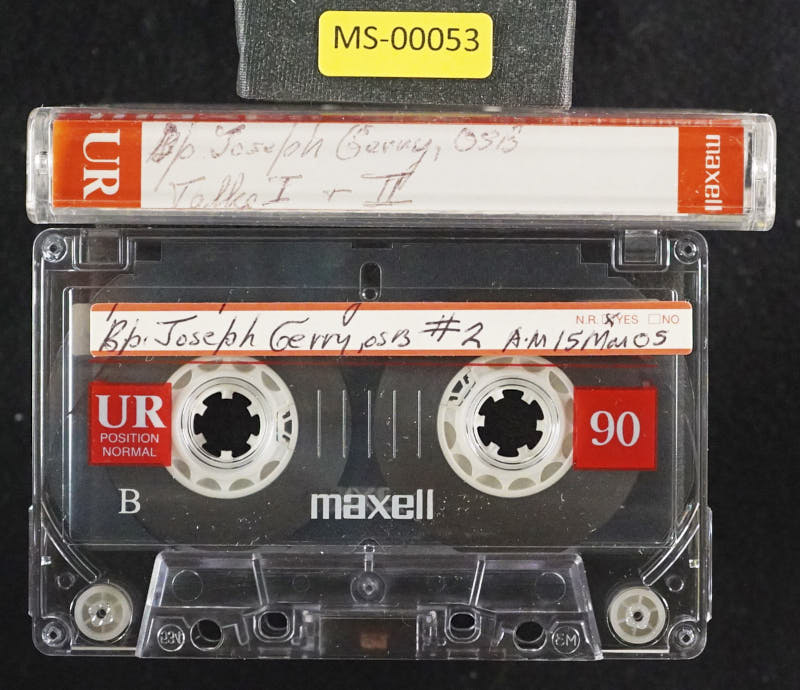
AI Vision - Possible Values from Photos:
Speaker: Bp. Joseph Gerry
Possible Title: Talk #1
Additional text: I
Speaker: Bp. Joseph Gerry
Possible Title: Talk #2
Additional text: II
@AI-Vision_v002
First thing I should say is that I'm very pleased to be here. Father Gabriel, there you are. No, where's Gabriel? Oh, he's sitting behind me. Okay. You know, in 1962, when he made his vows with prior Damasus, Father Christopher Hagen, who had studied at Maria Locke, and Damasus, I believe, was the junior master at the time, The Abbot Bertram asked us to come and see the Abbot Bertram to talk with him, precisely about choir brothers in those days. And my recollection is correct. The Abbot Bertram was going to the Congress of Abbots and Abbot Bertram was not, at that time his age was not able to go, and he wanted him to speak in his behalf regarding choir brothers. And so we drove out. I won't go into that. That's another story. We won't go into that. So I am very, very, and then I came back, was it three years ago, four years ago? And so I'm very pleased to be with you.
[01:02]
I'll say this because through Father Christopher, Maria Lack and his own formation in liturgy had a tremendous impact on our own house. I mean, we still enjoy, we were taught the theology of liturgy back in my day as a seminarian because of Christopher. We had four years of theology and theological liturgy in those days. So when Vatican II came out, for most of us, that was the most logical thing and things we've been talking about for ages. So we feel very indebted that way. The reader who was reading this evening on the Psalms, a short time ago when I returned to the monastery, I mean, you all know... about me, et cetera, so I won't go to that. But when I returned to the Monetary, one of the things I picked up was a book on the Psalms. And just one thought came this evening during supper. I always think the author, in talking about the Psalms of Lamentation, made this very lovely, at least for me, a lovely point.
[02:06]
He said, when you look at the Psalms of Lamentation and you see how How people are asking God, you know, where are you? These great things in the past. I've heard all about that. My forefathers told us that, but where are you today? You know, and all the things they go through. Are they really able to kind of empty their gut to God of what they're really experiencing? Most human thing possible, huh? But how do they all end up? They all end up with God reigns. Tremendous. You know, after... going through this whole thing, who is it you're saying all these things to? It's the God. And inventing, so to speak, to him, all of a sudden it dawns on you there's nobody else. I'll tell you a story, a very consoling story for me. During the 2002, when everything hit in Boston, and Portland was very near Boston, we always had a
[03:09]
a youth convention right after Easter. And that particular year, the newspapers were just, because we lived so close to Boston, what was happening in Boston was in the papers constantly, constantly. And so the newspapers go down to these thousand kids, one convention, and ask them, are you all talking about the scandal? And the kids said we weren't until you came and asked us. And so then I had the closing mass, and at the closing mass, the chairperson, who was a senior in high school, a young kid, usually got up, and he said, now I call to a close Youth Convention of 2002, and he hit the gavel, and that was it. Well, this time he got up, and he said, many people ask me how I can remain a Catholic with all the scandals going on within the church. And I say to them what Peter said to Christ when Christ said, you're going to lead me too?
[04:14]
And he said, to whom shall we go? You have the words of eternal life. And all the kids went wild. And for me at that time, it was painful as all get out, as you can expect. But for me at that time, it was really... as if the Lord had just kind of patted you on the back and said, you know, don't, you know, the world is much bigger. It's much bigger than the problem you're going through at the moment. And I think that's a good important. The other thing I just, in passing, this is just a conglomeration of a little incident. The other thing I just might mention is the prior and I were talking about it on the way in. There's a book out by Blythner. I think his name is Blythner. He was the rector. I think he was rector at St. Patrick's in Menlo Park, the seminary there. And then he became the rector at Theological College connected with Catholic University in Washington.
[05:20]
And a very highly respected person. He wrote a book just recently. He's on a sabbatical and he wrote a book. And the purpose of the book... was really to talk on priestly spirituality as a result of what happened after 2002 and then tracing back the time, when the problems began, all that type of thing. But one of the points he was making, and I think it's an encouraging point, he was saying that this last group of seminarians that he had, he found the healthiest and the best that he has encountered in his years in the seminary. And I think it is good for us to realize that what has happened in the church, the scandals, it was, as St. Luke would put it, it was necessary. It was necessary that it surface. I'm convinced of that.
[06:21]
Had it not surfaced, it would, I fear, it would not have been addressed. Now, we may have addressed it, we may have cut everybody's head off in the process, but it had to be addressed. And I am convinced that in time the church is going to be purified and things are going to be much better in many, many ways regarding governance and And I think also, as I've been told recently, that the officers in the Holy See are beginning to understand this is not an American problem, despite the fact that they're like to think it. And I remember going up north in Maine because of two priests who had to talk with the people. And one lady made the observation, I don't know what everybody's all excited about. Everybody... every family had an Uncle Charlie that Mama told the young boys to stay away from.
[07:26]
Now, that may be an exaggeration, but the point she was making is, and we know that it's a fact now, that the molestation of youngsters is the majority of people, less than married men. You know, it's not... But the reason I mention this is because I think... You're finding among the young people, I think, a new breed. I'll give you an example. I was in Rome not too, too long ago. At the time, Tim Dolan, who now is the Archbishop of Milwaukee, was the rector of the North American. At that time, I said to him, I said, Tim, is it true that the seminarians are much more conservative now than they were? And he said to me, I would not put it that way. He said, you've got to remember, these youngsters have never known anything but Vatican II. So they're not really reacting. He said, but so many of them have come from broken families, dysfunctional families, and they are looking, they're looking for some guidance.
[08:40]
And they're looking for some structure to their life. And so as a result, what are they doing? They're adopting... the structure that many of us knew when we were younger. In other words, the rosary has begun to make sense to them. The Adoration of Blessed Sacrament began to make sense to them. The office, I mean, the number of people you'll find praying in the office, you never found that when I was a kid. Nobody but the priests at the office in those days. I'll give you two other examples. At the monastery, St. Anselm's, we have a young fellow who now is a junior monk who graduated from the Abbey, went, bought his business for a few years, ended up going to Catholic University, got his master's in theology, and then returned to us. And so he'll be up for solemn baths this year, I guess. I talked with a young fellow just the other day who graduated, I'm going to say three years ago, three or four years ago, spent a year...
[09:46]
with the Jesuit volunteers out in Montana, then went to Yale, got his master's in theology, and has taught a year or two at Portsmouth Abbey, and now he was one of our great, now he wants to come in the summer. I'm thinking of a young freshman, no, I take that back, a junior, who told me, that he came to St. Ayes precisely because he wanted to be in an atmosphere that had some kind of spiritual dimension to it and a bright kid. So the point I'm trying to point is, I think there's a lot of hope regarding the future of the church and the future vocations. It's going to be very painful for a while. We know that. But God's providence is much bigger than we are. as you know. The climate that these poor kids grow up in, I would not want to have grown up in it because, as you know, it's very secular.
[11:00]
It ran away back at the Vatican, around the time the Vatican Council described those times as what he called practical atheism. In other words, we don't live in times where people are out fighting against God, but it's just that God is not that important. You know, if he wants to exist, that's fine, but he doesn't have any effect whether he does or doesn't with me. That's kind of the attitude. Or, as someone we had the other day, they used the word, God is missing, but not missed. God is missing but not missed. Now, as a philosopher, we would say ontologically that's not correct whether he feels that way or not. Whether he knows it or not, he is missed. But that's not the point of the story. A little 18-year-old fellow, a college kid in Portland, was coming into the church.
[12:01]
And I said to him, whatever drew you to the church? And he said to me, all of a sudden it dawned on me that I was 18 years old and I knew absolutely nothing about God. I don't think you could have found someone in the town I grew up in, 18 years old, that could never make a statement like that. A lady went shopping on Holy Saturday for these grocery stores, as we call them. She got down to the register And the lady at the register yelled at the one next door and said, how come we're closed tomorrow? She yells back, because it's Easter. The other one yells back, and what is that? And she yells back, I don't know, it's something like Christmas. Now, who would ever have heard that? The little lady was coming into the church in Portland, she was a college graduate, and
[13:07]
She was actually, I believe, don't ask me how that happened, but she was doing kind of volunteer teaching in Portland. And I had met her several times. I thought she was Catholic. And I said, oh, what were you before you decided to become a Catholic? And she said, I was nothing. And I said, oh. I've always wanted to meet someone like you. I said, I can't imagine what it would have been like as a youngster growing up not to have had the light of faith in making moral decisions. Even if I did wrong, to know I did wrong, that's a grace. That's a great gift. I said, how did you do it? She said to me, I just muddled along, which I took to mean that, like the reed, She went in the direction that the wind was blowing. So I think the youngsters really have a very difficult time of it, much more so, I think, certainly than my generation did.
[14:17]
Now I realize God takes care of a lot of things. Now, what I really wanted to do in these few minutes... And my talks the rest of the week will not be like this, so you don't have a beginning and an end. What I wanted to do is simply say this, that it seems to me that one of the great attitudes to have during a retreat is the attitude of remembering. Remember the great fall in the Old Testament was they forgot. They always forgot what God had done. the wonderful things he had done. And I think that if we reflect on our own lives, we find that it's very easy to forget. You know, we have moments when we're very conscious of how real the Lord is, how close he is to us, how supportive he is, but we forget it.
[15:20]
And a dark day comes and you'd think the world was going to end. until all of a sudden something else happens and the Lord helps us to remember. Now, it seems to me that in our tradition, if you look, for example, we have through, for example, the Desert Fathers. What is that but a remembering? When I was a young monk, I was not that impressed with the Desert Fathers' sayings. I didn't find that impressive. I thought, Some of them were kind of out to lunch, if I may say that. But as I grew older, I began to see the wisdom in them. And then you remember when Benedicta Ward wrote her little book, I think it was The Alphabetical Sayings of the Father, whatever she called it. But in that, she described the Desert Father's sayings like having a medicine cabinet loaded with potent drugs.
[16:23]
Huh? And she said, you have to be able to discern when someone comes to you what drug you're going to give them, what medicine you're going to give them. So it's an art. And if you reflect on those sayings, you will find everything in it. You will find sayings that speak of talking as a good. You'll find sayings that speak of talking as an evil. You've got to know what the problem is. So I used to say to the To the youngsters, I was a novice master at one time, among other things in my life, and I used to say to them, stop and think. Just imagine, some little monk had a problem, and he went to his abbot, and the abbot said, you know, Abbot Anthony had that same problem. And they'll tell him a little story. And it's amazing how people can hold on to a story where they can't seem to hang on to teaching.
[17:30]
Now, I just want to give you a couple little stories just to prove my point, if I can find them. Now, I can just imagine, stop and think now, what would the problem be that a monk would have that someone might tell this story. When the holy Abba Anthony lived in the desert, he was beset by acedia and attacked by many sinful thoughts. He said to God, Lord, I want to be saved, but those thoughts do not leave me alone. What shall I do in my affliction? How am I to be saved? A short while afterwards, when he got up to go out, Anthony saw a man like himself, sitting at his work, getting up from his work to pray, then sitting down and plating a rope, then getting up again to pray.
[18:31]
It was, as always, it was an angel of the Lord sent to correct and reassure him. He heard the angel say to him, do this and you will be saved. At these words, Anthony was filled with joy and courage. He did this and he was saved. Now that's where we get our whole thing ora et labora, isn't it? Work and pray. In other words, it's a notion of balance to one's life and rhythm to one's life. The notion of being aware of the presence of the Lord. The other little story, when the same Abba Anthony thought about the depth of the judgments of God, He asked, Lord, how is it that some die when they are young, while others drag on to extreme old age? Why are there those who are poor and those who are rich? Why do wicked men prosper, and why are the just in need?
[19:33]
He heard a voice answering him, Anthony, keep your attention on yourself. These things are according to the judgment of God, and it is not to your advantage to know anything about them. It's almost like the psalm of lamentation, in a sense. We all have those questions. I just lost a niece, 46 years old. She's been fighting cancer for 10 years. You can imagine, these are the same questions. She has a little boy, 12 years old. Those are the same questions that people raise. And you're confronted with things that are beyond us. And to think you're going to give someone an answer that's going to fit the bill, you're kidding yourself. Unless they're willing to, like the psalmist, somehow or other, after they have vented their gut, to be able to say the Lord reigns,
[20:38]
that somehow he's bigger than I am. He's the one who gave me life. But it takes time. Then he had this little one. Someone asked Abba Anthony, what must one do in order to please God? The old man replied, pay attention to what I tell you. Whoever you may be, always have God before your eyes. Whatever you do, do it according to the testimony of Holy Scripture. In whatever place you live, do not easily leave it. Keep these three precepts and you will be saved. Now, there's tremendous wisdom in that. Tremendous, tremendous. Abbot Anthony said to Abbot Payment, this is the great work of a man, always to take the blame for his own sins before God and to expect temptation
[21:40]
to his last breath. Not very consoling, but you can imagine someone, again, a monk coming and thinking he's been working very hard at this, a youngster and new in his monastic life, and just amazed that he still finds temptations coming his way. And when you can say, you know, this is what happened, evidently payment must have experienced something, and Anthony was giving a little word of wisdom. That's not something new, you know. Temptation is old. He also said, whoever has not experienced temptation cannot enter the kingdom of heaven. He even added, without temptations, no one can be saved. Now, I'm not suggesting you preach that, but I mean that you can see the wisdom. You can see someone who's trying to give himself to a monastic way of life that he is going to.
[22:47]
That's going to be part of the pathway. And how else are you purified? How else are you purified? How else do you get to your true character except in that particular way? The brethren also asked, among all good works, and I love this one, which is the virtue which requires the greatest effort? Remember that? Which is the virtue that requires the greatest effort? Anybody want to make a guess? He answered, forgive me, but I think there is no labor greater than that of prayer to God. For every time a man wants to pray, His enemies, the demons, want to prevent him, for they know that it is only by turning him from prayer that they can hinder his journey. Whatever good work a man undertakes, if he perseveres in it, he will attain rest.
[23:54]
By prayer, his warfare to the last breath. We'll have more along those lines later, but I think, again, The easiest thing to let go of is prayer. In the diocesan priesthood, you find those people who were involved. You will find, they will tell you, they dropped their office. They only said mass when there were people. Well, the prayer and the opposite. Well, how can you expect? What do you think is going to happen? It's like nowadays in our culture. Nobody wants God to exist, and nobody wants to believe in a natural law. Now, how you're going to establish a society is very difficult in my book.
[24:56]
Now, this is the last one. It was said of Abba Agathon. that for three years he lived with a stone in his mouth until he had learned to keep silence. Now, the reason I like that is because I can imagine some young monk having a problem in silence, and I could imagine someone saying, that's not new. That's not new. The greats had a problem. Look at Agathon, one of the greats. Now, the point of the story is not to put a rock in your mouth. That's not the point of the story. The point of the story is that it takes effort and discipline to develop what really is behind silence. So that... Now, one second here, just a quotation. And then, so those... So the point I'm trying to make is don't lose your memory, and part of your memory is experiences you've had, wisdom that has been passed on.
[26:08]
And I'm going to give you two little things. One, two little personal things. One, when I went to college, first time to St. A's, Now this may not be true, I mean absolutely true, but it's true in my recollection. I met a monk who for the first time of any priesthood I had known, that when he spoke about God, he seemed to be speaking about someone he knew. It didn't seem to be some kind of theory or something, but it was talking about someone. that he knew that you could tell was very important in his life, and he thought that it would be very good for us if we knew him. No, it wasn't that I didn't know God, you know, in a sense, but I mean, it was, and I never forgot that.
[27:12]
That was an experience that I'm eternally grateful for, and I am convinced it played a part in my own choice of vocation. I'm convinced of that. One of the old monks, oh, he wasn't old, I take that back. Well, depending on what you call old. At 76, there's no such thing as old age. But there was a monk who was dying, and he was 6'6". He had been a chaplain in the Second World War. He came back to the abbey when the veterans were coming back to start their colleges in those days, and the abbot made him dean of students. which was a marvelous thing because before that, we were really, when I went to St. A's, this regular student, daily mass was compulsory. So you wouldn't even think of that nowadays, huh? But the point of the story is he was dying. And I went down to see him. We were talking. And he told me this story.
[28:15]
Now, the story is going to only make sense if you realize this monk was dying. Okay? And he knows he's dying. And the story he told me was that one day he was totally frustrated with being dean of students. He was a great big 6'6". Bertrand was probably 5'5 or something. Abbott was short. He walks into Abbott Bertrand's office, threw the keys on his desk, and said, I resign. And Abbott Bertrand said, monks don't resign. Take up those keys and get back to work. When I want those keys, I'll ask for them. I said, what did you do? He said, I picked up the keys and went back to work. Now, remember when he told me this story. At least to me, it meant that that experience he had never forgotten and that somehow or other is like the thumb of lamentation.
[29:16]
The conclusion he reached, the Lord reigns. And the thing is, don't... That's why I keep saying, don't lose your memories. And don't lose... I mean, that's how you remember the Lord. Now, there's one other little thing I want to... Are we... Is it time for vigils now? Now, I'm just going to... This is a... Did any of you who have read... I didn't... I won't go this long. But anyone who's read the... journey of a soul. Remember John the 23rd. Remember the journey of a soul. Anybody who's read that, if you look at that, what's amazing, it still sticks with me, if you look at he is when he's 17, you look when he's 35, 45, 60, 75 or 80, whatever it was, you will find he is saying mea culpa for the same faults.
[30:21]
It is amazing. I think that's a good thing for us to remember. I wouldn't be a bit surprised that if you reflect, you will see that your faults, your shortcomings, are pretty consistent. It's amazing. Yet, as you confess them, It's not the same. It's a new expression of it. It doesn't always mean exactly the same thing that it meant back. It's kind of a revelation to you of the limitations that are ours as human beings in our journey. I think that is a good thing to remember. The last little thing that I wanted to Oh, I want this before I tell you the last little thing.
[31:22]
The next to the last little thing is a lovely quote from an individual, David. Do you remember David Stanley? He's dead now, but he was a scripture scholar. And he was giving a homily one day on Paul's words... Since one died for all, all died. He died for all that those who live might live no longer for themselves. He died for all so that those who live might live no longer for themselves, but for him who for their sakes died and was raised up. And then he looked at the community and he said to them, what that means is that there is nothing so totally incompatible with Christianity as doing something selfish.
[32:38]
Something selfish. There's nothing so totally incompatible with Christianity as doing something selfish. I mean, those are powerful words, but again, if you don't lose your memory, that is exactly what the Desert Fathers are all about. That's exactly what the whole notion of entering into the heart is all about. The purification. Now, the last little tidbit, and then we're going to stop on this, is When I used to go into the schools, the lower grades, I was, there was a couple of things I was always trying to teach the kids. One thing I always had to teach them was the thing I just love of Cardinal Hume. Cardinal Hume gave the retreat to the bishops around 18, 18, sings that way, 1984.
[33:40]
I became bishop in 86, so I was not at the retreat, but I heard the tapes. And he was talking to the bishop, he said, fathers, don't underestimate those Ten Commandments. Those Ten Commandments are nothing more than the manufacturer's instructions. When you buy a product, if you want it to work, follow the instructions. If you don't follow the instructions, don't be surprised it doesn't work. I would tell that to these kids over and over again. I said, if I come back next year, will you remember that? Oh, sure, sure. Because it's a simple, simple way of helping them to understand what the Ten Commandments are part of our being. And if we don't follow them, we can't be surprised that there's a mess in society. Can't be surprised. But the point of the other thing, I was always trying to teach them. I say, do you know that the Second Vatican Council tells us
[34:41]
that whenever the scriptures are read at the liturgy, it is Christ himself who was present and speaking to us. Just think of that now. They'd look at me looking crazy. And I said, just imagine now, if Johnny here went and see the President of the United States, and he came out, what's the very first thing you'd ask him? They would say, what's he look like? Not say no. No, you wouldn't ask what he looked like. You would ask him, What did he say? Oh, he said, just imagine now if some little boy knew that you had been to church and that Christ had just spoken to you. But he wasn't one of your church. He didn't go to your church. But he knew that that happened. So you come out of church and he says to you, I understand Jesus just spoke to you. What did he say? Wouldn't it be awful if you had to say to him, I forgot. Because you know when you go to a classroom, you ask a question, the hands are up before you finish the question, and you say yes, and the kid will say to you, I forgot.
[35:47]
So I said, wouldn't that be a shame? Oh, yeah. So I said, now train yourself while you're young. Just before the scriptures begin, ask the Lord to help you get one, to hear one word that he wants you to take with you. If you develop while you're young, develop a habit, you know, The words can be all kinds of things, but try to hear one word he wants you to take with you. Now, with that, I'm going to conclude with this lovely, lovely quote from St. Gregory. And it is a beaut. It means I like it. Writing to encourage a friend to ponder God's word daily, Gregory made this interesting observation. First, he points out to him that the scriptures are the words of the Redeemer. And then he asks, what is scripture if not a letter from Almighty God to his creature?
[36:50]
And then he raises a further question. Suppose you receive a letter from someone you consider very important. Might we even say central to your life? Would you just lay it aside, not open it, and go about doing other things? Then Gregory adds, the king of heaven, the Lord of men and angels, has written you a letter so that you might live. Now notice that. The Lord has written you a letter so that you might live, and yet, this is important now, What are you doing in college? Are you teaching? Mark this down. This is coming on the exam. Now, has written you a letter so that you might live, and yet you neglect to read it with ardent love. In that simple observation, we learn that it is not only important to read or to listen to the letter that God has sent us,
[38:01]
but also to realize that it was written so that we might have life and have it abundantly, and thus it is important to approach it and to read it or to listen to it with ardent love. Otherwise, we will not become the word we hear, for without love, true union can never come about. Now listen to Gregory. Strive, I beg you, to meditate each day on the words of your Creator. Learn to know the heart of God in the words of God. Learn to know the heart of God in the words of God. Thus you will long for the things of heaven with greater desire, and your soul will be more eager for the joys that are invisible.
[39:05]
May the Spirit fill your soul with his presence, and in filling it, make it more free. You could not possibly give a title to this, but if you were trying to, and you sometimes make things up, you probably would say, well, I'm not saying what you would say, but I would say if I were trying to, I would probably say how important it is to remember. And by that I mean experiences we've had, words we've had, the instruments or the means that are given to us in our monastic journey that help us learn the heart of God and enable us to live the Word. Because on the extent that we live the Word, are we in turn supportive of one another and not, as Stanley put, not getting lost in selfishness?
[40:21]
Peace and benediction. What do I do? What do I do now? How do I get out of this thing? Now, if we were looking for a title to what's going to follow, we might possibly, you might find other titles, but we might call it a Lent. a Lent, a time for self-reflection. Now then, to say the obvious, we are in the season of Lent. It is the time of year, as St. Benedict reminds us, when we strive to keep our manner of life most pure, while at the same time working at washing away our negligences of other times and looking forward to the Holy Easter. with the joy that comes from a heart that longs for the Lord. So that seems to me to be something that is characteristic not only of a beginner, shall we say, but it's something that's characteristic of us as long as we live.
[41:33]
Now since Ask Wednesday, now I know we all have a different reading cycle these days, but since then we've had some marvelous readings from the early fathers of the church. For example, one from Clement of Rome, encouraged us to focus on the blood of Christ. I'm going to go off that for a minute. Not too long ago, I was reading something, and it said, whenever you hear the notion of the blood, blood in the Old Testament, you're always referring to family. In other words, being incorporated into becoming a blood brother, so to speak, that type of thing. When we think of blood, we think of redemption. That's exactly what we're thinking of. The price paid it so that we could truly become one with our God. Anyway, St. Clement speaks in terms of focusing on the blood of Christ. Then he gives us some insight.
[42:34]
He says this, it is the blood of Christ that has won the grace of repentance. Not for one person, huh? has won the grace of repentance for the whole human race. In other words, we can say that as a result of Christ shedding his blood, handing himself over totally to the Father for us, then we, as it were, have the right, the right to hope for the gift of repentance. That's what he's telling us. That gift is ours as a result of of the blood of Christ. Then we had that most beautiful blending of Scripture texts by Clement as he has the Lord say to us, even if your sins reach from earth to heaven, even if they are redder than scarlet, blacker than sackcloth, you have only to turn to me and with your whole heart and say, Abba, Father,
[43:43]
and I will listen to you as a holy people. It seems to me it's so simple, but it's a very beautiful insight, again, into the heart of the Father. No matter what your sins, only turn to me and say, Abba, Father, and he will listen to you as to a holy people. Now, the very reason... we can say Abba Father is precisely because of the blood of Christ which has made us sons. St. John Chrysostom spoke of five different ways we have of exercising repentance. The first is admitting our sins. I mentioned this last evening, but I really consider that a tremendous grace when we can name our sins. That's a tremendous grace.
[44:45]
Because if you can't name your sins and you're doing wrong, then whether you know it or not, you're hurting yourself. Whether you're guilty or not, you're hurting yourself as a human being. Chrysostom assures us that if we wish to be justified, then we must begin by confessing, that is, by admitting that we have sinned. And then he goes on to say, If we condemn our own sins, we already have a sufficient claim to forgiveness. For by confessing our own sins, we will less easily fall into them again. And by making our own conscience our accuser, we will avoid being accused before the Lord's tribunal. Because it means we're coming before the Lord repentant. We know who we are. There can be no real act of penitence if one has not discovered his own sinfulness.
[45:50]
And this is why the fathers of the church are constantly encouraging us, and also the desert, the monastic fathers, are constantly encouraging us to enter into our hearts, to go inward, to search our life and our soul. For if we truly desire to lead the good life, we must enter into what they constantly are referring to as the spiritual combat. And to do this, so they tell us, we must first know where the real enemy is. In other words, the real spiritual enemy, and you find this over and over again, obviously, the real spiritual enemy is not outside of ourselves. The real spiritual enemy is something or someone It's not something or someone out there. Rather, it is within our own heart. So to fail to enter into one's own heart, to be able to name things, is to fail to discover where the real battleground is as well as where the real enemy is.
[46:53]
This can cause, as you would expect, real wounds towards a friend while we're doing battle. We might see something of this in the story that's come down to us about the merchant from St. Petersburg. He wrote to his Russian, I know Russian staritz is the holy man, and he wrote to his staritz and he said, my maid has left me and my friends recommend a village girl to replace her. What do you advise me to do? Shall I hire her or not? The village girl. The Staritz, who is known for the fewness of his words, simply writes back and says yes. After a while, the merchant writes back to his Staritz and he said, you must let me dismiss her at once. Since she has arrived, I've been in a constant state of anger. And the Staritz this time writes back a little longer and he says, take care not to dismiss her. She is an angel whom God has sent to you.
[47:58]
to make known to you, to enable you to see how much anger was hidden in your heart, which the previous maid was never able to let you see. Now, nobody likes stories like that. But, I mean, any story, it's like the Desert Father's sayings. It goes in your medicine chest and you've got to have discernment when you use it. But it's a tremendous wisdom in that little saying. So I'm sure that all of us, we could say, have little angels whom God has sent to reveal to us what is really hidden in our hearts. But very often, we, like the merchant, refuse to take responsibility for the passion that surfaces. Somehow, we have to learn not only to accept our neighbor, but also to accept ourselves and where we are on our journey.
[49:00]
I'll tell you a personal story. I was prior at the Abbey during what some refer to as the war years. Now, the war years of that time following Vatican II. It was sometimes very difficult in monasteries, as you know. And I had a brother who was a monk. who was six years older than I, but had entered the monastery two years after I did. He was really a very gentle and kind person, extremely kind. So he'd be the one that when I was excited, shall we say, he's the one with whom I would vent. One day he said to me, Joseph, remember, anger is like any other passion. You only exercise it because you enjoy it. Now, in our, I don't know about your office, but those of you who have read Dorotheus of Gaza, that we have, I think, at least in the Roman office, and we read about the monastery too, some wonderful insights.
[50:11]
I forget when he lived, I think the 400s, 400 or 500s. You'd swear it was a modern psychologist describing what anger does to you and all the steps. All of us have been in those situations where we've had a very heated argument with someone. We part company. What happens? What happens? We sit back and we know exactly what we should have said. We go through that whole battle and who's in control? I'm in control. We have demolished our enemy. And what have we done? We've nursed. We have nursed the enemy within. So those are real things. And I think what my brother said is like any other passion. You want any exercise. And that's true with all the passions. I'm thinking of all those things. What do we call them? We call them the capital sins, huh? But as you know, the capital sins were not invented by some theologian sitting back trying to dream up things.
[51:16]
They came forth from people who entered into their hearts and saw the various pools. And from Desert Fathers, we know that those things, I mean, there's always some of them there. You won't go to that right now. But anyway, then Anthony Bloom, You know, remember him? He was a former Orthodox Archbishop of London. He died a few years back. He told us that very often he'd hear confessions, and people would come in, they'd confess their sins, and they would stop for a moment only to take a quick breath and begin a long discourse telling him in so many words that had God not afflicted them with such a hard life, they would not sin so much. Of course, they would say, I am in the wrong, but. I'm in the wrong, but. What can I do with such a son-in-law, my rheumatism, or the Russian Revolution?
[52:19]
Now, I am sure that we all have our own list of God-inflicted hardships that we could add regarding our own life. More than once, the archbishop tells us that he would suggest to such penitents. before reading the prayer of absolution, that peace, and I love this, that peace between God and man was a two-way street. And he would ask them whether they were prepared to forgive God all his misdeeds, all the wrong he had done, all the circumstances which prevented them from becoming saints. He admitted the penitents did not like this approach. But he insists that unless we take full responsibility for the way we face our heredity, our situation, our God, and ourselves, we shall never be able to face more than a very small fraction of our life and our self.
[53:29]
I'm not saying anything new to you. What I'm trying to do simply during this retreat is simply kind of sit back and reflect on what we've learned in our monastic life. That's when we spoke of John XXIII. If you look at John XXIII, that life of his, I told you if you look at that, you will find him saying mea culpa throughout his life to pretty much the same faults. We may be in different stages on our growth and our development, but this kind of seems to me at least, in my experience, this is the way life is. Then he concludes, this is Bloom, if we want to pass a true and balanced judgment on ourselves, we must consider ourselves as a whole in our entirety. which includes the way we respond to others and to our situation. You know, once you begin becoming reflective, and you all know this from your own experience, once you begin becoming reflective, it's amazing how different things surface that you never thought were in you.
[54:42]
And you become conscious, you know, that somehow you're much more dominant thinking than you thought you were. You have much more desire to be in control than you kind of thought you wanted to be in control. All those things, and it helps to us in our growth, it seems to me. It seems to me that the spiritual writers are suggesting that far too often we live at a level of our being that leaves us unconscious of the real battle that is going on within our own hearts. And consequently, we are not even aware of how we compromise not only our true self, but in a sense, how we tend to compromise God as the penitent did. Now, you may recall the way of the pilgrim. And in the way of the pilgrim, remember, that's where the development of the Jesus prayer, Lord Jesus Christ, Son of the living God, have mercy on me.
[55:44]
Excuse me. But in that book, you will hear him say, and this is a holy man speaking, turning my eyes carefully upon myself and watching the course of my inward state, I have verified by experience that I do not love God, that I have no love for my neighbor, and that I have no religious belief, and that I am filled with pride and sensuality. That's a holy man speaking. I'm not suggesting that all of us have reached that state of humility and honesty where we can truly utter such words. But what I find truly interesting, personally, that some of the same things that he discovered within his own heart I can find in my better moments within my own.
[56:50]
Is his insight really so different from what the greats have always told us, namely, that the closer we draw to God, the more conscious we become of the distance yet to go, but at the same time with a greater sense and awareness of peace. I think that's a wonderful insight, they told us. The closer we draw to God, the more conscious we become of the distance yet to go, while at the same time experiencing a greater sense of peace in our journey. Now, we hear a lot about the present Holy Father, John Paul II, and his predecessor, John Paul I, as you remember, always seemed to have a smile, and his talks were always very, very simple. And he was a pope, as you all recall, for only 30 days, and yet he touched the hearts of many people precisely because of his utter simplicity.
[57:59]
And I do want to share a couple of very simple little things. Now, this is the pope speaking, you know. He tells this story. I always recommend, he said, I always recommend, talking to the people, I always recommend not only great acts of charity, but little ones. And then to illustrate his point, he related a story that he read some years ago in Carnegie's popular work, How to Win Friends and Influence People. That would not be on the novice's reading list. The story goes something like this. A woman lived with her husband, a brother, and two grown sons. The burden of the housework, cooking, laundry, cleaning, shopping, all fell on her and her alone. And one Sunday, when the four men came to the table, they found on their plates nothing but a handful of straw. Obviously, when they looked at their plates, they were shocked. Acknowledging their astonishment, she said to them, This is the first time...
[59:07]
You have ever manifested any reaction to anything that I have ever done for you. Yet every day I prepared your food. I washed your clothes. I cleaned the house. Never once have you said a word of encouragement. I am not made of stone. Say something. The Pope then went on to make the very simple observation. People bring a greater presence, more of themselves. They bring a greater joy and willingness to their work when what they do is acknowledged or encouraged. I think we all know that's true. I don't think it matters how old you are. I don't think it matters. You know that's true. All of us have in our homes and communities, men and women, who are waiting for and in need of a compliment, recognition, and love.
[60:10]
There are so many of these little acts of charity that we can perform. Today, he continued, I recommend these little acts of love. Then, as if to enlarge our vision as to those who are in need of our little acts of charity, he explicitly mentioned the young, the sick, and the sinners. And I suppose we all at least come under the last having if we miss the young and the sick. On another occasion, to encourage all the faithful to embrace their vocation. Now this would tie in with Anthony Bloom's thing to the penitent, but in a simpler way. To embrace their vocation with a total heart, Pope John Paul I reminded them of the words of St. Francis de Sales. And he says, there is no vocation that does not have its troubles, its vexations, its disgust. Apart from those few who are fully resigned to God's will, each of us would like to change his or her own condition with that of others.
[61:19]
Those who are bishops wish they were not. Those who are married wish they were not. And those who are not married wish they were. Where does this general restlessness of spirit that is so much part of us come from, if not from a certain reaction that we have toward discipline and fidelity, and from a spirit that blinds us from seeing God's providential hand in our daily life and that makes us suppose that others are better off than we are? The key to me is... seeing God's providential hand in our life. Benedict's great stress on presence, the awareness of the presence of God. And it seems to me that's got to be seen in the totality of our life and the totality of our experiences. This is not so radically different from the story Anthony Balloon told us about the merchant and the maidservant.
[62:24]
In other words, it is not easy to arrive at true self-knowledge. It is not easy to know the real enemy, and it is not easy to grow into the stature of Christ. There is no other way than by responding to the Lord in the everydayness of the life that is ours with its people and the concreteness of the situation that is ours. I don't think this differs from observations that Captain Hume made over and over again. One day, in speaking to his monks, he said to them, do not forget that wherever you are, with whomever you are, whatever you are doing, you can, in the present moment, attain union with God. And the rule... You know, when the individual knocks on the door, the first thing you see, is he truly seeking God? That's what our life is all about.
[63:27]
We are all inclined to think that if circumstances were other than they are, things would be better. And our cardinal says, do not be too sure. It is in the depths of our hearts that we meet God, and nothing can separate us from his love. Now, we might see something of this in the example from the apostles and of their growth in living in a world not at their own making, but living in the world that it was. Reflect for just a moment on some of their conversations with the Lord. It seems that they expected to be mighty rulers. They expected to They expected a kingdom, an earthly kingdom. They were going to be part of it. And remember, John and James' mother wanted them to have their closest seats. They were so fascinated with their imaginary kingdom that they actually fought about who was going to be the most powerful in it.
[64:36]
Wonderful sense of humor when you think of it. There was no reality about what they were fighting about. Later on, they came to accept themselves. They came to accept their surroundings and the world in which they live. And what a striking difference between them as dreamers and them as mature apostles. Consider, for example, the incident of the Transfiguration. Peter, James, and John immediately proposed to build three tents in which they would remain in happiness for the rest of their days. And yet, these same men, as they matured, accepted the trouble of preaching the word in season and out. They accepted listening to endless complaints, mediating numerous quarrels. Look at Paul. In this way, they came of age and were able to embrace even a martyr's death.
[65:38]
They came to understand themselves. They came to love their God, and they came... bear one another's burdens. Nothing so proves the reality of friendship, nothing so proves the presence of a true communion of persons working to build up the body of the Lord, as the fact that the members are actually bearing one another's burdens in patience and love. I think, to me at least, that is exactly what chapter 72 in the rule is all about. And it seems to me that is what you, what I like to think, how I strive to do in our own limited way. And the pleasure, we'll talk about that later, that gives the Lord as we struggle to do the things that please him. That was pretty good.
[66:40]
Congratulations. We got that done. We didn't get that done. Thank you. Thank you kindly. And we'll see you at night.
[66:53]
@Transcribed_UNK
@Text_v005
@Score_93.69